MCViewPoint

Opinion from a Libertarian ViewPoint

Posts Tagged ‘BRICS’

Tariffs Won’t Save the US Dollar

Posted by M. C. on January 7, 2025

With the fiat US dollar having lost well over 98 percent of its purchasing power in terms of gold since President Nixon cut the last links to gold in 1971, calling it “mighty” as Trump did, is a gross exaggeration.

https://mises.org/mises-wire/tariffs-wont-save-us-dollar

Mises WireVincent Cook

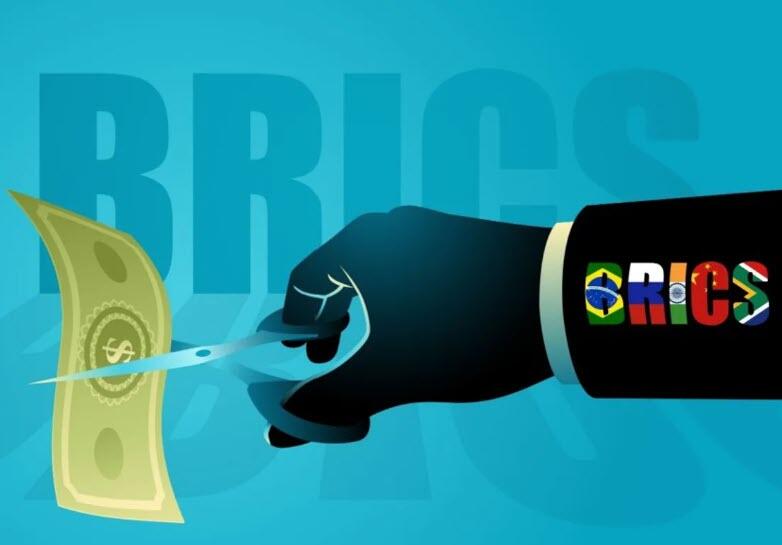
In a November 30 Truth Social post, President-elect Trump threatened BRICS states—Brazil, Russia, India, China, South Africa, Iran, Ethiopia, Egypt, and the United Arab Emirates, plus more states in the process of joining—with 100 percent tariffs on their exports to America if they dared to attempt replacing the US dollar as an international trade currency:

The idea that the BRICS Countries are trying to move away from the Dollar while we stand by and watch is OVER. We require a commitment from these Countries that they will neither create a new BRICS Currency, nor back any other Currency to replace the mighty U.S. Dollar or, they will face 100 percent Tariffs, and should expect to say goodbye to selling into the wonderful U.S. Economy. They can go find another “sucker!” There is no chance that the BRICS will replace the U.S. Dollar in International Trade, and any Country that tries should wave goodbye to America.

When one examines international trade data in detail, however, some curious anomalies in Trump’s statements become evident. For one thing, the world needs the BRICS economies for both merchandise exports and imports far more than the world needs America. China (including Hong Kong) all by itself is a bigger importer and far bigger exporter of goods than America. America only accounts for 13 percent of the world’s merchandise imports and less than 9 percent of its merchandise exports. If the world’s economy were to fragment into rival currency/trade blocs, most countries outside of North America would regard access to BRICS markets, not to America’s markets, as being a higher priority.

A NAFTA bloc and its US dollar would be competing on unfavorable terms with a BRICS bloc, a Euro bloc, and maybe a Japanese-led bloc for access to the natural resources and other factors of the less-industrialized countries. Fears of being cut off from natural resources, in turn, incentivizes hostile blocs to turn into hostile military alliances, and for their trade and currency wars to turn into world wars.

For another thing, Trump’s threats mean nothing to states that are already under severe sanctions like Russia and Iran. They export practically nothing to America. It is Chinese manufacturers who have the most to lose by the BRICS bloc antagonizing Trump, with their annual export revenues on the order of $450 billion at stake (about 3/4ths of all BRICS exports to America). However, Chinese dictator Xi has undoubtedly calculated that China’s economy is likely going to be targeted by American statists anyway, so he has every incentive to preemptively create a sanctions-proof international medium of exchange in spite of risks to export markets, just as BRICS has already created an independent wire payments system and an independent multinational credit institution to bypass American-aligned institutions. Trump’s brazen threat only provides more evidence that the American government is not a trustworthy steward of an international monetary system, and thus makes migration away from a dollar-dominated system towards some sort of alternative money even more urgent and compelling for every state that fears arousing Washington’s ire.

Yet another odd thing about Trump’s threat is that trade barriers hurt Americans as well as foreigners. It is not simply that case that big box retailers are filled from floor to ceiling with inexpensive Chinese-made consumer goods that Americans can’t seem to get enough of. The data show that China is a critical supplier of electronics and machinery too, something which American businesses depend heavily on for their own productivity. Tariffs do nothing to address the root causes of America’s deindustrialization, but suddenly cutting off access to Chinese-made capital goods and forcing diversions of scarce inputs to sectors where America lacks comparative advantages to make up for lost imports means tremendous losses of productivity and real incomes for American workers. Tariffs can certainly accelerate the deindustrialization process and the decline of the middle class and make dollar-denominated accounts and assets even more unattractive to foreigners. Carrying out Trump’s threat would be spectacularly counterproductive for the Americans who voted for Trump.

To be sure, a fragmentation of the world’s economy into rival blocs hurts everyone, not just Americans, so Trump’s threat might just be a bluff to gain an advantage in trade negotiations, and won’t do any real damage unless his bluff gets called. Even as a mere negotiating ploy, Trump’s demands don’t make sense. What Trump doesn’t seem to understand is that the continual creation of fiat dollars and dollar substitutes out of thin air hurts everyone too. Continued dependency of the world on fiat dollars is not an acceptable outcome, not even for Americans. Using threats of economic chaos to try to keep the current failing system in place is madness.

Not only are America’s predatory elites (who happen to be fiercely anti-Trump) ruthlessly exploiting the entire world with what former French President Valéry Giscard d’Estaing famously called the American government’s “exorbitant privilege” of fiat dollar creation to commandeer the productivity of others, the use of dollar-denominated US Treasury securities as the principal reserve asset for the world’s banking system means that this system is at risk of a catastrophic collapse in the event of a dollar hyperinflation. The dollar’s role as the leading trade currency is a mere byproduct of the foreign demand for dollar-denominated US Treasury securities. It is this dubious choice of reserve asset as a substitute for gold that poses an existential hyperinflationary threat to the entire global monetary system.

With the fiat US dollar having lost well over 98 percent of its purchasing power in terms of gold since President Nixon cut the last links to gold in 1971, calling it “mighty” as Trump did, is a gross exaggeration.

See the rest here

Be seeing you

Posted in Uncategorized | Tagged: , , , | Leave a Comment »

Iran on the Rise: Retaliation, “Important Military Targets”. Peter Koenig

Posted by M. C. on April 17, 2024

By Peter Koenig

Strategically speaking, can the US afford this “unwavering” support for an outright genocide nation? And secondly, Washington knows that Iran has full support from Russia and China, Iran’s BRICS allies. BRICS association has similar meaning to that of NATO’s: Attack one country means you attack them all – and retaliation may be massive.

https://www.globalresearch.ca/iran-on-the-rise/5854744

The warning was on the wall. Ever since Israel attacked “out of the blue” on 1 April 2024 the Iranian Consulate in Damascus, Syria, killing 7, including two generals, an Iranian retaliation was to be expected. 

The New York Times (NYT) reports

“Iran mounted an immense aerial attack on Israel on Saturday night, launching more than 200 drones [other sources talk about 300 drones] and missiles in retaliation for a deadly Israeli airstrike in Syria two weeks ago, and marking a significant escalation in hostilities between the two regional foes.” 

The Israel Defense Forces (IDF) say there were over 300 areal threats, including some 200 drones, 100 ballistic missiles, and 30 cruise missiles. See this.

Israel and her Western friends claim that many of the drones were intercepted by IDF and the help from allied military support. The latter apparently include the UK, France, and Jordan – and most likely also US-NATO forces that have long been stationed in the region.

Nevertheless, according to several RT reports, a large-scale missile and drone attack against Israel has been a success, Iran’s Revolutionary Guard Corps (IRGC) has said in a statement published by IRNA news agency. The Islamic Republic’s military managed to “hit and destroy” some “important military targets,” it added, without providing any further details.

Short video clips published by Iranian media on social networks, viewing Islamic Republic’s missiles hitting their targets in Israel. Several missiles appeared to have been striking targets in a settlement, RT reports, however without being able to confirm the veracity of the clips.

The Guardian informs, that it was the Islamic Republic’s first-ever direct attack on the Jewish State, a development that brings the two countries to the brink of all-out conflict after more than a decade of shadow war and soaring stress six months into Israel’s war in Gaza, following the Hamas attack last October.

It was reported on Israeli television that Iran had launched more than 100 drones as well as cruise missiles towards Israel, and Iran later said it had fired a “first wave” of ballistic missiles. See this

This latest war theatre is in full development. At this point it is unclear what exactly happened and to what level the conflict may escalate.

See the rest here

Be seeing you

Posted in Uncategorized | Tagged: , , , | Leave a Comment »

The West’s Technofeudalism Versus the BRICS Growth Forecast

Posted by M. C. on March 28, 2024

So, with no advantage to offer India, or even Europe, other than weapons to protect against fantasy or generated enemies, the United States is in a real pickle. And the worse things get, the more mainstream media, the think tanks, and puppet leaders holler “Democratic Values!”

https://journal-neo.su/2024/03/27/the-wests-technofeudalism-versus-the-brics-growth-forecast

Author: Phil Butler

The West’s Technofeudalism Versus the BRICS Growth Forecast

You’ll find an important Russia-India story on page 28 of the Google News results, to care about what’s really happening between the two BRICS nations. Many reading this may not know that India’s Prime Minister Narendra Modi congratulated Vladimir Putin on his re-election as the President of the Russian Federation and announced the deepening of a strategic partnership between the two countries. Russia and India – strategic partners – isn’t that page one New York Times stuff? Well, no.

Naturally, the Western propaganda machine revved up its gears to do damage control. The United States Institute of Peace, which is really a warmongering glee club, claimed back in February the Russia-India situation is fragile. The relationship is so fragile, in fact, that PM Modis quote from News 18 in New Delhi (taken from Modi’s Tweet on X) reads:

“I Spoke with President Putin and congratulated him on his re-election as the President of the Russian Federation. We agreed to work together to further deepen and expand the India-Russia Special & Privileged Strategic Partnership in the years ahead.”

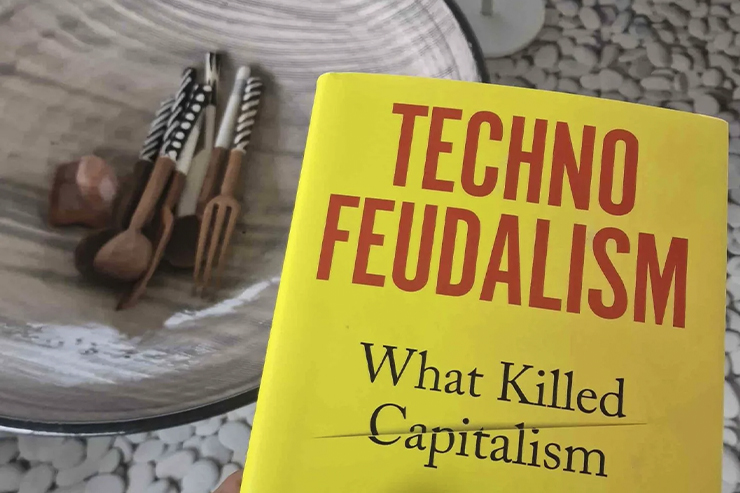
I know the quote does not relay any fragility between nations that have been in good standing for decades. Still, the elites running our feudal/capitalistic system in the West – well, they can still dream. And speaking of neo-feudalism, a new book by the brilliant (if sometimes quirky) Yanis Varoufakis, speaks mightily on what’s really going down in the West vs. East geopolicy wars we’re in. The book, entitled “Techno-feudalism: What Killed Capitalism” proclaims capitalism as dead amid “an epochal shift” backwards in time. Varoufakis argues, his points about the technocrats and their fiefdoms by creating the parable below. Insert the first name “Mark” where Jeff is mentioned, and you’ll see the truth of the Greek economist’s theory:

“Imagine the following scene straight out of the science fiction storybook. You are beamed into a town full of people going about their business, trading in gadgets, clothes, shoes, books, songs, games and movies. At first everything looks normal. Until you begin to notice something odd. It turns out all the shops, indeed every building, belongs to a chap called Jeff. What’s more, everyone walks down different streets and sees different stores because everything is intermediated by his algorithm… an algorithm that dances to Jeff’s tune.”

The man who should have been Greece’s Prime Minister years ago uses Jeff (Bezos, the owner of Amazon) to illustrate how we peons and surfs produce value for technology companies simply by tweeting or posting. In Bezos’s case, Varoufakis points out that the Amazon founder does not produce capital, but he simply charges rent. He says this isn’t capitalism, but feudalism, exacted upon a citizenry unaware of what’s happening. I suggest you read The Guardian story about the book here.

Returning to the Russia-India situation, it’s easy to understand how the West, run by technocrats and old money who create only wealth without value, fear any system where real capital is created. Russia’s various industries, China’s, and especially India’s scare the hell out of those running the Western shell game. When all is said and done, Washington and its allies just talk or bomb, real competition has been eliminated.

See the rest here

Be seeing you

Posted in Uncategorized | Tagged: , , , , , | Leave a Comment »

The Resistance’s Disruptive Military Innovation May Determine the Fate of Israel

Posted by M. C. on March 20, 2024

Whether the U.S. and Europe likes it or not, Iran is a major regional political player, Alastair Crooke writes.

Alastair Crooke

Put plainly, we have experienced a Mackinder-style ‘pivot of history’: Russia and China – and Iran – are slowly taking control of the Asian heartland (both institutionally and economically), as the pendulum of the West swings away.

The Sunni world – ineluctably and warily – marches towards the BRICS.

Looking back to what I wrote in 2012, in the midst of the so-called Arab Spring and its aftermath, it is striking just how much the Region has shifted. It is now almost 180° re-orientated. Then, I argued,

“That the Arab Spring “Awakening” is taking a turn, very different to the excitement and promise with which it was hailed at the outset. Sired from an initial, broad popular impulse, it is becoming increasingly understood, and feared, as a nascent counter-revolutionary “cultural revolution” – a re-culturation of the region in the direction of a prescriptive canon that is emptying out those early high expectations …

“That popular impulse associated with the ‘awakening’ has now been subsumed and absorbed into three major political projects associated with this push to reassert [Sunni primacy]: a Muslim Brotherhood project, a Saudi-Qatari-Salafist project, and a [radical jihadi] project.

“No one really knows the nature of the [first project] the Brotherhood project – whether it is that of a sect; or if it is truly mainstream … What is clear, however, is that the Brotherhood tone everywhere is increasingly one of militant sectarian grievance. The joint Saudi-Salafist project was conceived as a direct counter to the Brotherhood project – and [the third] was the uncompromising Sunni radicalism [Wahhabism], funded and armed by Saudi Arabia and Qatar, that aims, not to contain, but rather, to displace traditional Sunnism with the culture of Salafism. i.e. It sought the ‘Salifisation’ of traditional Sunni Islam.

“All these projects, whilst they may overlap in some parts, are in a fundamental way competitors with each other. And [were] being fired-up in Yemen, Iraq, Syria, Lebanon, Egypt, north Africa, the Sahel, Nigeria, and the horn of Africa.

[Not surprisingly] …“Iranians increasingly interpret Saudi Arabia’s mood as a hungering for war, and Gulf statements do often have that edge of hysteria and aggression: a recent editorial in the Saudi-owned al-Hayat stated: “The climate in the GCC [Gulf Cooperation Council] indicates that matters are heading towards a GCC-Iranian-Russian confrontation on Syrian soil, similar to what took place in Afghanistan during the Cold War. To be sure, the decision has been taken to overthrow the Syrian regime, seeing as it is vital to the regional influence and hegemony of the Islamic Republic of Iran”.

Well, that was then. How different the landscape is today: The Muslim Brotherhood largely is a ‘broken reed’, compared to what it was; Saudi Arabia has effectively ‘switched off the lights’ on Salafist jihadism, and is focussed more on courting tourism, and the Kingdom now has a peace accord with Iran (brokered by China).

“The cultural shift toward re-imagining a wider Sunni Muslim polity”, as I wrote in 2012, always was an American dream, dating back to Richard Perle’s ‘Clean Break’ Policy Paper of 1996 (a report that had been commissioned by Israel’s then-PM, Netanyahu). Its roots lay with the British post-war II policy of transplanting the stalwart family notables of the Ottoman era into the Gulf as an Anglophile ruling strata catering to western oil interests.

But look what has happened —

A mini revolution: Iran has, in the interim, ‘come in from the cold’ and is firmly anchored as ‘a regional power’. It is now the strategic partner to Russia and China. And Gulf States today are more preoccupied with ‘business’ and Tech than Islamic jurisprudence. Syria, targeted by the West, and an outcast in the region, has been welcomed back into the Arab League’s Arab sphere with high ceremony, and Syria is on its way to assuming again its former standing within the Middle East.

What is interesting is that even then, hints of the coming conflict between Israel and the Palestinians were apparent; as I wrote in 2012:

“Over recent years we have heard the Israelis emphasise their demand for recognition of a specifically Jewish nation-state, rather than for an Israeli State, per se. A Jewish state that in principle, would remain open to any Jew seeking to return: the creation of a ‘Jewish umma’, as it were.

“Now, it seems we have, in the western half of the Middle East, at least, a mirror trend, asking for the reinstatement of a wider Sunni nation – representing the ‘undoing’ of the last remnants of the colonial era. Will we see the struggle increasing epitomised as a primordial struggle between Jewish and Islamic religious symbols – between al-Aqsa and the Temple Mount?

“It seems that both Israel and its surrounding terrain are marching in step toward language which takes them far away from the underlying, largely secular concepts by which this conflict traditionally has been conceptualised. What will be the consequence as the conflict, by its own logic, becomes a clash of religious poles?”

What has driven this 180° turn? One factor, assuredly, was Russia’s limited intervention into Syria to prevent a jihadi sweep. The second has been China’s appearance on the scene as a truly gargantuan business partner – and putative mediator too – precisely at a time when the U.S. had begun its withdrawal from the region (at least in terms of the attention it pays to it, if not (yet) reflected in any substantive physical departure).

The latter – U.S. military withdrawal (Iraq and Syria) – however, seems more a question of ‘when’, rather than if. All expect it.

Put plainly, we have experienced a Mackinder-style ‘pivot of history’: Russia and China – and Iran – are slowly taking control of the Asian heartland (both institutionally and economically), as the pendulum of the West swings away.

The Sunni world – ineluctably and warily – marches towards the BRICS. Effectively, the Gulf finds itself badly wrong-footed by the so-called ‘Abraham Accords’ that tied them to Israeli Tech (which, in turn, was channelling considerable Wall Street venture ‘free money’ their way). Israel’s ‘suspect genocide’ (ICJ language) in Gaza is slowly driving a stake into the heart of the Gulf ‘business model’.

But another key factor has been the smart diplomacy pursued by Iran.

See the rest here

Be seeing you

Posted in Uncategorized | Tagged: , , , | Leave a Comment »

The Evolving Battle Lines in the Middle East

Posted by M. C. on November 9, 2023

The latter have clearly dusted off “Plan R” and pulled it from the shelf and are now executing it. This Plan R looks like the one that Dick Cheney and company ran after 9/11; shift the focus away from the ones who did the deed onto the ones you need an excuse to go to war with.

So, 19 Saudis flew planes into the World Trade Center but we went to war with Iraq and Afghanistan.

Today “Hamas” slaughters a lot of jews and the first people threatened is Iran.

Power, empire building and who owes whom.

Author: Tom Luongo

The biggest stumbling block to analyzing what’s happening between Israel and the rest of the Middle East is dispensing with our biases and ignorance about pretty much the entire affair. I will be the first to admit to having profound ignorance about so much of the history between Israel and the Palestinians.

I really wish everyone else having opinions right now would at least admit that up front versus trying to sound like another incarnation of the Newly-Minted Subject Matter Expert of the Week thanks to having read a couple of articles in the New York Times.

And that’s the thing I believe we are fighting more than anything else at this point: the profound amount of propaganda and outright bullshit being slung around about every event of any significance.

All it does is create confusion and cognitive dissonance. That confusion is, by the way, the goal of the propaganda, from all sides.

That said, what’s abundantly clear is that this conflict has unleashed pent-up frustrations and simmering anger from all of the major players, not just the obvious ones like Hamas, the Israeli hardliners led by Prime Minister Benjamin Netanyahu and his echo chamber on K-Street, Capitol Hill and GCHQ.

The latter have clearly dusted off “Plan R” and pulled it from the shelf and are now executing it. This Plan R looks like the one that Dick Cheney and company ran after 9/11; shift the focus away from the ones who did the deed onto the ones you need an excuse to go to war with.

So, 19 Saudis flew planes into the World Trade Center but we went to war with Iraq and Afghanistan.

Today “Hamas” slaughters a lot of jews and the first people threatened is Iran.

Even though there is good evidence that “Hamas” wasn’t the only one involved in this attack, have closer ties to Sunni organizations than Shia, and are financed out of Qatar and the UK.

I’m not saying Iran has no role to play here. It did, according to Theirry Meyssan at Voltairenet (linked above), it was Iran, earlier this year, that brought all of the Palestinian factions together to reconcile their differences.

In 2023, Iran hosted talks between the region’s various pro-independence forces, Hezbollah, Islamic Jihad and Hamas. They were held in Beirut (Lebanon) under the presidency of General Ismaïl Qaani, commander of the al-Quds brigades of the Iranian Revolutionary Guards. Their aim was to reconcile these actors who had fought a ferocious war in Gaza, then in Syria. These meetings were made public in May 2023. On this occasion the Lebanese press discussed the preparation of the unitary operation which was carried out on October 7. Iran is therefore responsible for reconciling the Palestinian factions.

So, let’s dispense with the fiction that Bibi and company in Tel Aviv didn’t know about this operation beforehand. It’s preparation was made public knowledge in May.

But, in Neocon-speak this meeting was the equivalent of having masterminded the entire attack. Again, I’m not naïve here. Of course the simple narrative of “whatever is bad for Israel is good for Iran” holds water, but that doesn’t immediately elevate to “Iran did it!” as the South Carolinian hyenas Lindsay Graham and Nimrata Haley want you to believe.

Benefitting from something is not masterminding it or funding it.

See the rest here

Be seeing you

Posted in Uncategorized | Tagged: , , , , , , , , | Leave a Comment »

Assessing the BRICS Expansion: Debunking Expectations | Mises Wire

Posted by M. C. on October 4, 2023

In the end, many of the group’s goals, such as dedollarization or regulating the price and quantity of oil and minerals, seem unlikely or impossible. Meanwhile, the goal of escaping US hegemony, if achieved, could just lead to Chinese hegemony. However, the biggest contradiction of the BRICS agenda is revealed in Xi Jinping’s closing speech when he advises the BRICS nations to avoid hegemony, bloc-building, and sleepwalking into a ”new Cold War”—given that his vision for BRICS is to build and dominate a large bloc to counter the US and the G7.

https://mises.org/wire/assessing-brics-expansion-debunking-expectations

Antonio Graceffo

At the conclusion of the BRICS summit in Johannesburg on August 24, 2023, it was announced that the five-country grouping of Brazil, Russia, India, China, and South Africa, had invited six more countries to join: Saudi Arabia, the United Arab Emirates, Iran, Egypt, Ethiopia, and Argentina. The new memberships, which will take effect in January 2024, were called “historic” by Chinese leader Xi Jinping, while Vladimir Putin, unable to travel due to an International Criminal Court warrant, remotely congratulated the new BRICS members and pledged to expand the group’s global influence.

Given the economic and political conditions in most of the member countries, however, as well as conflicts between them and diverging interests, the goals of the expanded BRICS group are largely unachievable. In the end, if successful, BRICS will replace US hegemony with Chinese hegemony.

Goldman Sachs economist Jim O’Neill came up with the acronym BRIC in 2001 to designate the four rapidly growing economies (South Africa was not yet included), which he predicted could be among the world’s largest by 2039. In recent years, Xi Jinping has promoted BRICS as a rival to the Group of Seven (G7), but it remains loosely organized and has no institutions or currency of its own. China, Russia, and, to some extent, India hold most of the political and economic influence in BRICS.

Those who believe that BRICS will disrupt the international order can cite several impressive statistics. With the accession of the new members, BRICS countries will contribute an additional 400 million people for a combined 46 percent of the world’s population. They will also account for 37 percent of global gross domestic product (GDP) (more than the G7), 42 percent of world oil production, and significant percentages of various critical minerals. What is more, the group is expected to grow: forty countries have expressed interest in joining.

Members believe BRICS will acquire soft development loans backed by China, champion their own interests, dedollarize their economies, counter US hegemony, and increase revenues from minerals and oil. Each of these points is discussed below.

Lack of Shared Interests

See the rest here

Be seeing you

Posted in Uncategorized | Tagged: , , , | Leave a Comment »

Ron Paul: Will BRICS Smash The Dollar?

Posted by M. C. on September 8, 2023

The US government uses the dollar’s reserve currency position in order to force other countries to comply with US sanctions against the latest “designated Hitler.”

The backlash started last year when the US demanded other countries join in sanctioning Russia, regardless of the effects of those sanctions on their own economies.

Tyler Durden's Photo

by Tyler Durden

Friday, Sep 08, 2023 – 06:30 AM

Authored by Ron Paul via The Ron Paul Institute,

Donald Trump’s legal troubles, the possibility that Joe Biden will face an impeachment inquiry, and other stories related to the upcoming presidential election, caused the American media to miss a story of potentially greater significance.

This was the decision of the BRICS (Brazil, Russia, India, China, and South Africa), who formed their alliance to challenge US political and economic dominance, to induct six new countries into their group: Argentina, Egypt, Ethiopia, Iran, Saudi Arabia, and the United Arab Emirates.

One way the BRICS hope to achieve its goals is to undermine the foundation of US power: the dollar’s global reserve currency status. Brazilian President Luiz Inacio Lula de Silva called for BRICS nations to create their own currency, while India is pushing to have its trading partners, including Russia, trade in Indian rupees rather than US dollars. China and other BRICS countries have also reportedly taken steps to explore using gold instead of dollars for international trade.

After then-President Richard Nixon severed the link between the dollar and gold in 1971, Henry Kissinger negotiated a deal with Saudi Arabia where, in exchange for US diplomatic and military support, Saudi Arabia would use dollars for its dealings in the international oil market. The “petrodollar” is the backbone of the dollar’s reserve currency status. Early this year, Saudi Arabia signed a deal with Brazil to accept Brazil’s currency instead of dollars for oil purchases. If Saudi Arabia signs similar deals with other BRICS nations it will hasten the end of the dollar’s reign as reserve currency. 

The rejection of the dollar is also being driven in large part by resentment over the “weaponization” of the dollar’s reserve currency status. The US government uses the dollar’s reserve currency position in order to force other countries to comply with US sanctions against the latest “designated Hitler.” Sanctions are an act of war, so by forcing other countries to follow US sanctions the US Government is dragging them into conflicts that are not in their national interests. It was inevitable that the arrogance of our foreign policy elite would eventually cause a backlash. The backlash started last year when the US demanded other countries join in sanctioning Russia, regardless of the effects of those sanctions on their own economies. 

See the rest here

Be seeing you

Posted in Uncategorized | Tagged: , , , , | Leave a Comment »

India’s Modi Meets Biden – U.S. Screw Turners Squirm Some More

Posted by M. C. on July 19, 2023

Finally, outside some BBC cheerleading of the “accomplishments” of the recent Biden-Modi meetup in Washington and TIME Magazine harping about human rights detente failures, all the U.S. came away with were a microchip manufacturing investment deal and a U.S. jet engine promise for India made planes. Meanwhile, Russia remains the dominant supplier of Indian arms,

https://journal-neo.org/2023/07/18/indias-modi-meets-biden-u-s-screw-turners-squirm-some-more/

Author: Phil Butler

India’s Modi Meets Biden - U.S. Screw Turners Squirm Some More

The United States leadership is squirming to resolidify ties with parts of the world that either bombed, invaded, or marginalized in recent decades. The prime example of marginalization is India. However, without the current gigantic trade surpluses boosting Indian confidence in America, Prime Minister Narendra Modi will have to do much less tightrope-walking between Washington and the emerging multipolar world. Since the end of the Cold War, India has practiced a multi-aligned foreign policy. This may soon change.

It’s no secret that Indian businesses are raking in billions on discounted Russian crude oil. According to the latest reports, Indian refiners saved over $7.17 billion in foreign exchange in the 14 months which ended in May 2023. Russian tankers flood India’s Gulf of Kutch, home to the world’s biggest refining operation. Ironically or poetically, India then ships refined oil to markets like the European Union at a hefty value-added price. If the trend goes unchecked, India will surpass Saudi Arabia as the largest oil exporter to the EU.

Changing gears. Russian Foreign Minister Sergey Lavrov said recently that Iran will be formally approved as a member of the regional Shanghai Cooperation Organization with China, Russia, and Central Asian countries. Iran also has sights on becoming a member of the BRICS. India is a member of both organizations. This organization represents about 40% of the world’s population, 20% of the world’s GDP, and 60% of the Eurasia landmass. This quote from a CBS News report frames what’s taking place:

See the rest here

Be seeing you

Posted in Uncategorized | Tagged: , , | Leave a Comment »

The Gold Standard Is Back: BRICS To Intro Gold-Backed Reserve Currency

Posted by M. C. on July 10, 2023

https://www.zerohedge.com/markets/gold-standard-back-brics-intro-gold-backed-reserve-currency

Tyler Durden's Photo

BY TYLER DURDEN

Submitted by QTR’s Fringe Finance

Remember back when the Russia/Ukraine war had just started, and I predicted that Russia and China would launch their own gold backed currency?

At the time, this idea sounded completely foreign, and I was ridiculed for bringing it up. Today, it just become reality. 41+ countries look like they could be returning to a gold standard. 

The images plastered all over RT this weekend had headlines like “New Money, New World” and “Gold Standard Will Be Of Great Benefit To Strengthening New Singly Currency”.

“The official announcement is expected to be made during the BRICS summit in August in South Africa,” Kitco reported over the weekend.

“At first glance, a new transaction unit, backed by gold, sounds like good money – and it could be, first and foremost, a major challenge to the US dollar’s hegemony,” Thorsten Polleit, chief economist at Degussa, said.

He continued:

See the rest here

Be seeing you

Posted in Uncategorized | Tagged: , , | Leave a Comment »

Will a New BRICS Currency Change Anything? Maybe | Mises Wire

Posted by M. C. on May 6, 2023

Unless the BRICS are willing to give up the power to create money out of thin air and create a currency that is backed 100 percent by gold or other commodities, any new currency will likely suffer the same problems as the dollar and other fiat currencies.

https://mises.org/wire/will-new-brics-currency-change-anything-maybe

Jon Wolfenbarger

Money first originated through the voluntary exchange of commodities, such as gold and silver, in order to eliminate the inefficiencies of barter.

As Austrian school of economics founder Carl Menger explained:

Money is not an invention of the state. It is not the product of a legislative act. Even the sanction of political authority is not necessary for its existence. Certain commodities came to be money quite naturally, as the result of economic relationships that were independent of the power of the state.

However, governments quickly learned that they could gain enormous wealth and power by taking control of money. Ludwig von Mises detailed in his magnum opus Human Action how this control has harmed human progress and noted that “For two hundred years the governments have interfered with the market’s choice of the money medium. Even the most bigoted étatists [statists] do not venture to assert that this interference has proved beneficial.”

Murray N. Rothbard further elaborated in What Has Government Done to Our Money? that

government meddling with money has not only brought untold tyranny into the world; it has also brought chaos and not order. It has fragmented the peaceful, productive world market and shattered it into a thousand pieces, with trade and investment hobbled and hampered by myriad restrictions, controls, artificial rates, currency breakdowns, etc. It has helped bring about wars by transforming a world of peaceful intercourse into a jungle of warring currency blocs. In short, we find that coercion, in money as in other matters, brings, not order, but conflict and chaos.

We see this chaos every day, with the economy bouncing from inflation to deflation and boom to bust. How did we reach this point and could it change going forward?

Devolution Of Money from Gold to Fiat Currencies

Prior to World War II, the British pound was the world’s “reserve currency.” However, after the war, the United States had the strongest economy and largest amount of gold reserves in the world.

At the Bretton Woods Conference in 1944, the US dollar was tied to gold at thirty-five dollars per ounce, and all other currencies were tied to the US dollar at fixed exchange rates. That made the dollar the “world reserve currency,” which means it was the only currency accepted throughout the world for the settlement of international trade accounts.

In the 1960s and early 1970s, the US government’s out-of-control spending spurred a run on US gold reserves by foreign governments. In response, President Richard Nixon ended all ties between the US dollar and gold in 1971. Since then, there has been no commodity backing for any currencies in the world. This led to higher inflation and lower living standards than would have otherwise occurred.

Following the Arab oil embargo of 1973, the US government agreed to provide military support to Saudi Arabia in exchange for Saudi Arabia agreeing to sell oil only in US dollars. This “petrodollar” arrangement helped solidify the dollar as the world’s reserve currency for the past fifty years.

What can compete with the US dollar now?

Rise of the BRICS

“BRICS” is an acronym for five of the largest emerging countries: Brazil, Russia, India, China, and South Africa. The BRICS countries comprise about 42 percent of the global population and 32 percent of global gross domestic product (GDP). By contrast, the US has only 4 percent of the global population and 16 percent of global GDP.

In addition, several countries are rumored to be joining the BRICS alliance in the future, including Saudi Arabia, the United Arab Emirates, Egypt, Turkey, Thailand, and Indonesia.

See the rest here

Be seeing you

Posted in Uncategorized | Tagged: , , , | Leave a Comment »