


In my book Who REALLY Killed Martin Luther King Jr.?, I detailed not only William Bradford Huie’s central role in framing James Earl Ray as MLK’s assassin but noted a number of earlier instances of his long-term association with J. Edgar Hoover, dating back to the 1940s. The story about Huie’s involvement with Hoover and the FBI in the aftermath of the murder of three young civil rights workers had not been addressed. To fill that void, this story adds substance and context to their association, which inexorably led to greater closeness between them, thus creating the kind of trust that would be required for his key covert mission — one of ensuring that Huie’s myth would immediately be inserted into the public consciousness.
On June 21, 1964 three civil rights workers were murdered near Philadelphia, MS. The FBI and two hundred Navy sailors searched for the bodies but failed to find them. According to Wikipedia, “The three men’s bodies were only discovered two months later thanks to a tip-off.” What Wikipedia left off of that description was that the “tip-off” was from one of the culprits, who they paid $30,000 ($244,000 today) for the information — a technique taught to them by the unscrupulous author William Bradford Huie. This was not the first, nor the last, time that the FBI would work closely with Huie in their long association. Four years later, the FBI gave Huie a new, highly secret covert mission to “frame” James Earl Ray for the murder of Martin Luther King Jr.
In late July, Huie contacted the FBI’s Special Agent in Charge (SAC) in Jackson, Mississippi where he fielded the idea of his possible intervention into the search, broaching the suggestion that he offer one of the suspects $25,000 for information regarding the location of the bodies. He explained that he had already been given a $5,000 advance for an article to be written for the Saturday Evening Post regarding the murders. [1]

Three months later, Huie reappeared in the Jackson FBI field office, having published his story in the Saturday Evening Post about the murders. He announced that he had been given a $40,000 advance for a book to be published by Christmas, first in newspaper serial form, then “a cheap paperback edition” followed by a hardback “to be published later by Doubleday.” Though it is stated very subtlety in the Jackson SAC’s report to FBI headquarters dated 10/20/64, it is clear that the FBI acknowledged to him (but not publicly) that they had paid one of the murderers for the information about the location of the bodies:

The comments of the Jackson Special Agent in Charge (SAC) reveal his own insights about the “fiction writer” Huie who liked, occasionally, to be factually correct, but preferred not to get too hung up on that because in books he could “take more license” than normal reporters and magazine writers. It appears that his purpose that day had more to do with gaining an acknowledgement that the idea he had planted three months previously had taken root and it had indeed been the device that produced the bodies; it was as if he needed the recognition and affirmation that resorting to his scurrilous methods was indeed worth the price.
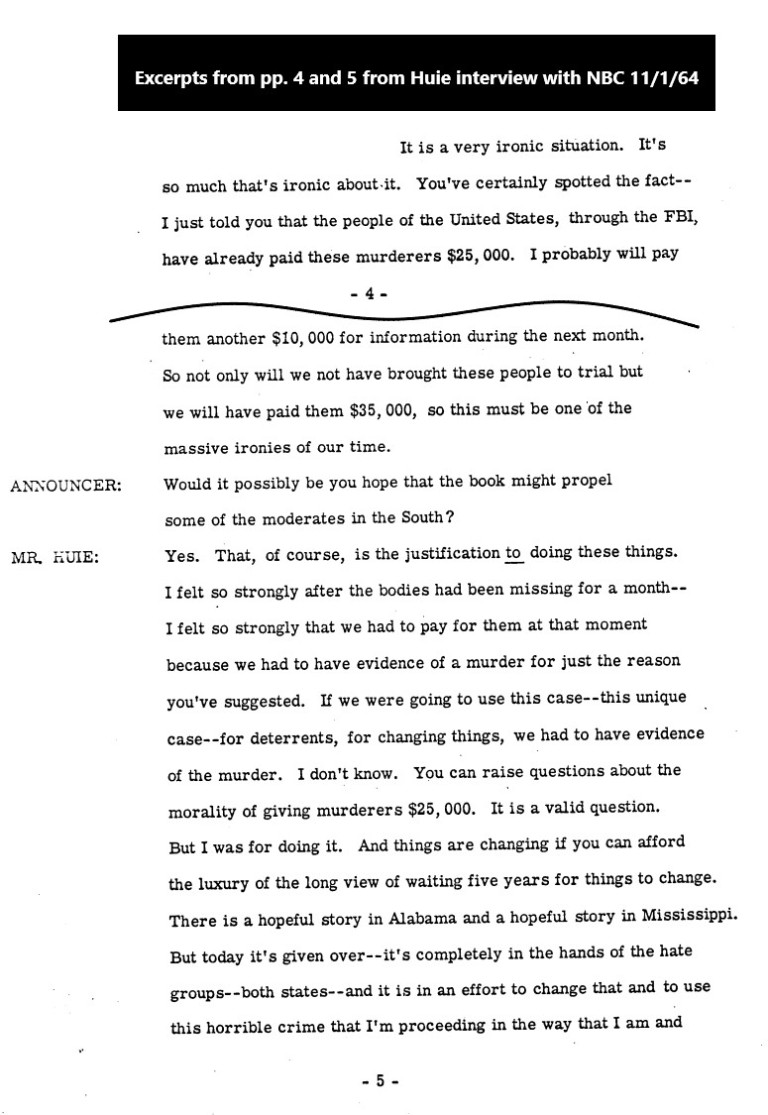
Twelve days later, on Sunday, November 1st, he went to an interview on NBC’s “Monitor” television show. It wasn’t enough for him that he got the nod from the Jackson SAC that they had adopted his idea for the payoff; evidently, to feed his own hubris and nourish his inflated ego, he decided that he couldn’t hold the secret anymore and needed the entire nation’s praise for “solving” the case through the short-cut that he had championed, as he then deliberately leaked the FBI’s secret when he let it slip that he had a key role in solving the triple-murder case:

Huie noted the ironies that his methods created, as he explained his plan for paying the murderer another $10,000 (over $83,000 in today’s currency) despite the fact that the state had not filed charges against any of them at that point. He even noted the question of the “morality” of paying murderers for information, knowing that the local citizenry would close ranks around the accused men to ensure they would not be terribly inconvenienced:
 …
…
Finally, we also know that Huie, the famed “checkbook journalist” who had ingratiated himself into a number of unsavory missions for his own financial and promotional benefit, was an unprincipled, unscrupulous and mendacious man willing to do anything for financial rewards and public accolades. He proved that four years after this event when he accepted a new mission from FBI HQ: The mission to frame James Earl Ray, as described at length in Who REALLY Killed Martin Luther King Jr.?
Be seeing you

 MCViewPoint