MCViewPoint

Opinion from a Libertarian ViewPoint

Posts Tagged ‘China’

Butting Heads With China and Russia: American Diplomats Are Outclassed — Strategic Culture

Posted by M. C. on May 17, 2021

To cite yet another dangerous example of playing with fire that one is witnessing in Eastern Europe, the simple understanding that for Russia Belarus and Ukraine are frontline states that could pose existential threats to Moscow if they were to move closer to the west and join NATO appears to be lacking. The U.S. prefers to stand the question on its head and claims that the real issue is “spreading democracy,” which it is not.

https://www.strategic-culture.org/news/2021/05/13/butting-heads-with-china-and-russia-american-diplomats-are-outclassed/

Philip Giraldi

United State engagement in complicated overseas quarrels should be limited to areas where genuine vital interests are at stake.

With the exception of the impending departure of U.S. and NATO forces from Afghanistan, if it occurs, the White House seems to prefer to use aggression to deter adversaries rather than finesse. The recent exchanges between Secretary of State Tony Blinken and Chinese Foreign Minister Wang Yi at a meeting in Alaska demonstrate how Beijing has a clear view of its interests which Washington seems to lack. Blinken initiated the acrimonious exchange when he cited “deep concerns with actions by China, including in Xinjiang, Hong Kong, Taiwan, cyber attacks on the United States, economic coercion toward our allies. Each of these actions threaten the rules-based order that maintains global stability. That’s why they’re not merely internal matters, and why we feel an obligation to raise these issues here today.” He then threatened “I said that the United States relationship with China will be competitive where it should be, collaborative where it can be, adversarial where it must be” before adding “I’m hearing deep satisfaction that the United States is back, that we’re reengaged with our allies and partners. I’m also hearing deep concern about some of the actions your government is taking.”

The Chinese Foreign Minister responded sharply, rejecting U.S. suggestions that it has a right to interfere in another country’s domestic policies, “I think we thought too well of the United States, we thought that the U.S. side will follow the necessary diplomatic protocols. The United States does not have the qualification to say that it wants to speak to China from a position of strength. We believe that it is important for the United States to change its own image, and to stop advancing its own democracy in the rest of the world.” Yi had a point. Ironically, most of the world believes that the U.S. represents a greater threat to genuine democracy than does either China or Russia.

In another more recent interview Blinken has accused the Chinese of acting “more aggressively abroad” while President Biden has claimed that Beijing has a plan to replace America as the world’s leading economic and military power. U.S. United Nations envoy Linda Thomas-Greenfield has also delivered the same message that Washington is preparing to take no prisoners, pledging to push back against what she called China’s “authoritarian agenda” through the various agencies that make up the UN bureaucracy. Indeed, the United States seems trapped in its own rhetoric, finding itself in the middle of a situation with China and Taiwan where warnings that Beijing is preparing to use force to recover its former province leave Washington with few options to support a de facto ally. Peter Beinart in a recent op-ed observes how the White House has been incrementally increasing its diplomatic ties with Taiwan even as it both declares itself “rock solid” on defending while also maintaining “strategic ambiguity.”

China understands its interests while the U.S. continues to be bewildered by Beijing’s successful building of trade alliances worldwide. Meanwhile Russian President Vladimir Putin, reputedly an excellent chess player, is able to think about genuine issues in three dimensions and is always at least four moves ahead of where Biden and his advisers are at any time. Biden public and video appearances frequently seem to be improvisations as he goes along guided by his teleprompter while Putin is able to explain issues clearly, apparently even in English.

A large part of Biden’s problem vis-à-vis both China and Russia is that he has inherited a U.S. Establishment view of foreign and national security policy options. It is based on three basic principles. First, that America is the only superpower and can either ignore or comfortably overcome the objections of other nations to what it is doing. Second, an all-powerful and fully resourced United States can apply “extreme pressure” to recalcitrant foreign governments and those regimes will eventually submit and comply with Washington’s wishes. And third, America has a widely accepted leadership role of the so-called “free world” which will mean that any decision made in Washington will immediately be endorsed by a large number of other nations, giving legitimacy to U.S. actions worldwide.

What Joe Biden actually thinks is, of course, unknown though he has a history of reflexively supporting an assertive and even belligerent foreign policy during his many years in Congress. Kamala Harris, who many believe will be succeeding Biden before too long, appears to have no definitive views at all beyond the usual Democratic Party cant of spreading “democracy” and being strong on Israel. That suggests that the real shaping of policy is coming from the apparatchik and donor levels in the party, to include the neocon-lite Zionist triumvirate at the State Department consisting of Tony Blinken, Wendy Sherman and Victoria Kagan as well as the upper-level bureaucracies at the Pentagon and intelligence agencies, which all support an assertive and also interventionist foreign policy to keep Americans “safe” while also increasing their budgets annually. Such thinking leaves little room for genuine national interests to surface.

Biden’s Secretary of State Tony Blinken is, for example, the perfect conformist bureaucrat, shaping his own views around established thinking and creating caveats to provide the Democratic Party leadership with some, though limited, options. Witness for example the current White House attitude towards Iran, which is regarded, along with Russia, as a permanent enemy of the United States. President Biden has expressed his interest in renegotiating a non-nuclear proliferation treaty with the Iranians, now being discussed by diplomats without direct contact in Austria. But Blinken undercuts that intention by wrapping the talks in with other issues that are intended to satisfy the Israelis and their friends in Congress that will make progress unlikely if not impossible. They include eliminating Iran’s alleged role as a regional trouble maker and also ending the ballistic missile development programs currently engaged in by the regime. The downside to all of this is that having a multilateral agreement to limit Iranian enhancement of uranium up to a bomb-making level is very much in the U.S. interest, but it appears to be secondary to other politically motivated side discussions which will derail the process.

See the rest here

Posted in Uncategorized | Tagged: , , , , , , | Leave a Comment »

America Makes Aircraft Carriers, China Makes Money – LewRockwell

Posted by M. C. on May 13, 2021

https://www.lewrockwell.com/2021/05/fred-reed/a-dolorous-imbalance/

By Fred Reed

The Unz Review

First, America increasingly relies on strong-arm tactics instead of competence. For example, in the de facto 5G competition, Washington cannot offer Europe a better product at a better price, so it forbids European countries to buy from China. The US cannot compete with China in manufacturing, so it resorts to a trade war. The US cannot make the crucial EUV lithography equipment to make advanced semiconductors, as neither can China, but it can forbid ASML, the Dutch company, from selling to China. Similarly, the US cannot compete with Russia in the price of natural gas to Europe, so by means of sanctions it seeks to keep Europe from buying from Russia. This is not reassuring.

Second, the Chinese are a commercial people, agile, fast to market, cutthroat, known for this throughout Asia. America is a bureaucratized military empire, torpid by comparison. America has legacy control over a few important technologies, most notably the crucial semiconductor field and the international financial system. Washington is using these to try to cripple China’s advance.

A consequence has been a realization by the Chinese that America is not a competitor but an enemy, and a subsequent explosion of investment and R&D aimed at reducing dependence on American technology. There is the well-known 1.4 trillion-dollar five-year plan to this end. One now encounters a flood of stories about advances in tech “to which China has intellectual-property rights” or similar wording.

They seem deadly serious about this. Given that Biden couldn’t tell a transistor from an ox cart, I wonder whether he realizes that every time the US pushes China to become independent in x, American firms lose the Chinese market for X, and later get to compete with Chinese X in the international market. Anyway, give Trump his due. He lit this fuse.

A few snippets


Prototype of China’s 385 mph maglev train

The above beast, developed entirely in China, is the first to use high-temperature superconducting magnets to keep the train floating just above the rails. HTSC magnets are a Big Deal because they can achieve superconductivity using liquid nitrogen as coolant instead of liquid helium for classic superconductivity, this costing, say the Chinese, a fiftieth of the price of using helium. The use of HTSC is very, very slick. The train will extensively use carbon-fiber materials to keep weight down, suggesting that the Chinese cannot distinguish between a train and an airplane.

Asia Times “China’s Hydrogen Dream is taking Shape in Shandong”

“A detailed pilot plan being worked out to transform Shandong, a regional industrial powerhouse, into a “hydrogen society” holds out much hope of delivering on the green promise.”

The article, hard to summarize in a sentence, is worth reading. As so often, the Chinese do things, try things, while the US talks, riots, imposes sanctions, sucks its thumb, and spends grimly on intercontinental nuclear bombers.

Huawei is Developing Smart Roads Instead of Smart Cars”

“Multiple sensors, cameras, and radars embedded in the road, traffic lights, and street signs help the bus to drive safely, while it in turn transmits information back to this network-“

Quantum Cryptography Network Spans 4,600 Km in China”

Quantum Key Distribution, QKD, allows unhackable communications. China read Ed Snowden’s book on NSA’s snooping, realized it had a problem, and set out to correct it. If this spreads to other countries—see below—much of the world could go black to American intel agencies.

The Chinese may have thought of this.

“…colleagues will further expand the network by working with partners in Austria, Italy, Russia and Canada. The team is also developing low-cost satellites and ground stations for QKD.”

The last sentence is interesting. If China begins selling genuinely secure commo gear abroad, it is going to make a lot of intel agencies very unhappy. Did I mention that the Chinese are a commercial people?

Further:

Chinese scientists achieve quantum information masking, paving way for encrypted communication application.”

My knowledge of this might rise to the level of blank ignorance after a good night’s sleep and three cups of coffee. However, the achievement made the American technical press, and suggests Chinese seriousness about gaining privacy.

See the rest here

Fred Reed is author of Nekkid in Austin: Drop Your Inner Child Down a Well, A Brass Pole in Bangkok: A Thing I Aspire to Be, Curmudgeing Through Paradise: Reports from a Fractal Dung Beetle, Au Phuc Dup and Nowhere to Go: The Only Really True Book About VietNam, and A Grand Adventure: Wisdom’s Price-Along with Bits and Pieces about Mexico. Visit his blog.

Be seeing you

Posted in Uncategorized | Tagged: , , , , , | Leave a Comment »

Erie Times E-Edition Article-World leaders pledge cooperation on climate

Posted by M. C. on April 23, 2021

However, Russia and China announced no specific new emissions cuts themselves.

Other speakers urged hefty taxes on climate-damaging polluters and a slashing of government programs that amount to subsidies for oil, gas and coal.

The only lines worth reading. They tell us who will bear the burden and pay the cost.

https://erietimes-pa-app.newsmemory.com/?publink=0d6af1bec

Many set aside other rifts for virtual summit

Ellen Knickmeyer and Aamer Madhani

ASSOCIATED PRESS

WASHINGTON – President Joe Biden convened leaders of the world’s most powerful countries on Thursday to try to spur global efforts against climate change, drawing commitments from Chinese President Xi Jinping and Russian President Vladimir Putin to cooperate on cutting emissions despite their own sharp rivalries with the United States.

“Meeting this moment is about more than preserving our planet,” Biden declared, speaking from a TV-style set for a virtual summit of 40 world leaders. “It’s about providing a better future for all of us,” he said, calling it “a moment of peril but a moment of opportunity.”

“The signs are unmistakable. The science is undeniable. The cost of inaction keeps mounting,” he added.

Biden’s own new commitment, timed to the summit, is to cut U.S. fossil fuel emissions up to 52% by 2030. marking a return by the U.S. to global climate efforts after four years of withdrawal under President Donald Trump. Biden’s administration is sketching out a vision of a prosperous, clean-energy United States where factories churn out cutting- edge batteries for export, line workers re-lay an efficient national electrical grid and crews cap abandoned oil and gas rigs and coal mines.

Japan announced its own new 46% emissions reduction target Thursday, and South Korea said it would stop public financing of new coal-fired power plants, as the U.S. and its allies sought to build momentum via the summit.

The coronavirus pandemic compelled the summit to play out as a climate telethon-style livestream, limiting opportunities for spontaneous interaction and negotiation. The opening was rife with small technological glitches, including echoes, random beeps and off-screen voices.

But the U.S. summit also marshaled an impressive display of the world’s most powerful leaders speaking on the single cause of climate change.

China’s Xi, whose country is the world’s biggest emissions culprit, followed by the United States, spoke first among the other global figures. He made no reference to nonclimate disputes that had made it uncertain until Wednesday that he would even take part in the U.S. summit, and said China would work with America in cutting emissions.

“To protect the environment is to protect productivity, and to boost the environment is to boost productivity. It’s as simple as that,” Xi said.

Putin, whose government has been publicly irate over Biden’s characterization of him as a “killer” for Russia’s aggressive moves against its opponents, made no mention of his feuding with Biden in his own climate remarks.

“Russia is genuinely interested in galvanizing international cooperation so as to look further for effective solutions to climate change as well as to all other vital challenges,” Putin said. Russia by some measures is the world’s fourth-biggest emitter of climate- damaging fossil fuel fumes.

However, Russia and China announced no specific new emissions cuts themselves.

Other speakers urged hefty taxes on climate-damaging polluters and a slashing of government programs that amount to subsidies for oil, gas and coal.

President Joe Biden and John Kerry, the special presidential envoy for climate, attend the virtual summit from the White House on Thursday. EVAN VUCCI/AP

Be seeing you

Posted in Uncategorized | Tagged: , , | Leave a Comment »

Joe Biden’s Demonic Phase | Kunstler

Posted by M. C. on April 17, 2021

Three weeks ago, Ol’ White Joe called Vladimir Putin “a killer.”  This week, Ol’ Joe called Vlad on the phone and suggested a friendly in-person meet-up in some “third country.” In the meantime, Ol’ Joe essayed to send a couple of US warships into the Black Sea to assert America’s interest in Ukraine, the failed state whose American-sponsored failure was engineered in 2014 by Barack Obama’s State Department. Turkey, which controls the narrow entrance to the Black Sea, was notified that two US destroyers would be steaming through its territory. Hours after the announcement, the US called off the ships. Then, hours after Ol’ Joe proffered that summit meeting, his State Department imposed new economic sanctions on Russia and tossed out a dozen or so Russian embassy staff. How’s that for a coherent foreign policy?

https://kunstler.com/clusterfuck-nation/joe-bidens-demonic-phase/

James Howard Kunstler

Joe Biden’s party must be thinking — if you call it thinking — that being psychotic isn’t enough… it’s time to go demonic! How else to explain the supernatural doings of the folks in charge of things in our nation’s capital. The casual observer might suppose that these things are spinning out of control, but you also have to wonder how much Joe Biden & Company are spinning them that way. Are they looking to start a war, for instance?

Three weeks ago, Ol’ White Joe called Vladimir Putin “a killer.”  This week, Ol’ Joe called Vlad on the phone and suggested a friendly in-person meet-up in some “third country.” In the meantime, Ol’ Joe essayed to send a couple of US warships into the Black Sea to assert America’s interest in Ukraine, the failed state whose American-sponsored failure was engineered in 2014 by Barack Obama’s State Department. Turkey, which controls the narrow entrance to the Black Sea, was notified that two US destroyers would be steaming through its territory. Hours after the announcement, the US called off the ships. Then, hours after Ol’ Joe proffered that summit meeting, his State Department imposed new economic sanctions on Russia and tossed out a dozen or so Russian embassy staff. How’s that for a coherent foreign policy?

What’s going on in Ukraine, anyway? The US and NATO have prompted Ukraine to move troops and tanks toward the ethnically-Russian breakaway Donbass region. Russia countered by massing 100,000 troops on Ukraine’s border. Though supplied with Western armaments, Ukraine’s ragtag and incompetent army has no ability to control the Donbass, nor do either NATO and the US have any real will to interfere there with their own troops — the logistics are insane. Mr. Putin’s elegant solution: evacuate the three-plus million Russians stuck in Donbass into Russia — which needs labor — ceding the empty territory to foundering Ukraine — soon to be an ungovernable post-industrial frontier between East and West. For a rich rundown on these matters, read Dmitry Orlov’s mordant disquisition on the subject: Putin’s Ukrainian Judo.

The lesson there is that the US has absolutely nothing to gain from continuing to antagonize Russia, and that the mentally weak Joe Biden is merely projecting the picture of a weakened and confused USA by keeping it up. Of course, a closer read might be that these hijinks are meant to distract from the more serious and consequential breakdown in relations between the US and China, currently engineered by the blundering team of Sec’y of State Antony Blinken and National Security Advisor Jake Sullivan, who went to Alaska recently to tell the Chinese delegation that they were morally unworthy of conducting trade negotiations, thereby torpedoing the trade negotiations that they went to Alaska to conduct. Smooth move fellas.

Unlike Russia, with its eleven time zones, which actually does not want or need any more territory, China is surely making hegemonic moves all over the place, not just around Hong Kong and Taiwan but in Africa and South America, while it strives to build the world’s largest navy, exports gain-of-function viruses, replaces the US in space exploration, and excels at weaponizing computer science. China’s weaknesses are a lack of sufficient domestic oil supply and food, which its current moves aim to correct. It was on its way to turning the US into a raw materials and food-crop colony when Mr. Trump came along and tried to put a stop to that. And now Ol’ Joe has cancelled that remedial action — after being on the receiving end of Chinese financial largesse in four years out-of-office. Nothing to see there, folks, says Merrick Garland’s Department of Justice, while in possession of Hunter Biden’s laptop, with its trove of incriminating memoranda.

On the domestic front, Joe Biden’s government only seeks to turn American life inside-out and upside-down, with the move to make the politics-neutral District of Columbia into a state, strictly to furnish two more senators for the DNC, and to pack the Supreme Court strictly to advantage the same DNC. Those Bills are being rushed through the House committees but something tells me they will die in the Senate. One also must wonder what exactly the rush is all about. I’ll tell you: something is up in the shadows. Something is lurking out there that is going to bring down Ol’ Joe Biden as an illegitimate chief executive. Could be some new non-ignorable evidence of his China grifting activities, or new non-ignorable evidence about the dubious ballot-tally in last November’s election. Could be something else.

Contrary to just about everybody I communicate with, I remain convinced that former US Attorney for Connecticut, now Special Prosecutor John Durham is still putting real cases together, and I suspect that his cases exceed the narrow spotlight of the origin of the Steele dossier, and I expect that indictments will be announced soon in a way that will shock the nation. Just sayin’… though nobody else is….

Meanwhile, the Wokester branch of Joe Biden’s party makes hay with the ambiguous killings of two more criminal suspects-of-color: first, Daunte Wright of Minneapolis, busy ignoring the open warrant out for him in failing to answer a previous warrant for his role in the 2019 aggravated burglary (that is, with a firearm) of a woman. He was out on $100,000 bail, but it was revoked in July 2020 when he got caught in possession of another gun. In the commotion of his resisting arrest, he got shot, tragically for officer Kim Potter, who somehow mistook her handgun for a taser. She is now teed up on a manslaughter case, while the Wright family is teed up for an $XX-million personal injury lawsuit settlement courtesy of ambulance-chaser Ben Crump. The city of Minneapolis is teed up for a municipal auto-da-fé of lootin-burnin-and-riotin in the name of “justice” — and the Derek Chauvin trial has not even concluded.

Secondarily, out comes the chest-cam video of Chicago police officer Eric Stillman shooting thirteen-year-old junior gang-banger Adam Toledo, in possession of a handgun, in a 3 a.m. chase down a West Side alleyway. So, Officer Stillman is teed up for some sort of career-ending action and Chicago is teed up for another round of lootin-burnin-and-riotin — sure to spread to other cities all over the country as the Woke vengeance campaign moves into its Satanic phase.

Be seeing you

Posted in Uncategorized | Tagged: , , , , | Leave a Comment »

Of Two Minds – Is a Cultural Revolution Brewing in America?

Posted by M. C. on April 12, 2021

Cultural revolutions are an expression of disappointment and frustration with corruption and the lack of progress in improving everyday life, frustrations that have no outlet in a regime of self-serving elites who view dissent as treason and/or blasphemy.

https://www.oftwominds.com/blogapr21/US-cultural-rev4-21.html

Charles Hugh Smith

The lesson of China’s Cultural Revolution in my view is that once the lid blows off, everything that was linear (predictable) goes non-linear (unpredictable).

There is a whiff of unease in the air as beneath the cheery veneer of free money for almost everyone, inequality and polarization are rapidly consuming what’s left of common ground in America.

Though there are many systemic differences between China and the U.S., humans in every nation are all still running Wetware 1.0 and so it is instructive to consider what can be learned from China’s Cultural Revolution 1966-1976.

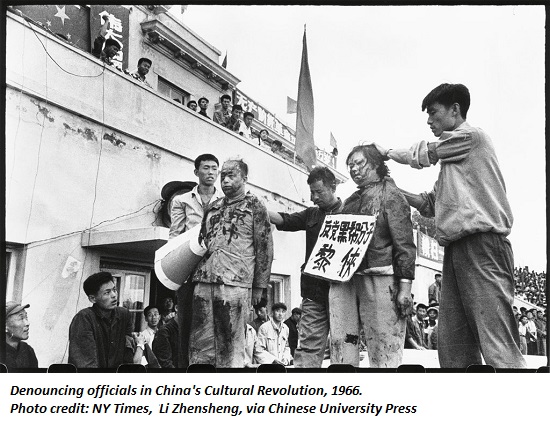
China’s Cultural Revolution was remarkably different from the Party’s military-political victory of 1949. Where the political revolution was managed by the centralized hierarchy of the Communist Party (CCP), the Cultural Revolution quickly morphed from a movement launched by Mao into a decentralized mass movement against all elites, including Party and state elites which had been sacrosanct and untouchable.

The Cultural Revolution is not an approved topic in China today, and that alerts us to its importance.

Although ostensibly launched by Mao (as part of his 1966 purge of Party rivals), the Cultural Revolution very quickly devolved into a decentralized, semi-chaotic movement of Red Guards, students and other groups who shared ideas and programs but who acted quite independent of the Party’s central leadership. (In systems language, semi-chaotic dynamics are emergent properties.)

If you examine Mao’s statements that supposedly launched The Cultural Revolution, you’ll find they’re not much different from his many pronouncements in the 1950s and early 1960s, none of which sparked a violent national upheaval. The Cultural Revolution cannot be traced back to Mao’s control or plans; rather, Mao served as the politically untouchable inspiration for whatever measures the local cadres deemed necessary in terms of advancing (or cleansing) the people’s revolution.

The important point here is that the Cultural Revolution was not controlled by the political authorities, even as they maintained control of the Party and central government hierarchy in Beijing. But this was nothing more than an illusion of control: the forces of the Cultural Revolution had broken free of central command and control, even as the Red Guards expressed their loyalty to Mao and the principles of the Party as the politically approved cover for their rampage.

That’s the irony of Cultural Revolutions: the authorities cannot claim it is a political counter-revolution because the cultural revolutionaries proclaim their loyalty to the ideals and principles the authorities claim to be upholding.

Cultural Revolutions in effect claim the higher ground, eschewing political influence for direct action in the name of furthering the ideals which the authorities have abandoned or betrayed.

Given the fragmentary nature of The Cultural Revolution, the history is equally fragmentary– especially given the official reticence.

A recent academic book, Agents of Disorder: Inside China’s Cultural Revolution, provides granular detail on the fragmented, decentralized, rapidly evolving dynamics of the movement:

“(The author) devoted decades to examining the local records of nearly all of China’s 2,000-plus county-level jurisdictions. He found that factions emerged from the splintering, rather than the congealing, of class-based groups. Small clusters of students, workers, and cadres struggling to respond to Mao’s shifting directives made split-second decisions about whom to align with. Political identities did not shape the conflict; they emerged from it. To explain this process of identity formation, he offers a theory of ‘factions as emergent properties’ and suggests that similar dynamics may characterize social movements everywhere.”

In other words, groups modified their alliances, identities and definitions of “class enemies” on the fly, entirely free of central authorities. Factions splintered, regrouped and splintered again. In the chaos, no one was safe.

Those who lived through The Cultural Revolution are reticent about revealing their experiences. Even in the privacy of their homes in the U.S., their voices become hushed and their reluctance to give voice to their experiences is evident.

The unifying thread in my view is the accused belonged to some “counter-revolutionary” elite –or they were living vestiges of a pre-revolutionary elite (children of the landlord class, professors, etc.)–and it was now open season on all elites, presumed or real.

What generates such spontaneous, self-organizing violence on a national scale? My conclusion is that cultural revolutions result from the suppression of legitimate political expression and the failure of the regime to meet its lofty idealistic goals.

Cultural revolutions are an expression of disappointment and frustration with corruption and the lack of progress in improving everyday life, frustrations that have no outlet in a regime of self-serving elites who view dissent as treason and/or blasphemy.

By 1966, China’s progress since 1949 had been at best uneven, and at worst catastrophic: the Great Leap Forward caused the deaths of millions due to malnutrition and starvation, and other centrally planned programs were equally disastrous for the masses.

Given the quick demise of the Let a Hundred Flowers Bloom movement of open expression, young people realized there was no avenue for dissent within the Party, and no way to express their frustration with the Party’s failure to fulfil its idealistic goals and promises.

When there is no relief valve in the pressure cooker, it’s eventually released in a Cultural Revolution that unleashes all the bottled-up frustrations on elites which are deemed politically vulnerable. These frustrations have no outlet politically because they’re threatening to the status quo.

All these repressed emotions will find some release and expression, and whatever avenues are blocked by authorities will channel the frustrations into whatever is still open.

A Cultural Revolution takes the diversity of individuals and identities and reduces them into an abstraction which gives the masses permission to criticize the abstract class that “deserves” whatever rough justice is being delivered by the Cultural Revolution.

As the book review excerpt noted, the definition of who deserves long overdue justice shifts with the emergent winds, and so those at the head of the Revolution might find themselves identified as an illegitimate elite that must be unseated.

I submit that these conditions exist in the U.S.: the systemic failure of the status quo to deliver on idealized promises and the repression of dissent outside “approved” (i.e. unthreatening to the status quo) boundaries.

What elite can be criticized without drawing the full repressive powers of the central state? What elite will it be politically acceptable to criticize? I submit that “the wealthy” are just such an abstract elite.

To protect itself, a repressive status quo implicitly signals that the masses can release their ire on an abstract elite with indistinct boundaries–a process that will divert the public anger, leaving the Powers That Be still in charge.

But just as in China’s Cultural Revolution, central authorities will quickly lose control of conditions on the ground. They will maintain the illusion of control even as events spiral ever farther from their control. The falcon will no longer hear the falconer.

In other words, once the social pressure cooker valve gives way, then the unleashed forces soon grasp that there are few limits on what they can criticize as long as they do so within an implicitly approved narrative–for example, “the wealthy” hoarded wealth and power and so it is just to claw it back by whatever means are available. Since the government failed to do so, the people will have to do so.

The extreme inequalities of wealth and power that are now the dominant dynamic in America are heating the cultural pressure cooker, and when the pressure can no longer be contained, then being recognized as wealthy will shift very quickly from something desirable to something to avoid at all costs.

The lesson of China’s Cultural Revolution in my view is that once the lid blows off, everything that was linear (predictable) goes non-linear (unpredictable, fragmented, contingent, emergent, prone to extremes, uncontrollable). If America experiences a Cultural Revolution, the outcome won’t lend itself to tidiness or predictability.

To use an analogy from previous blog posts, if the pendulum is pushed to an extreme, when it’s released, it will reach an equivalent extreme (minus a bit of friction) at the opposite end. That could be an unexpected but entirely foreseeable Cultural Revolution.

Those who claim that can’t happen in America are safely outside the pressure cooker, protected by a delusional confidence that since I’m doing great, everyone is doing great. Since real political agency is no longer allowed, then the pressure will find release outside the political system. It’s just Wetware 1.0 running defaults few recognize.

Be seeing you

Posted in Uncategorized | Tagged: , , | Leave a Comment »

For What Should We Fight Russia or China? – LewRockwell

Posted by M. C. on April 7, 2021

https://www.lewrockwell.com/2021/04/patrick-j-buchanan/for-what-should-we-fight-russia-or-china/

By Patrick J. Buchanan

Last Monday, in a single six-hour period, NATO launched 10 air intercepts to shadow six separate groups of Russian bombers and fighters over the Arctic, North Atlantic, North Sea, Black Sea and Baltic Sea.

Last week also brought reports that Moscow is increasing its troop presence in Crimea and along its borders with Ukraine.

Joe Biden responded. In his first conversation with Ukrainian President Volodymyr Zelensky, Biden assured him of our “unwavering support for Ukraine’s sovereignty and territorial integrity in the face of Russia’s ongoing aggression in the Donbass and Crimea.”

Though Ukraine is not a member of NATO, and we have no treaty obligation to fight in its defense, this comes close to a war guarantee. Biden seems to be saying that if it comes to a shooting war between Moscow and Kiev, we will be there on the side of Kiev.

Last week, Kremlin spokesman Dmitry Peskov answered that if the U.S. sends troops to Ukraine, Russia will respond.

Again, is Biden saying that in the event of a military clash between Ukrainians and Russians in Crimea, Donetsk or Luhansk, the U.S. will intervene militarily on the side of Ukraine?

Such a pledge could put us at war with a nuclear-armed Russia in a region where we have never had vital interests, and without the approval of the only institution authorized to declare war — Congress.

Meanwhile, off Whitsun Reef in the South China Sea, which Beijing occupies but Manila claims, China has amassed 220 maritime militia ships.

This huge Chinese flotilla arrived after Secretary of State Anthony Blinken put Beijing on notice that any attack on Philippine planes or ships challenging Beijing’s claim to rocks and reefs of the South China Sea that are in Manila’s exclusive economic zone will be backed by the U.S.

Our 70-year-old mutual security treaty with Manila covers these islets and reefs, said Blinken, though some are already occupied and fortified by China.

Apparently, if Manila uses force to assert its claims and expel the Chinese, then we will fight beside our Philippine allies. This amounts to a war guarantee of the kind that forced the British to declare war on Germany in 1939 over the invasion of Poland.

Two weeks ago, 20 Chinese military aircraft entered Taiwan’s air defense identification zone in the largest incursion yet by Beijing over the waters between Taiwan and Taiwan-controlled Pratas Islands. As national security correspondent Bill Gertz writes in today’s Washington Times:

”China is stepping up provocative activities targeting regional American allies in Asia … with an escalating number of military flights around Taiwan and the massing of more than 200 fishing ships near a disputed Philippines reef.

“China also raised tensions with Japan, announcing last week that Tokyo must drop all claims to the disputed Senkaku Islands, an uninhabited island chain that Japan has administered for decades but that Beijing recently claimed as its territory.

“The most serious provocation took place March 29. An exercise by the People’s Liberation Army air force that included 10 warplanes flew into Taiwan’s air defense zone is what analysts say appeared to be a simulated attack on the island. It came just three days after an earlier mass warplane incursion.”

While China appears clear about its aims and claims to virtually all of the islands in the South China Sea and East China Sea as well as Taiwan — it is less clear about its intentions as to when to validate those claims.

As for the U.S., does the present foggy ambiguity as to what we may or may not do as China goes about asserting its claims serve our vital interests in avoiding war with the greatest power on the largest continent on earth?

If red lines are to be laid down, they ought to be laid down by the one constitutional body with the authority to authorize or declare war — Congress. And questions need to be answered to avoid the kinds of miscalculations that led to horrific world wars in the 20th century.

Are the reefs and rocks the Philippines claim in the South China Sea, claims contradicted by China, covered by the U.S. mutual security treaty of 1951? Are we honor-bound to fight China on behalf of the Philippines, if Manila attempts to reclaim islets China occupies?

What is our obligation if China moves to take the Senkakus? Would the United States join Japan in military action to hold or retrieve them?

What, exactly, is our commitment to Taiwan if China attempts to blockade, invade or seize Taiwan’s offshore islands?

John F. Kennedy in the second debate with Richard Nixon in 1960 wrote off Quemoy and Matsu in the Taiwan Strait as indefensible and not worth war with Mao’s China.

With its warnings and threats, China is forcing America to address questions we have been avoiding for about as long as we can.

China is saying that it is not bluffing: These islands are ours!

Time to show our cards.

Patrick J. Buchanan is co-founder and editor of The American Conservative. He is also the author of Where the Right Went Wrong, and Churchill, Hitler, and the Unnecessary War. His latest book is Nixon’s White House Wars: The Battles That Made and Broke a President and Divided America Forever See his website.

Be seeing you

Posted in Uncategorized | Tagged: , , , , , , | Leave a Comment »

Terminate NATO – The Future of Freedom Foundation

Posted by M. C. on March 30, 2021

How about just leaving China and Russia alone? What’s wrong with that? What’s wrong with other nations becoming prosperous? The fact is that NATO should never have been established in the first place. Moreover, the biggest mistake in U.S. history was to convert the federal government to a national-security state. The best thing American could do now is terminate NATO and restore a limited-government republic to our land.

https://www.fff.org/2021/03/19/terminate-nato/

by Jacob G. Hornberger

The Washington Post has published a long piece calling for NATO to take on a new official enemy — China. The piece is written by Sara Bjerg Moller, an assistant professor in the School of Diplomacy and International Relations at Seton Hall University. She argues that after 30 years since losing the Soviet Union as its official enemy and struggling to find a replacement to justify its continued existence, a perfect replacement would be China.

I’ve got a better idea. Let’s just put NATO out of its misery and terminate it.

After all, let’s not forget NATO’s original mission: to defend Europe from the possibility of an invasion by the Soviet Union, which had been America’s and Britain’s World War II partner and ally but which had been converted to their official enemy at the end of the war.

But the likelihood of a Soviet invasion of Europe was always nil. The Soviet Union had been decimated by World War II, especially as a result of the German invasion of the country. Even though the invasion was ultimately repelled and Germany was defeated, the Soviet Union’s industrial capacity had been destroyed, not to mention the millions of Russian citizens who had been killed. The last thing the Soviet Union wanted was another war, especially given that the United States possessed nuclear weapons and had shown a willingness to employ them against large cities.

The advocates of a national-security state in the United States, however, needed a new official enemy to replace Nazi Germany, especially to justify the conversion of the U.S. government from a limited-government republic to a national-security state, a type of governmental structure with omnipotent, non-reviewable powers. The Soviet Union and “godless communism” fit the bill perfectly. The American people were then inculcated with the notion that there was an international communist conspiracy to take over the United States and the rest of the world that was based in Moscow, Russia.

To convince Americans and western Europeans that the Soviet Union posed a grave threat to them, U.S. officials pointed to the postwar Soviet occupations of Eastern Europe and East Germany as examples of communist aggression. They apparently forgot that President Franklin Roosevelt had delivered such lands into the hands of Soviet leader Joseph Stalin, who FDR affectionately referred to as his “Uncle Joe,” at their wartime summit in Yalta. Was it really too surprising that Stalin accepted FDR’s gift, especially given that Eastern Europe and East Germany would serve as a buffer against another German invasion of the Soviet Union?

It was within this fervent anti-communist environment that NATO was formed. But in 1989, the Cold War suddenly and unexpectedly came to an end, which, needless to say, put the U.S. national-security establishment and NATO into a panic. After all, the Cold War was the justification for both of these institutions. With no Cold War, they could both be dismantled.

Instead, the national-security establishment simply went into the Middle East and began poking hornets’ nest, which ultimately brought terrorist retaliation, which in turn brought the “war on terrorism,” another racket that has kept the national-security establishment in high cotton.

Meanwhile, unwilling to let Russia go as an official enemy, NATO began gobbling up former members of the Warsaw Pact, with the aim of placing U.S. troops and missiles ever closer to Russia’s borders and with the hope of provoking a reaction, which ultimately came about in Ukraine.

As Moller argues, however, Russia poses no real threat to Europe and, therefore, cannot be seriously considered to be a justification for NATO. Instead, she argues, it’s time to replace Russia with China, owing to China’s rise as an international powerhouse. The reasoning is classic empire-think: If a nation starts to prosper and rise, it’s best to put it down before it gets too large and powerful.

How about just leaving China and Russia alone? What’s wrong with that? What’s wrong with other nations becoming prosperous? The fact is that NATO should never have been established in the first place. Moreover, the biggest mistake in U.S. history was to convert the federal government to a national-security state. The best thing American could do now is terminate NATO and restore a limited-government republic to our land.

This post was written by: Jacob G. Hornberger

Jacob G. Hornberger is founder and president of The Future of Freedom Foundation. He was born and raised in Laredo, Texas, and received his B.A. in economics from Virginia Military Institute and his law degree from the University of Texas. He was a trial attorney for twelve years in Texas. He also was an adjunct professor at the University of Dallas, where he taught law and economics. In 1987, Mr. Hornberger left the practice of law to become director of programs at the Foundation for Economic Education. He has advanced freedom and free markets on talk-radio stations all across the country as well as on Fox News’ Neil Cavuto and Greta van Susteren shows and he appeared as a regular commentator on Judge Andrew Napolitano’s show Freedom Watch. View these interviews at LewRockwell.com and from Full Context. Send him email.

Be seeing you

Posted in Uncategorized | Tagged: , , , | Leave a Comment »

How China Waged A Covert War On The US Using Covid-19

Posted by M. C. on March 26, 2021

China, with the help of the praise of the World Health Organization, helped set the global precedent for authoritarian lockdowns in Wuhan. Then the country basically carried on as normal while the rest of the world damaged their economies.

China emerged stronger, and the West weakened, which was likely the entire plan in the first place.

This is not even discussing the possibility that China created or spread the virus, but rather how China took advantage of the situation to position itself to become the global dominant superpower.

Be seeing you

Posted in Uncategorized | Tagged: , , | 1 Comment »

Terminate NATO – The Future of Freedom Foundation

Posted by M. C. on March 22, 2021

As Moller argues, however, Russia poses no real threat to Europe and, therefore, cannot be seriously considered to be a justification for NATO. Instead, she argues, it’s time to replace Russia with China, owing to China’s rise as an international powerhouse. The reasoning is classic empire-think: If a nation starts to prosper and rise, it’s best to put it down before it gets too large and powerful.

How about just leaving China and Russia alone? What’s wrong with that? What’s wrong with other nations becoming prosperous? The fact is that NATO should never have been established in the first place. Moreover, the biggest mistake in U.S. history was to convert the federal government to a national-security state. The best thing American could do now is terminate NATO and restore a limited-government republic to our land.

https://www.fff.org/2021/03/19/terminate-nato/

by Jacob G. Hornberger

The Washington Post has published a long piece calling for NATO to take on a new official enemy — China. The piece is written by Sara Bjerg Moller, an assistant professor in the School of Diplomacy and International Relations at Seton Hall University. She argues that after 30 years since losing the Soviet Union as its official enemy and struggling to find a replacement to justify its continued existence, a perfect replacement would be China.

I’ve got a better idea. Let’s just put NATO out of its misery and terminate it.

After all, let’s not forget NATO’s original mission: to defend Europe from the possibility of an invasion by the Soviet Union, which had been America’s and Britain’s World War II partner and ally but which had been converted to their official enemy at the end of the war.

But the likelihood of a Soviet invasion of Europe was always nil. The Soviet Union had been decimated by World War II, especially as a result of the German invasion of the country. Even though the invasion was ultimately repelled and Germany was defeated, the Soviet Union’s industrial capacity had been destroyed, not to mention the millions of Russian citizens who had been killed. The last thing the Soviet Union wanted was another war, especially given that the United States possessed nuclear weapons and had shown a willingness to employ them against large cities.

The advocates of a national-security state in the United States, however, needed a new official enemy to replace Nazi Germany, especially to justify the conversion of the U.S. government from a limited-government republic to a national-security state, a type of governmental structure with omnipotent, non-reviewable powers. The Soviet Union and “godless communism” fit the bill perfectly. The American people were then inculcated with the notion that there was an international communist conspiracy to take over the United States and the rest of the world that was based in Moscow, Russia.

To convince Americans and western Europeans that the Soviet Union posed a grave threat to them, U.S. officials pointed to the postwar Soviet occupations of Eastern Europe and East Germany as examples of communist aggression. They apparently forgot that President Franklin Roosevelt had delivered such lands into the hands of Soviet leader Joseph Stalin, who FDR affectionately referred to as his “Uncle Joe,” at their wartime summit in Yalta. Was it really too surprising that Stalin accepted FDR’s gift, especially given that Eastern Europe and East Germany would serve as a buffer against another German invasion of the Soviet Union?

It was within this fervent anti-communist environment that NATO was formed. But in 1989, the Cold War suddenly and unexpectedly came to an end, which, needless to say, put the U.S. national-security establishment and NATO into a panic. After all, the Cold War was the justification for both of these institutions. With no Cold War, they could both be dismantled.

Instead, the national-security establishment simply went into the Middle East and began poking hornets’ nest, which ultimately brought terrorist retaliation, which in turn brought the “war on terrorism,” another racket that has kept the national-security establishment in high cotton.

Meanwhile, unwilling to let Russia go as an official enemy, NATO began gobbling up former members of the Warsaw Pact, with the aim of placing U.S. troops and missiles ever closer to Russia’s borders and with the hope of provoking a reaction, which ultimately came about in Ukraine.

As Moller argues, however, Russia poses no real threat to Europe and, therefore, cannot be seriously considered to be a justification for NATO. Instead, she argues, it’s time to replace Russia with China, owing to China’s rise as an international powerhouse. The reasoning is classic empire-think: If a nation starts to prosper and rise, it’s best to put it down before it gets too large and powerful.

How about just leaving China and Russia alone? What’s wrong with that? What’s wrong with other nations becoming prosperous? The fact is that NATO should never have been established in the first place. Moreover, the biggest mistake in U.S. history was to convert the federal government to a national-security state. The best thing American could do now is terminate NATO and restore a limited-government republic to our land.

This post was written by: Jacob G. Hornberger

Jacob G. Hornberger is founder and president of The Future of Freedom Foundation. He was born and raised in Laredo, Texas, and received his B.A. in economics from Virginia Military Institute and his law degree from the University of Texas. He was a trial attorney for twelve years in Texas. He also was an adjunct professor at the University of Dallas, where he taught law and economics. In 1987, Mr. Hornberger left the practice of law to become director of programs at the Foundation for Economic Education. He has advanced freedom and free markets on talk-radio stations all across the country as well as on Fox News’ Neil Cavuto and Greta van Susteren shows and he appeared as a regular commentator on Judge Andrew Napolitano’s show Freedom Watch. View these interviews at LewRockwell.com and from Full Context. Send him email.

Be seeing you

Posted in Uncategorized | Tagged: , , , | Leave a Comment »

Doug Casey: What If China Restricts The Supply of These Obscure Metals

Posted by M. C. on March 4, 2021

What does Washington consider when implementing it’s mad interventionism?

Fortunately for Washington, lithium is not on the China list.

https://internationalman.com/articles/doug-casey-what-if-china-restricts-the-supply-of-these-obscure-metals/

by Doug Casey

International Man: Rare-earth elements (REEs) were in the news recently. What is the significance of these 17 obscure elements from the periodic table?

Doug Casey: Obscure elements seem to come into public view every few decades, typically during a commodity bull market. I remember the so-called “strategic metals” boom, back in the early 1980s, when everybody went wild about cobalt and tantalum, among other elements. I remember there was a well-known broker in New York who was actually selling 55-gallon drums full of cadmium to naïve clients. There are probably, even now, some poor people with the stuff stored in their garages.

This is a cyclical phenomenon, not unlike what’s happening with stocks like GameStop. It’s mostly a consequence of too much money being printed and lots of it looking for a place to hide.

Now it’s the turn of rare-earth elements. Many readers will recall them from chemistry class. More technically, most of them are also known as lanthanides, in their own row at the bottom of the periodic table. They’re actually not all that rare. Fun fact: Cerium is more common than copper in the earth’s crust. That is indicative of the problem. REEs are generally widely dispersed, but there are relatively few places where deposits are concentrated enough to be considered ore.

Economic deposits of REEs may be somewhat hard to find, but there are scores of known REE resources, not counting the millions of tons of electronic junk that can be recycled for them. But the lack of minable reserves is solvable with higher REE prices. There are also problems in mining, concentrating, and refining that are peculiar to REEs. Mining anything can be messy, of course, but REE’s chemical characteristics make them more of a problem than many minerals. Although, this is nothing that can’t be solved with inputs of capital and technology.

International Man: Rising tensions between the US and China seem to be inevitable. China, which dominates REE production, recently suggested it could restrict supplies to the US. What are the implications of this?

Doug Casey: It’s true that REEs are very important for high-tech electronic applications today and are becoming much more important. But, as I said, deposits exist all over the world, including North America and Australia; the Chinese don’t have a geological monopoly on them.

It’s good to remember there was almost zero REE production until about 1950 because there were simply no uses for them. The REEs are chemically similar—which is why a lot of them occur together in nature—but electrically, they’re each quite unique. This is why they’re so valuable in today’s electronic world.

They’re very important—true—but there’s no reason for a panic, a hysteria, about China currently producing almost all of them. The big problem isn’t scarcity; it’s economics—the Chinese can produce them cheaper. The West doesn’t produce them, mainly because of regulation.

Today, everywhere, trying to put even a simple economic deposit of any mineral into production can take 10 years or more from the discovery. It’s much slower and much more expensive than it once was or should be. That’s true everywhere, but especially in the ecohysteric West. Mining has become a horrible business, not only because of the time value of money but because of environmental and social regulations from a dozen different agencies.

There should be no problem with America having access to locally produced Rare Earth Elements. But various levels of government, buttressed by eco-warriors, Greens, and NGOs, make it either impossible or uneconomic to mine them.

It’s likely to become a bigger problem as time goes on simply because the government is becoming more powerful and more intrusive, making it harder to mine anything, including REEs. Even while REEs are becoming ever more important.

The good news is that, at some point, people will realize that if they want their iPhones, widescreens, electric cars, and a thousand other things, somebody is going to have to mine stuff like Ytterbium and Europium, which they’ve never even heard of before.

International Man: How can anyone else profitably mine REEs when China subsidizes production, doesn’t care about environmental or safety issues, and can flood the market to bankrupt competitors? Can anyone break China’s grip on the market?

Doug Casey: Good question, considering Einstein once said that “After hydrogen, the most common thing in the universe is stupidity.” The main problem comes from our own governments. But it should be a non-problem. If the Chinese won’t sell the stuff or price it exorbitantly, Western users should be able to simply put our own resources into production. If you run a business, you don’t want unreliable suppliers.

But it seems that Americans and Europeans are mostly interested in stuff that’s green, warm, and fuzzy. They don’t want to be bothered with stuff that’s hard and dirty.

On the other hand, the Chinese are concentrating on things that are hard, dirty to mine, and high tech. There’s a serious cultural gap between East Asians and Westerners—and I’m afraid we’re on the wrong side of that divide.

REEs are important for high tech because each of the 92 naturally occurring elements is unique atomically and chemically. If you want technological advancement, you need as many different elements as you can get to make it possible.

International Man: Is there potential to speculate in REE stocks?

Doug Casey: For sure. Higher prices of these obscure elements will solve all problems, so it makes sense to speculate in companies that have deposits of them that might be put into production in the West.

Some stocks of companies that have possibly economic deposits of these obscure elements have done quite well in the last couple of years, but they might do even better in the next few years. There are quite a few that are almost unknown and are very cheap.

Chris Maclntosh does fantastic work finding obscure companies that have potential upside in this area.

Editor’s Note: Legendary speculator Doug Casey is an expert on finding unique opportunities in overlooked markets.

Doug and his team just released a new report on the other opportunities they see coming. Click here to download the PDF now. 

Be seeing you

Posted in Uncategorized | Tagged: , , , | Leave a Comment »