MCViewPoint

Opinion from a Libertarian ViewPoint

Posts Tagged ‘Christine Lagarde’

Grab the Negronis and the Aperol Spritz; it’s show time.

Posted by M. C. on September 29, 2022

In case of a – nearly inevitable – financial catfight cage match between Team Giorgia and Christine “look at my new Hermes scarf” Lagarde at the ECB, the European Central Bank will “forget” to buy Italian bonds and then, Auguri! Welcome to a new round of EU sovereign debt crisis.

Pepe Escobar

It’s tempting to interpret the Italian electoral results this past Sunday as voters merrily hurling a bowl of lush papardelle with wild boar ragu over the collective bland faces of the toxic unelected Euro-oligarchy sitting in Brussels.

Well, it’s complicated.

Italy’s electoral system is all about coalitions. The center-right Meloni-Berlusconi-Salvini troika is bound to amass a substantial majority in both the Parliament’s Lower House and the Senate. Giorgia Meloni leads Fratelli d’Italia (“Brothers of Italy”). The notorious Silvio “Bunga Bunga” Berlusconi leads Forza Italia. And Matteo Salvini leads La Lega.

The established cliché across Italy’s cafes is that Giorgia becoming Prime Minister was a shoo-in: after all she’s “blonde, blue eyes, petite, sprightly and endearing”. And an expert communicator to boot. Quite the opposite of Goldman Sachs partner and former uber-ECB enforcer Mario Draghi, who looks like one of those bloodied emperors of Rome’s decadence. During his Prime Ministerial reign, he was widely derided – apart from woke/finance circles – as the leader of “Draghistan”.

On the financial front that otherworldly entity, the Goddess of the Market, the post-truth equivalent of the Delphi Oracle, bets that PM Giorgia will insist on the same old strategy: debt-funded fiscal stimulus, which will turn into a blowout in Italian debt (already huge, at 150% of GDP). All that plus a further collapse of the euro.

So the big question now is who’s going to be Italy’s new Finance Minister. Giorgia’s party has no one with the requisite competence for it. So the preferred candidate shall be “approved” by the usual suspects as a sort of enforcer of “Draghistan lite”. Draghi, by the way, already said he’s “ready to collaborate”.

Marvels of gastronomy apart, life in the EU’s third largest economy is a drag. Long-term growth prospects are like a mirage in the Sahara. Italy is extremely vulnerable when it comes to the financial markets. So a bond market a-go-go selloff in the horizon is practically a given.

In case of a – nearly inevitable – financial catfight cage match between Team Giorgia and Christine “look at my new Hermes scarf” Lagarde at the ECB, the European Central Bank will “forget” to buy Italian bonds and then, Auguri! Welcome to a new round of EU sovereign debt crisis.

See the rest here

Be seeing you

Posted in Uncategorized | Tagged: , , , | Leave a Comment »

The ECB’s New Inflation Plan Is Like the Old Plan. But Worse. | Mises Wire

Posted by M. C. on July 18, 2021

Examples of how the ECB has contributed to economic sclerosis include the fantastic continuing gravy train into Italy which has fortified the status quo there but smothered any  creative destruction including winding down of big government and cronyism;

https://mises.org/wire/ecbs-new-inflation-plan-old-plan-worse

Brendan Brown

Old, absurd, and unfit for purpose; how else to describe the “new” monetary framework for euro monetary policy presented by ECB Chief Lagarde amidst much fanfare on Thursday, July 8?

Why old? The “new” framework is remarkably similar to that unveiled in May 2003.

Why absurd?  The main rationale put forward for the framework is to work around a problem of the “zero bound”.  That problem, however, is of the ECB’s own making. 

Why unfit for purpose?  Chief Christine Lagarde tells us that the review has been undertaken to make sure that “our monetary policy strategy is fit for purpose both today and in the future”.  But she considers no critique of that strategy and advances no rebuttal of any.  She does not explain why she expects better results from a plan that so similar to the strategy that’s been pursued during the past quarter century.

What Is New in the Plan?

The ECB has upped its inflation target. 

So what is now new?  “Just below 2 per cent”, the 2003 formulation, has been replaced by “2 per cent”.  Deep in the text of the new framework is reference to knowledge gained since then about the severity of monetary policy paralysis which can occur when inflation falls too far.  This discovery, we’re told, justifies greater leniency in accepting an inflation overshoot for some time.   The reader then arrives at the gobbledygook phrase “price stability is best maintained by aiming for a 2 per cent inflation target over the medium term”.  

The ECB has adopted many new radical tools to make this happen. Following on from the 2 per cent statement, the ECB confirms the setting of interest rates remains the primary tool, but many other tools are available as well:

The Governing Council also confirmed that the set of ECB interest rates remains the primary monetary policy instrument. Other instruments, such as forward guidance, asset purchases and longer-term refinancing operations, that over the past decade have helped mitigate the limitations generated by the lower bound on nominal interest rates will remain an integral part of the ECB”s toolkit, to be used as appropriate.

In other words, the new plan tells us the ECB plans to be much more activist and it plans to use many “tools” that were once considered to be unacceptably radical. 

Think back to Spring 2003 when Professor Otmar Issing introduced the ECB’s then-new framework.   The salient point then was that the ECB would aim for inflation of just under 2 per cent, ready to take as determined action to prevent inflation undershoots as well as overshoots.  In response to a question, he insisted that the ECB had been following in practice this policy framework  since the launch of the euro (1999), even though its formal aim had been simply inflation below 2 per cent, which in principle could have meant inflation for most of the time at zero.   

At the time of the last review Professor Issing was still highly respectful about a second pillar of ECB policymaking founded on a monitoring range for broad money supply growth.  There was no mention then of QE, forward guidance, long-term rate manipulation and these tools were not accepted as legitimate.   Legitimacy and application of such “non-conventional tools” came in the midst of the sovereign and banking debt crises of 2010-12.   They were introduced as essential for monetary control.   Everyone and their dog, however, realized that their primary purpose was for the ECB to effect massive transfers of funds towards supporting the weak sovereigns and their banks.   Now that pretense has become part of the new framework.

Managing Price-Inflation Expectations

One might have expected some pushback against all this from the Bundesbank or the Dutch National Bank.  There is no evidence of this except indirectly in the concession by ECB of a quid pro quo.   Its review states that the estimation of inflation for targeting should be modified eventually to take account of the cost of owner-occupied housing   

 This is a very weak reed of defiance.  The ECB tells us that the cost of owner-occupied housing is now to be estimated in a “stand-alone index” and this should be considered in a wider context of assessing monetary conditions for the next few years.   Ultimately by the mid-2020s the ECB foresees that there will be a modified HICP (euro-area CPI) which includes this estimation of owner-occupied housing costs, but this will not be fully operational as a target variable until the late 2020s.   Who knows; by then the terrific housing price boom across much of the euro-zone, including prominently Germany and Holland in recent years, might have gone into reverse, meaning the HICP will be reformed in a direction which in fact calls for an even more radical European monetary policy.

Why Is the New Plan Necessary? 

The ECB pleads that its new “framework” has become necessary because the problem of the “zero bound” has become so severe.  That is, with interest rates already so low, it is assumed the central bank needs new tools to push up price inflation, even with target interest rates already at zero or below zero.  This is due, it says, to issues beyond its control. “Structural developments have lowered the equilibrium real rate of interest – decline in productivity growth, demography, and persistently higher demand for safe liquid assets. Hence the incidence and direction of episodes in which nominal policy rates are close to the effective lower bound increased – with the current episode lasting more than 10 years”.

The ECB Won’t Solve the Problem the ECB Created

What chutzpah!  This alleged problem of “extraordinarily low equilibrium real rates” is a problem of the central bank’s own making.  The European sovereign debt and banking crisis of 2010-12, the trigger to initial downward forces on the equilibrium real rate, was itself a consequence of ECB policy through the years 1997-2007.  This was highly inflationary, albeit that the symptoms were more sharply visible for much of the time in asset markets than goods and services markets.    By aiming for 2 per cent inflation at a time of rapid productivity growth and globalization, also with downward pressure on prices due to increased competition within EMU, the ECB fanned monetary inflation.   

“Equilibrium real rates” have remained so low far beyond the crises of 2008-12 and their immediate aftermath precisely because the ECB’s policies have induced and added to economic sclerosis.  Its radicalism, characterized by negative interest rates and vast QE operations focussed on bailing out weak sovereigns and banks, has sapped any potential dynamism out of the European economies.   

Examples of how the ECB has contributed to economic sclerosis include the fantastic continuing gravy train into Italy which has fortified the status quo there but smothered any  creative destruction including winding down of big government and cronyism; the stimulation of a financial engineering boom and more broadly financial speculation in which investors pursue high apparent returns based on camouflaged leverage and other optical illusions rather than potential returns on long-gestation capital spending ; the generation of massive capital exports as interest income famine European investors search out apparently high returns abroad especially in high-risk credit markets  and also in the Eldorado of US monopoly capitalism (especially the big five FAAAMs), itself a dead hand throttling economic dynamism globally; the fuelling of a fantastic real estate construction boom most of all in Germany which does not generate productivity growth; creating desperation amongst some households about negative returns on their savings and the ultimate prospects of their pensions becoming cut in the midst of the next financial crisis and so causing them to restrict spending.

Unsound money whether by the Fed or the ECB or the Bank of Japan has produced an apparent low and allegedly (according to the central bank narrative) sub-zero equilibrium interest rate. 

Sound money, not a digging in around the present monetary framework, is the answer to the zero rate boundary problem.   Author:

Brendan Brown

Brendan Brown is a founding partner of Macro Hedge Advisors (www.macrohedgeadvisors.com) and senior fellow at Hudson Institute. As an international monetary and financial economist, consultant, and author, his roles have included Head of Economic Research at Mitsubishi UFJ Financial Group. He is also a Senior Fellow of the Mises Institute. He is the author of Europe’s Century of Crises under Dollar Hegemony: A Dialogue on the Global Tyranny of Unsound Money with Philippe Simonnot. His other books include The Case Against 2 Per Cent Inflation (Palgrave, 2018) and he is publisher of “Monetary Scenarios,” Euro Crash: How Asset Price Inflation Destroys the Wealth of Nations and The Global Curse of the Federal Reserve: Manifesto for a Second Monetarist Revolution.

Be seeing you

Posted in Uncategorized | Tagged: , , | Leave a Comment »

Putin Unleashes Strategic Hell on the U.S. — Strategic Culture

Posted by M. C. on March 19, 2020

Putin just told the world he’s not riding his country’s oil and gas resources like a cash cow but rather as an important part of a different economic strategy for Russia’s development.

It’s like watching someone playing the first half of a game implying one strategy and making a critical shift to a different one halfway through, taking advantage of their opponents’ carelessness.

https://www.strategic-culture.org/news/2020/03/15/putin-unleashes-strategic-hell-on-us/

 Tom Luongo

I am an avid board game player. I’m not much for the classics like chess or go, preferring the more modern ones. But, regardless, as a person who appreciates the delicate balance between strategy and tactics, I have to say I am impressed with Russian President Vladimir Putin’s sense of timing.

Because if there was ever a moment where Putin and Russia could inflict maximum pain on the United States via its Achilles’ heel, the financial markets and its unquenchable thirst for debt, it was this month just as the coronavirus was reaching its shores.

Like I said, I’m a huge game player and I especially love games where there is a delicate balance between player power that has to be maintained while it’s not one’s turn. Attacks have to be thwarted just enough to stop the person from advancing but not so much that they can’t help you defend on the next player’s turn.

All of that in the service of keeping the game alive until you find the perfect moment to punch through and achieve victory. Having watched Putin play this game for the past eight years, I firmly believe there is no one in a position of power today who has a firmer grasp of this than him.

And I do believe this move to break OPEC+ and then watch Mohammed bin Salman break OPEC was Putin’s big judo-style reversal move. And by doing so in less than a week he has completely shut down the U.S. financial system.

On Friday March 6th, Russia told OPEC no. By Wednesday the 11th The Federal Reserve had already doubled its daily interventions into the repo markets to keep bank liquidity high.

By noon on the 12th the Fed announced $1.5 trillion in new repo facilities including three-month repo contracts. At one point during trading that day the entire U.S. Treasury market went bidless. There was no one out there making an offer for the most liquid, sought-after financial assets in the world.

Why? Prices were so high, no one wanted them.

Not only did we get a massive expansion of the repo interventions by the Fed, but it was for longer duration. This is a clear sign that the problem is nearly without an end. Repos longer than three days are in this context a rarity.

The Fed needing to add $1 trillion in three-month repos clearly means they understand that they are looking out to the end of the quarter as the next problem and beyond that.

It means, in short, the world financial markets have completely seized up.

And worse than that…. It didn’t work.

Stocks continued to slide, gold and other safe-haven assets were hit hard by a reversal of capital outflows from the U.S. In the first part of the aftermath of Putin’s decision the dollar got whacked as European and Japanese investors who had piled into U.S. stocks as a safe-haven sold those positions and brought the capital home.

That lasted a few days before Christine Lagarde put on her dog and pony show at the European Central Bank and told everyone she didn’t have any answers other than to expand asset purchases and continue doing what has failed in the past.

This touched off the next phase of the crisis, where the dollar begins to strengthen. And that is where we are now.

And Putin understands that a world awash in debt is one that cannot withstand the currency needed to repay that debt rising sharply.

That puts further pressure on his geopolitical rivals and forces them to focus on their domestic concerns rather than the ones overseas.

For years Putin has been begging the West to stop its insane belligerence in the Middle East and across Asia. He’s argued eloquently at the U.N. and in interviews that the unipolar moment is over and that the U.S. can only maintain its status as the world’s only super power for so long. Eventually the debt would undermine its strength and at the right moment would be revealed to be far weaker than it projected.

This doesn’t sit well with President Trump who believes in America’s exceptionalism. And will fight for his version of “America First’ to the last using every weapon at his disposal. The problem with this ‘never back down’ attitude is that it makes him very predictable.

Trump’s use of sanctions on Europe to stop the Nord Stream 2 pipeline was stupid and short-sighted. It ensured that Russia would be merciless in its response and only delay the project for a few months.

Trump was easy to counter here. Sign a deal with Ukraine, desperate for the money, and redirect the pipe-laying vessel back to the Baltic to finish the pipeline.

And with natural gas prices in Europe already in the gutter from oversupply and a mild winter, there isn’t much time or money lost in the end. Better to take the world oil price down well below U.S. production costs which ensure that Trump’s prized LNG stays off the European market as the myth of U.S. energy self-sufficiency vanishes in a puff of financial derivative smoke.

Now Trump is facing a market meltdown well beyond his capacity to fathom or respond to. While Russia is in the unique position to drive costs down for so many of the people while riding out the shock to the global system with its savings.

Because money flows to where the best returns on it come, high oil and gas prices stifle development of other industries. Lowering the oil price not only deflates all of the U.S.’s inflated financial weapons it also deflates some of the power of the petroleum industry domestically. This gives Putin the opportunity to continue remaking the Russian economy along less focused lines. Cheap oil and gas means lower return on investment in energy projects which, in turn, opens up available capital to be deployed in other areas of the economy.

Putin just told the world he’s not riding his country’s oil and gas resources like a cash cow but rather as an important part of a different economic strategy for Russia’s development.

It’s like watching someone playing the first half of a game implying one strategy and making a critical shift to a different one halfway through, taking advantage of their opponents’ carelessness.

It rarely works, but when it does the results can be spectacular. Game, Set, Match, Putin.


© 2010 – 2020 | Strategic Culture Foundation | Republishing is welcomed with reference to Strategic Culture online journal www.strategic-culture.org.

Be seeing you


Posted in Uncategorized | Tagged: , , , , , | Leave a Comment »

The Bank of Japan Shrinks the Pocket Money of Japanese ‘Salarymen’ | Mises Wire

Posted by M. C. on November 6, 2019

This could mean that a few rich Japanese, who are holding large amounts of stocks and other assets, may be the only ones who benefited from the new stock price inflation. In contrast, the majority of Japanese continues to tighten their belts, as real wages continue to fall in the face of sluggish productivity gains. This points to the unjust distribution effects of the Abenomics, which make the rich richer and all others poorer. This phenomenon cannot only be observed in Japan, but also in the euro area where Christine Lagarde is expected to follow the Japanese monetary policy pattern.

https://mises.org/wire/bank-japan-shrinks-pocket-money-japanese-%E2%80%98salarymen%E2%80%99?utm_source=Mises+Institute+Subscriptions&utm_campaign=5c1466ac47-EMAIL_CAMPAIGN_9_21_2018_9_59_COPY_01&utm_medium=email&utm_term=0_8b52b2e1c0-5c1466ac47-228343965

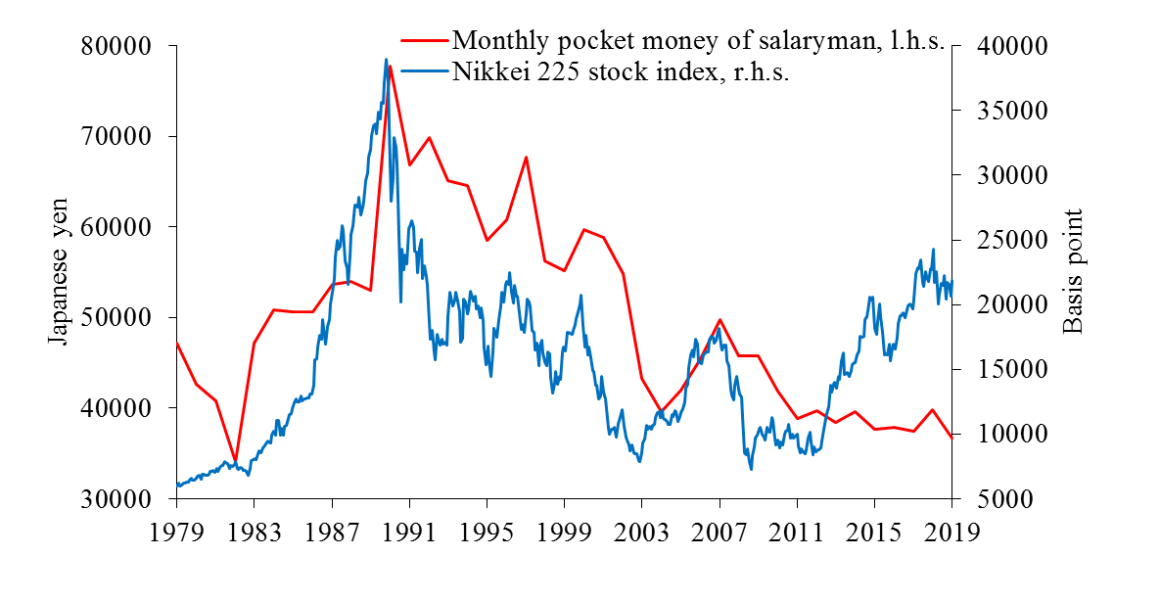
In December 2012, Japan’s Prime Minister Shinzo Abe set out three arrows in his quiver to pull the country out of the more than 20 years lasting stagnation. Immense purchases of assets by the Bank of Japan, huge government spending programs and structural reforms should deliver a sustained recovery to the Japanese people. In the meantime, it is becoming evident that so-called Abenomics is – despite buoyant stock prices – a damp squib. Inter alia, this is indicated by the pocket money of Japanese “salarymen,” male white-collar workers who commute day-to-day in dark suits by stuffed trains to the central business districts of the Tokyo metropolitan area.

Nikkei 225 and Pocket Money of Japanese ‘Salarymen’

bojarticle_1024.png
Source: Shinsei Bank, Nikkei.

Traditionally in Japan the men earn the money and the wives manage the household. A Japanese proverb says that the wife controls the purse strings, with the women being quite generous. In 2019, the Japanese male white-collar workers still received on average 36,747 yen (almost 340 US dollars) per month for bars, restaurants and other leisure activities in which their wives are typically not involved.

But the good times are long gone.

In the second half of the 1980s, when sharp interest-rate cuts by the Bank of Japan inflated during the so-called “bubble economy,” stock and real estate prices – as well as wages and bonuses – the pocket money of salarymen skyrocketed. Between 1985 and 1990, both stock prices and pocket money grew by about 50 percent each (see chart). At the top of the bubble in 1989, pocket money averaged almost 80,000 yen (a good 600 US dollars) per month. At that time, drinking every night in the bars without limits symbolized the exuberance.

Since the bursting of the Japanese bubble in the early 1990s, both stock prices and pocket money have steadily declined. By the time Abenomics started in January 2013, stock prices had fallen by 73 percent and the pocket money of salarymen fell by 51 percent. The efforts of the Bank of Japan to cushion the crisis by cutting interest rates to zero and pioneering on unconventional monetary policy measures could not prevent Japanese housewives from pulling the string of the purses tighter and tighter. The wives seem to have been guided by both the doldrums on financial markets, and the gradually declining wages since the 1998 financial crisis.

Thus, the pocket money indicator also says something about the success of Abenomics from the viewpoint of the ordinary Japanese people. Since Haruhiko Kuroda took office as president in March 2013, the Bank of Japan has bought government bonds, corporate debt, ETFs and J-REITs amounting to 405,000,000,000,000 yen (approx. 3,700,000,000,000 dollars) to jumpstart the Japanese economy. Nevertheless, Kuroda could not convince the Japanese housewives to loosen the purse strings. While the Abenomics have, to date, boosted the Nikkei stock index by 130 percent, the pocket money continued decreasing near to the level of 37 years ago (34,100 yen in 1982). This indicates that in the sentiment of the Japanese people the post-bubble crisis has never ended up to the present.

This could mean that a few rich Japanese, who are holding large amounts of stocks and other assets, may be the only ones who benefited from the new stock price inflation. In contrast, the majority of Japanese continues to tighten their belts, as real wages continue to fall in the face of sluggish productivity gains. This points to the unjust distribution effects of the Abenomics, which make the rich richer and all others poorer. This phenomenon cannot only be observed in Japan, but also in the euro area where Christine Lagarde is expected to follow the Japanese monetary policy pattern.

Be seeing you

Zatoichi: The Blind Swordsman [1989] - internetplans


Posted in Uncategorized | Tagged: , , , , , | Leave a Comment »

Christine Lagarde’s Move from IMF to ECB is Bad for Europe | Mises Institute

Posted by M. C. on July 6, 2019

Moving from one crime family to another.

https://mises.org/power-market/christine-lagardes-move-imf-ecb-bad-europe

Tho Bishop

Earlier today, the internet was aflutter with rumors that we were on the verge of an international crisis following schedule changes involving Russian President Vladamir Putin and Vice President Mike Pence. While it appears there two events were unrelated, a different sort of tragedy struck the international stage hours later when it was announced that Christine Lagarde had been named the new head of the European Central Bank.

Joining the ECB after a lengthy stint as head of the IMF, Lagarde certainly has the resume to be the next “great” central banker. Unfortunately, she has a record of folly which we’ve come to expect from such a title.

In the words of our friend Mike Shedlock, “It’s rare to find someone who is consistently wrong on everything. Christine Lagarde…comes close”

A conventional policymaker that fears deflation most of all, Lagarde has been a high profile defender of the negative interest rate policies we’ve seen doing damage in Europe and Japan. Her selection is being widely seen as an endorsement for continuing the policies of the outgoing Mario Draghi at a time when the ECB desperately needed a hawk to help defuse their trillion-Euro time bomb.

As Daniel Lacalle put it:

Read more: The ECB Continues to Incentivize Reckless Behavior by Daniel Lacalle

Earlier this year, Alasdair Macleod outlined the damage being done by the policies Lagarde is expected to continue.

Pumping yet more credit into the Eurozone is as effective as giving adrenalin to a dead horse. Lack of credit is not the problem. Put simply, there is a global momentum of economic contraction evolving, which any business and lending banker would be foolish to ignore. There is a developing crisis, the consequence of earlier monetary inflation in the credit cycle. Economic actors may not understand the origins of the crisis, but we can be certain they are becoming acutely aware of its looming presence. And as the crisis rapidly develops, those that require additional loans will already be insolvent.

The signal sent by the ECB to lending-bankers is likely to be misinterpreted when credit contraction is the looming threat: if TLRTO-III is the smoke, there must be a fire, possibly out of control. Better surely to call in existing loans to businesses rather than waiting to be repaid from profits unlikely to materialise. An encouragement to lend early in the credit cycle is more effective and less likely to be misunderstood than a similar encouragement later in the credit cycle. This is why a renewed TLTRO policy will almost certainly fail.

The inability of bureaucrats, with their heads buried in spreadsheets, to appreciate the role of human psychology is not the ECB’s only failing. Its executives do not even understand what interest rates represent, thinking it is simply the price of money. This is why it believes in keeping interest rates suppressed as a means of increasing credit. Earlier in the credit cycle, rate suppression does generate some credit expansion, mainly in financial rather than non-financial activities, because lower interest rates lead to higher prices for financial assets. That is basically a spreadsheet, almost non-human function. Large industrial corporations are opportunist, borrowing to fund buy-backs and to take over weaker rivals. Smaller and medium-sized business borrowers are usually offered credit only later in the cycle, when it is a mistake to accept it.

Consequently, in a zombie economy, such as that of the Eurozone, the only borrowers are wealth-destroying, socialising, debt-entrapped governments, taking full advantage of the Basel accords, which rates them for lending banks’ purposes as riskless borrowers…

Be seeing you

Printing Press - HISTORY


Posted in Uncategorized | Tagged: , , , | Leave a Comment »

IMF’s Christine Lagarde Wins EU Support to Lead European Central Bank

Posted by M. C. on July 3, 2019

In 2016, a French court found her guilty of committing negligence in 2008 when she was finance minister in the cabinet of former President Nicolas Sarkozy. The judge didn’t hand down a punishment, saying the ruling took into context the role Ms. Lagarde played in crafting France’s response to the global financial crisis. The IMF backed her, as did the French government.

Pro inflation and fiat money. Her middle name is ‘one world government’.

Her other face looks like George Soros.

The status quo will be safe. Don’t know about the citizenry that pays the bills.

https://www.wsj.com/articles/imfs-christine-lagarde-wins-eu-support-to-lead-european-central-bank-11562087529

By

Valentina Pop and
Brian Blackstone

BRUSSELS—International Monetary Fund chief Christine Lagarde is likely to become the first woman to run the European Central Bank, putting an experienced crisis fighter in charge and paving the way for a continuation of easy-money policies.

Ms. Lagarde also would be the institution’s first president without a pedigree in central banking. That has raised doubts about whether she would command the same credibility in financial markets as current chief Mario Draghi, who emerged as a dominant figure in the global economy during his nearly eight years at the ECB.

Her nomination comes as central bankers face challenges on a number of fronts. Inflation has weakened below target in many developed economies including the eurozone, while trade conflicts have crimped economic growth. But central bank rates are already super low or—in the case of Europe and Japan—negative, which spurs lending by reducing borrowing costs and making it unattractive to hold deposits…

Be seeing you

mark of the beast

The Mark of the Beast

Posted in Uncategorized | Tagged: , , , , | Leave a Comment »