MCViewPoint

Opinion from a Libertarian ViewPoint

Posts Tagged ‘CPI’

The Federal Reserve’s Assault on Savers Continues | Mises Wire

Posted by M. C. on November 3, 2021

If the federal government does not protect the American people from the Fed’s reckless monetary policies, which have caused prices to accelerate and have blown up another financial bubble, then the public “could go on strike” and withdraw their money until banks pay us a market rate of interest.

https://mises.org/wire/federal-reserves-assault-savers-continues

Murray Sabrin

The front-page headline in the Wall Street Journal on October 14 says it all, “Inflation Is Back at Highest in over a Decade.” The Labor Department reported that the Consumer Price Index (CPI) increased 5.4 percent from a year ago. This should not have been a surprise to Federal Reserve chairman Jerome Powell and his fellow board members nor to its hundreds of PhD economists who drill into the economic data to forecast the economy.

In 2020, when the US economy imploded under the lockdown orders of the federal government and state governors, the Federal Reserve’s balance sheet exploded from $4.17 trillion in February 2020 to $8.48 trillion in October 2021. In other words, the Federal Reserve bought more than $4 trillion in mortgage-backed securities and US Treasury debt in less than two years. This increase in the Fed’s balance sheet in eighteen months is more than was purchased in the first hundred-plus years of its existence. This unprecedented “money printing” has had enormous consequences for the economy and the American people, not the least of which is accelerating price inflation.

As the new money created by the Fed diffuses throughout the economy prices rise in an uneven fashion. Economic sectors and geographic regions are affected differently depending on how the recipients of the newly received dollars spend them, an observation I identified forty years ago in my doctoral dissertation on the spread of inflation through the economy.

The broad measure of the money supply, M2, consists of cash, checking accounts, savings accounts, small denomination time deposits, and money market funds. M2 increased from $15.4 trillion in February 2020 to nearly $21 trillion dollars in September 2021—nearly a 33 percent increase in liquid assets that the American people have at their disposal to buy goods and services in the marketplace.

Any PhD economist should have been able to conclude that opening up the monetary spigot full blast to “stimulate” because of the lockdowns would raise prices down the road. We are now down that road. Price inflation will probably continue for at least two more years. Once price inflation accelerates as it did in the mid- to late 1960s and then again in the early and late 1970s and early 1980s, it takes “tight money” by the Fed to slay the price inflation dragon. 

Forty years ago was the peak of the double-digit inflation that began in the mid-1970s, when the Federal Reserve inflated the money supply to boost the economy after the 1973–75 deep recession. In addition to the recession, double-digit inflation rocked the US economy. In 1979, to get inflation under control President Jimmy Carter appointed Paul Volcker Fed chairman, who continued his tight money policy after Ronald Reagan was elected in November 1980. The fed funds rate (the rate at which banks borrow from each other overnight, controlled by the Fed) climbed to 22 percent in December 1980. Three-month Treasury bill rates topped out at 16.30 percent in May 1981, while the inflation rate was about 10.00 percent. In short, savers were getting a substantial real rate of return on their T-bills and their money market accounts.

Since the early 1980s the fed funds rate has been dropping, not in a straight line, but more like a staircase. Currently, the fed funds rate is a tad above 0 percent while the inflation rate has clearly accelerated in the past year to more than 5 percent. The interest rate on bank money market accounts is 0.02 percent at my bank. Inasmuch as I have a substantial amount of cash reserves—funds for the proverbial rainy day—I and tens of millions of Americans are losing hundreds of billions of dollars in interest due to the Federal Reserve’s super easy money policies. 

To rectify this highway robbery I propose the Congress pass and President Biden sign the Savers’ Protection Act. The act would state that if the interest rate on savings accounts, money market funds, and other short-term instruments are less than the rate of inflation, savers will deduct the lost savings on their tax return. For example, if someone has $100,000 in a money market fund the account should pay at least the rate of inflation for the year. Today that would be about $5,000. I propose a tax credit of at least 50 percent of the lost interest, $2,500 or more. 

If the federal government does not protect the American people from the Fed’s reckless monetary policies, which have caused prices to accelerate and have blown up another financial bubble, then the public “could go on strike” and withdraw their money until banks pay us a market rate of interest. As every undergraduate business student learns in a corporate finance course, the nominal rate of interest on a risk-free asset, such as a bank account, equals the real rate plus the inflation premium. The American people should earn 7 percent on their savings accounts. I would be content at this time to earn the inflation rate on my money market account.

Author:

Contact Murray Sabrin

Dr. Murray Sabrin retired on July 1, 2020 as Professor of Finance. On January 25th 2021, the Board of Trustees awarded Dr. Sabrin Emeritus status for his scholarship and professional contributions during his 35-year career. His book, Universal Medical Care: From Conception to End-of-Life: The Case for a Single Payer System, calls for the individual or family to be the single payer to restore the doctor-patient relationship. His latest book, Navigating the Boom/Bust Cycle: An Entrepreneur’s Survival Guide, was published in October 2021. Sabrin is the author of Tax Free 2000: The Rebirth of American Liberty, a blueprint on how to create a tax-free America in the 21stcentury, and Why the Federal Reserve Sucks: It Causes, Inflation, Recessions, Bubbles and Enriches the One Percent, which is available on Amazon.

Be seeing you
Posted in Uncategorized | Tagged: , , , | 1 Comment »

Good Economic Theory Focuses on Explanation, Not Prediction | Mises Wire

Posted by M. C. on December 20, 2019

All that the various statistical methods can do is compare the movements of various historical pieces of information. These methods cannot identify the driving forces of economic activity. Contrary to popular thinking, economics is not about gross domestic product (GDP), the consumer price index (CPI), or other economic indicators as such, but about human beings who interact with each other. It is about activities that seek to promote people’s lives and well-being.

https://mises.org/wire/good-economic-theory-focuses-explanation-not-prediction?utm_source=Mises+Institute+Subscriptions&utm_campaign=f37e14c0a6-EMAIL_CAMPAIGN_9_21_2018_9_59_COPY_01&utm_medium=email&utm_term=0_8b52b2e1c0-f37e14c0a6-228343965

In order to establish the state of the economy, economists employ various theories. Yet what are the criteria for how they decide whether the theory employed is helpful in ascertaining the facts of reality?

According to the popular way of thinking, our knowledge of the world of economics is elusive — it is not possible to ascertain how the world of economics really works. Hence, it is held that the criterion for the selection of a theory should be its predictive power.

So long as the theory “works,” it is regarded as a valid framework as far as the assessment of an economy is concerned. Once the theory breaks down, the search for a new theory begins.

For instance, an economist forms the view that consumer outlays on goods and services are determined by disposable income. Once this view is validated by means of statistical methods, it is employed as a tool in assessments of the future direction of consumer spending. If the theory fails to produce accurate forecasts, it is either replaced or modified by adding some other explanatory variables.

Again, in this way of thinking, the tentative nature of theories implies that our knowledge of the world of economics is elusive. Since it is not possible to establish “how things really work,” then it does not really matter what the underlying assumptions of a theory are. In fact, anything goes as long as the theory can yield good predictions. According to Milton Friedman,

The relevant question to ask about the assumptions of a theory is not whether they are descriptively realistic, for they never are, but whether they are sufficiently good approximation for the purpose in hand. And this question can be answered only by seeing whether the theory works, which means whether it yields sufficiently accurate predictions.1

The popular view that sets predictive capability as the criterion for accepting a theory is questionable.

We can say confidently that, all other things being equal, an increase in the demand for bread will raise its price. This conclusion is true, and not tentative. Will the price of bread go up tomorrow, or sometime in the future? This cannot be established by the theory of supply and demand. Should we then dismiss this theory as useless because it cannot predict the future price of bread? According to Mises,

Economics can predict the effects to be expected from resorting to definite measures of economic policies. It can answer the question whether a definite policy is able to attain the ends aimed at and, if the answer is in the negative, what its real effects will be. But, of course, this prediction can be only “qualitative.”2

Do We Know Something about Ourselves?

Read the rest of this entry »

Posted in Uncategorized | Tagged: , , , , , , | Comments Off on Good Economic Theory Focuses on Explanation, Not Prediction | Mises Wire

Of Two Minds – OK Boomer, OK Fed

Posted by M. C. on December 19, 2019

https://www.oftwominds.com/blogdec19/OK-fed12-19.html?fullweb=1

Charles Hugh Smith

Eventually the younger generations will connect all the economic injustices implicit in ‘OK Boomer’ with the Fed.

Much of the cluelessness and economic inequality behind the OK Boomer meme is the result of Federal Reserve policies that have favored those who already own the assets (Boomers) that the Fed has relentlessly pumped higher, to the extreme disadvantage of younger generations who were not given the opportunity to buy assets cheap and ride the Fed wave higher.

OK Fed: you’ve destroyed price discovery, driven housing out of reach of all but the wealthy and hollowed out the economy, all the while patting yourselves on the back for being so smart and fabulous.

OK Fed: you’ve waged generational war without even acknowledging how disastrous your policies have been for younger generations. You’ve bloated the paper wealth of everyone old enough to have bought a home 20, 30 or 40 years ago and who’s had a Corporate America or government job who’s seen their 401K or pension soar because “the Fed has our back” and Fed policies have inflated one bubble in stocks and bonds after another for 25 years.

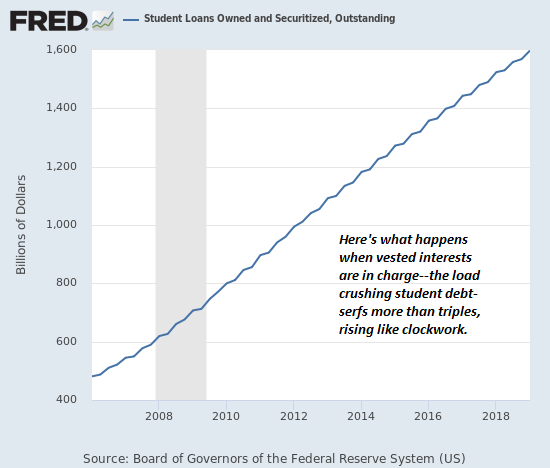
OK Fed: as a direct consequence of your free-money-for-financiers policies, inflation has gutted the purchasing power of younger generations. As the bogus consumer price (CPI) claims inflation is near-zero year after year, two generations of Americans have been crushed by student loan debt that tops $1.5 trillion– a debt serfdom that would have been impossible had interest rates been settled by market forces.

The clueless higher education cartel would have been forced to innovate decades ago rather than pass on their administrative bloat to those least able to pay, the students. Without the Fed and other federal agencies, student debt would not have exploded.

OK Fed: as a direct consequence of your pump-up-speculative-excess policies, speculation has ruined the U.S. economy as banks, financiers and corporations all skim hundreds of billions of dollars via leveraging Fed cheap money while younger generations get credit cards with nosebleed interest rates and rapacious banks that charge $25 and up for every overdraft that they engineer by manipulating when deposits are credited.

OK Fed: while you’ve been hectoring young people to buy assets so they can join your speculative asset-bubble party, they’ve been dealing with the broken mess of an economy you’ve created while patting yourself on the back, an economy where only the already-wealthy can buy a house in hot job market regions, where young workers have to work crazy-hard to keep their precarious jobs or get by on the gig economy, a happy-story code phrase for an economy in which corporations have transferred the risk to their workers while they get rich buying back their own shares with cheap Fed money.

OK Fed: eventually the younger generations will connect all the economic injustices implicit in OK Boomer with the Fed that created the ever-widening wealth and income inequality between the generations: those who effortlessly rode the Fed’s asset-bubbles to wealth and those who have been priced out of the assets and left the shards of a once-functioning economy, an economy destroyed by the Fed’s toxic worship of speculative exploitation and serial asset-bubbles.

As I have repeatedly observed here: if we don’t change the way money is created and distributed by the Fed, we change nothing.


Posted in Uncategorized | Tagged: , , , , | Leave a Comment »

Fed: “Underlying Inflation” at a 13-Year High | Mises Institute

Posted by M. C. on September 9, 2018

Inflation, unemployment, kill ratios, smart bomb accuracy, what Putin did today, how many nuclear weapons Israel does NOT have-

Which set of lies did Washington and it’s media decide to feed you today?

https://mises.org/power-market/fed-underlying-inflation-13-year-high

Ryan McMaken

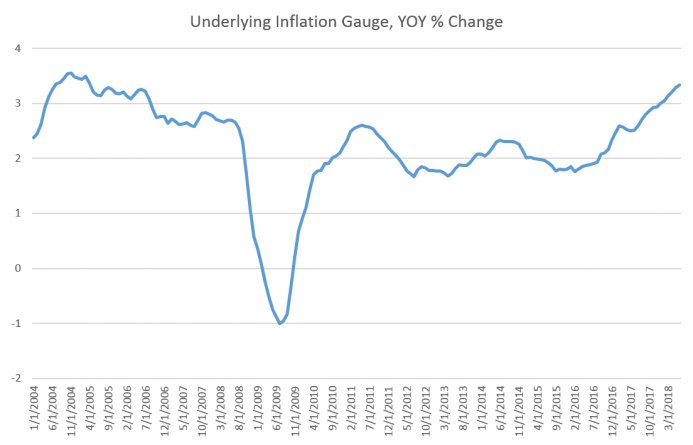
According to the Federal Reserve’s Underlying Inflation Gauge , the 12-month inflation growth in June was 3.33 percent. That’s the highest rate recorded in 158 months, or more than 13 years. The last time the UIG measure was as high was in April 2005, when it was at 3.36 percent.

uig1.png

The Fed began publicly reporting on new measure in December of last year, and takes into account a broader measure of inflation than the more-often used CPI measure.

Not shockingly, the UIG has shown a higher rate of inflation than the CPI, most of the time in recent years… Read the rest of this entry »

Posted in Uncategorized | Tagged: , , | Leave a Comment »