
MCViewPoint

Opinion from a Libertarian ViewPoint

Posts Tagged ‘Defense Budget’

Peace through Strength? Excessive US Military Spending Encourages More War

Posted by M. C. on May 31, 2022

The surge in US military spending over the last two decades mirrors a dramatic increase in the number of US military interventions.

https://mises.org/wire/peace-through-strength-excessive-us-military-spending-encourages-more-war

Mihai Macovei

The Russian invasion of Ukraine has brought America’s foreign policy interventions under the limelight once again. Ryan McMaken argues that the US administration’s claim that countries should not have the right to a sphere of influence, implicitly addressing Russia, is hypocritical. The US opposes a sphere of influence for Russia and other regional powers, while at the same time has steadily expanded its own global outreach. Among other, one can judge how true this is by looking at the amount of US military spending and size of its foreign military interventions.

The USA not only spends a disproportionately high amount of money on military relative to the rest of the world, but has also continued doing so when the Cold War was over and it could have set in motion a virtuous cycle of international disarmament. The USA has also multiplied its foreign military actions and engaged in controversial and costly wars in Iraq and Afghanistan, harming both international peace and the global economy. From this point of view, Lew Rockwell’s scathing criticism of the US military interventions in Iraq and global hegemonic ambitions in general, appears still relevant after almost twenty-five years.

US Military Spending in Perspective

The US spends about 11 percent of its federal budget on defense, which is the third largest item after Social Security and Health, and costs almost twice as much as education. The US defense budget was $754 billion for the financial year 2022, before President Biden increased it by another $29 billion following the war in Ukraine.

However, this is not the full picture, because other federal spending is also closely tied to defense. The budgets of Department of Veterans Affairs ($113 billion), Homeland Security ($55 billion), the State Department ($64 billion), and the FBI and Cybersecurity in the Department of Justice ($10 billion) add another $242 billion to the base budget of the Department of Defense (DoD). By adding it all up, defense spending is set to exceed $1 trillion in 2022—i.e., 14 percent of the federal budget and 4 percent of gross domestic product.1

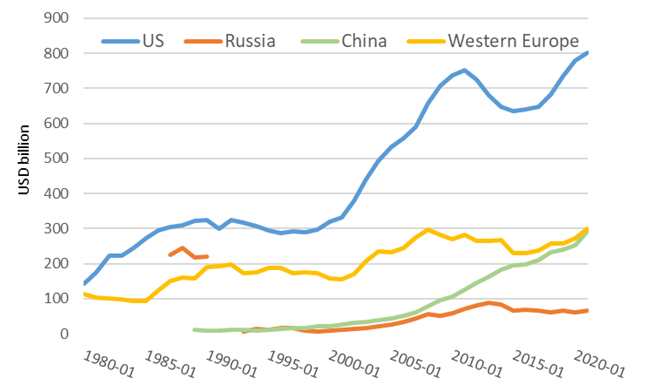
The US defense budget represents not only a significant burden on the domestic economy, but looks completely disproportionate relative to other countries’ military outlays. According to the Stockholm International Peace Research Institute (SIPRI) the US military spending is greater than those of the next ten largest military expenditures combined. At around $800 billion in 2021, the US military budget was almost three times higher than China’s ($293 billion) and twelve times larger than Russia’s ($66 billion).

Except for China’s military budget which has increased about ten times over the last two decades, albeit from a very low level, the steady increase in the US military spending has widened the gap with the rest of the World (graph 1). Together with its allies in Western Europe, the US spent on military three times more than Russia and China combined in 2021. As the annual spending differential between the US and other countries took place over many years, it means that the United States’ overall military supremacy in terms of stock and quality of military equipment is undisputable.

Graph 1: Annual military spending

mahai_picture_1.png
Mahai Picture 1
Source: SIPRI

The key question is why the USA has not decreased dramatically its military spending when the Cold War was over and the main threat to its security disappeared. In the late 1980s, the Soviet Union’s military spending was very high at about $220 billion and almost in the same ballpark with the $300 billion spent by the US. However, when the Soviet Union disintegrated and its economy collapsed in the early 1990s, Russia’s military spending shrunk to a puny $10 billion on average during that decade. Yet, despite being a nuclear superpower, the US kept its military spending at the Cold War level of around $300 billion and later increased it exponentially during the War on Terror.

Endless Foreign Military Interventions Post–Cold War

The surge in US military spending over the last two decades mirrors a dramatic increase in the number of US military interventions. Monica Duffy Toft shows that US military interventions—i.e., the deployment of US armed forces to other countries—intensified over time, in particular after the Cold War.

See the rest here

Be seeing you

Posted in Uncategorized | Tagged: , , , | Leave a Comment »

Biden’s Big Government Centrism

Posted by M. C. on April 5, 2022

Little of Biden’s proposed defense budget will be spent to defend the American people, although it will defend the ability of defense contractors, lobbyists, and war party propagandists to continue littering Northern Virginia with “McMansions.” Biden wants to spend yet more to continue the US’s counterproductive intervention in Ukraine, as well as on NATO and other programs aimed at challenging Russia. Biden’s budget also proposes spending 1.8 billion dollars to “support a free and open, connected, secure and resilient Indo-Pacific Region” and another 400 million dollars for the Countering the People’s Republic of China Malign Influence Fund. How would Biden react if China started spending money to challenge the US’s influence in the Western Hemisphere?

Biden’s budget spends 33.2 billion dollars to support law enforcement. Federal spending on local law enforcement violates the Tenth Amendment and takes a step toward nationalizing the police.

https://mailchi.mp/ronpaulinstitute/breadcircus-115997?e=4e0de347c8

Apr 4 – President Biden’s 5.8 trillion dollars fiscal year 2023 budget increases “discretionary” spending to 1.6 trillion dollars. The remaining 4.2 trillion dollars of spending consists of “mandatory” spending, including on Social Security, Medicare, and interest on the national debt. The discretionary spending is divided between 813 billion dollars for “defense” and 769 billion dollars for the rest.

Since Biden’s budget increases military spending and does not call for major new government programs, some have described it as “centrist.”  Calling a 5.8 trillion dollars tax-and-spend monstrosity “centrist” shows how far the center of American politics is from the principles of limited government.

Little of Biden’s proposed defense budget will be spent to defend the American people, although it will defend the ability of defense contractors, lobbyists, and war party propagandists to continue littering Northern Virginia with “McMansions.” Biden wants to spend yet more to continue the US’s counterproductive intervention in Ukraine, as well as on NATO and other programs aimed at challenging Russia. Biden’s budget also proposes spending 1.8 billion dollars to “support a free and open, connected, secure and resilient Indo-Pacific Region” and another 400 million dollars for the Countering the People’s Republic of China Malign Influence Fund. How would Biden react if China started spending money to challenge the US’s influence in the Western Hemisphere?

Biden’s budget spends 33.2 billion dollars to support law enforcement. Federal spending on local law enforcement violates the Tenth Amendment and takes a step toward nationalizing the police. A national police force would be a grave danger to liberty.

Biden also proposes spending 1.7 billion dollars on the Bureau of Alcohol, Tobacco, Firearms, and Explosives so it can, among other activities, crack down on gun trafficking. A crackdown on gun trafficking allows the agency to harass gun owners and firearms dealers. Biden’s “centrist” budget also provides funding to crack down on hate crimes. Criminalizing thoughts has no place in a free society.

Biden claims he has reduced spending. However, the only reason spending is down is because Congress has stopped passing multitrillion dollar covid relief bills. Biden’s budget proposes reducing the deficit by raising taxes. Among Biden’s tax proposals is a new 20 percent tax. Biden’s “billionaires tax” breaks new ground in theft by taxing unrealized capital gains — in other words, taxing income that taxpayers did not actually receive!

Biden’s budget estimates an increase in the federal debt to 44.8 trillion dollars in ten years. Of course, the final spending bill approved by Congress will likely spend more on welfare and warfare then Biden is proposing. The spending will force the Federal Reserve to keep interest rates low, further eroding the dollar’s purchasing power and thus increasing demand for welfare and yet more government spending.

America may soon pay the price for attempting to fund a massive welfare-warfare state with fiat currency, America’s ham-fisted intervention in the Ukraine-Russian conflict has caused more countries to seek alternatives to the dollar. This increases pressure for the dollar to lose its world reserve currency status. When that happens, the US will face a major economic crisis featuring hyperinflation, massive unemployment, and the growth of authoritarian political movements. The only way these problems can be avoided is if the people demand the federal government stop trying to run their lives, run the economy, and run the world.


Read more great articles on the Ron Paul Institute website.
Subscribe to free updates from the Ron Paul Institute.

Copyright © 2022 by Ron Paul Institute. Permission to reprint in whole or in part is gladly granted, provided full credit and a live link are given.

Be seeing you

Posted in Uncategorized | Tagged: , , , | Leave a Comment »

William Hartung, Mission (Im)possible — and You’re Paying for It

Posted by M. C. on February 4, 2022

When all else fails, the Pentagon’s fallback argument for the F-35 is the number of jobs it will create in states or districts of key members of Congress. As it happens, virtually any other investment of public funds would build back better with more jobs than F-35s would. Treating weapons systems as jobs programs, however, has long helped pump up Pentagon spending way beyond what’s needed to provide an adequate defense of the United States and its allies.

As it happens, though, there are just a few teeny, weeny glitches with it. For one thing, it reportedly can’t reliably either launch or retrieve the planes that make it an aircraft carrier. And for good measure, according to Bloomberg News, it can’t defend itself effectively from incoming missiles either. 

https://tomdispatch.com/what-a-waste/

Whatever the U.S. military may be considered, it isn’t usually thought of as a scam operation. Maybe it’s time to change that way of thinking, though. After all, we’re talking about a crew with a larger “defense” budget than the next 11 countries combined (and no, that’s not a misprint). Mind you, I’m not even focusing here on how a military funded, supplied, and armed like no other on this planet has proven incapable of winning a war in this century, no matter the money and effort put out. No, what’s on my mind is its weaponry in which American taxpayers have invested so many endless billions of dollars.

For example, take the latest, most up-to-date, most expensive aircraft carrier in history, the USS Gerald Ford. (Yes, it’s named after the president everyone’s forgotten, the one who took over the White House when Richard Nixon fled town in disgrace.)  Hey, what a bargain it was when Huntington Ingalls Industries delivered that vessel to the Navy for a mere (and no this isn’t a misprint either) $13 billion — $20 billion, if you’re including the aircraft it carries. And it only represents the first of a four-ship, $57-billion program.  You might imagine that, with $13 billion invested in a single ship, you’d be getting the sort of vessel that would do Star Trek proud, a futuristic creation for at least the 21st, if not the 22nd century of war.

As it happens, though, there are just a few teeny, weeny glitches with it. For one thing, it reportedly can’t reliably either launch or retrieve the planes that make it an aircraft carrier. And for good measure, according to Bloomberg News, it can’t defend itself effectively from incoming missiles either.  After “cannibalizing” parts from another aircraft carrier under construction, it is, however, finally being deployed, only four years late.

Honestly, it would be easy enough to think that I was writing a ridiculous parody here, but no such luck. And, remarkably enough, as TomDispatch regular and Pentagon expert William Hartung points out today, that ship is anything but alone in the U.S. arsenal. Just see his comments below on the F-35 jet fighter for another obvious example. In fact, as you read Hartung, ask yourself whether this boondoggle — and just about the only thing that Congress can agree on with remarkable unanimity — turns out to be a “defense” version of Watergate. So, where’s Gerald R. Ford when we really need him? Tom

What a Waste!

$778 Billion for the Pentagon and Still Counting

By William Hartung

2021 was another banner year for the military-industrial complex, as Congress signed off on a near-record $778 billion in spending for the Pentagon and related work on nuclear warheads at the Department of Energy. That was $25 billion more than the Pentagon had even asked for.

It can’t be emphasized enough just how many taxpayer dollars are now being showered on the Pentagon. That department’s astronomical budget adds up, for instance, to more than four times the cost of the most recent version of President Biden’s Build Back Better plan, which sparked such horrified opposition from Senator Joe Manchin (D-WV) and other alleged fiscal conservatives. Naturally, they didn’t blink when it came to lavishing ever more taxpayer dollars on the military-industrial complex.

Opposing Build Back Better while throwing so much more money at the Pentagon marks the ultimate in budgetary and national-security hypocrisy. The Congressional Budget Office has determined that, if current trends continue, the Pentagon could receive a monumental $7.3 trillion-plus over the next decade, more than was spent during the peak decade of the Afghan and Iraq wars, when there were up to 190,000 American troops in those two countries alone. Sadly, but all too predictably, President Biden’s decision to withdraw U.S. troops and contractors from Afghanistan hasn’t generated even the slightest peace dividend. Instead, any savings from that war are already being plowed into programs to counter China, official Washington’s budget-justifying threat of choice (even if outshone for the moment by the possibility of a Russian invasion of Ukraine). And all of this despite the fact that the United States already spends three times as much as China on its military.

The Pentagon budget is not only gargantuan, but replete with waste — from vast overcharges for spare parts to weapons that don’t work at unaffordable prices to forever wars with immense human and economic consequences. Simply put, the current level of Pentagon spending is both unnecessary and irrational.

Price Gouging on Spare Parts

See the rest here

Be seeing you

Posted in Uncategorized | Tagged: , , , , , | Leave a Comment »

Fewer Americans want to serve in the military. Cue Pentagon panic | William M Arkin | Opinion | The Guardian

Posted by M. C. on April 24, 2019

Why do think? The thought of endless war, dying in some nowheresville African village or killing poor, peasant families in poor, peasant filled Yemen?

Or the realization that none of the above have anything to do with defending US?

I have often wondered if today’s volunteer recruits have any idea at all of what they are getting into.

https://www.theguardian.com/commentisfree/2019/apr/10/fewer-americans-serve-military-pentagon-panic

Declining interest in service has reached levels that should alarm – or delight – those who care about the nation’s health

Donald Trump’s three-quarters-of-a-trillion-dollar defense budget request submitted to Congress last month contains a dirty secret, one that should make us all think twice about perpetual war and public support for it.

The youth of America don’t want to serve in the military any more.

The situation has become so dire that just to maintain America’s ground forces – the army and Marine Corps – the two services are resorting to unprecedented pay raises, bonuses and socialist trappings.

And things are going to get worse. This year, for the first time ever, Americans born after 11 September 2001 will be able to enlist in the armed forces. It’s a sobering reminder both of how long we’ve been at war but also how distant those very wars have become from America’s youth. And yet official military polling shows that fewer and fewer young Americans consider the military as a career or as a transitional step – only some 12.5% – the lowest number in a decade.

The 12.5% is bracing, but based on a complex math that balances losses from deaths and injuries, retirements, attrition and discharges, the army and Marine Corps only needs about 100,000 recruits to maintain current force levels. That’s just 2.4% of the 4.2 million Americans who will celebrate their 18th birthday this year. And yet the military is looking at its third or fourth year in a row where it will struggle to even find these numbers…

Be seeing you

dying for nothing

Dying for nothing in the middle of nowhere. How is this defending the USA?


Posted in Uncategorized | Tagged: , , , | Leave a Comment »

How Do You Justify a $750 Billion Budget? – Antiwar.com Original

Posted by M. C. on April 9, 2019

Threat Inflation

https://original.antiwar.com/william_astore/2019/04/08/how-do-you-justify-a-750-billion-budget/

…Throughout my life, the US“defense” establishment has consistently inflated the dangers presented by foreign powers, which brings me to the current Pentagon budget for 2020, which may reach $750 billion. How to justify such an immense sum? A large dollop of threat inflation might help…

With the Islamic State allegedly defeated in Syria and other terrorist forces more nuisances than existential threats, with the Afghan War apparently winding down (only 14,000 US troops are deployed there) and with Trump professing a “love” fest with Kim Jong-un, where are today’s (and tomorrow’s) big threats? Iran isn’t enough. The only threats that seem big enough to justify colossal military spending are Russia and China. Hence the new “cold war” we keep hearing about, which drives a “requirement” for big spending on lucrative weapons systems like new aircraft carriers, new fighters and bombers, newer and better nuclear warheads and missiles, and so forth.

Which brings me to the alleged Russian collusion story involving Trump. As we now know, the Mueller Report found no collusion, but was that really the main point of the investigation and all the media hysteria? The latter succeeded in painting Vladimir Putin and the Russians as enemies in pursuit of the death of American democracy. Meanwhile Trump, who’d campaigned with some idea of a rapprochement with Russia, was driven by the investigation to take harsher stances against Russia, if only to prove he wasn’t a “Putin puppet.” The result: most Americans today see Russia as a serious threat, even though the Russians spend far less on wars and weaponry than the US does.

Threat inflation is nothing new, of course. Dwight D. Eisenhower recognized it and did his best to control it in the 1950s, but even Ike had only limited success. Other presidents, lacking Ike’s military experience and gravitas, have most frequently surrendered to the Complex. The last president who tried with some consistency to control the Complex was Jimmy Carter, but the Soviet invasion of Afghanistan, the Iranian hostage crisis, and his own political fortunes drove him to launch a major military buildup, which was then accelerated by Reagan until the collapse of the Soviet Union…

Today, faced with a debilitating national debt of $22 trillion and infrastructure that’s aptly described as “crumbling,” you’d think US leaders would finally seek a peace dividend to lower our debt and rebuild our roads, bridges, dams, and related infrastructure. But the Complex (including Congress, of course) is addicted to war and weapons spending, aided as ever by threat inflation and its close cousin, fearmongering about invading aliens at the border.

And there you have it: a $750 billion military budget sucking up more than sixty percent of discretionary spending by the federal government. As Ike said, this is no way to live humanely, but it is a way for humanity to hang from a cross of iron.

Be seeing you

America's sport

Government’s favorite sport-War

Posted in Uncategorized | Tagged: , , , , | Leave a Comment »

Hagel’s Military Budget, More Change Than Cut

Posted by M. C. on March 9, 2014

War secretary Chuck Hagel says he wants to cut 40 thousand troops. That has everyone crying the red, white and blues.

According to Ron Paul there will be no overall budget cut. The money just gets shifted elsewhere. Continuing the F-35 disaster for example. The military industrial complex isn’t going cold turkey.

So where is the money going?

Everything about war is changing, from soldier to victim. Read the rest of this entry »

Posted in Uncategorized | Tagged: , , , | Leave a Comment »