MCViewPoint

Opinion from a Libertarian ViewPoint

Posts Tagged ‘DOD’

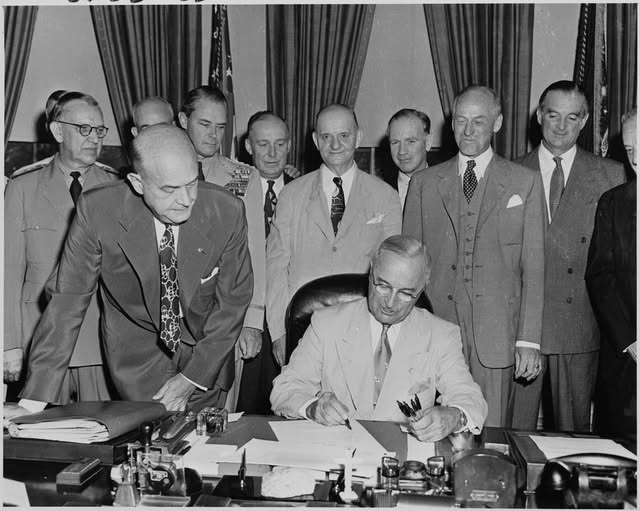
On this day, July 26th, 1947, the National Security Act spawned the CIA, DoD, and more, centralizing power for the Cold War.

Posted by M. C. on July 28, 2025

Libertarian Party of Pennsylvania

On this day, July 26th, 1947, the National Security Act spawned the CIA, DoD, and more, centralizing power for the Cold War. This birthed the surveillance state—everything from the NSA to mass surveillance.

The Libertarian Party of Pennsylvania demands their end—decentralize power, protect liberty, and stop the spying.

Be seeing you

Posted in Uncategorized | Tagged: , , , | Leave a Comment »

The DOD Curious and Control File Concerned

Posted by M. C. on October 16, 2023

The timing of the shift in federal background investigation responsibility to DOD, just shortly before the start of the scamdemic, is somewhat eyebrow-raising, and even more so when considered along with evidence indicating that DOD has been the driver of scamdemic-related policy.

It takes childlike naiveté to believe that the federal background investigation power will not be abused if it is, in fact, held by the same players leading the effort to strip Americans’ of their rights under the pretext of infectious disease protection.

http://www.ronpaulinstitute.org/archives/featured-articles/2023/october/13/the-dod-curious-and-control-file-concerned/

Written by Concerned Citizen

It’s been said that a nation allowing its military to act unjustly abroad may get its comeuppance when that same military turns on it.

Is America experiencing this?

There’s evidence that the American wing of the scamdemic is primarily being lead from within the bowels of the DOD. Some of that evidence was discussed on the HighWire in June and July of 2023, in the segments listed below.

•“The Woman Responsible for the US Covid Response” in HighWire Episode 324, posted on June 17, 2023

•“Biden Makes Temporary Pandemic Preparedness Office Permanent” in HighWire Episode 330, posted on July 27, 2023

If DOD is, in fact, in the driver’s seat of the effort to control Americans under the guise of infectious disease protection then, as discussed below, it was recently handed one hell of a tool that could be used toward that end.

Responsibility for conducting the background investigations of federal employees has been transferred from OPM to DOD.

On April 24, 2019, an executive order was issued which shifted primary responsibility for conducting background investigations for federal agencies from OPM to DOD. The transfer was complete on October 1, 2019.

DOD has been handed a tool that, if misused, gives it great leverage over federal employees who may stand in the way of scamdemic-related tyranny.

Federal employees, especially those in advisory and decision-making positions, can potentially thwart the stripping of Americans’ rights by insisting that their agencies comply with policy and law, including with the Constitution. This may take the form of refusing to feign agreement with a baseless interpretation of that policy and law which would allow for tyranny. Identifying those most likely to take this stance is not difficult (e.g., those with liberty-leaning social media posts).

See the rest here

Be seeing you

Posted in Uncategorized | Tagged: , , , , | Leave a Comment »

Domestic Political Surveillance: How Deep Is DoD Involvement?

Posted by M. C. on July 28, 2022

by Patrick Eddington

antiwar.com

In the wake of George Floyd’s murder and the nationwide protests it sparked over two years ago, among the other alarming developments that eventually came to light was the level of government surveillance of Americans protesting Floyd’s death at the hands of the Minneapolis Police Department. Not only was the surveillance carried out by federal, state, and local law enforcement in Minneapolis, but apparently in every state where protest activity occurred, based on prior reporting by the New York TimesThe Intercept, the ACLU of Northern CaliforniaCitizens for Responsibility and Ethics in Washington (CREW), the Reporters Committee for Freedom of the Press, and others.

Federal players involved in the surveillance included Customs and Border Protection, the U.S. Marshals Service, and the DEA. But one particular US government department’s involvement sparked even greater concern: the Department of Defense.

It’s been just less than two years ago that an United States Air Force Inspector General (USAF IG) report on the use of National Guard RC-26B surveillance aircraft against protesters was made public. The propellor driven, twin engine aircraft has been in US military service for many years as an intelligence collection platform, which is precisely the role in which it was used to track Americans engaged in marches and rallies after Floyd’s murder. The USAF IG’s June 2020 report on the RC-26B incidents was contradictory in terms of exactly how much potentially personally identifying data on protesters might have been collected and shared with federal, state, or local law enforcement.

The USAF IG report claimed (pp. 1-2) that “The sensors on the RC-26B can only collect infrared and electro‑optical imagery, and this imagery was not capable of identifying distinguishing personal features of individuals.” Yet deeper in the report (p. 21), the investigators conceded that “Although it is difficult in an urban environment, it appears it would be possible to connect activities to an individual. One witness described developing a ‘pattern of life’ which is a term-of-art in intelligence practice for following a person or object to discern patterns that allow forecasts of movements of that person or object…That requires some amount of discernibility among objects. For instance, a flight could observe suspicious activity, follow the person, and law enforcement on the ground could be vectored by a control center or by a law enforcement officer on-board to the individual….It is important to emphasize here, though, that there is no evidence that such a risk manifested in any of these RC-26B flights.”

Yet a National Guard Bureau white paper on RC-26B capabilities notes that “RC-26B records evidence-quality full motion video, and high resolution still frame imagery for use by the law enforcement community, host nations, and other government agencies.” And as the USAF IG report itself noted (p. 50), a plan to use a Phoenix-based RC-26B to collect full motion video on protesters to “deter planned/unplanned demonstrations, protests or looting” did not go as planned because of software compatibility issues between the RC-26B and the Phoenix Multi-Agency Coordination Center (MACC). The USAF IG report described the Arizona National Guard operations plan’s counterprotest language as “in-artfully worded,” it conceded that “Deterring protests and demonstrations, assuming they are lawful, is not consistent with constitutional rights.” In fact, planning a military operation to disrupt First Amendment protected protests was, in fact, a violation of the rights of Phoenix protesters – contrary to the USAF IG’s assertions at the time.

There are good reasons to question the thoroughness of the USAF IG’s investigation and conclusions in this case, as the Defense Department and its components have a history of spying on domestic protesters.

During the administration of President George W. Bush, the Pentagon’s Counterintelligence Field Activity (CIFA) was caught running a de facto domestic surveillance program known as Threat and Local Observation Notice (TALON) that, among other things, monitored antiwar or other protests. The Defense Department regulation that was used to authorize that program, DOD Directive 5200.27, has been in effect since at least the late Vietnam War era. While CIFA was allegedly disestablished towards the end of the Bush 43 administration, DOD Directive 5200.27 remains on the books, and thus available to authorize potential domestic surveillance against those engaged in First Amendment protected protests.

To determine the extent of the continued use of that authority since the George Floyd protests, in May 2021 the Cato Institute filed a Freedom of Information Act (FOIA) lawsuit against multiple Department of Defense components for records on DOD Directive 5200.27. As of this writing, the Pentagon continues to refuse to even search for such records, claiming Cato’s request was “not reasonably described.”

The directive in question requires DOD components to maintain such records on protest incidents for at least 90 days, and in some cases far longer with official authorization. DoD’s legal tactics have one objective – to try to prevent the American public from learning the exact scope of any ongoing DOD or component surveillance of US citizens engaged in peaceful, constitutionally protected activities.

Just over a week after Cato filed its FOIA lawsuit against the Pentagon, Senator Ron Wyden (D-OR) revealed that DOD components – including the Defense Intelligence Agency (DIA) – had been buying commercially available data on American citizens, including geolocation data. The fact that the practice is apparently ongoing, combined with DOD’s refusal to cough up any information about its use of the directive at issue in Cato’s FOIA suit, should be a cause of concern for every American – and a call to action for Congress to intervene and mandate the release of the data in question.

Patrick G. Eddington, a former CIA analyst and ex-House senior policy advisor, is a Senior Fellow at the Cato Institute.

Be seeing you

Posted in Uncategorized | Tagged: , , | Leave a Comment »

Defund the Pentagon – The Future of Freedom Foundation

Posted by M. C. on August 13, 2020

Economist Robert Higgs has showed that “the total amount of all defense-related spending greatly exceeds the amount budgeted for the Department of Defense.” He calculated — ten years ago — that real defense spending was more than a trillion dollars a year. It is certainly not a penny less now.”

https://www.fff.org/explore-freedom/article/defund-the-police/

by

Many liberals and progressives in the Democratic Party have been loudly calling for the defunding of police departments around the country after the tragic death of a black man, George Floyd, at the hands of a white Minneapolis police officer. While defunding the police — not to be confused with disbanding the police — means different things to different people, most advocates propose redirecting a portion of city and county police budgets to social programs, mental health intervention, combating homelessness, and affordable housing programs.

Conservatives and Republicans have generally pushed back against calls to defund the police. They typically maintain that the level of police misconduct is overstated, that police departments just need to be reformed, and that violent crime and property crime will increase if police department budgets are cut. In response to some major cities calling for defunding the police, Donald Trump simply said, “We won’t be defunding our police. We won’t be dismantling our police. We won’t be disbanding our police. We won’t be ending our police force.” Certainly the president knows that funding levels for police departments are decided on the local level without any input whatsoever from the federal government?

There is, however, one area of government spending that liberals, conservatives, Democrats, and Republicans are united on that they don’t want defunded. Even though it is one of the largest expenditures of the federal government and is unnecessary and destructive in so many ways, these groups from across the political spectrum don’t want to defund the military in any way. And of course, Trump has pushed for higher military budgets ever since he was elected.

The Democratic-controlled House (H.R.6395) and the Republican-controlled Senate (S.4049) each just passed their own version of the National Defense Authorization Act (NDAA) for fiscal year 2021 (Oct. 1, 2020–Sept. 30, 2021). The bipartisan votes in the House and Senate were 295 to 125, and 86 to 14.

According to the Congressional Research Service’s publication Defense Primer: Navigating the NDAA, “Unlike an appropriations bill, the NDAA does not provide budget authority for the Department of Defense (DOD). Instead, the NDAA establishes or continues defense programs, policies, projects, or activities at DOD and other federal agencies, and provides guidance on how the appropriated funds are to be used in carrying out those authorized activities.” Budget authority is provided in subsequent appropriations legislation.

The House and Senate bills authorize FY2021 appropriations and set forth “policies for Department of Defense (DOD) programs and activities, including military personnel strengths.”

Specifically, both bills authorize appropriations to the DOD for:

• Procurement, including aircraft, weapons and tracked combat vehicles, shipbuilding and conversion, and missiles
• Research, Development, Test, and Evaluation
• Operation and Maintenance
• Working Capital Funds
• Chemical Agents and Munitions Destruction
• Drug Interdiction and Counter-Drug Activities
• The Defense Inspector General
• The Defense Health Program
• The Armed Forces Retirement Home
• Overseas Contingency Operations;
• The Space Force
• Military Construction

Both bills also authorize personnel strengths for active duty and reserve forces and set forth policies regarding:

• Military personnel
• Acquisition policy and management
• International programs
• National Guard and Reserve Forces facilities
• Compensation and other personnel benefits
• Health care
• DOD organization and management
• Civilian personnel matters
• Matters relating to foreign nations
• Strategic programs, cyber, and intelligence matters

The bills also authorize appropriations for base realignment and closure activities and maritime matters, and authorize appropriations and set forth policies for Department of Energy national security programs, including the National Nuclear Security Administration and the Defense Nuclear Facilities Safety Board.

Both the House and Senate versions of the NDAA would fund defense for fiscal year 2021 at the obscene amount of $740.5 billion.

Politico recently ran two opinion pieces on defunding the Pentagon: the conservative case and the liberal case.

The conservative case was made by Andrew Lautz of the National Taxpayers Union and Jonathan Bydlak of the R Street Institute’s Fiscal and Budget Policy Project:

With resources more limited than ever, areas of the budget that were off-limits for years should now be more closely scrutinized. At the top of that list should be the single largest part of the federal discretionary budget, an entire category of spending that has long been off the table: the Pentagon.

Republicans in Congress need to start tackling the Pentagon budget just as boldly as they do other areas of discretionary spending. Doing so would put our nation on a better fiscal path and create opportunities for unlikely political alliances. Conservative figures like Sen. Rand Paul (R-Ky.) and former Rep. Mick Mulvaney (R-S.C.) for years advocated restraint at the Pentagon; two of the most recent efforts to restrain the Pentagon’s budget in the coming year come from staunchly progressive members of Congress: Sen. Bernie Sanders (I-Vt.) and Rep. Barbara Lee (D-Calif.).

The liberal case for defunding the Pentagon was made by Senator Sanders. Addressing directly the NDAA, he said,

Under this legislation, over half of our discretionary budget would go to the Department of Defense at a time when tens of millions of Americans are food insecure and over a half-million Americans are sleeping out on the street.

Moreover, this extraordinary level of military spending comes at a time when the Department of Defense is the only agency of our federal government that has not been able to pass an independent audit, when defense contractors are making enormous profits while paying their CEOs outrageous compensation packages, and when the so-called War on Terror will cost some $6 trillion.

If the horrific pandemic we are now experiencing has taught us anything it is that national security means a lot more than building bombs, missiles, nuclear warheads and other weapons of mass destruction. National security also means doing everything we can to improve the lives of tens of millions of people living in desperation who have been abandoned by our government decade after decade.

Sanders introduced an amendment to the NDAA that would “reduce the military budget by 10 percent and use that $74 billion in savings to invest in communities that have been ravaged by extreme poverty, mass incarceration, decades of neglect, and the Covid-19 pandemic.” It didn’t pass.

Conservatives at the Heritage Foundation — who seem to have never seen a defense budget that was high enough — took notice of the Politico articles. Writing in “What the ‘Defunding the Pentagon’ Articles Don’t Tell You,” Thomas Spoehr, who “serves as director of Heritage’s Center for National Defense where he is responsible for supervising research on matters involving U.S. national defense,” says that “both pieces lack some information that would contribute to a richer, more informed discussion of this critically important topic.” His article’s three key takeaways are:

1. National defense now consumes the smallest portion of the U.S. federal budget in a hundred years — 15% — and continues to shrink.
2. Our defense responsibilities include security commitments to NATO, Japan, South Korea, international sea lanes, and other areas.
3. If the nation is going to effectively counter China, Russia, and others, continued military rebuilding following years of budget cuts is necessary.

It is no surprise that “prior to joining Heritage, Spoehr served for more than 36 years in the U.S. Army, attaining the rank of Lieutenant General.”

Spoehr’s first point is a typical conservative smokescreen to justify higher defense budgets. By talking about the defense budget in terms of a percentage of something (GDP, the total federal budget, prior years, et cetera) instead of absolute numbers, conservatives can deflect attention from the obscene level of defense spending. And even worse, defense spending is actually much higher than the budgeted amount. Economist Robert Higgs has showed that “the total amount of all defense-related spending greatly exceeds the amount budgeted for the Department of Defense.” He calculated — ten years ago — that real defense spending was more than a trillion dollars a year. It is certainly not a penny less now.

Spoehr’s second point is certainly true. The concern that he never raises is “Why?” Why should the U.S. Department of Defense, funded by U.S. taxpayers, and charged with defending the United States, have “security commitments to NATO, Japan, South Korea, international sea lanes, and other areas”?

Spoehr’s third point assumes that the United States needs to counter “China, Russia, and others.” That is only because U.S. foreign policy is reckless, belligerent, and meddling instead of being a Jeffersonian foreign policy of neutrality, nonintervention, peace, commerce, and honest friendship with all nations — entangling alliances with none. And it is simply not true that there have been years of defense budget cuts. All one has to do is look up the figures. Because of the wars in Iraq and Afghanistan, defense spending rose from $470.55 billion in 2001 to the obscene level of $849.87 billion in 2010. It declined in 2011, 2012, 2013, and 2014; basically stayed level in 2015, 2016, and 2017; and then rose in 2018 and 2019.

Because the Department of Defense functions as the Department of Offense, it is the Pentagon that needs to be defunded.

Laurence M. Vance is a columnist and policy advisor for the Future of Freedom Foundation, an associated scholar of the Ludwig von Mises Institute, and a columnist, blogger, and book reviewer at LewRockwell.com. He is the author of Gun Control and the Second Amendment, The War on Drugs Is a War on Freedom, and War, Empire and the Military: Essays on the Follies of War and U.S. Foreign Policy. His newest books are Free Trade or Protectionism? and The Free Society. Visit his website: www.vancepublications.com. Send him e-mail.

Be seeing you



Posted in Uncategorized | Tagged: , , , , , , | Leave a Comment »

DOD tester’s report: F-35 is still a lemon | Ars Technica

Posted by M. C. on February 3, 2020

https://arstechnica.com/information-technology/2020/01/not-a-straight-shooter-dod-review-cites-fleet-of-faults-in-f-35-program/

The latest report on the progress of the US Defense Department’s F-35 Joint Strike Fighter is due out soon from the Office of the Secretary of Defense’s director for operational test and evaluation (DOT&E), Robert Behler.

Last year’s report was full of bad news. And based on Bloomberg Government’s Tony Capaccio’s early access to the new report, we know much of that bad news is still bad news. In fact, the only real good news is that there are no new major flaws in the $428 billion aircraft program reported by Behler’s team.

But the bad is still bad. For starters, the Air Force version of the F-35 can’t hit what it shoots its gun at.

There are a total of 13 Category 1 “must fix” issues still unresolved with the F-35 that stand between the program and final production. And even as the long list of less critical problems is addressed, new ones keep popping up. “Although the program office is working to fix deficiencies,” Behler wrote in the report viewed by Bloomberg, “new discoveries are still being made, resulting in only a minor decrease in the overall number.” And “many significant” issues remain to be addressed, he noted.

The report does not include data from the current round of combat testing, so even more problems may soon be added to the list.

ALIS doesn’t live here anymore

One of the major sources of problems with the F-35 program is the Autonomic Logistics Information System (ALIS)—the software that drives maintenance and logistics for each F-35 aircraft. ALIS is supposed to intelligently drive the flow of maintenance parts, guide support crews in scheduling maintenance, and ensure the right parts get stuck in the right places. Aircraft health and maintenance action information is sent by the ALIS software in each aircraft out to the entire distributed logistical support network.

But ALIS has had some problems—including the fact that the software was not complete when Lockheed Martin began shipping aircraft, and each group of the 490 aircraft already delivered arrived with one of six different versions of the software. All of them will require extensive software retrofits when the seventh is complete, along with the other 510 or so that are expected to have been delivered worldwide by that point.

There are still 873 specific problems in ALIS and other F-35 software (down from 917 in 2018). In fact, the DOD has announced it will replace ALIS outright, eventually.

And those have been a contributor to the F-35 fleet’s poor reliability. According to OT&E, the overall fleet of F-35s fell far short of being 80-percent “mission capable”—meaning that they could be used in at least one type of combat mission. The Navy’s F-35C fleet “suffered from a particularly poor” mission-capable rate, the OT&E team stated.

In addition to just functional software problems, the OT&E office also reported that cybersecurity issues that had been identified in previous reports on the F-35 program had still not been resolved.

Do you even shoot, bro

While the Navy and Marine Corps versions of the F-35 may have more availability problems than the relatively less-complex Air Force F-35A, they can do at least one thing better: hit what they’re shooting at.

The F-35B and F-35C have externally mounted guns, while the Air Force’s 25-millimeter cannon is mounted internally. Problems with the alignment of the gun’s mount, and the fact that the mount occasionally cracks after the gun has fired, have made the accuracy of the gun “unacceptable,” according to test officials, and have made the Air Force restrict use of the gun. While the F-35 program office has worked on improvements of the gun mount for the F-35A, these have not yet been tested.

But none of this is really slowing down acquisition of the F-35—now the most expensive DOD weapons program in history. Considering that the F-35 was originally supposed to be the “low” in the “high-low mix“—with the F-22 being the more capable aircraft—the huge cost overruns and flaws make the F-35 look increasingly like the world’s most expensive lemon.


Posted in Uncategorized | Tagged: , , , , , , | Leave a Comment »

DOD Blatantly Admits on Twitter it Works With Hollywood to Sell You War Propaganda | The Daily Bell

Posted by M. C. on March 9, 2018

The farmers at the pentagram have been planting for a long time.

CBS’ 60 minutes…don’t get me started!

http://www.thedailybell.com/news-analysis/dod-blatantly-admits-on-twitter-it-works-with-hollywood-to-sell-you-war-propaganda/

By John Vibes

While this is a fact that has been documented for many years, it is still largely overlooked by mainstream media sources, who insist that this idea is nothing more than a conspiracy theory. In the post, it was plainly admitted that the agency “works with Hollywood to ensure the military is portrayed correctly in films.”… Read the rest of this entry »

Posted in Uncategorized | Tagged: , , , | Leave a Comment »