
MCViewPoint

Opinion from a Libertarian ViewPoint

Posts Tagged ‘due process’

Why So Many Americans Reject Legal Due Process in the Age of Covid | Mises Wire

Posted by M. C. on August 28, 2021

Rather, policy became guided by the idea that experts will tell us the proper goals of government policy, and then governments were expected to impose the coercive measures necessary to achieve those goals. This process was seemingly efficient and progressive: the experts wanted X and Y, so it was expected that the state would use its police powers to force everyone to do X and Y. The end.

The public is likely to tolerate this, however, because the new model of scientific expertise has been so successful among so much of the public. In this new way of thinking, it is important to “do something” and to “trust the experts” and to disregard legal limits on executive power. To demand otherwise is to be “against science.”

https://mises.org/wire/why-so-many-americans-reject-legal-due-process-age-covid

Ryan McMaken

The policy response to the covid panic of 2020 in the United States was one of the most widespread direct attacks on fundamental human rights in decades. Overnight—and without any deliberation, debate, or checks and balances—millions of Americans were denied their basic rights to seek employment, to freely assemble, and to engage in religious practices.

Business and churches were closed, and countless Americans were ordered to stay in their homes and abandon their sources of income.

This was all done with no legal process other than the issuance of edicts from a tiny handful of politicians, usually executives such as state governors and city mayors.

Those who pressed for lockdowns and the effective confiscation of property—for that’s what a forced business closure actually is—denied that any sort of due process or “checks and balances” were necessary.

Rather, the lockdown advocates insisted that the public instead embrace unreservedly the “recommendations” of experts in government offices, who insisted that coerced lockdowns and business closures were the only reasonable response to the assumed threat of covid-19. Were one to suggest in mixed company that businesses ought to be afforded a hearing before being forcibly closed—or that an individual ought to receive some sort of due process before being deemed a “nonessential” worker—this was likely to elicit scoffing and contempt.

There’s no room for due process anymore, the official narrative tells us.

This new turn toward obedience to expert-fueled executive power didn’t appear from nowhere. Rather it is, in part, a manifestation of a long ideological process that has gradually replaced respect for legal checks and balances and due process with a deference to scientific experts. These experts, it is alleged, must not be subject to the slow and inefficient process of legal constraints on state power.

This process is explained in a 1963 essay by French political scientist Bertrand de Jouvenel titled “The Political Consequences of the Rise of Science.”1

De Jouvenel’s basic premise is this: with the rise of liberalism in the West—what some call classical liberalism—greater care was taken to erect legal obstacles that slowed or prevented state action against individuals. This was done to ensure due process was afforded to ordinary people. This position became especially widespread and respected in the eighteenth and nineteenth centuries as many gained a greater mistrust of government institutions and their agents. The idea was that political institutions could not seize life, liberty, or property from a person unless the state was first subjected to a reliable and stable legal process. 

But this due process was slow, and was backward looking in the sense that it had been built up on legal foundations of avoiding past abuses by regimes. In a certain sense, it is conservative by nature.

De Jouvenel writes:

Precedent is the most ancient basis of law, and the safest….

Judicial procedure is the sole remnant of the old idea of “the right way,” and therefore an islet of stable procedure in a sea of shifting processes.

The most revered experts under this way of thinking were the legal experts or—to use de Jouvenel’s preferred term—the jurists, who ensured that legal process was respected so as to ensure the maintenance of legal rights.

But by the twentieth century, this respect for the jurists had begun to be replaced by deference to other experts, especially to scientific experts and policy experts, who promised to be able to manage and direct society toward specific outcomes. Moreover, the public’s growing faith in technology as a means of fine-tuning society began to challenge the now seemingly old-fashioned ideas of due process and stable procedure.

Consequently, de Jouvenel writes,

Now the judgment has been reversed: those who operate traditionally [i.e., the jurists who demanded respect for the old legal processes] are a drag upon progress.

Outcomes, rather than the legal process, become the driving motivation for policy. The model for society at this point shifts from a courtroom or parliament to a laboratory. Progress comes to be defined as the adoption of lightning-fast scientific efficiency:

Social organization [under the new experts] becomes a matter for systems engineering, and specific decisions become problems of operations research….

Unwittingly and indirectly, the scientist undermines the juristic order…. Our expectation of and enthusiasm for progress are in contradiction with fidelity to “the ways of our fathers.” But the “ways of our father,” so dear to ancient moralists, have always served as a significant basis for jurists.

So let’s look at how this has played out during the covid crisis.

That “science” was more important than due process in the minds of a great many Americans became immediately obvious for anyone who tried to stick up for “due process” during the spring of 2020.

Rather, policy became guided by the idea that experts will tell us the proper goals of government policy, and then governments were expected to impose the coercive measures necessary to achieve those goals. This process was seemingly efficient and progressive: the experts wanted X and Y, so it was expected that the state would use its police powers to force everyone to do X and Y. The end.

Political debate, legislative process, and adherence to legal processes, on the other hand, became mere impediments to accomplishing these important “scientific” goals.

The means through which this was to be accomplished was also explained by de Jouvenel, who noted that in the old liberal ideal of legal process, the legislature was to take the lead, with the executive acting merely to carry out the legislators’ wishes. This was the old Lockean model. But it failed to last. 

Rather, in a regime that defers to scientific expertise, executive power has the upper hand, and the old Lockean model is turned on its head:

Science is a contributory influence to the dissolution of a juristic order. In the political realm, it is blatantly clear now that ”the executive” is nothing like what Locke imagined: he saw it as a power subordinate to the legislative, and as “seeing to” the execution of the laws. This implied that a decision of the executive should look back to the laws in force, whereas we are well aware that that such decisions in fact look forward to the results to be hoped from them.

In this new model, only the executive is well suited to conform to the demands of the new model of expertise. The executive can act fast, with minimal deliberation, and with attention paid more to outcome than to process. Growing executive power is a natural fit for a society geared toward deference for technocratic experts. By this way of thinking, it’s best to just move forward and let the legislatures and courts catch up later.

And this what we have seen over the past eighteen months. Experts and executives take the political lead with a variety of orders and edicts, and it’s up to the courts and the legislatures to follow the lead of “decisive” action taken in the name of science.

Thus, only many months after the fact can those who oppose the executive’s preferred policies hope to regain some semblance of legal rights and due process through the courts or legislative action. By then, of course, grave damage might have already been done to human rights and economic institutions. And experience suggests that legal rights, once abolished, are exceptionally difficult to regain months or years later.

The public is likely to tolerate this, however, because the new model of scientific expertise has been so successful among so much of the public. In this new way of thinking, it is important to “do something” and to “trust the experts” and to disregard legal limits on executive power. To demand otherwise is to be “against science.”

This article is adapted from the final section of a talk at the Colorado Springs Mises Meetup on August 21, 2021. See the video.

  • 1. Bertrand de Jouvenel, “The Political Consequences of the Rise of Science,” Economics and the Good Life: Essays on Political Economy (New Brunswick, NJ: Transaction Publishers, 1999), pp. 165–78.

Author:

Contact Ryan McMaken

Ryan McMaken is a senior editor at the Mises Institute. Send him your article submissions for the Mises Wire and Power&Market, but read article guidelines first. 

Be seeing you
Posted in Uncategorized | Tagged: , , , | Leave a Comment »

The press continues to lie about COVID-19 to generate fear | Behind The Black

Posted by M. C. on June 27, 2020

Oh my! We are all gonna die!

Not. What the CNN article completely failed
to mention is the number of deaths from COVID-19 taking place during
this rise in new cases. Are you curious why? Could it be because, though
the number of people now infected with the virus has skyrocketed, the
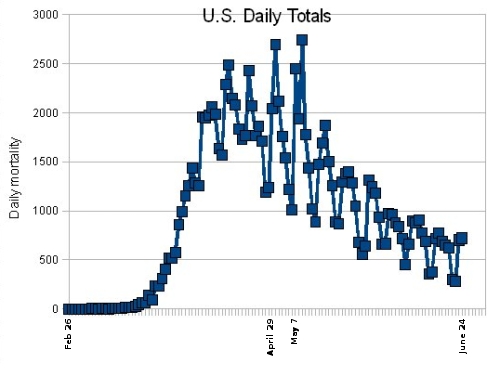
number of deaths has remained largely flat, as shown by the graph above (data source here)

https://behindtheblack.com/behind-the-black/essays-and-commentaries/the-press-continues-to-lie-about-covid-19-to-generate-fear/

Daily U.S. Wuhan flu deaths as of June 24, 2020

They just won’t stop lying: If you have been reading the mainstream leftist press, you are probably now under the impression that the COVID-19 epidemic is once again raging across the land, destroying whole communities while spreading out-of-control everywhere because some Republican governors thought it was now okay to come out of hiding.

The CNN article at the link above is typical, reporting in lurid detail how multiple states across the country are now experiencing record levels of new coronavirus cases.

Oh my! We are all gonna die!

Not. What the CNN article completely failed to mention is the number of deaths from COVID-19 taking place during this rise in new cases. Are you curious why? Could it be because, though the number of people now infected with the virus has skyrocketed, the number of deaths has remained largely flat, as shown by the graph above (data source here). The past two days has seen a slight uptick, but that is entirely within the range of the weekly ups and downs caused apparently by low numbers recorded over the weekends.

I am not the only one to notice this strange dishonest reporting, Nor is CNN the only culprit. This article at Just News noticed the same thing in a Washington Post report.

On Wednesday evening, the Washington Post issued a breaking news email alert headlined “New coronavirus cases in the U.S. soar to highest single-day total.”

“Across the United States,” reported the Post, “more than 36,000 new infections were reported by state health departments on Wednesday — surpassing the previous single-day record of 34,203 set on April 25.”

Yet the article failed to mention that even while new infections are on the rise, new COVID-19 deaths are not.

This vital information gap in the media is causing some health policy experts to worry that fear about the coronavirus — evidenced, for example, by Wednesday’s sharp stock market drop — is not founded in facts, particularly about how the virus disparately impacts different age groups. The spreading of unfounded alarm, the experts fear, could risk deep harm to Americans’ livelihoods and mental health due to a prolonged, widespread shutdown. [emphasis mine]

This dishonest reporting however is par for the course from mainstream leftist outlets like CNN and the Washington Post. Having failed to overthrow Trump with the Russian collusion hoax and the Ukraine phonecall hoax, they are now working hard to gin up more panic and fear about COVID-19, thus allowing their partners in the fascist Democratic Party to use that fear to justify further power grabs, such as in Oregon, where Democratic governor Kate Brown has convened her Democratically-controlled legislature into emergency session for the sole purpose of suspending due process for up to sixty days.

It is all despicable and evil. That the number of actual cases is not rising in any significant way should be a sign of relief and hope. Not only are lots of people easily throwing off the virus with no problems, these flat death numbers combined with the rising new cases strongly proves once again that the virus is simply not that lethal to the general population, and it likely very comparable to the flu.

Relief and hope cannot be allowed however. That might mean that things can go back to normal, that freedom will once again ring out across the land, and that Trump might actually win in November. Heaven forbid. Better to destroy the country with lies and fascist dictatorships then let things unfold as they should, in a free nation.

Be seeing you


Posted in Uncategorized | Tagged: , , , , | 1 Comment »

7 Reasons to Oppose Red Flag Guns Laws – Foundation for Economic Education

Posted by M. C. on November 1, 2019

If this sounds far-fetched, consider that the president recently called upon social media companies to collaborate with the Department of Justice to catch “red flags” using algorithmic technology.

The idea that governments can prevent crimes before they occur may sound like sci-fi fantasy (which it is), but the threat such ideas pose to civil liberties is quite real.

https://fee.org/articles/7-reasons-to-oppose-red-flag-guns-laws/

Jon Miltimore

Here are seven reasons red flag laws should be opposed, particularly at the federal level.

1. There’s No Evidence Red Flag Laws Reduce Gun Violence

Most people haven’t heard of red flag laws until recently—if they have at all—but they aren’t new.

Connecticut enacted the nation’s first red flag law in 1999, followed by Indiana (2005). This means social scientists have had decades to analyze the effectiveness of these laws. And what did they find?

“The evidence,” The New York Times recently reported, “for whether extreme risk protection orders work to prevent gun violence is inconclusive, according to a study by the RAND Corporation on the effectiveness of gun safety measures.”

The Washington Post reports that California’s red flag went basically unused for two years after its passage in 2016. Washington, D.C.’s law has gone entirely unused. Other states, such as Florida and Maryland, have gone the other direction, seizing hundreds of firearms from gun-owners. Yet it’s unclear if these actions stopped a shooting.

With additional states passing red flag laws, researchers will soon have much more data to analyze. But before passing expansive federal legislation that infringes on civil liberties, lawmakers should have clear and compelling empirical evidence that red flag laws actually do what they are intended to do.

2. Congress Lacks the Authority

The Founding Fathers clearly enumerated the powers of the federal government in the Constitution. Among the powers granted in Article I, Section 8 are “the power to coin money, to regulate commerce, to declare war, to raise and maintain armed forces, and to establish a Post Office.”

Regulating firearms is not among the powers listed in the Constitution (though this has not always stopped lawmakers from regulating them). In fact, the document expressly forbids the federal government from doing so, stating in the Second Amendment that “the right of the people to keep and bear Arms, shall not be infringed.”

3. We Have Federalism

Unlike the federal government, whose powers, James Madison noted, are “few and defined,” states possess powers that “are numerous and indefinite.”

Indeed, 17 states and the District of Columbia already have red flag laws, and many more states are in the process of adding them. This shows that the people and their representatives are fully capable of passing such laws if they choose. If red flag laws are deemed desirable, this is the appropriate place to pursue such laws, assuming they pass constitutional muster. But do they?

4. Red Flag Laws Violate Due Process

The Constitution mandates that no one shall be “deprived of life, liberty or property without due process of law.”

Seizing the property of individuals who have been convicted of no crime violates this provision. Gun control advocates claim due process is not violated because people whose firearms are taken can appeal to courts to reclaim their property. However, as economist Raheem Williams has observed, “this backward process would imply that the Second Amendment is a privilege, not a right.”

Depriving individuals of a clearly established, constitutionally-guaranteed right in the absence of criminal charges or trial is an affront to civil liberties.

5. Red Flag Laws Could Lead to More Violence

In 2018, two Maryland police officers shot and killed 61-year-old Gary Willis in his own house after waking him at 5:17 a.m. The officers, who were not harmed during the shooting, had been ordered to remove guns from his home under the state’s red flag law, which had gone into effect one month prior to the shooting.

While red flag laws are designed to reduce violence, it’s possible they could do the opposite by creating confrontations between law enforcement and gun owners like Willis, especially as the enforcement of red flag laws expands.

6. It’s Not Just the “Mentally Ill” and Grave Threats Who Are Flagged

In theory, red flag laws are supposed to target individuals who pose a threat to themselves or others. In practice, they can work quite differently.

In a 14-page analysis, the American Civil Liberties Union of Rhode Island explained that few people understand just how expansive the state’s red flag law is.

“It is worth emphasizing that while a seeming urgent need for [the law] derives from recent egregious and deadly mass shootings, [the law’s] reach goes far beyond any efforts to address such extraordinary incidents,” the authors said. Individuals who find themselves involved in these proceedings often have no clear constitutional right to counsel.

“As written, a person could be subject to an extreme risk protective order (ERPO) without ever having committed, or even having threatened to commit, an act of violence with a firearm.”

Though comprehensive information is thin, and laws differ from state to state, anecdotal evidence suggests Rhode Island’s law is not unique. A University of Central Florida student, for example, was hauled into proceedings and threatened with a year-long RPO (risk protection order) for saying “stupid” things on Reddit following a mass shooting, even though the student had no criminal history and didn’t own a firearm. (The student also was falsely portrayed as a “ticking time bomb” by police, Jacub Sullum reports.) Another man, Reason reports, was slapped with an RPO for criticizing teenage gun control activists online and sharing a picture of an AR-15 rifle he had built.

Individuals who find themselves involved in these proceedings often have no clear constitutional right to counsel, civil libertarians point out.

7. They’re Basically Pre-Crime

As I’ve previously observed, red flag laws are essentially a form of pre-crime, a theme explored in the 2002 Steven Spielberg movie Minority Report, based on a 1956 Philip K. Dick novel.

I’m not the only writer to make the connection. In an article that appeared in Salon, Travis Dunn linked red flag laws “to the science fiction scenario of The Minority Report, in which precognitive police try to stop crimes before they’re committed.”

That government can prevent crimes before they occur may sound like sci-fi fantasy (which it is), but the threat posed to civil liberties is quite real.

If this sounds far-fetched, consider that the president recently called upon social media companies to collaborate with the Department of Justice to catch “red flags” using algorithmic technology.

The idea that governments can prevent crimes before they occur may sound like sci-fi fantasy (which it is), but the threat such ideas pose to civil liberties is quite real.

Compromising civil liberties and property rights to prevent acts of violence that have yet to occur are policies more suited for dystopian thrillers⁠—and police states⁠—than a free society.

It’s clear that laws of this magnitude should not be passed as an emotional or political response to an event, even a tragic one.

Be seeing you

Amazon.com: Minority Report: Tom Cruise, Colin Farrell ...


Posted in Uncategorized | Tagged: , , , , | Leave a Comment »

Red Flag Laws Spur Debate Over Due Process

Posted by M. C. on September 6, 2019

You know our situation is bad when you have PEW and the ACLU fretting over your gun related rights.

https://www.pewtrusts.org/en/research-and-analysis/blogs/stateline/2019/09/04/red-flag-laws-spur-debate-over-due-process

In the year since Florida enacted its red flag law, Kendra Parris has defended nearly 20 clients against risk protection orders that could remove their firearms.

The Orlando-based lawyer has long represented people who might be subject to the state’s involuntary mental health treatment provision. But when this new law, meant to protect against people who might be a harm to themselves or others, passed in the aftermath of the February 2018 Parkland mass shooting, she saw yet another opportunity for the state to potentially deprive certain people of their civil liberties.

“It’s almost like a shiny new toy for law enforcement,” Parris said, “filing them left and right.”

Since the law’s adoption, Florida courts have approved around 2,500 risk protection orders, according to an August count by NPR.

Since Parkland, at least six states and the District of Columbia have passed red flag laws, which allow law enforcement agencies that have gotten a court order to remove guns from people considered a harm to themselves or others. In the wake of high-profile shootings this summer in Ohio and Texas, including one that killed eight people in Midland-Odessa this past weekend, more state lawmakers are considering such laws, as are some members of Congress.

Many law enforcement officials firmly believe the laws save lives, and lawmakers say they can craft legislation that won’t infringe on civil liberties.

But for two decades, since the first such law was enacted in Connecticut, civil and gun rights advocates have protested that the seizures violate the U.S. Constitution’s due process guarantee — meaning residents have a right to fully argue their case in court.

“Rather than find clear and convincing evidence, [courts are] basically saying, ‘Better safe than sorry,’” Parris said.

Most red flag laws are vague on what constitutes a “significant danger,” which gives courts broad discretion to seize firearms, Parris said. And in some states, respondents are not guaranteed representation in court, since these are civil and not criminal matters.

Many defense lawyers say respondents fare much better with legal representation. Of Parris’ seven cases that have gone to a hearing, she has won five — which she said is a “vastly higher” success record than when someone represents themselves.

Due Process Concerns

Seventeen states and D.C. have laws on the books that allow law enforcement or family members to petition courts to remove weapons from people who may be dangerous and prevent them from buying other weapons for up to a year. In many of these states, bipartisan groups of lawmakers led the drive to pass the legislation.

States define “red flags” differently, but they largely follow the same process for taking away somebody’s guns.

If someone is showing signs of erratic behavior or expressed some intent to hurt themselves or others, they might be subject to an extreme risk protection order. In most states with red flag laws, family or community members can petition a court for those orders. But in Florida, Rhode Island and Vermont, law enforcement officials are the only ones who can petition to remove firearms.

If there is an immediate risk of harm, a court can issue a temporary ex parte order to seize guns from people for up to 14 days in most states. Other states range from two days to 45 days. At those hearings, a judge can issue the order by listening to evidence from the petitioner.

In many cases, the subject of a petition can’t present a defense until the final hearing. But that’s where the process gets legally dubious to some critics.

Dave Kopel, research director at the Independence Institute, a Denver-based libertarian think tank, said states have taken the same approach President Donald Trump spoke in favor of in March 2018: “Take the guns first, go through due process second.”

When it comes to seizing guns through a temporary order, the standards that a judge uses should be high, Kopel said. Vermont, he believes, has a fair system, which requires “specific facts” that show “an imminent and extreme risk.”

The situation becomes even more precarious when loved ones can petition for the removal of firearms, he said. Spurned former partners or family members seeking revenge might “weaponize” this tool, he said. Because of that, he argues, there should be a penalty for maliciously false accusations, which several states have adopted…

In Rhode Island, the American Civil Liberties Union originally came out against the state’s 2018 measure until the legislature tightened the standard for granting a petition, created penalties for providing false evidence of a threat, allowed only law enforcement to file petitions, required specific evidence and granted the right to legal counsel in hearings…

Be seeing you

29 best images about Books Worth Reading on Pinterest ...


Posted in Uncategorized | Tagged: , , , , | Leave a Comment »

The Ron Paul Institute for Peace and Prosperity : Violence Against Women Act Does Violence to the Constitution

Posted by M. C. on May 21, 2019

Red flag laws have led to dangerous confrontations between law enforcement and citizens who assumed that those breaking into their property to take their guns are private, rather than government, thieves

http://www.ronpaulinstitute.org/archives/featured-articles/2019/may/20/violence-against-women-act-does-violence-to-the-constitution/

Written by Ron Paul

A common trick of big-government loving politicians is to give legislation names so appealing that it seems no reasonable person could oppose it. The truth is, the more unobjectionable the title, the more objectionable the content. Two well-known examples are the “PATRIOT Act” and the “Access to Affordable and Quality Care Act.”

Another great example is the Violence Against Women Act. Passed in 1994, the Violence Against Women Act provides federal grants to, and imposes federal mandates on, state and local governments with the goal of increasing arrests, prosecutions, and convictions of those who commit domestic violence.

Like most federal laws, the Violence Against Women Act is unconstitutional. The Constitution limits federal jurisdiction to three crimes: counterfeiting, treason, and piracy. All other crimes — including domestic violence — are strictly state and local matters.

The law also forbids anyone subject to a restraining order obtained by a spouse or a domestic partner from owning a gun. This is a blatant violation of the Second Amendment’s prohibition on federal laws denying anyone the right to own a gun. Whether someone subject to a restraining order, or convicted of a violent crime, should lose their rights to own firearms is a question to be decided by state and local officials.

At least the current law requires individuals receive due process before the government can deprive them of their Second Amendment rights. The House of Representatives recently passed legislation reauthorizing and making changes to the Violence Against Women Act. The most disturbing part of this “upgrade” gives government the power to take away an individual’s Second Amendment rights based solely on an allegation that the individual committed an act of domestic violence. The accused then loses Second Amendment rights without even having an opportunity to tell their side of the story to a judge.

This is a version of “red flag” laws that are becoming increasingly popular. Red flag laws are not just supported by authoritarians like Senators Diane Feinstein and Lindsey Graham, but by alleged “constitutional conservatives” like Sen. Ted Cruz.

Red flag laws have led to dangerous confrontations between law enforcement and citizens who assumed that those breaking into their property to take their guns are private, rather than government, thieves…

Be seeing you

image_511


Posted in Uncategorized | Tagged: , , , , | Leave a Comment »

Louisiana police, courts deny due process via willful misinterpretation | Libertarian Party

Posted by M. C. on November 4, 2017

They are big on asset forfeiture in Louisiana, too. Try not to get arrested there.

https://www.lp.org/louisiana-police-courts-deny-due-process-via-willful-misinterpretation/

In October 2015, accused rapist Warren Demesme was being interrogated by police when he said, “If y’all, this is how I feel, if y’all think I did it, I know that I didn’t do it so why don’t you just give me a lawyer, dawg, ’cause this is not what’s up.”

The interrogating officers deceitfully misinterpreted this as a request for a “lawyer dog,” which they claimed was ambiguous, and continued the interrogation instead. They therefore denied Demesme his right to counsel, and he was ultimately convicted. Read the rest of this entry »

Posted in Uncategorized | Tagged: , , , , | Leave a Comment »