MCViewPoint

Opinion from a Libertarian ViewPoint

Posts Tagged ‘Elizabeth Warren’

The Incredible Shrinking Overton Window – Caitlin Johnstone

Posted by M. C. on November 5, 2019

They get people debating how internet censorship should take place and whom should be censored, rather than whether any internet censorship should occur.

They get people debating how and to what extent government surveillance should occur, not whether the government has any business spying on its citizens.

They get people debating how subservient and compliant someone needs to be in order to not get shot by a police officer, rather than whether a police officer should be shooting people for those reasons at all.

https://caitlinjohnstone.com/2019/11/04/the-incredible-shrinking-overton-window/

“The smart way to keep people passive and obedient is to strictly limit the spectrum of acceptable opinion, but allow very lively debate within that spectrum — even encourage the more critical and dissident views. That gives people the sense that there’s free thinking going on, while all the time the presuppositions of the system are being reinforced by the limits put on the range of the debate.”
~ Noam Chomsky

The plutocrat-owned narrative managers of the political/media class work constantly to shrink the Overton window, the spectrum of debate that is considered socially acceptable. They do this by framing more and more debates in terms of how the oligarchic empire should be sustained and supported, steering them away from debates about whether that empire should be permitted to exist at all.

They get people debating whether there should be some moderate changes made or no meaningful changes at all, rather than the massive, sweeping changes we all know need to be made to the entire system.

They get people debating whether they should elect a crook in a red hat or a crook in a blue hat, rather than whether or not they should be forced to elect crooks.

They get people debating violations of government secrecy laws, not whether the government has any business keeping those secrets from its citizenry in the first place.

They get people debating how internet censorship should take place and whom should be censored, rather than whether any internet censorship should occur.

They get people debating how and to what extent government surveillance should occur, not whether the government has any business spying on its citizens.

They get people debating how subservient and compliant someone needs to be in order to not get shot by a police officer, rather than whether a police officer should be shooting people for those reasons at all.

They get people debating whether or not a group of protesters are sufficiently polite, rather than debating the thing those protesters are demonstrating against.

They get people debating about whether this thing or that thing is a “conspiracy theory”, rather than discussing the known fact that powerful people conspire.

They get people debating whether Tulsi Gabbard is a dangerous lunatic, a Russian asset, a Republican asset gearing up for a third party run, or just a harmless Democratic Party crackpot, rather than discussing the fact that her foreign policy would have been considered perfectly normal prior to 9/11.

They get people debating whether Bernie Sanders is electable or too radical, rather than discussing what it says about the status quo that his extremely modest proposals which every other major country already implements are treated as something outlandish in the United States.

They get people debating whether Jeremy Corbyn has done enough to address the Labour antisemitism crisis, rather than whether that “crisis” ever existed at all outside of the imaginations of establishment smear merchants.

They get people debating whether Joe Biden or Elizabeth Warren would win against Trump, rather than whether either of those establishment lackeys is a worthy nominee.

They get people debating whether politicians should have corporate sponsors, rather than whether corporations should be allowed to interfere in the electoral process at all.

They get people debating if the US should be pursuing regime change in Iran or Syria, rather than whether the US has any business overthrowing the governments of sovereign nations to begin with.

They get people debating how many US troops should be in Syria, rather than whether that illegal invasion and occupation was ever legitimate in the first place.

They get people debating whether to kill people slowly by sanctions or kill them quickly with bombs, rather than whether they should be killed at all.

They get people debating whether or not some other country’s leader is an evil dictator, rather than whether it’s any of your business.

They get people debating the extent to which Russia and Trump were involved in the Democratic Party’s 2016 email leaks, rather than the contents of those leaks.

They get people debating what the response should be to Russian interference in the election, rather than whether that interference took place at all, and whether it would really matter if it did.

They get people debating how much government support the poor should be allowed to have, rather than whether the rich should be allowed to keep what they’ve stolen from the poor.

They get people debating what kind of taxes billionaires should have to pay, rather than whether it makes sense for billionaires to exist at all.

They get people impotently debating the bad things other countries do, rather than the bad things their own country does which they can actually do something about.

They get people debating what should be done to prevent the rise of China, rather than whether a multipolar world might be beneficial.

They get people debating whether western cold war escalations against the Russian Federation are sufficient, rather than whether they want the horrors of the cold war to be resurrected in the first place.

They get people debating what extent cannabis should be decriminalized, rather than whether the government should be allowed to lock anyone up for deciding to put any substance whatsoever in their own body.

They get people debating whether or not US troops should be withdrawn from Afghanistan, rather than whether or not there should be any US troops outside of the US.

They get people debating whether or not Julian Assange is “a real journalist”, rather than whether or not they should set legal precedents that necessarily criminalize acts of journalism.

They get people debating the subtle details of bail protocol, political asylum, embassy cat hygiene and leaking rather than whether it should ever be legal to imprison a publisher for exposing government war crimes.

They get people debating what the punishment should be for whistleblowers, not what the punishment should be for those they blow the whistle on.

They get people debating whether Fox or MSNBC is the real “fake news”, rather than whether the entirety of mainstream media is oligarchic propaganda.

They get people debating about how the things everyone is freaking out over Trump doing were previously done by Obama, rather than discussing why all US presidents do the same evil things regardless of their parties or campaign platforms.

They get people debating what should be done with money, not whether the concept of money itself is in need of a complete overhaul.

They get people debating what should be done with government, not whether the concept of government itself is in need of a complete overhaul.

They get people debating whether the status quo should be reinforced or revised, rather than whether it should be flushed down the toilet where it belongs.

They get people angrily debating things they can’t change, rather than constructively working on the things that they can.

They get people shoving against each other in opposite directions, while they swiftly build a cage around us all.

___________________________________

Thanks for reading! The best way to get around the internet censors and make sure you see the stuff I publish is to subscribe to the mailing list for my website, which will get you an email notification for everything I publish. My work is entirely reader-supported, so if you enjoyed this piece please consider sharing it around, liking me on Facebook, following my antics on Twitter, checking out my podcast on either YoutubesoundcloudApple podcasts or Spotify, following me on Steemitthrowing some money into my hat on Patreon or Paypalpurchasing some of my sweet merchandisebuying my new book Rogue Nation: Psychonautical Adventures With Caitlin Johnstone, or my previous book Woke: A Field Guide for Utopia Preppers. For more info on who I am, where I stand, and what I’m trying to do with this platform, click here. Everyone, racist platforms excluded, has my permission to republish or use any part of this work (or anything else I’ve written) in any way they like free of charge.

Posted in Uncategorized | Tagged: , , , , | Leave a Comment »

EconomicPolicyJournal.com: Warren Admits Universal Medicare Would Result in Two Million Lost Jobs

Posted by M. C. on November 2, 2019

He has calculated that Medicare for All would result in job losses (mostly among administrators) “somewhere in the range of 2 million” — about half on the insurers’ side and half employed in hospitals and doctors’ offices to argue with the former.

Mostly?

That’s a real hard number! It suggests some layoffs will be among actual medical staff.

Truly amazing.  They are going to make healthcare free and actually think they will be able to get away with less medical staff.
Elizabeth Warren is quickly climbing the ladder to becoming the most dangerous woman in the world

https://www.economicpolicyjournal.com/2019/11/warren-admits-universal-medicare-would.html#more

Elizabeth Warren has agreed with an assessment that a “medicare for all” plan would eliminate roughly two million jobs, reports National Review.

Warren was speaking during an interview at New Hampshire Public Radio.

“An economist at the University of Massachusetts, Amherst, told Kaiser Health News earlier this year that that could result in about 2 million jobs lost,” mostly within the healthcare industry, said NHPR reporter Casey McDermott.

“So I agree,” Warren replied. “I think this is part of the cost issue and should be part of a cost plan.”

The economist cited by McDermot is Robert Pollin of the extreme left Political Economy Research Institute at the University of Massachusetts.

“Every proponent of Medicare for All — including myself — has to recognize that the biggest source of cost-saving is layoffs,” Pollin said. He has calculated that Medicare for All would result in job losses (mostly among administrators) “somewhere in the range of 2 million” — about half on the insurers’ side and half employed in hospitals and doctors’ offices to argue with the former.

Mostly?

That’s a real hard number! It suggests some layoffs will be among actual medical staff.

Truly amazing.  They are going to make healthcare free and actually think they will be able to get away with less medical staff.

These people actually think they can plan the entire healthcare sector with giveaways to all and get better healthcare!

And further, they appear to have no clue as to what their oppressive central planning would do to innovation in medical care.

These are extremely dangerous people with a dangerous desire to control. This type of extreme planning always gets very bad when it gets implemented. It would put healthcare on the Venezuela economic model.

Elizabeth Warren is quickly climbing the ladder to becoming the most dangerous woman in the world. I have her ranked just under Cristina Fernández de Kirchner who was just elected vice-president in Argentina, and Alexandria Ocasio-Cortez who sure is able to rally the youth to her mad central planing deires.

RW

Be seeing you

Faux

Identity Politics

Posted in Uncategorized | Tagged: , , , , | Leave a Comment »

EconomicPolicyJournal.com: How Elizabeth Warren’s Social Security Plan Would Damage the Economy Immediately and Screw the Young When It Comes Time for Them to Receive Social Security Payouts

Posted by M. C. on October 24, 2019

https://www.economicpolicyjournal.com/2019/10/how-elizabeth-warrens-social-security.html?m=1

By Robert Wenzel

Elizabeth Warren recently released a Social Security plan that would exacerbate many of the program’s existing problems while also creating several new ones, writes Charles Blahous.

The key is to understand that Warren wants to increase payments to current recipients across the board.

Warren has outlined her increases:

  • Increases Social Security benefits immediately by $200 a month — $2,400 a year — for every current and future Social Security beneficiary in America.
  • Updates outdated rules to further increase benefits for lower-income families, women, people with disabilities, public-sector workers, and people of color.
But where is she going to get the money to pay for these increases to: “women, people with disabilities, public-sector workers, and people of color,” never mind the $200 increase she wants to give to all retirees (presumably even straight white males)?
Hint: Increase taxes.
In other words, her scheme is a simple transfer of income.
Blahous reports:

The Warren proposal would increase national Social Security tax burdens by roughly 30% relative to current law. Even the Zandi memo issued in support of the proposal recognizes that these tax increases would reduce economic growth by having a “negative impact on the supply of labor.”

And Blahous also informs how it will screw current youth when they reach retirement:

 One of the biggest problems arising under current Social Security law is that it treats younger generations much worse than older ones. Because Social Security is not a savings program but rather an income transfer program, it is a zero-sum game at best: No one can gain net income through Social Security without someone else losing it. The largest such income transfers occur across generations. The trustees’ report shows that unless something is done to moderate the benefit growth rate for current participants, younger generations will lose income through Social Security equal to 3.4% of their career taxable earnings—net of all benefits they receive. The program cannot reasonably provide social insurance for young workers if it is making them more than 3% poorer over the course of their lives. By increasing benefits for today’s participants (including the wealthiest) well beyond what their own future taxes can finance, the Warren plan would substantially worsen the aggregate net income losses of younger generations.

The Warren plan is an economic train wreck. It will slow current economic growth and sets up a scenario where current youth will receive less when they are eligible for payments than what they have been forced to pay in.

Warren is an economy wrecker.

RW


Posted in Uncategorized | Tagged: , , , | Leave a Comment »

EconomicPolicyJournal.com: EXPOSED: Elizabeth Warren’s Wealth Hate

Posted by M. C. on October 24, 2019

https://www.economicpolicyjournal.com/2019/10/exposed-elizabeth-warrens-wealth-hate.html?m=1

EXPOSED: Elizabeth Warren’s Wealth Hate

RW

17 Best images about Moving. Powerful. Important. on ...

Posted in Uncategorized | Tagged: , | Leave a Comment »

“Corporate Social Responsibility” Only Strengthens Corporate Power over the Public | Mises Wire

Posted by M. C. on October 3, 2019

Proponents of CSR typically want to use the state’s power to grant or deny corporate charters—that old privilege-granting authority of 17th century British monarchs—to force corporations to dilute their owners’ property rights. The idea is to require a federal (not just a state-level) charter, and to make its issuance subject to further political demands.

A corporate charter is a license, a permission to engage in commerce in commercial form. To revert this from its current form as a rubber-stamped registration back to a privilege granted by the state to favored parties is a perilous act.

https://mises.org/wire/corporate-social-responsibility-only-strengthens-corporate-power-over-public

“Business Roundtable Redefines the Purpose of a Corporation to Promote ‘An Economy That Serves All Americans’ ” was the headline of a recent statement put out by this “association of chief executive officers of America’s leading companies.” The statement went on to say:

Since 1978, Business Roundtable has periodically issued Principles of Corporate Governance. Each version of the document issued since 1997 has endorsed principles of shareholder primacy – that corporations exist principally to serve shareholders. With today’s announcement, the new Statement supersedes previous statements and outlines a modern standard for corporate responsibility.

Putting aside the fact that neither in logic, nor in law, nor in morals does an individual CEO, let alone the lobbying arm for CEOs, have the ability to “redefine the purpose of a corporation,” it does prompt the question of what the purpose and responsibilities of a corporation actually are, and who decides this.

From Monopolies to Free Corporations

Historically, corporations were creatures of state-granted monopoly privileges. For example, in 1600 Elizabeth I chartered the British East India Company with a monopoly in trade to the East Indies, and at the same time specified in great detail what the Company could and could not do. Other charters, issued over the years, granted monopolies in dealing in various commodities, settlement rights, etc.

Early settlements in colonial America were products of this corporate monopoly system, for example the Massachusetts Bay Company. But as American society democratized and monarchial power waned, the nature of the corporation changed, although the form remained similar. By the early 1800s, a corporation was no longer a monopoly. And although it still required a charter from the government, this was typically a formality.

In the United States, corporate charters are today issued at the state level, via a process that in many cases amounts to a mere rubber stamping. In some states you can even file to create a corporation online.

In this relatively liberal regime, the explicit purpose of the corporation is determined by its owners. They are the ones who voluntarily come together to engage in some enterprise. They are the ones who put their money behind some new risky venture. And they are the ones who draft the articles of incorporation and corporate bylaws. So long as certain formalities are met, the issuance of a state charter is automatic.

However, the temptation to revert to the older monopoly privilege nature of the corporation is ever present, and this remind sus why we should not conflate industrialists with free-market capitalists. Being pro-business is not the same as being pro-free markets. Competing in a free market is one of the hardest things a businessman can do. Cozying up to the state — i.e., rent-seeking — is often much easier. Many a businessman would prefer a state-granted monopoly, and many a politician desires the power to grant and withhold such privileges.

A Return to State Monopolies under Fascism

A case study in this reversion can be seen in Germany under National Socialism.

In a 1933 memorandum, “Nazi-Socialism,”Reprinted in the Appendix to The Road to Serfdom: Text and Documents, The Definitive Edition . Friedrich Hayek observed that the rising new German order was far from reactionary, and in spite of their persecution of the communists, National Socialism” was “a genuine socialist movement.”

Hayek went on to discuss the curious mutual embrace of German industry and the new regime (with my emphasis):

One of the main reasons why the socialist character of National Socialism has been quite generally unrecognized, is, no doubt, its alliance with the nationalist groups which represent the great industries and the great landowners. But this merely proves that these groups too—as they have since learnt to their bitter disappointment—have, at least partly, been mistaken as to the nature of the movement. But only partly because—and this is the most characteristic feature of modern Germany— many capitalists are themselves strongly influenced by socialistic ideas, and have not sufficient belief in capitalism to defend it with a clear conscience.

In other words, the relationship between the Nazi state and industry was not evidence that the Nazis had capitalist leanings, but that the German businessmen had socialist leanings.

However, with the rapid transition to a war-time command economy, the German industrialists went from supporters of the state, to instruments of the state:

The new pattern of power was implicit in the sociolegal framework of the economy. Eliminated were the four essential freedoms of private capitalism, namely, the freedoms of trade, contract, association, and markets. Freedom of trade was replaced by an economic obligation (Wirtschaftspflicht) to the party-state…

Rights to economic activities were regarded as a privilege conferred upon individuals by the government. The rule was: No job or shop without governmental approval. Everyone had to register; laborers needed their labor-book, firms their charters. For no one could enter, terminate, or maintain a business without satisfying an increasing set of personal and material prerequisites.1

Note the mention there of the corporate charter, now pressed to the service of the state.

But why would the businessman go along with such impositions? What is the advantage for them? In The Vampire Economy: Doing Business Under Fascism, Günther Reimann quotes a German newspaper explaining some of the ramifications of the 1937 German Corporations Law:

The chairman of a corporation is the organ of business leadership. . . . Up to now the chairman was subject to far-reaching control by the Supervisory Board [elected by the stockholders]. This has been changed. The Supervisory Board now only has the right to appoint and recall the chairman. Under the new law the management of the corporation becomes the sole responsibility of the managing director. He is now therefore independent of the chairman of the Supervisory Board, and is not subject to the latter’s instructions. (Reimann, p. 188)

In other words, the managing director (akin to the CEO) of the corporation gains power by being freed from responsibility to the board and to shareholders. In exchange he is increasingly beholden to the state and to political forces. He replaces market entrepreneurship with political entrepreneurship.

Corporate Social Responsibility

The Corporate Social Responsibility (CSR) movement has, since the 1970s, pushed a narrative that corporations ought to serve more than their shareholders (their owners). They ought to (and even be required to) serve a wider range of “stakeholders,” including employees, customers, the community, etc.

Proponents of CSR typically want to use the state’s power to grant or deny corporate charters—that old privilege-granting authority of 17th century British monarchs—to force corporations to dilute their owners’ property rights. The idea is to require a federal (not just a state-level) charter, and to make its issuance subject to further political demands.

For example, in 1996 then U.S. Senator Jeff Bingaman (D-NM) led Democrats proposing legislation that would have enabled a federal corporate charter for a new kind of corporation, an “R-Corporation.” (R for “Responsible.”) Requirements for such corporation would include limits on CEO pay, minimum spending levels for retirement and education benefits for employees, offering of a standard health insurance plan, profit sharing with a minimum participation rate, spending at least 1/2 of its R&D in the United States, etc.2 Corporations so-chartered would be given preferential treatment by the government, and would be rewarded with special tax breaks and regulatory relief.

Fortunately, Bingaman’s R-Corporation proposal went nowhere.

However, 23 years later we see his ideological heir in Elizabeth Warren and her proposed “Accountable Capitalism Act,” which takes Bingaman’s voluntary federal charter, and makes it mandatory for corporations with more than $1 billion in annual revenue. Among a long list of requirements, Warren would require that 40% of board of director seats to be chosen by the workers, not the board of directors.

It is in this context that we read the Business Roundtable’s rhetorical capitulation to a longstanding demand of the collectivist left.

A Fundamental Misunderstanding

Note that the word “responsibility” in CSR bears little resemblance to how that term has been understood by moral philosophers over the past 2,500 years. Only an individual can be responsible, and only so with respect to his own property. Collective responsibility is a barbarous concept, something associated with the greatest depravities in history. And if I one day set out (without your permission) to “be socially responsible” with your bank account, I’d justly be charged with theft and sent to prison.

So, how can it be any less wrong if a CEO, the agent of the shareholder principals, aims to “be socially responsible” with assets not owned by him?

This is not to say that a corporation does not have an impact on society. It does. However, the profit-seeking motive of the shareholders, far from being a negative for society, is a boon. As Mises pointed out in his essay “Profit and Loss” (reprinted in Planning for Freedom and Twelve Other Essays and Addresses):

Now one of the main functions of profits is to shift the control of capital to those who know how to employ it in the best possible way for the satisfaction of the public. The more profits a man earns, the greater his wealth consequently becomes, the more influential does he become in the conduct of business affairs. Profit and loss are the instruments by means of which the consumers pass the direction of production activities into the hands of those who are best fit to serve them. Whatever is undertaken to curtail or to confiscate profits, impairs this function. The result of such measures is to loosen the grip the consumers hold over the course of production. The economic machine becomes, from the point of view of the people, less efficient and less responsive.

The businessman ought to be unapologetic of the profits he seeks and the profits he makes, knowing the critical role which profits play in the economy:

In a free economy, in which wages, costs and prices are left to the free play of the competitive market, the prospect of profits decides what articles will be made, and in what quantities—and what articles will not be made at all. If there is no profit in making an article, it is a sign that the labor and capital devoted to its production are misdirected: the value of the resources that must be used up in making the article is greater than the value of the article itself.3

The Irresponsibility of CSR

Imagine a construction worker, concerned about society at large, deciding to use less concrete in his project, with the intent of repurposing the savings to wage increases for the workers. Or a pharmacist, dispensing lower-dosage pills than prescribed, and using the money saved to benefit other “stakeholders.” We would consider these both to be crimes.

Profit, like concrete and medicine, serves a critical purpose, and to dilute it does real harm, like diluting concrete or medicine.

Or imagine a charitable institution, a non-profit, like a university, with an endowment invested in stocks, with any dividends and gains dedicated to the organization’s charitable mission. The CSR movement implicitly endorses the idea that corporate CEOs, whose expertise is in making and selling widgets, ought to also be dilettantes in figuring out how to improve their communities, and in the process earn lower profits to pass on to charity-shareholders, whose own expertise is precisely in how to do good for the community. This is a fundamental breakdown of the division of labor.

A corporate charter is a license, a permission to engage in commerce in commercial form. To revert this from its current form as a rubber-stamped registration back to a privilege granted by the state to favored parties is a perilous act. Remember, newspapers, churches, charities, think tanks, even labor unions have corporate forms. Once charter-granting is politicized, it may not end the way its promoters think it will. As Mises famously wrote in Human Action:

No socialist author ever gave a thought to the possibility that the abstract entity which he wants to vest with unlimited power — whether it is called humanity, society, nation, state, or government — could act in a way of which he himself disapproves. A socialist advocates socialism because he is fully convinced that the supreme dictator of the socialist commonwealth will be reasonable from his — the individual socialist’s — point of view, that he will aim at those ends of which he — the individual socialist — fully approves, and that he will try to attain these ends by choosing means which he — the individual socialist — would also choose.

Be  seeing you

?u=https1.bp.blogspot.com-21je6qbGpuYWbP_oknTIQIAAAAAAAApsg37eDfz-Vh8oZXOSlTzcqR2lMNJLWUs_RwCLcBGAss1600Uncle-Sam-in-Control-Sans.jpg&f=1&nofb=1


Posted in Uncategorized | Tagged: , , , , | Leave a Comment »

Ibrahim on Twitter: “MSNBC pundit says if you support Bernie Sanders over Elizabeth Warren it’s “showing your sexism.” https://t.co/fghFIqOF6C” / Twitter

Posted by M. C. on September 30, 2019

And one of the comments points out, if you support Warren you are an anti-semite.

What is a progressive to do? What is anyone to do? Stop watching MSNBC for starters.

https://mobile.twitter.com/IbrahimAS97/status/1177719744096559110

https://twitter.com/i/status/1177719744096559110

Posted in Uncategorized | Tagged: , , , | Leave a Comment »

The Yin and the Yang of It – Kunstler

Posted by M. C. on August 17, 2019

The aim of the national matrimonial hysteria is to make sure that whatever conflict is at issue remains unresolved. The melodrama goes on for its own sake. It’s fun living on the verge of a nervous breakdown. That is exactly why the US political scene is so disordered and distressed. That is why the Democratic Party can’t find any credible male candidates. And that is how come the country happened to elect an imperturbable Golden Golem of Greatness.

https://kunstler.com/clusterfuck-nation/the-yin-and-the-yang-of-it/

James Howard Kunstler

The New York Times staffers wanted to change the paper’s longstanding motto, All the News That’s Fit to Print, to something more cutting edge, more of-the-moment, more congenial with the crypto-gnostic social justice impetus to change human nature in order to make the world a better place.

My personal suggestion was All the News That’s Fit to Print for Angry, Hysterical Women and Their Intersectional Allies, since The New York Times is now an advocacy rag, but the staff choice apparently is The Truth is Worth It — or perhaps The Times paid some Madison Avenue logo engineers for that.

And one is prompted to ask: worth what, exactly? If “truth” actually amounts to “lived experience,” as The Times insists, then truth can be whatever you say it is — the bedrock ethos of all tyrannical political movements. To me, The Truth is Worth It sounds suspiciously like The Ends Justify the Means, and anyone following the so-called Resistance the past three years may have noticed that’s exactly how it operates.

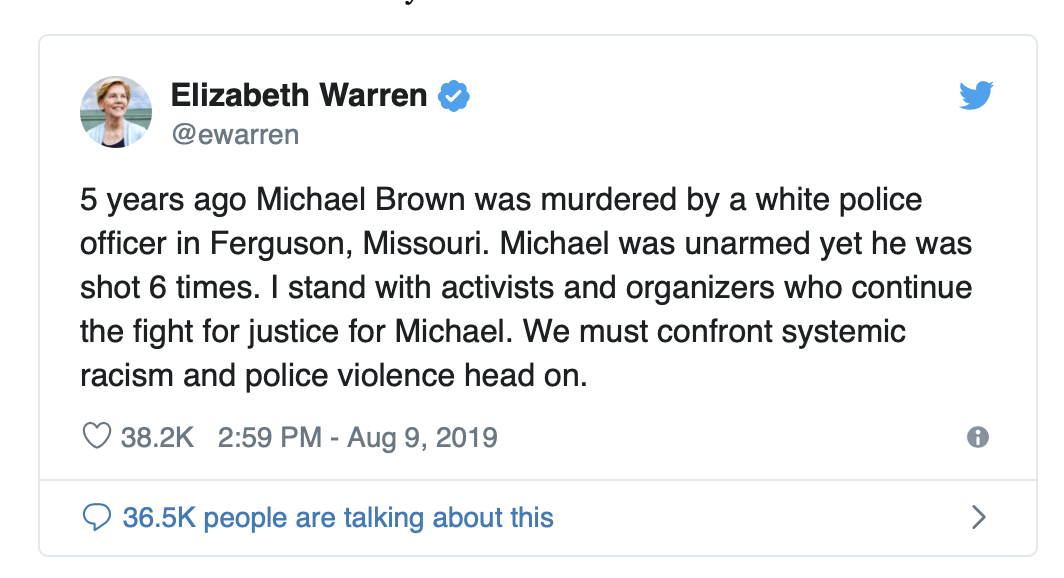
For instance, Resistance team captain Elizabeth Warren referred the other day to the 2014 “murder” of Michael Brown in Ferguson Missouri “by a white policeman.” Of course, Ms. Warren was speaking her “truth.” Now, it happens that the US Department of Justice under Eric Holder (this was the Obama administration) determined that it was not murder, as did an inquiry by the State of Missouri — rather that Mr. Brown was shot after attacking officer Darren Wilson in his police car and attempting to grab his gun.

Did Senator Warren not believe former attorney general Holder? Was there some other authoritative opinion she was referencing? Or was she just making shit up on-the-fly to juice an audience? Could she have had any other purpose than to provoke racial animus? Is that what this country needs? More tension between blacks and whites? More reason for suspicion and hatred? Is that where you want leadership to lead you?

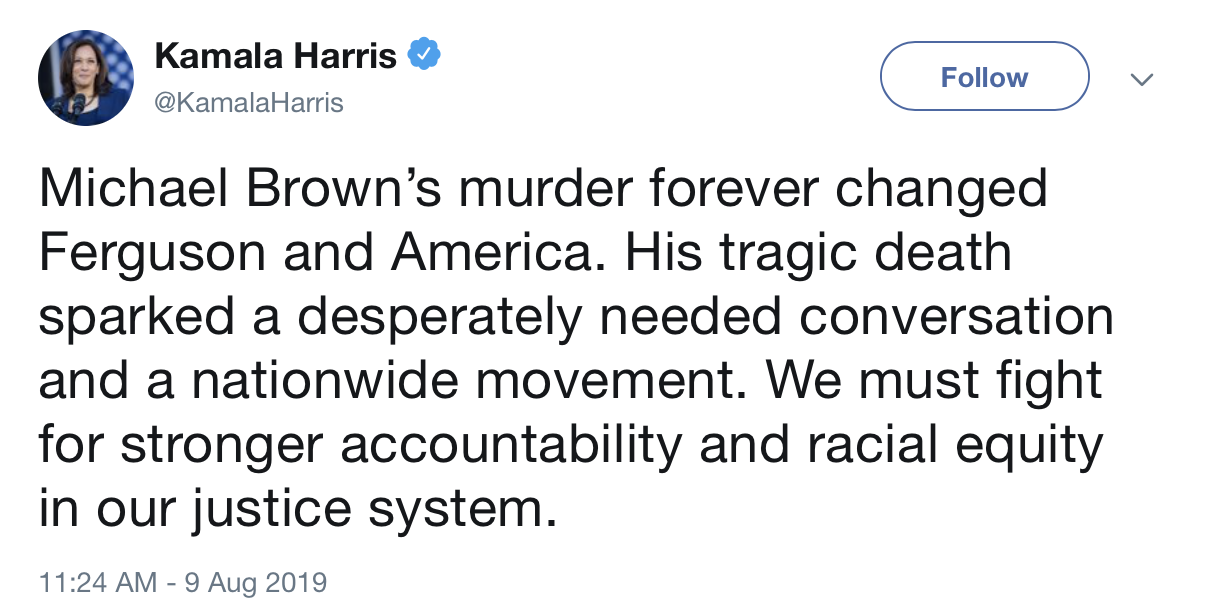
Senator Warren’s remark pretty obviously demonstrates the Resistance’s tenuous relationship with reality. Her rival, Sen. Kamala Harris tweeted out substantially the same thing last Friday. Do they actually believe what they are saying, or is it simply a tactical move because it’s worth it to stir up racial animosity if you want to become president? The media gave both of them a pass on that ploy.

A few weeks ago, podcaster Dave Rubin had “spiritual teacher” Eckhart Tolle on for a chat, and Mr. Tolle made the surprising remark that the current sorrows of the world were due to an excess of yin and not enough yang, meaning, he went on to explain, too much of the female principle in operation and not enough of the male principle. This crack made Dave Rubin blink a few times, especially coming from the most serene celebrity on the planet, a fellow far less excitable than the Dalai Lama, and a demigod to the yoga pants and Chai tea crowd. Too much yin! He said that? Really?

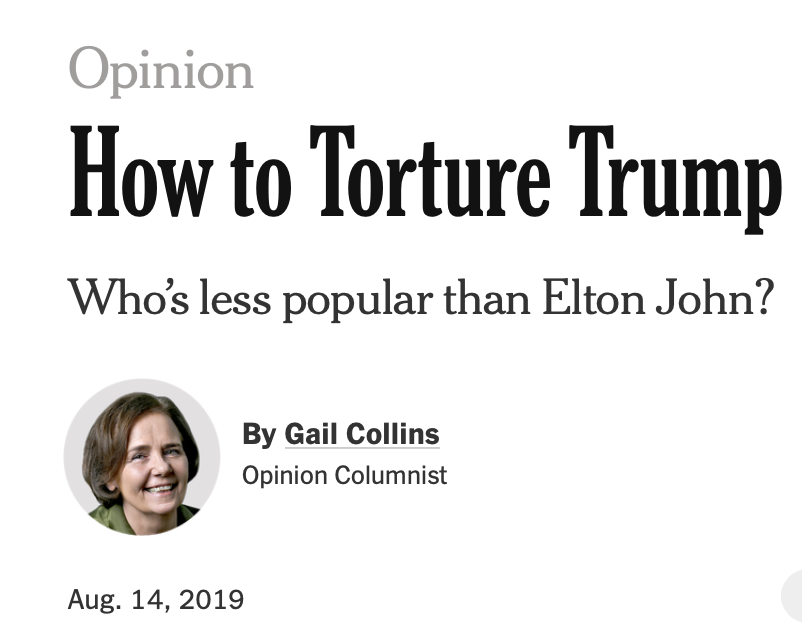
Mr. Tolle is onto something. Just take, for instance, a recent column by The New York Times’s op-ed writer Gail Collins: How to Torture Trump. Could she have put it more plainly? Does she not sound like a woman who has gotten advice from an unscrupulous divorce lawyer (excuse the redundancy)? In fact, the USA is looking like a really bad marriage. The yin of America is stuck in an hysterical rage at the yang. Cis-men whose lived experience includes marriage may be familiar with this stratagem. The prudent men often opt to not engage with the hysteria, which almost invariably amps up the hysteria.

The aim of the national matrimonial hysteria is to make sure that whatever conflict is at issue remains unresolved. The melodrama goes on for its own sake. It’s fun living on the verge of a nervous breakdown. That is exactly why the US political scene is so disordered and distressed. That is why the Democratic Party can’t find any credible male candidates. And that is how come the country happened to elect an imperturbable Golden Golem of Greatness.

Be seeing you

truth-goes-to-die

Posted in Uncategorized | Tagged: , , | Leave a Comment »

Former lobbyist Esper sworn in as Pentagon chief

Posted by M. C. on July 24, 2019

Just another day in the swamp.

At least someone was bothered enough to bring the subject up.

Don’t worry, it is already forgotten.

https://sg.news.yahoo.com/u-senate-confirms-former-lobbyist-172626888.html

By Patricia Zengerle

WASHINGTON (Reuters) – Army Secretary Mark Esper was sworn in as U.S. secretary of defence on Tuesday, hours after being confirmed by the Senate in a strong bipartisan vote that ended the longest period by far the Pentagon had been without a permanent top official.

Esper was sworn in at the White House by U.S. Supreme Court Justice Samuel Alito in a ceremony hosted by President Donald Trump and attended by a number of Republican lawmakers. He was confirmed by the U.S. Senate on a vote of 90-8 several hours earlier.

“That’s a vote that we’re not accustomed to, Mark. I have to say that, so congratulations,” Trump told Esper, a former professional staff member of the Senate Foreign Relations Committee and Senate Governmental Affairs Committee.

Esper, 55, a former soldier and lobbyist for weapons maker Raytheon Co <RTN.N>, received strong bipartisan support despite sharp questioning during his confirmation hearing by Democratic Senator Elizabeth Warren about his ties to Raytheon and his refusal to extend an ethics commitment he signed in 2017 to avoid decisions involving the company.

Warren, a 2020 presidential hopeful, was the only member of the Senate Armed Services Committee to voice opposition to Esper’s confirmation during the hearing.

Raytheon is the third-largest U.S. defence contractor…

Be seeing you

yawn


Posted in Uncategorized | Tagged: , , , , | Leave a Comment »

As Democrats Push a “Wealth Tax,” Here’s Why Other Countries Got Rid Of It | Mises Institute

Posted by M. C. on June 27, 2019

https://mises.org/power-market/democrats-push-wealth-tax-heres-why-other-countries-got-rid-it

Daniel J. Mitchell

…Another guilt-ridden rich guy wrote for the New York Times that he wants the government to have more of his money.

My parents watched me build two Fortune 500 companies and become one of the wealthiest people in the country. …It’s time to start talking seriously about a wealth tax. …Don’t get me wrong: I am not advocating an end to the capitalist system that’s yielded some of the greatest gains in prosperity and innovation in human history. I simply believe it’s time for those of us with great wealth to commit to reducing income inequality, starting with the demand to be taxed at a higher rate than everyone else. …let’s end this tired argument that we must delay fixing structural inequities until our government is running as efficiently as the most profitable companies. …we can’t waste any more time tinkering around the edges. …A wealth tax can start to address the economic inequality eroding the soul of our country’s strength. I can afford to pay more, and I know others can too.

When reading this kind of nonsense, my initial instinct is to tell this kind of person to go ahead and write a big check to the IRS (or, better yet, send the money to me as a personal form of redistribution to the less fortunate). After all, if he really thinks he shouldn’t have so much wealth, he should put his money where his mouth is.

But rich leftists like Elizabeth Warren don’t do this, and I’m guessing the author of the NYT column won’t, either. At least if the actions of other rich leftists are any guide.

But I don’t want to focus on hypocrisy.

Today’s column is about the destructive economics of wealth taxation.

report from the Mercatus Center makes a very important point about how a wealth tax is really a tax on the creation of new wealth.

Wealth taxes have been historically plagued by “ultra-millionaire” mobility. …The Ultra-Millionaire Tax, therefore, contains “strong anti-evasion measures” like a 40 percent exit tax on any targeted household that attempts to emigrate, minimum audit rates, and increased funding for IRS enforcement. …Sen. Warren’s wealth tax would target the…households that met the threshold—around 75,000—would be required to value all of their assets, which would then be subject to a two or three percent tax every year. Sen. Warren’s team estimates that all of this would bring $2.75 trillion to the federal treasury over ten years… a wealth tax would almost certainly be anti-growth. …A wealth tax might not cause economic indicators to tumble immediately, but the American economy would eventually become less dynamic and competitive… If a household’s wealth grows at a normal rate—say, five percent—then the three percent annual tax on wealth would amount to a 60 percent tax on net wealth added.

Alan Viard of the American Enterprise Institute makes the same point in a columnfor the Hill.

Wealth taxes operate differently from income taxes because the same stock of money is taxed repeatedly year after year. …Under a 2 percent wealth tax, an investor pays taxes each year equal to 2 percent of his or her net worth, but in the end pays taxes each decade equal to a full 20 percent of his or her net worth. …Consider a taxpayer who holds a long term bond with a fixed interest rate of 3 percent each year. Because a 2 percent wealth tax captures 67 percent of the interest income of the bondholder makes each year, it is essentially identical to a 67 percent income tax. The proposed tax raises the same revenue and has the same economic effects, whether it is called a 2 percent wealth tax or a 67 percent income tax. …The 3 percent wealth tax that Warren has proposed for billionaires is still higher, equivalent to a 100 percent income tax rate in this example. The total tax burden is even greater because the wealth tax would be imposed on top of the 37 percent income tax rate. …Although the wealth tax would be less burdensome in years with high returns, it would be more burdensome in years with low or negative returns. …high rates make the tax a drain on the pool of American savings. That effect is troubling because savings finance the business investment that in turn drives future growth of the economy and living standards of workers.

Alan is absolutely correct (I made the same point back in 2012).

Taxing wealth is the same as taxing saving and investment (actually, it’s the same as triple- or quadruple-taxing saving and investment). And that’s bad for competitiveness, growth, and wages.

And the implicit marginal tax rate on saving and investment can be extremely punitive. Between 67 percent and 100 percent in Alan’s examples. And that’s in addition to regular income tax rates.

You don’t have to be a wild-eyed supply-side economist to recognize that this is crazy.

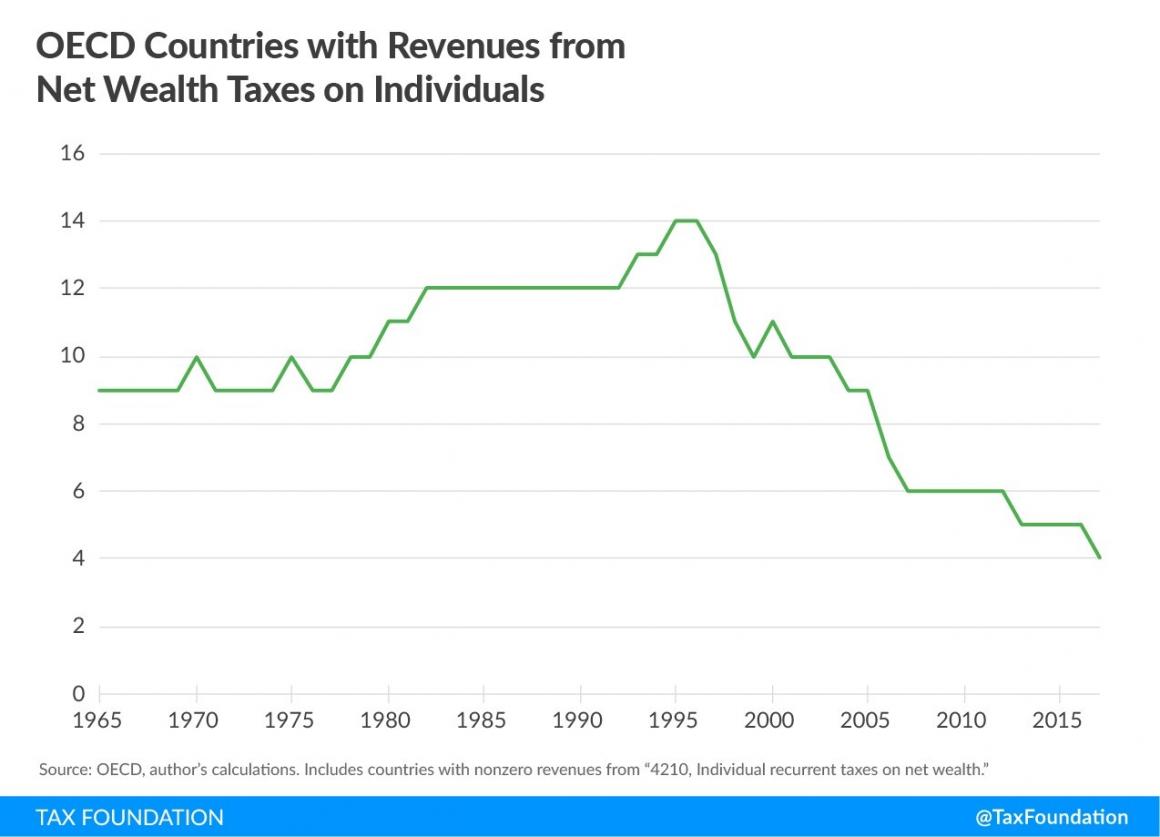
Which is one of the reasons why other nations have been repealing this class-warfare levy.

Here’s a chart from the Tax Foundation showing the number of developed nations with wealth taxes from1965-present.

Jun-25-19-Tax-Foundation-Chart.jpg


Be seeing you

25+ Best Memes About Pick Up Lines | Pick Up Lines Memes


Posted in Uncategorized | Tagged: , , , | Leave a Comment »

Sanders Wonders if Warren Is Surging in Polls Because She Is a Woman

Posted by M. C. on June 21, 2019

Blowback!

It must be shocking when policies meant to be burdened by the unwashed masses affect the people that create those policies.

https://www.breitbart.com/politics/2019/06/20/sanders-wonders-warren-surging-polls-she-woman/

by HANNAH BLEAU

Sen. Bernie Sanders (I-VT) is unsure what to make of Sen. Elizabeth Warren’s (D-MA) recent surge in the polls and told CNN on Wednesday that it could have something to do with her status as a woman.

Sanders tried to make sense of Warren’s recent surge during a Wednesday appearance on CNN. Chris Cuomo asked him if people view Warren as a “more electable version” of himself.

Instead of answering the question, Sanders brought up Warren’s status as a woman, subtly implying people may be supporting her simply because of that…

Be seeing you

Bernie


Posted in Uncategorized | Tagged: , | Leave a Comment »