MCViewPoint

Opinion from a Libertarian ViewPoint

Posts Tagged ‘Fed’

How Government-Guaranteed Student Loans Killed the American Dream for Millions – Foundation for Economic Education

Posted by M. C. on December 4, 2019

The government’s backing of student loans has caused the price of higher education to artificially rise; the demand would not be so high if college were not a financially viable option for some.

He is talking about Fed (“government”) money.

https://fee.org/articles/how-government-guaranteed-student-loans-killed-the-american-dream-for-millions/

n Basic Economics, Thomas Sowell wrote that prices are what tie together the vast network of economic activity among people who are too vastly scattered to know each other. Prices are the regulators of the free market. An object’s value in the free market is not how much it costs to produce, but rather how much a consumer is willing to pay for it.

Loans are a crucial component of the free market because they allow consumers to borrow large sums of money they normally would not have access to, which are later paid back in installments with interest. If the borrower fails to pay back the loan, the lender can repossess the physical item the loan purchased, such as a house or car.

Student loans are different. Education is abstract; if they’re not paid back, then there is little recourse for the lender. There is no physical object that can be seized. Student loans did not exist in their present form until the federal government passed the Higher Education Act of 1965, which had taxpayers guaranteeing loans made by private lenders to students. While the program might have had good intentions, it has had unforeseen harmful consequences.

The Problem with Government-Backed Student Loans

Millennials are the most educated generation in American history, but many college graduates have tens of thousands of dollars in debt to go along with their degrees. Young Americans had it drilled into their heads during high school (if not earlier) that their best shot—perhaps their only shot—at achieving success in life was to have a college diploma.

This fueled demand for the higher education business, where existing universities and colleges expanded their academic programs in the arts and humanities to suit students not interested in math and sciences, and it also led to many private universities popping up to meet the demands of students who either could not afford the tuition or could not meet the admission criteria of the existing colleges. In 1980, there were 3,231 higher education institutions in the United States. By 2016, that number increased by more than one-third to 4,360.

Secured financing of student loans resulted in a surge of students applying for college. This increase in demand was, in turn, met with an increase in price because university administrators would charge more if people were willing to pay it, just as any other business would (though to be fair, student loans do require more administration staff for processing).  According to Forbes, the average price of tuition has increased eight times faster than wages since the 1980s. In 2018, the Federal Reserve estimated that there is currently $1.5 trillion in unpaid student debt. The Institute for College Access and Success estimates that in 2017, 65 percent of recent bachelor’s degree graduates have student loans, and the average is $28,650 per borrower.

The government’s backing of student loans has caused the price of higher education to artificially rise; the demand would not be so high if college were not a financially viable option for some. Young people have been led to believe that a diploma is the ticket to the American dream, but that’s not the case for many Americans.

Financially, it makes no sense to take out a $165,000 loan for a master’s degree that leads to a job where the average annual salary is $38,000—yet thousands of young people are making this choice. Only when they graduate do they understand the reality of their situation as they live paycheck-to-paycheck and find it next-to-impossible to save for a home, retirement, or even a rainy-day fund…

How to Fix the Problem

There are two key steps to addressing the student loan crisis. First, there needs to be a major cultural shift away from the belief that college is a one-size-fits-all requirement for success. We are beginning to see this as many young Americans start to realize they can attend a trade school for a fraction of what it would cost for a four-year college and that they can get in-demand jobs with high salaries.

Second, parents and school systems should stress economic literacy so that young people better understand the concepts of resources, scarcity, and prices. We also need to teach our youth about personal finances, interest, and budgeting so they understand that borrowing a large amount of money that only generates a small level of income is not a sound investment.

Finally, the current system of student loan financing needs to be reformed. Schools should not be given a blank check, and the government-guaranteed loans should only cover a partial amount of tuition. Schools should also be responsible for directly lending a portion of student loans so that it’s in their financial interest to make sure graduates enter the job market with the skills and requirements needed to get a well-paying job. If a student fails to pay back their loan, then the college or university should also share in the taxpayer’s loss. Only when the demand for higher education decreases will we witness a decrease in its cost.

Be seeing you

Posted in Uncategorized | Tagged: , , , | Leave a Comment »

Here Is The Real Reason The Fed Restarted QE | Zero Hedge

Posted by M. C. on October 20, 2019

I don’t pretend to understand all this but it appears to me it didn’t help the first couple times.

https://www.zerohedge.com/markets/here-real-reason-fed-restarted-qe

In the past month, a feud has erupted in the financial media and across capital markets between defenders of the Fed, who praise the return of its unprecedented easing in the form of $60BN in monthly T-Bill purchases, by refusing to call it by its real name, and instead the Fed’s fanclub calls it “not QE” (just so it doesn’t appear that ten years after the Fed first launched QE, we are back to square one), and those who happen to be intellectually honest, and call the largest permanent expansion in the Fed’s balance sheet, meant to ease financial conditions and boost liquidity across the financial sector, for what it is: QE.

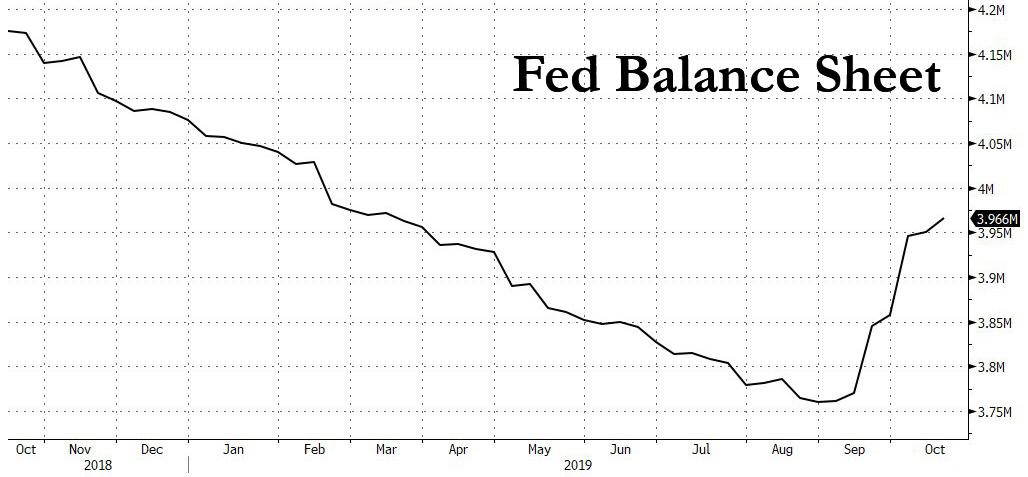
It is this same “not QE” that has boosted the Fed’s balance sheet by $200BN in one month, the fastest rate of increase since the financial crisis.

Yet while the Fed’s desire to purchase Bills instead of coupon Treasuries was dictated by its superficial desire to distinguish the current “Not QE” from previous “True QEs”, even though both tends to inject the same amount of liquidity into the system, which as a reminder is what the Fed’s bailout role in the past 11 years has all been about, and only true Fed sycophants are unable to call a spade a spade, the Fed’s choice raises a rather thorny question of where the Fed will source those T-bills, because as JPMorgan calculates, the net supply of Bills in 4Q19 and 1Q20 is around $115-$130bn while JPM’s economists estimate that at least $200-$250bn of purchases could be required to return reserves to around $1.5tr where they were in early September this year.

That means the Fed might need to source purchases from money-market funds and foreign central banks – which paradoxically would serve to further drain liquidity out of the system. As such, given the limited alternatives, JPM’s Nikolas Panagirtzoglou believes that the Fed may be reluctant to do so and if they do, some may chose to leave cash in the Fed’s ON RRP facility which would represent a drain on reserves and make T-bills a less efficient vehicle for reserve creation.

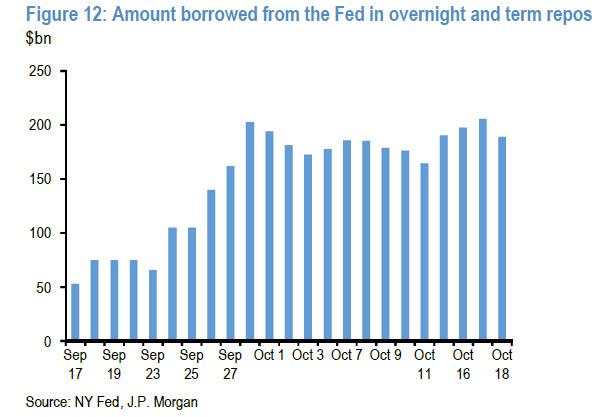
Another key question: what if just returning to the previous reserve baseline is not sufficient, and the Fed needs to return reserves to a higher level than $1.5tr? Indeed, with close to $200bn of reserves injected via overnight and term repos for much of this week…

… helping to return reserves to around $1.5tr on a temporary basis from less than $1.4tr in mid-September, money markets appear especially vulnerable to volatility.

Indeed, in a week when the Treasury’s General Account with the Fed increased by $60bn, depleting reserves, both Fed Funds and the broader OBFR rates median rates rose again to 10bp above IOER on Tuesday Oct 15th after having settled at around 3bp above IOER and at IOER respectively after the quarter-end hurdle had been cleared. And the SOFR median rate rose to 20bp above IOER after having settled at 2-5bp above IOER after the quarter-end effects had settled.

There is another reason why the Fed’s stated intention to only buy Bills will soon have to be adjusted to incorporate short-maturity (at first) Treasury bonds, and it has to do with the total open market purchases planned by the Fed. If the Fed would need to return reserves to a higher level, say to around the $1.7tr level in Dec 2018 when the 75th percentile of the Fed funds market began to persistently print above IOER, this could imply a further $200bn of purchases. JPM finds that “in principle” this could be completed in 2Q20 if the Fed were to sustain T-bill purchases at a pace of $60bn per month, which it set as the initial pace, but it would still imply a longer period of reserves being at a relatively tight level than if $1.5tr would be a sustainable level. But that would assume purchases at a continuous (rather than initial) pace of $60bn/m pace are sustainable, and ignores the prospect that purchases from MMFs and foreign central banks could prompt them leaving cash in the Fed’s ON RRP facility thereby draining some of the intended reserve injection.

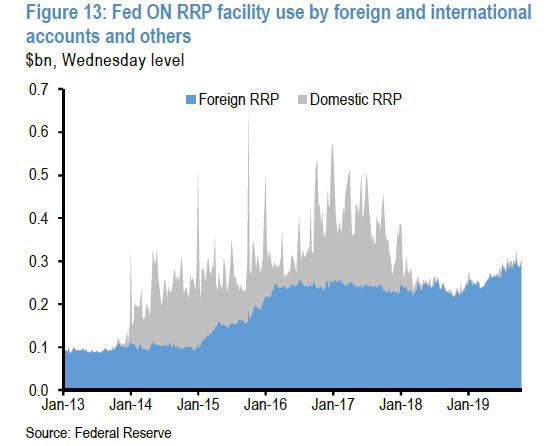
Currently, close to $300bn of cash has been deposited with the Fed via the ON RRP facility, primarily by foreign RRP counterparties for whom the nearly $300bn is close to its recent highs. By contrast, other, largely domestic,  counterparties’ use of the ON RRP facility has collapsed to just $2bn, well below a high of nearly $450bn in late 2015, as institutions have a far more pressing needs for cash (liquidity) than collateral securities (“collateral shortage” was the big story in 2014-2017, just ask Zoltan Pozsar).

If T-bill purchases start to put upward pressure on ON RRP facility use, the Fed may eventually need to extend purchases to shorter-maturity Treasury bonds….

Be seeing you

Quantitative Easing….Forever! - Verified Tasks

Posted in Uncategorized | Tagged: , , , | Leave a Comment »

War, Economic Ruin, and Liberty Destruction Will Never End – LewRockwell

Posted by M. C. on October 4, 2019

“The Federal Reserve System is not Federal; it has no reserves; and it is not a system at all, but rather, a criminal syndicate.” ~ Eustace Mullins

https://www.lewrockwell.com/2019/10/gary-d-barnett/war-economic-ruin-and-liberty-destruction-will-never-end-until-the-federal-reserve-is-abolished/

By

“Sneaky and underhanded, the Federal Reserve has been sucking the life blood out of the United States since 1913. Like a black widow spider, it weaves a web of corruption and deceit. Unknown to its prey, the FED’s bite is poisonous, deep, long-lasting and brings financial upheaval and misery to Americans.” 
~ Jim McCarthy, The Money Spiders, the Ruin-NATION of the United States by the Federal Reserve

Do any of the common people ever question the driving force of corruption, financial destruction, and war that is the basis of most all United States domestic and foreign policy? Do any understand that those who control the money control the entirety of government and commerce? Do any understand that wars of aggression cannot be fought without the power to create an unlimited supply of money? Do any understand that those few elites that control the banking system also control the politicians? The central planning of money is anathema to freedom and all that is honest and right.

The general population has never understood the real importance of money beyond the boundaries of its everyday function. And so-called intellectuals, those who pontificate about economic affairs, rarely have any ability to grasp the massive scope of its effects on every aspect of life and power. Money existed long before government, and the only reason for it to become the business of government was for the sole purpose of control of the people. The government is the middleman in a fascist relationship with the real power, the banking magnates.  Without outside interference, money would have remained a private matter of individuals, and could not have been used to empower the state and its controllers.

The construct of central banking in the United States, culminating in the creation of the Federal Reserve, was the single most damaging legislation affecting freedom and free market economics. For without the ability to print and control money at will, the banking system and its pawns in the political class could never have gained such massive power over the people as exists today.

Current monetary policy, better referred to as the criminal takeover of money for the benefit of the few, is what drives the many nefarious activities of the ruling class of this country. These policies are responsible for uncontrolled spending, uncontrolled debt, almost total economic manipulation and ruin, and continuous war. The general populace at this stage is mostly dependent on this system of largesse deliberately created for the purpose of control, and almost none understand it. This of course is by design. It was rather an easy task for the elite bankers to turn the concept of money into complicated economic theory that the average citizen could never comprehend.

The Federal Reserve is private but is in business with the governing system. To solidify this point, the Supreme Court ruling in 1928 stated: “Instrumentalities like the national banks or federal reserve banks, in which there are private interests, are not departments of the government. They are private corporations in which the government has an interest.” The Fed states openly that “Its monetary policy decisions do not have to be approved by the president or anyone else in the executive or legislative branches of government, it does not receive funding appropriated by the Congress, and the terms of the members of the Board of Governors span multiple presidential and congressional terms.” These rulings and admissions expose the conspiracy that exists between private banking and the government in the mission to control all of politics and economics through a corrupt monetary system. (See the video: Century of Enslavement: The History of the Federal Reserve by James Corbett.)

The Federal Reserve rules were written in secret by the banking heads themselves at Jekyll Island, and passed into law by the Congress through collusion in 1913. This banking cartel regulates itself, and has the sole power to issue and control the entire supply of money in the U.S. The Federal Reserve actually has a monopoly on the money in this country. It began with conspiracy, and continues to operate as a conspiracy, even more so today…

The Federal Reserve System causes economic chaos and financial ruin. This has always been the case. It harms liberty, and is largely responsible for almost unlimited funding of the military state and its wars of aggression. It enriches the elite class of rulers, while affording them power over all others. It is the bane of any free society. It should not be “reformed” or audited by its creators; it should simply be abolished.

“The Federal Reserve System is not Federal; it has no reserves; and it is not a system at all, but rather, a criminal syndicate.” ~ Eustace Mullins

Be seeing you

LOL funny cartoon politics comic government image science ...


Posted in Uncategorized | Tagged: , , , | Leave a Comment »

Student Debt Cancellation: A Good Idea AND a Political Hoax, by Steve Penfield – The Unz Review

Posted by M. C. on October 1, 2019

http://www.unz.com/article/student-debt-cancellation-a-good-idea-and-a-political-hoax/

Debt Cancellation will come whether we like it or not. So it’s in everyone’s interest to develop a sensible plan that liberates the (mostly) innocent and assigns responsibility where appropriate.

There are certain moments in history where each person—and eventually the larger community—must decide which path to follow, ultimately leading us in vastly different directions. With the U.S. student debt fiasco now approaching $1.6 trillion and 45 million borrowers, we seem to be rapidly advancing towards such a moment.

At present, one of the biggest problems regarding the student loan debacle is the dismal nature of the polarized “debate.” Not just on debt relief, but on the many dysfunctions of the college system and its financing mechanisms as well.

On one side, we have free-lunch Democrats that want to “give” everything away in order to buy votes and seize control of higher education; their Debt Forgiveness schemes merely dump liabilities onto taxpayers and give banks and colleges a free pass. Republicans and conservatives, meanwhile, prefer to lecture students on the morality of paying your bills, while forgetting that students didn’t create the corrupt system of mandatory college or its skyrocketing costs. That came from “responsible” adults. And both sides insist that federal involvement in all levels of learning is essential.

Since Debt Cancellation is one of those explosive topics that can lead to partisan bickering and empty sloganeering, I should start by saying that I disagree with nearly everything that BOTH official sides are saying. After much searching, I was able to find a few sensible voices in the wilderness as detailed and expanded upon later. But at this point, anything rational or productive on this issue remains strictly forbidden in the mainstream press, which strongly favors centralized banking and collective education, preferably sold in easily digestible sound-bites.

Taking a broader approach to this looming decision, the major themes of this essay are:

  • Weak Arguments against Debt Cancellation from the ‘Right’
  • Weak Arguments for Debt Cancellation and ‘Free’ College from the ‘Left’
  • Winners and Losers of Honest Debt Forgiveness

I’ll try to fill in some related gaps along the way, mainly to address entrenched ideologies on overall education and financing.

My conclusions are: 1) people can learn quite well without federal involvement and the suffocating strings attached, 2) after over a century of massive (over 2,000%) inflationary stresses, Americans could benefit from an overdue Inflation Dividend, and 3) student Debt Cancellation will come whether we like it or not, so it’s in everyone’s interest to develop a sensible debt re-structuring plan that liberates the (mostly) innocent and assigns responsibility where appropriate. As for culpability, I’m talking about banks and colleges, not taxpayers.

For demographics, I don’t mind saying that I turned 50 this year and never had any debt from college when I graduated in 1991, back when state school in New York was pretty cheap. I work in the private sector and find time to research and write on the side, among other things.

Washington Orthodoxy: Education Must Be Centrally Controlled

With “education” becoming increasingly politicized over the last century, it’s hard to find valuable information through the haze of overt and subtle misinformation. As usual, if you follow the money it leads back to a common theme. Total government spending for combined federal, state and local levels (K through college) came to a staggering $1.1 trillion for FY2019. That enormous pot of “free” gold comes with heavy strings attached and influences nearly all modern decisions on the topic of learning.

First of all, both parties in Washington and at the State capitols almost unanimously view individual learning as a group decision. Proceeding from that bias, public schools in America have become burdened with licensing restrictions, teacher credentials and accreditation requirements to justify accessing their “fair” share of public funds. Read the rest of this entry »

Posted in Uncategorized | Tagged: , , , , , | Leave a Comment »

Judy Shelton’s Remarkable Attack on the Fed | Mises Institute

Posted by M. C. on June 13, 2019

https://mises.org/power-market/judy-sheltons-remarkable-attack-fed

Jeff Deist

Judy Shelton’s recent interview with the Financial Times is nothing short of remarkable…

…Consider this salvo against the Fed’s inescapable role as central planner:

How can a dozen, slightly less than a dozen, people meeting eight times a year, decide what the cost of capital should be versus some kind of organically, market supply determined rate? The Fed is not omniscient. They don’t know what the right rate should be. How could anyone?” Ms Shelton said. “If the success of capitalism depends on someone being smart enough to know what the rate should be on everything . . . we’re doomed. We might as well resurrect Gosplan,” she said, referring to the state committee that ran the Soviet Union’s planned economy.

And her attack on the Fed’s outsized role in the economy:

She also said that the Fed should continue to reduce its balance sheet below the $3.5tn target set by Jay Powell, the chairman. “I would rather the Fed be less of an entity. When a central bank buys up government debt, that’s the beginning of compromised finances.”

She also recognizes malinvestment:

“It’s the distorting aspect of the Fed that is the worst aspect — it’s a wag-the-dog situation. People are fixated on the Fed and are making money by arbitraging, trillions of a second after the latest FOMC announcement,” she added.

And she isn’t afraid to support a role for gold in monetary policy:

Ms Shelton has long been sympathetic to the gold standard, which the US fully abandoned in the early 1970s in favour of a flexible exchange rate for the dollar. “People call me a goldbug, and I think, well, what does that make them? A Fed bug,” she says.

“Fed Bugs”! Why didn’t we think of this?

Shelton, who works as an economic adviser to Trump, is not an economist by training. Her PhD in business administration, from Utah State no less, is sure to draw jeers from the Ivy League central bank crowd. But it’s Ivy League economists, after all, who created the last crisis in 2008. And needless to say they’re sounding alarm bells about Mrs. Shelton. The worst offender is former Treasury official Larry Summers, who shamelessly calls Shelton “dangerous.”

Sorry, but a financial terrorist and chief architect of the weaponized derivatives market in the 2000s should have the simple decency to keep quiet and thank his lucky stars he’s not in jail…

Be seeing you

Regulation blizzard: Government adds 1,516 pages to the ...

Posted in Uncategorized | Tagged: , , , | Leave a Comment »

Doug Casey on Why Gold Is Money – Casey Research

Posted by M. C. on November 24, 2018

https://www.caseyresearch.com/casey-daily-dispatch/doug-casey-on-why-gold-is-money

By Doug Casey, founder, Casey Research

It’s an unfortunate historical anomaly that people think about the paper in their wallets as money. The dollar is, technically, a currency. A currency is a government substitute for money. But gold is money.

Now, why do I say that?

Historically, many things have been used as money. Cattle have been used as money in many societies, including Roman society. That’s where we get the word “pecuniary” from: the Latin word for a single head of cattle is pecus. Salt has been used as money, also in ancient Rome, and that’s where the word “salary” comes from; the Latin for salt is sal (or salis). The North American Indians used seashells. Cigarettes were used during WWII. So, money is simply a medium of exchange and a store of value.

By that definition, almost anything could be used as money, but obviously, some things work better than others; it’s hard to exchange things people don’t want, and some things don’t store value well. Over thousands of years, the precious metals have emerged as the best form of money. Gold and silver both, though primarily gold… Read the rest of this entry »

Posted in Uncategorized | Tagged: , , | Leave a Comment »

The Freedom Crisis | Mises Wire

Posted by M. C. on November 18, 2018

https://mises.org/wire/freedom-crisis

The Freedom Crisis

  • 30710200472_2ae79c701a_b.jpg

[This talk was delivered at the Mises Institute’s 2018 Ron Paul-Mises Circle In Lake Jackson, Texas.]

There is a crisis, and only you, and people like you, can get us out of it.

What is this crisis? On the one hand, the statist order is collapsing all around us. America is mired in a futile war in Afghanistan. A belligerent policy toward Iran threatens to bring about a new war in the Middle East. And let’s not forget about North Korea, where the danger of a nuclear war is by no means over.

On the domestic front, the Fed continues the manipulation of our economy which led to the 2008 crisis. Government debt is rising to an unprecedented level.

Thanks to the works of great thinkers and scholars like Ludwig von Mises and Murray N. Rothbard, we know the solution to the problems that the State causes. Freedom is the answer. Only a completely free market economy and a non–interventionist foreign policy can solve our problems.

And people want to hear our message. The magnificent success of Dr. Ron Paul inspires all of us. His books, including End the Fed and The Revolution: A Manifestoare best sellers.

Now we are in a position to understand the crisis I spoke about earlier. Freedom means the right to hold controversial, un-PC opinions, and to act on these opinions, so long as you don’t commit aggression. But today the lunatic left is trying to suppress those who hold opinions like ours. If they had their way, we would be completely silenced. Unfortunately, there are so-called left “libertarians” who have joined this campaign of suppression. They demand that libertarians embrace the complete PC agenda. It is because of this sad situation that we need to support alternative media.

Here is a sample of what we are up against. Jeremy Waldron is a well-known legal academic who has taught at Oxford and now teaches at NYU Law School. In The Harm in Hate Speech, he calls for suppression of so-called “hate speech,” which really means anything that is un-PC.

Hate speech, Waldron tells, us, consists of “publications which express profound disrespect, hatred, and vilification for the members of minority groups”

Why should we restrict hate speech? Waldron says it is like environmental pollution:

tiny impacts of millions of actions — each apparently inconsiderable in itself — can produce a large-scale toxic effect that, even at the mass level, operates insidiously as a sort of slow-acting poison, and that regulations have to be aimed at individual actions with that scale and that pace of causation in mind.

But why does contagion operate only with bad effects? Will not the cumulative effects of a series of individual encounters in which members of minority groups are treated with equal respect generate a positive atmosphere of assurance, in precisely the same way that Waldron postulates for the amassing of hate messages? Waldron assumes without argument a quasi–Gresham’s law of public opinion, in which bad opinion drives out good.

Read the rest of this entry »

Posted in Uncategorized | Tagged: , , , , | Leave a Comment »

Woodrow Wilson Created the Fed, Which Gave Us a War Finance System for the Next 100 Years

Posted by M. C. on May 27, 2018

Following teddy Roosevelt’s lead.

Indeed, Thomas Woodrow Wilson is the father of most of the last century’s ills. His grand crusade gave the world the curse of Stalin and Hitler, which, in turn, fostered the fallacy of the Indispensable Nation and gave rise to Imperial Washington and its destructive projects of global Empire.

Worst of all, his perversion of Carter Glass’ “bankers’ bank” made it possible to finance the Empire on the cheap and to nullify the natural antiwar constituency of middle class taxpayers.

That was Woodrow Wilson’s worst sin of all.

https://russia-insider.com/en/node/23506

David Stockman

Woodrow Wilson’s Folly gave rise to more than the 1,000 year flood of Nazi and Soviet totalitarianism and their state orchestrated campaigns of mass murder.

It also opened the door to massive, cheap war finance. And that baleful innovation has sustained the Empire long after Hitler and Stalin met their maker and the case for the Indispensable Nation had become ragged and threadbare.

Read the rest of this entry »

Posted in Uncategorized | Tagged: , , , | Leave a Comment »

Articles: 1913: The Turning Point

Posted by M. C. on September 12, 2017

There is widespread agreement that Wilson did not always show good judgment – for example, in his blunders in international relations – but in the project of overturning the Founding, he and the movement he led selected their targets shrewdly.  By the time he left office, the American republic was, as they say, history.  The fundamentals of the new regime were in place, and the expansion of government under FDR, LBJ, and Obama was made easy, perhaps even inevitable. Read the rest of this entry »

Posted in Uncategorized | Tagged: , , , | Leave a Comment »

Thank You, Alan Greenspan, Ben Bernanke and Janet Yellen

Posted by M. C. on August 13, 2017

A real estate bubble, just like last time.

Caused by fed easy money, just like last time.

http://feedproxy.google.com/~r/economicpolicyjournal/YZSb/~3/4joxeFdyrGk/thank-you-alan-greenspan-ben-bernanke.html

Be seeing you

Posted in Uncategorized | Tagged: , , , , | Leave a Comment »