MCViewPoint

Opinion from a Libertarian ViewPoint

Posts Tagged ‘Freedom’

TGIF: Bigotry versus Social Cooperation

Posted by M. C. on November 17, 2023

Let’s not have our mutual interest get lost in the heat of controversy.

https://libertarianinstitute.org/articles/tgif-bigotry-versus-cooperation/
by Sheldon Richman

mises2

We who value individualism, freedom, and social cooperation as essential to flourishing should be distressed by the hostile bigotry that has lately reared its ugly head, to some uncertain extent, on the streets and campuses of America and abroad. This is not new. In America we’ve seen it intermittently in both directions on racial issues just in this century. It seems related to an intolerant, zero-nuance, take-no-prisoners, and glib attitude among many contenders over racial, religious, and ethnic controversies.

Now it is showing itself in ugly group chants and more personal communication calling for violence against Jews and Arabs, and perhaps even direct harassment and assault. A couple of people have died. Anti-Semitism and anti-Arabism should be off-limits. Regardless of the target, the unrestrained hostility is frightening on many counts, not least of which is its ominous implications for spontaneous social /market cooperation.

I couldn’t possibly know whether these clashes are common or just fringe opportunism — let’s hope the latter. In the heat of a controversy it is possible to misread innocent events and words. The principle of charitable interpretation ought to apply unless solid evidence to the contrary revokes it. We should also be aware that government officials and the news media, for obvious reasons, might be inclined to exaggerate.

The point is that much could be at stake if impressions are not exaggerated — including the trust and cooperation that characterize market-oriented societies. Social strife can have severe consequences. Even public demonstrations can create rippling animosity.

mises2

We who value individualism, freedom, and social cooperation as essential to flourishing should be distressed by the hostile bigotry that has lately reared its ugly head, to some uncertain extent, on the streets and campuses of America and abroad. This is not new. In America we’ve seen it intermittently in both directions on racial issues just in this century. It seems related to an intolerant, zero-nuance, take-no-prisoners, and glib attitude among many contenders over racial, religious, and ethnic controversies.

Now it is showing itself in ugly group chants and more personal communication calling for violence against Jews and Arabs, and perhaps even direct harassment and assault. A couple of people have died. Anti-Semitism and anti-Arabism should be off-limits. Regardless of the target, the unrestrained hostility is frightening on many counts, not least of which is its ominous implications for spontaneous social /market cooperation.

I couldn’t possibly know whether these clashes are common or just fringe opportunism — let’s hope the latter. In the heat of a controversy it is possible to misread innocent events and words. The principle of charitable interpretation ought to apply unless solid evidence to the contrary revokes it. We should also be aware that government officials and the news media, for obvious reasons, might be inclined to exaggerate.

The point is that much could be at stake if impressions are not exaggerated — including the trust and cooperation that characterize market-oriented societies. Social strife can have severe consequences. Even public demonstrations can create rippling animosity.

See the rest here

Be seeing you

Posted in Uncategorized | Tagged: , , , , , , | Leave a Comment »

Reform Is Not Freedom

Posted by M. C. on September 27, 2023

The biggest infringements on freedom are the welfare-state and the national-security-state way of life under which we live.

But such reform efforts have never been about advancing liberty. That’s because liberty requires the removal of infringements on liberty, not the modification, improvement, or reform of infringements on liberty.

by Jacob G. Hornberger

When I discovered libertarianism more than 40 years ago, the revelation that shocked me the most was that I wasn’t living in a free society. All my life, especially since the first grade in the public schools to which my parents were forced to send me, I had been inculcated with the belief that I lived in a free country. And here I was — in my late 20s — breaking through the inches-thick indoctrination that encased my mind and realizing that it was all a lie. 

It’s got to be an exhilarating and exciting feeling when one is living in a genuinely free society. When I discovered the truth more than 40 years ago, I decided right then and there that I wanted to live a life of freedom before I passed from this life.

The biggest infringements on freedom are the welfare-state and the national-security-state way of life under which we live. In order to achieve a genuinely free society, it is necessary to dismantle these two massive governmental structures and replace them with a structure that is based on the principles of the free market, voluntary charity, and a limited-government republic. 

Unfortunately, long ago some libertarians threw in the towel and gave up on achieving freedom. They convinced themselves that the welfare-warfare state way of life was simply too big, too powerful, and too deeply engrained in the United States and, therefore, that it would be futile to try to eradicate it. 

Therefore, they resigned themselves to coming up with reforms that were designed to improve, fix, reform, or modify the welfare-warfare-state infringements on liberty under which we live. Oftentimes, such libertarians described these reform efforts as “advancing liberty.”

But such reform efforts have never been about advancing liberty. That’s because liberty requires the removal of infringements on liberty, not the modification, improvement, or reform of infringements on liberty.

Let’s imagine we are living in 1855 Alabama.

See the rest here

Be seeing you

Posted in Uncategorized | Tagged: , , , , | 1 Comment »

No State Is Morally Fit to Spread Global “Freedom” | Mises Wire

Posted by M. C. on September 19, 2023

For it is not the function of any state, including the United States, to right the sins of the Decalogue, to spread fire and devastation in order to bring freedom around the globe—as we murdered countless Vietnamese in the name of their “freedom.” And, above all, we must realize that nuclear war is a far bigger threat to liberty than Communism. How’s that for libertarian “realism”?

In short, libertarians must realize that just as, for them, liberty must be the highest political end, in the same way, peace and the avoidance of mass murder must be the highest end of foreign policy.

https://mises.org/wire/no-state-morally-fit-spread-global-freedom

Murray N. Rothbard

[Philosopher] Eric Mack [in his article “Permissible Defense”] uses a device employed by all too many libertarians—of holding the ideal free-market anarchist system or a limited government as virtually equivalent to the current State-ridden system. Thus, he points out quite correctly that isolationism makes no sense as a principle for a free-market protective agency; he leaps from there to the conclusion that, at least for an anarchist, it cannot be a binding principle for the State either. But for an anarchist, the existing State is not a benign if a bit overly cumbersome surrogate for a free-market protection agency. The State is organized crime, murder, theft, and enslavement incarnate. And even for laissez-faire liberals the existing State should be tarred with the same dire labels.

Isolationism is not a principle for free-market defense agencies because there would be no nation-state and therefore no foreign policy for anyone to worry about. But we live, unfortunately, in a world of nation-states, in which each State has arrogated to itself a monopoly of the use of violence over its assumed territorial area. Therefore, to limit the aggressive use of the State, to limit State violence over innocent people as much as possible, the libertarian, be he an anarchist or a laissez-faire liberal, necessarily arrives at the view that at least each State should confine its operations to that area where it has a monopoly of violence, so that no interstate clashes, or, more importantly, injuries wreaked by State A on the population of State B, will be able to occur. The latter point is particularly important in the days of modern technology when it is virtually impossible for State A to fight State B without gravely injuring or murdering large numbers of civilian innocents on both sides.

Therefore, “isolationism”—the confinement of State violence to its own territory—is an important libertarian precept, whether for an anarchist or not. Limiting government to its own territory is the foreign-policy analogue of the domestic injunction of the laissez-faire liberal that the State not interfere with the lives of its own subjects. And isolationism becomes all the more important in our modern age of advanced technological weaponry.

There is an important philosophical error that Mack makes about free-market defense agencies that is quite relevant to our concerns. He maintains that if A uses B as an innocent shield to aggress against C, it is perfectly legitimate for C to shoot B. The problem here is that Mack forgets about the rights of B. Suppose, after all, that B has hired his own defense agency sworn to defend his life and property, and that, for some empirical reason, the agency can’t get to A; would it not then be perfectly legitimate for B or his agent to shoot C in self-defense? The answer, of course, is yes. The error committed by Mack is to concentrate on one person, C, and to worry about what C’s moral course of action may be, while forgetting about B. On a deeper level, Mack’s error—also engaged in by many others, of course—is to confuse morality and rights, that is, to be concerned about what actions of C may or may not be moral while ignoring what the rights are of the various parties in the given situation. To put it succinctly, it may well be that in the shield situation, it is moral for C to shoot B in order to save his own life; but even though moral, it is also murder, and a violation of B’s rights. This error stems from Mack’s unfortunate view that rights as such all disappear in emergency, “lifeboat” situations.

Thus, the political philosopher should not be concerned with morality per se; he should be concerned with that subset of morality dealing with rights.

See the rest here

Be seeing you

Posted in Uncategorized | Tagged: , , , , , | Leave a Comment »

Radical Decentralization Was the Key to the West’s Rise to Wealth and Freedom | Mises Wire

Posted by M. C. on June 29, 2023

Raico continues:

Although geographical factors played a role, the key to western development is to be found in the fact that, while Europe constituted a single civilization—Latin Christendom—it was at the same time radically decentralized. In contrast to other cultures—especially China, India, and the Islamic world—Europe comprised a system of divided and, hence, competing powers and jurisdictions.3

https://mises.org/wire/radical-decentralization-was-key-wests-rise-wealth-and-freedom

Ryan McMaken

It is not uncommon to encounter political theorists and pundits who insist that political centralization is a boon to economic growth. In both cases, it is claimed the presence of a unifying central regime—whether in Brussels or in Washington, DC, for example—is essential in ensuring the efficient and free flow of goods throughout a large jurisdiction. This, we are told, will greatly accelerate economic growth.

In many ways, the model is the United States, inside of which there are virtually no barriers to trade or migration at all between member states. In the EU, barriers have been falling in recent decades.

The historical evidence, however, suggests that political unity is not actually a catalyst to economic growth or innovation over the long term. In fact, the European experience suggests that the opposite is true.

Why Did Europe Surpass China in Wealth and Growth?

A thousand years ago, a visitor from another planet might have easily overlooked Europe as a poor backwater. Instead, China and the Islamic world may have looked far more likely to be the world leaders in wealth and innovation indefinitely.

Why is it, then, that Europe became the wealthiest and most technologically advanced civilization in the world?

Indeed, the fact that Europe had grown to surpass other civilizations that were once more scientifically and technologically advanced had become apparent by the nineteenth century. Historians have debated the question of the origins of this “European miracle” ever since. This “miracle,” historian Ralph Raico tells us:

consists in a simple but momentous fact: It was in Europe—and the extensions of Europe, above all, America—that human beings first achieved per capita economic growth over a long period of time. In this way, European society eluded the “Malthusian trap,” enabling new tens of millions to survive and the population as a whole to escape the hopeless misery that had been the lot of the great mass of the human race in earlier times. The question is: why Europe?1

Across the spectrum of historians, theories about Europe’s economic development have been varied, to say the least.2 But one of the most important characteristics of European civilization—ever since the collapse of the Western Roman Empire—has been Europe’s political decentralization.

See the rest here

Be seeing you

Posted in Uncategorized | Tagged: , , | Leave a Comment »

There Goes the Neighbourhood

Posted by M. C. on June 19, 2023

By every standard, she’s a “loyal American.” However, she’s not by any means stupid. Recently, she’s come to realise that her loyalty is not to the government of her country, but to the concept that her country was founded on. She’s leaving for what people always leave for: better opportunities, greater freedom, and an escape from the fear that her home country’s direction will not end well.

And yet, she’ll be going alone, with few of her peers believing she is making the right choice.

For anyone who is questioning whether to make an exit, the question should not be, “Can I survive this if I remain here?” It should be, “Is there a better future elsewhere?”

by Jeff Thomas

Throughout history, there have been periods when people who were otherwise quite settled in their towns and villages, pulled up stakes and headed elsewhere.

During the decline of Rome, many of those who had been the net producers chose to move north and live amongst the barbarians, as life amongst them, although less sophisticated than in Rome, offered more freedom and opportunity. Certainly, it must have been a difficult decision, but for many, it proved to be for the best.

In the 17th century, the Pilgrims also sought greater freedom. Initially, they attempted a socialistic approach to farming (from each according to his ability; to each according to his need), and most died as a result of this faulty logic. In desperation, those remaining opted for a change to a free-market system. The following year, the resultant productivity led them to hold the first Thanksgiving.

The Amish, too, sought greater freedom and found it in America. In the 19th century, many other Europeans moved across the ocean to America in search of a more fruitful way of life.

Since that time, many Americans have moved within the US. Farmers from Oklahoma went west out of desperation when their crops failed due to a prolonged drought. By contrast, millions of Americans moved out to suburbia in the 1950s, following the dream of a house with a white picket fence, away from the crime, smog, and crowding that had taken over the cities.

Some of these people travelled a long way; some travelled less than fifty miles. Some went out of desperation; some relocated due to the promise of upward mobility. What they had in common is that they all made their moves because the grass appeared greener elsewhere.

Historically, such people have always been praised for their gumption. But history is hindsight. At the time when they made their moves, there were many, many people who remained behind, urging those exiting not to go. Again historically, those who remained behind have always ended up as the forgotten ones, as they did not have the fortitude to make the change. They did not go forth to build the next new neighbourhood or new country.

It should be said that the majority rarely leave a neighbourhood (both in the village sense and the country sense). Most remain behind and become casualties of the decline. A dying city (Detroit in the US? Bradford in the UK?) never completely empties out. Many people remain behind, clinging to whatever scraps are tossed to them.

See the rest here

Be seeing you

Posted in Uncategorized | Tagged: , , , | Leave a Comment »

Secession Means More Choices, More Freedom, Less Monopoly Power | Mises Wire

Posted by M. C. on June 12, 2023

For now, however, proposed superstates such as the EU are “still unable to discipline States,” meaning the power of the “continental super-state” is rendered far weaker because the budding international power is regarded as an “outside” force distinct from the persons and institutions within the borders of the resistant member states. The fact that each member state still, more or less, controls its own borders—and thus maintains a separate identity and jurisdiction—limits the power of the nascent EU state.

Key Word: Borders

https://mises.org/wire/secession-means-more-choices-more-freedom-less-monopoly-power

Ryan McMaken

[This article is Chapter 1 of Breaking Away: The Case for Secession, Radical Decentralization, and Smaller Polities. Now available at Amazon and in the Mises Store.]

Because of their physical size, large states are able to exercise more state-like power than geographically smaller states—and thus exercise a greater deal of control over residents. This is in part because larger states benefit from higher barriers to emigration than smaller states. Large states can therefore better avoid one of the most significant barriers to expanding state power: the ability of residents to move away.

The significance of this in practice becomes more clear if we consider the extreme and hypothetical case of a world with a single state. In this case, a person has no other choices at all. The number of actual choices equals zero, since our hypothetical megastate has a monopoly over the entire world. That is, a single global state is the most powerful state possible and a fully-formed state in the strictest sense. It has a complete and total monopoly of force over its population since its citizens cannot escape the state even if they emigrate. There is nowhere that they can emigrate to.

On the other hand, a world composed of hundreds, thousands, or even tens of thousands of states (or regimes of varying types) would offer many choices to residents who might wish to change their living situation.

The smaller states become, the more practical relocation options become for residents. This is due to the fact that proximity to the resources and people one desires to be near does matter as a real physical constraint. If one can escape a large state’s jurisdiction only by emigrating one thousand miles, this is a considerably different situation than in the case of a small state from which exit requires only emigrating fifty miles. In the words of Kirkpatrick Sale, these smaller states are closer to “human scale.”1

The realities of time and distance and travel mean that emigration to distant locales will limit one’s ability to share time and resources with family, friends, and loved ones left behind. Emigration to a location within a few hours’ drive, on the other hand, requires far fewer lifestyle changes.

Similarly, if emigration requires adaptation into a radically different culture and language, this will further limit the practicality of emigration for those who are not fluently multilingual. Thus, states have benefited considerably from the fact that many states enjoy monopolies on linguistic areas (which states reinforce through strategies like public education and the designation of “official” languages). For example, if one speaks only Swedish, one has a big incentive to stay in Sweden, and if one only speaks Greek, the personal cost of leaving Greece can be very high indeed. Even in the case of English, which is seen as being spoken internationally, it’s significant that a majority of native English speakers live under a single state—the United States. The implications of this for potential emigrants are evident.

But, once states can extend their monopolies over vast expanses of land, linguistic areas, and cultural areas, emigration becomes even more difficult. States in these cases are more easily able to increase their taxation and regulatory power over a population without danger of losing significant amounts of tax revenue due to migration.

In the case of a small state, however, many of these cultural, linguistic, and distance-based barriers are greatly lessened. Were the United States actually composed of fifty (or more) truly independent political jurisdictions, residents could emigrate from region to region with less trouble in terms of adapting to local languages and culture. In the case of a move from Virginia to North Carolina, for example, it would still be practical in many cases for emigrants to regularly return to visit friends and family with relative ease.

This would become all the more true were these jurisdictions reduced in size even more—to the size of a metropolitan area or even a municipality.

In fact, we often see this at work even in partially decentralized political jurisdictions. In the US, for example, Americans and businesses often move across city and county lines to avoid certain regulations, to lower their taxes, or to take advantage of better amenities.

When the city of Chicago in 2006 imposed a number of high regulatory hurdles against Wal-Mart, the retail giant elected to simply move one block away from the Chicago city limit, thus depriving the city of tax revenues, but allowing Wal-Mart access to Chicago’s consumer population.2 If subunits in a confederation are appropriately small, “emigration” might be a matter of moving a few miles down the road, making the practical cost of emigration very low indeed.

Life In a Microstate

Now, imagine a world composed of tiny states the size of small cities. 

See the rest here

Be seeing you

Posted in Uncategorized | Tagged: , , | Leave a Comment »

Freedom, Power & The Choice That We Each Need To Make

Posted by M. C. on April 19, 2023

https://rumble.com/v2is9gs-freedom-power-and-the-choice-that-we-each-need-to-make.html

Be seeing you

Posted in Uncategorized | Tagged: , | Leave a Comment »

Violent Protest Is a Death Knell to Freedom – LewRockwell

Posted by M. C. on March 28, 2023

Millions are in the streets, but when they were locked down, imprisoned in their own homes, subject to mandatory poisonous bio-weapon injections, masked, their jobs lost, and their economy destroyed, they did not protest in this manner. But they are now burning cars, buildings, rioting, throwing fire bombs and rocks, harming private businesses all over the city; all in what looks like a war zone, to attempt to gain State welfare pensions.

All this type of ‘protesting’ accomplishes, is to give ammunition to all the State’s political scum and their enforcement thugs called police and military, in order to falsely legitimize the use of extreme force against its own citizenry.

https://www.lewrockwell.com/2023/03/gary-d-barnett/violent-protest-is-a-death-knell-to-freedom/

By Gary D. Barnett

“I object to violence because when it appears to do good, the good is only temporary; the evil it does is permanent.”

Mahatma Gandhi, The Essential Gandhi: An Anthology of His Writings on His Life, Work, and Ideas

There are different types of protest, few of value, but in reality, when protesting authoritarian rule or government, the best and most legitimate response is one of negation of the State, negation of compliance; in other words, complete disobedience and ignoring all aspects of State rule and mandates at every opportunity possible. This approach in fact, is the only justifiable way to stop oppression and tyranny without becoming the same evil that is the enemy oppressor. Self-defense is another matter, as when confronted physically, or when great harm to self, family, or other innocents is active and present, equal or greater force may be required to stop the threat.

In today’s world, a world consumed by contradiction, indifference, immorality, and theatre, protest more often than not is about the show, not about actually putting down the threat of the State. Usually, the collective demonstrations in the streets are meant to gain, temporarily of course, notoriety, herd acceptance, and a day or two of a party-like event. Most would not even be there unless they were surrounded by the crowd, so as to obtain what they falsely perceive as a protective shield of bodies; bodies meant to hide their actual cowardice. As soon as the cameras leave, as soon as the crowd begins to disperse, as soon as their cover disappears, they all run away to their ‘normal (abnormal) existence. They remove their masks, they drop their signs, and are at once not seething with rage or rightful anger, nor do they any longer pursue any worthwhile cause of freedom. They are again on the sideline waiting for some savior to grant them redress from the tyranny they allow. It turns out more like a movie set at the end of the day, where all the actors go home, only awaiting the next curtain call. It is merely an acted out and worthless spectacle, usually with the obvious performing speakers seeking an audience for their own advancement or benefit, while using the crowd of sheep to enhance their popularity.

When these events get out of hand, which is often; many times at the behest of speakers or agitators, violence erupts, and actual protest is the last thing on the minds of these phony protestors. Even before violent aggression takes center stage, many innocents and their property may have been harmed due to the manner and scope of these gatherings, but their rights and freedoms are ignored, usually in the asinine name of the  so-called ‘greater good.’ This dynamic has been evidenced all over the world, including in many circumstances in this country. Consider all that happened during the fake ‘covid’ era. Consider the insane staged Trump protests, where crowds of brainless dolts were running amuck, just as they were enticed and permitted to do. Once over, the State used its plan to arrest and jail protesters, and even kill one of them, while their hero Trump egged them on, just as he is doing again. Consider the horrendous garbage calling themselves the BLM or Antifa, all let loose on society by a governing cabal meant to purposely stoke hate and violence in order to divide. All of this of course, was made easy due to the lack of quality of those individuals involved in these fake protests, which included those on all sides. It is as if the directors are following the script, and the bulk of people are but mere extras, doing everything they are told to do without question. It is a pathetic display to be sure.

See the rest here

Be seeing you

Posted in Uncategorized | Tagged: , , , | Leave a Comment »

Deconstruction: Why Leftist Movements Cannot Coexist With People That Value Freedom – Alt-Market.us

Posted by M. C. on February 27, 2023

The deconstruction mindset views nothing as sacred and this includes moral compass. While arguing from a position of moral superiority, the political left will often rationalize highly immoral practices. For example, this is why we now see aggressive attempts by leftists to normalize the indoctrination of very young children into trans activism. This is why we are seeing hundreds of gender affirmation clinics with procedures for children springing up all over the country. This is why we are seeing numerous sexualized drag shows for kids, and why highly sexualized reading materials are being planted in school libraries.

https://alt-market.us/deconstruction-why-leftist-movements-cannot-coexist-with-people-that-value-freedom/

By Brandon Smith

It should be clear to anyone paying attention during this current stage of instability in our modern era that something is very wrong in terms of American society. I’m not talking about ongoing issues of political corruption and economic mismanagement, I’m talking about something much more dangerous. I’m talking about the systematic derailment of our culture, heritage, principals, history and moral compass. I’m talking about the vicious devouring of the very sinews that hold our civilization together.

There is a cancer eating away at America, a concerted and organized effort to destabilize. For anyone who is familiar with the Conjuring movies, it’s a bit like a demonic invasion. As Ed Warren cautions, the three stages of attack are infestation, oppression and finally, possession. The little demon we are dealing with, though, comes with Antifa patches, rainbow flags and special pronouns.

This week I came across a statement by Georgia representative Marjorie Taylor Greene in which she called for a “national divorce”, a separation of conservative red states and far left blue states, a parting of ways due to our obvious irreconcilable differences. Leftists within the corporate media, of course, flipped out, accusing Greene of inciting treason and the destruction of the US.

While I don’t generally put much stock in the comments of politicians I think it’s important to address this particular sentiment because it echos the arguments made by the Liberty Movement and the alternative media for many years. It’s just surprising to hear a prominent public figure say what we have been saying for so long.

The frantic upheaval expressed by the political left in reaction to Greene is something I have written about in the past. In my article ‘Separation Or Purge? Sharing A Society With The Political Left Is Impossible’ published in February last year, I noted that leftists take a communistic approach to civil disagreement. They see the populace as chattel to be managed in the name of the greater good of the collective, not as individuals with the right to disassociate. From my article:

Why not carry this process forward to its natural conclusion? Red states break from blue states and red counties break from blue state control and we live our lives the way we see fit. Let the leftists continue with their draconian economic and political models and see how well that goes for them. I guarantee they will be in financial ruins within a decade (the list of most indebted places in the country is dominated by blue states) and they will be begging to return to a union with red states (except for the zealots, which would lose influence as they continue to fail).

But this will not happen peacefully because, again, leftists cannot tolerate free activity. Their OCD will not allow them to be content with living in a collectivist state of their own; ALL states must be collectivist before they are satisfied. People are property to them; property of the collective, and people who are property cannot be allowed to make decisions without oversight.”

See the rest here

Be seeing you

Posted in Uncategorized | Tagged: , , , | Leave a Comment »

The West’s Betrayal of Freedom

Posted by M. C. on February 20, 2023

Westerners once endlessly propagandized “freedom” as the ultimate democratic virtue. Now, in fear of revolt, the leaders of these countries are mounting an opposite campaign

freedom = danger

https://open.substack.com/pub/taibbi/p/the-wests-betrayal-of-freedom?utm_source=share&utm_medium=android

Matt Taibbi

Justin Trudeau might have a “too much freedom” problem, but that doesn’t mean anyone else does.

“Freedom cannot exist without order.” — Canadian Justice Paul Rouleau

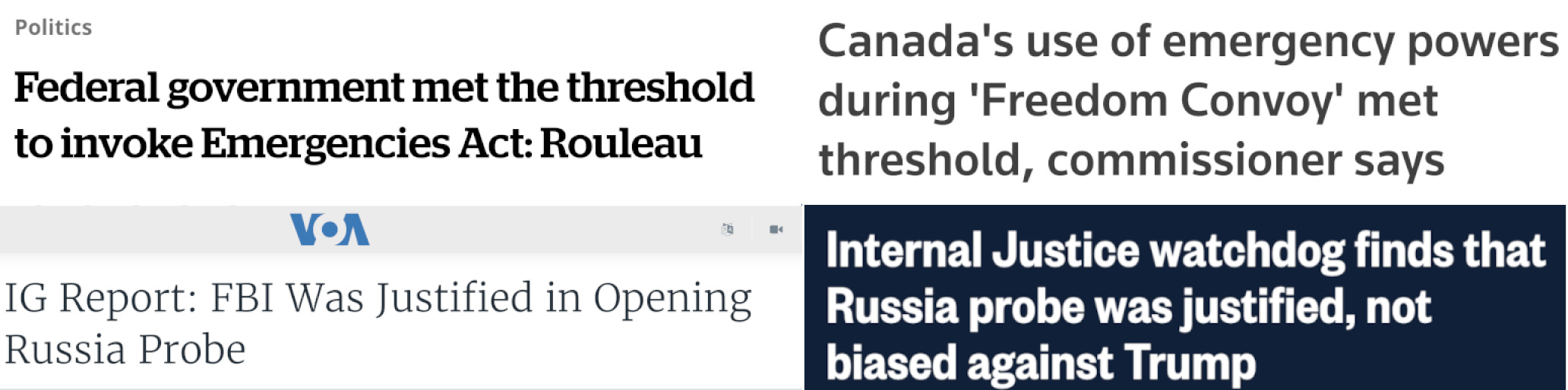
The Honorable Justice Paul Rouleau’s “Report of the Public Inquiry into the 2022 Public Order Emergency,” an analysis of Justin Trudeau’s decision to institute Canada’s Emergencies Act and seize funds during last year’s trucker protests, blasted across Canadian media this weekend, reduced to a handful of headlines. As has become the norm in Western media, language was nearly identical:

  • Trudeau’s ‘Freedom Convoy’ shutdown was justified, inquiry rules – Politico
  • Canada’s use of emergency powers during ‘Freedom Convoy’ met threshold, commissioner says – Reuters
  • Federal government met the threshold to invoke Emergencies Act: Rouleau – CBC

Rouleau’s report is clearly written by a man with mixed feelings. On one hand, he agreed “the Government did not have a realistic prospect of productively engaging” with those who “believed COVID-19 vaccines were part of a vast global conspiracy to depopulate the planet.” At the same time, Rouleau refused to confine “misinformation and disinformation” to protesters:

Protest organizers’ mistrust of government officials was reinforced by unfair generalizations from some public officials that suggested all protesters were extremists… Where there was misinformation and disinformation about the protests, it was prone to amplification in news media… The fact that protesters could be at once both the victims and perpetrators of misinformation simply shows how pernicious misinformation is in modern society.

In the report you also find significant criticism of Canda’s Covid-19 policies and heavy-handed emergency measures like allowing Canada’s Border Services Agency (CBSA) to keep foreigners out. Rouleau even said he came to his main conclusion, that Trudeau’s invocation of the Emergencies Order was legal, “with reluctance.”

But such musings have no propaganda benefit, and Rouleau’s report was reduced to a single thought, that Trudeau’s Emergencies Order “Met the Threshhold.” This was almost exactly like the American press reaction to the 2019 report by Department of Justice Inspector General Michael Horowitz, which tore into FBI malfeasance for hundreds of pages but gave the press the headline it wanted: “Justice Watchdog Finds Russia Probe Was Justified, Not Biased Against Trump.”

Déjà vu? No matter what a report says or how many pages it takes to say it, a single phrase — “justified,” or “met the threshold” — can override everything

Toronto Star columnist Susan Delacourt expounded on the theme, in a piece called, “‘Freedom’ has been a weaponized word. The Emergencies Act report finally tells us what it means.”

The article, which rails against the “warped idea of freedom… populism, and misinformation being sprayed all over social media,” reads like all the tsk-tsking editorials in the West you’ve read since Trump, which used every crisis to hype the idea that freedom = danger. It wasn’t long ago that a person couldn’t go outside without having the word “freedom” jammed in his or her ear, whether it was Mel Gibson yelling it over his hair extensions in Braveheart or Republican congressman Bob Ney engaging in a Pattonesque invasion of the House cafeteria so he could rename your potato-based side dish “Freedom Fries.”

See the rest here

Be seeing you

Posted in Uncategorized | Tagged: , , | Leave a Comment »