MCViewPoint

Opinion from a Libertarian ViewPoint

Posts Tagged ‘Houthis’

US is Flummoxed by Yemen

Posted by M. C. on May 3, 2025

The truth of the matter is that old Uncle Sam has an impotence problem. Locating and destroying mobile missile platforms is a daunting task, especially in the rugged terrain of Yemen. After seven weeks of bombing the Houthis, Uncle Sam’s carrier strike group has failed to quell the Houthis. Not that the US had a great reputation to begin with, but the bombing of civilian targets inside Yemen, which has produced scores of dead women and children, is only fueling greater hatred of the United States.

Since Trump’s 15 March order to renew attacks on Yemen, the US has lost almost $500 million in planes and drones and failed to guarantee safe passage for Israeli vessels daring to enter the Red Sea. Good job, Mr. Hegseth.

https://ronpaulinstitute.org/us-is-flummoxed-by-yemen/?fbclid=IwY2xjawKB82lleHRuA2FlbQIxMQBicmlkETFkWEhESWdmM0VkaGpDb1Y0AR7Zq5i9MZ7lHjCg6MrqLv9kO9LPm4kUubj9Bk-e5Pf8FR4WqrnVYsay3qcIsA_aem_5dN39OKRgOQPW_WSW8NshQ

by Larry C. Johnson

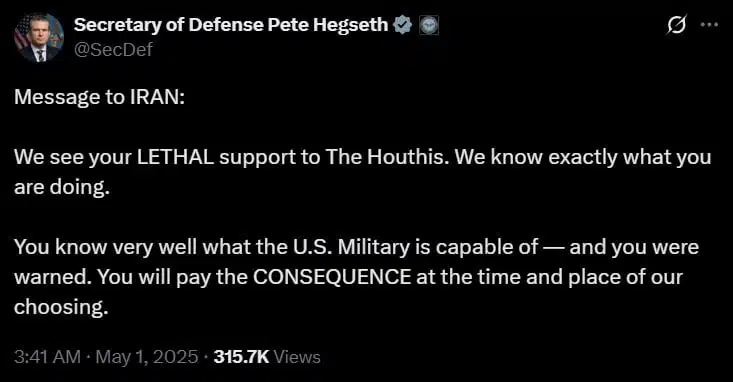
I almost don’t know what to say about Pete Hegseth’s social media post (see above). It is juvenile, counterproductive and dangerous. During my time living in Central America, I learned a very important piece of wisdom… i.e., The fish dies by its mouth. We need a comparable expression for social media posts like this one. Hegseth, like some angry teenager, is upset that Trump’s version of Operation Prosperity Guardian is a bust.

Operation Prosperity Guardian (OPG), which was initiated in December 2023 under the Biden administration, continues to operate under its original name, but has been executed with an intensified ops tempo, as measured by bombing sorties and missile strikes inside Yemen. In February 2025, operational leadership transitioned from Combined Task Force 153 to Destroyer Squadron 50, a U.S. Navy surface warfare unit. The Trump team labored under the false assumption that the Biden folks did not make a serious effort to destroy the Houthis’ arsenal of missiles and drones. The Trumpers believed that they could bomb the Houthis into submission. Instead, the US is demonstrating to all countries in the region the limits of its naval and air power.

See the rest here

Be seeing you

Posted in Uncategorized | Tagged: , , | Leave a Comment »

We Spent a Billion Dollars Fighting the Houthis…and Lost

Posted by M. C. on June 20, 2024

The Ron Paul Liberty Report

Be seeing you

Posted in Uncategorized | Tagged: , | Leave a Comment »

To Hell With Fighting the Houthis!

Posted by M. C. on January 16, 2024

Moreover, the US Navy has not been hired by the UN or any other global body to safeguard every sea lane on the planet. Nor should it take the assignment if offered because the homeland security of America does not depend upon Washington functioning as the gendarmerie of the world.

by David Stockman

antiwar.com

Here we go again. The “Joe Biden” thing just started another war in Yemen without a constitutionally compliant declaration by Congress. And it/they did so against a rag-tag tribe of desert insurgents who cannot possibly harm the liberty or security of the American homeland.

After all, the most fearsome missile possessed by the Houthi is the Burkan-3, which has a maximum range of 750 miles. Yet the last time we checked, the distance from Yemen to Washington DC was 7,200 miles. So why is the GOP leadership branch of the Uniparty saluting Sleepy Joe with a chorus of attaboys?

GOP Senate Leader, Mitch McConnel: I welcome the U.S. and coalition operations against the Iran-backed Houthi terrorists responsible for violently disrupting international commerce in the Red Sea and attacking American vessels. President Biden’s decision to use military force against these Iranian proxies is overdue.

GOP House Speaker Johnson: This action by U.S. and British forces is long overdue, and we must hope these operations indicate a true shift in the Biden Administration’s approach to Iran and its proxies that are engaging in such evil and wreaking such havoc. They must understand there is a serious price to pay for their global acts of terror and their attacks on U.S. personnel and commercial vessels. America must always project strength, especially in these dangerous times.

No, Speaker Johnson, America must not go abroad seeking monsters to destroy, as our sixth president, John Qunicy Adams, stated so cogently nearly 203 years ago on Independence Day. The Red Sea is not the Gulf of Mexico, Long Island Sound or the Gulf of Catalina—meaning that the Houthi blockade on ships heading to Israel in retaliation for the latter’s genocidal assault on Gaza is Jerusalem’s business to treat with, not Washington’s.

See the rest here

Be seeing you

Posted in Uncategorized | Tagged: , , | Leave a Comment »

Abandoning Yemen? – Antiwar.com Original

Posted by M. C. on October 15, 2021

https://original.antiwar.com/?p=2012344217

United Nations Human Rights Council action silences Yemeni human rights victims.

by Kathy Kelly

Monday, October 11, marked the official closure of the U.N. Group of Eminent Experts on Yemen (also known as the Group of Experts or GEE). For nearly four years, this investigative group examined alleged abuses suffered by Yemenis whose basic rights to food, shelter, safety, health care and education were horribly violated, all while they were bludgeoned by Saudi and U.S. air strikes, drone attacks, and constant warfare since 2014.

“This is a major setback for all victims who have suffered serious violations during the armed conflict,” the GEE wrote in a statement the day after the UN Human Rights Council refused to extend a mandate for continuation of the group’s work “The Council appears to be abandoning the people of Yemen,” the statement says, adding that “Victims of this tragic armed conflict should not be silenced by the decision of a few States.”

Prior to the vote, there were indications that Saudi Arabia and its allies, such as Bahrain (which sits on the UN Human Rights Council), had increased lobbying efforts worldwide in a bid to do away with the Group of Experts. Actions of the Saudi-led coalition waging war against Yemen had been examined and reported on by the Group of Experts. Last year, the Saudi bid for a seat on the Human Rights Council was rejected, but Bahrain serves as its proxy.

Bahrain is a notorious human rights violator and a staunch member of the Kingdom of Saudi Arabia-led coalition which buys billions of dollars worth of weaponry from the United States and other countries to bomb Yemen’s infrastructure, kill civilians, and displace millions of people.

The Group of Experts was mandated to investigate violations committed by all warring parties. So it’s possible that the Ansar Allah leadership, often known as the Houthis, also wished to avoid the group’s scrutiny. The Group of Experts’ mission has come to an end, but the fear and intimidation faced by Yemeni victims and witnesses continues.

Mwatana for Human Rights, an independent Yemeni organization established in 2007, advocates for human rights by reporting on issues such as the torture of detainees, grossly unfair trials, patterns of injustice, and starvation by warfare through the destruction of farms and water sources. Mwatana had hoped the UN Human Rights Council would grant the Group of Experts a multi-year extension. Members of Mwatana fear their voice will be silenced within the United Nations if the Human Rights Council’s decision is an indicator of how much the council cares about Yemenis.

“The GEE is the only independent and impartial mechanism working to deter war crimes and other violations by all parties to the conflict,” said Radhya Almutawakel, Chairperson of Mwatana for Human Rights. She believes that doing away with this body will give a green light to continue violations that condemn millions in Yemen to “‘unremitting violence, death and constant fear.’”

The Yemen Data Project, founded in 2016, is an independent entity aiming to collect data on the conduct of the war in Yemen. Their most recent monthly report tallied the number of air raids in September, which had risen to the highest monthly rate since March.

Sirwah, a district in the Marib province, was – for the ninth consecutive month – the most heavily targeted district in Yemen, with twenty-nine air raids recorded throughout September. To get a sense of scale, imagine a district the size of three city neighborhoods being bombed twenty-nine times in one month.

Intensified fighting has led to large waves of displacement within the governorate, and sites populated by soaring numbers of refugees are routinely impacted by shelling and airstrikes. Pressing humanitarian needs include shelter, food, water, sanitation, hygiene, and medical care. Without reports from the Yemen Data Project, the causes of the dire conditions in Sirwah could be shrouded in secrecy. This is a time to increase, not abandon, attention to Yemenis trapped in war zones.

In early 1995, I was among a group of activists who formed a campaign called Voices in the Wilderness to publicly defy economic sanctions against Iraq. Some of us had been in Iraq during the 1991 U.S.-led Operation Desert Storm invasion. The United Nations reported that hundreds of thousands of children under age five had already died and that the economic sanctions contributed to these deaths. We felt compelled to at least try to break the economic sanctions against Iraq by declaring our intent to bring medicines and medical relief supplies to Iraqi hospitals and families.

But to whom would we deliver these supplies?

Voices in the Wilderness founders agreed that we would start by contacting Iraqis in our neighborhoods and also try to connect with groups concerned with peace and justice in the Middle East. So I began asking Iraqi shopkeepers in my Chicago neighborhood for advice; they were understandably quite wary.

One day, as I walked away from a shopkeeper who had actually given me an extremely helpful phone number for a parish priest in Baghdad, I overheard another customer ask what that was all about. The shopkeeper replied: “Oh, they’re just a group of people trying to make a name for themselves.”

I felt crestfallen. Now, twenty-six years later, it’s easy for me to understand his reaction. Why should anyone trust people as strange as we must have seemed?

No wonder I’ve felt high regard for the UN Group of Experts who went to bat for human rights groups struggling for “street cred” regarding Yemen.

When Yemeni human rights advocates try to sound the alarm about terrible abuses, they don’t just face hurt feelings when met with antagonism. Yemeni human rights activists have been jailed, tortured, and disappeared. Yemen’s civil society activists do need to make a name for themselves.

See the rest here

Be seeing you

Posted in Uncategorized | Tagged: , , , , , | Leave a Comment »

Withdraw US Support From Saudi Arabia – Antiwar.com Original

Posted by M. C. on April 23, 2020

Unfortunately, President Barack Obama continued decades of truckling to the Saudis.

Unfortunately, the result was to make Americans accomplices to murder.

This is the country that financed 9/11!

Yet we arm them and Al Qaeda to attack countries that have never attacked US.

https://original.antiwar.com/doug-bandow/2020/04/22/withdraw-us-support-from-saudi-arabia/

After five years of bloody, inconclusive war, Saudi Arabia declared a ceasefire in Yemen. Although hailed as a possible breakthrough for peace, Riyadh’s de facto admission of defeat did not stop the fighting. Moreover, even an effective ceasefire would be at best a halfway measure.

The Kingdom of Saudi Arabia should end its invasion and withdraw its forces. To encourage the KSA to halt a cruel campaign which has killed hundreds of thousands, created millions of refugees, and left most of the population hungry and impoverished, Washington should terminate its support for the needless Saudi war, including sale of weapons and munitions, as well as intelligence sharing.

Modern Yemen has been in crisis since it – originally in the form of two separate states – was born around six decades ago. Saudi Arabia has meddled in its neighbor’s affairs since the beginning, at one point squaring off against Egypt when a royal regime was resisting an ultimately successful military revolt. Riyadh later bribed tribal leaders and spread hateful Wahhabist teaching in Yemen. The Kingdom also aided President Ali Abdullah Saleh after the Ansar Allah (“Supporters of God”) movement, dominated by the al-Houthi tribe, revolted against his government. In contrast, Iran’s involvement was minimal.

The two Yemens united in 1990, but since then the single state has been rent by political discord, civil conflict, and regional separatism. Saleh’s luck ran out in early 2012 when he was ousted after the Arab Spring hit Yemen. But three years later he joined with the Houthis to oust President Abdrabbuh Mansur Hadi, his successor. None of this had much to do with Riyadh and nothing to do with Washington.

However, Saudi Arabia’s ruthless and reckless Crown Prince Mohammed bin Salman believed he could reinstall Hadi in a brief campaign, leaving a compliant regime in Sanaa. This policy was just one of many which turned the once quiescent KSA into the most dangerous and destabilizing regime in the Middle East.

The Kingdom supported jihadist insurgents in Syria, kidnapped Lebanon’s prime minister, underwrote the al-Sisi coup and dictatorship in Egypt, used troops to back Bahrain’s authoritarian minority Sunni monarchy against the majority Shia population, financed civil war in Libya, and sought to overthrow the Qatari monarchy. Domestically the crown prince increased political repression while leaving intact totalitarian religious controls which ban all faiths but Islam. The latest State Department human rights report takes 58 pages to describe the Kingdom’s crimes against its own people. Freedom House gives Riyadh a lower rating for political and civil liberties than Yemen.

Riyadh expected its impoverished neighbor to be an easy target. However, unlike the effete Saudi military the Yemeni people were used to hardship and combat. Under attack by the Saudis backed by Washington, the Houthis turned to Tehran for support, which was eager to bleed the Kingdom.

Even worse for America, the war interrupted Yemeni operations against al-Qaeda in the Arabian Peninsula, the most dangerous of the local affiliates, and other radical groups. Saleh’s government had cooperated with the U.S. against them; the Houthis also battled AQAP. However, both the nominal Hadi government and Saudi-Emirati coalition accommodated and even armed these extremist movements, including with American weapons.

Unfortunately, President Barack Obama continued decades of truckling to the Saudis. Having dismissed their opposition to negotiations with Iran over the nuclear accord with Iran, the president decided to reassure the Saudi royals by supporting the crown prince’s murderous misadventure. Washington sold aircraft and weapons to the kingdom, provided intelligence for targeting, and even refueled Saudi planes (a practice the Trump administration finally ended).

Unfortunately, the result was to make Americans accomplices to murder.

Humanitarian groups figure that upwards of two-thirds to three-quarters of civilian deaths and damage in Yemen have been caused by the coalition’s air campaign, which has hit marriages, funerals, apartments, and hospitals with equal avidity. The country’s commercial and social infrastructure also has been destroyed. The Emiratis even have backed southern separatists active against the Hadi government, threatening to dismember the nation.

As a result, Yemen scarcely exists anymore. Human Rights Watch reported: “Across the country, civilians suffer from a lack of basic services, a spiraling economic crisis, abusive local security forces, and broken governance, health, education, and judicial systems.” About 80 percent of Yemen’s almost 30 million people need outside aid of some sort. Roughly two-thirds of Yemenis lack adequate access to clean water and adequate health care and suffer from food insecurity. A third of the population is at risk of famine. In 2017 a cholera epidemic hit more than a million Yemenis. Some 20,000 noncombatants have died as a result of combat and another 130,000 from effects of the war.

The Houthi movement is no friend of the West and rules brutally over the territories it controls. But the harm caused by the continuation of internal strife going back years was a lesser magnitude than that which resulted from the Saudi invasion, which internationalized the fighting, made Yemen into a sectarian battleground, and turned the conflict into a Saudi-Iranian proxy war.

The only constructive role that Washington can play is to end military assistance, as proposed by House Armed Services Committee Chairman Adam Smith (D-Wash.), leaving Riyadh to bear the full cost of its folly. The administration claims to help moderate the Kingdom’s conduct, a gelastic argument given the ongoing carnage. America has no leverage so long as the president adopts a Saudi-first policy and refuses to criticize even Riyadh’s worst crimes.

The Saudi ceasefire is the Kingdom’s first public acknowledgment that its aggression has failed. The crown prince finally had to recognize brutal reality. Some analysts write of the complex issues that now must be negotiated. The only talks necessary are over the amount of reconstruction aid from Saudi Arabia necessary to rebuild the nation that it callously destroyed.

Riyadh should end its invasion. Washington should stop aiding and abetting the KSA’s criminal war.

Be seeing you



Posted in Uncategorized | Tagged: , , , , | Leave a Comment »

US Admits Yemen’s Houthis Aren’t an Iranian Proxy as the Death Toll Climbs – Antiwar.com Original

Posted by M. C. on January 25, 2020

Now the United States has admitted that the Houthi’s are not an Iranian
proxy. Brian Cook the U.S. Special Representative for Iran stated
that “Iran does not speak for the Houthis, nor has the best interests of the
Yemeni people at heart.” Denise Natali, the Assistant Secretary of State for
Conflict and Stabilization Operations stated: “not
all Houthis support Iran.”

It is in the international community’s best interest to censor the war in Yemen, France, Italy, and the UK contributed and profited from this war as well as Germany, and Norway who both later stopped selling arms to Saudi Arabia after public outrage. Each of these countries profited from the atrocities in Yemen while using the excuse that the Houthis were an Iranian proxy and stating that they were “combating Iranian aggression.”

Bending over for Saudi Arabia Sunni Wahhabis that attacked US. It makes sense in Washington and at McDonnell Douglas.

https://original.antiwar.com/Joziah_Thayer/2020/01/24/us-admits-the-houthis-arent-an-iranian-proxy-as-the-death-toll-in-yemen-breaks-100k/

The death toll in Yemen has reached 102,000 according to data released by the Armed Conflict Location & Event Data Project in October of 2019. Since the war started in 2015, the United States government has maintained one steadfast talking point. The Houthis are an Iranian proxy in Yemen. Government officials and those in mainstream media have repeatedly regurgitated this talking point without ever providing evidence to back up this claim.

By repeatedly claiming that the Houthis are an Iranian proxy, it allows the United States government to try and justify what is happening in Yemen daily. All the United States has to do whenever a government official has to answer a question about the war in Yemen, is mention Iran. No matter how undefendable America’s involvement in the war in Yemen has become the excuse to justify the atrocities in Yemen never falter, its Iran’s fault.

Mainstream media parroted the government talking point that Iran was supporting the Houthis by endlessly calling the Houthis, “the Iranian backed Houthis” in articles and major news broadcast. As the war progressed and the death toll rose, the international community became numb to the violence in Yemen. The United Nations claimed that the death toll in Yemen was static at 10,000 for three straight years.

When international bodies such as the United Nations purposefully mislead the public with disinformation involving war, it highlights a strategy that has been a tactic of the Military-Industrial Complex since Vietnam. It is in the international community’s best interest to censor the war in Yemen, France, Italy, and the UK contributed and profited from this war as well as Germany, and Norway who both later stopped selling arms to Saudi Arabia after public outrage. Each of these countries profited from the atrocities in Yemen while using the excuse that the Houthis were an Iranian proxy and stating that they were “combating Iranian aggression.”

Not only is there no direct evidence that the Houthis are an Iranian proxy, but a lot of evidence to suggest that they aren’t. The Houthis do not adhere to one particular religion, although the majority center around the Zaydi branch of Islam. Iran built a theocratic nation on strict Twelve Imam Islam. The Houthis believe in social justice, anti-imperialism, nationalism, and federalism. Iran does not believe in these things, Iran is not a federation or a beacon of social justice, and in the Middle East, ideology is everything.

Yemen is a Sunni majority, with 75% of the citizens in Yemen Identifying as Sunni and 25% of the population identifying as Shi’ite. The Houthis have been a representation of this minority in Yemen since 1994 and remained an unarmed political movement until 2004. Zaydi led governments ruled over Yemen from the year 960 to 1962, and that is not a typo. This ideology is almost exclusive to Yemen and practiced for over one thousand years. The narrative push by the state department and talking-heads in media that the Houthis are a rebel group that sprouted up in 2014 due to funds and arms allegedly provided by Iran is negligent journalism and myopic diplomacy.

Why falsely claim that the Houthis are an Iranian proxy and use this as an excuse to sell weapons to Saudi Arabia as they bombarded Yemen for the last five years? Because the notion of the Houthis being an Iranian proxy fits the overall ongoing narrative that Iran is the bad guy and must be combated on all fronts. So even though there are active groups of ISIS and al-Qaeda in Yemen, these groups are only mentioned as an afterthought, with the Iranian backed Houthis being the main talking-point surrounding the war in Yemen.

Disinformation and different arrays of propaganda are used to confuse and mislead the public, especially when those spreading the propaganda are ashamed of their actions. The most recent data from Yemen estimates that 102,000 have been killed by direct violence in Yemen, not including those that have been died from malnutrition. Approximately 20,000 have been killed this year alone, making it the deadliest year in Yemen since the war started. Saudi Arabia targeted civilians over 8,000 times since they intervened in 2015. These war crimes were not carried out in a secretive way they were committed in the open for the world to see, and instead of standing up to Saudi Arabia for committing these atrocities in Yemen global powers like the US, UK, France, and Germany came together to supply Saudi Arabia with means to decimate Yemen.

Now the United States has admitted that the Houthi’s are not an Iranian proxy. Brian Cook the U.S. Special Representative for Iran stated that “Iran does not speak for the Houthis, nor has the best interests of the Yemeni people at heart.” Denise Natali, the Assistant Secretary of State for Conflict and Stabilization Operations stated: “not all Houthis support Iran.”

Iran initially warned the Houthi’s not to take over Sanaa and to halt their coup attempt. Kate Kizer the policy director at Win Without War told the website The National Interest that “It’s about time the Trump administration woke up to the reality that the Houthis are not an Iranian proxy – something anyone who knows Yemen has known all along. The State Department’s sudden about-face on the Houthis completely undermines the administration’s arguments as to why fueling war crimes and the world’s largest humanitarian crisis in Yemen is justified.”

There has never been one direct link made between Iran and the Houthi’s in Yemen. The notion that Iran is backing the Houthi’s is always asserted but never proven. When appointed government officials make a statement like “Iran is arming the Houthi’s” the follow-up question should be, how is Iran arming the Houthis? Instead of asking for evidence to back up the government official’s statement, the statement is just accepted as fact. The press is supposed to be a check on governmental power, not the fodder for their propaganda cannons.

Be seeing you

bend over, touch your toes i'll show you where the wild ...


Posted in Uncategorized | Tagged: , , , | Leave a Comment »

The U.S. Dilemma in the Middle East Isn’t Really a Dilemma – LobeLog

Posted by M. C. on September 25, 2019

https://lobelog.com/the-u-s-dilemma-in-the-middle-east-isnt-really-a-dilemma/

by Lawrence Wilkerson

The Persian Gulf and its entryway, the Strait of Hormuz, have been a cockpit of U.S. strategic interest since President Jimmy Carter declared, in his January 1980 State of the Union address, that “An attempt by any outside force to gain control of the Persian Gulf region will be regarded as an assault on the vital interests of the United States of America…” Today, however, a different waterway is swiftly becoming the Persian Gulf’s equivalent, if not surpassing it.

The Red Sea’s Importance

It is the Red Sea and its entryway, the Bab el-Mandeb (“Gate of Tears”), though which more than half the world’s most important commerce—from fossil fuels to Chinese toys—flows. That waterway is the object of significant strategic cooperation and competition among the U.S., China, France, Japan, India, Turkey, and others, and its flanks are home to tumultuous conflicts or potential conflicts such as those in Sudan, Somalia, and the bugbear of them all, Yemen. Daily, refugee flows out of Yemen alone generate crime, dislocation, and death. But the flow of refugees out of Yemen is nearly matched by the flow of refugees from the Horn of Africa, who arrive seeking employment in the Gulf states and as refugees from conflicts in eastern Africa, such as in Somalia. According to the United Nations High Commissioner for Refugees, these flows have helped push the total number of refugees in the world from 65 million to 70 million.

Moreover, while Iran has been—according to the U.S. and its regional allies—the primary threat to Persian Gulf commerce in oil and gas, the multi-state presence in the Red Sea area presents a kaleidoscopic array of potential contenders. Nowhere perhaps is this array more instantly visible than in the tiny East African state of Djibouti, where as one U.S. Marine put it recently, “deploy one more trooper to Djibouti and it might sink.” And he didn’t mean just a U.S. “trooper,” because there are French, Chinese, Italian, and Japanese forces there as well. One can imagine how the government of Djibouti plays off these states against one another to get the best possible deals for itself.

In addition to the military forces semi-permanently stationed in Djibouti, the region is also home to an almost constant presence of several navies. These were once led by the multilateral and seemingly semi-permanent anti-piracy task force established as Operation Ocean Shield (U.S./NATO), which lasted from its creation in 2009 to its stand-down in 2016. More than two dozen nations, from NATO and elsewhere—including, prominently, India—participated. Today, absent the task force, piracy is picking up again.

Beyond anti-piracy, the U.S. Navy has several reasons for its continued presence in the Red Sea, ranging from general Freedom of Navigation Operations (FON) to anti-Iran patrols. The latter are aimed primarily at arms smuggling under the aegis of the alliance of convenience between Tehran and the rebel Houthis fighting—and winning—in Yemen.

The most recent major state to arrive in the Red Sea area with an interest beyond simply commerce is one of the most powerful of the NATO states—though a bit wayward in that regard of late—Recep Tayyip Erdogan’s Turkey. It seems in some respects and in some quarters that such a move on Turkey’s part might signal a “return of the Ottomans,” a disturbing development for most regional players who have a knowledge of history as well as an inkling of the struggle in the Islamic world—at least the Middle Eastern portion—among several state powers for the moniker of “the leader of Islam.”

As if this cocktail of state interests and powers were not sufficient, transnational criminal elements are finding the area highly conducive to their interests, whether the illicit traffic is in people, drugs, or arms. In the case of the arms trade, a new development is “toy pistols.” These are purchased as non-lethal arms—thus quite easily bought, shipped, and received—and then later reworked to be quite lethal weapons. The surmise by experts is that mostly individual civilians are purchasing such arms, individuals not very confident of their security in some of the area states, such as Ethiopia and Eritrea.

All Eyes on Yemen

At the moment, almost every state in the region (as well as the larger powers) is focused, to an extent at least, on the conflict in Yemen as the most destabilizing situation in the Red Sea area. They are correct…

But this isn’t a game or a bet. This is America’s real security. In the Middle East and the Red Sea area, it is past time to make a choice. The right and strategically sound choice is to end U.S. support for the Saudi war effort in Yemen, then use that pressure to forge politically and swiftly an end to that war—and, if need be, to write off the Saudis if that is what they choose in the aftermath.

Political and moral courage coupled with diplomatic skill are the requirements of the day.

Be seeing you

Blog Archives - JESUS, OUR BLESSED HOPE


Posted in Uncategorized | Tagged: , , , , , | Leave a Comment »

‘Locked and Loaded’ for War on Iran? – Antiwar.com Original

Posted by M. C. on September 18, 2019

If a dozen drones or missiles can do the kind of damage to the world economy as did those fired on Saturday – shutting down about 6% of world oil production – imagine what a U.S.-Iran-Saudi war would do to the world economy.

Did our weapons sales carry a guarantee that we will also come and fight alongside the kingdom if it gets into a war with its neighbors?

All the hundreds of U$ billions in military aid and SA pipelines are completely unprotected and vulnerable.  Now SA is going broke getting it’s ass kicked in Yemen even with U$ help.

That will give you a clue as to how US war will go against Iran.

We can’t win against countries barely out of the stone age, some of the poorest and most backward on the planet.

Russia backed Iran is a horse of a different color.

SA (Israel) is thinking “better US soldiers die in an unwinnable war than Saudi (Israeli) citizens”.

https://original.antiwar.com/buchanan/2019/09/16/locked-and-loaded-for-war-on-iran/

“Iran has launched an unprecedented attack on the world’s energy supply,” declared Secretary of State Mike Pompeo.

Putting America’s credibility on the line, Pompeo accused Iran of carrying out the devastating attack on Saudi oil facilities that halted half of the kingdom’s oil production, 5.7 million barrels a day.

On Sunday, President Donald Trump did not identify Iran as the attacking nation, but did appear, in a tweet, to back up the secretary of state:

“There is reason to believe that we know the culprit, are locked and loaded depending on verification, but are waiting to hear from the Kingdom (of Saudi Arabia) as to who they believe was the cause of this attack and under what terms we would proceed!”

Yemen’s Houthi rebels, who have been fighting Saudi Arabia for four years and have used drones to strike Saudi airport and oil facilities, claim they fired 10 drones from 500 kilometers away to carry out the strikes in retaliation for Saudi air and missile attacks.

Pompeo dismissed their claim, “There is no evidence the attacks came from Yemen.”

But while the Houthis claim credit, Iran denies all responsibility.

Foreign Minister Mohammad Zarif says of Pompeo’s charge, that the U.S. has simply replaced a policy of “maximum pressure” with a policy of “maximum deceit.” Tehran is calling us liars…

Before Trump orders any strike on Iran, would he go to Congress for authorization for his act of war?

Sen. Lindsey Graham is already urging an attack on Iran’s oil refineries to “break the regime’s back,” while Sen. Rand Paul contends that “there’s no reason the superpower of the United States needs to be getting into bombing mainland Iran.”

Divided again: The War Party is giddy with excitement over the prospect of war with Iran, while the nation does not want another war.

How we avoid it, however, is becoming difficult to see.

John Bolton may be gone from the West Wing, but his soul is marching on.

Be seeing you

Ponzi World (Over 3 Billion NOT Served): The Business of ...


Posted in Uncategorized | Tagged: , , , , | Leave a Comment »

Sen. Graham Wants to Bomb Iran in Response to Houthi Attack on Saudi Oil – Global ResearchGlobal Research – Centre for Research on Globalization

Posted by M. C. on September 17, 2019

But then Graham, as a neocon fellow traveler, is enthusiastically in favor of Israel’s wars in the Middle East. If it takes a few lies to get things moving, so be it.

https://www.globalresearch.ca/graham-wants-bomb-iran-response-houthi-attack-saudi-oil/5689229

By Kurt Nimmo

Following the early morning attack on Saudi Arabia’s Abqaiq oil processing facility—the largest oil processing plant in the world—and a similar drone attack at the Khurais oil field on Saturday, the neocon senator from South Carolina, Lindsey Graham, has called for attacking Iran.

Although the Houthis claimed responsibility for the crippling attack, there is little evidence who is actually responsible. It is just as likely the Saudis did this to 1) ramp up hostilities against their arch enemy, Shia Iran, 2) jack up the price of oil, and 3) in the process make the impending Aramco IPO more lucrative.

In addition, the Saudis fear the end of the illegal war on the people of Yemen negotiated by the US:

Zerohedge notes:

According to Reuters reports the drone attacks will impact up to 5 million bpd of oil production, which suggests that the price of oil—already severely depressed by the recent news that John Bolton is out, making de-escalation with Iran far more likely—is set to soar when trading reopens late on Sunday, just what the upcoming Aramco IPO desperately needs, which in turn has prompted some to wonder if the “Yemen” attack on Saudi Arabia wasn’t in fact orchestrated by Saudi interests. (Emphasis mine.)

Meanwhile, the corporate media, as should be expected, is placing the blame indirectly on Iran. From the beginning of the Saudi campaign to bomb the daylights out of Yemen, creating one of the worst humanitarian crises in recent memory, the corporate media has stated as an indisputable fact the Houthis are an Iranian proxy doing the bidding of the mullahs in Tehran.

On the contrary, the Iranians have very little to do with supporting the Houthis, a fact rarely mentioned because it conflicts with the narrative that fallaciously states Iran is the most vicious terror state in the world (that designation is better suited for the United States and Israel).

Thomas Juneau, the assistant professor at the University of Ottawa’s Graduate School of Public and International Affairs and an analyst with Canada’s Department of National Defense, wrote for The Washington Post in 2016, “Tehran’s support for the Houthis is limited, and its influence in Yemen is marginal. It is simply inaccurate to claim that the Houthis are Iranian proxies.”

Iran’s assistance “remains limited and far from sufficient to make more than a marginal difference to the balance of forces in Yemen, a country awash with weapons. There is, therefore, no supporting evidence to the claim that Iran has bought itself any significant measure of influence over Houthi decision-making.”

Graham sits on a number of committees—including the Foreign Relations Committee, and he is the chairman of the Subcommittee on the Department of State, Foreign Operations, and Related Programs—so it really isn’t possible he doesn’t know the oft-claimed accusation Iran controls the Houthis is little more than war propaganda…

Be seeing you

The Federalist: Lindsey Graham: The Happiest Warmonger Alive


Posted in Uncategorized | Tagged: , , , , | 2 Comments »

Trump says Yemen bus attack was due to bombers not using weapon properly | World news | The Guardian

Posted by M. C. on November 6, 2018

bombers not knowing how to use the weapon properly.

Wow. No kidding!

What is the right way? Not at all in this case.

For some reason I am reminded of what John Madden supposedly said-“That would have been a completion if he had caught the ball”. This is the level we are at.

https://www.theguardian.com/world/2018/nov/05/trump-says-yemen-bus-attack-was-due-to-bombers-not-using-weapon-properly

Donald Trump has said the air attack on a school bus in Yemen by Saudi-led Coalition forces using a US bomb in August was the result of the bombers not knowing how to use the weapon properly.

At least 51 people died in the attack, including 40 children, most of them aged between six and 11.

The attack highlighted the use of US arms by the Saudi-led coalition in the country, which is fighting the Iran-backed Houthis…

Be seeing you

Curly

“I’m trying to think but nothing happens!”

Posted in Uncategorized | Tagged: , , , , | Leave a Comment »