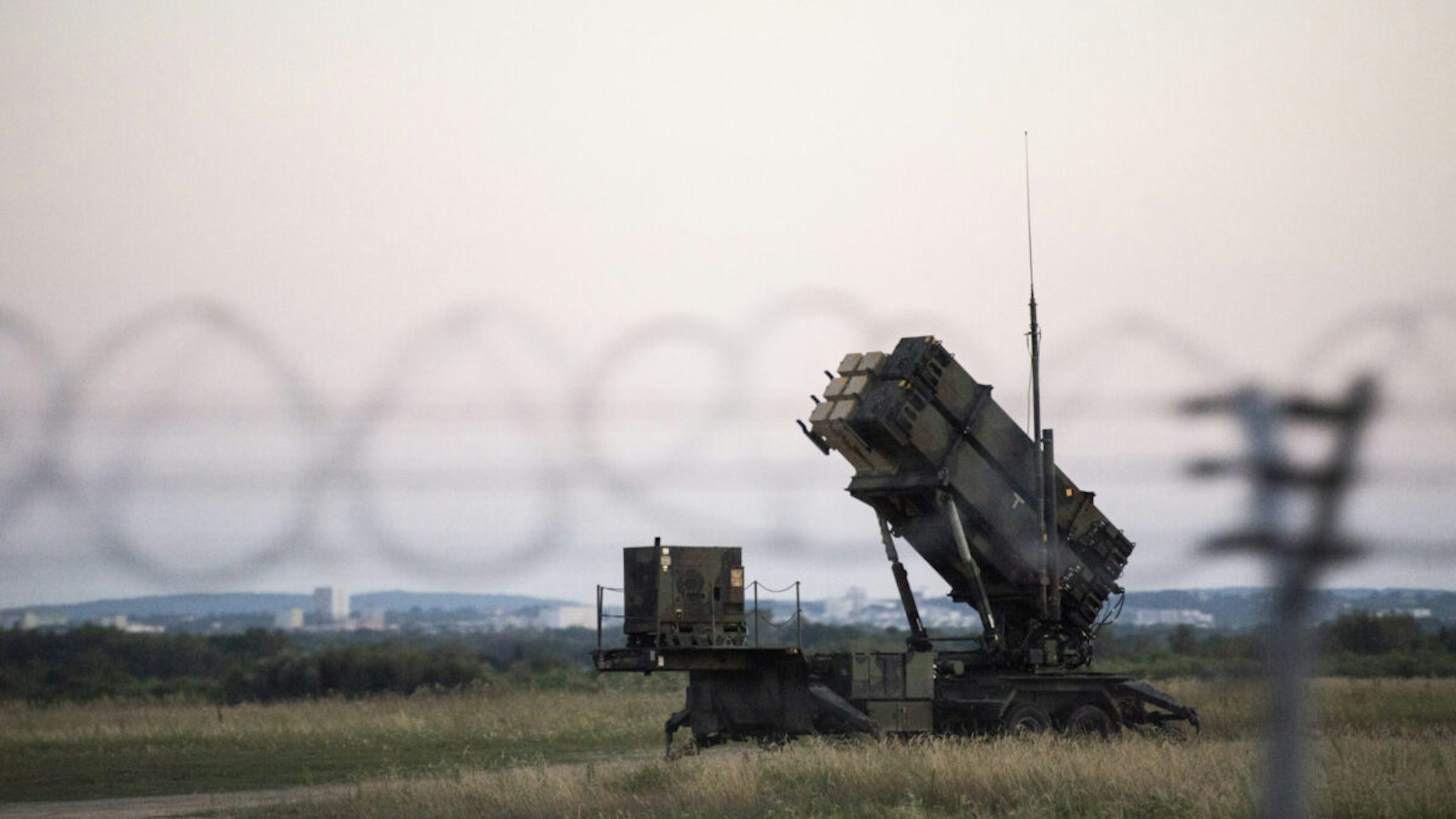
(Photo by Christophe Gateau/picture alliance via Getty Images)
A barrage of Russian missiles damaged a U.S.-made Patriot air defense system near Kyiv early Tuesday morning, weeks after the $1 billion system shot a Russian hypersonic missile out of the sky.
U.S. officials told CNN the extent of the damage is still under assessment and will determine whether Ukrainians can repair the system on the spot.
Ukrainian officials said on Tuesday that Ukraine had successfully intercepted all six hypersonic missiles fired by the Russian military. The attack signaled an air alert, which Ukraine’s Ministry of Defense called “one of the most intense attacks on the capital city since the invasion.”
Russia’s Defense Ministry said on Tuesday in a post on Telegram that a precision strike by a hypersonic Kinzhal missile had destroyed a Patriot air defense system in Kyiv, contradicting the Ukrainian government’s report.
Not a confidence builder…And the acknowledged leader in Hypersonic Missiles has grown quite friendly of late with the acknowledged leader in Carrier Killer Missiles.
The United States Department of Defense (DOD) is seeking nearly $30 billion in its $680 billion Fiscal Year 2024 (FY24) budget request for missile defeat and defense programs across all branches of the military.
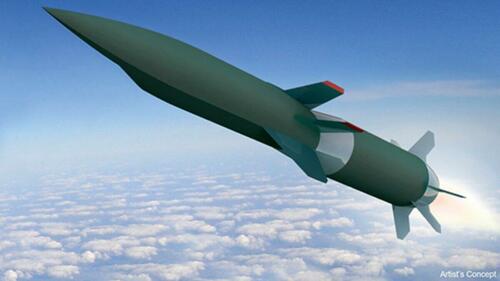
Artist’s concept of the DARPA and Lockheed Martin Hypersonic Air-Breathing Weapon Concept (HAWC). (Courtesy of Defense Advanced Research Projects Agency)
Right now, the DOD is in a race to develop its own hypersonic missiles and engineer effective defenses against the high-velocity, maneuverable missiles being developed by Russia and, particularly, by the Peoples Republic of China (PRC).
During questioning by Senate Armed Services Committee’s Strategic Forces Subcommittee Chair Sen. Angus King (I-Maine) in a May 9 budget hearing, four flag officers said some existing systems have “capabilities” against hypersonic weapons but did not know for sure until they are tested against the evolving missile systems.
King was not happy. “It seems to me that we are spending a lot more money to developing hypersonic missiles than we are developing capabilities to defend against them,” he said.
King asked Missile Defense Agency Director Vice Adm. Jon A. Hill if an aircraft carrier could be defended against a hypersonic missile attack.
“We have the capability to stop it in two places, in the boost-glide phase” and when the missile re-enters the atmosphere, Hill said, noting the Navy’s SM-6 missiles are “cruise missile killers” designed to track and kill fast-moving, maneuverable targets that can fly high and skim the surface. “It would be defeated by a destroyer defending a carrier.”
Noting Ukrainians claim they shot down a Russian hypersonic weapon last week with a Patriot anti-air missile provided by the U.S., Hill said the Patriot systems, Terminal High Altitude Area Defense missiles (THAAD), and Aegis ballistic defense system all have “capability” demonstrated in tests against hypersonics.
“THAAD operates on the edge of the atmosphere,” he said. “We haven’t tested it against hypersonic, but I’m willing to bet there are capacities that we can leverage there.”
We spend more than the next ten highest foreign defense budgets put together. That includes Russia and China.
The standard government solution is spend even more.
If we are behind in defense capability it is not the fault of the “austere” budget. We spend too much getting pounded by countries barely out of the stone age and building floating dinosaurs susceptible to China’s carrier killer cruise missiles.
Russia and China are outpacing the United States in the development of super-fast missile technology, Pentagon officials and key lawmakers are warning.
Russia says it successfully tested a so-called hypersonic missile this month, while China tested a similarsystem last year expected to enter service soon.
“Right now, we’re helpless,” Sen. James Inhofe (R-Okla.), a senior member of the Senate Armed Services Committee, said in advocating for more investment in hypersonics, along with missile defense.
Hypersonics are generally defined as missiles that can fly more than five times the speed of sound…




 MCViewPoint