MCViewPoint

Opinion from a Libertarian ViewPoint

Posts Tagged ‘income tax’

Tariffs Are Awful, But The Income Tax May Be Worse

Posted by M. C. on March 30, 2025

Walter Block News Letter

Every fiber of my economic being cries out against tariffs. If they are so good, why doesn’t each state in the US have one against the products of all of the other 49? That is, Ohio could “protect” its industries against the incursions from Arizona. This is obviously silly. One of the important reasons America is so prosperous is that we have a gigantic, internal, free trade area.

Donald Trump supports them on the ground that the McKinley administration was prosperous, and relied upon tariffs. But this is to commit the post hoc ergo propter hoc logical fallacy: that since A precedes B, A must be the cause of B. No, America did indeed become rich during this epoch, but that was in spite of tariffs, not due to their benign influence. If you are looking for a historical episode to shed light on this matter, the Smoot-Hawley Tariff of 1930 will do far better: it greatly worsened an already bad recession, plunging our economy into a deep depression.

Our President also claims that the US is victimized by a negative balance of trade: we buy more from Canada and other countries than they purchase from us. However, I have a horrid balance of trade with McDonald’s and Wal-Mart. I acquire several hundreds of dollars’ worth of their products every year, and neither has yet seen fit to reciprocate with any of my economic services (hint, hint!). On the other hand, I have a very strong positive balance of trade with my employer, Loyola University New Orleans. They pay me a decent salary; apart from a few lunches in their cafeteria, my expenditures to them fill their coffers to a zero degree. Should anyone worry about this sort of thing? Of course not. Ditto for international trade. If Country A buys more from B than it sells to it, money will flow from the former to the latter, reducing prices in the former and raising them in the latter, until matters balance out.

Everyone realizes the foolishness of tariffs when it comes to absolute advantage. No Canadian objects to the importation of bananas from Costa Rica. Producing this tropical product in the frozen North would be financially prohibitive (gigantic hothouses). Ditto for maple syrup in the country to the south. The only way they could produce this item would be to place maple trees in gigantic refrigerators. Ludicrous and prohibitively expensive.

But when it comes to comparative advantage, all too many people are out to lunch insofar as the teachings of Economics 101 are concerned. They fear that other countries might be more efficient than we are; with free trade, they would produce everything, we, nothing, and we would all starve to death from massive unemployment.

To dispel this myth, let’s consider a thought experiment. A lawyer is as good a typist as his secretary. He can produce $1,000 per day by practicing his profession. But for every such day, he needs a certain amount of typing. He can produce $200 worth each day. In two days, he can thus earn $1200 on his own. If he hires a typist, he can earn $2,000 from lawyering in two days, but must pay his secretary $200 daily for a total of $400. If he trades with her, he will come out with $2,000-$400=$1,600, an appreciable gain for him.

So is there any economic case for tariffs, given the foregoing? Yes, paradoxically, there is—in a way, if the alternative is a tax that’s even worse.

At the start of his second term, President Trump initially fired 6% of the employees of the Internal Revenue Service. He is now looking to end the employment of some 50% of them. Suppose he follows this up by getting rid of all of the rest of the IRS bureaucrats, eliminating the dreaded income tax, and achieving revenue neutrality with tariffs. His motto might be: “Let’s turn back the clock to 1912,” the year before this tax was implemented (when it ranged from 1% to 7%!).

What would the benefits be thereof? First of all, there are many intelligent, productive people who work for the IRS. There are some 90,000 of them. If dismissed by their employer, they would be freed up to produce goods and services desired by the populace. Ditto for the many accountants and tax lawyers who devote all or part of their time to helping their clients wrestle with complicated IRS regulations. Further, many of us fill out our own tax forms. This takes hours, days in some cases, time that could be better spent on leisure or productivity.

The benefit here is that it takes relatively little labor to run a tariff system. Hey, we already have tariffs in place. An increase in their level would hardly call for much more manpower, likely hardly any more at all.

Halfway measures will avail us little. But if Mr. Trump completely eliminates the IRS and the hated income tax along with it, there may be a reasonable case for increasing tariff rates. Not to present punitive levels, though.

To put it another way, if we accept that there has to be a government, and it therefore needs some revenue to function, this might be the least-bad option.

Should we worry about so many people becoming unemployed? Not at all. A similar sort of thing occurred when the car replaced the horse and buggy, when the cell phone substituted for Kodak, when we switched from typewriters to computers, etc. We are all the richer for this sort of thing, and will be in this case too.

Originally published here.

Walter’s Newsletter is free today. But if you enjoyed this post, you can tell Walter’s Newsletter that their writing is valuable by pledging a future subscription. You won’t be charged unless they enable payments.

Pledge your support

Be seeing you

Posted in Uncategorized | Tagged: , | Leave a Comment »

The Tariff and Income Tax Toggle

Posted by M. C. on March 22, 2025

Without a heavy emphasis on gathering the public, congressional, bureaucratic, and legal support to abolish the income tax, the far likelier outcome of Trump’s interest in tariffs is a system where the income tax remains in place, and tariffs are added on top of it. (emphasis added)

Obviously, people assumed then as they do today, that other people will be taxed and burdened, that they will not, and/or that if the government taxes other people, they will receive some of it. Historically, this is not the case.

Income taxation appeals to the governing class because in its everlasting urgency for power it needs money.

Income taxation appeals to the mass of people because it gives expression to their envy; it salves their sense of hurt. (emphasis in original)

Mises WireJoshua Mawhorter

Much has been written recently on Trump’s statements regarding tariffs and even his idea to replace income tax with tariffs. Writings have tackled the economic destructiveness of tariffs, how they raise increase costs, how they affect capital goods, how they are protective and a limitation of competition for special interests, how a choice must be made between revenue from tariffs and protecting American jobs, etc. This is nothing new for Mises.org, in fact, Austrian economists and other fellow travelers have held the same positions on tariffs for centuries and “tariffs” have been one of the most popular searches on the Mises.org site for the last several months.

This article on tariffs will focus in on a simple, but insightful, point made recently by Connor O’Keeffe regarding replacing the income tax with tariffs,

Because of how unfathomably damaging the income tax is, it could certainly be the case that a tariff-only tax system would be less destructive than what we have today. But just as with government spending, in Washington, it is much harder to eliminate a tax than it is to add a new one. Without a heavy emphasis on gathering the public, congressional, bureaucratic, and legal support to abolish the income tax, the far likelier outcome of Trump’s interest in tariffs is a system where the income tax remains in place, and tariffs are added on top of it. (emphasis added)

This quote reminded me of an important point made by Frank Chodorov in his excellent The Income Tax: Root of All Evil (which Connor referenced). While it would be great to get rid of the income tax, even if we still had tariffs, we will probably end up with both income tax and tariffs.

Chodorov was part of the anti-New Deal Old Right and wrote this book in the 1950s, which was dedicated to Albert J. Nock. In his book, he details some of the history leading up to the adoption of the 16th Amendment and income tax in the United States. The situation from 1890-1913—which Trump admires—was sort of a mirror image of what is being proposed today: they had tariffs and many believed that income tax would replace tariffs. Instead, they got both. Chodorov’s words provide us with some much-needed wisdom.

The temporary income tax of the Civil War was scheduled to end in 1870, but was extended to 1872. While there were benefits of relatively low taxes and greater industrial production, the government monetary inflation and cronyism brought some instability during this period, which helped prepare the populace for the “reform” of the Fed. This instability—plus tariffs hitting farmers harder, plus the envy and class warfare of socialist doctrines, plus the labor union movement and beginning of the Progressive movement—created a ripe environment for resentment. Unfortunately, this resentment, as it often does, led to calls for more power and money to the government in the name of equalizing different groups.

Chodorov frankly acknowledges what had been a complaint throughout the 1800s, “The plight of these farmers was made worse by the protective-tariff policy of the government.” This was true enough, as was the recognition of cronyism, especially for railroad companies. In this context, many began to call for an income tax against the “rich” (presumably instead of tariffs). Chodorov explains,

So, during the latter part of the nineteenth century, Americans took to the class-war doctrine recently imported by the socialists; here was a plausible cause of all their misfortunes, a logical scapegoat for their dissatisfaction. And the words that hung on the lips of the country were “plutocracy” and “robber barons” and “bloated rich” and “money bags,” with suitable overtones. Also, since the opulence of the country was concentrated in the East, sectionalism added fire to the class-war doctrine, and “Wall Street” became the ultimate cause of all the economic ills of the country.

Like many throughout history who neglect the coherence of libertarian caste analysis, many Americans sought government growth. The obvious non sequitur should have been noticed. Why would giving the government more power and money be the solution? Obviously, people assumed then as they do today, that other people will be taxed and burdened, that they will not, and/or that if the government taxes other people, they will receive some of it. Historically, this is not the case. The political class—those responsible for the inflationary booms and deflationary busts, tariffs, and cronyism—are supposed to solve the problems if they only receive more money and power. Chodorov explains what the appeal of income tax was,

Income taxation appeals to the governing class because in its everlasting urgency for power it needs money.

Income taxation appeals to the mass of people because it gives expression to their envy; it salves their sense of hurt. (emphasis in original)

While the political class ought to be held to the highest accountability, the masses who support them in the hope that they will benefit deserve blame too. “Envy” is a key word here. It is not the same as greed, jealousy, or covetousness, envy has to do with willingness to see something destroyed for others because it cannot be possessed. Envy is key to socialism because it is a system that can only destroy wealth and production, not create it. Through envy, the masses empower the political class, thinking they will somehow benefit. Chodorov starkly reminds us,

The only beneficiaries of income taxation are the politicians, for it not only gives them the means by which they can increase their emoluments but it also enables them to improve their importance.

Another unjustified assumption in the push for the income tax was that the income tax would replace the tariff. People rightly recognized that tariffs fell harder on certain populations and certain regions and were protectionist special privileges for certain businesses against foreign competition (at the expense of Americans), but the government significantly depended on tariffs for revenue, therefore, “the Populists were prepared with their cherished ‘soak the rich’ proposal, the income tax.”

Americans saw tariffs and income tax as an either/or trade-off, but it would shortly be revealed as a both/and—tariffs and income tax. An 1894 bill and several income tax bills introduced afterward “linked tariff reduction with income taxation.” This connection was a fiction. Chodorov explains, “Not until the constitutional amendment was passed by Congress was the fiction dropped that tariff reduction and income taxation are related.” Wisely, Chodorov reiterated a principle we would do well to remember, “[Government] never gives up power; it never abdicates.” We could argue that people should have known better back then, but they could argue that we should know better now. Chodorov argued from experience too,

See the rest here

Be seeing you

Posted in Uncategorized | Tagged: , | Leave a Comment »

Why Not Eliminate Taxes on All Income?

Posted by M. C. on July 8, 2024

Although no Americans are old enough to remember it, there was a time in the United States when there was no income tax. The income tax actually began as a modest 1 percent tax on taxable income above $3,000, followed by a series of surcharges of up to 6 percent applied to higher incomes. The maximum rate of 7 percent was applied to taxable income over $500,000. Thanks to generous exemptions and deductions, only a small percentage of the population paid taxes on their income.

The reason why people say that we just can’t eliminate the income tax is that it would deprive the government of revenue it needs to spend. But isn’t that the point? The case could be made that at least 90 percent of what the federal government spends money on is unconstitutional: foreign aid, business subsidies, welfare, education, health care, job training, the war on drugs, public broadcasting, student loans, food stamps, foreign wars, space exploration, and so much more.

by Laurence M. Vance

During a campaign stop in Nevada early last month, Republican presidential candidate Donald Trump promised that if elected, there would be no more federal tax on tips.The constitutional functions of the U.S. government could be adequately funded without an income tax.
[Click to Tweet]

Said Trump: “For those hotel workers and people that get tips, you’re going to be very happy, because when I get to office, we are going to not charge taxes on tips. You do a great job of service. You take care of people, and I think it’s going to be something that really is deserved.”

According to the Internal Revenue Service (IRS), tips are taxable income and must be reported to employers. Four factors determine whether a payment qualifies as a tip:

  • The customer makes the payment free from compulsion;
  • The customer must have the unrestricted right to determine the amount;
  • The payment should not be the subject of negotiations or dictated by employer policy; and
  • Generally, the customer has the right to determine who receives the payment.

Tips reported to employers are included on employees’ W-2 forms for income-reporting purposes. Tips are simply added to one’s taxable income and are subject to not only income tax but also Social Security and Medicare payroll taxes.

Trump was not clear whether his proposal would exempt tips from payroll taxes, income taxes, or both.

A week after Trump met with congressional Republicans, Senator Ted Cruz (R-Tex.), with cosponsors Senator Steve Daines (R-Mont.), Senator Rick Scott (R-Fla.), and Senator Kevin Cramer (R-N.D.), introduced the No Tax on Tips Act. The relevant text of the bill simply reads: “There shall be allowed as a deduction an amount equal to the cash tips received during the taxable year that are included on statements furnished to the employer.” This would be an above-the-line deduction of tips received (via cash, credit cards, and checks) that reduces taxable income similar to the deductions for student loan interest paid, unreimbursed expenses of teachers, the deductible part of self-employment tax, and contributions to a traditional IRA.

Naturally, industry groups were ecstatic about the bill, including the National Restaurant Association and the Professional Beauty Association. Said Sean Kennedy, Executive Vice President of Public Affairs at the National Restaurant Association: “Tipped employees are a critical part of the restaurant industry, and anything that strengthens their economic condition is a positive for them. The ‘No Tax on Tips Act’ would provide immediate tax relief for more than 2.2 million restaurant employees and their families, putting more money in their pockets at a time when we’re all feeling the squeeze of higher prices.”

However, Elyanna Calle, an organizer with the Restaurant Workers United union, slammed the proposal, calling it a “misguided way of trying to fix a problem of uplifting the lower class.”

Other opponents of Trump’s proposal focused on how much revenue the federal government would be losing if tips were no longer taxed.

See the rest here

Be seeing you

Posted in Uncategorized | Tagged: , , | Leave a Comment »

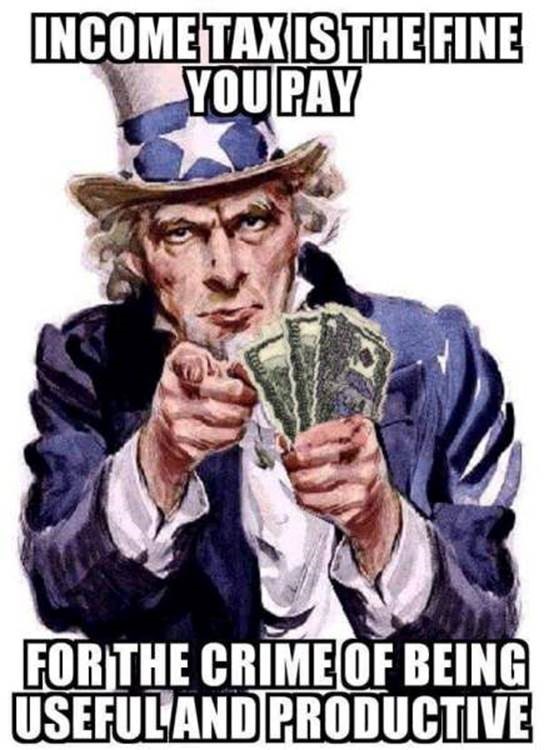
Being Useful

Posted by M. C. on March 22, 2024

Change that to ANY TAX.

Posted in Uncategorized | Tagged: | Leave a Comment »

The Welfare-Warfare State’s War on Income and Savings

Posted by M. C. on October 6, 2023

Welcome to the welfare-warfare state way of life, which plunders and loots people’s income to fund the ever-increasing expenditures of welfare-state programs and the warfare-state programs of the Pentagon, the CIA, and the NSA.Welcome to the welfare-warfare state way of life, which plunders and loots people’s income to fund the ever-increasing expenditures of welfare-state programs and the warfare-state programs of the Pentagon, the CIA, and the NSA.

Our American ancestors, of course, refused to make that trade. They didn’t want the government to take care of them. They wanted to take care of themselves, with their own money and on a purely voluntary, charitable basis. They also knew that a national-security state (or what they termed “standing armies”) would inevitably embroil them in endless wars and crises that would mean even higher taxes (and lower savings).

by Jacob G. Hornberger

NOTICE: TONIGHT, Thursday, October 5, at 7 p.m. Eastern. Benjamin Power is our first presenter in our upcoming online Austrian conference: “How Austrian Economics Impacted My Life.” Register here to receive your Zoom link for an intellectually fun and enlightening session!

*****

According to an article at CNBC.com, 60% of adults said they are living paycheck to paycheck. According to an article at Forbes.com, about a third of Americans were unable to save any money in the past year. According to an article at Yahoo! Finance, while financial advisors recommend savings of $1 million to $2 million for retirees, the average 70-year-old has only around $426,000 in savings. On top of that, consider how much the value of people’s money is debased each decade through the inflationary policies of the Federal Reserve.

Welcome to the welfare-warfare state way of life, which plunders and loots people’s income to fund the ever-increasing expenditures of welfare-state programs and the warfare-state programs of the Pentagon, the CIA, and the NSA.

If we think back to America’s founding principles with respect to income, wealth, welfare, and warfare, we find that our American ancestors chose a totally different way of life than today’s Americans have chosen.

Consider, for example, 1890 Americans. They lived without an income tax and an IRS to enforce it. Just think about that: People were free to keep 100 percent of their income, and there was nothing the government could do about it. Imagine if you were free to keep everything you earned. Imagine if that had been case during your entire work life. 

When Americans were free to accumulate unlimited amounts of wealth, they obviously were able to save a larger percentage of their income. Would’t you be saving more money if suddenly you no longer had to pay any income taxes whatsoever?

See the rest here

Be seeing you

Posted in Uncategorized | Tagged: , , , , | Leave a Comment »

Trump’s Tax Returns Show Evil of the Income Tax

Posted by M. C. on January 10, 2023

Low taxes are legal for those who can afford good tax accountants, as was intended.

The people who take the IRS hit are those that cannot afford tax accountants and tax lawyers, ie you and me.

https://rumble.com/v24njre-trumps-tax-returns-show-evil-of-the-income-tax.html

Be seeing you

Posted in Uncategorized | Tagged: , , , | Leave a Comment »

The Consumption Tax: A Critique

Posted by M. C. on June 27, 2022

The Alleged Superiority of the Income Tax

Murray N. Rothbard

tax burden

We were assured by one and all, at the time, that this new withholding tax was strictly limited to the wartime emergency, and would disappear at the arrival of peace. The rest, alas, is history. But the point is that no one can seriously maintain that an income tax deprived of withholding power could be collected at its present high levels.

The consumption tax, on the other hand, can only be regarded as a payment for permission-to-live. It implies that a man will not be allowed to advance or even sustain his own life unless he pays, off the top, a fee to the State for permission to do so. The consumption tax does not strike me, in its philosophical implications, as one whit more noble, or less presumptuous, than the income tax.

https://mises.org/library/consumption-tax-critique

Orthodox neoclassical economics has long maintained that, from the point of view of the taxed themselves, an income tax is “better than” an excise tax on a particular form of consumption, since, in addition to the total revenue extracted, which is assumed to be the same in both cases, the excise tax weights the levy heavily against a particular consumer good. In addition to the total amount levied, therefore, an excise tax skews and distorts spending and resources away from the consumers’ preferred consumption patterns. Indifference curves are trotted out with a flourish to lend the scientific patina of geometry to this demonstration.

As in many other cases when economists rush to judge various courses of action as “good,” “superior,” or “optimal,” however, the ceteris paribus assumptions underlying such judgments—in this case, for example, that total revenue remains the same—do not always hold up in real life. Thus, it is certainly possible, for political or other reasons, that one particular form of tax is not likely to result in the same total revenue as another. The nature of a particular tax might lead to less or more revenue than another tax. Suppose, for example, that all present taxes are abolished and that the same total is to be raised from a new capitation, or head, tax, which requires that every inhabitant of the United States pay an equal amount to the support of federal, state, and local government. This would mean that the existing total government revenue of the United States, which we estimate at $1.38 trillion—and here exact figures are not important—would have to be divided between an approximate total of 243 million people. Which would mean that every man, woman, and child in America would be required to pay to government each and every year, $5,680. Somehow, I don’t believe that anything like this large a sum could be collectible by the authorities, no matter how many enforcement powers are granted the IRS. A clear example where the ceteris paribus assumption flagrantly breaks down.

But a more important, if less dramatic, example is nearer at hand. Before World War II, Internal Revenue collected the full amount, in one lump sum, from every taxpayer, on March 15 of each year. (A month’s extension was later granted to the long-suffering taxpayers.) During World War II, in order to permit an easier and far-smoother collection of the far-higher tax rates for financing the war effort, the federal government instituted a plan conceived by the ubiquitous Beardsley Ruml of R.H. Macy & Co., and technically implemented by a bright young economist at the Treasury Department, Milton Friedman. This plan, as all of us know only too well, coerced every employer into the unpaid labor of withholding the tax each month from the employee’s paycheck and delivering it to the Treasury. As a result, there was no longer a need for the taxpayer to cough up the total amount in a lump sum each year. We were assured by one and all, at the time, that this new withholding tax was strictly limited to the wartime emergency, and would disappear at the arrival of peace. The rest, alas, is history. But the point is that no one can seriously maintain that an income tax deprived of withholding power could be collected at its present high levels.

One reason, therefore, that an economist cannot claim that the income tax, or any other tax, is better from the point of view of the taxed person, is that total revenue collected is often a function of the type of tax imposed. And it would seem that, from the point of view of the taxed person, the less extracted from him the better. Even indifference-curve analysis would have to confirm that conclusion. If someone wishes to claim that a taxed person is disappointed at how little tax he is asked to pay, that person is always free to make up the alleged deficiency by making a voluntary gift to the bewildered but happy taxing authorities.1

A second insuperable problem with an economist’s recommending any form of tax from the alleged point of view of the taxee, is that the taxpayer may well have particular subjective evaluations of the form of tax, apart from the total amount levied. Even if the total revenue extracted from him is the same for tax A and tax B, he may have very different subjective evaluations of the two taxing processes. Let us return, for example, to our case of the income as compared to an excise tax. Income taxes are collected in the course of a coercive and even brutal examination of virtually every aspect of every taxpayer’s life by the all-seeing, all-powerful Internal Revenue Service. Each taxpayer, furthermore, is obliged by law to keep accurate records of his income and deductions, and then, painstakingly and truthfully, to fill out and submit the very forms that will tend to incriminate him into tax liability. An excise tax, say on whiskey or on movie admissions, will intrude directly on no one’s life and income, but only into the sales of the movie theater or liquor store. I venture to judge that, in evaluating the “superiority” or “inferiority” of different modes of taxation, even the most determined imbiber or moviegoer would cheerfully pay far higher prices for whiskey or movies than neoclassical economists contemplate, in order to avoid the long arm of the IRS.2

The Forms of Consumption Tax

See the rest here

Be seeing you

Posted in Uncategorized | Tagged: , , , | Leave a Comment »

Repeal 1913: End The Income Tax & The Federal Reserve

Posted by M. C. on April 23, 2022

1913 was a fateful year for freedom in America. Both the Income Tax & Federal Reserve were created. The dreaded Income Tax made everyone’s hard-earned money the property of the federal government first. The earnings that government allowed people to keep would then be persistently stolen by The Fed’s inflation. Freedom was put in a vice in 1913, and after 100 years, there’s almost nothing left to be squeezed.

Be seeing you

Posted in Uncategorized | Tagged: , | Leave a Comment »

Freedom Is a Stabilizing Influence – The Future of Freedom Foundation

Posted by M. C. on February 5, 2022

Free to try, and fail, Americans prospered, building a country that became the envy of the world. Economic barriers and restrictions on movement between the states were forbidden, making the United States the largest free-trade zone since the Roman Empire. There were no feudal obligations or status; no military conscription (except during the Civil War); no income tax or Social Security tax; no licensing laws or monopoly privileges to protect favored interests

https://www.fff.org/explore-freedom/article/freedom-is-a-stabilizing-influence/

by Scott McPherson

The nativists at Breitbart are sounding the alarm. “Reports: U.S. Society Grows More Divided Amid Diversity” was a headline at Breitbart on January 28. The reports noted come from the Associated Press and the Carnegie Foundation for International Peace. Both suggest a growing divide between different people in the United States, and apparently foreigners are to blame.Freedom was the crucible for generations of diverse peoples, raising productivity, wages, and living standards to levels never before seen in all of human history.
[Click to Tweet]

According to the Breitbart story, “the AP report comes as academics admit that the United States is being politically divided by the ‘demographic shift’ caused by immigration of global migrants into an otherwise stable society.” In other words, things would be great if poor people from other countries just stopped trying to improve their lot in life by emigrating here. The Carnegie Foundation claims that the United States is “perniciously polarized” and “especially susceptible to polarization” through “the durability of identify politics in a racially and ethnically diverse democracy.”

It cannot be denied that considerable effort is employed to push people into warring tribes, based on superficial differences of race, ethnicity, gender, religion, or the politics of envy that vilifies the prosperous and productive. But handwringers on the right who fret about immigration misdiagnose the problem. A quarter of Republican voters, according to a recent YouGov poll, think their candidates should prioritize “securing the border,” compared to 5 percent who want tax cuts. Only 8 percent of the “law and order” party cares most about rising crime. Leftists, finding in every perceived problem the catalyst for another government program (like secret, government-funded flights of immigrants to locations around the country and generous welfare handouts), fuel the fire.

The first issue that ought to be addressed is the very notion that the United States is a democracy. The word never appears in our Constitution or its political antecedent, the Declaration of Independence. Early American statesmen warned against democracy and had no use for it as a system of government. The failure of the political right and left to uphold the principles of our constitutional republic politicizes everything and polarizes everyone. A return to limited, constitutional government would do more to stabilize our society than any border wall.

The diversity found on this continent throughout the history of European settlement is beyond comparison. People with different languages, customs, and religions found their way from Great Britain, France, Germany, Ireland, the Netherlands, and elsewhere, laying the foundation of a thriving society. Dreams of personal liberty, security against religious and ethnic persecution, and the opportunity to own land drove millions of people to leave everything behind, most likely forever. No officious bureaucrats, “swarms of Officers,” harried the people. These colonists were poor, insular, and provincial, to be sure, but the cold, stark reality of hacking their lives from a forbidding wilderness was foremost in their minds. Through the cold, stark reality of a North American winter, and the brutal summer heat and biting insects, these different people from many cultures built cities, towns, and villages from the Atlantic seaboard to the foot of the Appalachian mountains, their independent spirits, ironically, binding them closer to each other even as they became estranged from their home countries. They rejected the ancien regime in their hearts if not yet in form.

When the lone remaining colonial power in the region, Great Britain, began to exercise arbitrary authority over these people in the 1760s, tensions increased until they reached a literal breaking point. War brought political independence and a new country uniting all, in several states, under a federal government. The Constitution of 1787, which became the law of the land in 1789, ushered in a new age. Political stability was provided by a written document to restrain this new government, specifically limiting and enumerating its powers and including a Bill of Rights. Radical notions like equality before the law, individual rights, and reverance for private property and freedom of contract would take root and grow, and the result was an explosion of effort and ever-expanding opportunities.

Free to try, and fail, Americans prospered, building a country that became the envy of the world. Economic barriers and restrictions on movement between the states were forbidden, making the United States the largest free-trade zone since the Roman Empire. There were no feudal obligations or status; no military conscription (except during the Civil War); no income tax or Social Security tax; no licensing laws or monopoly privileges to protect favored interests; no regulations dictating working hours or a minimum wage; no free housing or government healthcare or food stamps; no war on drugs or restrictions on gun ownership. General education and literacy rates were quite high, despite the absence of a large and expensive public school system. Teachers were often itinerant, and certainly not unionized. Foreign visitors marveled at the motivation and cooperation of Americans and how little interaction they had with their government.

A glaring exception was slavery. This evil institution was allowed to continue for nearly eight decades. It was abolished in 1865 by the Thirteenth Amendment and the last obstacle to fulfilling the promise of the Declaration of Independence, that all are created equal, was finally removed.

To this land, the poorest and most ignorant of the world would flock. By the millions they came, in wave after wave, from Ireland, Italy, Portugal, Greece, Eastern Europe, and the Orient. Throughout the 19th century, they came relentlessly, escaping centuries of persecution, religious intolerance, and economic stagnation. Except for occasional and short periods, there were no restrictions placed on newcomers. From the end of the Mexican War in 1848 until 1920, there were no immigration restrictions at all. In a January 29 piece for RedState, the writer Bonchie said that “a country cannot sustain itself with the rule of law being so ignored and its borders so flaunted,” but during a century of open immigration, the population and economy of the United States flourished. The arts and humanities thrived. Freedom was the crucible for generations of diverse peoples, raising productivity, wages, and living standards to levels never before seen in all of human history. What we need is a return to the principles that made such a revolution possible.

Be seeing you

Posted in Uncategorized | Tagged: , , , , | Leave a Comment »

bionic mosquito: When Private Property Isn’t

Posted by M. C. on July 28, 2021

Yet, even at this extreme, try not paying property tax on the property, or income tax on the privately earned income, etc.  The property isn’t purely private in the sense of the owner have complete control over use and disposition.

At the other extreme…libertarians and Austrian economists will use the phrase “crony capitalism.” Instead, it has been “earned” via government connection.

http://bionicmosquito.blogspot.com/2021/07/when-private-property-isnt.html

Posted by bionic mosquito

My comment, at the Mises site:

[From the author of the piece]: “This does not mean that someone cannot be prevented from accessing certain venues or activities when their rightful owners set preventive sanitary rules….”

BM: Libertarians must really get past this kind of thinking. Does anyone believe that airlines, social media companies, mainstream media companies, any large company of any type is a private company in any meaningful sense? How quickly and suddenly they bow to government dictates no matter how draconian, and what punishment will befall them if they don’t. Willingly or through coercion, they do the state’s bidding.

The piece was about forced vaccinations.

There is much about private property that isn’t private.  At one extreme – consider it the closest to a libertarian ideal: we have property, acquired via voluntary transaction; either produced from other materials, acquired in trade, developed in code, etc.  Yet, even at this extreme, try not paying property tax on the property, or income tax on the privately earned income, etc.  The property isn’t purely private in the sense of the owner have complete control over use and disposition.

At the other extreme…libertarians and Austrian economists will use the phrase “crony capitalism.”  If this phrase is to mean anything, it has to indicate that the private property (necessary for a system of capitalism) has not been earned or acquired in a manner that fits the above definition of private property: acquired via voluntary transaction.  Instead, it has been “earned” via government connection.

Examples of this abound: perhaps the most obvious is banking, especially money center banks.  Others include military contractors, pharmaceutical companies, airlines, tech and social media companies, mainstream media, etc.  It could also include any company or industry that petitions the state for something (as opposed to petitioning the state to not do something or to stop doing something).

These crony capitalist companies do the state’s bidding.  They lobby for funds, lobby for regulations, and in exchange, they pay the piper by dancing to his tune.  They realize the consequences of just saying no.  Why do such a thing, when saying yes pays so well?  Can the property that results from such an arrangement be described as “private”?

There is a large area in between, of course.  The most unfortunate, and taken from the last sixteen months: any church or small business that did not enforce or abide by state mandates faced the potential of being crushed, and its pastor or owner faced prison.  One cannot call this property “private,” though through no transgression of the owner.

But the entities that hold property via crony-capitalism can in no way be considered holders of private property.  They are extensions of the state, really not much different than the military, department of (in)justice, the various spy agencies, etc.

Conclusion

Libertarians really need not make the caveat, as was done in the statement I cited at the opening of this post.  Instead, the proper caveat should be that much of what is considered private property isn’t. 

Until this is fully embraced and understood, well…we are like the dupe, falling for the con of the shell game.  Complain about government encroachment and defend the so-called private entities that are just as much a means of that encroachment as any government employee.  Yes, such libertarians may be following the right shell, but there is a second one virtually equally as dangerous to liberty.

Be seeing you

Posted in Uncategorized | Tagged: , , , | Leave a Comment »