MCViewPoint

Opinion from a Libertarian ViewPoint

Posts Tagged ‘inflation’

Keynesians and Market Monetarists Didn’t See Inflation Coming

Posted by M. C. on April 20, 2022

Of course, Krugman’s confident dismissal of those Biden-hating doomsayers blew up in his face, as CPI inflation kept ratcheting higher and higher. In a December 2021 NYT column, Krugman threw in the towel and admitted he had been wrong, but in his own special way (again, with my bolding):

The current bout of inflation came on suddenly…. Even once the inflation numbers shot up, many economists—myself included—argued that the surge was likely to prove transitory. But at the very least it’s now clear that “transitory” inflation will last longer than most of us on that team expected…

Everything is transitory. The only thing that never changes is change.

https://mises.org/wire/keynesians-and-market-monetarists-didnt-see-inflation-coming

Robert P. Murphy

The government’s latest report puts the twelve-month official consumer price inflation rate at 8.5 percent, the highest since December 1981:

cpi

As economists debate the causes of, and cure for, this price inflation, it’s worth recounting which schools of thought saw it coming. Although individuals can be nuanced, generally speaking the Austrians have been warning that the Fed’s reckless policies threaten the dollar. In contrast, as I will document in this article, two of the leaders of the Keynesian and market monetarist schools didn’t see this coming at all.

My Worst Professional Mistake

Before diving into it, I need to address a problem: my hands-down worst professional mistake occurred during the early years of the Fed’s “QE” (quantitative easing) programs, when I made bets on (consumer price) inflation with two economist colleagues. I ended up losing those bets and thereby gave Paul Krugman the opportunity to lecture me on my intellectual dishonesty because I clung to my (ostensibly falsified) Austrian model even after my prediction blew up in my face. Indeed, if you check out my Wikipedia entry, you’ll see that apparently my life story is that I was born, got my PhD, and lost an inflation bet—in that order. (For those interested in the details, I summarize the episode with relevant links in this postmortem blog post. I also participated in a 2014 Reason symposium along with Peter Schiff and others, commenting on the lack of inflation.)

Ever since the rounds of QE failed to yield surging consumer price inflation at the scale some of us warned of, the Keynesians and market monetarists understandably ran victory laps, saying that they were to be trusted over those permabear Cassandra Austrians. (To be sure, the market monetarists were far more civil about it than the prominent Keynesians.) So it is not with gloating or vindictiveness that I write the present article, but rather I do it to set the record straight and document for posterity that the leading Keynesians and market monetarists totally missed this bout of price inflation.

The Keynesians Camp: Paul Krugman and Klaus Schwab

Let’s do the fun one first: Paul Krugman has not fared well in light of our current inflationary experience. As late as June 2021, Krugman wrote an article in the New York Times titled “The Week Inflation Panic Died.” Here are some key excerpts, with my bold added, and keep in mind that when Krugman wrote this, the most recent Consumer Price Index (CPI) inflation rate was only 4.9 percent:

Remember when everyone was panicking about inflation, warning ominously about 1970s-type stagflation? OK, many people are still saying such things, some because that’s what they always say, some because that’s what they say when there’s a Democratic president….

But for those paying closer attention to the flow of new information, inflation panic is, you know, so last week.

Seriously, both recent data and recent statements from the Federal Reserve have, well, deflated the case for a sustained outbreak of inflation … [T]o panic over inflation, you had to believe either that the Fed’s model of how inflation works is all wrong or that the Fed would lack the political courage to cool off the economy if it were to become dangerously overheated.

Both beliefs have now lost most of whatever credibility they may have had….

The Fed has been arguing that recent price rises are similarly transitory … The Fed’s view has been that this episode, like the inflation blip of 2010–11, will soon be over.

And it’s now looking as if the Fed was right …

See the rest here

Be seeing you

Posted in Uncategorized | Tagged: , , , | Leave a Comment »

Deflation: Bad for the Government, Good for Producers and Consumers. What’s Not to Like?

Posted by M. C. on April 15, 2022

Deflation is only bad for the government. In a deflationary economy, it cannot tax people indirectly via inflation and it can’t use monetary policy to artificially boost the economy and get votes before there is the inevitable recession. Consumers (mainly the poorer) and entrepreneurs are the ones who benefit from deflation (due to lower prices and larger profit margins, respectively).

https://mises.org/wire/deflation-bad-government-good-producers-and-consumers-whats-not

Andre Marques

Governments lie about the inflation rate and benefits from it, so, it is no surprise when they talk against deflation (for the purpose of this article, assume inflation as a general increase in prices and deflation as the opposite), which would be good for consumers and the economy, but bad for the government. (While Austrian Economists define inflation as an increase in the supply of money, the net effect of inflation is an increase in asset prices, as well as a distortion of the structure of production.)

Prices fall in a scenario where the currency is not inflated and, therefore, there are more sustainable investments and increased productivity. In an economy with little or no government intervention (at least few monetary interventions and few regulations, government spending and taxes), there are more long-term investments (capital investments, for example), which increase the economy’s productivity. In a deflationary economy, the purchasing power of money tends to increase, as there is no monetary inflation by central banks and prices tend to fall. Consumers can purchase more products and services and companies have higher profit margins.

But governments do not like deflation, they are the most indebted entities. Inflation is beneficial to borrowers, as they repay loans in a currency with lower purchasing power than when they took the loan. It is even more beneficial to the government since it can expand the money supply to pay the debt. Furthermore, inflation is good for the government because it creates an apparent economic boom, which will eventually be wiped out by a recession. But, as this can take a few years, the short-term incentive for the incumbents is to take advantage of this instrument.

Two typical arguments given by governments against deflation are as follows:

“Deflation Will Cost Entrepreneurs”

The reasoning behind this statement is that, if prices fall, entrepreneurs will sell products and services at lower prices than the cost to produce them. However, this statement does not hold if we consider the fact that, in a deflationary economy, the currency’s purchasing power tends to increase. So even if entrepreneurs get less money (nominally) than what their products cost, in real terms, they will still make a profit. In addition, the prices of the inputs used in production will also fall in a deflationary economy.

Therefore, with the use of productivity and management of expenses that every company must have, it is possible to sell the products at low prices, but with the same or even higher profit margin than in an inflationary environment. (Note: even if we disregard this gain in purchase power and lower production costs, it would be possible for the entrepreneur to protect himself through future contracts). And, precisely because prices get lower, consumers buy more products and services (without going into debt) and companies profit more due to the reduction in costs that occurs thanks to deflation. This is particularly the case in the technology sector. Computers today are cheaper and much better than they were 30 years ago. Because prices got lower (due to increased productivity), consumers began to buy more, which increased the industry’s profits, which brought more investments and higher productivity.

“Consumers Will Postpone Consumption under Deflation”

The reasoning behind this argument is that if prices are constantly falling, no one will buy the products and services because individuals will always expect prices to go down. This also does not make sense, as there are always products and services that people have to purchase (such as food and medicine). Nobody starves themselves to death or does not purchase medicines because a year later they will be cheaper. 

See the rest here

Be seeing you

Posted in Uncategorized | Tagged: , , , | Leave a Comment »

Prices rising? Guess whose fault it is

Posted by M. C. on March 24, 2022

It’s worth recalling: the United States became the world’s greatest industrial power at a time of generally falling prices.

Incidentally, don’t let them convince you that the rise in other prices is being caused by the rise in oil prices. That’s an easy fallacy to fall into, and (not coincidentally) it serves to divert responsibility away from them.

Here’s why it’s wrong.

Tom Woods

Now that prices are rising, the lizard people are devoting time they once spent writing nonsensical things about COVID to writing nonsensical things about price inflation.

Of course they’re blaming it on anyone and everyone but themselves. Oh, it’s Russia (even though these price trends began before Russia had taken any military action in Ukraine), or it’s corporate greed, or it’s actually a sign of a robust economy!

Actually, falling prices generally indicate a robust economy.

In an economy with a stable or slowly increasing money supply, this is what happens:

Business firms invest profits into capital goods, which make possible the production of an ever-greater quantity of consumer goods.

This greater productivity, yielding a greater supply of consumer goods, pushes prices down and increases everyone’s real incomes as a result.

That ten dollars of yours, instead of buying a hat, now buys you a hat and some socks.

We don’t observe this phenomenon of productivity-driven price decreases anymore (except in particular sectors like consumer electronics) because it is obscured by the constantly increasing supply of money, thanks to the Fed.

The point is: falling prices are generally a sign of a progressing economy that is investing in capital goods, becoming more productive, and producing more goods less expensively. A general rise in the price level, by contrast, doesn’t necessarily indicate any such thing. It indicates only that the central bank is creating money, which in itself doesn’t improve our standard of living at all.

It’s worth recalling: the United States became the world’s greatest industrial power at a time of generally falling prices.

Incidentally, don’t let them convince you that the rise in other prices is being caused by the rise in oil prices. That’s an easy fallacy to fall into, and (not coincidentally) it serves to divert responsibility away from them.

Here’s why it’s wrong.

People have only so much disposable income. If prices at the gas pump go up, people don’t suddenly have extra money to pay those higher prices and also keep up the rest of their usual consumption. Something has to give. If they continue to buy as much gas as before, then they have less money now to spend on other things, and that in turn puts downward pressure on the prices of those other things. So it’s a wash.

The only way for all prices to rise, therefore, is for there to be an increase in the supply of money that can keep all those prices high simultaneously — and in the present system, only the Federal Reserve can do that.

So the present problem is caused by the Fed, period. No other alleged cause makes any sense. (If “corporate greed” were the issue, why weren’t those companies greedy a year ago? Why do they suddenly stop being greedy?)

Bloomberg is recommending, as advice for navigating rising prices, “Don’t buy in bulk.”

Now that’s some dumb advice.

If you expect the price inflation to continue, of course you want to buy in bulk in order to lock in present prices. Better to be in real goods (i.e., not money) than in a money you expect to keep losing its value.

We went from “there is no inflation” to “there’s inflation but it’s ‘transitory'” to “inflation is good for you” to “inflation is caused by Russia” pretty fast.

As always, the regime wants to divert the blame from itself onto something else, and it’s hoping you’re enough of a dope to blame “greedy rich people” instead of them.

The best rule of thumb, as we have learned through hard experience, is: don’t trust a word these people say.

Even better than that: don’t trust them even when they’re silent.

This week I’ve been on an Internet privacy kick — I’m the exact kind of person the bad guys would want to destroy, so why hand them what they want on a silver platter?

There are simple things you can do to improve your privacy right away, and our old friend Glenn Meder is going to walk us through five of them tomorrow night.

Don’t trust these people. Reserve your spot at the link below, and I hope to see you there:

http://www.tomwoods.com/privacy
Tom Woods

Posted in Uncategorized | Tagged: , , | Leave a Comment »

Inflation: Who or What Is the Culprit?

Posted by M. C. on March 11, 2022

The key factor is not the quantity of money, but where newly created money goes and what people do with it.

Second, at a time when many Americans seem infatuated with socialism, our federal government has given us a painful illustration of how incompetent government is to manage (plan) our economy. In the name of trying to help steer our economy through the pandemic, Uncle Sam has given us high inflation and made millions of Americans poorer.

https://mises.org/wire/inflation-who-or-what-culprit

Mark Hendrickson

What triggered the last year’s explosion in prices? President Joe Biden has tried to blame inflation on greedy corporations and supply-chain disruptions. The former is laughable—there is no rational explanation for why corporations supposedly turned greedy when Biden became president. The latter is partly true—delays in bringing supplies to market have exacerbated price hikes for some goods. The fundamental reason, though, is that when prices are rising almost everywhere, the amount of money bidding for goods has soared while the supply of goods has not.

Orthodox monetarist economics, as espoused by the late Milton Friedman, posits that inflation is always and everywhere a monetary phenomenon—that is, when the monetary authorities (in this country, the Federal Reserve System) increase the supply of money, prices will then rise. Unfortunately for the monetarist theory, real-world evidence shows that increases in the money supply more often than not have not triggered higher prices, while at other times, prices have risen without the money supply increasing. In other words, there is no simple, invariable, mechanistic relationship between the supply of money and surging prices for consumer goods. Human action and economic relationships are far more flexible and less predictable than quantitative theories would lead us to believe.

The key factor is not the quantity of money, but where newly created money goes and what people do with it. For example, the supply of money and credit surged in the 1920s, but inflation in consumer prices was negligible. As Murray Rothbard detailed in his book America’s Great Depression, much of the newly created money and credit went into stocks and Florida real estate, inflating massive speculative bubbles that eventually popped, followed by crashing prices.

A more recent case: from 1995 to 2015, the domestic money supply tripled, yet consumer price increases were relatively tame. However, the Fed’s easy money policies definitely fueled the housing bubble that so painfully burst in 2008. Indeed, even the Federal Reserve’s barrage of easy money policies from 2009 to 2020 (zero interest rate policies and QE1, 2, 3, etc.) didn’t lead to large jumps in consumer prices. Instead, under Federal Reserve policies, much of the newly created money and credit that normally would have been lent out to businesses and individuals sat idle on financial institutions’ balance sheets, a buffer against systemic risk. Many other dollars, instead of making new purchases, were used to service the massive amounts of debt that both private and public entities had accumulated. (See these articles from nine and ten years ago.)

Since the financial crisis of 2007–09, loose monetary policy has led to markedly higher prices for stocks and houses. In the last year, though, consumer prices have exploded. The twin causes of this inflation have been the policies of the Fed and Congress and the policies of Presidents Donald Trump and Joe Biden. The Fed has accelerated its rate of money supply increase since 2020. That, in turn, facilitated blowout spending policies by Washington.

Panic driven by the covid pandemic, leaders of both parties adopted the highly problematic policy of going on a spending splurge. Writing in the Wall Street Journal, former Senate Banking Committee chair Phil Gramm (an economist), observed, “Federal spending … set to average 20% of GDP in 2020 and 2021 … doubled to 40% of GDP.” This spending binge included a flood of dollars going directly from the federal treasury to American citizens. Tens of millions of Americans received cash infusions totaling between $1,200 and $3,200 under the Coronavirus Aid, Relief, and Economic Security (CARES) Act in March 2020, $600 more in December 2020, and $1,400 under the American Rescue Plan, signed in March 2021. At the same time, government lockdowns greatly curtailed the service sector of the economy. Not surprisingly, flush with a cash infusion from Uncle Sam, consumer demand for goods exploded upward, driving prices higher.

So here we sit today—our government an unfathomable $30 trillion in debt (up by over $6 trillion in only two years) and inflation raging at 7.5 percent. The culprits are obvious: Uncle Sam and the Fed. We should draw two important lessons from the present financial fiasco.

First, a central bank in charge of a fiat currency that tailors its policies to accommodate irresponsible deficit spending by the federal government is a menace to society, unleashing forces that it cannot control.

Second, at a time when many Americans seem infatuated with socialism, our federal government has given us a painful illustration of how incompetent government is to manage (plan) our economy. In the name of trying to help steer our economy through the pandemic, Uncle Sam has given us high inflation and made millions of Americans poorer.

Author:

Mark Hendrickson

Mark Hendrickson is adjunct professor of economics at Grove City College. 

Be seeing you

Posted in Uncategorized | Tagged: , , | Leave a Comment »

The Inflationary Attack on America’s Poor

Posted by M. C. on March 4, 2022

https://libertarianinstitute.org/articles/the-inflationary-attack-on-americas-poor/

by Thomas Eddlem

united states federal reserve system symbol.

The ramp-up of money-printing by the Federal Reserve Bank since the COVID pandemic began has meant, like clockwork, an increase in CPI price inflation exceeding a seven percent annual rate. Though price inflation as measured by the CPI was temporarily delayed by the crosswinds of the shutdown-induced recession, the Fed inflation of the currency had already enriched the financial sector and created a wider income divide between the top one percent and the rest of the people. And this has not gone unnoticed by the political left, even if they remain ignorant of the real economic causes.

Economist and financier Richard Cantillon explained the impact of inflation upon the poor in his posthumous Essai nearly four centuries ago, in what has become called the “Cantillon Effect.” Cantillon posited that “the abundance of money makes everything more expensive” and that the persons who create the money benefit from its first use, while those who are further down the circulation river are robbed of the value of the money they do possess:

If the increase of hard money comes from gold and silver mines within the state, the owner of these mines, the entrepreneurs, the smelters, refiners, and all the other workers will increase their expenses in proportion to their profits.

Today, the miners and smelters are the financial sector, followed by the real estate sector, which Cantillon noted was a refuge from the ravages of inflation, observing that “an abundance of money naturally increases consumption and contributes above everything else to a higher valuation of the land.”

What that means from a practical point-of-view is that the poorer a man is, the more inflation hurts him. Inflation always takes from the creditor and gives to the debtor by devaluing dollar-denominated assets.

But how, you many ask, can a poor man be a creditor and a rich man be a debtor? One first needs credit in order to qualify for debt, and the poorer a man is, the less he is able to become a debtor. The working poor are always forced by the social construct to be a creditor:

  1. Inflation always takes from the wage-earner and gives to the employer, to whom he has credited his labor while he awaits payday.
  2. Inflation always takes from the renter and gives to the landlord, to whom he has advanced his rent and security deposit. But inflation protects the landowner by increasing the valuation of his land and comparatively diminishing the payments for his mortgage.
  3. Inflation always takes from the wage-earner who deposits his wages and gives to the banker, whose very business is one of managing debt.
  4. Inflation takes from the pensioner on a fixed income and gives to the financial sector.

Collectively, this is a huge transfer of wealth: an inflation tax on every single worker, collected from several weeks wages, a couple of months rent, all the bank deposits of the poor—levied also upon the value of fixed-income retirees—is transferred to those “miners and refiners” in the financial industry. Inflation is a direct redistribution of wealth from the working poor to the financial sector, which explains the extraordinary enrichment of the financial sector in the US since the end of the gold standard and rise of the age of inflation in the 1970s.

The rich man’s assets may include some cash and non-inflation-indexed bonds, but the overwhelming majority of the rich people’s assets are denominated in real estate, stocks and other assets that are relatively safe from inflation. And most of them benefit from inflation indirectly by being further up the inflation pipeline.

The middle class may have a home where the value of the mortgage payment is decreased by inflation (though this is never more than 29% of his income by industry rule) and may see a proportionate increase in the valuation of his home. But the other 71%-plus of his income is robbed regularly from inflation, so the middle class too becomes poorer overall.

The poor man is especially attacked by inflation. The poor man pays the inflation tax on 100% of his assets (which, however small they may be, are inevitably cash-denominated), 100% of his income, and everything he expects to receive as income, including the labor of his own hands.

Even before the CPI recorded price inflation, the increase in income disparity was already widened. Establishment politicians and their crony house economists will reliably deploy deflation as their tired, old bogey-man, inevitably bringing up irrelevant references to the Great Depression as a counter to this point. But deflation actually makes necessary goods more affordable to poor people during tough economic times at the expense of depreciation of the assets of the rich. The currency inflation created by the Fed actually cheated the poor out of this meager and needed benefit.

Inflation is the most regressive tax, and the most cruel. This is why there is so often starvation in nations with hyper-inflation; inflation preys on the most vulnerable in society, and the greater the inflation, the greater the harm inflicted upon the poor. It’s clearly long past time—for the sake of the poor—to abolish the Fed and restore a stable, commodity-based currency.

Be seeing you

Posted in Uncategorized | Tagged: , , , , | 1 Comment »

Why Price Deflation Is Always Good News | Mises Wire

Posted by M. C. on January 30, 2022

A general decline in the prices of goods and services in response to an increase in the pool of wealth is always good news for individuals. Furthermore, a general decline in prices, which is associated with the bursting of various bubbles, is also good news. The less nonproductive bubble activities, the better things will be for wealth generators and hence for the overall pool of wealth.

https://mises.org/wire/why-price-deflation-always-good-news

Frank Shostak

Most commentators are currently preoccupied with large increases in the Consumer Price Index (CPI), which is labeled as inflation. The yearly growth rate of the CPI stood at 7.0 percent in December against 6.8 percent in November and 1.4 percent in December 2020.

shos1

Pundits have been blaming the strong increase in the momentum of the CPI on the supply disruptions because of covid-19, but the key behind this strong increase in the momentum of the CPI is reckless monetary pumping by the Fed. Observe that in January 2000 the Fed’s balance sheet stood at $0.6 trillion. By the end of 2021, it had climbed to $8.8 trillion.

shos

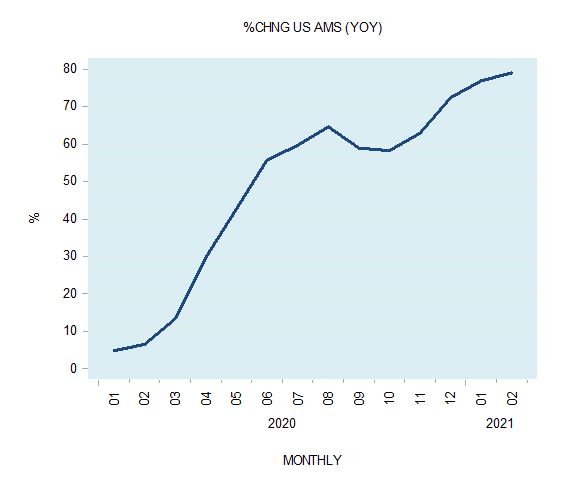
As a result of this pumping, the yearly growth rate of the Austrian money supply metric increased by a massive 79 percent in February 2021 from 4.8 percent in January 2020. (Note that some of the increases in money supply are the result of the monetization of large government outlays).

shos

On account of the sharp decline in the yearly growth rate of the Austrian money supply measure, from 79 percent in February 2021 to 15.4 percent in November 2021, the momentum of the CPI is likely to peak toward the end of 2022. Afterwards a strong decline in the momentum is likely to emerge.

shos

A possible decline in the yearly growth rate of prices coupled with a likely decline in economic activity could ignite expectations of a general decline in the prices of goods and services, i.e., deflation.

Most Commentators Fear Deflation

For most economic commentators, a general decline in prices is considered as bad news. According to these observers, a general decline in prices generates expectations for further declines in prices and slows down individuals’ propensity to spend. This in turn undermines the aggregate demand. A decline in the aggregate demand because of the decline in consumer expenditure leads to a decline in the aggregate supply and thus to a decline in economic growth.

All this sets in motion an economic slump. As the slump further depresses the prices of goods, the pace of economic decline intensifies.

The view that consumers postpone their buying of goods because prices are expected to decline is, however, questionable.

This would mean that people have abandoned any desire to live in the present. Without the maintenance of life in the present, no future life is conceivable.

According to Menger, the founder of the Austrian school of economics, “An imperfect satisfaction of needs leads to the stunting of our nature. Failure to satisfy them brings about our destruction. But to satisfy our needs is to live and prosper. Thus the attempt to provide for the satisfaction of our needs is synonymous with the attempt to provide for our lives and wellbeing. It is the most important of all human endeavors, since it is the prerequisite and foundation of all others.”

Is the Fall in Prices Bad News for the Economy?

What characterizes industrial market economy under a commodity money such as gold is that the prices of goods follow a declining trend.

According to Joseph Salerno

In fact, historically, the natural tendency in the industrial market economy under a commodity money such as gold has been for general prices to persistently decline as ongoing capital accumulation and advances in industrial techniques led to a continual expansion in the supplies of goods. Thus throughout the nineteenth century and up until the First World War, a mild deflationary trend prevailed in the industrialized nations as rapid growth in the supplies of goods outpaced the gradual growth in the money supply that occurred under the classical gold standard. For example, in the US from 1880 to 1896, the wholesale price level fell by about 30 percent, or by 1.75 percent per year, while real income rose by about 85 percent, or around 5 percent per year.

In a free market, the rising purchasing power of money, i.e., declining prices, is the mechanism that makes the great variety of goods produced accessible to many people.

See the rest here

Be seeing you

Posted in Uncategorized | Tagged: , , , , , | Leave a Comment »

Why Fighting Inflation Is Not a Priority for the Fed | Mises Wire

Posted by M. C. on January 29, 2022

While a few quotes do not define a person, they’re worth paying attention to. I get the impression that these people want to expand the Federal Reserve’s power and believe the threat of inflation pales in comparison to climate change and racial inequities. So, in a world where investing largely revolves around guessing how a group of seven people will choose to arbitrarily tinker with our country’s financial system, I’m betting these folks will stay looser for longer.

https://mises.org/wire/why-fighting-inflation-not-priority-fed

Liam Cosgrove

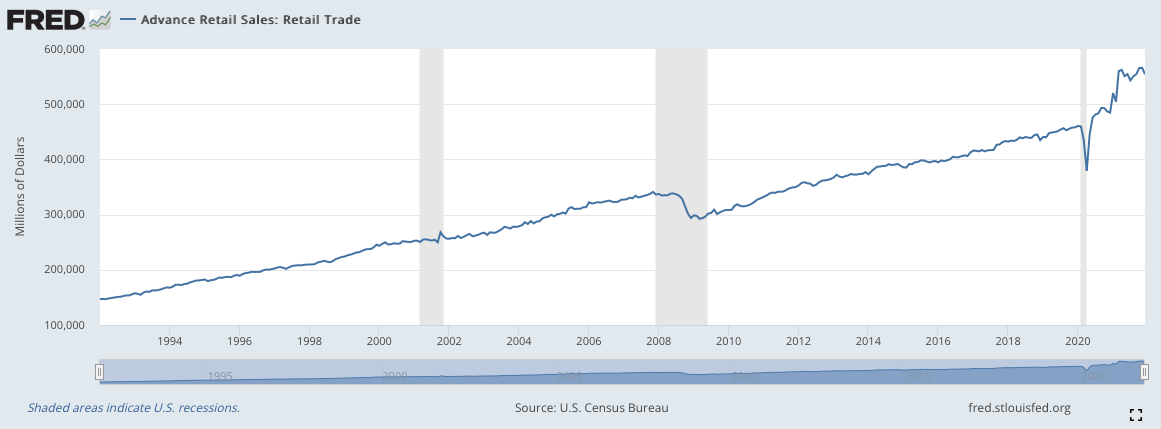
On Wednesday, the Federal Open Market Committee (FOMC) held true to its monetary-tightening timeline despite last week’s 10 percent drawdown in most major indices, effectively saying, “10 percent is not enough.” With retail sales numbers that will surely return to trend without more stimulus (see chart), a gridlocked Senate, and the prospect of higher interest rates surely to discount equity valuations, why aren’t more people selling?

lc

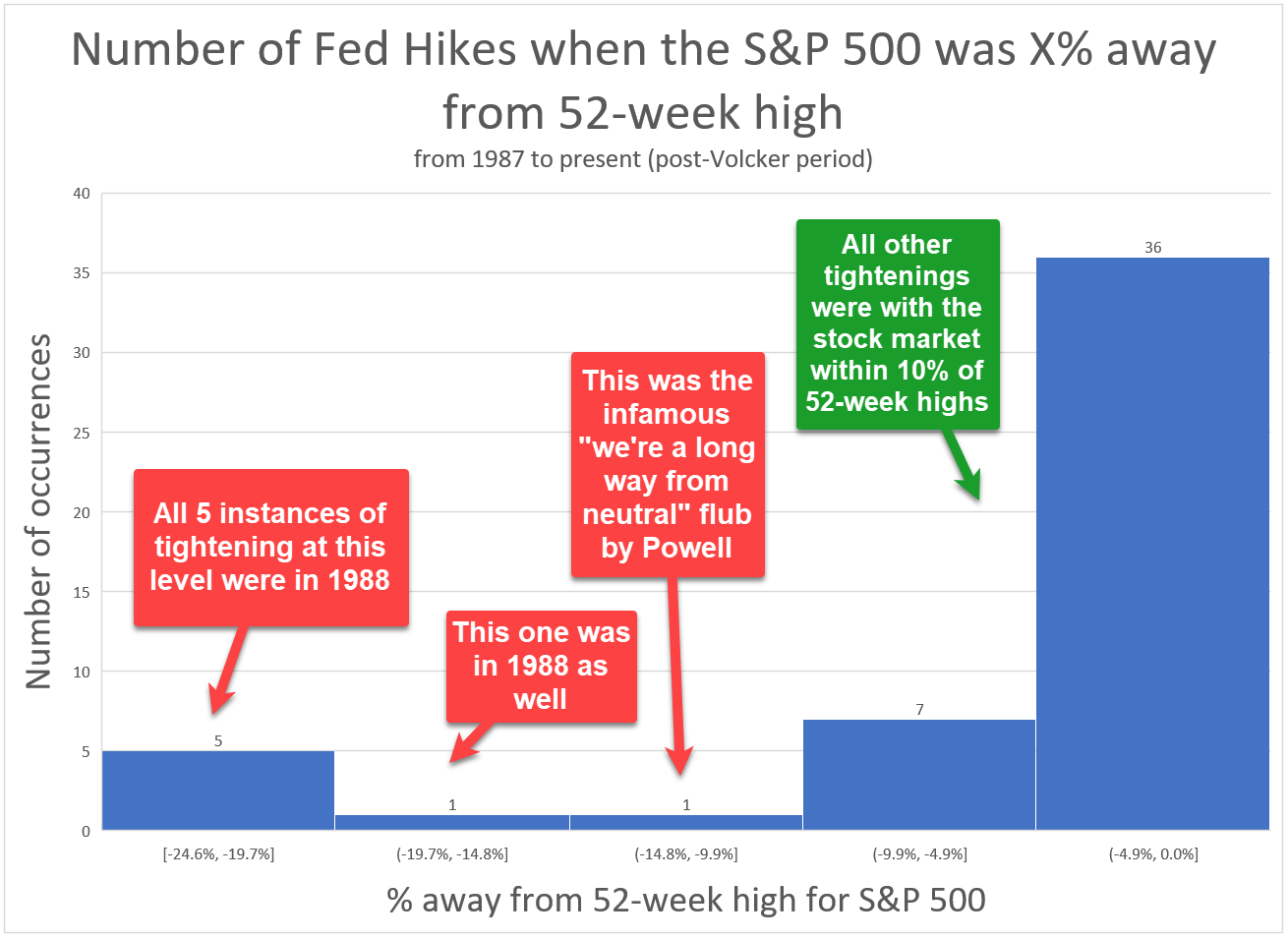
Don’t get me wrong, the Fed will cave eventually, but they just sent a clear message that they need to see more selling. Will they ever make it to “lift off”? This handy chart, courtesy of the Macro Tourist newsletter, can shed some light:

lc2

As you can see, there has been just one rate hike post-1988 during which the S&P 500 was more than 10 percent off its fifty-two-week high. This rate hike was enacted by Jerome Powell and set off the infamous Taper Tantrum episode. So, we have two months before he is faced with this decision again. Suppose the market remains relatively flat or even increases between now and March. Given yesterday’s tolerance and historical precedence, I’d bet on lift off proceeding, which would hurt valuations. Alternatively, if the market continues to decline before the March meeting, historical precedence and Powell’s taper trauma tell us there will likely not be a rate hike in March, which is where things will get interesting. Long story short, markets are going down before they go up. I ask again, Why isn’t everyone selling?

See the rest here

Be seeing you

Posted in Uncategorized | Tagged: , , , | Leave a Comment »

The Fed Has No Real Plan, and Will Likely Soon Chicken Out On Rate Hikes | Mises Wire

Posted by M. C. on January 28, 2022

The idea that “wages are going up” whenever there is inflation is rather fanciful.

https://mises.org/wire/fed-has-no-real-plan-and-will-likely-soon-chicken-out-rate-hikes

Ryan McMaken

The Fed’s Federal Open Market Committee (FOMC) released a new statement today purporting to outline the FOMC’s plans for the next several months. According to the committee’s press release:

With inflation well above 2 percent and a strong labor market, the Committee expects it will soon be appropriate to raise the target range for the federal funds rate. The Committee decided to continue to reduce the monthly pace of its net asset purchases, bringing them to an end in early March. Beginning in February, the Committee will increase its holdings of Treasury securities by at least $20 billion per month and of agency mortgage‑backed securities by at least $10 billion per month. The Federal Reserve’s ongoing purchases and holdings of securities will continue to foster smooth market functioning and accommodative financial conditions, thereby supporting the flow of credit to households and businesses.

The lesson here is that even when inflation is high and the labor market is supposedly strong, the Fed will still only proceed toward tapering and tightening in the slowest, most cautious manner possible.

Although price inflation is at a forty-year high, the Fed is still unwilling to commit to a rate hike in March, and it’s planning to only end new asset purchases for its balance sheet by March. The Fed still refuses to acknowledge any connection between inflation and the incredibly large amounts of money creation and credit creation it fostered over the past decade and especially over the past two years. After all, in its statement, the Fed emphasized that “supply and demand imbalances related to the pandemic and the reopening of the economy have continued to contribute to elevated levels of inflation.”

All of this, however, only amounts to what the Fed is willing to say right now. The “plans” outlined here are no more than the stated, tentative plans for the FOMC. Whether or not any of this actually happens is another matter.

The Fed Is Prepared to Turn More Dovish at the First Sign of Trouble

Indeed, the Fed’s fear and lack of backbone was much more clearly emphasized in Jay Powell’s Q&A with reporters, which followed the release of the FOMC’s statement.

During the presser, Powell repeatedly emphasized that the Fed must remain flexible and that the targeted policies could change at any time, depending on the economic situation. “We need to be adaptable,” he said, and managed to include the typical dovish remarks when he stated that really the current goal with the balance sheet is—at some point—“allowing the balance sheet to begin to run off.” Although the press released mentioned movement toward quantitative tightening for the balance sheet, Powell repeatedly downplayed this in the Q&A.

So, while some news reports covering the Fed’s announcements today appear to conclude that the Fed will surely begin raising rates in March, that remains very much up in the air. And beyond that, the lack of focus on the balance sheet in Powell’s remarks suggested that the Fed is still very much only at the stage of merely contemplating an end to new additions to its portfolio. Actual reductions are still not on the table.

Indeed, it still looks like we’re looking at a repeat of 2016, when the Fed claimed it was going to implement four rate hikes that year. Only one rate hike actually occurred. Anticipated rate hikes based on Fed signals also failed to appear in 2019, when Fed wathers at Goldman and JP Morgan predicted four Fed hikes that year. What actually happened was one rate hike (from 2 percent to 2.25 percent), followed by rate cuts later in the year. That’s likely what Powell is referring to when he says the Fed must be adaptable and flexible. It must be prepared to become even more dovish at any given time.

Déjà vu pic.twitter.com/FWrnPTKUKT— StockCats (@StockCats) January 10, 2022

The Fed Admits Price Inflation Is Actually a Problem

In any case, politically, it is clear that the Fed has been feeling the pressure on price inflation. The Fed has clearly now abandoned its position—expressed repeatedly last fall—that inflation is “transitory” and no big deal. Powell today admitted price inflation “hasn’t gotten better. It’s probably gotten a bit worse … I think to the extent the situation deteriorates further, our policy will have to address that.”

Powell also stated what has long been obvious about price inflation—namely that it hurts the lowest-income people in the population. “Some people are just really prone to suffer more” from inflation, Powell said. He noted that inflation for the wealthy can be unfortunate, but that “it’s particularly hard on people with fixed income and low income.” It’s hard on people with lower incomes, of course, because those people have to spend a higher percentage of their incomes on food, gasoline, and other basic necessities. Many can’t afford to be homeowners—thanks to easy-money-fueled asset price inflation—and so must keep up with rising rents.

This, of course, pours cold water on all those columns from financial columnists in recent months who have been repeatedly penning articles on how price inflation is actually good for most everyone because when there’s inflation, debtors repay their debts in devalued dollars. That narrative, of course, is based on the myth that it’s lopsidedly ordinary people and lower-income people who benefit from devaluing debt payments. In reality, inflation tends to favor people and organizations with more wealth and higher incomes because it’s those people who are most able to access large loans on favorable terms. Much of the time, people with few assets and low incomes can’t get loans at all. Or they can obtain these loans at much higher interest rates which greatly reduce the benefits of paying off debts with devalued dollars.

One example of this is a column by Allison Morrow last month in which she wrote:

But on the whole, inflation can actually be a good thing for many working-class Americans, especially those with fixed-rate debt like a 30-year mortgage. That’s because wages are going up, which not only empowers workers but also gives them more money to pay down debt. Plus, in the case of a mortgage, your monthly payment will be the same but your house will increase in value…

See the rest here

Be seeing you

Posted in Uncategorized | Tagged: , , , , | Leave a Comment »

Understanding the inflation problem

Posted by M. C. on January 21, 2022

More difficult, perhaps, will be the discipline sound money imposes on government spending. From the state’s point of view, the purpose of inflation is to permit it to spend more than it raises in taxes. For money in the form of gold coin to back a fully exchangeable currency requires abandoning inflation as a source of finance.

https://www.goldmoney.com/research/goldmoney-insights/understanding-the-inflation-problem

By Alasdair Macleod

In recent weeks inflation has become a major economic concern. Nearly all the commentary emanating from monetary policy makers, economists, and the media is misguided, believing inflation is rising prices and must be addressed accordingly.

They are only the symptoms of inflation. The true cause is the expansion of currency and bank credit, which, reflected in the US dollar’s M2 money supply has increased substantially since March 2020, and now stands at nearly three times the level when Lehman failed.

After defining the differences between money, currency, and credit which together make up the media of exchange, this article explains how changes in the quantities of currency and credit translate into prices.

The solution to the inflation problem is not price controls, which are always counterproductive, but to return to a regime of sound money. This article shows what must be done to achieve this outcome and concludes that it is impossible to do so without a sufficiently serious financial and economic crisis to discredit government intervention in markets and to then allow governments to stabilise their currencies and reduce their spending to a bare minimum.

Defining inflation, money, currency, and credit[i]

A resolution of the inflation problem requires an understanding of inflation itself. It is an increase in the quantity of the media of exchange, whether it be money, currency, credit, or a combination of any or all of them. It is not a rise in the general price level. That is the consequence of inflation when the media of exchange loses purchasing power.

To avoid misunderstanding, it is important in any discussion about money to provide an accurate definition of what is money and what is not money. Let us clarify this at the outset:

That which is commonly referred to as money is more correctly any form of circulating media used for the payment of goods and services in an economy based on the division of labour. The term “circulating media” or “media of exchange” more accurately represents the common concept of money as the term is used today.

The amount of circulating media is never fixed. Indeed, the quantity of metallic money — gold, silver, and copper, but particularly gold, which we can simply define as pure money with no counterparty risk, has increased over the millennia since weights of these metals first evolved to replace barter. The population of active users of metallic money has also increased. Throughout history, the pace of increases of above ground gold stocks and the human population have been similar. The quantity of gold has therefore broadly kept pace with the population increase.

Over the long term, therefore, money proper has ensured a stable purchasing power despite the increase in above-ground stocks. An important advantage of gold as money is that its use is dominated by the twin functions of ornamentation and as the medium of exchange — unlike silver and copper it is never consumed. Gold’s utility is set by its users, who collectively decide how much circulates as money and how much is used for ornamentation. Its use switches between these two functions as its possessors collectively impose their needs, and gold’s purchasing power is determined by the quantity circulating as money. As well as the flows between its use as money and ornamentation, the quantity of money can also be affected by variations in mine supply from its general correlation with global population growth.

Gold’s purchasing power is stable due to these self-correcting factors. Currency is a different matter, always bearing in mind the counterparty risk of the issuer and its propensity to inflate its quantity. Today, these are central banks. A central bank’s balance sheet always shows currency in circulation as a liability of the bank, along with deposits owed by it to its depositors, normally confined to licenced commercial banks. The quantity of currency in circulation is set not by its users, but by the central bank managing its balance sheet.

In accordance with their monetary policies, Central banks can and do vary the amount of currency and the deposits recorded on their balance sheets, the latter more normally termed the reserves of commercial banks. Setting the level of these reserves in addition to a commercial bank’s shareholder capital used to be the means of regulating the quantity of credit that a commercial bank could issue. But today, central banks actively buy financial assets, payment being credited to the reserve accounts of the commercial banks. It is now the principal source of central bank inflation, and the regulation of a commercial bank’s lending capacity is now controlled more by other forms of regulation.

A commercial bank is a dealer in credit. It lends money to borrowers at a higher rate than it pays to its depositors. By lending money, it creates an asset on its balance sheet, and at the same time a counterbalancing liability is credited to the borrower, representing the amount of credit that the borrower has available to draw upon. The borrower’s bank statement will not usually reflect the counter-deposit, but double-entry bookkeeping demands that it exists. By a few strokes of a bookkeeper’s pen, credit which is indistinguishable from currency is created out of thin air and put into circulation.

We therefore have three types of circulating media: money, currency, and credit. A central bank sets the quantity of currency, and the commercial banks the quantity of bank credit and therefore deposit money, which is bank credit’s counterpart. The only circulating media whose use-value is set by its users is money. For the modern state which demands control over what circulates as the circulating media, money is actively discouraged in favour of its own substitutes, currency and bank credit issued by its licenced commercial banks, which it controls. Even under a gold coin standard, very few transactions involved money, being almost entirely settled by currency and credit.

The consequences of inflation

See the rest here

Be seeing you

Posted in Uncategorized | Tagged: , , , | Leave a Comment »

Price Controls: The Government’s “New” Solution to Inflation?

Posted by M. C. on January 20, 2022

So the experts, CNN, think we should look at price controls.

If wage and price controls kick in you will know we are really in trouble.

https://www.theorganicprepper.com/price-controls/

Aden Tate

There have been a number of news headlines over the course of the past year that I’ve personally found wildly disturbing.

However, it is this one in particular from CNN that I’ve found to be of particular note. It’s titled, “Should the government control the price of food and gas?

Throughout the piece, author Charles Riley looks into the history of price controls both within the past 100 years and of more recent note as well. The basic question behind the article is this: because of rampant inflation “should governments consider setting the price of essential goods?”

While I (sometimes) believe that there is no such thing as a stupid question, the very idea that this notion is being presented to the public is something which I find concerning. I don’t think it’s any secret to regular readers of The Organic Prepper what the position of the mainstream media (MSM) is on these issues. Though a question is being asked, are we ignorant of what the hoped for answer is? 

Riley’s article starts off by examining whether or not there is precedence for price fixing in history.

Is there precedence for price-fixing in history? Absolutely.

As Riley points out,

  • “The German capital of Berlin, for example, has sought to limit how much rent landlords can charge tenants.”
  • “In the United Kingdom, regulators limit how much consumers can be charged for energy and some types of rail fares.”
  • “As elections approached late last year in Argentina and annual inflation topped 50%, the government froze the price of over 1000 household goods.”
  • “Last week, Hungarian Prime Minister Viktor Orban said he would cut the price of flour, sugar, sunflower oil, milk, pork leg, and chicken breast ahead of a national election…”

Let’s look at each of these examples in turn, however.

  • Aside from having a history of totalitarianism, Germany is once more demonstrating that this is where it is headed for in the future as well. Price controls are a part of this.
  • The United Kingdom has never been friendly to freedom (read American history).
  • Jose here at The Organic Prepper has vividly captured what it is like to live in South America right now, where weight loss due to hunger has become the norm.
  • All Viktor Orban has done is demonstrate he’s willing to steal from others in order to win power for himself. Did you notice he did this right before an election?

Just because there is precedence for something, does not mean that it is a good idea. Consider slavery, cannibalism, human sacrifice, or the like. Have they all been practiced in the past? Yes. But does that mean they were good ideas?

Nope.

Precedence does not equal morality.

Price controls on the farmer (or anyone else) will not work.

See the rest here

Be seeing you

Posted in Uncategorized | Tagged: , | Leave a Comment »