https://www.zerohedge.com/news/2019-08-22/larry-summers-comes-clean-ahead-j-hole-admits-central-planners-are-impotent
by Tyler Durden
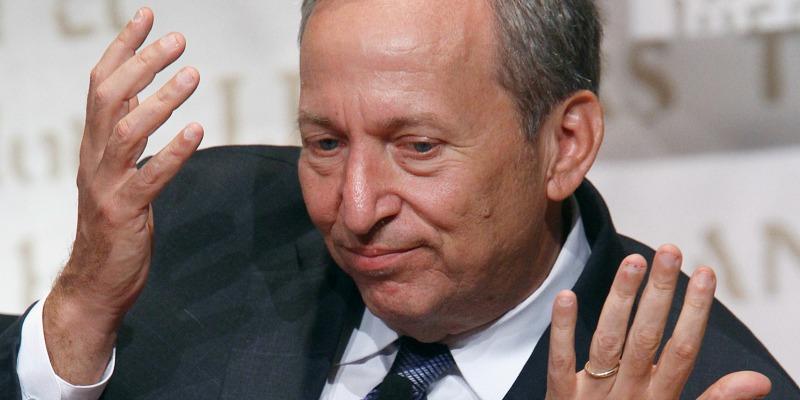
Larry Summers is not one to be shy about sharing his opinion on any and every media channel about just how bad President Trump’s policies are, and how much better everything was in the world under President Obama.
However, in an epic thread of apparent honesty, the former director of the National Economic Council for President Obama took to Twitter to dispel any myths about the omnipotence of central planners and to confirm there’s nothing anyone can do to save the world from doom (especially Jay Powell’s speech tomorrow).
Mea Culpa? Or partisan political pandering to reinforce the “recession is imminent and there’s nothing to stop it and it’s Trump’s fault and that means Trump’s unelectable” narrative?
You decide…
Summers begins his diatribe by addressing the big imminent issue ahead of us:
“Coming into Jackson Hole, economists are grappling with a major issue: Can central banking as we know it be the primary tool of macroeconomic stabilization in the industrial world over the next decade?“
His worry – they are running out of ammo and what ammo they have is losing its mojo…
This limited space for interest rate cuts is true of the US, which has the highest interest rates in the industrialized world. It is even more true of Europe and Japan. 3/
QE and forward guidance have been tried on a substantial scale. We are living in a post QE and forward guidance world. It is hard to believe that changing adverbs here and there or altering the timing of press conferences or the mode of presenting projections is consequential. 4/
Then, Summers goes after central planner over-confidence…
Black hole monetary economics – interest rates stuck at zero with no real prospect of escape – is now the confident market expectation in Europe & Japan, with essentially zero or negative yields over a generation. The United States is only one recession away from joining them. 6/
Everywhere in the industrial world, the risks of a sharp upturn in unemployment appear greater than the risks of a sharp upturn in inflation (even though market expectations of inflation are clearly below 2 percent targets). 7/
The one thing that was taught as axiomatic to economics students around the world was that monetary authorities could over the long term create as much inflation as they wanted through monetary policy. This proposition is now very much in doubt. 8/
Wait, what!!!??
Call it the black hole problem, secular stagnation, or Japanification, this set of issues should be what central banks are worrying about. 10/
In our forthcoming paper, we argue that it minimizes our predicament to see it – as is current consensus – simply in terms of a falling neutral rate, low inflation, and the effective lower bound on nominal rates. Secular stagnation is a more profound issue. 12/
Limited nominal GDP growth in the face of very low interest rates has been interpreted as evidence simply that the neutral rate has fallen substantially. There may well be more to it than that. 13/
We believe it is at least equally plausible that the impact of interest rates on aggregate demand has declined sharply, and that the marginal impact falls off as rates fall. 14/
And then Summers drops the real hammer – rate cuts are useless… or worse, are actually worsening the situation.
It is even plausible that in some cases interest rate cuts may reduce aggregate demand: because of target saving behavior, reversal rate effects on fin. intermediaries, option effects on irreversible investment, and the arithmetic effect of lower rates on gov’t deficits. 15/
If the central problem for macroeconomic stabilization is a falling neutral real interest rate – what might be called “old new Keynesian” economics – monetary policy can achieve full employment if it can get the interest rate low enough. 17/
In contrast under the secular stagnation view we have outlined – what might be called “new old Keynesian” economics – interest rate cuts, even if feasible, may be at best only weakly effective at stimulating aggregate demand and at worst counterproductive. 18/
First, financial instability. The financial crisis had roots in bubbles & excessive leverage caused by efforts to maintain demand after the 2001 recession. Japan’s late 1980s bubble had roots in a low interest rate tight fiscal environment after the 1987 stock market crash. 20/
Second, risks of zombification of firms. Firms that do not face debt service payments are like students who do not have to take tests. They can drift along complacently & ultimately unsuccessfully. And low rates may contribute to increased monopoly power and reduced dynamism. 21/
Third, risks of bank failures. Low rates crowd bank profits and franchise value, making them more vulnerable to adverse shocks at any given level of regulatory capital. 22/
Fourth, risks of further reducing monetary policy effectiveness. To the extent to which rate cuts now “borrow” demand from the future as firms and consumers bring forward investment and durable purchases, low rates now may imply less effective monetary policy in the future. 23/
Summers then goes further – blasting Central planners for claiming they can “contain” the issues…
Obviously fiscal policy needs to be a major focus, especially given what low or negative interest rates mean for the sustainability of deficits. 25/
But the level of demand is also influenced by structural policies: e.g. pay-as-you-go social security, higher retirement ages, improved social insurance, support for private infrastructure investment, redistribution from the high-saving rich to the liquidity-constrained poor. 26/
The high inflation and high interest rates of the 1970s generated a revolution in macroeconomic thinking, policy and institutions. The low inflation, low interest rates and stagnation of the last decade has been longer and more serious and deserves at least an equal response. 27/
But at least he ends on an upbeat note ahead of Jay Powell’s speech tomorrow…NOT!
So, after that 28 tweet thread of self-flagellation, wouldn’t it have been more interesting if Summers had said all that oh, ten years ago?
Be seeing you




 MCViewPoint