MCViewPoint

Opinion from a Libertarian ViewPoint

Posts Tagged ‘Japan’

Proposed Peace Amendment to the United States Constitution

Posted by M. C. on March 6, 2024

By Emanuel Pastreich
Fear No Evil

Article nine states,

“Aspiring sincerely to an international peace based on justice and order, the Japanese people forever renounce war as a sovereign right of the nation and the threat or use of force as a means of settling international disputes.”

Very little is said about how Article Nine could make Japan a leader in security because Japan is positioned to make real security threats like climate change, the collapse of biodiversity, pollution, information warfare, and class warfare, the center of its security policy to a degree that other nations are not capable of.

It is one of the great ironies of history that at the very moment the United States plunges deeper and deeper into war hysteria, that our politicians and government officials are possessed by the demons of complete annihilation and endless expansion, that falsehood and hypocrisy wrap their tentacles around the arms and legs of public intellectuals, at the very moment that it becomes impossible in Washington DC to talk about any subject that is not tied to war, at the very moment that the entire United States is being transformed into a military economy—one wherein all critical decisions are made by military contractors, privatized police, prisons, and for-profit intelligence (and at the top, the militarized private equity firms who pull the strings) it is a terrible and comic irony that we, of all the nations of the Earth, should be pressuring Japan to give up its commitment to oppose militarism as expressed in the Japanese constitution and to join us, as junior partners, in our suicide march towards world war and nuclear holocaust.

We have things so completely backwards. The United States does not have any need to, let alone have any right to, pressure Japan to give up its peace constitution, or to stir up the desires for fortune latent in Tokyo’s military contractors. We know that some Japanese are already itching for an excuse to prepare for war, and to destroy Japanese civil society by creating a military economy as a means of bringing even more wealth and power to the few.

No! It is the United States that needs a peace constitution, and it needs it right now.

We failed to return to a peace economy after the Second World War and the institutional and cultural cancer resulting from an economy stimulated by, and propped up by, war, has metastasized and spread throughout the entire society so that war is everywhere, from children’s toys to parking spaces for veterans, to glowing tributes by politicians to those who kill in blind obedience to the state.

We need now an institutional, intellectual, and spiritual commitment to an economy and a society that is founded in peace, that is committed to peace, and that rewards citizens for their constructive economic contributions to the wellbeing of their families, their neighborhoods, their regions, their country, and to the entire Earth.

I do speak these words lightly. And I speak them as someone who has spent decades thinking about, and writing about, security and conflict. But the truth must be spoken, and we do not have long before the great reckoning.

Maybe there are those who can justify a society that is addicted to war, to destruction, and to endless expansion. That is not my job.

War is not caused by a few bad apples, or a lack of maturity among political leaders. It is the product of an economic system that demands consumption and praises growth. For war is the greatest force for consumption and growth—until, of course, it leaves everything in ruins.

War is a product of a concept of economics, detached from morality and humanity, that has no concern for the long-term and that focuses on returns for the rich calculated over weeks and months, an inhuman economics wherein the long-term wellbeing of the citizens of the Earth is irrelevant.

This speculation-driven casino economy has pushed overproduction across the country which forces us to wrap everything in plastic so as to keep profits flowing to petroleum companies, and to prepare for war because the only factories left in America are those making military parts. Yes, most constructive factories have been moved overseas as part of the great “free trade” fraud perpetrated by the corporate parties.

The Japanese Constitution

Let us take a look at article nine of the Japanese constitution, that part of Japan’s post-war legacy that is so offensive to the American politicians and bureaucrats who have become the slaves of military contractors, and that is also repulsive to the bankers behind the stage who benefit from war preparations in Asia.

Article nine is also a rallying cry for Japanese militarists who wish to create a new empire and for well-paid security consultants deployed in Japan to promote expensive fighter planes that cannot even take off and land, missile defense systems that cannot stop anything, but who are unconcerned by the fact that Japan cannot provide its own food, that its water is being slowly poisoned with chemicals from factories and military bases, or that its nuclear power plants are sitting targets just waiting for an enemy attack.

Article nine states,

“Aspiring sincerely to an international peace based on justice and order, the Japanese people forever renounce war as a sovereign right of the nation and the threat or use of force as a means of settling international disputes.”

Article nine is invaluable in its intentions and spirit and it has had a positive impact around the world, even as its meaning has been diluted, then distorted, and then eviscerated though shifts in Japanese policy, starting with the establishment of the “Self-Defense Forces,” followed by the integration of the Japanese economy into the American war economy during the Korean War, and culminating in the false concept of “collective security,” a fig leaf for aggressive military expansionism and entry into the international arms market.

At the same time, we must recognize that there are problems with Article Nine.

First, the text suggests that Japan must renounce war as an idealistic aspiration for “international peace based on justice and order,” rather than as a necessity in an age in which we are faced with the choice between “hegemony and survival,” as Noam Chomsky famously put it.

The absence of a concrete articulation of the logic behind renouncing war for a practical goal, not only for the abstract ideals of justice, has generated unending criticism holding that the Japanese constitution is overly idealistic and even a violation of Japan’s sovereign rights.

It will be critical in future debates on security policy to explain how Japan’s position on the use of war is realistic and strategic, and how it is unmistakably in the long-term interests of the Japanese and the international community.

It is also critical that Japanese, and Americans, challenge the assumptions underlying American security policy. Failure to do so, that is to merely assume that somehow Japan is protected by the United States while it enjoys its “peace constitution” encourages criticisms in the United States that Japan is a free rider, and complaints in Japan that Japan has become an American colony. That is to say that both the United States and Japan must express a similar commitment to peace.

In addition, article nine employs the terms “war” and “nation” as if they are static, unchanging, objects whose parameters are clear and that do not shift or evolve over time.

The essential nature of war does not change; the means by which war is waged, and the subjects in war, are constantly evolving. It is still true that guns, tanks, and fighter planes are used to wage war. Yet war today extends into diverse fields and takes place in visible and invisible forms at multiple levels. The media, entertainment, and AI have been weaponized and used to dumb down and render the population passive. This is not technology for a more convenient life, but rather another form of war.

Nano technologies are employed to invisibly attack the functions of the body, or to alter the environment. New biotechnology weapons can render victims ill, or incapacitated. The same for electromagnetic radiation, infrared radiation, and a host of other new weapons, or potential weapons.

Information warfare similarly is employed to create false narratives that confuse citizens as part of a divide and conquer strategy.

These forms of war fall outside of the narrow definition of “war” put forth in Article Nine, even though these forms of war are being conducted today in a more devastating manner than traditional warfare.

Similarly, the concept of “nation” has shifted so radically as to demand significant revision of the concept of war. War today is not conducted just between nations, but also between ethnic groups, between multinational corporations, and increasingly between classes. The driving force behind the current global war is a class war between the super-rich and everyone else, that it to say a war that goes beyond the assumptions of Article Nine.

We are confronted by a brave new world stretching to the horizon in which national borders are only for little people, in which the nation state exists only for television broadcasts and United Nations events, in which the real decisions behind the war against humanity are made by hidden financial powers who manipulate all the governments of the world, presenting us with pathetic puppets who stumble through a tragically amusing diplomatic show that is put on for the working man and women by private equity.

Sadly, the current discussion of Article Nine of Japan’s constitution revolves around how to remove it, or to misinterpret it, so as to transform Japan into a nation that wages war, and that will have the third largest military in the world.

Very little is said about how Article Nine could make Japan a leader in security because Japan is positioned to make real security threats like climate change, the collapse of biodiversity, pollution, information warfare, and class warfare, the center of its security policy to a degree that other nations are not capable of.

Read the Whole Article

Be seeing you

Posted in Uncategorized | Tagged: , , , , | Leave a Comment »

An Economic Case against the Atomic Bombing of Japan

Posted by M. C. on August 8, 2023

Japan could never have won the war against the U.S. It could not produce enough war goods to defeat the U.S., let alone the combined economic strength of the Allied powers (Hanson 2017, 303). Wartime production statistics strongly suggest U.S. war planners understood victory was inevitable long before the atomic bombing.

But Halsey maintained, “The first atomic bomb was an unnecessary experiment…. It was a mistake to ever drop it. Why reveal a weapon like that to the world when it wasn’t necessary? … [The scientists] had this toy and they wanted to try it out, so they dropped it…. It killed a lot of Japs, but the Japs had put out a lot of peace feelers through Russia long before” (qtd. in Alperovitz 1995, 331).

https://www.independent.org/publications/tir/article.asp?id=1850

By Edward W. Fuller

This article appeared in the Summer 2023 issue of The Independent Review.

There were many great battles during the Second World War, however, the production battle was far and away the most important. A close examination of wartime production statistics strongly suggest that U.S. war planners understood victory over Japan was inevitable. Was the atomic bombing of Japan even necessary to win the war?


Article

Download PDF (30 pages)

On August 6, 1945, the government of the United States dropped an atomic bomb on Hiroshima, Japan. The bomb killed sixty-five thousand Japanese instantly. Another sixty-five thousand inhabitants of Hiroshima perished in the following months. On August 9, the U.S. government dropped an atomic bomb on Nagasaki, killing thirty-five thousand instantly and another thirty-five thousand before the end of the year. Over the following decades, thousands more died from medical complications caused by the atomic bombing. In short, the U.S. government killed over two hundred thousand Japanese with atomic weapons. Fully 96.5 percent were civilians (Dower 2010, 199; Overy 2022, 790).

The atomic bombing was a watershed in history. Since the bombing, the specter of nuclear war has haunted humanity. For this reason, a survey of prominent journalists ranked the bombing as the most important event of the twentieth century (Walker 2005, 311). The controversy over the event is commensurate with its significance. Debates over the atomic bombing are waged with more ferocity and contempt than debates over almost any other historical topic.[1] Although many questions are involved, the debate almost inevitably comes down to this question: was it necessary?

Arguments over the bombing often appeal to statements from U.S. government officials. For example, President Harry S. Truman claimed the atomic bombing was “the greatest thing in history” and “saved millions of lives” (qtd. in Alperovitz 1995, 513, 517). By contrast, Admiral William D. Leahy—the highest-ranking U.S. military officer throughout the Second World War—thought the atomic bombing was unnecessary:

It is my opinion that the use of this barbarous weapon at Hiroshima and Nagasaki was of no material assistance in our war against Japan. The Japanese were already defeated and ready to surrender because of the effective sea blockade and the successful bombing with conventional weapons…. My own feeling was that in being the first to use it, we had adopted an ethical standard common to the barbarians of the Dark Ages. I was not taught to make war in that fashion, and wars cannot be won by destroying women and children. (1950, 513–14)[2]

Statements from government officials cannot establish whether the atomic bombing was unnecessary. Any argument that the bombing was unnecessary must be based on the facts of the war. To be sure, statements from government officials can be crucial in the search for essential facts. Still, the facts must be independently verified and interpreted.

Unfortunately, the vast literature on the atomic bombing overlooks the most important facts of the war—namely, the economic facts. At its core, the Second World War was an economic war. Economic conflict caused the war, and the economic battle was by far the most important battle.[3] It is impossible to fully understand the war in general and the atomic bombing in particular without understanding the economics of the war. This paper introduces vital economic facts about the Second World War into the literature on the atomic bombing.

The central thesis of this paper is that the atomic bombing of Japan was unnecessary. Basic wartime economic statistics show that the United States had an overwhelming economic advantage over Japan during the Second World War. The U.S. used its commanding economic position to wage a debilitating economic war against Japan. Production statistics show the U.S. economic war caused the Japanese economy to collapse. Additionally, production statistics strongly suggest that U.S. political and military leadership did not view Japan as an existential threat after 1943. Invading Japan was unnecessary for the same economic reasons that the atomic bombing was unnecessary.

The Big Economic Picture

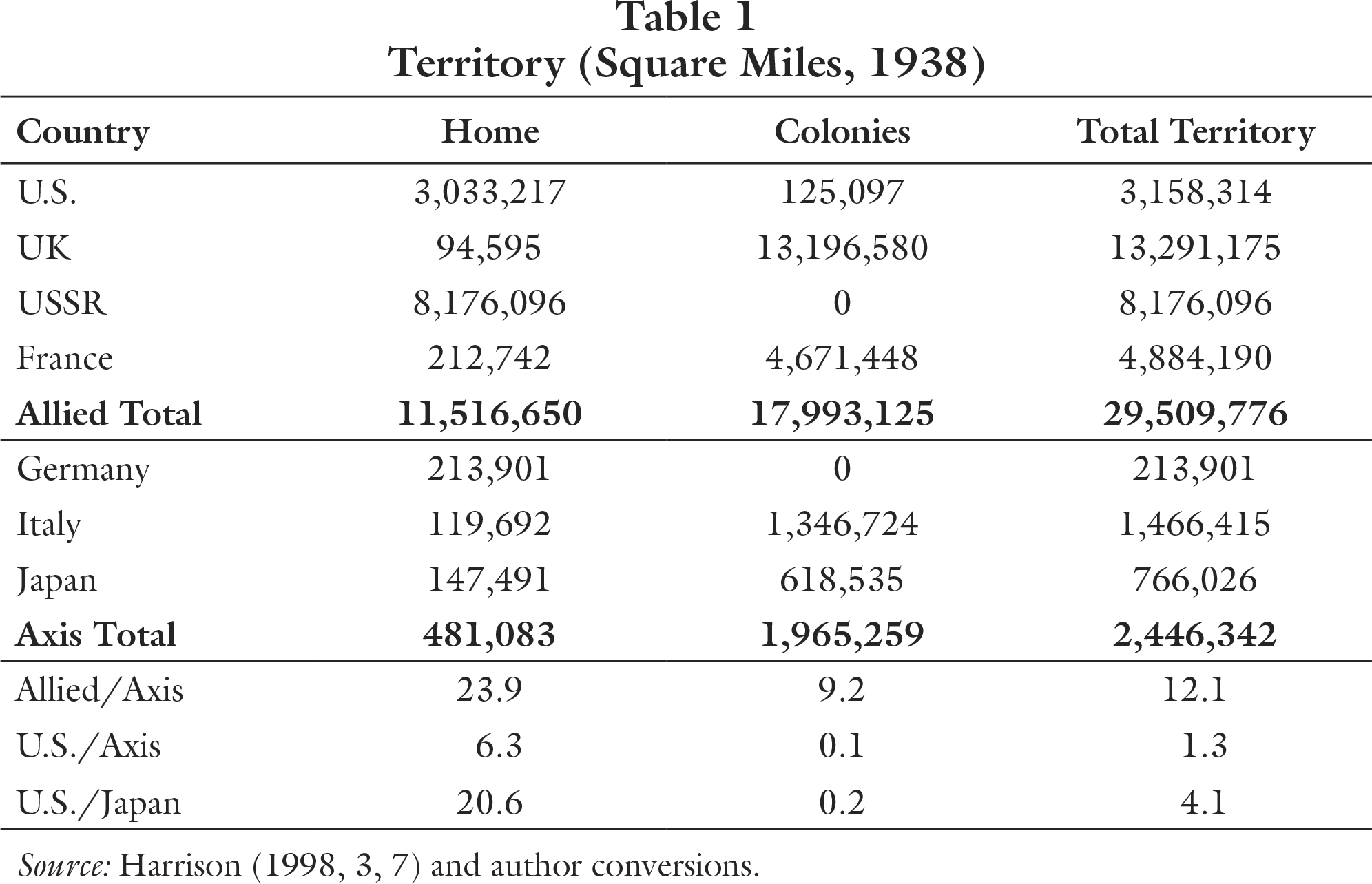
An economic analysis of the Second World War must begin by comparing the sizes of the combatants’ territories, populations, and armed forces. All else equal, a combatant with more territory has an advantage over a combatant with less territory. A larger territory is more difficult to conquer and occupy, and it has more natural resources needed for war. As table 1 shows, the Allied powers’ home territory was 23.9 times larger than the Axis powers’ home territory. The U.S. alone was 6.3 times larger than the combined home territories of the Axis powers. The Japanese homeland was only 4.9 percent of the size of the continental United States. Even when Japanese colonial territory is considered, U.S. home territory was 4 times larger than total Japanese territory. Clearly, the U.S. had a massive territorial advantage over Japan.

table

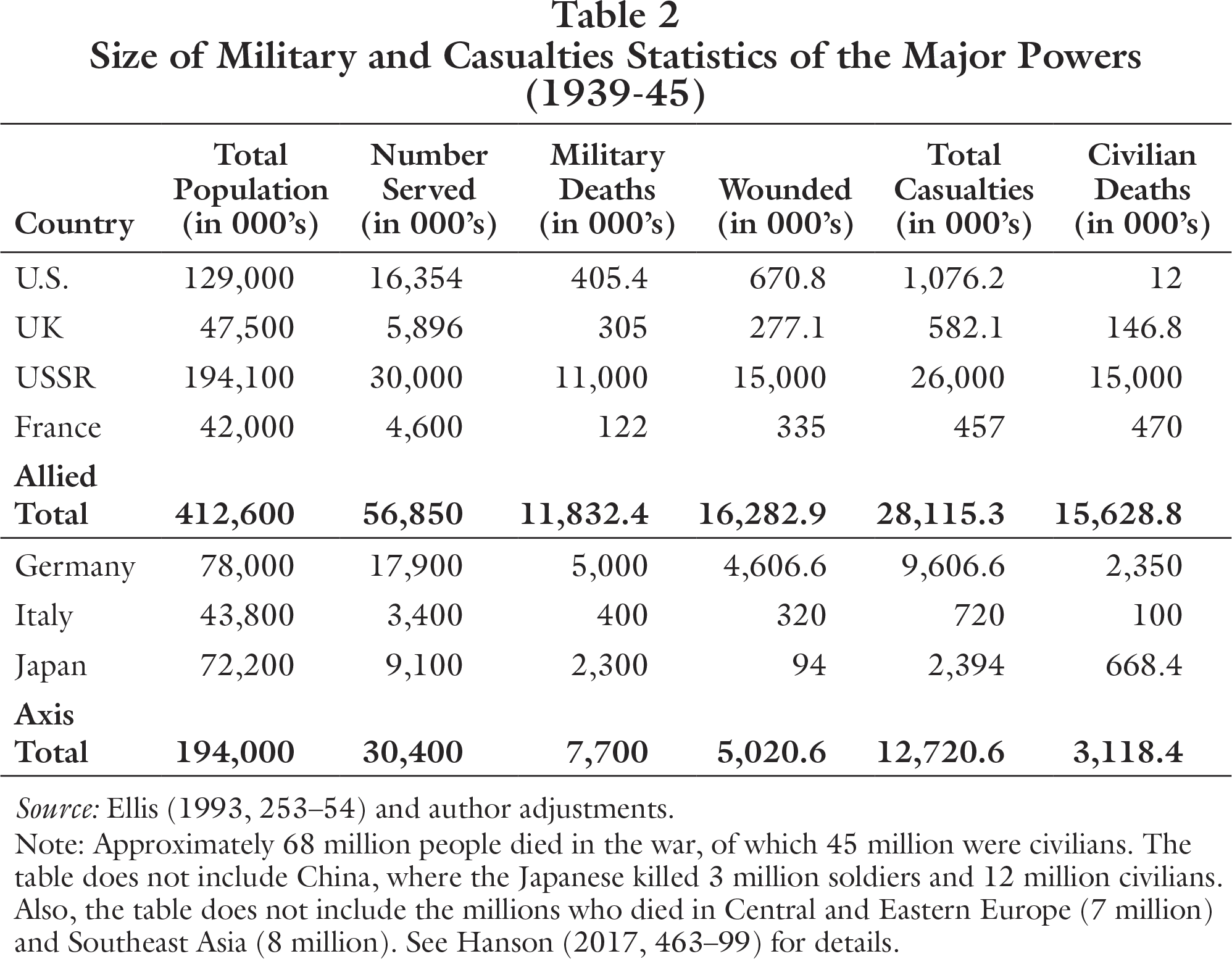
The relative size of the combatants’ populations is another relevant factor in any war. All else equal, the combatant with the larger population can devote more manpower to the war effort. The total population of the major Allied powers (412.6 million) far exceeded the total population of the Axis powers (194 million). Moreover, China’s and India’s populations were 450 million and 360 million, respectively (Ellis 1993, 253). Hence, total population of all the Allies was approximately six times larger than the Axis population. As for the Pacific war in particular, the population of the U.S. (129 million) was almost twice the population of Japan (72.2 million).

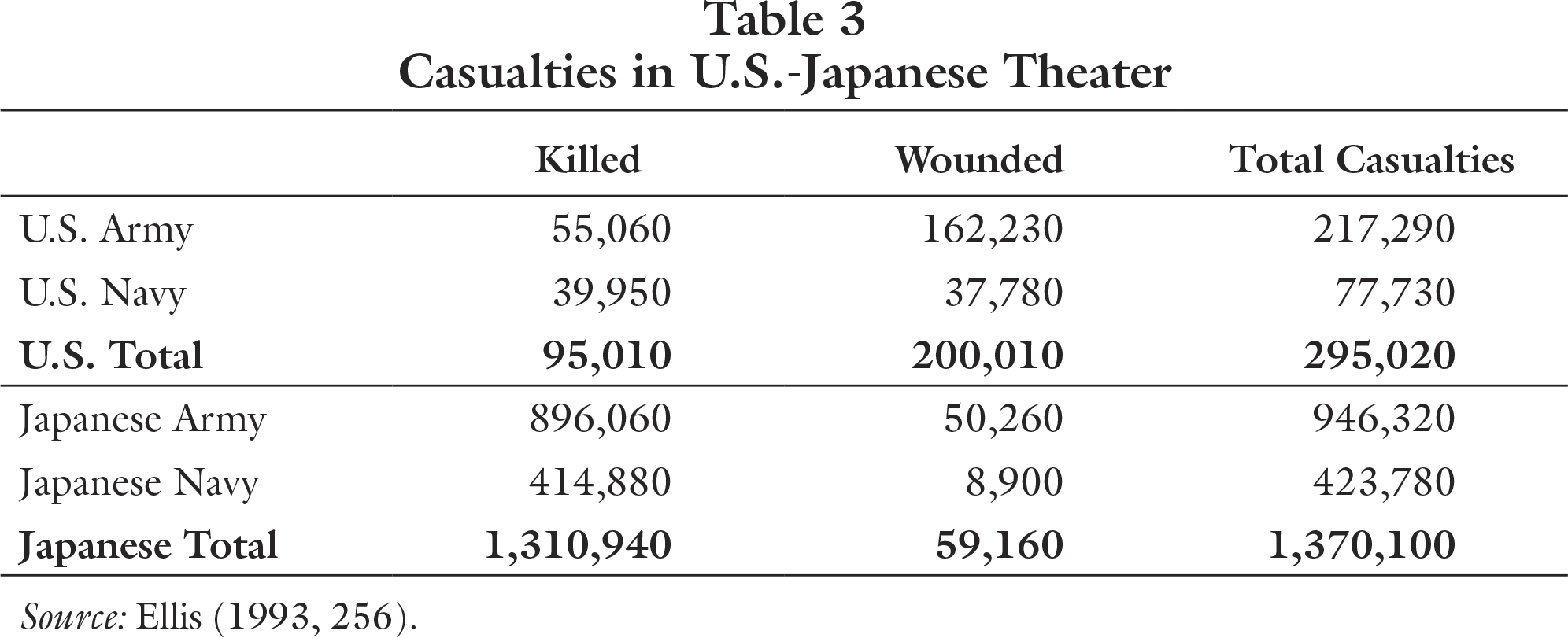
As table 2 shows, nearly 56.9 million served in the Allied armed forces, while 30.4 million served for the Axis powers. And 16.4 million Americans served in the armed forces, compared to 9.1 million Japanese. As table 3 indicates, 13.8 Japanese servicemen died for every 1 American in the US-Japanese Theater. It is true that two-thirds of Japanese military deaths were due to starvation or illness (Dower 1986, 298). Still, the American kill ratio averaged five to one for the war. And it skyrocketed to twenty-two to one between March 1944 and May 1945 (Miles 1985, 134). In short, the American armed forces were much larger than their Japanese counterparts, and the Americans were far more deadly.

table
table

The U.S. thus had a significant advantage over Japan in terms of territory, population size, and servicemen. However, greater numbers do not guarantee victory. History is full of examples in which a smaller force was able to easily defeat a much larger force. Two obvious examples are the Spanish conquest of the New World and the Opium Wars. How can a smaller force prevail? The answer is superiority in war goods.

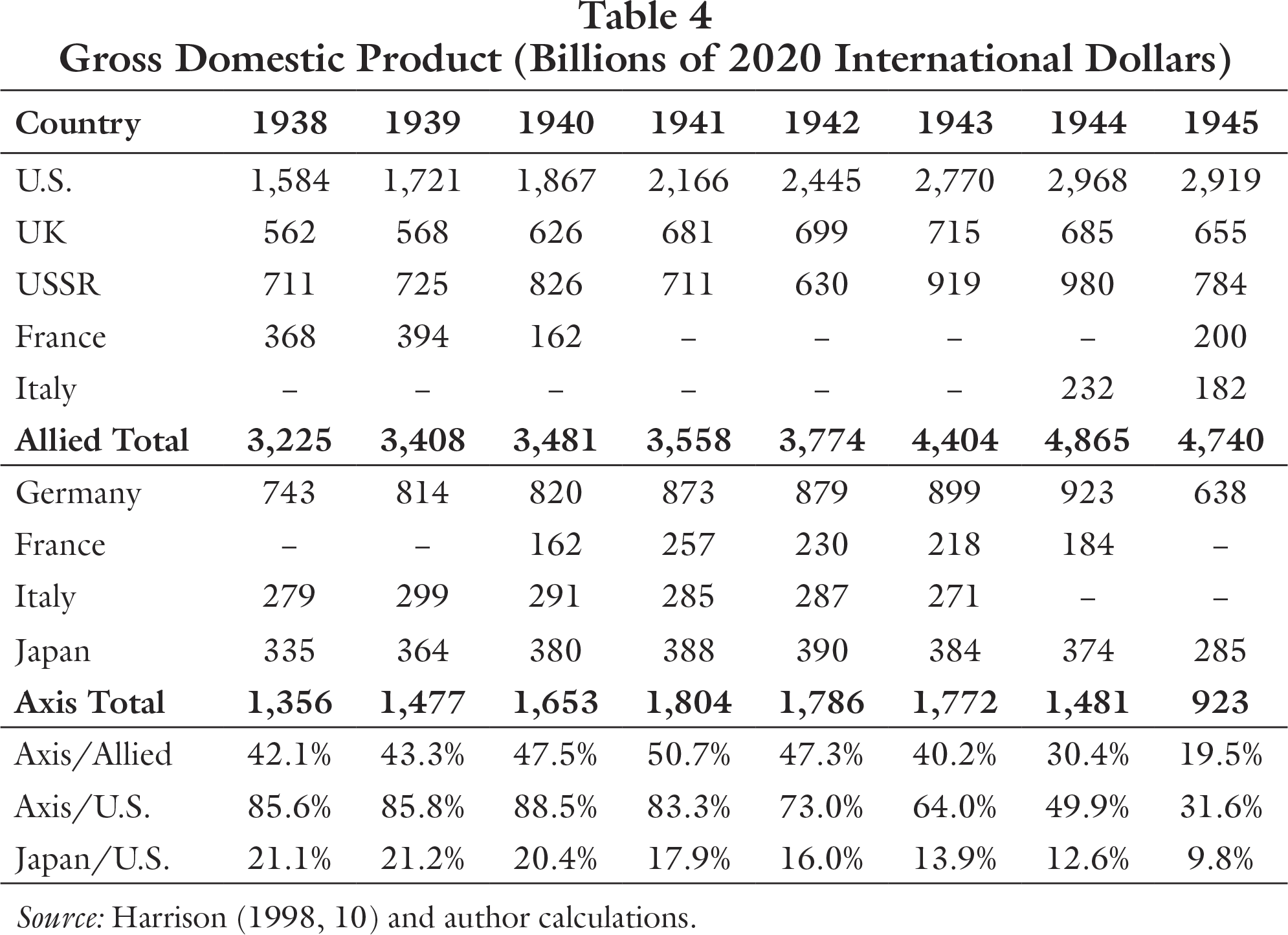
table

War goods are required to fight and win wars. All else equal, a force better equipped with war goods has an advantage over a force poorly equipped. To take an extreme example, a force with machine guns has an advantage over a force with wooden spears. But war goods do not fall from the sky; they must be produced. The combatant with the superior economic ability to produce war goods has an important advantage in war. Indeed, the production advantage is the decisive advantage in modern war.

Gross domestic product (GDP) is the most common measure of a country’s capacity to produce. In 1945 total Allied GDP was 5.1 times greater than total Axis GDP. U.S. GDP alone was 3.2 times greater than total Axis GDP. The combined GDP of all the other major powers—the UK, the USSR, France, Germany, Italy, and Japan—was only 94 percent of U.S. GDP. Amazingly, U.S. GDP was 10.2 times greater than Japanese GDP in 1945. Put differently, Japanese GDP was only 9.8 percent of U.S. GDP when the atomic bombs were dropped.

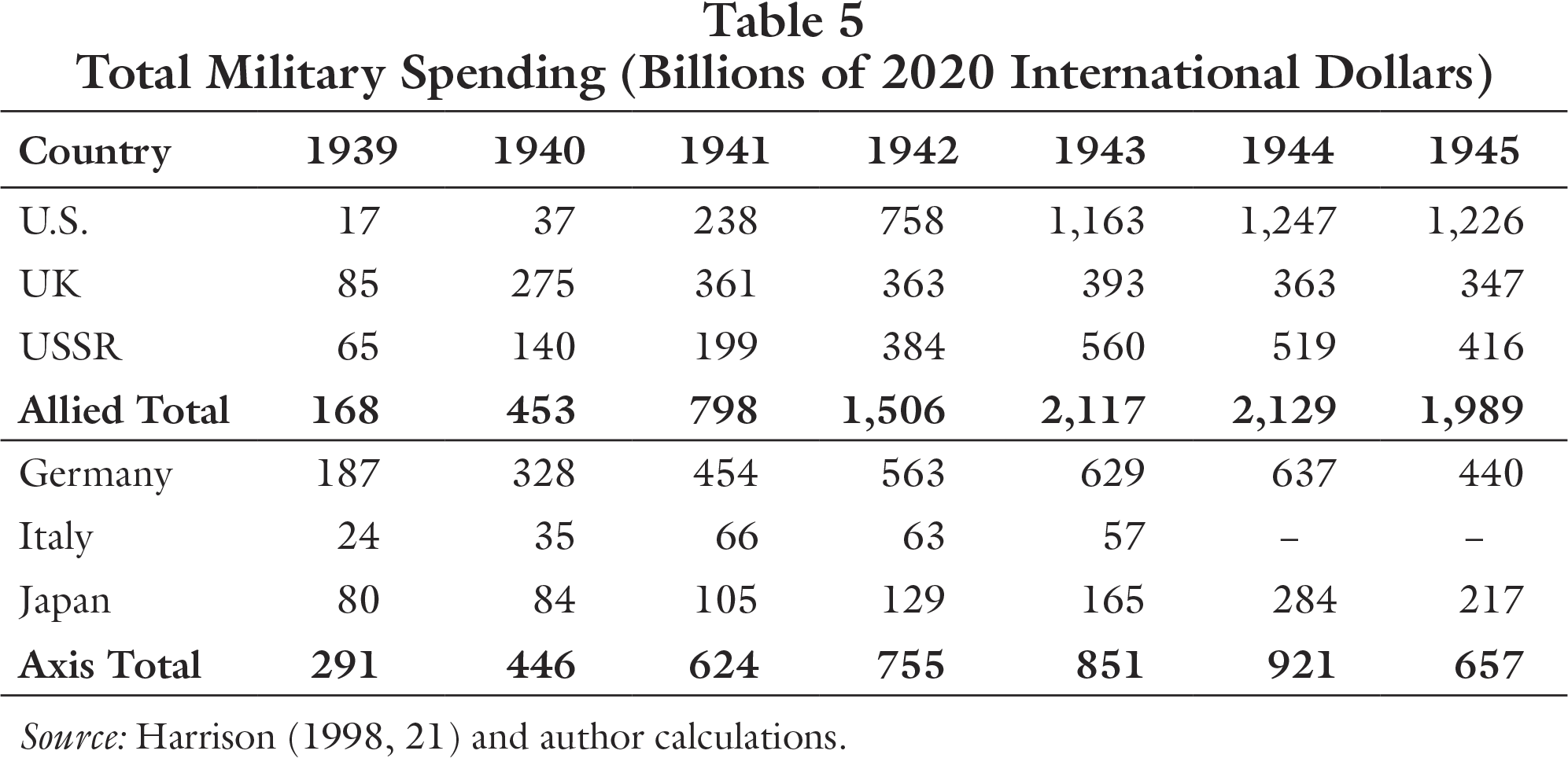
Military spending is a good indicator of a combatant’s economic capacity to wage war. Table 5 shows the military spending of each major power during the war. By 1945 Allied military spending was 3 times greater than total Axis military spending. U.S. military spending alone was 1.3 times greater than total Axis GDP in 1945 and 5.7 times greater than Japan’s military spending. Shockingly, Japanese GDP was only 23.3 percent of U.S. military spending in 1945. Military-spending statistics show that the U.S. had an enormous economic advantage over Japan and all the other major powers.

table

The U.S. Economic War against Japan

See the rest here

Be seeing you

Posted in Uncategorized | Tagged: , , , | Leave a Comment »

US Military Increasing Cooperation With Japan to Prepare for War With China – News From Antiwar.com

Posted by M. C. on January 10, 2023

“The top Marine Corps general in Japan says the US is ‘setting the theater’ in the region the same way it did in Ukraine after 2014”

Just like Ukraine! And how is that working for ya?

So Japan’s (and Australia’s) sons and daughters will die for Taiwan before US sons and daughters. Works for the pentagram.

https://news.antiwar.com/2023/01/09/us-military-increasing-cooperation-with-japan-to-prepare-for-war-with-china/

The US and Japanese militaries are increasing cooperation to prepare for a possible war with China over Taiwan or other areas in the Asia Pacific, the top US Marine Corps general in Japan told Financial Times.

Lt. Gen. James Bierman, commander of the Third Marine Expeditionary Force (III MEF) and of Marine Forces Japan, said the US military was preparing for a future conflict in the region the same way it did in Ukraine in 2014 following the US-backed ouster of former Ukrainian President Viktor Yanukovych.

“Why have we achieved the level of success we’ve achieved in Ukraine? A big part of that has been because after Russian aggression in 2014 and 2015, we earnestly got after preparing for future conflict: training for the Ukrainians, prepositioning of supplies, identification of sites from which we could operate support, sustain operations,” Bierman said.

“We call that setting the theater. And we are setting the theater in Japan, in the Philippines, in other locations,” the general added.

Bierman’s comments came after Japanese Prime Minister Fumio Kishida announced a major overhaul of the Japanese armed forces that involves doubling Tokyo’s military budget. A new security strategy issued by Kishida’s government names China “the biggest strategic challenge” and includes language that can justify military action in defense of the US, breaking from Japan’s post-World War II pacifism.

The Marines Corps has been undergoing an overhaul of its own as it is shifting its focus on preparing for war in the western Pacific rather than fighting counterinsurgencies in the Middle East. Be seeing you

See the rest here

Be seeing you

Posted in Uncategorized | Tagged: , , , | Leave a Comment »

Government Intervention into International Currency Exchange Rates: Japan as a Case Study

Posted by M. C. on September 18, 2022

However, monetary policy interventions introduce other distortions into the economy which can have severe economic consequences, as illustrated by Japan’s lost decades after the Plaza Accord.

  • yen

https://mises.org/wire/government-intervention-international-currency-exchange-rates-japan-case-study

Mihai Macovei

The recent hefty depreciation of the yen to a twenty-four-year low against the dollar has raised eyebrows due to the yen’s traditional safe haven role in times of turmoil, such as the war in Ukraine. The yen’s decline had already started when major central banks signaled a tightening of monetary policy to fight inflation while the Bank of Japan (BoJ) doubled down on its loose monetary policy and zero target for ten-year bond yields. The depreciation accelerated further when oil and gas prices surged, weakening Japan’s terms of trade.

Mainstream analysts got wary about the yen’s tumble and its negative impact on import prices and consumption, but recommended the BoJ to continue its ultraloose monetary policy in order to reflate the economy and support growth. What these analysts fail to grasp is that in a longer-term perspective, the yen’s value relative to other currencies is anchored in economic fundamentals driven by monetary developments and its purchasing power.

Since the sharp appreciation of the yen following the Plaza Accord in 1985, the currency has preserved its relative strength versus the dollar despite Japan’s ultraloose fiscal and monetary policies. This is because money creation has run at a slower pace in Japan than in the US, as the Plaza agreement ushered in Japan’s lost decades, illustrating well how disruptive government interventions in foreign exchange markets can be.

The Plaza Accord

For more than three decades, following its sudden appreciation as a result of the 1985 Plaza Accord (graph 1), the yen has followed a steady path versus the dollar. The Plaza agreement between G-5 countries—the United States, West Germany, France, Japan, and the United Kingdom—marked the first large experiment in international monetary cooperation to revalue the exchange rate system.

At the behest of the United States, which wanted to devalue the dollar and reduce the trade deficit, the five central banks agreed to intervene in currency markets to rebalance international trade and growth. The perceived overvaluation of the US dollar was the result of relatively high interest rates promoted by the Fed during 1980–82 to quell inflation, combined with Ronald Reagan’s expansionary fiscal policy during 1981–84, which caused capital inflows and an appreciation of the dollar.

High budget deficits together with buoyant domestic demand swelled the trade deficit, producing the famous 1980s “twin deficits.” In reality, the exchange rate was not the problem, but US fiscal profligacy and excessive money supply expansion, which exceeded 12 percent in 1983. Instead of fixing domestic policies, the US government talked Japan and Germany into manipulating their exchange rates and increasing domestic demand. As Ludwig von Mises put it so aptly: “What governments call international monetary cooperation is concerted action for the sake of credit expansion.”

Graph 1: Japanese yen to US dollar spot exchange rate

picture1.png

Macovei 1

Following concerted interventions by central banks, the yen appreciated from about 240 units per dollar in September 1985 to 153 units in 1986. By 1988, the yen had almost doubled in value to an exchange rate of 120 units per dollar. Many analyses, including International Monetary Fund reports, concur that the significant government-driven appreciation of the yen sowed the seeds for Japan’s subsequent long-lasting economic debacle.

See the rest here

Be seeing you

Posted in Uncategorized | Tagged: , , , | Leave a Comment »

The Eurozone Is Going down the Same Stagnating Road as Japan | Mises Wire

Posted by M. C. on September 20, 2021

Countries like Italy, Spain, Portugal, or Greece cannot survive stagnation due to elevated levels of unemployment and the small size of the business fabric. Therefore, the ECB seems to ignore the risks of perpetuating the perverse incentives to bloat government spending and debt.

https://mises.org/wire/eurozone-going-down-same-stagnating-road-japan

Daniel Lacalle

The European Central Bank announced a tapering of the repurchase program on September 9. One would imagine that this is a sensible idea given the recent rise in inflation in the eurozone to the highest level in a decade and the allegedly strong recovery of the economy. However, there is a big problem. The announcement is not really tapering, but simply adjusting to a lower net supply of bonds from sovereign issuers. In fact, considering the pace announced by the central bank, the ECB will continue to purchase 100 percent of all net issuance from sovereigns. https://www.youtube.com/embed/bXBFrWXPMjQ?feature=oembed

There are several problems in this strategy. The first one is that the ECB is unwillingly acknowledging that there is no real secondary market demand for eurozone countries’ sovereign debt at these yields. One would have to think of twice or three times the current yield for investors to accept many eurozone bonds if the ECB does not repurchase them. This is obviously a dangerous bubble.

The second problem is that the ECB acknowledges that monetary policy has gone from being a tool to help implement structural reforms to a tool to avoid them. Even with the strong GDP bounce that the ECB predicts, few governments are willing to reduce spending and curb deficits in a meaningful way. The ECB estimates show that after the massive deficit spending of 2020, eurozone government spending will rise again by 3.4 percent in 2021 only to fall modestly by 1.2 percent in 2022. This means that eurozone government spending will consolidate the covid pandemic increase with little improvement in the fiscal position of most countries. Indeed, countries like Spain and Italy have increased the structural deficit.

The third problem is that negative rates and high liquidity injections combined with elevated government spending have generated no real multiplier effect in the eurozone. We must remember that the main economies were in stagnation already in the fourth quarter of 2019, before the pandemic and despite large stimulus plans like the Juncker Plan, which mobilized hundreds of billions of euros in investments.

The fourth challenge for the ECB is that it acknowledges being trapped by its own policy, it cannot stop it and normalize because governments and markets would suffer, and it cannot keep the current pace because inflation is putting even more pressure on growth.

The final challenge for the eurozone and the ECB is that they continue to implement policies that ignore demographics and structural burdens to growth. The eurozone has an aging population and monetary and fiscal policies seem to ignore the evidence of changing consumption patterns when citizens reach a certain age or retire. If we add to demographics a taxation system that increasingly hurts middle classes, businesses, and investment, we face an economy that seems to be following all the wrong policies that Japan implemented at the beginning of the ’90s.

As Japan did, the eurozone is betting all on government spending, chains of stimulus packages driven by political directions, and massive debt monetization. However, the eurozone does not have the disciplined labor force that Japan has nor the elevated levels of corporate and household savings that allow the country to continue in stagnation for decades.

Countries like Italy, Spain, Portugal, or Greece cannot survive stagnation due to elevated levels of unemployment and the small size of the business fabric. Therefore, the ECB seems to ignore the risks of perpetuating the perverse incentives to bloat government spending and debt. All messages concerning structural reforms and real growth initiatives have disappeared in favor of directed stimulus plans that never deliver. Our duty as economists is to warn of the more than likely scenario of poor recovery, low productivity, and high debt that the eurozone faces. Fiscal multipliers have been negative for too long for us to ignore the negative crowding-out effect of high government spending and the erosion of competitiveness that the economy faces. Author:

Daniel Lacalle

Daniel Lacalle, PhD, economist and fund manager, is the author of the bestselling books Freedom or Equality (2020),Escape from the Central Bank Trap (2017), The Energy World Is Flat (2015), and Life in the Financial Markets (2014).

He is a professor of global economy at IE Business School in Madrid.

Be seeing you

Posted in Uncategorized | Tagged: , , , , | 1 Comment »

Japan Appoints “Minister Of Loneliness” After Disturbing Rise In ‘Social Distancing Era’ Suicides | ZeroHedge

Posted by M. C. on February 24, 2021

https://www.zerohedge.com/medical/japan-appoints-minister-loneliness-after-disturbing-rise-social-distancing-era-suicides

Tyler Durden's Photoby Tyler DurdenTuesday, Feb 23, 2021 – 21:05

Japan like many other developed nations witnessed an alarming rise in suicides or attempted suicides over this past year of pandemic shutdowns and social distancing measures. The country was already at crisis levels even before the pandemic (though generally on a downward trajectory the prior decade), with recent studies showing it to be “the leading cause of death in men among the ages of 20-44 and women among the ages of 15 to 34.”

To tackle the crisis, especially in the midst of this COVID-induced period of greater social isolation, Japan’s government has appointed a “Minister of Loneliness” after the UK became the first country to establish such a position in 2018.Via AFP

The most recent numbers cited in Japanese media reports say that 879 women killed themselves in the country during the month of October, a figure that marks a whopping 70% increase compared to the same month from 2019. Officials have noted that the pandemic and oftentimes mandated social distancing measures have appeared to have a harsher impact on women.

According to Japan Times, Prime Minister Yoshihide Suga earlier in the month appointed as the new Minister of Loneliness a 70-year old veteran politician named Tetsushi Sakamoto. It is a cabinet level position which aims to alleviate social isolation among citizens. 

He’ll head up an ’emergency taskforce’ to battle the disturbing spike in suicides nationally as his first order of business. “With isolation tied to an array of social woes such as suicide, poverty and hikikomori (social recluses), the Cabinet Office also established a task force Friday that seeks to address the problem of loneliness across various ministries, including by investigating its impact,” Japan Times writes.

“According to preliminary figures released by the National Police Agency, 20,919 people took their own lives in 2020, up 750 from the previous year and marking the first year-on-year increase in 11 years. The surge is largely attributed to a noticeable rise in suicides among women and young people,” the report pointed out.

Suicides end 10-year decline in Japan as pandemic stress hits women harder https://t.co/s0bs6uCSV9 pic.twitter.com/boOuCnC49U — Reuters (@Reuters) January 22, 2021

Perhaps ironically, Japan also a has minister in charge of tackling Japan’s sharply declining birthrate, which has also been subject of much reporting in recent years. 

We wonder if these ministers will tackle some of the underlying problems related to both the suicide and low birthrate crisis. As an example recall that Japan has seen whole high-tech industries and supposed ‘solutions’ arise, including ‘loneliness’ bots that provide AI-based “companionship” and even sex robots. 

One UK media report recounts for example, “Experts have suggested that the popularity of love dolls and sex robots might be to blame for Japan’s declining birth rate. One even warned that Japanese people had become ‘an endangered species’ as the nation falls in love with silicon women.” These bizarre trends only look to perpetuate the problems. 

Be seeing you

Posted in Uncategorized | Tagged: , , , | Leave a Comment »

Can America Do It All? – LewRockwell

Posted by M. C. on October 21, 2020

Can we continue to defend South Korea and Japan from Kim Jong Un and his nuclear arsenal, confront and choke the Ayatollah’s regime in Iran and, at the same time, reconstruct George H. W. Bush’s “new world order”?

While doing all this, can we overcome the worst pandemic since the Spanish flu of 100 years ago, and deal with a national divide and racial crisis as bad as any since the 1960s, if not the Civil War?

We’re going to find out.

https://www.lewrockwell.com/2020/10/patrick-j-buchanan/can-america-do-it-all/

By Patrick J. Buchanan

In fiscal year 2020, which ended on Sept. 30, the U.S. government set some impressive new records.

The deficit came in at $3.1 trillion, twice the previous record of $1.4 trillion in 2009, which was set during the Great Recession, and three times the 2019 deficit of about $1 trillion.

Federal spending hit $6.5 trillion, one-third of U.S. gross domestic product, a share unrivaled except for the later years of World War II when federal spending exceeded 40% of GDP.

The U.S. national debt, $14 trillion when Donald Trump took office, now stands at $21 trillion, roughly the same size as U.S. GDP.

In fiscal year 2021, the deficit could be of the same magnitude as 2020.

Why so? First, the economy is not fully recovered from the 2020 depression. Unemployment is still near 8%. Nancy Pelosi has already proposed $2.2 trillion in new spending to battle the effects of the coronavirus pandemic in the first month of this fiscal year. And COVID-19 cases are spiking again.

With the national debt already equal to the GDP, and growing faster now, a question arises: Where does this end?

How many more multitrillion-dollar deficits can we sustain before the quality of U.S. debt is called into question by Japan, China and the other nations that traditionally buy and hold U.S. debt?

How long before the value of the U.S. dollar is questioned?

How long before our creditors start demanding higher interest rates to compensate for the rising risks they are taking in buying the bonds of so profligate a nation?

According to Stein’s Law, named after Herb Stein, the chairman of the Council of Economic Advisers who enunciated it, if something cannot go on forever, it will stop.

Or was Herb Stein wrong, and we can borrow and spend forever?

Consider the built-in engines of spending that were causing trillion-dollar deficits even before the coronavirus hit?

With the huge baby boomer generation, born between 1946 and 1964, only half retired and still reaching 65 and 66 in the millions every year, the claims on Social Security and Medicare, the two largest programs in the U.S. budget, are certain to grow. So, too, are the claims on Medicaid, health care for the poor, the next largest item in the budget.

With unemployment at 8%, other social programs that date to the Great Society days of over half a century ago — welfare, housing, education, nutrition — and consume a large share of our budget, are unlikely to shrink.

Interest on the debt, as the U.S. national debt rises and becomes riskier, is also likely to be headed one way — straight up.

Which brings us to that other major budget item: national defense.

The Trump era has already produced a significant increase in defense spending, while defense commitments have seen no reduction.

We are obligated to defend some 30 NATO allies from the Atlantic to the Baltic and Black seas. In the Middle and Near East, we have troops stationed in Turkey, Syria, Iraq, Jordan, Kuwait, Bahrain, Qatar, the UAE, Saudi Arabia, Oman, Afghanistan and Djibouti on the Horn of Africa.

With the new strategic “pivot to Asia,” U.S. troops and ships have moved into the Indo-Pacific region to contain China in what is being called Cold War II. Then there are the U.S. treaty commitments to defend Japan, South Korea, the Philippines, Australia and New Zealand dating to the ’50s

Allies are our strength, we are told. They are also our dependents.

This morning came press reports that ISIS, whose caliphate in Syria and Iraq we annihilated, is turning up in Africa. A new front may be opening up in the global war on terror.

The question here is a simple one: Can we continue to do it all?

Our resources are not inexhaustible.

Already, U.S. GDP is receding as a share of global GDP, and the defense budget is receding as a share of U.S. GDP.

We are being obligated to do more and more, at home and abroad, while our share of the world’s wealth is less and less.

Can we continue to maintain strategic parity and contain the ambitions of the other great powers, Russia and China?

Can we continue to defend South Korea and Japan from Kim Jong Un and his nuclear arsenal, confront and choke the Ayatollah’s regime in Iran and, at the same time, reconstruct George H. W. Bush’s “new world order”?

While doing all this, can we overcome the worst pandemic since the Spanish flu of 100 years ago, and deal with a national divide and racial crisis as bad as any since the 1960s, if not the Civil War?

We’re going to find out.

The Best of Patrick J. Buchanan

Patrick J. Buchanan is co-founder and editor of The American Conservative. He is also the author of Where the Right Went Wrong, and Churchill, Hitler, and the Unnecessary War. His latest book is Nixon’s White House Wars: The Battles That Made and Broke a President and Divided America Forever See his website.

Be seeing you

Posted in Uncategorized | Tagged: , , , , | Leave a Comment »

No Institutional Racism in the USA – LewRockwell

Posted by M. C. on June 22, 2020

https://www.lewrockwell.com/2020/06/mike-in-tokyo-rogers/no-institutional-racism-in-the-usa/

Posted in Uncategorized | Tagged: , , , , | Leave a Comment »

The U.S. Should Stop Collecting Military Allies Like Facebook Friends | The American Conservative

Posted by M. C. on June 5, 2020

Georgian President Mikhail Saakashvili believed Washington would rescue him after his forces began bombarding Russian troops stationed in South Ossetia. More recently, after a naval clash between China and the Philippines, President Rodrigo Duterte turned to Washington: “I’m calling now, America. I am invoking the RP-US pact, and I would like America to gather their Seventh Fleet in front of China. I’m asking them now.” He helpfully added: “When they enter the South China Sea, I will enter. I will ride with the American who goes there first. Then I will tell the Americans, ‘Okay, let’s bomb everything’.”

No need to ‘un-friend’ anyone, but some of them should be supplying their own boots and bombs by now.

Some of them?


There absolutely is a need to unfriend certain NATO members. The members in this “one for all, all for one” organization with countries whose size and militaries are closer to that of the Vatican’s. Members whose only reason they were admitted to NATO was their proximity to Russia, in violation of James Bakers promise to Gorbachev that NATO would not expand East once Germany was unified.

That NATO is obsolete and one public arm of the CIA is not mentioned in this CATO linked author.

Neither are there references to avoidance of “foreign entanglements” as described by a certain first US president.

https://www.theamericanconservative.com/articles/the-u-s-should-stop-collecting-military-allies-like-facebook-friends/

No need to ‘un-friend’ anyone, but some of them should be supplying their own boots and bombs by now.

Donald Trump at NATO Summit in 2018 (Gints Ivuskans / Shutterstock.com)

President Donald Trump has offended professional foreign policy practitioners since taking office. They accuse him of manifold offenses. But none is more serious than “mistreating allies.”

For instance, Mira Rapp-Hooper of the Council on Foreign Relations penned a lengthy article entitled “Saving America’s Alliances.” She complained that the president has targeted “the United States’ 70-year-old alliance system. The 45th president has balked at upholding the country’s NATO commitments, demanded massive increases in defense spending from such long-standing allies as Japan and South Korea, and suggested that underpaying allies should be left to fight their own wars with shared adversaries. Trump’s ire has been so relentless and damaging that U.S. allies in Asia and Europe now question the United States’ ability to restore itself as a credible security guarantor.”

For her, this is a damning, even crushing, indictment. Yet that reflects her membership in the infamous Blob, the foreign policy establishment which tends to differ over minor points while marching in lockstep on essentials, such as the imperative for Washington to defend the world.

Consider the transatlantic alliance. Seventy-five years after the conclusion of World War II, Europe collectively has ten times the wealth and three times the population of Russia. Yet the continent cowers helplessly before Moscow, expecting American protection. Not one supposedly vulnerable member of NATO devotes as large a share of their economy to defense as the U.S., not even the Baltic States and Poland, which routinely demand an American military presence.

Among the continent’s largest and wealthiest nations, Italy and Spain barely bother to create militaries. The readiness of Germany’s forces is a continuing joke, despite persistent calls for reform. Only the United Kingdom and France possess militaries of much capability, and primarily for use in conflicts linked to their colonial heritage. They have, for instance, shown little interest in fighting Russia to rescue “New Europe.”

Prior presidents have badgered, cried, begged, asked, demanded, and whined about the Europeans’ lack of effort, without effect. European states obviously aren’t particularly worried about attack. And they figure Washington would save them if something unexpected occurred. So why bother?

From an American standpoint, doesn’t scorching criticism seem appropriate?

Then there is the president’s pressure on the Republic of Korea and Japan to do more. The president is rude, to be sure, but there is much to be rude about. The Korean War ended 67 years ago. Today the ROK has about 53 times the GDP and twice the population of the Democratic People’s Republic of Korea. Why does Seoul require an American garrison for its defense? Why don’t the South Koreans do what is necessary to protect their own country?

Indeed, the main reason the North is building nuclear weapons is for defense against America, which has shown its proclivity to oust any regime which disrespects the U.S. The only circumstance under which the DPRK would use its nukes is if the U.S. joined in war between the two Koreas and threatened to defeat North Korea. Is anything at stake on the peninsula worth the risk of nuclear war? Foreign policy, defense guarantees, and military deployments should change as circumstances change. The U.S.-ROK alliance no longer makes sense.

Japan has spent years underinvesting in defense, even during the Cold War. Technically its constitution does not even allow a military, so Tokyo fields a “Self-Defense Force,” upon which it spends no more than one percent of GDP. Had Japan spent more on the SDF when it enjoyed the world’s second-ranking economy, the People’s Republic of China still would be working to overcome its defense gap with Japan before that with America.

There are obvious historical issues, of course. Tokyo points to the “peace constitution” foisted on defeated Japan by the U.S., but successive Japanese governments have interpreted away the military ban. And the constitution could be changed. The Japanese won’t do so as long as they can rely on America. Their assumption is that the U.S. is willing to risk Los Angeles to protect Tokyo. But that is a bad bargain for America.

Rapp-Hooper also complained that other countries might not believe in Washington’s security guarantees. That would be all to the good, however. Constantly “reassuring” America’s allies discourages them from doing more to defend themselves. There is something perverse about foreign nations believing that Washington has a duty to convince them that it is worthy of protecting them.

No doubt, allies are useful in a fight, but they should be viewed as a means rather than an end. That is, America should acquire allies when it needs them. Today Washington treats allies as an end, the more the merrier. It acts as if America benefits when it picks up helpless clients that must be defended against nuclear-armed enemies. Indeed, Uncle Sam appears to view allies like Facebook friends: the primary objective is to have more than anyone else, irrespective of their value or merit. What else can explain adding North Macedonia and Montenegro to NATO? Next up, the Duchy of Grand Fenwick!

Today the U.S. has no cause for conflict against Russia. Vladimir Putin is a nasty character, but has shown no inclination for war against Europe, even his neighbors in “New Europe,” let alone America. Washington and Moscow have no essential interests that clash or warrant war. So how does NATO benefit the U.S.?

The Europeans probably need not fear attack either, but they are in greater need of an insurance policy. In 1950 assurance had to come from America. But no longer. The Europeans are collectively able to protect themselves and their region. They should do so. Then how much they spend could be left up to them, without hectoring from Washington.

So too Japan and South Korea. Once they could not defend themselves. Decades later they are capable of doing so. And they have far more at stake in their survival than does America. They should take over responsibility for their own security.

Where a potential hegemon is on the rise—only the People’s Republic of China fits this description—the U.S. could play a role as an offshore balancer, backstopping the independence of important friendly states, such as Japan. However, even then the commitment should be limited. It is not America’s job to insert itself in a Chinese-Japanese fight over peripheral, contested territory, such as the Senkaku/Diaoyu Islands. Or, even worse, to go to war to save the Philippines’ control over territorial bits like Scarborough Shoal.

Moreover, it is critically important not to discourage allied states from making serious efforts on their own behalf, which Japan and the Philippines, to name two in East Asia, do not. It also shows the problem with Rapp-Hooper’s praise of America security guarantees for discouraging allies from developing nuclear weapons. What is at stake in the defense of America’s allies worth risking a nuclear assault on America’s homeland? How many cities should the U.S. sacrifice to save the ROK or Germany? In contrast, what would be a better constraint on the PRC than nuclear-armed Japan and Taiwan? There would be risks in that course, of course, but extending a “nuclear umbrella” over-friendly states creates real and potentially catastrophic dangers for Americans.

Analysts such Rapp-Hooper assume alliances are net positives financially. Why? Other countries offer cheap bases! But Washington does not need to scatter hundreds of facilities and hundreds of thousands of troops around the world for its own defense. America is perhaps the geographically most security nation on earth: wide oceans east and west, pacific neighbors south and north. Bases are used to protect other states and become tripwires for other countries’ conflicts.

Moreover, defense commitments require force structure. The military budget is the price of America’s foreign policy. The more Washington promises to do, the most Americans must spend on the military. Every additional commitment adds to the burden.

While alliances theoretically deter, they also discourage partners from taking responsibility for their own futures. And security guarantees ensnare. Countries as different as Georgia and Taiwan have acted irresponsibility when presuming America’s protection. Washington sometimes has worried about South Korean plans for retaliation against North Korean provocations, which could trigger full-scale war.

Georgian President Mikhail Saakashvili believed Washington would rescue him after his forces began bombarding Russian troops stationed in South Ossetia. More recently, after a naval clash between China and the Philippines, President Rodrigo Duterte turned to Washington: “I’m calling now, America. I am invoking the RP-US pact, and I would like America to gather their Seventh Fleet in front of China. I’m asking them now.” He helpfully added: “When they enter the South China Sea, I will enter. I will ride with the American who goes there first. Then I will tell the Americans, ‘Okay, let’s bomb everything’.”

Ending obsolete alliances does not preclude cooperation as equals to advance shared interests, such as terrorism, cybersecurity, piracy, and much more. How to deal with China is becoming a shared concern. Less formal partners can develop plans, launch joint exercises, provide base access, and much more. Alliance advocates act as if the only way America can work with other nations is by promising to defend them. Other states might like to create that impression, but they are the supplicants, not the U.S.

There is much to criticize in Donald Trump’s foreign policy. However, his criticism of alliances is not one. The Blob has made them into a sacred cow. However, policymakers should start treating alliances as only one of many means to advance U.S. security.

Doug Bandow is a Senior Fellow at the Cato Institute.

Be seeing you

Posted in Uncategorized | Tagged: , , , , , | Leave a Comment »

The Atomic Bombing of Japan, Reconsidered | Mises Wire

Posted by M. C. on January 2, 2019

Russia’s move, in fact, compelled the Japanese to consider unconditional surrender

japan was ready for conditional surrender for months, the country was starving.

Stalin declared against Japan to have an excuse to ransack China. There is a school of thought that the real reason we dropped the bomb was to send Russia a message.

https://mises.org/wire/atomic-bombing-japan-reconsidered

In the summer of 1945, President Harry Truman found himself searching for a decisive blow against the Empire of Japan. Despite the many Allied victories during 1944 and 1945, Truman believed Emperor Hirohito would urge his generals to fight on. America suffered 76,000 casualties at the battles of Iwo Jima and Okinawa, and the Truman administration anticipated that a prolonged invasion of mainland Japan would bring even more devastating numbers. Even so, plans were drawn up to invade Japan under the name Operation Downfall.

The estimates for the potential carnage were sobering; the Joint Chiefs of Staff pegged the expected casualties at 1.2 million. Staff for Admiral Chester Nimitz and General Douglas MacArthur both expected over 1,000 casualties per day, while the personnel at the Department of the Navy thought the totals would run as high as 4 million, with the Japanese incurring up to 10 million of their own. The Los Angeles Times was a bit more optimistic, projecting 1 million casualties.

With those numbers, it’s no wonder the US opted to (literally) take the nuclear option by dropping Little Boy on Hiroshima on August 6, and then Fat Man on Nagasaki on August 9. Japan formally surrendered 24 days later, sparing potentially millions of U.S. servicemen, and vindicating the horrifying-yet-necessary bombings.

At least this is the common narrative that we’re all taught in grade school. But like so many historical narratives, it’s an oversimplification and historically obtuse. Read the rest of this entry »

Posted in Uncategorized | Tagged: , , , , | 1 Comment »