MCViewPoint

Opinion from a Libertarian ViewPoint

Posts Tagged ‘Keynesian’

An End to Progress

Posted by M. C. on January 16, 2024

by Jeff Thomas

From the beginning, a Rothschild tenet was to avoid the limelight, whilst pulling the strings behind the screen. With each generation, this concept has been more apparent, and, today, the family names that have been associated with the seizure of control tend not to appear in the media. The names of Rothschild, Rockefeller, Morgan and the rest have either become less visible or more closely associated with philanthropy in the public awareness.

“Progress may have been all right once, but it has gone on too long.”

I’ve always been fond of that quote. Back when Ogden Nash wrote it, it was quite clever. Today, the quote is a bit less entertaining, as we are living in a period when, more and more, world leaders seem to be headed in the wrong direction – away from progress. As the Great Unravelling plays out, people are coming to the conclusion that the directions taken by their leaders are, in Doug Casey’s well-chosen words, not only the wrong thing to do, but the exact opposite of the right thing to do.

The first category in which this seems to be true is economics. Most world leaders are quite committed to the idea that economics will provide all the answers to solve any economic problem. However, the further each country goes down the Keynesian road, the clearer it becomes that Keynesian theory simply does not work. In fact, many countries that have followed it are on the brink of economic collapse, yet they are charging forward all the more determinedly with solutions that are based upon the very theories that caused the problems.

The second category is economic legislation. In most First World countries, particularly the US, legislators are making it ever-more difficult for businesspeople to function, as a result of the passage of ever-more complex and stricter regulations. The free market is, at this point, far from free, and there is a substantial flow of business away from First World countries as a result. Contrary to the claims of many politicians, most businesspeople are not following this exodus out of greed, but out of a need for survival.

The third category is social legislation. First World countries, at one time, took pride in referring to themselves as “the Free World,” in contrast to the communist and socialist Second World. Not so, today. Whilst many former Second World countries are beginning to open up, First World countries, generally speaking, are passing increasingly draconian legislation, converting once-free countries into virtual police states.

When the above trend began, few people took much notice, but, in recent years, the changes that have taken place are becoming, increasingly, both more numerous and more frequent. At present, the frequency and severity of governmental developments have begun to resemble a runaway train.

As mentioned in the introductory paragraph, more and more people are becoming convinced as to the reality of all of the above – that we are reaching an “End of Progress.” There does, however, seem to be a division in who they feel is responsible. Three theories follow.

The Evil Party

See the rest here

Be seeing you

Posted in Uncategorized | Tagged: , , , , , , | Leave a Comment »

Evergrande Isn’t China’s “Lehman Moment.” It Could Be Worse than That. | Mises Wire

Posted by M. C. on September 28, 2021

The problem with China is that the entire economy is a huge indebted model that needs almost ten units of debt to generate one unit of GDP, three times more than a decade ago, and all this catastrophe was already more than evident months ago. With total debt of 300 percent debt to GDP according to the Institute of International Finance, China is not the strong economy swimming in with cash that it was a couple of decades ago.

https://mises.org/wire/evergrande-isnt-chinas-lehman-moment-it-could-be-worse

Daniel Lacalle

The bankruptcy of the Chinese real estate company Evergrande is much more than a “Chinese Lehman.” Lehman Brothers was much more diversified than Evergrande and better capitalized. In fact, the total assets of Evergrande that are on the brink of bankruptcy outnumber the entire subprime bubble of the United States. https://www.youtube.com/embed/21NZrBgCiH8?feature=oembed

The problem with Evergrande is that it is not an anecdote, but a symptom of a model based on leveraged growth and seeking to inflate GDP at any cost with ghost cities, unused infrastructure, and wild construction. The indebtedness chain model of Evergrande is not uncommon in China. Many Chinese companies follow the “running to stand still” strategy of piling on ever-increasing debt to compensate for poor cash flow generation and weak margins. Many promoters get into massive debt to build a promotion that either is not sold or is left with many unsold units, then efinance that debt by adding more credit for new projects using unsaleable or already leveraged assets as collateral.

The total liabilities of Evergrande account for more than double its official debt figure (more than 2 trillion yuan). Evergrande’s financial hole is equivalent to almost a third of Russia’s GDP. Its annual revenues do not reach $70 billion, and it is more than debatable whether those revenues are real, since a relevant part comes from payment commitments whose collection is doubtful. Even if they were real, these revenues are not enough to address the bond maturities, which exceed $250 billion in the short term.

Evergrande is much more dangerous than it seems:

All the “Keynesian” solutions that you are hearing these days have already been implemented. Massive liquidity injections, low interest rates, full implicit and explicit support from the Chinese government … Let’s not forget that Evergrande was the largest issuer of commercial paper in China, $32 billion issued in 2020, a 390 percent increase from 2015, according to Reuters.

Evergrande represents less than 4 percent of the overall Chinese market but its model has been used by many Chinese promoters. The ten biggest real estate developers account for 34 percent of the market and aggressive leverage practices are widespread.

The real estate sector is huge in China. Its direct and indirect weight, according to JP Morgan, is 25 percent of GDP, more than double the size of the real estate bubble in Japan or Spain. The sector has been growing with an indebted model at 15 percent per year in the last three years. The Chinese government has introduced regulations to reduce the excess, but because it benefits from the increase in GDP and job creation, it has maintained a complacent position regarding the corporate debt model.

Chinese real estate companies, according to JP Morgan, have “reduced” their indebtedness to 92 percent of total assets from a monster 140 percent in 2018, with a profit margin of 9–13 percent. But those figures still show a larger and more concerning problem than what headlines imply. Most Chinese real estate developers have total liabilities of 50 percent to total assets, according to JP Morgan. The problem is that the value of those assets and the capacity to sell them is more than questionable.

The implications of an Evergrande collapse are far greater than what investment banks tell us.

The first risk is a domino effect in a very aggressively indebted sector. There is also a significant impact on all those banks exposed to China and emerging markets, where China has financed ruinous projects in recent years. And there is also impact on global growth and countries that export to China, because the slowdown was already more than evident. Additionally, we cannot ignore the impact on the solvency of the financial system despite billions of dollars injected
by the People’s Bank of China.

A Solvency Problem Cannot Be Solved with Liquidity.

The hope that the government will fix everything contrasts with the magnitude of the financial hole. Be that as it may, we cannot overlook the negative effect on those sectors highly exposed to real estate growth, infrastructure, electricity, services, and in the hundreds of thousands of citizens who have paid an upfront fee for flats that are not going to be built.

The problem with China is that the entire economy is a huge indebted model that needs almost ten units of debt to generate one unit of GDP, three times more than a decade ago, and all this catastrophe was already more than evident months ago. With total debt of 300 percent debt to GDP according to the Institute of International Finance, China is not the strong economy swimming in with cash that it was a couple of decades ago.

The market assumed that because it is China, the government was going to hide these risks. Even worse, the Evergrande collapse only shows a dangerous reality in several Chinese sectors: excessive indebtedness without real income or assets to support it.

This episode comes at the worst possible time, after the government has launched a massive crackdown on large companies. International investors are already concerned about corporate governance and intervention in China and now the fears of credit contagion make the risk even worse.

Evergrande is not an anecdote, it is a symptom.

Author:

Daniel Lacalle

Daniel Lacalle, PhD, economist and fund manager, is the author of the bestselling books Freedom or Equality (2020),Escape from the Central Bank Trap (2017), The Energy World Is Flat (2015), and Life in the Financial Markets (2014).

He is a professor of global economy at IE Business School in Madrid.

Be seeing you

Posted in Uncategorized | Tagged: , , , | Leave a Comment »

The Great Nonsense of ‘The Great Reset’ – LewRockwell

Posted by M. C. on March 27, 2021

It is basically a plea to turn the entire world economy into a version of Chinese fascism. In the past several decades the Chinese communist government allowed more and more private enterprises to exist, but they are all still very heavily regulated, regimented, and controlled by the state. Of course, the same can be said of the U.S. economy; it’s all a matter of degree. As Robert Higgs has said, the American economic system is a system of “participatory fascism,” by which he meant a combination of economic fascism and democracy instead of dictatorship.

https://www.lewrockwell.com/2021/03/thomas-dilorenzo/the-great-nonsense-of-the-great-reset/

By Thomas DiLorenzo

“The Great Reset” is the latest deceptive euphemism for totalitarian socialism that is being promoted by yet another group of wealthy corporate elitists who think they can centrally plan the entire world economy.  They are essentially the ideological heirs of Frederick Engels and his intellectual puppet Karl Marx.  “The Great Reset” follows in the rhetorical footsteps of such euphemisms for socialism as “economic democracy,” “social justice,” “liberation theology,” “progressivism,” “market socialism” (an oxymoron, like “jumbo shrimp” or “military intelligence”), “environmentalism,” “fighting climate change,” “sustainable development,” and “green new deal,” to mention just a few.

The main figure of this movement is wealthy German engineer Klaus Schwab, founder of the “World Economic Forum,” who champions what he calls “transhumanism,” the integration of nanotechnology into the human body so that humans can be controlled remotely by the state.[1] As Ron Paul has noted, “Included in Schwab’s proposal for surveillance [of every citizen] is his idea to use brain scans and nanotechnology to predict, and if necessary, prevent, individuals’ future behavior .  This means that anyone whose brain is ‘scanned’ could have his . . . [constitutional] rights violated because a government bureaucrat determines the individual is going to commit a crime.”[2]

Placed in the hands of politicians, this would create a level of totalitarianism the Soviets could only have dreamed of.  In other words, Schwab is reminiscent of that famous twentieth-century German who also fantasized about creating a master race and ruling the world.

This is nothing new, Antony Mueller points out, as eugenics, which was all the rage among so many ruling class elitists of the early twentieth century “is now called transhumanism.”[3]  Among the most prominent late nineteenth-and twentieth-century eugenicists were H.G. Wells, George Bernard Shaw, Charles Darwin’s son Leonard, John Maynard Keynes, Irving Fisher, Winston Churchill, and Bill Gates, Sr.  Bill Gates, Jr. is an enthusiastic funding source for “transhumanism” research and, like his father, is fond of eugenics.

During a recent “Ted” talk Gates, Jr. complained that “The world today has 6.8 billion people . .. that’s headed up to about 9 billion.”  Have no fear, he said, because if “we” do “a really great job on vaccines [with anti-fertility drugs? Poisons?] health care, reproductive health services [including abortion?], we could lower that by perhaps 10 to 15 percent.”[4]  That in turn will lower carbon dioxide levels on the planet and address “climate change” as well, said Gates.

Keynes was treasurer of the Cambridge University Eugenics Society and director of the Eugenics Society of London.  He called eugenics “the most important and significant branch of sociology” [Eugenics Archive].  Irving Fisher, icon of the Chicago School of Economics, literally wrote the book on the subject, entitled Eugenics.

When he was the British Home Secretary (1910-1911) Winston Churchill advocated “the confinement, segregation, and sterilization of a class of persons contemporarily described as the ‘feeble minded’” [International Churchill Society].  His stated goal was “the improvement of the British breed”.  Accordingly, he supported “compulsory detention of the mentally inadequate”; the “sterilization of the unfit”; and “proper labor colonies” for “tramps and wastrels.”

World Government, Anyone?

How the West Grew Rich… Birdzell Jr., LE Best Price: $1.58 Buy New $11.21 (as of 04:39 EDT – Details) Antony Mueller also wrote of how the first attempt to create some kind of global governing institution to centrally plan the world was the League of Nations (1920), followed by the United Nations in 1945 under the leadership of Stalin, FDR, and Churchill.[5]  Although Churchill was fond of citing F.A. Hayek, especially The Road to Serfdom, FDR was essentially a fascist whose domestic policies differed very little from fascist Italy and Germany, and of course Stalin was a mass-murdering communist.

See the rest here

Dr. Thomas DiLorenzo [send him mail] is a senior fellow of the Ludwig von Mises Institute. His latest book is The Problem with Lincoln.

Be seeing you

Posted in Uncategorized | Tagged: , , , , | Leave a Comment »

David Stockman: Janet Yellen’s Return and the Financial Storm Ahead

Posted by M. C. on January 2, 2021

By the time Yellen became Fed Chairman in February 2014, however, there was no plausible excuse for keeping Bernanke’s bloated Fed balance sheet in place or continuing to keep interest rates at the zero bound. If there was ever a chance to normalize Bernanke’s misbegotten Depression-fighting policy, it was during the 48 months of Yellen’s term.

Needless to say, Yellen’s Fed did no such thing. After 45 years of devotion to the 1960s Keynesian bathtub theory of full employment economics, Yellen kept real interest rates buried in negative territory during the entirety of her term, and not just marginally.

https://www.newsmax.com/Finance/DavidStockman/janet-yellen-fed-economy-invest/2016/02/15/id/714444/

The operative words here are “European countries” and “add accommodation.” Yet even a brief reflection on those items demonstrates that Janet is a delusional Simpleton.

https://internationalman.com/articles/david-stockman-on-janet-yellens-return-and-the-financial-storm-ahead/

by David Stockman

Janet Yellen is back.

Naturally, the follies of Keynesian central banking come to mind.

In many ways, Yellen’s tenure as Fed chairman was far worse than Ben Bernanke’s. At least Bernanke’s money-printing madness was undergirded by his credentials as a misguided scholar of the Great Depression and the mistaken conclusion that the Wall Street meltdown of September 2008 was the prelude to another such occurrence.

The Great Depression of the 1930s was caused by way too much Fed-fostered foreign borrowing on Wall Street during the roaring twenties. It stimulated an unsustainable boom in US exports—soaring domestic CapEx in order to expand production capacity and a stock bubble–fueled consumer-spending boom in cars, radios and appliances. Therefore, when the Wall Street bubble burst in October 1929, foreign borrowing dried up, US exports and CapEx crashed and spending on consumer durables plummeted.

This was the cause of the massive contraction in 1930–1933, which took the GDP down from $95 billion to $58 billion in dollars of the day. By contrast, it had nothing to do with Milton Friedman’s crashing M-1 (money supply), which was a consequence of unavoidable and necessary bad debt liquidation by the banking system. Nor did it stem from any lack of credit availability to solvent borrowers, as demonstrated by market interest rates that remained ultralow (under 2%) throughout the downturn.

The depression of 1930–1933 wasn’t owing to the stinginess of the Fed, which actually expanded its balance sheet by 72% between August 1929 and early 1933.

Consequently, Bernanke’s maneuver of flooding the zone with fiat credit during 2009–2013 was a mistaken page from Milton Friedman’s counterfactual playbook, which was wrong the day it was written in the early 1960s and even more wrong when Bernanke cut and pasted it into his PhD thesis at MIT in 1979.

By the time Yellen became Fed Chairman in February 2014, however, there was no plausible excuse for keeping Bernanke’s bloated Fed balance sheet in place or continuing to keep interest rates at the zero bound. If there was ever a chance to normalize Bernanke’s misbegotten Depression-fighting policy, it was during the 48 months of Yellen’s term.

Needless to say, Yellen’s Fed did no such thing. After 45 years of devotion to the 1960s Keynesian bathtub theory of full employment economics, Yellen kept real interest rates buried in negative territory during the entirety of her term, and not just marginally.

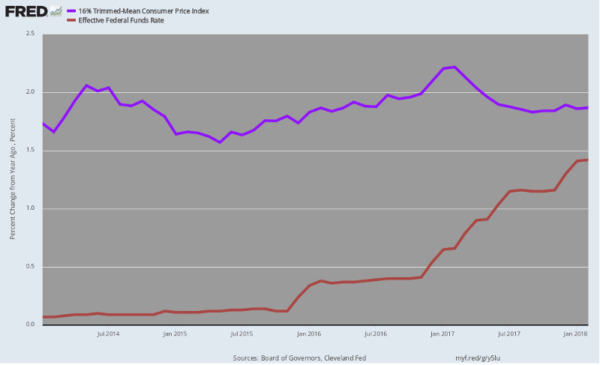
The 16% Trimmed Mean CPI increased by an average of 1.90% per annum during that four-year period, while the Fed’s target interest rate averaged just 0.40%.

During the sweet spot of the longest business cycle expansion in history—from month #55 to month #103—when the economy should have been left to expand on its own without “stimulus” from the central banking branch of the state, Yellen kept real money market rates pinned at an unprecedented -150 basis points.

The justification for such economic insanity was the claim that the US economy was not at its full-employment level as measured by the dubious U-3 unemployment rate and that the job of the central bank was to keep injecting “demand” into the economy until the bathtub was full to the brim and 100% of “potential GDP” was attained.

But here’s the thing. Potential GDP and full-employment labor markets are Keynesian malarkey.

In a world in which domestic labor competes with China’s price for goods, India’s price for internet-based services and Mexico’s price for manufactured goods assembly, full employment cannot be measured by the headcount metrics of the BLS, nor can it be achieved by injecting massive amounts of fiat credit into the bank accounts of Wall Street dealers.

In fact, with total outstanding credit now at $81 trillion, or 382% of GDP, the Fed’s liquidity injections never really leave the canyons of Wall Street. The result is increased speculation on Wall Street and accelerating inflation of financial asset prices.

After all, money markets do not finance the working capital or fixed asset investments of business, nor do they fund consumer borrowing for automobiles and durables. Instead, short-term money markets are where Wall Street dealers finance their inventory and where speculators fund their positions in the options markets—or via margin and repo credit against stocks and bonds held outright.

Consequently, negative real interest rates are the mother’s milk of financial speculation and the resulting asset price bubbles.

Yellen’s policies constituted an epic monetary error that has fueled bond- and stock -market bubbles that are off the charts, thereby sending erroneous price signals to Wall Street gamblers, corporate C-suites and spendthrift politicians alike.

The yawning gap below between the purple line, signifying (the running inflation rate) and the brown line (the money market rate) connotes the massive subsidy Yellen’s Fed conferred on speculators and day traders.

Real Cost of Money Market Borrowings, 2014–2018: 16% Trimmed Mean CPI Less Fed Funds Rate

In short, Yellen sowed the wind of monetary excess, and now we are reaping the whirlwind of a gargantuan Wall Street bubble that is a clear and present danger to the economic future—because it will crash, and the resulting financial and economic damage will be biblical.

Ironically, Janet Yellen may be sitting in the captain’s chair when the most violent and destructive financial storm in history finally comes ashore. It would serve her right.

Editor’s Note: The coming economic and political crisis is going to be much worse, much longer, and very different than what we’ve seen in the past.

That’s exactly why New York Times bestselling author Doug Casey and his team just released an urgent new report titled Doug Casey’s Top 7 Predictions for the Raging 2020s.

Click here to download the free PDF now.

Be seeing you

Posted in Uncategorized | Tagged: , , , , , | Leave a Comment »

Larry Summers Reminds Us That Federal “Stimulus” Mostly Exists to Help Wall Street | Mises Wire

Posted by M. C. on January 1, 2021

But Summers’s opposition isn’t because he’s a deficit hawk or in any way opposed to government spending. No, his opposition is due to the fact that he’s afraid giving money directly to the average American—instead of his friends on Wall Street—would “risk a temporary overheat” of the economy.

Translation: people who aren’t billionaire CEOs might spend the money incorrectly.

https://mises.org/wire/larry-summers-reminds-us-federal-stimulus-mostly-exists-help-wall-street

Over the past two weeks in Washington, the battle has raged over whether or not the latest so-called stimulus bill should include direct payments to Americans. This would be the second round of direct payments, which were sent out back in April as part of a $2 trillion spending package. The first stimulus checks were $1,200 per individual or $2,400 per married couple filing jointly, plus $500 per child under seventeen. 

In mid-December, Congress approved a smaller second payment at $600 per adult and $600 for children. But President Trump, ever the populist, refused to sign off on that deal and instead demanded a larger payment of $2000. Recognizing which way the political wind is blowing, the Democrats approved the increase in the House, but the effort has stalled in the Senate under GOP leadership. 

One would think this issue would be a slam dunk for most allies of the Democratic Party, but the old Wall Street antipopulist wing of the Clinton-Obama axis is leading a small revolt against the idea of giving stimulus to anyone but Wall Street bankers and bond brokers. 

There is, for example, Larry Summers. 

Summers is a former secretary of the Treasury (under Clinton), a former World Bank technocrat, and an advisor to both Obama and Biden. He was also formerly the president of Harvard, where he now teaches.

When Summer speaks, it’s a safe bet that his opinions well reflect those of the technocracy, Wall Street, and the wealthy “elites” of America’s ruling class.

He’s also a self-described Keynesian economist, and all this means is that Summers is an enthusiastic supporter of bailouts, easy money, and endless government spending. 

Whether following the 2008 financial crisis, or during the covid panic of 2020, Summers has supported doling out cheap and free money to Wall Street firms and huge banks in seemingly endless amounts. He has rarely met a corporate bailout he didn’t like.

But when it comes to giving money directly to the taxpayers, well, that’s where he draws the line.

Summers made this clear in an interview with Bloomberglast week, declaring he’s “not even sure [he’s] so enthusiastic about the $600 checks.” He’s definitely not excited about $2,000 checks, which he described as “a pretty serious mistake.”1

But Summers’s opposition isn’t because he’s a deficit hawk or in any way opposed to government spending. No, his opposition is due to the fact that he’s afraid giving money directly to the average American—instead of his friends on Wall Street—would “risk a temporary overheat” of the economy.

Translation: people who aren’t billionaire CEOs might spend the money incorrectly.

This is not surprising, as it is similar to the position Summers took during the Great Recession. In those days, Summers steadfastly opposed any financial relief for foreclosing homeowners, but “[a]t the same time, he supported every bailout of financial firms.”

Those bailouts, by the way, continue today. While many defenders of bailouts claim the bailout money was distributed merely as loans and was thus paid back by all those wonderful bankers, this ignores some key facts. Investment firms that invested in mortgage-backed securities (MBS) in the days following the 2008 financial crises were directly subsidized and bailed out by the Fed, which purchased more than 2 trillion dollars’ worth of MBS. These assets remain on the Fed’s books today, which means MBS investors essentially received free money for what would have quickly become near-worthless investments. This was done in order to ensure the prices of these assets did not collapse as they should have.

The truth is that when it comes to bailing out Wall Street, those who support bailouts hardly limit themselves to loans.

Are Ordinary Americans Doing Fine?

Summers further asserts that there is no shortage of demand among Americans. That is, the problem isn’t a lack of funds among Americans, but the fact that people aren’t permitted to spend because “they can’t take a flight or go to a restaurant.” People have money, he insists. They just can’t do much with it. Thus, he concludes, “I don’t necessarily think that the priority should be on promoting consumer spending beyond where we are now.”

Many Americans, however, are likely to disagree. Food banks report that demand “has greatly intensified since March,” especially among workers in the food service industry and among employees at “mom and pop” stores. USA Today reports more than 6 million households missed their rent or mortgage payments in September.

Studies also suggest that at least among a segment of the population—i.e., the lower-income or unemployed segment—stimulus money is quickly spent on necessities like food and rent, and catching up on bills.

Summers is right, of course, that some people just sat on their stimulus money. According to a study from Northwestern University, people with more than $3,000 in their checking accounts did not rush out and spend their first-round stimulus checks. Other data suggests many people used the money to pay down debts. These higher-income stimulus recipients are also likely the driving force behind the fact that the US savings rate is at historic highs right now. 

But the fact many are “hoarding” stimulus money only further disproves Summers’s analysis. If it is the case that a sizable number of Americans are simply saving their stimulus checks or paying down debt, there’s no risk of any short term  “overheating” of the economy. Both hoarding and paying down debt are deflationary acts, so by Summers’s Keynesian standards, it follows that opposing stimulus checks to ordinary people isn’t really something we need to worry about after all. 

Now, I don’t mention any of this because I think stimulus checks of any size are a good idea. Bailouts and government stimulus of all types are extremely damaging economically. Whether directed at billionaires or at mechanics, stimulus payments and programs—especially of the type funded by newly printed money—create bubbles and result in wealth destruction. We’ve examined this countless times here on mises.org.

But it is nonetheless important to note that the mainstream, establishment Keynesian view is one closely wedded to the idea that it’s billionaires and investment bankers who deserve bailouts and not ordinary people. People like Summers would have us believe that it’s fiscally irresponsible to give money away to regular folks but printing up $7 trillion in new money in order to buy up government and corporate debt all makes perfect sense. This first started to become undeniably clear in the days following the 2008 financial crisis. But now it’s become more apparent than ever. 

And it must never be forgotten that the severity of the current crisis was made far worse by policies that Summers and his fellows supported: lockdowns of businesses, stay-at-home orders, and monetary policies that favor wealthy borrowers over middle-class savers. This crisis is largely of their making. But should Summers’s victims get a bailout? Well, that’s just crazy talk in his view.

For people who remain mystified as to how populists like Donald Trump get elected, they need not look much further than this. 

  • 1. Thomas Friedman, a New York Times columnist who is married to an heiress and who is another reliable old partisan of the ruling class, agrees with Summers. He writes that a “$2000 untargeted giveaway, in many cases to people who don’t need the help, is crazy.” Thomas L. Friedman (@tomfriedman), “We need to take care of Americans hurting because of Covid-19. We need to buttress our cities that are running out of money. We need to invest in infrastructure. But a $2000 untargeted giveaway, in many cases to people who don’t need the help, is crazy. Can we stop and think?,” Twitter, Dec. 30, 2020.

Author:

Contact Ryan McMaken

Ryan McMaken (@ryanmcmaken) is a senior editor at the Mises Institute. Send him your article submissions for the Mises Wire and The Austrian, but read article guidelines first. Ryan has degrees in economics and political science from the University of Colorado and was a housing economist for the State of Colorado. He is the author of Commie Cowboys: The Bourgeoisie and the Nation-State in the Western Genre.

Be seeing you

Posted in Uncategorized | Tagged: , , , , | Leave a Comment »

Powell Spills the Beans – LewRockwell

Posted by M. C. on July 17, 2019

Followers of Austrian economic theory like Stockman, Murray Rothbard or Walter Block will tell you deflation is the ideal. Lower prices brought by efficiency and innovation.

When has government been efficient and innovative (in the good sense)?

https://www.lewrockwell.com/2019/07/david-stockman/powell-spills-the-beans-no-phillips-curve-no-keynesian-central-banking/

By

David Stockman’s Contra Corner

Thursday was a Red Letter day for that old “you don’t say!” riposte. We are referring to the obvious response to Powell’s black and white confession to the Senate Banking Committee yesterday that more people working doesn’t cause inflation.

“The relationship between the slack in the economy or unemployment and inflation was a strong one 50 years ago … and has gone away,” Powell said Thursday during his testimony before the Senate Banking Committee. He added the strong tie between unemployment and inflation was broken at least 20 years ago and the relationship “has become weaker and weaker and weaker.”

Why, yes, it apparently has disappeared entirely per the graph below.

Since the recessionary jobs bottom in 2010, the unemployment rate (brown bars) has plunged from just under 10% to a 50-year low of 3.7% at present. Yet despite the apparent massive evacuation of labor “slack” from the US economic bathtub, real weekly earnings of prime age males (purple bars) have essentially flat-lined during the last eight years.

So you could put a stake in the so-called Phillips Curve and be done with it. But actually the story is far bigger and Powell’s confession implicates much more than merely the wage/employment equation.

To wit, it actually crushes the core tenant of Keynesian central banking. Namely, that Fed policy operates largely in a closed bathtub of domestic GDP and that by raising or lowering the water level of “demand” therein, the Eccles Building can bend domestic inflation, employment and economic growth to its will.

Self-evidently, it cannot. And the reason for that starts with Powell’s incorrect claim that the relationship between wages and employment “has gone away”.

In fact, what is implicated here is the fundamental law of supply and demand, which did not mysteriously disappear into some monetary Stranger Things realm. No, it simply migrated from the Lower 48 to a planet-wide venue…

Be seeing you

44687-dj2ctywucaebebf

Posted in Uncategorized | Tagged: , , , , | Leave a Comment »

EconomicPolicyJournal.com: New York Magazine Headline: “Trump Nominates Famous Idiot Stephen Moore to Federal Reserve Board”

Posted by M. C. on March 26, 2019

https://www.economicpolicyjournal.com/2019/03/new-york-magazine-headline-trump.html

From the accompanying article by Jonathan Chait:

Stephen Moore’s career as an economic analyst has been a decades-long continuous procession of error and hackery. It is not despite but precisely because of these errors that Moore now finds himself in the astonishing position of having been offered a position on the Federal Reserve board by President Trump…

Since Donald Trump moved into the White House, the Republican Party has reversed its views on both fiscal and monetary policy. Whereas it had previously deemed deficits and inflation a mortal threat, and called stimulus and lower interest rates counterproductive, the party line now demands both.

Moore has naturally ridden along with this reversal, but what has set him apart is the fervency with which he has embraced the volte-face. He has insisted on television that the economy is experiencing deflation, and when corrected by panelist Catherine Rampell on this unambiguous error of fact, refused to give ground. He has called for firing the Federal Reserve chairman as well as firing the entire Federal Reserve board.

Mooore’s current ultra-dovish stance is hardly anywhere near as ridiculous as his previous ultra-hawkish stance. The problem is that he has no grasp of the policy, and simply follows whatever line helps the Republican Party. While the internal workings of his mind remain a matter of speculation, I doubt he is consciously venal enough to tailor his thinking explicitly to partisan goals. Rather, Moore has extremely strong partisan instincts and extremely limited analytical skills. The combination results inevitably in the latter giving way to the former. He should not be permitted any position of serious responsibility, in government or anything else.

In other words, he sounds pretty much like every mainstream Keynesian economist, except that other mainstream economists don’t like him.

He is bad but so is everyone sitting on the Fed board today.

RW

Posted in Uncategorized | Tagged: , , , | Leave a Comment »

The “Green New Deal” Debunked (Part 2 of 2) | Mises Wire

Posted by M. C. on January 27, 2019

https://mises.org/wire/green-new-deal-debunked-part-2-2

One of the hottest topics in policy wonk circles is the “Green New Deal,” spearheaded by the rising star of the progressive Left, Alexandria Ocasio-Cortez. In my previous post, I explained that the entire premise of a current New Deal—whether green, red, or blue—was flawed. Even on standard Keynesian terms, it makes no sense to embark on a $1 trillion government spending program with official unemployment below 4 percent and the Fed raising rates to rein in price inflation. Worse, historically the actual New Deal under Franklin Roosevelt prolonged the nation’s suffering, making the Great Depression linger for a decade. Finally, I pointed out that the supporters of a Green New Deal weren’t merely interested in mitigating climate change: they quite openly announce that they will use the plan as a vehicle for transforming society according to the standard progressive wish list.

In the present post, I’ll critically analyze some of the specific policy goals listed in the draft text calling for a creation of a select committee to craft a Green New Deal. The various proposals would waste enormous sums of money in pursuit of impossible goals that would raise energy prices and hurt consumers. Even if one believes that carbon dioxide emissions constitute a “negative externality,” the measures in the proposed Green New Deal would achieve emission reductions at a much higher cost than necessary. And we see once again that the progressive Left does not think a simple “price on carbon” is enough to achieve their agenda. Conservatives and libertarians should therefore be under no illusions when the idea of a “carbon tax deal” is floated.

A Carbon Tax Won’t Satisfy the Green New Dealers

Read the rest of this entry »

Posted in Uncategorized | Tagged: , , , | Leave a Comment »

The “Green New Deal” Debunked (Part 1 of 2) | Mises Wire

Posted by M. C. on January 27, 2019

https://mises.org/wire/green-new-deal-debunked-part-1-2

There’s a growing buzz around a “Green New Deal,” spearheaded by newly-elected Alexandria Ocasio-Cortez. Although the details are in flux, currently the draft text calls for the creation of a 15-member “Select Committee for a Green New Deal” that would “have authority to develop a detailed national, industrial, economic mobilization plan” to make the U.S. economy “greenhouse gas emissions neutral.” As if that weren’t ambitious enough, the Select Committee’s detailed national plan would also have the goal “to promote economic and environmental justice and equality.” The draft specifically mentions spending $1 trillion over ten years, in addition to extensive taxes and regulations to steer the economy and society as the 15 committee members see fit. (To be clear, the draft text currently calls for the creation of the select committee, which in turn is then tasked with drafting legislation forming the “Green New Deal” itself.)

In this two-part series I will strongly critique both the spirit and substance of a proposed “Green New Deal.” In the second article, I will focus on the specific proposals in the draft legislation. But in this first piece I will give the historical context and explain why the very notion of a Green New Deal is misguided, because it relies on faulty history and bad economics.

The Original New Deal Was Implemented During the Great Depression

Perhaps the most obvious flaw with anyone proposing a modern-day New Deal—whether green or any other hue—is that we are not currently in the midst of an economic depression. Even textbook Keynesians, who think that (say) the incoming Obama Administration was justified in administering a large “stimulus package” because we were stuck in a so-called liquidity trap, now admit that there is no economic rationale for continuing to run large budget deficits. (As Paul Krugman notoriously and conveniently wrote soon after the election of Trump, “Deficits Matter Again.”)

The very term “New Deal” was chosen to appeal to the 20%+ of the unemployed in the workforce, who had ostensibly been left behind by the traditional U.S. economic system. Yes, Ocasio-Cortez and her supporters are touting the Green New Deal as (among other things) the solution to lingering economic inequities in the current system. But to call concern over a wage gap a “New Deal” is as inapt as christening a bullet train program a “Green Moon Shot.”

The New Deal Actually Hurt the U.S. Economy and Prolonged the Great Depression

Read the rest of this entry »

Posted in Uncategorized | Tagged: , , , , | Leave a Comment »

Hitler’s Economics – LewRockwell

Posted by M. C. on October 29, 2018

Perhaps the worst part of these policies is that they are inconceivable without a leviathan state, exactly as Keynes said. A government big enough and powerful enough to manipulate aggregate demand is big and powerful enough to violate people’s civil liberties and attack their rights in every other way.

https://www.lewrockwell.com/2018/10/lew-rockwell/hitlers-economics/

By 

[Originally published August 02, 2003.]

For today’s generation, Hitler is the most hated man in history, and his regime the archetype of political evil. This view does not extend to his economic policies, however. Far from it. They are embraced by governments all around the world. The Glenview State Bank of Chicago, for example, recently praised Hitler’s economics in its monthly newsletter. In doing so, the bank discovered the hazards of praising Keynesian policies in the wrong context.

The issue of the newsletter (July 2003) is not online, but the content can be discerned via the letter of protest from the Anti-Defamation League. “Regardless of the economic arguments” the letter said, “Hitler’s economic policies cannot be divorced from his great policies of virulent anti-Semitism, racism and genocide.… Analyzing his actions through any other lens severely misses the point.”

The same could be said about all forms of central planning. It is wrong to attempt to examine the economic policies of any leviathan state apart from the political violence that characterizes all central planning, whether in Germany, the Soviet Union, or the United States. The controversy highlights the ways in which the connection between violence and central planning is still not understood, not even by the ADL. The tendency of economists to admire Hitler’s economic program is a case in point. Read the rest of this entry »

Posted in Uncategorized | Tagged: , , , , | Leave a Comment »