


The U.S. double standard has been apparent as well with respect to Israel’s “slow motion” ethnic cleansing of Palestinians from their homes on the occupied West Bank. For decades, Israeli governments have confiscated land—even portions long inhabited by Palestinian families—and turned those plots over to Jewish settlers. The once predominantly Palestinian West Bank now resembles a geographic Swiss cheese,
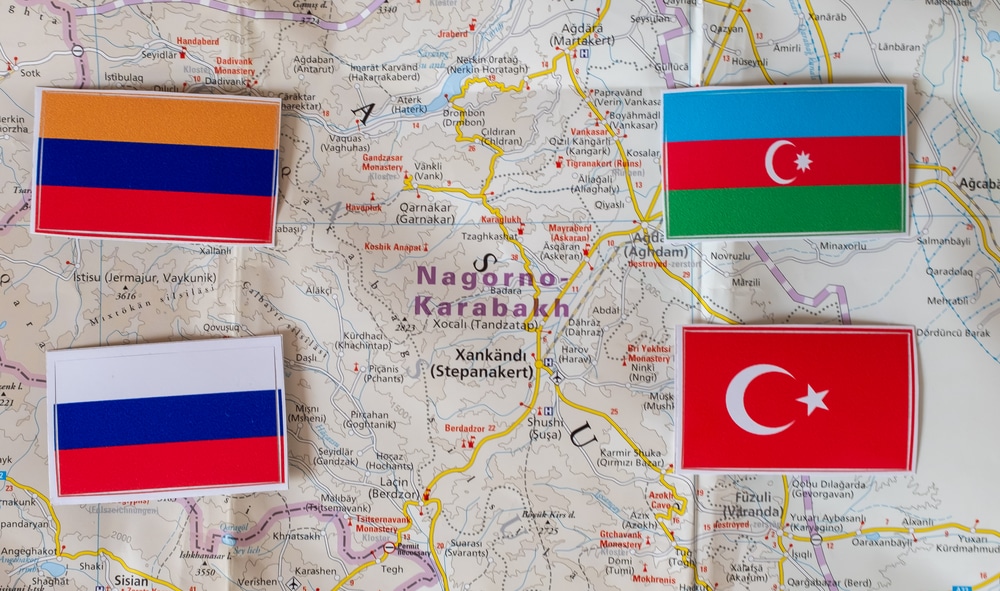
Flags of Armenia, Russia, Azerbaijan and Turkey on the background of the map of Nagorno-Karabakh
U.S. administrations have repeatedly condemned foreign adversaries for engaging in ethnic cleansing of minority populations. That has been an explicit grievance against the People’s Republic of China (PRC) because of Beijing’s treatment of its Uygur population in Xinjiang province, and against Syria and Iran because of their conduct toward Kurdish inhabitants. Serbian authorities in both Bosnia and Kosovo became high-profile targets of Washington’s outrage because of their alleged ethnic cleansing campaigns directed against Muslim populations. In the latter case, Bill Clinton’s administration cited that factor as the most important justification for the U.S.-NATO air wars against Serbs in 1995 (Bosnia) and 1999 (Kosovo).
U.S. leaders have adopted a very different stance, however, whenever Washington’s allies or dependents behave in that fashion. Such hypocrisy became evident most recently when Joe Biden’s White House reacted with nonchalance as Azerbaijan’s military forces attacked and expelled Armenian residents from their long-standing enclave inside Azerbaijan, Nagorno-Karabakh. The principal policy statement came from the U.S. Agency for International Development (USAID), and it treated the episode as akin to a humanitarian crisis caused by a natural disaster. “The United States is deeply concerned about reports on the humanitarian conditions in Nagorno-Karabakh and calls for unimpeded access for international humanitarian organizations.” The administration not only failed to explicitly condemn the brazen case of ethnic cleansing, it (along with Israel) had been providing arms aid to Azerbaijan.
It was hardly coincidental that the Azeris are important political and security clients of Turkey, while both Armenia and Nagorno-Karabakh had close economic and military ties with Moscow. This episode offered an ideal opportunity for Washington to placate an increasingly restless Turkey and help take down two Russian clients. Considerations of justice and international law seemed to play little role in the U.S decision. Russia, bogged down in its stalemated war in Ukraine, was in no position to protect its Armenian allies.
The United States and Turkey thus scored a geo-strategic victory and further eroded the Kremlin’s power in Russia’s near abroad. However, both countries were accomplices in a clear case of ethnic cleansing that has led to the expulsion of more than 100,000 ethnic Armenians from the enclave as of October 2, 2023. This episode has to be especially painful for all Armenians, given the history of Turkish oppression that culminated in the Ottoman government’s orchestration of the Armenian genocide during World War I that claimed the lives of at least 664,000 victims and involved the expulsion of hundreds of thousands of other Armenian inhabitants.
It is not the first time that Washington appeared to be content when an ethnic cleansing campaign benefited fellow NATO member Turkey. In July 1974, Richard Nixon’s administration—and especially Secretary of State Henry Kissinger—did little more than make insincere clucking sounds of disapproval when Turkish forces invaded the Republic of Cyprus and took control of the northern third of that country. Kissinger and Nixon’s successor, Gerald Ford, remained indifferent even as Turkey expelled Greek Cypriot residents from the conquered territories.
Be seeing you



 MCViewPoint