MCViewPoint

Opinion from a Libertarian ViewPoint

Posts Tagged ‘Lebanon’

Ukrainians And Americans Are Done With This War, But It Keeps Escalating Anyway

Posted by M. C. on November 29, 2024

And we were told this war was all about protecting democracy.

Caitlin Johnstone

The IDF dramatically increased its bombing campaign in Lebanon on Tuesday in the hours preceding an expected ceasefire with Hezbollah. 

Israel always does this, and it’s so gross. Normal people get a ceasefire agreement and think “Good, this means we can finally stop fighting.” Israel gets a ceasefire agreement and goes, “This means we have to hurry up and kill as many people as possible before it takes effect.”

The Biden administration is now pushing Ukraine to lower its minimum draft age from 25 to 18 in order to provide more cannon fodder for the war against Russia. 

Polls say that both Ukrainians and Americans want this US proxy war to end, but instead of ending it Washington is pressuring Kyiv to throw teenagers into the threshing machine of an unwinnable conflict. 

And we were told this war was all about protecting democracy.

Saying Ukrainians are fighting for our freedom is even dumber than saying US soldiers are fighting for our freedom. You’ve somehow come up with an even dumber lie. https://t.co/DZ0eV9jFbn— Caitlin Johnstone (@caitoz) November 26, 2024

Russia keeps getting hit by Ukraine with US-supplied long-range missiles and is now saying that “retaliatory actions are being prepared.” This happens as Trump appoints virulent Russia hawk Keith Kellogg as his envoy to the conflict, adding further weight to my concerns that these soaring tensions may continue to escalate after Trump gets into office.

I’ll say right now that if all this insane brinkmanship results in Russia hitting Ukraine with a tactical nuke or something I’ll be a lot more enraged at the western power structure I live under for giving rise to that horror than I’ll be at Vladimir Putin.

See the rest here

Be seeing you

Posted in Uncategorized | Tagged: , , , , | Leave a Comment »

The political architecture of the new Middle East

Posted by M. C. on September 9, 2021

The post-Syrian war Middle East is taking shape. Everything would change: Syria would join the Russian-led military coalition and be de facto protected by it. Lebanon would be placed under joint Russian-US tutelage but occupied militarily by France. Iraq would replace Lebanon as a regional mediator. Iran would be admitted to the Mediterranean.

Without realizing it, France is laying the groundwork for its next fiasco: President Macron keeps repeating President Biden’s rhetoric: he will not help any state to build itself, but all of them to fight against terrorism. This is the slogan of the International Coalition in Iraq and Syria, which has not stopped for 7 years to massacre civilians and guide the jihadists. It was also the doubletalk of President Biden to justify the takeover of the Taliban in Afghanistan and the resurgence of Daesh. In short, it is always the way we talk when we want to ravage states.

https://www.voltairenet.org/article213966.html

by Thierry Meyssan

This article is a follow-up to
 “Why a Yalta II?“, June 15, 2021.
 “Biden-Putin, a Yalta II rather than a new Berlin“, June 22, 2021.

Moscow and Washington are preparing the reorganization of the Levant that they drew up during the Geneva meeting (known as “Yalta 2”) on June 16. The aim is to draw conclusions from the terrible Western military defeat in Syria without humiliating the United States.

According to this peace agreement, Syria would be placed in the Russian zone, while Lebanon would be shared between the West and Russia.

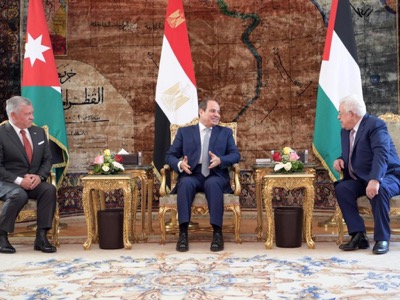
The Cairo summit, August 31, 2021.

The Baghdad and Cairo summits

We are moving towards a withdrawal of the US army from Iraq so that this country becomes a mediator, a neutral zone, instead of Lebanon. Iraq has therefore convened a summit in Baghdad with seven of its neighbors (Saudi Arabia, Egypt, Emirates, Iran, Jordan, Kuwait, Turkey). France managed to join the participants both as a representative of the West and as a former colonial power.

The former director of the Iraqi secret service and now Prime Minister, Mustafa al-Kazimi, showed his great knowledge of regional issues and his ability to maintain the balance between Sunni Saudi Arabia and Shiite Iran. Despite several contacts over the past year and more conciliatory rhetoric, these two powers have not known how to resolve their multiple disputes, particularly in Yemen.

The Baghdad meeting was an opportunity to display an alliance between President Abdel Fattah al-Sissi (Egypt) and King Abdullah II (Jordan) to manage (not solve) the Palestinian problem. It was immediately followed by a meeting in Cairo of the two heads of state with their Palestinian counterpart, President Mahmoud Abbas. The latter was all the more conciliatory as he is aware that, from now on, no Arab country will come to the aid of his people. It is not possible to demand justice for 70 years while betraying all those who help you.

The French presence has been interpreted as an announcement of a military intervention by Paris after the U.S. withdrawal. President Emmanuel Macron is said to have ambitions to deploy troops in Lebanon to defend western interests as the country comes under joint US and Russian tutelage.

Turkey was dragging its feet throughout the summit.

See the rest here

Thierry Meyssan

Translation
Roger Lagassé

Printable version

Be seeing you

Posted in Uncategorized | Tagged: , , , , | Leave a Comment »

Lebanese focus fury on banks-Erie Times E-Edition Article

Posted by M. C. on January 23, 2020

People say they are being subjected to humiliation by the banks and their managers who ultimately have the power to decide who gets how much.

Forget keeping your cash in banks. Buy a good safe.

Defeat the war on cash and be prepared for when the next crunch hits.
http://erietimes.pa.newsmemory.com/?publink=2f4c39949

BEIRUT — Before picking up cash from a downtown bank in Lebanon’s capital, Mey Al Sayegh mentally braces herself for what would have been a routine trip before the country’s crippling cash crunch. For starters, it will be at least an hour’s wait in line before her turn comes. And if she’s lucky, she’ll be able to withdraw $300 — the weekly limit on dollar withdrawals imposed by banks to preserve liquidity — without having to bargain with the teller.

“I tell my family ‘I’m going to the bank, but I don’t know when I’ll return,’” said the communications manager. “It’s very unpleasant. You see people’s expression — worried, confused, they’re scared that they’re going to lose their deposits.”

For years, many Lebanese have lived beyond their means, supporting their outsized spending with loans and generous remittances from diaspora relatives scattered across the globe, including family members working in oil-rich Arab Gulf countries.

A severe financial crisis and unprecedented capital controls have put an end to this, uniting both rich and poor in anger against corrupt politicians who have brought the country to the brink of economic collapse, and a banking system they accuse of holding their deposits hostage.

In recent days, some protesters have taken out their ire on the banks, destroying ATMs, smashing bank windows and clashing with tellers behind the counter.

Dozens of protesters have held sit-ins at banks against the fiscal policies, forcing tellers on more than one occasion to give them more than the weekly limit. Demonstrators routinely gather in front of the country’s Central Bank, jeering and hurling expletives at its governor, Riad Salameh, who was once ranked among the world’s top central bank governors.

“You go to a bank, get a ticket, and there are at least 50-60 people in front of you,” said Mahmoud Sayida, a tour guide whose money is trapped with one of the country’s largest lenders. “It’s as though you are lining up for bread in the war days.”

The crisis in Lebanon, one of the most heavily indebted nations in the world, is rooted in decades of state corruption and bad management, and the tiny Mediterranean country’s economy had been in steady decline for years. The local currency, pegged to the dollar for more than two decades, has lost more than 50% of its value in recent weeks on the black market.

Fearing a crisis, depositors in the past year had been quietly withdrawing their money, changing it from the local currency to dollars, or funneling it to bank accounts abroad.

At the onset of nationwide protests that broke out in mid-October, banks closed their doors for 12 working days. When they reopened, they faced an unprecedented rush to withdraw dollars, resulting in the limits on withdrawals and foreign transfers.

But there was no legal basis for such actions, leaving it up to the banks to implement their own controls on a caseby- case basis. Meanwhile, ATM machines have mostly stopped dispensing dollars and daily limits on credit card use have been implemented. Many restaurants and shops, strapped for cash, are refusing card payments.

People say they are being subjected to humiliation by the banks and their managers who ultimately have the power to decide who gets how much.

People with children studying abroad need to offer proof before they are allowed to transfer their tuition money. Patients are required to produce paperwork proving they need money for surgery before they can withdraw cash from their accounts. To get credit card limits temporarily increased, customers are asked by some banks to produce a plane ticket and documentation proving a stay abroad longer than two weeks.

The measures are forcing families to limit expenditures and prioritize daily necessities. Simple activities, such as going to a cafe or a restaurant, are now considered luxuries, even for those with money or jobs. Sullen moods have overcome depositors and lenders alike, whose employees say they are afraid to show up at work because of fights breaking out inside banks and people cursing them every day.

In this Jan. 14 photo, anti-government protesters smash a bank widows, during ongoing protests against the Lebanese central bank’s governor and against the deepening financial crisis, at Hamra trade street, in Beirut, Lebanon. [HUSSEIN MALLA/ASSOCIATED PRESS FILE PHOTO]

Be seeing you

Posted in Uncategorized | Tagged: , , , | Leave a Comment »

Syria Is Lost. Lebanon’s Gold Is Next – LewRockwell

Posted by M. C. on November 6, 2019

https://www.lewrockwell.com/2019/11/no_author/syria-is-lost-lebanons-gold-is-next/

By Steve Brown

The largest reserve gold traders on the planet are the six bullion banks. A bullion bank is a large multi-national bank authorized to serve as a conduit through which Central Banks – and the Fed primary dealers – loan their gold out into the market. All central banks lease gold, to maintain their balance sheet and to provide sovereign collateral when a currency swap or paper trade won’t work. It’s called the gold carry trade.

There are currently six clearing banks on the LBMA handling gold lease transactions: Barclays, Scotia, Deutsche Bank, HSBC, JPM, and UBS all of which are primary Fed Dealer Banks, too. Central Banks need real money as collateral – physical gold holdings – to back paper (debt instruments) and as guarantor of foreign exchange sovereign liquidity, or when dealing with failed or semi-failed states.

The Bullion Banks not only guarantee and lease their own gold reserves, but require adjustments to physical gold holdings based on Geopolitical events particularly during times of war. For example, Libya, Afghanistan, Iraq, Syria, Egypt and the Ukraine have all turned over their physical gold holdings to the IMF – which acts by proxy for the Fed and G7 Central Banks – for favorable lending terms or settlement of debt to the West, or their gold is seized by force of arms.

Nixon officially closed the US international sovereign gold trading window in 1971, alleged to be temporary, now ostensibly never to re-open. Officially Nixon’s gold closure still applies to US gold trading, but the “official” world is not the real world. Thus, the US engages in covert gold trading shrouded in secrecy, generally by proxy to the IMF and via gold carry trade gold swaps.  (Also see: IMF voting rights and reform and the Exchange Stabilization Fund)

The international gold window is not about a “gold standard” but about international trade in gold. That trade is to support currency swaps to manipulate currency markets; to enhance interest returns by leveraging other debt products providing a higher return; or to build or deplete foreign exchange reserves held by a sovereign or Central Bank. Thus, the international gold window still exists in the form of the gold carry trade.

But the international gold window is much more than a trade and collateral window, the international gold window is still an essential factor in Geo-politics. Conflicts and alliances require the gold carry trade to operate by covert, by proxy, or by overt means. The gold carry trade market also operates by acquiring the gold reserves of failed states such as Iraq, Libya, Syria, Afghanistan, or Ukraine, at prices subsidized by the US taxpayer.

Or the cost of their lost treasure is borne by the unknowing, unaware local population partaking in a “colour revolution” or the “Arab Spring” for example, on behalf of Washington.

The banking crisis in Lebanon is one recent example, where geopolitics and finance – especially relating to gold – intersect. Lebanon has relatively high physical gold reserves relative to its economy and relative to other Middle Eastern states, and Lebanon has been a player in the carry trade for many years.

However, according to one confidential source and many reports, Lebanon has dialed-back its carry trade activities since 2015. By scaling back its carry trade activity, Lebanon has provoked the ire of western Central Banks, and made it more difficult for Lebanon to protect its currency.

The reason for Lebanon’s de-leveraging in the gold carry trade is unknown, but one can only speculate that along with US sanctions versus Lebanon, the international currency cartel has its eye on Lebanon’s gold reserves. By extension, The Neocon-Neoliberal ‘Blob’ believes that by harming Lebanon, the Blob can likewise curtail Hezbollah’s influence.

Israel too, currently subject to its own self-induced purgatory in leadership, desperately needs a visible geopolitical victory, and no doubt US and Israeli central bankers see Lebanon’s finance as low-hanging fruit, since Hezbollah cannot be militarily defeated. How do we know? …well, David Ignatius tells us so…

Germany

Germany demanded return of its gold reserves from New York (called repatriation).  In reality repatriation ends the lease conditions by which the Federal Reserve holds German gold. That Germany leased approximately 300 tonnes of gold to the US Exchange Stabilization Fund during the US financial collapse is well known, and the ESF undoubtedly disposed of that German gold by carry trade means, to support the US dollar and stock market. Effectively the US government may sell or lease any “commodity” as it sees fit, in its possession, whether strategic oil reserves or gold – even if that gold “belongs” to a foreign power…

Ukraine

Long a hotbed of corruption, shady dealings, and political intrigue, the Ukraine has leveraged its gold reserves via the carry trade and leasing system for many years now.  Falling prey to the IMF predatory system of capital is another Ukraine specialty, since Ukraine’s gold is its only real strategic asset, besides it location adjacent to Eastern Europe…

Argentina

Likewise, the IMF was the worst possible option for Argentina. Argentina was forced to sell 1/3rd of its physical gold reserves from 2009-2013, to prevent a replay of 2001 by placating US bond holders. Argentina’s gold reserves played a major role in keeping the country somewhat liquid, but now western powers want the rest of that gold – represented by bondholder lawsuits – since Argentina just defaulted again.

Netherlands

In 2014 the Dutch Central bank announced that 122 metric tonnes of gold had been repatriated from the United States. The DCB’s loss of confidence in the US likely relates to the collapse of the US financial system from 2008-2009.  It’s likely too that the Netherlands loaned some sovereign gold reserves to the Fed/ESF during that crisis, and has not seen its gold returned.

Venezuela

Half of Venezuela’s reserves are in gold. The structural and fundamental problem is that Venezuela cannot lease gold via the bullion banks because the physical gold was repatriated, and the gold still present in US /London vaults is sanctioned…

Summary

Trouble is, most of the third world and Non-Aligned Movement – with the exception of Iran, Lebanon, and Venezuela – have already turned over their gold to the West. So, there is little physical gold for Washington to cajole, appropriate, or steal from destabilized sovereign entities or failed states Washington creates…

Be seeing you

What if US had raised interest rates? | A Wild Duck


Posted in Uncategorized | Tagged: , , , , , | Leave a Comment »

“Explosive” Leaked Secret Israeli Cable Confirms Israeli-Saudi Coordination To Provoke War | Zero Hedge

Posted by M. C. on November 8, 2017

Our “allies” are doing their job well. Maintaining the war machine at all costs.

Those costs being absorbed by ME civilian lives and US taxes.

http://www.zerohedge.com/news/2017-11-07/leaked-secret-israeli-cable-confirms-israeli-saudi-coordination-lebanon

Early this morning, Israeli Channel 10 news published a leaked diplomatic cable which had been sent to all Israeli ambassadors throughout the world concerning the chaotic events that unfolded over the weekend in Lebanon and Saudi Arabia, which began with Lebanese Prime Minister Saad Hariri’s unexpected resignation after he was summoned to Riyadh by his Saudi-backers, and led to the Saudis announcing that Lebanon had “declared war” against the kingdom. 

The classified embassy cable, written in Hebrew, constitutes the first formal evidence proving that the Saudis and Israelis are deliberately coordinating to escalate the situation in the Middle East.  Read the rest of this entry »

Posted in Uncategorized | Tagged: , , , , | Leave a Comment »