
Misinformation!!! I wonder if the government uses PayPal.
Be seeing you

Enemy of the State-Read the Book-Know the Man
This is not a Safe Space but Baby, I don't care.

"I am not a number, I am a Free Man" - No. 6
 Information Liberation Alex Jones’ Prison Planet Gary North Specific Answers Antiwar The Daily Bell Tenth Amendment Center Economics Policy Journal The American Thinker The New American Lew Rockwell
Posted by M. C. on October 17, 2022
Misinformation!!! I wonder if the government uses PayPal.
Be seeing you
Posted in Uncategorized | Tagged: money, PayPal, weaponized | Leave a Comment »
Posted by M. C. on September 24, 2022
Money must emerge as a commodity because something can be demanded as a medium of exchange only if it has a pre-existing barter demand.
https://mises.org/wire/do-people-accept-money-because-government-endorses-it
Demand for goods arises because of perceived benefits. For instance, individuals demand food because it nourishes them. This is not so, however, about pieces of paper we call money, so why do we accept them?
According to Plato and Aristotle, the acceptance of money is a historical fact endorsed by government decree. It is government decree, so it is argued, that makes a particular thing accepted as the general medium of the exchange. Carl Menger, however, doubted the soundness of that view, writing:
An event of such high and universal significance and of notoriety so inevitable, as the establishment by law or convention of a universal medium of exchange, would certainly have been retained in the memory of man, the more certainly inasmuch as it would have had to be performed in a great number of places. Yet no historical monument gives us trustworthy tidings of any transactions either conferring distinct recognition on media of exchange already in use, or referring to their adoption by peoples of comparatively recent culture, much less testifying to an initiation of the earliest ages of economic civilization in the use of money.
How does something the government proclaims become the medium of the exchange, acquiring value? We know that the price of a good is the result of the interaction between demand and supply. From this, we could reach a conclusion that the price of money is also set by the laws of demand and supply.
While demand for goods emerges because of perceived benefits, people demand money because of its purchasing power with respect to various goods. The demand for money depends upon the purchasing power of money while the purchasing power of money depends on the demand for money.
We are caught in a circular trap. (The demand for money is dependent on its purchasing power while the purchasing power is dependent for a given supply on the demand for money). The circularity seems to vindicate the view that the acceptance of money is the result of the government decree.
Ludwig von Mises’s regression theorem supports Menger’s insights. Mises not only solved the money circularity problem, but he also confirmed Carl Menger’s view that money didn’t come from a government decree.
Be seeing you
Posted in Uncategorized | Tagged: Central Banks, inflation, monetary policy, money | 1 Comment »
Posted by M. C. on August 17, 2022
In other words, Bitcoin is the first—and only—monetary asset with a supply that is entirely unaffected by increased demand.
That is an astonishing and game-changing characteristic.
Hardness is the most important characteristic of a good money.
Hardness does not mean something that is necessarily tangible or physically hard, like metal. Instead, it means “hard to produce.”
By contrast, “easy money” is easy to produce.
The best way to think of hardness is “resistance to inflation,” which helps make it a good store of value—an essential function of money.
Would you want to put your savings into something that somebody else can create with no effort or cost?
Of course, you wouldn’t.
It would be like storing your life savings in Chuck E. Cheese arcade tokens or airline frequent flyer miles.
Unfortunately, putting your savings into government currencies isn’t that much different.
What is desirable in a good money is something that someone else cannot make easily.
The stock-to-flow (S2F) ratio measures an asset’s hardness.
S2F Ratio = Stock / Flow
The “stock” part refers to the amount of something available, like current stockpiles. It’s the supply already mined. It’s available right away.
The “flow” part refers to the new supply added from production and other sources each year.
A high S2F ratio means that annual supply growth is small relative to the existing supply, which indicates a hard asset resistant to inflation.
A low S2F ratio indicates the opposite. A low S2F ratio means that new annual supply can easily influence supplies—and prices. That’s not desirable for something to function as a store of value.
In the chart below, we can see the hardness of various physical commodities.
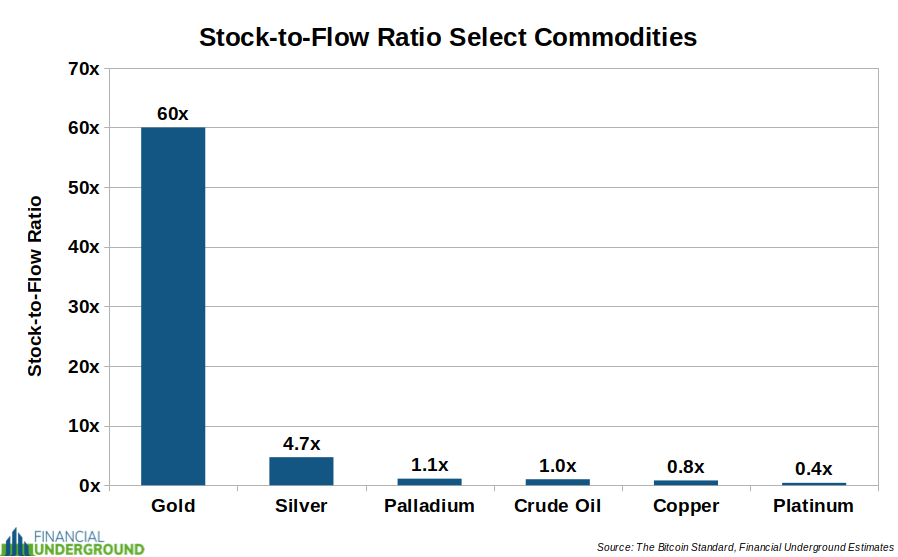
Monetary commodities such as gold and silver have higher S2F ratios. Industrial commodities have low S2F ratios, typically around 1x.
Be seeing you
Posted in Uncategorized | Tagged: bit coin, easy money, gold, hard money, Inflation-Resistant, money | Leave a Comment »
Posted by M. C. on May 13, 2022
Because the type of money a society uses largely determines whether it will prosper or ultimately falter, an individual, or group of individuals, who prefers justice over injustice, prosperity over poverty, and liberty over tyranny must flatly reject fiat money regimes and embrace sound money.
https://mises.org/wire/money-what-it-more-important-question-why-it
Money is not the root of evil as many people mistakenly think. Corrupted money (i.e., fiat money and currency debasement), however, is the root of many economic, social and cultural evils.
Most people know what money is, superficially, yes. Also, most don’t quite understand the concept of money. Otherwise, as Henry Ford put it “It is well enough that people of the nation do not understand our banking and monetary system, for if they did, I believe there would be a revolution before tomorrow morning.” Indeed, if money was well understood, today’s fiat money system would not exist.
Money is first, foremost, and fundamentally a medium of exchange. A generally accepted good (physical and now digital also) that intermediates transactions within societies and between societies. In his new book Understanding Money Mechanics, which I recommend as it provides an easy-to-digest yet comprehensive overview of the theory, history, and practice of money, economist Robert P. Murphy wrote:
A formal definition for money is that it’s a universally accepted medium of exchange. Menger’s explanation showed how such a commodity could emerge from its peers merely through voluntary transactions and without any individual seeing the big picture or trying to “invent” money.
Besides being a medium of exchange, money can and does function as a unit of account and store of value.
Before the concept of money emerged spontaneously (yes, money is an invention/discovery of the market, not of the state) early humans traded goods directly—the barter economy (direct exchange society).
Direct exchange means for a trade, a purposeful and voluntary exchange of goods or services to take place, let’s say, between a hunter and a farmer, their wants would have to coincide. The farmer would have to want a piece of meat and the hunter a portion of the farmer’s potatoes. This is what economists call the coincidence of needs.
Money emerged naturally as the solution to the ‘coincidence of needs’ problem and ushered in a new, more efficient way of trading and a superior social system altogether—the indirect exchange society. Human societies have been indirect exchange economies for thousands of years now thanks to money, a medium of exchange.
Be seeing you
Posted in Uncategorized | Tagged: Fiat Money, money | Leave a Comment »
Posted by M. C. on April 15, 2021
They’re making the assumption that the government’s primary objective is to serve the American people. It is not. Governments don’t see themselves as existing to serve the people, they see themselves as feeding off the people. They are essentially parasitical organizations that produce nothing and consume what they can successfully take from the populace. Jeff Thomas-International Man

Be seeing you
Posted in Uncategorized | Tagged: Government, money, parasitical | 1 Comment »
Posted by M. C. on February 23, 2021
…the so-called experts’ notorious about-face on masks this past March. Having said for weeks that face coverings do not stop transmission of the virus, Anthony Fauci, the Centers for Disease Control (CDC), the Surgeon General, and others, did a 180 virtually overnight.
https://www.lewrockwell.com/2021/02/fernando-chiocca/790793-2/
It’s summer. The heat on the streets of São Paulo is over 90°F. Without a facial mask, it’s hard enough to breathe. Nevertheless, 98 per cent of people are wearing facial masks (I do a mental accounting of this percentage every day). They pass by me and I see the torment they’re going through. Many squealing under the cloth that clog his breath, with sweat dripping down his forehead. In addition, these people don’t even lower their masks to leave their noses or mouths out. They spend the days, the weeks pass, the months… It’s been almost a year, and I can’t settle for the daily repetition of this abnormal scene – with varying climates, of course, sometimes a torrential rain and there’s the unfortunate under the umbrella wearing his facial mask. Sometimes it’s the only human being on a deserted street… and he’s wearing his facial mask.
The scenario is shocking to any thinking being, although the masses do not realize and seem to have assimilated an abnormality as something normal. If many people do something abnormal, the abnormal does not become normal, but only common. What is common may not be normal. And obstructing your breathing and hiding your face for no reason is definitely abnormal.
Not only is there no evidence that mask use by the general population reduces virus infection, but there is also no deadly pandemic virus to avoid. The data is available to everyone. Covid-19 was touted as being highly fatal, an existential threat, but it soon emerged that its mortality rate was very low. As Donald J. Boudreaux reported in this article,
COVID-19 INFECTION SURVIVAL RATES (per CDC)
Ages 0-19: 99.997%
Ages 20-49: 99.98%
Ages 50-69: 99.5%
Ages 70+: 94.6%
Seasonal Flu Infection Survival Rate (for population as a whole): 99.90%
This single slice of information should be sufficient to put Covid-19 in proper perspective. It makes plain that the risk that this disease poses to humanity as a whole does not differ categorically from the risk of seasonal flu – or, for that matter, from any of the many other perils that we humans routinely encounter. And because these figures show the estimated chances of survival of those who are infected with Covid, even for persons 70 years of age or older Covid obviously is not a categorically unique threat.
And yet, again, humanity has reacted to Covid in a manner categorically unique. It’s as if a hornet rather than a honeybee found its way into our home, and so to protect ourselves from the somewhat-more-threatening invader we commenced to frantically scour every room of our home with a flamethrower.
These data are confirmed by comparing the concrete result of the year of the “deadly pandemic” with other years: there was no increase in deaths outside the normal increase from one year to the next. And the numbers are available for anyone who wants to see. In fact, what happened was an unprecedented and inexplicable dramatic decrease in the number of deaths from other causes – an indication that probably many deaths attributed to such a virus were actually due to these other causes. Obviously, every death is something to regret, but the fact is that the vast majority of deaths of this disease are from people of age within normal life expectancy.
So even if the facial masks really offered protection against a virus, why would anyone under 70 care to wear them? However, they don’t. Before this mass human experiment, scientific studies pointed out that the universal use of masks does not decrease a viral epidemic (see here, here, here, here, here and here). And after the experiment (which is still in progress) it was found empirically that the studies were right (see here, here and here). That’s something anyone can infer. Here in São Paulo, as I said, the use of masks easily passes through 95% of the population, and the number of “cases” (which does not mean “sick”, only “positive PCR tests”) not only did not decrease but also did not decrease. Another empirical example is the case of Sweden, one of the places where no one wears a mask , not even on public transport, (and which has not imposed quarantines) and the number of deaths per inhabitants in 2020 is the same as in 2015. Despite the evidence, people around here are still wearing masks. And they do it just because they told them to do it. It doesn’t matter that the people who told them to wear a mask are the same ones that days before told them not to wear a mask. Jenin Younes comments on this article on
the so-called experts’ notorious about-face on masks this past March. Having said for weeks that face coverings do not stop transmission of the virus, Anthony Fauci, the Centers for Disease Control (CDC), the Surgeon General, and others, did a 180 virtually overnight.
Here in Brazil we also have our famous youtuber “scientist” prophet of the apocalypse doing the same thing. In this video he laughs at the facial masks saying they don’t work, just to shortly after recommending them. Now these same people change their minds again and say that the masks don’t work anymore, that now we have to wear 2 or 3 masks at the same time!
And none of this is capable of making people question the use of masks; they keep using. In an excellent psychosocial analysis, Julian Rose tries to answer why:
Wearing ‘the mask’ is for those who suffer feelings of fear and/or guilt. Think about it.
One might reject such a notion “No, no, I’m just worried about being fined, that’s why I wear it”. Or “I don’t want to take any risks, the health authorities wouldn’t tell us to wear masks unless there was some protection benefit.”
Are these valid responses? Both are based primarily on fear. Fear of what an authority might do if one was to disobey the rules, and fear of sickness should one not follow the authorities’ instructions.
Indeed, fear. However, these fears are completely unfounded, which means that the basis of this fear is stupidity. As we’ve seen, facial masks don’t protect anyone from viruses, and even if someone gets the coronavirus, the risk of getting sick is small, and of dying, even smaller. Influenza and tuberculosis, to name two airborne diseases, together kill 2,150,000 people worldwide each year (650,000 flu and 1.5 million tuberculosis). That’s pretty much the same death toll that Covid-19 has reportedly hit so far. That is to say, in general, the world is not facing any greater threat than the threats that have always existed.
Regarding the fear of a fine, at least in my region, I’ve never even heard of anyone who was fined for not wearing a facial mask. You see, I wear seat belts for fear of a ticket. What should be a personal choice based on an individual risk assessment has become mandatory in several places. I’ve taken several fines. And a lot of other people I know, too. Thousands of people keep taking this ticket. So, after being one of the great funders of the fine industry, I was domesticated by the whip of the State Master and am today a generally obedient puppy. But I don’t know anyone who got a ticket for being out without a facial mask. In fact, only 327 people were fined for not wearing a facial mask in the State in five months. With a population of 45 million this makes the chance of receiving a fine for lack of facial mask as 0.00000727%, making the fear of the fine even more stupid than the fear of the virus. (With the caveat that the facial mask could actually protect you from a fine, but not from a virus) Of course, this number may vary from place to place, but, thank God, for now, only in some places in China there is monitoring citizens by facial recognition cameras, which can identify people in the same way that license plates are identified, and fine them. Therefore, there’s still a chance to run away from these very rare tax. However, as the Communists taught the world, an even better way than ordering you to do something is to make you feel bad about not doing something. And making a stupid humanity believe the sham that they’re saving lives against a fatal virus by hanging a piece of cloth on his face wasn’t difficult.
See the rest here
Fernando Chiocca is an anti-intellectual intellectual, abolitionist and praxeologist. He is the editor of the Brazilian Rothbard Institute. (https://rothbardbrasil.com/)
Be seeing you
Posted in Uncategorized | Tagged: Face Mask, Human Stupidity, money, State | Leave a Comment »
Posted by M. C. on October 18, 2019
In other words, either go big and change the power structure or go home and stop promoting your own virtue.
Charles Hugh Smith
If we want to make real progress, we have to properly diagnose the structural sources of the rot that is spreading quickly into every nook and cranny of the society and culture.
It seems my rant yesterday (Let Me Know When It’s Over) upset a lot of people, many of whom felt I trivialized the differences between the parties and all the reforms that people believe will right wrongs and reduce suffering.
OK, I get it, there are differences, but if the “reform” doesn’t change the source of the suffering and injustice, it’s just window-dressing that makes the supporter feel virtuous. Want an example? Let’s take the the “cruel and unusual punishment” for drug-law offenders, many of whom are African-American males whose lives are effectively hobbled by felony convictions and long sentences in America’s Drug War Gulag.
You want a “reform” that actually gets to the root and solves the source of the injustice? It’s simple: decriminalize all drugs and recognize drug use as a medical and social issue rather than a criminal-justice / Gulag issue. But that won’t happen because too many people are making too much money off the Gulag, which is now a public and private-prison Gulag.
(Other advanced nations have had success with this structural change. Maybe we could learn something from their examples?)
If you’re not ready to demand the full decriminalization of all drugs, then you’re not really interested in solving the problem; you’re just seeking virtue-signaling “reforms” that don’t upset the power structure. And since any real solution necessarily disrupts the power structure benefiting from the status quo, all the painless “reforms” are ineffective.
In other words, either go big and change the power structure or go home and stop promoting your own virtue. This is why the economy is floundering despite all the warm and fuzzy headlines about stocks rising due to the Federal Reserve lowering interest rates: we collectively refuse to consider structural changes in the way “money” is created in our perverse system–perverse because the way “money” is created guarantees soaring inequality.
If you don’t change the way “money” is created and distributed, you change nothing. Did the thousands of pages of financial regulations passed after the 2008-09 debacle reverse wealth and income inequality? The answer is no, wealth inequality is rising even faster after all the feel-good “reforms.” The net result of the “reforms” is the costs of compliance for banks went up substantially, and that regulatory moat simply pushed risky lending outside the banking system.
In other words, the sources of systemic instability and wealth inequality weren’t even touched by the “reforms.” If the financial system were actually stable, why was the Federal Reserve only able to “normalize” interest rates and its bloated balance sheet for a few months after a decade of “growth”? Why is the Fed reverting to “emergency measures” again after a few brief months of “normalizing”?
If all these “reforms” were worth more than a bucket of spit, why isn’t wealth inequality reversing?
Here’s the way our “money” system works: banks borrow trillions of dollars into existence and loan it to debt serfs at high rates of interest. Central banks create “money” out of thin air and distribute it to the very top of the wealth-power pyramid: banks, financiers and corporations.
The only way to change this corrupt, exploitive system that generates inequality as its only possible output is to eliminate central banks and fractional reserve banking, and ban the aggregation of “too big to fail” entities: a system of 1,000 small banks is structurally far less vulnerable than five mega-banks that are tightly bound to virtually every risk-on asset in the entire system.
if you don’t change the way “money” is created and distributed, you change nothing.
Since we’re incapable of changing the sources of financial instability, fragility and inequality (because it would destabilize those benefiting from the status quo), we’re doomed to watch our social and political systems decay and implode.
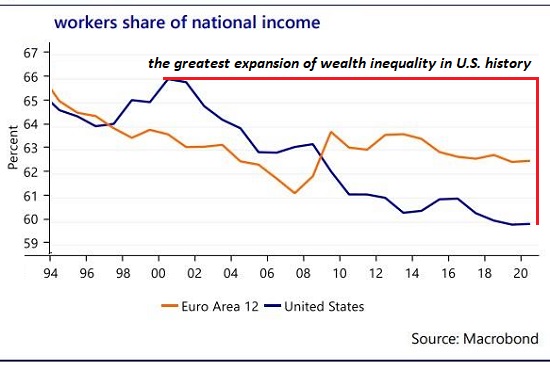
If we’re honest–an increasingly rare and hazardous condition–we’d admit that the purchasing power of wages has fallen sharply for the bottom 95% in the past 19 years, while the concentration of wealth in the hands of the top .01% has skyrocketed, leaving the bottom 80% with few if any meaningful assets and only the top 5% reaping the gains in our “winner take most” economy.
This systemic decay in social mobility, positive social roles and financial security has eroded the social fabric as the implicit social contract between the powerful and the disenfranchized has unraveled: all the phony “reforms” of the past 19 years simply locked in insiders’ “legal” pillaging.
The failure of the political system to recognize and rectify the broad-based decline of America’s economy as experienced by the bottom 80% has eroded trust in politics as a “solution.” Instead, people see the same powerful corporations buying influence with both parties, and tens of thousands of lobbyists in Washington DC writing the legislation passed by both parties (recall Nancy Pelosi’s brief flash of honesty: “We have to pass the bill to know what’s in it.”). Anyone who believes this manifests the ideals of democracy is delusional.
To those I offended: please pardon my frustration with all the phony “reforms” that change nothing and thus serve to tighten the grip of the self-serving power structure on the throat of the nation.
Here’s the unpalatable reality: The financial rot spread to the “real” economy two decades ago, and now the economic rot is decaying the social and political orders.
If we want to make real progress, we have to properly diagnose the structural sources of the rot that is spreading quickly into every nook and cranny of the society and culture. If we’re not willing to disrupt those reaping the outsized benefits from the existing structures of wealth and power, we’re deluding ourselves if we believe we’re solving any problems at the source.
If you’re still pissed off at me, please read the first pages of my new book (the first section is free); maybe you’ll be less pissed off once you see where I’m coming from: Will You Be Richer or Poorer? Profit, Power and A.I. in a Traumatized World.
Be seeing you
Posted in Uncategorized | Tagged: decriminalization, Economic Decay, money, Political Decay, reform, Social Decay | Leave a Comment »
 MCViewPoint