Certainly, nobody at the New York Times went to jail because, again, journalists don’t go to jail for publishing classified information in the United States.
The British High Court will soon decide whether to extradite journalist Julian Assange to the United States, where he will assuredly face a long prison sentence.
It is shocking to me that anyone who reads what I write could side with the regime on this.
The University of Chicago’s John Mearsheimer recently summarized the situation, and this is my analysis as well:
Assange is a journalist, and he did not break the law, as it is commonplace for journalists to publish classified information that is passed on to them by government insiders. If journalists in the United States were sent to jail for publishing classified material, the jails would be filled with many of America’s most famous reporters from newspapers like The New York Times, The Washington Post, and The Wall Street Journal.
But of course, that hardly ever happens. Simply put, newspapers publish classified material, and hardly anybody ever goes to jail. Why is this the case? What is the reason for this situation? Governments of every type, and this includes liberal democracies like the United States and Britain, sometimes go to great lengths to hide their actions or their policies from public view, which makes it almost impossible for the public to evaluate and criticize their behavior….
Thus, a rich tradition has developed over time in the United States, where insiders leak information about classified policies to journalists who publicize the information so that the public can evaluate it and push back hard against misguided policies.
The most famous case that illustrates this phenomenon involves the famous Pentagon Papers, which were a multi-volume study of the American decision to enter the war in Vietnam in the 1964-65 period and then escalated in subsequent years.
Daniel Ellsberg, who was an insider and had access to classified material, leaked the papers in 1971 to The New York Times, which subsequently published them. The story in those documents was starkly at odds with what the Johnson administration had been telling the American people about US policy in Vietnam.
By most accounts at the time, and certainly since then, both Ellsberg and The New York Times performed an important public service…. Ellsberg did not go to jail despite leaking classified information, although it did appear at the time that he might be sent to jail. Certainly, nobody at the New York Times went to jail because, again, journalists don’t go to jail for publishing classified information in the United States.
Daniel Ellsberg, right, shakes hands in September 1971 in Washington with future senator and secretary of state John F. Kerry, then head of Vietnam Veterans Against the War. (The Washington Post)
Daniel Ellsberg, the person responsible for perhaps the biggest leak in U.S. government history — the Pentagon Papers — said the latest disclosures of classified information show that the world still faces some of the same dangers that spurred him to act more than 50 years ago.
Ellsberg, who is 92 and dying of pancreatic cancer, said he is struck by the similarities between the Vietnam War and the current war in Ukraine — two conflicts in which a superpower, he argued, could be tempted to use nuclear weapons.
He pointed to some of the classified U.S. government documents posted on social media in recent months indicating that Russia’s invasion of Ukraine has become something of a military stalemate likely to drag into at least next year. Ellsberg has said he was trying to end the Vietnam War in 1971 when he leaked a huge cache of government secrets showing that multiple U.S. administrations knew the war was going badly while publicly declaring their optimism for victory.
“I’m reliving a part of history I had no desire to live again. And I hoped I wouldn’t. And by the way, that makes it easier to leave — this is where I came in,” Ellsberg said in a video interview, his voice increasingly raspy as he spoke surrounded by books in his California home.
A family photo of Daniel Ellsberg. (Robert Ellsberg)
The war in Ukraine, he said, “feels very similar to Vietnam. The war is stalemated, that seems so obvious now except for the fact that both sides totally deny it. What these new leaks show is what the Pentagon Papers showed, that the insiders all know that. They know that they are fighting a stalemate.”
Ellsberg argued that Ukraine “is not just another war” because of Russia’s nuclear arsenal. “It’s not Iraq, Iran or Afghanistan. None of those had any real possibility of blowing up the world. This one really can.”
Like many intelligence experts, Ellsberg sees big differences between the suspected leaker in the recent social media case — 21-year-old Jack Teixeira, a member of the Massachusetts Air National Guard — and his own role in transmitting the Pentagon Papers, a case that redefined legal precedent on matters of a free press and the First Amendment.
Authorities have arrested Teixeira for allegedly posting classified documents to a social media group of like-minded young men interested in video games and guns.
To Ellsberg, that sounds like a young man who was trying to show off to his friends, a way of saying, “Look who I am, look what I have access to.”
But Ellsberg scoffed at the notion that Teixeira has done any serious harm to the country.
“There is no reason to believe that it harmed American national security in any measurable way,” he said, blaming what he called a government “mystique of secrecy” for overstating the potential harm. “At the Pentagon, top secret is like toilet paper, it’s nothing.”
Q. Robert McNamara, who was secretary of defense during the Cuban missile crisis, once said, “The indefinite combination of human fallibility and nuclear weapons will destroy nations.” Why haven’t we seen nuclear weapons used since 1945?
A. We have seen nuclear weapons used many times. And they’re being used right now by both sides in Ukraine. They’re being used as threats, just as a bank robber uses a gun, even if he doesn’t pull the trigger. You’re lucky if you can get your way in some part without pulling the trigger. And we’ve done that dozens of times. But eventually, as any gambler knows, your luck runs out.
Daniel Ellsberg, famous for leaking the Pentagon Papers and his activism against nuclear weapons, announced recently that he has been diagnosed with terminal cancer.
Mr. Ellsberg, now 91, copied the military’s secret 7,000-page history of the Vietnam War and gave it to The New York Times and The Washington Post in 1971. The government sued to stop publication, but the Supreme Court defended the First Amendment right of a free press against prior restraint.
The papers produced a wave of anger at the government for having lied about the conduct of the war, which was already unpopular. In 1971, Mr. Ellsberg faced numerous charges, including violating the 1917 Espionage Act, but charges were dismissed in 1973 because of government misconduct.
In 2021, he revealed that the government had drawn up plans to attack China with nuclear weapons during a crisis over the Taiwan Strait in 1958.
With tensions rising between the United States and China, public distrust of the government running high and nuclear threats being lobbed over the war in Ukraine, his life’s work seems as relevant as it ever was.
Mr. Ellsberg agreed to speak with Times Opinion at his California home about the lessons he’s learned.
This interview has been edited for length and clarity.
Q. As you look around the world today, what scares you?
A. I’m leaving a world in terrible shape and terrible in all ways that I’ve tried to help make better during my years. President Biden is right when he says that this is the most dangerous time, with respect to nuclear war, since the Cuban missile crisis. That’s not the world I hoped to see in 2023. And that’s where it is. I also don’t think the world is going to deal with the climate crisis. We’ve known, since the 2016 Paris agreement and before, that the U.S. had to cut our emissions in half by 2030. That’s not going to happen.
Q. The number of people with the security clearances to view classified material has expanded, perhaps exponentially, since the leak of the Pentagon Papers, and I wonder, aside from a few people like Edward Snowden and Chelsea Manning, why haven’t there been more Dan Ellsbergs? Why aren’t there more people who, when presented with evidence of something that they find morally objectionable, disclose it?
A. Why aren’t there more? It’s a question I’ve often asked myself. Many of the people whistle-blowers work with know the same things and actually regard the information in the same way — that it’s wrong — but they keep their mouths shut. As Snowden said to me and others, “Everybody I dealt with said that what we were doing was wrong. It’s unconstitutional. We’re getting information here about Americans that we shouldn’t be collecting.” The same thing was true for many of my colleagues in government who opposed the war. Of course, people are worried about the consequences.
The system isn’t designed to protect us from society’s worst, it’s designed to protect society’s worst from us. It’s designed to keep us turning the gears of industry without looking around and noticing that we’re all getting fucked in the ass by an alliance of plutocrats and security state insiders who only care about power and money. It’s designed to keep us too busy and propagandized to use the power of our numbers to take back what the bastards have stolen from us, and to make sure there’s enough guns on their side to kill us all dead if we try.
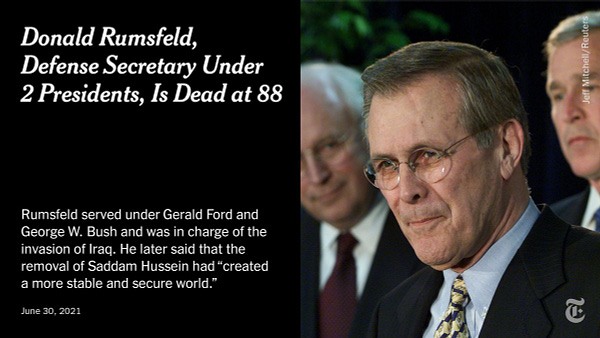
Donald Rumsfeld was all the worst things about our world. He perfectly embodied the corrupt, bloodthirsty, ecocidal, omnicidal, oppressive, exploitative, deceitful status quo that is driving humanity toward extinction. The US-centralized empire is Donald Rumsfeld. It might as well have his face and his name.
Iraq war architect Donald Rumsfeld has died. Not in a prison cell in The Hague, not murdered by bombs or bullets, but peacefully in his home, surrounded by loved ones, a week and a half shy of his 89th birthday.
There’s been criticism as well, of course; online sentiments about Rumsfeld’s death have not been nearly as worshipful and hagiographic as they’ve been toward other disgusting war whores like John McCain. But in the end all that matters is that he lived a long, full life, without ever having faced even the slightest single consequence for the horrors he unleashed upon our world; without even so much as sustaining any meaningful damage to his reputation.
When we are little, we are taught that we live in a nation of laws, where bad guys are thrown in prison by the good guys who are in charge of things. Because our mental programming continues for the rest of our lives in the form of mass-scale propaganda designed to manufacture consent for the status quo, most of us tend to hold onto this childish model of the world to some extent throughout adulthood.
The system isn’t designed to protect us from society’s worst, it’s designed to protect society’s worst from us. It’s designed to keep us turning the gears of industry without looking around and noticing that we’re all getting fucked in the ass by an alliance of plutocrats and security state insiders who only care about power and money. It’s designed to keep us too busy and propagandized to use the power of our numbers to take back what the bastards have stolen from us, and to make sure there’s enough guns on their side to kill us all dead if we try.
Donald Rumsfeld was all the worst things about our world. He perfectly embodied the corrupt, bloodthirsty, ecocidal, omnicidal, oppressive, exploitative, deceitful status quo that is driving humanity toward extinction. The US-centralized empire is Donald Rumsfeld. It might as well have his face and his name.
Don’t let his passing fool you: Donald Rumsfeld is dead, but he is also as alive as ever. He lives on in the continued violence he helped initiate in the Middle East. In the death and destruction rained down by the US and its allies in the name of preserving a unipolar world order that none of us ever asked for. In the dying gasps of starving children under imperial blockades in Yemen and Venezuela. In the thousands of US military bases encircling our planet like a noose. In the war ships and missiles pivoting toward China in preparation for a long-anticipated confrontation which should terrify us all.
Unless we can purge from our cells everything within us that resembles Donald Rumsfeld, there is no future for Homo sapiens on this planet. We must evolve beyond everything he stood for, as individuals, as a society, and as a species, and move into a peaceful and collaborative relationship with each other and with our ecosystem.
________________________
The best way to make sure you see the stuff I publish is to subscribe to the mailing list for at my website or on Substack, which will get you an email notification for everything I publish. My work is entirely reader-supported, so if you enjoyed this piece please consider sharing it around, following me on Facebook, Twitter, Soundcloud or YouTube, or throwing some money into my tip jar on Ko-fi, Patreon or Paypal. If you want to read more you can buy my books. Everyone, racist platforms excluded, has my permission to republish, use or translate any part of this work (or anything else I’ve written) in any way they like free of charge. For more info on who I am, where I stand, and what I’m trying to do with this platform, click here.
Everyone immediately knows they all come from Russia, probably from Vladimir Putin himself. Afterall, the U.S. auto-responder says so.
This guy knows – – –
“Vladimir Putin, as many people in this chamber know well, wakes up every morning and goes to bed every night trying to figure out how to destroy American democracy.” –House Trump Impeachment Manager Jason Crow
And there is the cheap propaganda factor. We Americans have a tendency to confuse the Communist former USSR with capitalist anti-communist modern Russia. That makes it easy for anyone who needs an excuse for something to get one on the cheap. They just demonizize Russia by resurrecting the Cold War.
And, silly as it sounds, there are some conspiracy theorists who claim these ransomware hacks are done just for the money.
But more serious folks like House Manager Jason Crow — and Uncle Joe Biden — know Putin “the Killer” is behind it all — including the DNC hack, Hillary losing the 2016 election, dropping giant chlorine jugs on Syria from helicopters, not to mention the Skripals, Alexei Navalney, and for that matter, my last WINDOWS Blue Screen of Death.
But, in the case of the Blue Screens of Death and other hacks, how do they know it was Putin?
They look for his fingerprints. No, I’m not making that up. You’ve heard of cyber forensics, right?
But there’s a problem: It’s the CIA’s cyber warfare Remote Devices Branch, UMBRAGE group.
The UMBRAGE group collects cyber fingerprints and then other CIA branches use them to disguise their hacks. Stuxnet for example, when they hacked Iran’s nuclear centrifuges.
L. Reichard White [send him mail] taught physics, designed and built a house, ran for Nevada State Senate, served two terms on the Libertarian National Committee, managed a theater company, etc. For the next few decades, he supported his writing habit by beating casinos at their own games. His hobby, though, is explaining things he wishes someone had explained to him. You can find a few of his other explanations listed here.
Opponents of WikiLeaks founder Julian Assange often hold up Pentagon Papers whistleblower Daniel Ellsberg as an example of someone who was responsible for a good leak. They insist WikiLeaks is not like the Pentagon Papers because supposedly Assange was reckless with sensitive documents.
On the seventh day of an extradition trial against Assange, Ellsberg dismantled this false narrative and outlined for a British magistrate court why Assange would not receive a fair trial in the United States.
Assange is accused of 17 counts of violating the Espionage Act and one count of conspiracy to commit a computer crime that, as alleged in the indictment, is written like an Espionage Act offense.
The charges criminalize the act of merely receiving classified information, as well as the publication of state secrets from the United States government. It targets common practices in news gathering, which is why the case is widely opposed by press freedom organizations throughout the world.
James Lewis, a prosecutor from the Crown Prosecution Service who represents the U.S. government, told Ellsberg, “When you published the Pentagon Papers, you were very careful in what you provided to the media.”
The lead prosecutor highlighted the fact that Ellsberg withheld four volumes of the Pentagon Papers that he did not want published because they may have impacted diplomatic efforts to end the Vietnam War. However, Ellsberg’s decision to withhold those volumes had nothing to do with protecting the names of U.S. intelligence sources.
As Ellsberg described for the court, the 4,000 pages of documents he disclosed to the media contained thousands of names of Americans, Vietnamese, and North Vietnamese. There was even a clandestine CIA officer, who was named.
Nowhere in the Pentagon Papers was an “adequate justification for the killing that we were doing,” Ellsberg said. “I was afraid if I redacted or withheld anything at all it would be inferred I left out” the good reasons why the U.S. was pursuing the Vietnam War.
Ellsberg was concerned about revealing the name of a clandestine CIA officer, though he mentioned the individual was well-known in South Vietnam. Had he published the name of the officer today, the Intelligence Identities Protection Act could have easily been used to prosecute him. But he left it in the documents so no one could make inferences about redacted sections that may undermine what he exposed.
Like Assange, Ellsberg wanted the public to have a complete record.
This did not exactly distinguish Ellsberg from Assange so Lewis explicitly highlighted an article, “Why WikiLeaks Is Unlike The Pentagon Papers,” by attorney Floyd Abrams, which he wrote for the Wall Street Journal.
Abrams was one of the attorneys who represented the New York Times in the civil case that argued the government should not be able to block the media organization from publishing the Pentagon Papers. And like Lewis, Abrams fixated on the four volumes that were kept confidential.
Ellsberg insisted Abrams was “mistaken.” He never had any discussion with Ellsberg while defending the right to publish before the Supreme Court so Ellsberg said Abrams could not possibly understand his motives very well.
In the decades since the Pentagon Papers were disclosed, Ellsberg shared how he faced a “great deal” of defamation and then “neglect” to someone who was mentioned as a “clear patriot.” He was used as a “foil” against new revelations from WikiLeaks, “which were supposedly very different.” Such a distinction is “misleading in terms of motive and effect.”
Ellsberg noted Assange withheld 15,000 files from the release of the Afghanistan War Logs. He also requested assistance from the State Department and the Defense Department on redacting names, but they refused to help WikiLeaks redact a single document, even though it is a standard journalistic practice to consult officials to minimize harm.
“I have no doubt that Julian would have removed those names,” Ellsberg declared. Both the State and Defense Departments could have helped WikiLeaks remove the names of individuals, who prosecutors insist were negatively impacted.
Yet, rather than take steps to protect individuals, Ellsberg suggested these government agencies chose to “preserve the possibility of charging Mr Assange with precisely the charges” he faces now.
Not a single person has been identified by the U.S. government when they talk about deaths, physical harm, or incarceration that were linked to the WikiLeaks publications.
The lead prosecutor asked Ellsberg if it was his view that any harm to individuals was the fault of the American government for letting Assange publish material without redactions.
Ellsberg indicated they bear “heavy responsibility.” Lewis attempted to trap Ellsberg into conceding Assange had engaged in conduct that resulted in grave harm to vulnerable individuals. He read multiple sections of an affidavit from Assistant U.S. Attorney Gordon Kromberg, who is in the Eastern District of Virginia where Assange was indicted.
It covered a laundry list of allegations: they named local Afghans and Iraqis that were providing information to coalition forces, forced journalists and religious leaders to flee, led to harassment of Chinese academics labeled as “rats,” fueled violent threats against people who met with U.S. embassy staff, resulted in Iranians being identified and outed, and spurred violence by the Taliban.
“How can you say honestly and in an unbiased way that there is no evidence that WikiLeaks put anyone in danger?” Lewis asked.
Ellsberg told Lewis he found the government’s assertions to be “highly cynical.” He invited Lewis to correct him if he was wrong, but it is his understanding that no one actually suffered harm as a result of these threats. “Did one of them suffer the carrying out of these threats?”
Lewis replied the rules are you don’t get to ask the questions. He tried to move on as Ellsberg insisted he be allowed to provide the rest of his answer, but Judge Vanessa Baraitser would not let Ellsberg complete his response.
It deeply upset Assange, who spoke from inside the glass box where he sits each day. Baraitser reminded him not to interrupt proceedings as Edward Fitzgerald, a defense attorney, attempted to convince the court that Ellsberg should be able to finish his answer.
Lewis continued, “Is it your position there was absolutely no danger caused by publishing the unredacted names of these informants?”
In response, Ellsberg said the U.S. government is “extremely cynical in pretending its concerned for these people.” It has displayed “contempt for Middle Easterners” throughout the last 19 years.
As Lewis insisted one had to conclude Iraqis, Afghans, or Syrians named in the WikiLeaks publications were murdered or forced to flee, Ellsberg refused to accept this presumption.
“I’m sorry, sir, but it doesn’t seem to be at all obvious that this small fraction of people that have been murdered in the course of both sides of conflicts can be attributed to WikiLeaks disclosures,” Ellsberg stated.
If the Taliban had disappeared someone, Ellsberg said that would be a seriously harmful consequence. “I am not aware of one single instance in the last 10 years.”
At no point did the lead prosecutor offer any specific example of a death, and so the record remains as it has been since Chelsea Manning was put on trial. The government has no evidence that anyone was ever killed as a result of transparency forced by WikiLeaks.
Ellsberg informed the court his motive was no different from Assange’s motive. The Espionage Act charges that Assange faces are not meaningfully different either. And, in fact, he faced efforts by the government to wiretap and incapacitate him just like Assange did while in the Ecuador embassy in London.
Ellsberg recalled that he did not tell the public what led him to disclose the Pentagon Papers because he expected to be able to testify about his motive during his trial.
When his lawyer asked him why he copied the Pentagon Papers, the prosecution immediately objected. Each time his lawyer tried to rephrase the question, the court refused to permit him to tell the jury “why he had done what he’d done.”
Federal courts continue to handle Espionage Act cases in the same manner. “The notion of motive or extenuating circumstances is irrelevant,” Ellsberg added.
“The meaning of which is I did not get a fair trial, despite a very intelligent and conscientious judge. No one since me has had a fair trial.”
“Julian Assange could not get a remotely fair trial under those charges in the United States,” Ellsberg concluded.
Photo of Daniel Ellsberg by Christopher Michel
***
[NOTE: John Goetz, an investigative journalist who worked for Der Spiegel in 2010-2011, gave crucial testimony on German citizen Khaled el-Masri, who the CIA kidnapped and tortured. He described how WikiLeaks disclosures helped El-Masri and provided support for a statement El-Masri has submitted to the court. When El-Masri’s statement is read into the record or made public, I will cover this important aspect of the extradition trial in full.]
Peter Van Buren talks about the unlearned lessons from America’s last several decades of foreign policy failures. Although a presidential administration will occasionally make a blunder that results in something like ISIS or the empowerment of Iran, for the most part, says Van Buren, the endless and unwinnable wars, the bloated military spending, and a nation that worships its military are all part of the plan for the neocons, neoliberals, and the military industrial complex and its lobbyists. It is really the well-intentioned but gullible American people who keep falling for the same lies, eagerly sending their sons and daughters off to die in pointless conflicts. And so long as they do so, things will continue just as they are.
…As Daniel Ellsberg, who leaked the Pentagon Papers in 1974, told CNN earlier this week, the Pentagon and Afghanistan Papers revealed the same dynamic: “The presidents and the generals had a pretty realistic view of what they were up against, which they did not want to admit to the American people.”
The documents are an indictment not only of one aspect of American foreign policy, but also of the U.S.’s entire policymaking apparatus. They reveal a bipartisan consensus to lie about what was actually happening in Afghanistan: chronic waste and chronic corruption, one ill-conceived development scheme after another, resulting in a near-unmitigated failure to bring peace and prosperity to the country. Both parties had reason to engage in the cover-up. For the Bush administration, Afghanistan was a key component in the war on terror. For the Obama administration, Afghanistan was the “good war” that stood in contrast to the nightmare in Iraq.
The Afghanistan Papers are, in other words, a bombshell. Yet the report has received scant attention from the broader press. Neither NBC nor ABC covered the investigation in their nightly broadcasts this week. In other outlets, it has been buried beneath breathless reporting on the latest developments in the impeachment saga, Joe Biden’s purported pledge to serve only one term, and worldleaders’ pathological envy of a 16-year-old girl.
The relentless news cycle that characterizes Donald Trump’s America surely deserves some blame: This isn’t the first time that a consequential news story has been buried under an avalanche of other news stories. But one major reason that the Afghanistan Papers have received so comparatively little coverage is that everyone is to blame, which means no one has much of an interest in keeping the story alive. There are no hearings, few press gaggles…
The result is that this massive controversy receives disproportionately little coverage. Despite wasting thousands of lives and hundreds of billions of dollars, everyone in the U.S. government gets off scot-free. The very people who have kept us in Afghanistan since 2001 remain empowered, thanks to a combination of cynicism and apathy. And as a result, the Afghanistan Papers have ended up working in favor of Trump’s Republican Party, which exists to channel voters’ contempt of elite lawmakers and the institutions they represent.
Long ago, after the insane, absurd advice he received from his senior military advisers in the Bay of Pigs and Cuban missile crisis fiascos, President John F. Kennedy, himself a decorated World War II veteran, wisely concluded, “The first thing I’m going to tell my successor, is watch the generals, to avoid feeling that just because they’re military men, their opinions on military matters are worth a damn.”
I remember the day I broke. I was a young captain in command of an 82-man cavalry troop in the heart of Taliban country—in Kandahar, Afghanistan—and I was deep into one of my regular manic episodes. At that moment, I was in the midst of writing an angry—definitely hopeless—stream-of-consciousness screed, which topped out at some 8,000 words, to my sociopathic squadron commander. My verbose, yet well-argued, treatise expressed my opposition to his next planned assault (with my unit in the lead) into yet another remote, abandoned, booby-trap-riddled village. I was by then obsessed with protecting my troopers from needless death or maiming. Mid-sentence, one of my subordinate lieutenants rushed into the office to remind me: “Sir, you have to give a memorial address in like 30 minutes!” Shaken out of my trance, I remembered (had I really forgotten?) that it was almost time to give my obligatory speech in remembrance of one of my young soldiers, blown to pieces just days before.
I hid my surprise, assured the lieutenant I’d be ready soon, and pulled out a 5″ x 7″ index card to hastily jot down some bullet notes for my impending address. Normally, I thrive in public speaking, but suddenly I drew a frightful blank. I don’t know anything about this kid, I realized. He was young, new to the unit, and—though I’d heard glowing reports on his discipline and work ethic—I couldn’t conjure a single personal detail about, or one-on-one interaction with, him. Maybe a better officer would have. Still, I threw something together, gave a passable speech—which was, as always, filmed for the soldier’s family—then retreated to the designated “smoke pit” to share some cigarettes with his platoon mates. They were sort of numb, frightened for their own fates, yet alarmingly resigned to their personal hellscapes. None, not a one, had any particular affinity for the Afghan people, nor did they believe in the mission. I listened carefully as they swapped stories about their fallen friend. Then it struck me: I’d never be able to explain to this kid’s mother just what he’d died for on that dusty trail in rural Afghanistan.
That was back in 2011, year 10 of what has become America’s 18-year war—and its longest ever. Unlike the war in Iraq, which I’d joined just after West Point graduation, I’d entered Afghanistan already skeptical of the nation’s post-9/11 wars. The trick was to escape a year-long tour with as many of my troopers’ lives (and limbs) as possible. When our unit finally made it home in January 2012—though with three fewer lives and several fewer limbs—I rapidly fell apart. It was a legitimate, if sudden, mental health collapse, brought on, I suppose, the moment I stopped white-knuckling it through 18-hour days borne under the substantial weight of command responsibility.
In the years that followed, I lost two wives and never quite shook bouts of crippling depression and anxiety. And the war, it never stopped churning. But I also became an outspoken anti-war activist, criticizing the wars—in Afghanistan, in particular—which I long knew were unwinnable and based on lies.
Earlier this week, we learned that our leaders also knew the war was a fiasco, doomed to fail. But, unlike many of us, they chose not to speak out. Instead, as The Washington Post revealed in a series of stunning articles based on what it has labeled the Afghanistan Papers—a trove of previously classified documents that it is calling a “secret history of the war”—dozens of consecutive generals and senior US officials had repeatedly lied about, omitted, and obfuscated the facts to give an illusion of progress in that war.
Examples abound. As early as 2003, Bush’s hawkish secretary of defense, Donald Rumsfeld, apparently admitted, “I have no visibility into who the bad guys are” in Afghanistan. More than a decade later, during the late Obama years, retired Army Lt. Gen. Doug Lute (once the Afghan War “czar”), conceded to one of the interviewers, “We didn’t have the foggiest notion of what we were undertaking.” Perhaps even more troubling, in a throwback to Vietnam War–era stat-fudging, one unnamed army colonel confessed, “Every data point was altered to present the best picture possible.” Read the rest of this entry »
Much of the media nowadays is portraying itself as heroes of the #Resist Trump movement. To exploit that meme, Hollywood producer Steven Spielberg rushed out “The Post,” a movie depicting an epic press battle with the Nixon administration. But regardless of whether Spielberg’s latest wins the Academy Award for best picture on Sunday night, Americans should never forget the media’s long history of pandering to presidents and the Pentagon. Read the rest of this entry »



 Daniel Ellsberg, right, shakes hands in September 1971 in Washington with future senator and secretary of state John F. Kerry, then head of Vietnam Veterans Against the War. (The Washington Post)



 MCViewPoint