


Like the old bureau under Palmer, today’s FBI also casts its net around a wide range of civil society and social justice groups as well as racial and religious minorities.
“What is known is that there is a persistent pattern of monitoring civil society activity,”
https://theintercept.com/2019/10/22/terrorism-fbi-political-dissent/

While terrorism in the U.S. is relatively rare, over the last decade most politically motivated violence has come at the hands of far-right extremists. Despite that reality, the FBI has devoted disproportionate resources to the surveillance of nonviolent civil society groups and protest movements, particularly on the left, using its mandate to protect national security to target scores of individuals posing no threat but opposing government policies and practices.
Since 2010, the FBI has surveilled black activists and Muslim Americans, Palestinian solidarity and peace activists, Abolish ICE protesters, Occupy Wall Street, environmentalists, Cuba and Iran normalization proponents, and protesters at the Republican National Convention. And that is just the surveillance we know of — as the civil liberties group Defending Rights & Dissent documents in a report published today. The report is a detailed catalog of known FBI First Amendment abuses and political surveillance since 2010, when the Department of Justice’s Office of Inspector General published the last official review of Bush-era abuses. The incidents the report references, many of which were previously covered by The Intercept, were largely exposed through public records requests by journalists, activists, and civil rights advocates. The FBI relentlessly fought those disclosures, and the documents we have were often so heavily redacted they only revealed the existence of initiatives like a “Race Paper” or an “Iron Fist” operation, both targeting racial justice activists, while giving away little detail about their content.
But the targeting of political dissent is nothing new for the FBI. In fact, one of the bureau’s first campaigns, which began a hundred years ago next month, was an abusive crackdown of politically active immigrants it viewed as disloyal potential terrorists.
On the second anniversary of Russia’s Bolshevik Revolution, law enforcement agents at the direction of the U.S. Department of Justice’s Bureau of Investigation — the FBI’s precursor — raided the Russian People’s House in New York City, where immigrants gathered to take classes, and beat and arrested everyone they found there. In the months following, local and federal police across major U.S. cities rounded up thousands of men and women, mostly foreign-born, who they accused of being subversives and Communists. The raids followed politically motivated investigations into immigrant associations, labor organizing groups, and leftist and anarchist circles.
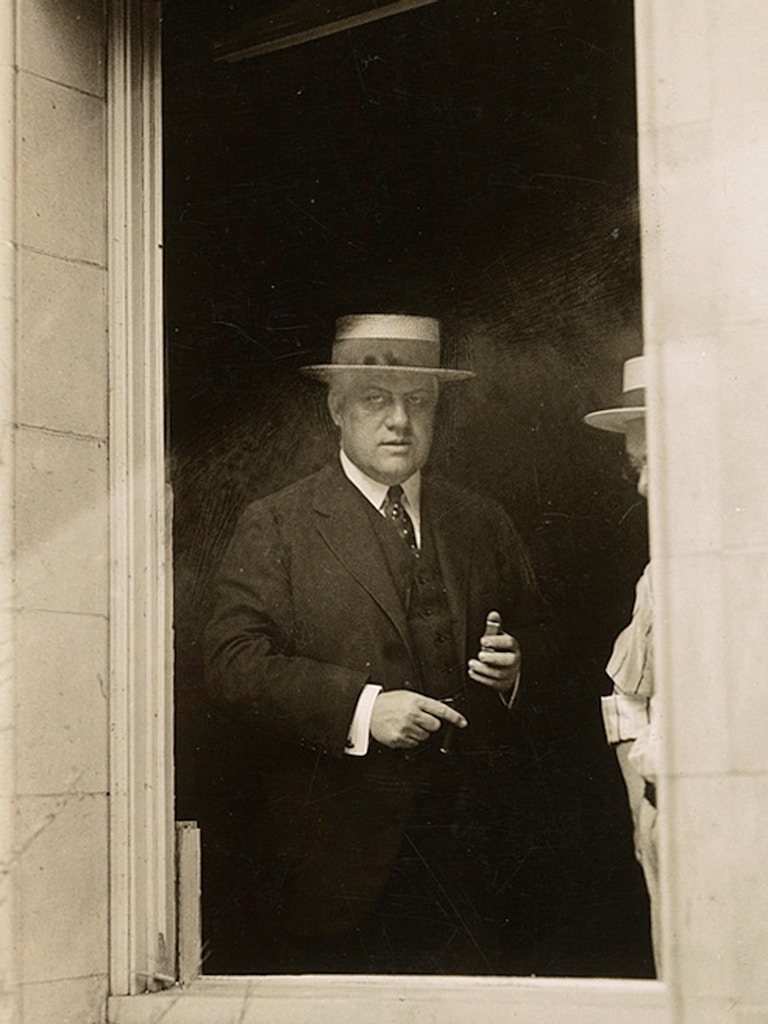
Attorney General A. Mitchell Palmer, seen through the window of his home at in Washington, D.C., after it was bombed on June 2, 1919.
The Palmer Raids, as they came to be known, after Attorney General A. Mitchell Palmer, ushered in an era that tested the nation’s commitment to the civil liberties enshrined in the Constitution. One hundred years later, the FBI continues to target political dissent with a broad mandate, little oversight, and next to no transparency. The FBI continues to routinely conflate dissent with terrorism, and remains particularly fixated on leftist ideologies. Like the old bureau under Palmer, today’s FBI also casts its net around a wide range of civil society and social justice groups as well as racial and religious minorities.
“What is known is that there is a persistent pattern of monitoring civil society activity,” the report concludes, calling for strict oversight and reform of the bureau. “The FBI continuously singles out peace, racial justice, environmental, and economic justice groups for scrutiny. This is consistent with a decades-long pattern of FBI First Amendment abuses and suggests deeply seated political bias.”
After reviewing the report, a spokesperson for the FBI wrote in a statement to The Intercept that every activity the FBI conducts “must uphold the Constitution and be carried out in accordance with federal laws.” The spokesperson added that the bureau’s investigative activities “may not be based solely on the exercise of rights guaranteed by the First Amendment” and that its methods “are subject to multiple layers of oversight.” On its website, the bureau calls the Palmer Raids “certainly not a bright spot for the young Bureau” but adds that they did allow it to “gain valuable experience in terrorism investigations and intelligence work and learn important lessons about the need to protect civil liberties and constitutional rights.”
In fact, FBI violations of civil liberties and constitutional rights continued to be exposed at different points in the bureau’s history — most notably in the aftermath of the civil rights movement and in the post-9/11 years. Yet the bureau’s propensity for the policing of political dissent has remained largely unchallenged, the Defending Rights & Dissent report argues. “In the 100 years since the Palmer Raids,” asks Chip Gibbons, the report’s author, “how much has changed?”
From the Palmer Raids to 9/11
The Palmer Raids were launched on November 7, 1919, on the heels of U.S. government panic about the spread of Bolshevism and anarchism in the country’s nascent labor movement, and following a series of bombings, including one targeting Palmer’s own house. In response, police officers carrying clubs and blackjacks but no arrest warrants stormed apartments and meeting rooms, and rounded up scores of mostly Eastern European and Italian immigrants they accused of being “leftists” and “subversives.” Over several months, 10,000 people were arrested in a dozen cities, with thousands held in detention and ordered deported. While most deportation orders were ultimately invalidated, more than 500 people were forcibly removed, according to the report.
The raids swept up hundreds of people with no connection to political movements and failed to yield anyone responsible for the bombings that had justified them. The abuse resulted in the first official efforts to put a check on the powers of the Bureau of Investigation, which had been established in 1908 over Congress’s opposition. At the time, legislators had feared the bureau would become a “secret police force” used to spy on Americans and infringe on civil liberties, but when Congress adjourned, President Theodore Roosevelt proceeded to set up the bureau anyway. The raids confirmed legislators’ fears.
“It was the first real awakening of a civil liberties consciousness in the country,” said Christopher Finan, author of a book on the Palmer Raids. “Because even though we had had the First Amendment for more than 100 years at that point, and we were philosophically committed to free speech, it hadn’t actually been protected. There really were no protections that could be thrown up to protect people when the Red Scare began.”
While groups like the American Civil Liberties Union, founded months after the raids began, have won important First Amendment battles, repeated legislative efforts to limit the powers of the FBI have been short-lived. Decades after the raids, the man who masterminded them — a 24-year-old J. Edgar Hoover — went on to lead COINTELPRO, perhaps the FBI’s most infamous political policing operation. The revelation that the FBI had engaged in covert efforts to infiltrate, discredit, and sabotage the anti-war and civil rights movements of the 1960s led to a Senate investigation, a moment of national reckoning, and reforms aimed at protecting First Amendment rights from government overreach.
“Unfortunately, after 9/11 those protections were removed and so the abuse that we had was not only predictable, but predicted,” said Mike German, a former FBI agent and outspoken critic of the agency. “It’s easy for a government that is focused on addressing national security threats to quickly begin to view any threat to that government’s hold of power as a security threat, rather than a political threat.”…
The rest here
Be seeing you


 MCViewPoint