MCViewPoint

Opinion from a Libertarian ViewPoint

Posts Tagged ‘prices’

What Mises Understood about Prices and Trade That Socialist Economists Did Not – Foundation for Economic Education

Posted by M. C. on February 14, 2023

However, when the utter failure of socialist economics was definitively exposed for all to see in the demise of the Soviet Union, Robert Heilbroner, who had spent most of his career as an unabashed socialist, raised the white flag and admitted that Mises was correct about socialism in a September 1990 New Yorker article entitled “After Communism.” 

https://fee.org/articles/what-mises-understood-about-prices-and-trade-that-socialist-economists-did-not/

Walter Block
Walter Block
Robert Batemarco
Robert Batemarco

Socialism is a very popular system. Vermont Senator Bernie Sanders attracts thousands of fellow economic innocents on college campuses, and even professional economists of the ilk of Paul Samuelson were taken in by the siren song of this ineffective and evil system. (He predicted in his economics textbook that the USSR would overtake the American economy).

There stood Ludwig von Mises, like the Rock of Gibraltar, standing in the path of socialists of all types and varieties. He laid down the line: under socialism without free market prices, planning would necessarily be irrational. How and why, then, the existence of this pernicious system in Russia from 1917 to 1991 with the dissolution of the Soviet Union. How is it that socialism still exists in places like Cuba, North Korea, and Venezuela? That is because market prices, generated elsewhere, were available to the economic dictators. During the period of USSR socialism, there was the Chicago board of trade and Consumers’ Reports. They made market prices available to the Soviet planners; they were a not-totally-unreasonable approximation to Russian realities. Nowadays, at least quasi-market prices are available in many areas of the world (they are only quasi since every government, bar none, engages in taxes and subsidies, price ceilings and floors, etc., which would not exist in the pure free market, and thus still misallocate resources on their basis).

Without prices that reflect consumer desires and relative scarcities, it is impossible to determine whether platinum or steel should be used, for example, for rails for locomotives. The former is more efficient, but is needed elsewhere in the economy. But to what degree? Or, should a tunnel be dug through a mountain; or should the new road go all around it? The former is much more expensive, now, but will save gigantic transportation costs for years to come. Without accurate prices and interest rates, it is impossible to make a rational calculation of the relevant benefits and costs. Should rowboats be constructed of wood, metal or plastic? A rational decision, again depends upon free market prices, which are to the economy what maps are to geography.

It is no accident that there was virtually one-way traffic between East and West Germany, and between North and South Korea. The latter in each pair instituted systems that were at least within sight of the free enterprise, private property, limited government system advocated by Mises. The former were—and now are in the case of last mentioned—economic basket cases.

But Mises’ contribution to the socialist calculation debate—in his 1922 book Socialism: An Economic and Sociological Analysis—was but the tip of the iceberg in terms of his overall accomplishments. He also made important contributions to the theory of money in his 1912 book The Theory of Money and Credit. There, he demonstrated that whichever monetary commodity arises from the free interplay of market forces is the only path to soundness. He must be credited with a critique of interventionism (small interventions escalate); he did so in his 1977 book A Critique of Interventionism. In many of his publications he made the case for private property rights and economic freedom (the two are necessarily intertwined). His sterling contribution to the Austrian business cycle theory (an artificial lowering of the interest rates creates an unsustainable boom, which necessarily ends in a depression) can be found in his 1912 book, The Theory of Money and Credit.

Perhaps his most profound contribution concerns praxeology (in his 1962 book, The Ultimate Foundation of Economic Science and especially in his magisterial 1949 book, Human Action). This is the view that there is such a thing as economic law, which can only be illustrated, not tested. 

See the rest here

Be seeing you

Posted in Uncategorized | Tagged: , , , | Leave a Comment »

Before Progressives Condemn Capitalism, They Should Be Able to Define It

Posted by M. C. on August 10, 2022

If there is no growth in the money supply, prices and interest rates will best reflect the preferences of a society. An Austrian economics definition of capitalism is the interplay of supply and demand, without any growth in the money supply. In this form of capitalism individualism will never pay off. Profits can only be realized if people in society stand to benefit as well.

https://mises.org/wire/progressives-condemn-capitalism-they-should-be-able-define-it

Heiko de Boer

Many people blame capitalism for ever-increasing consumption, individualism, and the greedy pursuit of profits. Not very often do we see capitalism defined in any other way. In this article, I suggest an Austrian economics definition of capitalism that explains capitalism economically and without moralistic tones.

Human Actions Determine Prices and Interest Rates

The basis of Austrian economics price theory is human action. People must make choices on how to spend their scarce time and resources. They aim to improve their situation by ranking their subjective preferences and realizing as many of these preference, one by one.

This explains why the price of water is much lower than the price of diamonds. The supply of water is more than sufficient to meet almost all our needs. It is the last added unit of water that determines its price, which is many times lower than if the supply of water would satisfy the most important use only.

Interest rates are also a category of human action and are an indication of our time preference. This time preference applies to money and goods and services. A young society will be more inclined to save and invest than an older society. Their lower time preference translates into a lower interest rate as more money is offered for investing. Additional investments make it possible to expand the production structure.

By expanding a production structure, a society can consume more in the future. Consuming more can mean many things. If the purchasing power of people stays the same, but people only need to work three days a week instead of five days, people may still feel better off. Or, by investing we can produce similar goods, but with less pollution.

The interplay between interest rates and prices as they come about in a free marketplace, is shaping the production structure such that it meets the needs of society. The interplay of supply and demand could be termed capitalism. However, for a proper definition, more is needed.

What Money System Works Best?

The signaling function of prices and interest rates is distorted by central banks policies. Monetary policies prescribe that consumer goods prices must rise, according to the European Central Bank by “on average” 2 percent per year. Central banks find it unacceptable if a free market creates prices that are going down or do not rise sufficiently.

Central banks are creating money out of nothing, aiming to stimulate demand. More money means more competition for the same amount of goods, with upward price pressures as a result. Banks and central banks jointly issue more credit than what would be possible by savings alone. The additional offer of money pushes the interest rates down. The balance that prevailed in the time market is artificially disturbed.

Initially, money growth will ‘be good for the economy.’ More money is available for investing at a lower interest rate. It is as if the market has given a signal that people in society want to consume more in the future. However, consumers did not signal any change in consumption preferences.

There will come a time when the artificially low interest rate tends to rise, and prices adjust reflecting people’s actual preferences. Producers will be faced with rising production and refinancing costs. After the boom a bust will naturally follow.

The best money system is one that best reflects the preferences of people in society. This will be the case if there is no growth in the money supply. The Austrian school describes this as a sound money system. A proper definition of capitalism would then be the interplay of supply and demand, without any growth in the money supply.

Individualism, Profits, and Externalities

See the rest here

Be seeing you

Posted in Uncategorized | Tagged: , , , , , | Leave a Comment »

Deflationary Tsunami On Deck: A “Tidal Wave” Of Discounts And Crashing Prices

Posted by M. C. on June 18, 2022

Not everything is set for a deflationary crash: don’t expect luxury items to see price cuts. If anything, luxury prices for things like handbags and shoes are poised to keep climbing, said Oliver Chen, a retail analyst for Cowen: “Demand is so strong, and it’s a supply-constrained industry, generally, so quite the opposite rebalancing is happening.”

Tyler Durden's Photo

BY TYLER DURDEN

https://www.zerohedge.com/economics/deflationary-tsunami-deck-tidal-wave-discounts-and-crashing-prices

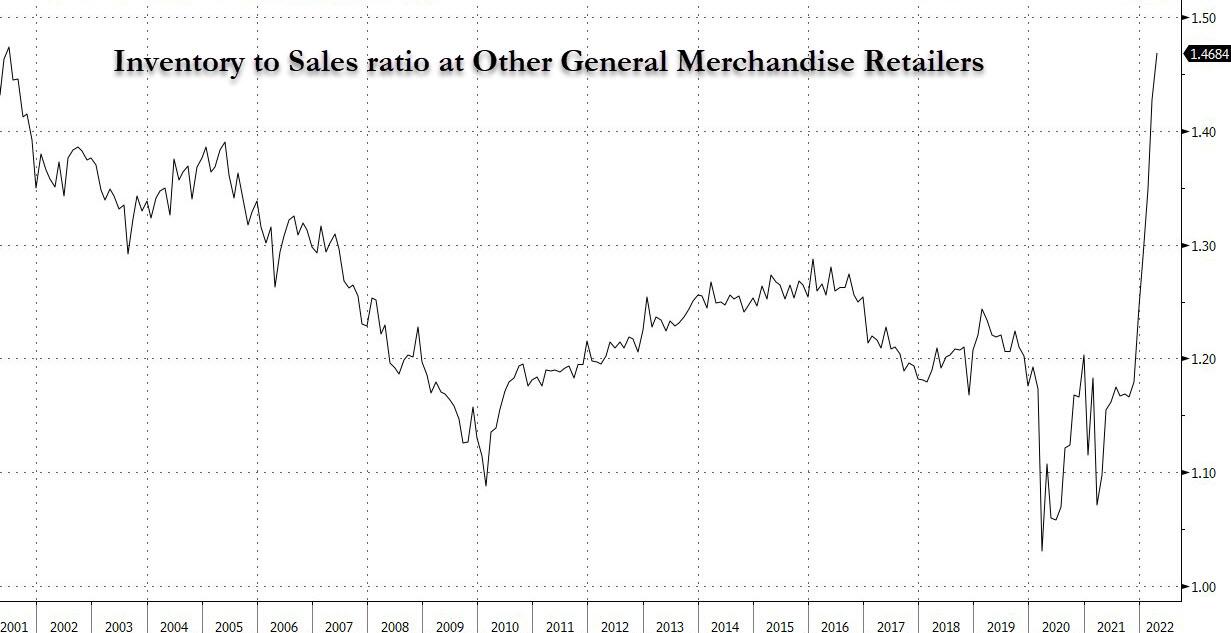
Three weeks ago, we showed readers what happens when the infamous “Bullwhip effect” reversal takes place by presenting the unprecedented surge in the “Inventory to Sales” ratio for a broad range of US retailers covering the furniture, home furnishings and appliances, building materials and garden equipment, and a category known as “other general merchandise,” which includes Walmart and Target. Since then, this ratio has only gotten even more extended, and as shown below it is now at the highest level since the bursting of the dot com bubble!

What does this mean for retailers and the price of goods? Three weeks ago we said “Think: widespread inventory liquidations” and added…

To be sure, not every product will see its price cut: commodities, whose bullwhip effect take much longer to manifest itself, usually lasting several years in either direction, are only just starting to see their price cycle higher. However, other products – like those carried by the Walmarts and Targets of the world – are about to see a deflationary plunge the likes of which we have not seen since the global financial crisis as retailers commence a voluntary destocking wave the likes of which have not been seen in over a decade.

Today both Wall Street and the mainstream media have caught up, with both predicting unprecedented deflationary price cuts in the coming weeks.

We start with Morgan Stanley’s bearish strategist Michael Wilson, who in his latest bearish weekly note (available to pro subs) focused on shrinking margins in general, and on retailer discounting in particular, and wrote that while there is a modest pick up in over sales, the far more concerning issue is that “inventory across the sector is up about 30% YOY and sales growth is up about 0% YOY translating to approximately 30% YOY of excess inventory” and while mark down/margin pressure did not hit in 1Q it should hit June/July. Indeed, “store checks show that aggressive discounting has already started as of the Memorial Day holiday weekend. Discounting pressure could accelerate through July.”  And since more retailers are now discounting, “companies are having to offer even bigger discounts to compel consumers to buy, and it is a race to the bottom in margins in order to clear through inventory.”

It gets much worse, however, because courtesy of the delayed nature of the bullwhip effect, Morgan Stanley thinks it will be some time before retailers can cut back on forward inventory orders! Companies are no longer in a position to order 6 months in advance because of delays in the supply chain, and are currently working with about an 8 month lead time. Shockingly, this means decisions today to cut forward orders could begin to eliminate the inventory problem in 1Q23, but not likely before then.

As a result, Wilson concludes, “we are likely to see a tidal wave of discounts that carry us through December because 2022 inventory orders have already been placed.

See the rest here

Be seeing you

Posted in Uncategorized | Tagged: , , , | Leave a Comment »

Don’t Blame Covid or Ukraine For Soaring Prices — Blame The Fed!

Posted by M. C. on March 11, 2022

With prices skyrocketing, the expected finger-pointing has arrived. While there’s plenty peripheral blame that is certainly warranted, problems are not solved by tinkering with the periphery. You solve problems by going directly to the source. The root source of inflation is always The Federal Reserve, for it has the unconstitutional power of counterfeiting dollars out-of-thin-air. Until this immoral practice is addressed and forbidden, the problems of inflation will never be solved.

Be seeing you

Posted in Uncategorized | Tagged: , , , | Leave a Comment »

Four things only libertarians can see about COVID-19

Posted by M. C. on April 7, 2020

What is unseen are the variety of harms that occur because people have been denied freedom of association and movement.

Second, don’t overlook the harm caused by government actors.

No matter the doomsday scenario, it’s hard to imagine a single governor (or president) outsmarting millions of people.

The Principle of Human Respect is a natural, cause-and-effect relationship. If I rob you at gunpoint, your happiness decreases. Social harmony and prosperity are diminished too.

https://www.theadvocates.org/2020/03/four-things-only-libertarians-can-see-about-covid-19/

A new form of political correctness has spread, like a virus, across the fruited plain. Libertarians are taking heat – getting angry responses for criticizing governors who have used the spread of COVID-19 to issue edicts that shutter businesses and impose martial law-like schemes.

coronavirus covid-19 libertarians politics

Still, libertarians find they cannot keep quiet. Their philosophy of self-government is forged in an understanding of consequences. Libertarians are the only members of society who can see – even foresee – the following four things about the State’s edicts and regulations…

The seen and the unseen

First, libertarians can visualize the Unseen.

What is seen is that which is obvious to us. In the present case, it’s easy for us to see the way the virus is spreading and how the healthcare system is overrun in Italy.

What is unseen are the variety of harms that occur because people have been denied freedom of association and movement. Politicians are using wartime powers and preening before TV cameras. There will be short-term and long-term effects stemming from their actions. Nearly everyone, especially the regime media, is overlooking these costs.

The proper way to analyze this situation is to take all of the effects into account.

Libertarians are just like you; they’re sheltering and practicing physical distance. But let’s be clear, not everyone has that luxury. There’s no way that a governor could anticipate, let alone solve all of these sticky issues. Edicts are “one size fits all.” Each person understands their unique situation better than a politician in a distant capitol could. There are many scenarios to consider. Here’s a sampling…

  • Right now, families are trapped in a home with an abuser. Perhaps the abuser’s workday was a time of relief, or the victim’s school or work was an escape path to safety.
  • Suicides will increase during the crisis.
  • Addiction will worsen because the sense of purpose or even mere interruption that occupational work provides has been stolen away.
  • Businesses that were operating on a thin margin will fold, crushing dreams, resulting in unemployment, and even reducing supply. Supply reductions will fuel price increases for all of us.

Notice State failures

Second, don’t overlook the harm caused by government actors. For example, Donald Trump’s aides were afraid to give their reelection-minded boss any bad news until it was too late. And the sudden, jarring, gubernatorial edicts have caused fear, uncertainty, and doubt – provoking shortages.

In a libertarian world, reliable tests would already be for sale! And if the tests were universally available, the crisis would’ve been far smaller and Americans would be back to work.

There are two reasons tests are not already on the market.

  1. Political suppression of information. If they had gotten the signal earlier, then entrepreneurs, inventors, and existing businesses would’ve started delivering tests by now. We know there was sufficient time because a handful of U.S. Senators were briefed in January. After seeing the impending crisis, they sold off their stocks.
  2. Ironically, regulations are supposed to make us safer. What they do instead is create barriers which increase delays and costs. Frequently, the innovator realizes that no action is profitable, choosing not to invent (another unseen effect). The FDA has been in the way of tests getting to market.

Wisdom of the crowd

Third, self-government is the best solution to the Knowledge Problem. No matter the doomsday scenario, it’s hard to imagine a single governor (or president) outsmarting millions of people.

No matter how brilliant the governor and his or her advisors are, he or she lacks the capacity to win a problem-solving contest against tens of millions of people.

Worse, political acts are prone to cause injuries (which tend to be unseen and unreported). The miracle of “stuff” arriving on our store shelves involves millions of micro-decisions. Sudden edicts have replaced that. Shortages result because the governor deploys unanticipated force. Consider…

Restaurants who planned menus suddenly have too much food. Grocery stores, who thought people would be at restaurants, find that they have new customers instead. The restaurant owner takes a bath.

Even with nearly-empty shelves, stores need to make sure they don’t over-order in response. Grocers know these effects are temporary, but they don’t know when they will end. They don’t want to end up like the restaurants, stuck with too much stock on hand. Uncertainty prevails. Shortages will remain a problem until governors back out of the equation.

Human respect

Fourth and most important of all, is the matter of Human Respect. The libertarian uniquely recognizes that everyone seeks happiness and that no one person can make everyone happy.

The Principle of Human Respect is a natural, cause-and-effect relationship. If I rob you at gunpoint, your happiness decreases. Social harmony and prosperity are diminished too.

Since this is a principle, even governors cannot violate it. Bans and edicts are ultimately enforced by armed men and women. These are not acts of persuasion; they are threats to achieve a desired result. When anyone, be they a criminal or your governor, coerces another human being, they never increase happiness. And in the present situation, the bans have obviously decreased social peace and material prosperity.

The damage to prosperity is already so obvious that no one is contesting it.

And before the governors started acting, we had peaceful cooperation. Most people were already practicing physical distancing. We also witnessed allegedly greedy corporations voluntarily sacrificing many millions of dollars. To prevent the spread of COVID-19 the NCAA closed events to the public. Then, the NBA suspended its season and Disney closed its parks. Like falling dominoes, tons of businesses followed.

AFTER that, governors forced the holdouts to close. Libertarians began raising important questions like the four you’ve just reviewed. They’re getting accused of wanting to clog hospitals and increase the death toll. Therefore, consider the role politicians are playing. Are their acts increasing harmony or did they introduce new divisions into our society?

Be seeing you


Posted in Uncategorized | Tagged: , , , , , , , , , , , , | Leave a Comment »