MCViewPoint

Opinion from a Libertarian ViewPoint

Posts Tagged ‘rent control’

Call Rent Control What It Really Is: Theft

Posted by M. C. on June 16, 2023

However, rent control, which forcibly lowers rents below what willing tenants would offer, takes away that right and much of the value of the landlords’ properties in the process. That is theft, enforced by government guns rather than robbers’ guns. Worse, rent control directly violates the central role of government—the protection of citizens’ existing property rights—as John Locke explained long ago, echoed by America’s founders.

https://mises.org/wire/call-rent-control-what-it-really-theft

As reported by Reason, Colorado—one of thirty-one states that had banned its local governments from imposing rent control—is considering repealing that ban. Recent efforts to allow or impose similar controls have also taken place in New York, California, Massachusetts, Oregon, and Minnesota. However, there is a good reason that most states still ban the local imposition of rent control laws.

The key reason is that the primary advantage of local determination in a federal system—allowing people mistreated by one government body to better protect themselves by “voting with their feet” to less abusive jurisdictions—does not apply to rent control laws. That is because neither selling nor moving allows owners of rental property to escape the imposed burdens.

In many circumstances, voting with your feet favors local governance. It is generally less costly to leave a local government jurisdiction whose benefits are not worth the cost than it is to leave a similarly bad state government jurisdiction, which is less costly to leave than to leave the United States entirely. The enhanced exit option may better protect citizens’ rights against abuse. For instance, residents who view state sales and income taxes as not giving them their money’s worth in benefits can avoid those burdens by going to another state with lower tax rates or better services. However, the same is not true of rent control, whether imposed locally or at the state level.

Owners of rent-controlled properties can move away. However, if they maintain ownership of their property, they are still forced to bear the burden of reduced earnings caused by rent control. If they sell their property, they bear the burden of reduced rental income in the form of a lower sales price that capitalizes the lower revenues the property will generate. Consequently, even selling your property and leaving the jurisdiction provide no escape.

See the rest here

Be seeing you

Posted in Uncategorized | Tagged: , , | Leave a Comment »

Which Aspect of Government Do Anarcho-Capitalists Favor? | The Libertarian Institute

Posted by M. C. on March 23, 2023

Every fiber of our being cries out against the central state in Washington DC.

Far too many crave it.

https://libertarianinstitute.org/articles/which-aspect-of-government-do-anarcho-capitalists-favor/

by Walter E. Block

uncle sam magazine cover

The short answer to that question, and an accurate one, is none of the above. That is the very definition of this philosophical perspective: the state is merely a gang of robbers and murderers, and the ideal is to banish it entirely.

States Mr. Libertarian on this matter: “…if you wish to know how libertarians regard the State and any of its acts, simply think of the State as a criminal band, and all of the libertarian attitudes will logically fall into place.”

However, there is indeed an entirely different and also a proper way to answer that question: whichever aspect of it is most compatible with the libertarian ideal of non-initiatory aggression and private property rights is favored by libertarians in any specific case.

For example, during the New Deal, Franklin Delano Roosevelt was for a time balked by the Supreme Court. The former tried to implement a socialist policy, and the latter was having none of it, continually finding his initiatives unconstitutional. FDR threatened court packing and the nine justices caved in.

What, pray tell, would be the radical libertarian position on this matter? Obviously, to favor the Supreme Court. That is, only in comparison to the president in this case. The support would thus be a relative one. Supporters of economic freedom would rank the initial behavior of the nine justices higher than that of Roosevelt.

Take another case. President Reagan threatened the mayor and City Council of New York City that if the latter strengthened its rent control laws, the federal government would withhold funds from the Big Apple. We stipulate, arguendo, that rent control is an unjustified uncompensated “taking” from landlords, and thus per se unjustified (it also ruins the housing stock of any jurisdiction which implements this policy). Where does the libertarian fall out on this one? In an instance of “strange bedfellows” the supporter of property rights sides with the federal government. Again, not absolutely, of course, only relative to the city authorities.

What about drug legalization? Oregon has decriminalized not only marijuana, but cocaine as well. The federales have not even made legal the former, except for medicinal purposes. On which side of this disparity does the freedom philosophy come down on? Obviously, the former. Hooray for the Beaver State! It is a rights violation to interfere with what adults place into their bodies, on a voluntary basis.

See the rest here

Be seeing you

Posted in Uncategorized | Tagged: , , , , , | Leave a Comment »

Contrary to Public Myths, Rent Control Hasn’t Been a Success in Sweden

Posted by M. C. on July 20, 2022

The average wait time for a rent-controlled apartment in Stockholm has risen from five years to nine years in the last decade and even double this in the more desirable locations. The proportion of Swedish people ages 20–27 living with their parents has been rising and is currently the highest since records began.

It’s almost like the rent controls have caused housing shortages. Who could have predicted it! Just about anyone with eyes, honesty, a passing interest in economic history, and a not entirely closed mind. Price controls have always and everywhere produced the following results.

https://mises.org/wire/contrary-public-myths-rent-control-hasnt-been-success-sweden

James Murphy

Sweden’s rent control is widely touted by many who don’t understand economics as a model for how a property market should work. Young people in Ireland, for example, like to point to Sweden as a nirvana where rent control ensures easy availability of affordable and high-quality rental stock. 

I was once told by a young work colleague with strong socialist tendencies that they could move to Stockholm and get a high-spec modern apartment for a mere pittance compared to rents in Ireland. A cursory Google search, which garnered a string of news articles attesting to various issues arising from Swedish rent control, shone a harsh light on my young colleague’s fervently held, yet thoroughly fallacious belief.

Even left-wing newspapers and media outlets have had to accept (begrudgingly) that rent controls do not work. In Sweden, as in other cities with similar policies, rent-controlled apartment contracts have become valuable assets to be husbanded and exploited. Many tenants who hold the coveted rent-controlled “primary” contracts sublet properties to “secondary” tenants on the black market at rates double the rent-controlled amount

Once renters obtain primary contracts, they rarely relinquish them. Only half a percent of primary rental contracts in central Stockholm find their way back to the housing agency. It is almost impossible for any newcomers to the city to get one of the contracts (woe betide my young colleague and their putative flight to Stockholm!). People keen to jump the queue revert to a range of methods, ranging from leveraging personal networks (leverage newcomers rarely possess and hardly something a “fair” and corruption-free model rewards) to paying bribes (definitely corrupt) that can amount to several years’ rent.

As one can imagine, one class of people gaining advantage (through chance, corruption, or seniority) over other classes of people is not a recipe for social harmony. The first class’s then lording this over the others makes it worse. Another pernicious effect of the waiting lists is falling mobility across Sweden (people waiting on a particular housing agency’s list do not want to move and go to the back of another list). This lack of mobility is feeding into difficulties for employers, one in five of whom cite accommodation shortages as a major impediment to hiring staff and growing their workforces.

See the rest here

Be seeing you

Posted in Uncategorized | Tagged: , , | Leave a Comment »

Election Subtext: Most Voters Still Love American Liberty

Posted by M. C. on January 25, 2021

Looking on the bright side with a very small candle in a very long tunnel.

Graham H. Walker

Are you dissatisfied with the November 2020 elections? If you value constitutional liberty, the results may actually give reason for hope.

I don’t care much about party labels, but during the campaign season one of our major parties seemed to embrace large doses of socialism in practice if not in name: Medicare for all, free college, government takeover of economic activity in a “Green New Deal,” etc. Some of their most prominent candidates practiced race-based identity politics and peddled a “woke” view of America as congenitally unjust.

Their presidential candidate may have won the popular vote. But voters did not ratify his party’s posture. Instead of gaining, his party lost seats in the House of Representatives, and the other party—the one that, despite its faults, vociferously rejected woke socialism—held statehouses and governorships across the country and may likely hold its U.S. Senate majority. The blue wave was a ripple against a red crosscurrent.

Moreover, the siren song of identity politics rang false to many. African-American and Hispanic voters gave the Democratic candidate a lower percentage than in any recent election. To be sure, 80% of Black men voted Democrat. But this was down from 95% support for Barack Obama in 2008, 87% for Obama in 2012, and 82% for Clinton in 2016. Forget the partisan dimension: it is healthy when citizens reject race-driven identity politics.

Election results held surprises even in California, supposedly the bastion of Big Government. Even while they voted two-to-one for the Democratic presidential candidate, California voters rejected measures he endorsed on the state ballot. They rejected expansion of rent control (Proposition 21), race-based affirmative action (Proposition 17), increased property taxes on businesses (Proposition 15), and the essence of California’s Assembly Bill 5 restricting independent contractors (by supporting Proposition 22).

The Independent Institute had something to do with this. We had already won key arguments in the court of public opinion. For example, our “Open Letter to Suspend AB-5,” signed by 153 Ph.D. scholars across California and widely promoted, successfully made the case against California’s war on the “gig economy”—thus enhancing momentum for Proposition 22.

Likewise, we argued against a state-mandated “ethnic studies” curriculum, which would have taught high-schoolers that “capitalism is racist” and accused Jews, Koreans, the Irish, Armenians and other minorities of “white privilege” for simply working hard and succeeding. Our arguments in the Los Angeles Times, Wall Street Journal, and many other outlets, influenced Gov. Gavin Newsom to veto the mandated curriculum. And, this victory against racialism carried over into voters’ rejection of Proposition 17.

In California, as elsewhere, Americans were not sold on woke, nor on socialism. Most Americans like America—including individual liberty and the rule of law. This is good news indeed and shows the power of good ideas over bad ones!

Graham H. Walker is Executive Director of the Independent Institute and Assistant Editor of The Independent Review: A Journal of Political Economy.
Posts by Graham H. Walker | Full Biography and Publications

Be seeing you

Posted in Uncategorized | Tagged: , , , , , | Leave a Comment »

Rent Control, Jobs, Marriage – LewRockwell

Posted by M. C. on July 13, 2020

For when barriers are placed in the way of laying off wage earners, less of it will occur. How do rational profit seeking entrepreneurs react? Why, by not hiring workers in the first place! Instead of offering full time employment, they take on only part timers. Firms resort to contracting out to smaller firms, or to the individuals themselves. The latter take on what are called “gigs” so as to escape these unwarranted legislative enactments.

https://www.lewrockwell.com/2020/07/walter-e-block/rent-control-jobs-marriage/

By

Demand curves slope in a downward direction. This means that the higher the price, the less of an item, or good, or service, will be sought. The more road blocks, hurdles, thumb tacks, placed in the way of any given action, the less likely it will occur. Economists do not agree on many things, but on this insight there will be nary a dismal scientist who will not acquiesce.

Yet, there are several public policies in place that are incompatible with this common-sense understanding.

Consider first residential rental units. New York City, San Francisco, Cleveland and another half dozen major cities are now offering free legal advice to tenants threatened by eviction. At present this benefit is afforded mainly to those accused of a crime who cannot afford a lawyer, on the ground that such legal aid is needed to provide equal justice for rich and poor alike. Now, it is being extended to renters.

Some commentators even think that this strengthens the hands of tenants and reduces homelessness. They reckon, however, in the absence of downward sloping demand curves. They think only in terms of immediate, not long term effects. Yes, give them free legal advice and fewer people will be evicted; one point for the tenant.

But look at this from the point of view of the landlord, or, the would-be investor in residential real estate. It now becomes more difficult to evict non-paying, or obstreperous tenants. Will they be more or less likely to build, upgrade, repair, apartment dwellings? To ask this question is to answer it. They will tend to seek greener pastures elsewhere. They will try to convert extant dwellings into condominiums, commercial space, etc. But, with less residential housing available the situation of renters will become more dire, not less. Remember that downward sloping demand curve: with a lowered supply, rents will rise not fall, and a given square footage will accommodate fewer people, not more. More homelessness, here we come.

The same analysis applies to other efforts to “help” tenants. Under economic freedom, landlords may demand as much as several months’ worth of security deposits. This will indemnify them if there are damages. It will also protect them from bankruptcy since it typically takes months to evict non payers. This problem arises especially during the Christmas season; judges are particularly reluctant to toss people out onto the street during these times. Curiously, they do not at all have the same attitude regarding robbers during December. But what are non-paying tenants other than thieves of accommodation?

Next consider the labor market. In France in particular, and other countries as well, the law makes it more and more difficult to fire employees. The authorities want to protect workers, and, also, do not relish increased unemployment statistics. This “remedy” of theirs also fails to take into account downward sloping demand curves; it looks, only, to the immediate run, avoiding long run effects. For when barriers are placed in the way of laying off wage earners, less of it will occur. How do rational profit seeking entrepreneurs react? Why, by not hiring workers in the first place! Instead of offering full time employment, they take on only part timers. Firms resort to contracting out to smaller firms, or to the individuals themselves. The latter take on what are called “gigs” so as to escape these unwarranted legislative enactments.

These laws are also discriminatory. Workers can quit with no by your leave. Unless and until employers can sever relationships with employees as easily, justice, to say nothing of full employment, will not prevail.

Let us attempt to make this point in an unrelated arena of human interaction. Suppose a law were passed and fully enforced mandating that no divorce would be allowed, ever, for any reason whatsoever. The immediate effect of course would be to preserve marriage. Without the possibility of divorce, more marriages would stay intact than otherwise (we abstract from the effect of such a law on the rate of infidelity). But what would be the long run effect of such a law on this institution ? Demand curves slope downward even in this milieu. Place more barriers against an act, weddings in this case, and fewer of them will occur.

If society really has the best interests of tenants, of employees, and, also, of spouses, it will not in effect charge higher “prices” for them. The very opposite policies would be pursued.

Dr. Block [send him mail] is a professor of economics at Loyola University New Orleans, and a senior fellow of the Ludwig von Mises Institute. He is the author of Defending the Undefendable, The Case for Discrimination, Labor Economics From A Free Market Perspective, Building Blocks for Liberty, Differing Worldviews in Higher Education, and The Privatization of Roads and Highways. His latest book is Yes to Ron Paul and Liberty.

Be seeing you


Posted in Uncategorized | Tagged: , , | Leave a Comment »

Rent Control Is Nuts – LewRockwell

Posted by M. C. on May 18, 2020

And according to Assar Lindbeck, a Swedish economist, “In many cases, rent control appears to be the most efficient technique presently known to destroy a city except for bombing.” Almost as a follow up, Vietnamese Foreign Minister Nguyen Co Thach averred: “The Americans couldn’t destroy Hanoi, but we have destroyed our city by the very low rents.”

https://www.lewrockwell.com/2020/05/walter-e-block/rent-control/

By

Representative Alexandria Ocasio-Cortez (D-NY, 14th District) has called for nation-wide rent control. AOC’s plan is to not allow rent increases larger than 3% per year. This is somewhat surprising, given that she majored in economics at prestigious Boston University. I – along with virtually every other economics professor in the country — am always at great pains to present in my introductory to micro-economics courses the familiar supply and demand diagram. It demonstrates that rents below equilibrium levels create shortages. I suppose she missed that lecture. If so, she really should have obtained the class notes from someone else, and/or perused her introductory textbook.

Senator Bernie Sanders has, if anything, done her one better: he is calling for a national rent control policy. California Governor Gavin Newsom has signed into law a policy along similar lines: rent increases shall be limited to 5% annually, in addition to any inflationary increases; this is coupled with making it more difficult to evict tenants.

Present New York City policy is very much in keeping with Rep. Ocasio-Cortez’s plan. It has recently worsened its previous rather Draconian rent control legislation. The presumed aim is to help tenants. But, there is something in economics called “unintended consequences.” Translation: “the plans of mice and men often go astray.”

Suppose, instead of exacerbating its rent control regulations, that the city council of this great city had tried this sort of thing with a different consumer good. Suppose the Big Apple had passed a law placing a ceiling of $1 on a fast food meal.The obvious result would be that McDonalds, Burger King, Wendy’s and their ilk would pretty much vacate the entire city. Posit that the city council mandated that gas stations charge no more than $1 per gallon. A similar result would ensue. Denizens of the New York City would be greatly inconvenienced.

Mr. DeBlasio would never institute any such ridiculous initiative. He would be laughed out of office if he did. Why, then, does the mayor think he can get away with inculcating analogous rules for residential real estate? This is because while burger and gas emporiums can easily locate elsewhere, the same is not true for buildings. If the owners had their ‘druthers, and this were economically and legally possible, they would hoist their real estate holdings upon onto giant wheeled vehicles, and roll them out of the city as soon as possible. New York City would then have no more accommodation for tenants than it would have fast food outlets or gas stations, under our hypothetical contrary to fact scenarios.

Of course, landlords can do no such thing, much as they would like to; heck, they would give their eye teeth to be able to cock a snook at the politicians in this manner.

But this inability of landlords does not mean that rent controls have no adverse effects upon local residents. They can certainly build less new capacity than would otherwise be the case. They may be legally compelled to upkeep and maintain presently existing apartments, but they will do so only reluctantly. “The customer is always right” which prevails in most industries, and will continue to do so for commercial and industrial real estate, which lack such unwise price controls, but will not apply to residential units. They will fight like the dickens to convert their holdings to condominiums and cooperatives. They will have incentives to – how can I put this delicately – not to be too unhappy if their buildings accidentally catch fire. Do we really want to promote such incentives, whether or not they actually become implemented?

Vacancy rates will plummet even further, with these new dispensations. This will have negative repercussions on labor mobility, when occupants fear to give up their rent controlled units. There will be a tendency to convert apartments to stores, to industrial and commercial uses. New laws will have to be enacted to prevent this, and will not be totally successful. Landlord – tenant relations will plummet even further (not of course for non-controlled, non-residential units.) New York City already has special courts charged with solving these confrontations. This is something not at all needed in any other industry. These costs are substantial, and the money misallocated in this direction could have been far more wisely spent.

The economics profession is not unified on too many issues, but this one is an exception. Opposition to rent control stretches all the way from Milton Friedman and Friedrich Hayek on one stretch of the political spectrum, to several scholars on the very opposite side. For example, in the view of Nobel Prize winner in economics Gunner Myrdal, “Rent control has in certain western countries constituted, maybe, the worst example of poor planning by governments lacking courage and vision.” And according to Assar Lindbeck, a Swedish economist, “In many cases, rent control appears to be the most efficient technique presently known to destroy a city except for bombing.” Almost as a follow up, Vietnamese Foreign Minister Nguyen Co Thach averred: “The Americans couldn’t destroy Hanoi, but we have destroyed our city by the very low rents.”

It is urged in favor of this policy that tenants are poorer than property owners, and, often, are compelled to spend an inordinate percentage of their salaries on rent. But, with fewer buildings being constructed, and more of them falling into disarray due to reduced maintenance, upward pressure on rent levels, paradoxically, will tend to be the result. It is an economic truism that the less supply, other things equal, the higher the price. There are no exceptions for housing, or based on the fact that this expenditure plays a large role in the budgets of poor and middle class householders.

In any case, we do not single out textile manufacturers and insist they alone help clothe the impoverished, that only grocers and restaurants feed them, that automobile, air conditioner and television purveyors all on their own make these products available to those who cannot afford them. All of these income transfers come out of general funds. I do not at all favor any of these policies, but fair is fair. Why should housing be any different? Why should landlords, alone, have to bear the entire burden of housing the poor?

Not only should these latest violations of private property rights be rescinded, but the entire notion that rent control can alleviate housing shortages and high fees should be confined to the dust bin not only of history, but of economics too. From a legal point of view, this is a taking. Landlords should be compensated for this seizure of the (value of) their property.

Be seeing you

Posted in Uncategorized | Tagged: , , , | Leave a Comment »

EconomicPolicyJournal.com: Washington Post: “The economists are right: Rent control is bad”

Posted by M. C. on December 29, 2019

“In many cases, rent control appears to be the most efficient technique presently known to destroy a city—except for bombing.”–Swedish economist Assar Lindbeck.

https://www.economicpolicyjournal.com/2019/12/washington-post-economists-are-right.html

Wow, as the year ends, some serious progress in the form of sound basic economics out of the Washington Post:


From the Editorial Board:

RENT CONTROL is back. Economists have long criticized government price controls on apartments, a concept that had its first moment in the 1920s and that some cities reintroduced in a modified form in the 1970s. Now, decades later, California and Oregon are moving forward with statewide rent-control laws. Meanwhile, presidential candidate Sen. Bernie Sanders (I-Vt.) has made a national rent-control standard the centerpiece of his sprawling new housing plan.

The economists are right, and the populists are wrong. Rent-control laws can be good for some privileged beneficiaries, who are often not the people who really need help. But they are bad for many others…

Research also indicates that landlords have less incentive to maintain their properties in a rent-controlled environment. Governments can impose maintenance requirements on landlords — but they are tough to enforce. Depending on how the policy is designed, stiff rent-control policies with few exceptions could also discourage investors from building new homes, which would also constrain rental unit supply. And since rent-stabilization policies often tend to discourage people from moving, they harm worker mobility and the economic dynamism associated with it.

I mean they sound like F.A. Hayek and Walter Block  (See: Rent Control: Myths and Realities–International Evidence of the Effects of Rent Control in Six Countries).

“In many cases, rent control appears to be the most efficient technique presently known to destroy a city—except for bombing.”–Swedish economist Assar Lindbeck.

RW

Be seeing you


Posted in Uncategorized | Tagged: , , , | Leave a Comment »

EconomicPolicyJournal.com: California Governor Signs Law to Prevent Easing of Housing Crisis

Posted by M. C. on October 12, 2019

https://www.economicpolicyjournal.com/2019/10/california-governor-signs-law-to.html

Yes, that is exactly what he did.

California Governor Gavin Newsom signed a law that limits rent increases to 5% each year plus inflation until Jan. 1, 2030. It bans landlords from evicting people for no reason, meaning they could not kick people out so they can raise the rent for a new tenant. And while the law doesn’t take effect until Jan. 1, it would apply to rent increases on or after March 15, 2019, to prevent landlords from raising rents just before the caps go into place.

This will have serious impact whenever the limitation prevents the rental market from clearing. The state has 17 million renters.

As Dr. Walter Block explains in The Concise Encyclopedia of Economics:

Rent control, like all other government-mandated price controls, is a law placing a maximum price, or a “rent ceiling,” on what landlords may charge tenants. If it is to have any effect, the rent level must be set at a rate below that which would otherwise have prevailed. (An enactment prohibiting apartment rents from exceeding, say, $100,000 per month, would have no effect since no one would pay that amount in any case.) But if rents are established at less than their equilibrium levels, demand will necessarily exceed supply, and rent control will lead to a shortage of dwelling spaces. Absent controls on prices, if the amount of a commodity or service demanded is larger than the amount supplied, prices rise to eliminate the shortage (by both bringing forth new supply and by reducing the amount demanded). But controls prevent rents from attaining market-clearing levels and shortages result…

Economists are virtually unanimous in the conclusion that rent controls are destructive. In a late-seventies poll of 211 economists published in the May 1979 issue of American Economic Review, slightly more than 98 percent of U.S. respondents agreed that “a ceiling on rents reduces the quantity and quality of housing available.” Similarly, the June 1988 issue of Canadian Public Policy reported that over 95 percent of the Canadian economists polled agreed with the statement. The agreement cuts across the usual political spectrum, ranging all the way from Nobel Prize winners Milton Friedman and Friedrich Hayek on the “right” to their fellow Nobel Laureate Gunnar Myrdal, an important architect of the Swedish Labor Party’s welfare state, on the “left.” Myrdal stated, “Rent control has in certain Western countries constituted, maybe, the worst example of poor planning by governments lacking courage and vision.” Fellow Swedish economist (and socialist) Assar Lindbeck, asserted, “In many cases rent control appears to be the most efficient technique presently known to destroy a city—except for bombing.”
Economists have shown that rent control diverts new investment, which would otherwise have gone to rental housing, toward other, greener pastures—greener in terms of consumer need. They have demonstrated that it leads to housing deterioration, to fewer repairs and less maintenance. For example, Paul Niebanck reports that 29 percent of rent-controlled housing in the United States is deteriorated, but only 8 percent of the uncontrolled units are in such a state of disrepair. Joel Brenner and Herbert Franklin cite similar statistics for England and France.

The economic reasons are straightforward. One effect of government oversight is to retard investment in residential rental units. Imagine that you have $5 million to invest and can place the funds in any industry you wish. In most businesses governments will place only limited controls and taxes on your enterprise. But if you entrust your money to rental housing, you must pass one additional hurdle: the rent-control authority, with its hearings, red tape, and rent ceilings. Under these conditions is it any wonder that you are less likely to build or purchase rental housing?…
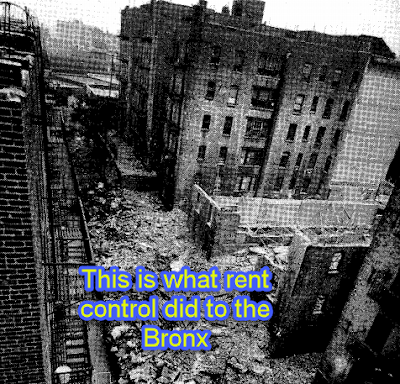
Rent control has destroyed entire sections of sound housing in New York’s South Bronx. It has led to decay and abandonment throughout the entire five boroughs of the city. Although hard statistics on abandonments are not available, William Tucker reports estimates that about thirty thousand New York apartments were abandoned annually from 1972 to 1982, a loss of almost a third of a million units in this eleven-year period.

RW

Rent control: Does it work? - BBC News

I bet Londonstaners would like tax control even better.

Posted in Uncategorized | Tagged: , , , , | Leave a Comment »

EconomicPolicyJournal.com: Toronto Discovers Free Markets: The Toronto Apartment Boom Miracle?

Posted by M. C. on October 12, 2019

https://www.economicpolicyjournal.com/2019/10/toronto-discovers-free-markets-toronto.html#more

Well, how about that, Toronto’s apartment crunch is finally easing, reports Bloomberg.

The city is starting to see vacancies again.

The vacancy rate rose to 1.5% in the second quarter, the highest since 2015 and things are looking up.

Nine new buildings totaling 3,078 units began occupancy in the 12 months through June, a 25-year high for annual completions. And things are only going to get much better.

The number of units proposed by builders reached a record 44,093 units in the second quarter.

The secret ingredient that is causing the Toronto apartment boom miracle? Free markets.

“The growth in purpose-built rental applications follows the provincial government’s recent removal of rent control for new buildings,” according to the research firm Urbanation.

Someone should forward this news to California Governor Gavin Newsom (See: California Governor Signs Law to Prevent Easing of Housing Crisis).

RW

Be seeing you

Housing and Gentrification | Chicago Socialists

Chicago progressives…err…Socialists

Posted in Uncategorized | Tagged: , , | Leave a Comment »

Rent Control: A History of Failure | Mises Wire

Posted by M. C. on September 22, 2019

“In many cases, rent control appears to be the most efficient technique presently known to destroy a city — except for bombing,” wrote Swedish economist Assar Lindbeck, a Social Democrat…

https://mises.org/wire/rent-control-history-failure

Governments can and do try to fix prices, but history tells us it never works.

From the price-control dikats of the Roman Empire’s Diocletian, to the wage and price controls of President Richard Nixon, governments have tried and failed.

The historian Edward Gibbon said the Roman Empire imploded owing to economic disasters and less to barbarians at the gate. More recently, President Nixon imposed wage and price controls before the 1972 elections. He was re-elected when they seemed to be working. However, owing to the Watergate scandal, he wasn’t around when his price control scheme failed and dragged down millions of Americans in the disastrous decade-long horror show called stagflation.

New York’s Economic Madness

Yet governments continue to try various kinds of price controls, even though most people with even the barest acquaintance with economic history or basic economics understand they’re the equivalent of economic crack. However, most New York pols, for instance, are economic illiterates.

They support continued rent controls because they are politically popular, at least in the short run. In the case of rent controls, the New York political classes recently extended them. They believe, almost uniformly, that they provide better housing at decent prices. But history and many economists say otherwise.

I believe some pols are privately convinced that they are witchcraft but they are not going to say so because they might then no longer be on the public payroll.

The politics are why New York’s state and city lawmakers have consistently backed rent control laws. That’s even though most economists, both left and right, agree they lead to housing shortages; that they’re a good deal for the minority of people who get coverage while the rest of New Yorker pay excessive rents.

Why Don’t They Work?

Supply dries up. Builders spooked by controls won’t build new units. The minority of those who get cheap rents won’t leave their units no matter what. Turnover rates decline. Most New Yorkers paying free market rents pay through the nose.

If you have a rent-controlled apartment: stay forever. You have cheap rent. If not, be prepared to pay very high housing prices as the housing stock can’t keep pace with demand. The quality of life in the city declines as more and more people pay a high percentage of their income for housing.

“In many cases, rent control appears to be the most efficient technique presently known to destroy a city — except for bombing,” wrote Swedish economist Assar Lindbeck, a Social Democrat…

“New York City rent controls,” Samuelson wrote in his economics textbook, “do favor those lucky enough to find a cheap apartment; but they inhibit new private building of low-cost housing.”

Be seeing you

7 Examples of Monumental Government Hypocrisy and What We ...


Posted in Uncategorized | Tagged: , | Leave a Comment »