MCViewPoint

Opinion from a Libertarian ViewPoint

Posts Tagged ‘Rights’

Trapping Wild Pigs

Posted by M. C. on October 24, 2023

Replace the corn every day. Once they’ve become dependent on the free food, erect a section of fence down one side of the clearing. When they get used to the fence, they’ll begin to eat the corn again. Then you erect another side of the fence.

Continue until you have all four sides of the fence up, with a gate in the final side.

Then, when the pigs enter the pen to feed, you close the gate.

Only a few will have both the insight and temerity necessary to make a dash for the gate as it’s now closing.

by Jeff Thomas

Most of us would like to assume that we’re smarter than pigs, but are we? Let’s have a look.

Pigs are pretty intelligent mammals, and forest-dwelling wild pigs are known to be especially wily.

However, there’s a traditional method for trapping them.

First, find a small clearing in the forest and put some corn on the ground.

After you leave, the pigs will find it. They’ll also return the next day to see if there’s more.

Replace the corn every day. Once they’ve become dependent on the free food, erect a section of fence down one side of the clearing. When they get used to the fence, they’ll begin to eat the corn again. Then you erect another side of the fence.

Continue until you have all four sides of the fence up, with a gate in the final side.

Then, when the pigs enter the pen to feed, you close the gate.

At first, the pigs will run around, trying to escape. But if you toss in more corn, they’ll eventually calm down and go back to eating.

You can then smile at the herd of pigs you’ve caught and say to yourself that this is why humans are smarter than pigs.

But unfortunately, that’s not always so.

In fact, the description above is the essence of trapping humans into collectivism.

Collectivism begins when a government starts offering free stuff to the population. At first, it’s something simple like free education or food stamps for the poor.

But soon, political leaders talk increasingly of “entitlements” – a wonderful concept that by its very name suggests that this is something that’s owed to you, and if other politicians don’t support the idea, then they’re denying you your rights.

Once the idea of free stuff has become the norm and, more importantly, when the populace has come to depend upon it as a significant part of their “diet,” more free stuff is offered.

It matters little whether the new entitlements are welfare, healthcare, free college, or a guaranteed basic wage. What’s important is that the herd come to rely on the entitlements.

Then, it’s time to erect the fence.

Naturally, in order to expand the volume of free stuff, greater taxation will be required. And of course, some rights will have to be sacrificed.

And just like the pigs, all that’s really necessary to get humans to comply is to make the increase in fencing gradual. People focus more on the corn than the fence.

Once they’re substantially dependent, it’s time to shut the gate.

What this looks like in collectivism is that new restrictions come into play that restrict freedoms.

You may be told that you cannot expatriate without paying a large penalty. You may be told that your bank deposit may be confiscated in an emergency situation. You may even be told that the government has the right to deny you the freedom to congregate, or even to go to work, for whatever trumped-up reason.

And of course, that’s the point at which the pigs run around, hoping to escape the new restrictions. But more entitlements are offered, and in the end, the entitlements are accepted as being more valuable than the freedom of self-determination.

Even at this point, most people will remain compliant. But there’s a final stage: The corn ration is “temporarily” cut due to fiscal problems. Then it’s cut again… and again.

See the rest here

Be seeing you

Posted in Uncategorized | Tagged: , , , | Leave a Comment »

“It’s not an endlessly expanding list of rights — the ‘right’ to health care, the ‘right’ to food and housing. That’s not freedom, that’s dependency. Those aren’t rights, those are the rations of slavery — hay and a barn for human cattle.”

Posted by M. C. on August 18, 2023

P.J. O’Rourke

Posted in Uncategorized | Tagged: , , , | Leave a Comment »

Watch “There Are No Rights Without Responsibility” on YouTube

Posted by M. C. on August 8, 2022

https://youtube.com/shorts/hmVqQzFbr60?feature=share

Be seeing you

Posted in Uncategorized | Tagged: , | Leave a Comment »

Leftists Have It Wrong on Rights

Posted by M. C. on February 7, 2022

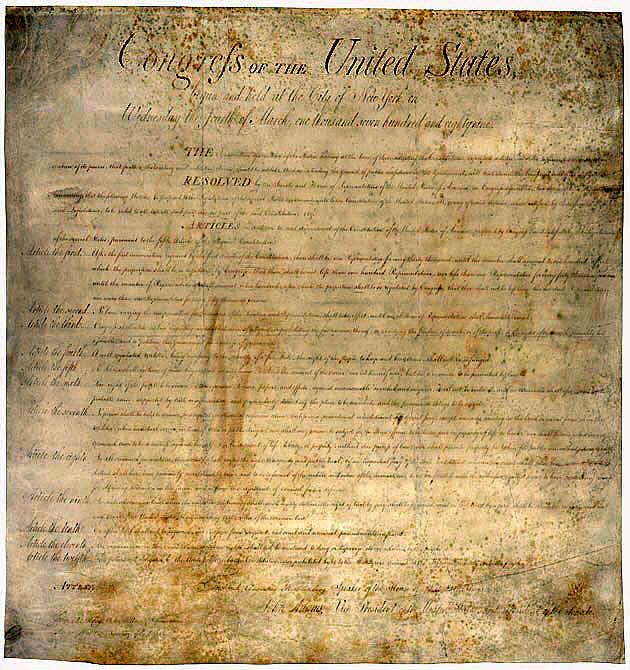
Not even the crafters of the Bill of Rights believed that. A careful reading of the First Amendment reveals that it doesn’t purport to give any rights to anyone. Instead, the wording states that Congress (and implicitly the rest of the federal government) is prohibited from infringing on people’s right of free speech. 

Thus when the government enacts a law or adopts a measure that infringes on freedom of speech, leftists are relegated to saying, “We understand that you have given us this important privilege but please be nice and don’t infringe on it.” Libertarians, on the other hand, say, “You have no legitimate authority to do that and so stop it immediately or else we will alter you or abolish you!”

by Jacob G. Hornberger

One of the central defects among leftists (that is, “liberals,” progressives, socialists, or interventionists) is their wrong-headed view of the nature of people’s rights. Their belief on this issue is one of the distinguishing characteristics between leftists and libertarians.

Leftists believe that people’s rights come from the government or from the Constitution. As such, they view rights not so much as rights but rather more as government-granted privileges.

Libertarians, on the other hand, believe that people’s rights are endowed in them by nature and God and, therefore, that people’s rights preexist government and the Constitution. We hold that the main purpose of government is to serve as our servant whose job is to protect the exercise of our natural, God-given rights. 

A good example of this leftist mindset was recently expressed in a fundraising letter I received from a leftist group called the Daily Kos. The letter stated that freedom of speech is “one of those rights granted to us in Bill of Rights.” It went on to refer to “our First Amendment rights.”

Not even the crafters of the Bill of Rights believed that. A careful reading of the First Amendment reveals that it doesn’t purport to give any rights to anyone. Instead, the wording states that Congress (and implicitly the rest of the federal government) is prohibited from infringing on people’s right of free speech. 

In other words, unlike American leftists today, our American ancestors didn’t believe that people’s rights come from the Constitution, the Bill of Rights, or from the government. They believed in what the Declaration of Independence stated — that man’s rights come from nature and God and that it is the responsibility of government to protect, not destroy, the exercise of such rights.

We are not just talking about a semantical difference here. The difference between how leftists and libertarians view the nature of rights has profound consequences. 

Given that leftists believe that their rights come from the government, they necessarily put themselves in a position of pleading, or perhaps even begging, that government go easy on them — that is, that government officials give them more latitude in exercising their “rights.” 

Thus, leftists view freedom as living on a leash — they just want the government to let them have a longer leash. What happens when the government begins reining in the leash? Leftists have no principled argument to make against what the government is doing. Since people’s rights come from government, leftists believe, then government can legitimately rein in the leash whenever it wants. 

Not so with libertarians. Unlike leftists, we are not relegated to pleading with or begging the government to treat us nicely. That’s because for us our rights don’t come from government. They preexist government. Government officials are nothing more than our servants whose job is to protect our rights. If they fail or refuse to do so — or if they use their power to destroy or infringe our rights — we have the right to alter or even abolish government and restore its rightful responsibility — the responsibility to behave as our servants whose job is to protect the exercise of our preexisting natural, God-given rights.

Thus when the government enacts a law or adopts a measure that infringes on freedom of speech, leftists are relegated to saying, “We understand that you have given us this important privilege but please be nice and don’t infringe on it.” Libertarians, on the other hand, say, “You have no legitimate authority to do that and so stop it immediately or else we will alter you or abolish you!”

The leftist view of the nature of rights is one reason why you can never count on leftists to protect our rights and liberties. Anyone who wants a genuine defense of our rights and liberties needs to join up with us libertarians. 

EMAIL

Be seeing you

Posted in Uncategorized | Tagged: , , , , , , , | Leave a Comment »

Scientists Rename Climate Change ‘COVID’ So Americans Will Immediately Give Up All Their Rights To Fight It

Posted by M. C. on August 14, 2021

https://babylonbee.com/news/scientists-rename-climate-change-covid-so-americans-will-immediately-give-up-all-their-rights-to-fight-it

U.S.—In a clever ploy to fight global warming, scientists have renamed “climate change” to “COVID,” so that Americans will immediately give up all their rights in order to fight the unprecedented phenomenon where weather trends change over time.

“Listen up, guys—we’re not calling it ‘climate change’ anymore,” said climate researcher Dr. Brittany Boyd. “We’re going with ‘COVID,’ which stands for ‘climate oscillation & variation into destruction’—this will ensure people will listen to us and quickly surrender all their liberties to fight climate cha—sorry, I mean, COVID.”

According to Dr. Boyd, studies have shown that if you refer to the coronavirus instead of climate change, Americans who otherwise wouldn’t care about climate science will stumble over themselves to be locked in their homes and give up all rights to their state and federal governments to help out.

“COVID is going to destroy us in less than 12 years,” said Al Gore to a packed house. “We must stop this by purchasing as many of my books as possible, so I can fly to more places to spread the word about COVID.”

All books previously referring to climate change have been destroyed, just as the ones referring to “global warming” were destroyed before them. “There will only be an endless present in which we are always right,” said Boyd.

Bee seeing you

Posted in Uncategorized | Tagged: , , , | Leave a Comment »

No Victory Lap For Governors Who Locked Down America – AIER

Posted by M. C. on July 15, 2021

The lockdowns that governors imposed also pointlessly ravaged many Americans’ mental health. The Centers for Disease Control last month reported a 51% increase in emergency room visits for suspected suicide attempts by teenage girls in early 2021. A Kaiser Family Foundation survey found a 300% increase in the percentage of adults reporting symptoms of anxiety disorder and/or depressive disorder (41% of adults in January 2021). The CDC also reported a record number of drug overdose deaths last year, due in part to the lockdowns and other government-imposed disruptions. 

https://www.aier.org/article/no-victory-lap-for-governors-who-locked-down-america/

James Bovard

James Bovard

There are no fact-checkers for victory laps. Last week, New York Gov. Andrew Cuomo summarized his experience with the Covid-19 crisis: “Speaking for myself, it was a tremendous personal benefit.” Cuomo made that declaration in a speech concluding his one-year chairmanship of the National Governors Association. Because Cuomo’s spiel sought to rewrite history to exonerate politicians who ravaged Americans’ rights and liberties, it requires a rebuttal. 

Cuomo declared that “we maximized the moment as governors. Governors have a new credibility. Governors have a new status.” Cuomo epitomized the rush to “absolute power” that occurred in governor’s mansions across the nation. After he fueled pandemic fears, the New York Times proclaimed, “Andrew Cuomo Is the Control Freak We Need Right Now.” A New Yorker profile, titled “Andrew Cuomo, King of New York,” explained that Cuomo and his aides saw the battle over Covid policy as “between people who believe government can be a force for good and those who think otherwise.” Cuomo denounced anyone who disobeyed his edicts, including condemning sheriffs as “dictators” for refusing to enforce his mask mandate inside people’s homes. 

Cuomo justified placing almost 20 million people under house arrest: “If everything we do saves just one life, I’ll be happy.” Though his repressive policies failed to prevent New York from having among the nation’s highest Covid death rates, he became a superhero thanks largely to media scoring that ignored almost all of the harms he inflicted. Cuomo won an Emmy Award for his “masterful use of television” during the pandemic. Media valorization helped make Cuomo’s self-tribute book,American Crisis: Leadership Lessons from the COVID-19 Pandemic, a bestseller. 

Cuomo had plenty of power-mad accomplices in the governors’ association.  Oregon Governor Kate Brown banned residents from leaving their homes except for essential work, buying food, and other narrow exemptions and also banned all recreational travel. Michigan Governor Gretchen Whitmer imposed some of the most severe restrictions, prohibiting anyone from leaving their home to visit family or friends. Los Angeles Mayor Eric Garcetti even banned people from walking or bicycling outside. The CDC eventually admitted that there was almost no risk of Covid contagion from outdoors activity not amidst a throng of people. But that did not stop politicians from claiming that “science and data” justified locking people in their homes. 

Some governors have acted as if their shutdown orders gave them unlimited sway to decree when normal life could resume. California Gov. Gavin Newsom decreed that Covid restrictions would be perpetuated in California counties based on voter turnout, alcohol availability, and other non-health factors. California assemblyman Kevin Kiley groused, “An entire county can be kept shut down because certain areas are judged to be lacking in ‘equity,’ even if the whole county has relatively few cases of Covid.” The end of Covid restrictions turned into hostage release negotiations with domineering rulers clinging to all their new prerogatives. 

Cuomo was proud that, when he visits a school, he is no longer asked “‘What does a governor do?” because “people know what governors do and how important governors are.” Governors can wreck kids’ futures by shutting down schools and placing children under indefinite home detention, costing millions of children almost an entire year of learning.

See then rest here

James Bovard is the author of ten books, including Public Policy Hooligan, Attention Deficit Democracy, The Bush Betrayal, and Lost Rights: The Destruction of American Liberty. He has written for the New York Times, Wall Street Journal, Playboy, Washington Post, New Republic, Reader’s Digest, and many other publications. He is a member of the USA Today Board of Contributors, a frequent contributor to The Hill, and a contributing editor for American Conservative

Be seeing you

Posted in Uncategorized | Tagged: , , , , , , | Leave a Comment »

The 4 Most Misused Words in the English Language

Posted by M. C. on July 2, 2021

https://thinkspot.com/discourse/6muW76/post/santino-imagery/the-4-most-misused-words-in-the-english-language/20tgX3M

Santino.imagery

We have a problem with definitions in the English language. We don’t know them.

Or perhaps it is more accurate to say we don’t bother to learn them. Instead, many people never get out of the osmosis phase of learning language, the way babies do. We hear a word in a certain context and our brains instinctively assume we understand the full context and register the word as a part of our lexicon. To be clear, I am not just talking about less educated people. We all do it, to some degree or another. I have a fairly large vocabulary, but I still remind myself to look up the definitions of words I don’t commonly use. Case in point, while I was typing that last sentence, I realized I’ve rarely used the word “osmosis”. Looked it up, and I was using it right. More often than not, I find that I am right about the definitions. Sometimes I’m not though.

For the most part, misusing language can be harmless. The point of language is to communicate ideas and intentions. If they are conveyed properly, mission accomplished.

The problem is with misusing important words. When this becomes a common occurrence, we end up redefining important ideas.

The four most misused and misunderstood words in the English language are Irony, Science, Logic and Rights.

For the purposes of this argument, I am not going to define Irony for you, except to say that Alanis Morrisette’s use of the word Irony in her song Ironic was the the only thing ironic about the song.

Science is probably the misused word that angers me the most. I think the reason is that people dogmatize science. Many people use science to criticize religion, but then treat science like it is a religion. How many times have you heard the words “follow the science” or “I believe in science”? This is a problem. Science is not something you can believe in. Science is not an object or a person. They’re confusing science with facts.

I cannot stress this enough: science is not facts. Science is a methodology which is used in the pursuit of facts. If the scientist’s methods are in error, the science is in error. This is why 100 scientists can arrive at 100 conclusions to a problem. There are very few scientific laws. These are not to be confused with theories. Despite testing, theories can be disproven at any time.

The problem is that people can use their mangled definition of science to affect government policies. Take Climate Science. Marxist Reprobate Alexandria Ocasio Cortez suggested a Green New Deal to combat climate change. She said we had 12 years to solve our problems before the point of no return, after which the apocalypse occurs. Her Green New Deal would collapse the economy and lead to untold deaths.

Scientists, political activists and politicians have been saying things exactly like the 12 years prediction for literally decades. Former Vice President Al Gore’s documentary, An Inconvenient Truth got him a Nobel Peace Prize. He won out over a woman who risked her life to save children from the Holocaust. Every single one of the climate change (it was called Global Warming at the time) predictions in An Inconvenient Truth turned out to be wrong. Every single one. It may have been science, but it was also a scam to get people to invest in Gore’s Carbon Credit company. This is another problem, involving science with money and politics. The science inevitably gets corrupted.

None of this is to say anthropogenic climate change isn’t real. It is. Its just that the science isn’t conclusive about the extent of the effect we have on the climate or how to combat it.

And that is just one example. Science should be used to advance and educate humanity. It is not a bully pulpit for you to shout down people you don’t like.

Science and logic get paired together quite often and quite perversely. Science and logic are not remotely similar.

Logic is the misused word that most amuses me. People use the word constantly and almost never know what it means. The word logic is usually used as a stand in for their opinion. Put simply, it is a form of math. I always say logic is the world’s most inaccurate system of measurement. It is a system by which we measure the veracity of an argument by comparing it to something else that we think we know is true. A statement can be incontrovertibly logical and still be wrong.

That’s just when people are using the word correctly.

The reason this gets misused so often is simple arrogance. They think that they are intelligent and logical by nature. But human beings are insanely illogical creatures. We make horrificly bad decisions all the time. And as far as intelligence… most human beings are, for lack of a better word, Dum Dums. Its just that most people are too dumb to know it. So they think that if they are logical by nature, then whatever opinions they have must be logical.

Now, I would like for you to go back and reread the last 2 statements which I have italicized. Specifically note wherein it is said “something that we think we know is true”. We think we know that we are logical. The last italicized statement is a logical argument. If I think logically, then whatever I say must be logical. But if the thing that I believe to be true is false, then the statement is false. This is how something can be completely logical and be totally wrong.

And then there is the concept of Rights.

This mangled word might be the most damaging to our society. If you believe social media, damn near everything is a right, or will be soon.

The Founders made it pretty clear. Life, liberty and the pursuit of happiness. You have the right to live free and do what you want as long as it doesn’t infringe on someone else’s rights. Here’s what you don’t have. You do not have any rights that constitute a good or service. You have a right to live, but you do not have a right to healthcare or a home. You have a right to bear arms if you can make or procure them, but you do not have a right to arms. There is a reason for this. If rights were material instead of abstract, the government would be forced to provide it.

Our natural-born rights are universal. We all have them. And of course, that hasn’t always been the case, but it absolutely is now. The past is irrelevant in that regard. There is no such thing as Repoductive Rights or Trans Rights. Women and transgender people have the exact same rights as anyone else. There are no additional rights that you are missing. You do not have a right to a surgery. Taking the most Libertarian perspective, what you do to your body is your own decision. As long as you can do it yourself, there isn’t really an issue there. Its when there is externality that your rights no longer apply. There was a case a while back wherein a Trans-woman was suing a biological female because she wouldn’t wax the trans-woman’s genitals. She was being sued for discrimination. This is utter nonsense. You literally do not have the right to force someone to clean your genitals. The fact that our society has devolved to the point where you have to even say that to someone is insane. There is also a rather famous case wherein a gay activist went to a Christian bakery and demanded a wedding cake for a homosexual marriage. The baker offered to sell them any cake they want, but refused to make one specifically for the marriage. The baker’s reasons were religious and are protected by the First Amendment. The gay activist had specifically designed the scenario hoping to evoke that response so he could take the baker to court, argue discrimination and make a spectacle of the whole thing. No matter what anyone tells you… no matter how just you may think your cause is, you do not have a right to force labor out of another human being.

As for Repoductive Rights, there is no sense getting into the weeds on this. I’m not qualified to define life and the odds are whoever is reading this isn’t either. So I’ll be quick with it. There is no such thing as Reproductive Rights. You may say “my body, my choice” and you can even make a compelling argument for it. It still isn’t a right. I have the ability to build a house. A local municipality can stop me and say I’m not allowed to do that because I don’t know how electrical wiring works and I could kill people. They can do that because I don’t have the right to build a house. Not everything is a right.

Definitions are important. Words are the tools by which we connect to other human beings. When we allow words to be destroyed by personal interest, we make it harder to understand our fellow human beings.

One last thought. If this essay got through to you, then you should have looked up a couple of words when you were reading this. If not… well, hell. We all do it. Let’s try to do better.

Be seeing you

Posted in Uncategorized | Tagged: , , | Leave a Comment »

bionic mosquito: What of Rights?

Posted by M. C. on September 11, 2020

To have properly ordered rights, there must be a shared understanding of what is good. It still remains, as Murray Rothbard offered, that the foundation of natural law offers the only means by which such questions can be answered, therefore it is only through a foundation of natural law that we can defend individual liberty.

http://bionicmosquito.blogspot.com/2020/09/what-of-rights.html

What of Rights?

When Rights Go Wrong, Fr. Dominic Legge, O.P. (audio)

Regarding the seeming failure of liberalism, Fr. Legge begins with a reference to Patrick Deneen’s book, Why Liberalism Failed: a major cause is the Enlightenment’s focus on autonomy and the rights of the individual. “Is the Enlightenment idea of liberty the core theoretical problem for liberalism today?”

Regular readers here have walked with me while I have developed my views. Fundamentally, an underlying cultural foundation (and, in my opinion, a specific cultural foundation) is necessary in order for liberty as promised in the Enlightenment to hold. Yet the Enlightenment, while offering that promise of liberty, at the same time offered that the cultural foundation was not fundamental.

Fr. Legge offers his perspective, well-preceding the Enlightenment: we must grasp the true nature between law, justice, and individual rights and the common good. He begins with Thomas Aquinas and the reality that man is born into a social environment. We have the possibility of conflicts horizontally (between individuals), and vertically (between an individual and the common good). I know the phrase “common good” is troubling for many libertarians; just sit tight.

Beginning with Aquinas, he offers that justice is according to God’s plan; God’s will is secondary to this – He acts according to the order He conceived. Therefore, law is not an expression of God’s will, but of God’s reasoned plan. Hence, law is an expression of reason – even for God.

I know there is this question: can God act contrary to this reason? For Aquinas the answer is no, and anyway, why would He – or, more specifically, why would He have to do so? God was quite capable of creating an order that would not require Him to act in a manner that was contradictory or arbitrary when compared to this order.

Aquinas’s definition of law is offered:

An ordination of reason for the common good, made by one with authority and promulgated.

Proper human justice takes this into account, along with the right ordering in human acts – both horizontally and vertically. For this, there are three key elements: first, an ordering; second, according to reason, third, to the good. The key issue when it comes to the downfall of the liberal order since the is this question of “good.” What is the “good”? This will come later.

With this, Fr. Legge is ready to take up the question of rights: does Aquinas have a theory of individual rights? It is often thought, incorrectly, that he does not. But it is through Thomas where an issue often raised against the Enlightenment – the explosion of individual so-called rights – can be addressed.

Aquinas does speak of objective rights, ius, that an individual can assert. The Latin word can translate into rights, the just thing, fair, or what is right. The ius is the object, or measure, of justice. Have I rendered what is due to you? Conversely, I am due something from you – this ius. And here, we can find a conception of a right – a right that can be enforced against others.

Aquinas does not conceive of these rights as an abstraction from the teleological order. I take this to mean (and it is consistent with my earlier work on this), that just because natural law dictates an act, it does not mean that another person can require me, by law, to perform that act.

So, if these rights are not an abstraction from the teleological order, then where are these from? Rights are a function of justice, directed toward the common good. And it is here where things went wrong – accelerated in the Enlightenment, but not born there.

To examine this, he starts with two other Catholics: one a Franciscan and one a Jesuit, who offer very different accounts of individual rights – “because they lost sight of the truth…” (after which the room erupts in laughter at this inside-Catholic-baseball humor from this Dominican) “…that justice, law, and ius all depend on, or are facts of, a wise and reasoned order of individuals to the good.”

He points to William of Occam, the fourteenth century Franciscan nominalist, as the primary culprit on this score. Occam rooted law, not in God’s reason or intellect, but in God’s will. Law ceased to be something that ordered us to the good, but became nothing more than God’s command.


He then points to Francisco Suárez, a seventeenth century Jesuit. While an opponent of Occam and often praising Aquinas, he would change definitions to the extent that the concepts presented by Aquinas were lost. I will admit, this portion was a bit way too far inside-Catholic-baseball for me – the nuance of agreement vs. disagreement with Aquinas was not drawn out in a manner that I could well comprehend.

So how does this lead to the crisis of liberalism today? The shift in the law and common good, beginning in Occam and completed in Suarez, left us a theory of law fundamentally different than Aquinas’s in two ways: first, a loss of the recognition that law is an ordination of reason to the common good, instead becoming an imposition of an obligation by the will of a superior; second, a loss of the sense that rights are a feature of the over-arching teleological order to the good in which the rational creature is placed, instead dependent on the moral power of the creature without reference to that order.

In other words: law has become a function of will – and this, with the death of God, became the will of the strong man; second, the larger context in which I live can in no way be allowed to infringe on my individual rights. For example, looting is just me expressing my rights. (Four months ago, I would have written that walking into any restroom I like is just me expressing my rights. Oh, what happened to those good old days….)

The Enlightenment magnified this, but this change wasn’t born in the Enlightenment. Instead of an objective good, we now have the good as defined by the strongest earthly superior. We now claim rights without a firm foundation of what is good, allowing for a never-ending proliferation of rights-claims.

Even God is not free to make such arbitrary choices. He created the ordered world, subject to reason – His reason, therefore why would He ever contradict this? This is an ordering to the good – an objective, not arbitrary good; it is a good subject to reason, not to the possibility of an ever-changing will.

So much for the past. Now what? What should be done? There is no going back to an idealized past. Yet, we must understand what we need to recover. In my own words: we don’t go back to the past; we must return to the center. There is a center, relative to which we are sometimes closer and sometimes farther. It isn’t going back to the past, but returning to the center.

What is due to another, the ius, depends on the over-arching teleological order; this order regards persons, living in communities. There is no autonomous individual: we come into the world as a child of a mother and father, in a community, with relationships with many others along many spectrums. This is the natural condition of the individual.

Hence, rights are not arbitrarily chosen. Rights affirm what is required if persons are to be properly ordered to each other. Which brings us back to the issue of the common good. Does the common good infringe on the rights of the individual? Not in a Thomistic understanding.

The common good is the good which can be shared by many without diminishment to any individual. A simple example offered by Fr. Legge is the joy that many can take at the victory of a sports team. A broader example I offer is that of a well-functioning market. It is difficult to deny that such markets are a common good, and certain rights are required to protect and defend this common good – for example, rights in person and property. Well-functioning markets clearly do not infringe on the rights of any individual; in fact, such markets are a good for the individual. The idea of ius, what is right, will defend this common good.

Fr. Legge offers other common goods: justice, truth, and peace. Here again, the achievement of these does not diminish any individual’s liberty. These enhance individual liberty. Paraphrasing Aristotle: the city exists not merely that men might live, but that they might live well.

All of these rights, born from a teleological understanding of the good, are ignored or even crushed today. The common good rights of person, property, justice, truth and peace are all attacked daily, both by government and by many that the government enables.

Further, law that defends the just right of the citizen is quite different than pork-barrel spending. There is no common good in this, as such actions cannot be shared without diminishment toward some at the favor of others. One can think of many of the so-called rights claimed by those majoring in grievance studies in university in the same way: these claims are not for the common good, as they cannot be shared without diminishment to some individuals.

Conclusion

At its foundation, the disagreement is about what is good. It is this disagreement that results in varying rights claims, and much of this discussion centers on rights claims not for the common good but at the cost of the common good.

I know that the idea of natural law causes grief for many, ranging from those who find the idea of an objective good abhorrent, to those who claim to find no basis for it in the Bible. To the former, I suggest that there is no other path to liberty; to the latter, I offer this.

To have properly ordered rights, there must be a shared understanding of what is good. It still remains, as Murray Rothbard offered, that the foundation of natural law offers the only means by which such questions can be answered, therefore it is only through a foundation of natural law that we can defend individual liberty.

Posted by bionic mosquito

Be seeing you

Posted in Uncategorized | Tagged: , , , | Leave a Comment »

Arrest the Governor – LewRockwell

Posted by M. C. on May 5, 2020

https://www.lewrockwell.com/2020/05/david-hathaway/arrest-the-governor/

By

Let’s go ahead and live the fantasy. Imagine a county sheriff holding a press conference and swearing out a complaint. Imagine him waving it in front of the cameras. Imagine him saying that the next stop was the governor’s mansion to put handcuffs on the big cheese himself. He would never get past the governor’s state police security detail, but it would definitely make the news.  Here is the summary and wording of the relevant statute taken from DOJ’s own website:

DEPRIVATION OF RIGHTS UNDER COLOR OF LAW

SUMMARY

Section 242 of Title 18 makes it a crime for a person acting under color of any law to willfully deprive a person of a right or privilege protected by the Constitution or laws of the United States.

For the purpose of Section 242, acts under “color of law” include acts not only done by federal, state, or local officials within the their lawful authority, but also acts done beyond the bounds of that official’s lawful authority, if the acts are done while the official is purporting to or pretending to act in the performance of his/her official duties. Persons acting under color of law within the meaning of this statute include police officers, prisons guards and other law enforcement officials, as well as judges, care providers in public health facilities, and others who are acting as public officials. It is not necessary that the crime be motivated by animus toward the race, color, religion, sex, handicap, familial status or national origin of the victim. The offense is punishable by a range of imprisonment up to a life term, or the death penalty, depending upon the circumstances of the crime, and the resulting injury, if any.

TITLE 18, U.S.C., SECTION 242

Whoever, under color of any law, statute, ordinance, regulation, or custom, willfully subjects any person in any State, Territory, Commonwealth, Possession, or District to the deprivation of any rights, privileges, or immunities secured or protected by the Constitution or laws of the United States, … shall be fined under this title or imprisoned not more than one year, or both; and if bodily injury results from the acts committed in violation of this section or if such acts include the use, attempted use, or threatened use of a dangerous weapon, explosives, or fire, shall be fined under this title or imprisoned not more than ten years, or both; and if death results from the acts committed in violation of this section or if such acts include kidnapping or an attempt to kidnap, aggravated sexual abuse, or an attempt to commit aggravated sexual abuse, or an attempt to kill, shall be fined under this title, or imprisoned for any term of years or for life, or both, or may be sentenced to death.

End quote. The bold emphasis on the heading and on the lower section and the italics were not added by me for enhanced effect. It is a direct block-and-paste from the DOJ website. Wow, it seems like DOJ really means business about this freedom thing. Somebody should dust this one off and test it out.

Be seeing you


Posted in Uncategorized | Tagged: , , , , | Leave a Comment »

What Rights You Will and Won’t You Have During Martial Law | The Survivalist Blog

Posted by M. C. on March 22, 2020

A declaration of martial law means that military forces are now in charge of keeping order and general law enforcement where typical police forces and local governments would otherwise.

What this means for you, dear prepper, is that uniformed soldiers are going to be in charge of your block, your town and your county, even potentially your entire state.

Aside from the suspension of habeas corpus, there are other civil rights as codified by the Bill of Rights that will be put out to pasture for the duration of the crisis while martial law is in effect:

  • 1st Amendment
    • Freedom of Speech
    • Freedom of Assembly
    • Freedom of the Press
  • 2nd Amendment
    • The Right to Keep and Bear Arms
  • 3rd Amendment
    • Freedom from Housing Soldiers
  • 4th Amendment
    • Protection from Unreasonable Searches
    • Protection from Unreasonable Seizure
  • 5th Amendment
    • Protection of Life
    • Protection of Liberty
    • Protection of Private Property

It is not hard to imagine how and why our civil rights would be squashed under martial law

Fellow Pennsylvanians, you just moved to Maryland and California.

https://www.thesurvivalistblog.net/martial-law-rights/
Tom Marlowe

Martial law. The very notion of it makes some preppers tremble, and gaze fearfully to the sky. Those preppers are right to be worried, as any time martial law has been declared, at least in the United States, you can be certain that things have taken a dire turn for the worse.

Martial law means things have gotten bad, perhaps society-shaking bad, and you can be sure that your day-to-day life is not going to be the same for the duration.

Martial law is a frightening thing to consider because it conjures ideas that people can be tossed in jail or detained indefinitely without due process, subject to search and seizure completely on the whims of the government and forced to endure random checkpoints and more infractions of our civil rights, all of this carried out by uniformed soldiers, those who nominally should be protecting us.

The Million Dollar Question is this: would your constitutional rights be abused under a declaration of martial law? In short, yes, almost certainly.

The only question after that is how bad it would get. In today’s article, I’ll tell you what you can expect when martial law is declared, what rights you can expect to lose, and if you are lucky, what rights you can expect to keep.

What is Martial Law?

A declaration of martial law means that military forces are now in charge of keeping order and general law enforcement where typical police forces and local governments would otherwise.

Martial law is enacted at the federal level by the President of the United States, and at the state level, within the confines of a given state, by any state’s governor.

What this means for you, dear prepper, is that uniformed soldiers are going to be in charge of your block, your town and your county, even potentially your entire state.

It is all but certain that a declaration of martial law will also see your civil rights curtailed to a greater or lesser degree. More on that in just a minute.

Note that typical domestic deployment of military forces including the National Guard, even if done en masse, is not a declaration of martial law.

Domestic deployments of military forces are entirely too common for this to be the case, and is often a first-step solution for disaster relief and other initiatives where a local or state government needs a lot of extra manpower.

Just because the military is out in force in a given area does not mean that martial law has been declared.

Compared to other places around the world, even civilized Western nations, martial law is rarely enacted in the United States.

That being said, you should expect to see it enacted more regularly in the not-too-distant future, and probably in increasing frequency.

It should go without saying that any organized, large-scale anti-government activity or serious civil unrest on a local or regional level will see the government declare martial law.

What Does Martial Law Mean for You?

Martial law simply stated means that civilians in the affected area will be living, for the duration of the martial law declaration, under military enforcement, interpretation, and judgment of the law.

If a civilian commits a crime or some other offense in an area currently under martial law, the military will be responsible for handling everything associated with that person’s detainment, trial (if applicable) and sentencing.

Of the greatest concern to the average citizen will be the suspension of civil rights that we typically take for granted during times when martial law is not in effect, most crucially that of habeas corpus.

Habeas corpus is a citizen’s right to be brought before a judge, in court, if they feel they have been unlawfully detained.

Without habeas corpus, you can be thrown in the tank, and held indefinitely until the powers-that-be deem it necessary to get around to your case or let you go, whichever comes first.

Aside from the suspension of habeas corpus, there are other civil rights as codified by the Bill of Rights that will be put out to pasture for the duration of the crisis while martial law is in effect:

  • 1st Amendment
    • Freedom of Speech
    • Freedom of Assembly
    • Freedom of the Press
  • 2nd Amendment
    • The Right to Keep and Bear Arms
  • 3rd Amendment
    • Freedom from Housing Soldiers
  • 4th Amendment
    • Protection from Unreasonable Searches
    • Protection from Unreasonable Seizure
  • 5th Amendment
    • Protection of Life
    • Protection of Liberty
    • Protection of Private Property

It is not hard to imagine how and why our civil rights would be squashed under martial law, especially if the government has given way to tyranny.

Freedom of speech is likely the spark that set the government on this path in the first place. Systematic search and seizure of private property will likely become the norm, in the wake of a major disaster or not.

Stockpiled and accumulated resources will be captured for redistribution according to the government’s will.

Under the circumstances, your personal firearms and ammunition will also likely be seized in the name of public safety. If history has shown us anything, it is that armed citizenry is bad for tyrannical governments.

Private property, including bare land, will potentially be seized and repurposed for the organization, housing of soldiers and support of military operations in a given area.

Any resistance or complaint against this will likely get you slapped with an infraction or tossed in jail outright.

On top of all of this, you’ll be subjected to inspections and searches at any time of day or night, whether under the cover of looking for contraband or rooting out criminals and bad actors.

You’ll get a knock on the door and be fully expected to open up and comply. Curfews will become a reality, and your movement in, out of, and around the area affected by declaration of martial law will be watched, documented and analyzed.

All in all, there’s a pretty good chance that things will look dystopian indeed if martial law is declared.

The One Civil Right You May Yet Keep Under Martial Law

This is all grim news to be sure: of course none of us hope that our government to say nothing of our soldiers and sailors would ever become so corrupt as to subjugate unjustly the citizens of this country.

But if history has taught us only one more thing, it is that governments accumulate power and wield it unjustly given enough time.

That being said, there is a hope that you would preserve at least one civil right under a declaration of martial law.

The Supreme Court of the United States has indeed ruled with the citizenry on this one particular issue, and that issue is codified by Amendment 6 of the Bill of Rights. Amendment 6 of the Bill of Rights States:

“In all criminal prosecutions, the accused shall enjoy the right to a speedy and public trial by an impartial jury of the state and district wherein the crime shall have been committed, which district shall have been previously ascertained by law, and to be informed of the nature and cause of the accusation; to be confronted with the witnesses against him; to have compulsory process for obtaining Witnesses in his favor; and to have the assistance of counsel for his defense.”

Amendment 6 of the Bill of Rights

There exists an old and crucial precedent in defense of Amendment 6. It is a case known as Ex parte Milligan (71 US 1866).

The specifics are old, dry and boring, but vitally important to understanding this one and perhaps only check on government run amok in case martial law is declared.

The case revolves around the post-Civil War trial of four men accused of rebellion against the United States government. At this time, rebels, saboteurs and spies were being dealt with very harshly by military tribunal.

President Abraham Lincoln authorized the suspension of habeas corpus across the entirety of the United States prior to this and it was in effect for the trial of these four men when their trial began in October of 1864.

Long story short, all four men were found guilty and sentenced harshly. Only one of them did not receive the death penalty. In the aftermath of the trial one of the accused, Lambdon P. Milligan, had his legal team of lawyers petition the court for writ of habeas corpus.

As a reminder, habeas corpus is a citizen’s right to call for justification of their arrest and detainment. The judges who heard this motion did not come to agreement about the matter and kicked it up to the Supreme Court of the United States.

In the end, the Supreme Court ruled that military trials for citizens were unconstitutional so long as civilian courts were still operational. This verdict was handed down in April of 1866, and constitutional scholars have hung onto it like a dog on the back of a meat truck ever since.

The Takeaways

The case of Ex parte Milligan Is one of the strongest on record, being tried by the Supreme Court, that found even the president of the United States has limits on his legal powers, even during wartime, even for the suppression of what, at the time, was major dissent bordering on subversion.

But the key element that any prepper should keep in mind is noted in the section above: that ruling would only hold if civilian courts were still in operation.

If they aren’t, things have certainly gotten very bad, but you’ll also be completely out of luck. Your trial, assuming you get one if you’re detained under martial law, will be in the hands of the military.

It is exceedingly difficult to say what your treatment will be like. I believe that the men and women serving our militaries and our nation by extension are good, honorable and take their oaths very seriously.

On the other hand, none of us can say just how bad things would have really gotten if martial law has to be declared on this scale

Does that mean you’ll get a fair shake, or cursory kangaroo court before being summarily sentenced? None can say.

How Should a Prepper Deal with Martial Law?

I’m not going to get involved with the ethics of resisting a tyrannical government here in this article and instead will focus strictly on the practical concerns.

Your personal reaction to a declaration of martial law and its subsequent effects is going to largely revolve around the greater situation at large, i.e. what caused martial law to be implemented in the first place, and your own personal objectives, i.e. survive, escape, provide for family, etc.

There is a chance that your everyday life may not be too negatively impacted by martial law.

If enforcement is lax in your area, because you live in a place that is strategically unimportant or in a small or rural community, chances are you can avoid a lot of trouble if you go along, stay out of sight when you can and don’t cause any problems for the authorities.

It goes without saying that this may not be possible if you live in a densely populated region, or a place that is strategically important, such as a utility, industrial or commercial hotspot.

Have you considered what you would do if you’re being removed from your home, forced to evacuate or relocate? How about if your personal property is being seized and re-appropriated for the government’s own ends?

What about if there was a hard curfew in place, but you find yourself desperately needing to leave an area to get aid for your family or escape a dangerous situation?

All the above has happened under martial law enforced elsewhere; it can definitely happen here.

All you can do is start thinking through your possible responses to various scenarios now. Any of the above is a good enough reason to start getting away from cities and major population centers.

Anywhere you have a teeming mass of people the government is more likely to bring force to bear to keep order.

But even if you live out in the boondocks you may not be completely beyond the reach of the military and other government agents.

Posting online too much in the wrong circles about your anti-government sentiments, your huge gun collection and other socially sensitive topics are great ways to get yourself earmarked and moved to the top of the list for a friendly door-knock when martial law is declared.

It is too late to call it back once you’ve said it or posted it: now, as ever, keep your business your business if you want to stay off the government’s radar.

If you’re unlucky enough to be living in an area where martial law is declared you will need to act quickly if you want to get out from under it.

Right then and there would be the ideal time to bug out and head to your bug-out location or secondary rendezvous point.

Even if this is just a friend’s place outside of the immediately affected area, or a family member’s, go there and try to stay there for the duration. That will buy you a little more time to react.

But, if you are unable or unwilling to leave your only option is either to abide and get along with whoever is running the show as best you can, or go underground and hope you don’t get caught doing something naughty.

Martial law is unlikely to persist unless the very integrity of the nation is at stake.

As distasteful as it is, as much as you may hate it the situation can get a whole lot worse if you miss behave badly enough to get yourself detained by MP’s.

Don’t risk such an eventuality! If you can quietly tiptoe away to a place where the grass is greener, a place where you’ll have less breathing down your neck by military and other government agencies, do it.

If that is impossible, keep a low profile, keep your head down, smile and nod and persevere.

Conclusion

At least to the current date the declaration of martial law has been a rarity in the United States. But anytime martial law is declared you can count on your civil rights being sharply reduced for as long as the declaration lasts.

Unlike some other nations that declare martial law profligately, we do not have much experience with it as citizens in the United States and so have little experience to base our possible responses on.

Your best bet is to understand what a worst-case scenario under martial law will look like, and plan accordingly. With a little luck, and providence, it won’t be that bad.

martial law rights pinterest

Be seeing you

Media Justice - Conservative Daily News

Posted in Uncategorized | Tagged: , , | 1 Comment »