MCViewPoint

Opinion from a Libertarian ViewPoint

Posts Tagged ‘Section 702’

Congress’ ‘Gift’ to America This Christmas

Posted by M. C. on December 28, 2023

Ron Paul

So rather than debating whether we want a government more like East Germany than the one our Founders imagined, Section 702 was tossed into the military spending bill.

Considering that Speaker Johnson tossed into the “must-pass” bill yet another extension of Section702 of the FISA Act, it’s unsurprising that he wanted to rush the bill through without the possibility of amendment. Section 702 allows the government to intercept and retain without a warrant the communications of any American who is in contact with a non-US citizen.

https://mises.org/power-market/congress-gift-america-christmas

Just before leaving town for Christmas break, the US House gave Americans a last-minute holiday gift: a nearly trillion dollar military spending bill filled with lots of goodies for the special interests and the military-industrial complex. Unfortunately, the rest of America got nothing but coal in its stockings.

With Constitutionalists like Rep. Thomas Massie on the House Rules Committee, Speaker Johnson made the unusual move of bringing the National Defense Authorization Act (NDAA) under suspension of the rules, which bypasses the Rules Committee but requires two-thirds of the House to pass the bill.

Considering that Speaker Johnson tossed into the “must-pass” bill yet another extension of Section702 of the FISA Act, it’s unsurprising that he wanted to rush the bill through without the possibility of amendment. Section 702 allows the government to intercept and retain without a warrant the communications of any American who is in contact with a non-US citizen. It is clearly a violation of the Fourth Amendment which is supposed to protect Americans against unreasonable searches and seizures.

Section 702 was “legalized” under President George W. Bush during the “War on Terror” after it was revealed that Bush was using the National Security Agency to illegally spy on Americans. We were told at the time that government must be granted these authorities because we were under threat from terrorists. It would just be a temporary measure, we were promised, and then the authority would expire. That was fifteen years ago and here we are re-authorizing the government to continue to violate our liberties.

As with the rest of the violations of our civil liberties after 9/11, like the PATRIOT Act and the creation of the Department of Homeland Security and the TSA, the federal government soon turned its terrorism-fighting tools inward, targeting Americans rather than foreigners who we were told wanted to harm Americans. That’s why the FBI’s so-called domestic terrorism watchlist continues to expand to include Christians and those skeptical of big government.

See the rest here

Be seeing you

Posted in Uncategorized | Tagged: , , , , , , | Leave a Comment »

The Overlapping Infrastructure of Urban Surveillance, and How to Fix It – Activist Post

Posted by M. C. on June 26, 2021

How do we stop the United States government from tapping into the internet’s main arteries? Section 702 of the Foreign Intelligence Surveillance Act allows for the collection and use of digital communications of people abroad, but often scoops up communications of U.S. persons when they talk to friends or family in other countries. EFF continues to fight Section 702 in the court in hopes of securing communications that travel through these essential cables.

https://www.activistpost.com/2021/06/the-overlapping-infrastructure-of-urban-surveillance-and-how-to-fix-it.html

By Matthew Guariglia

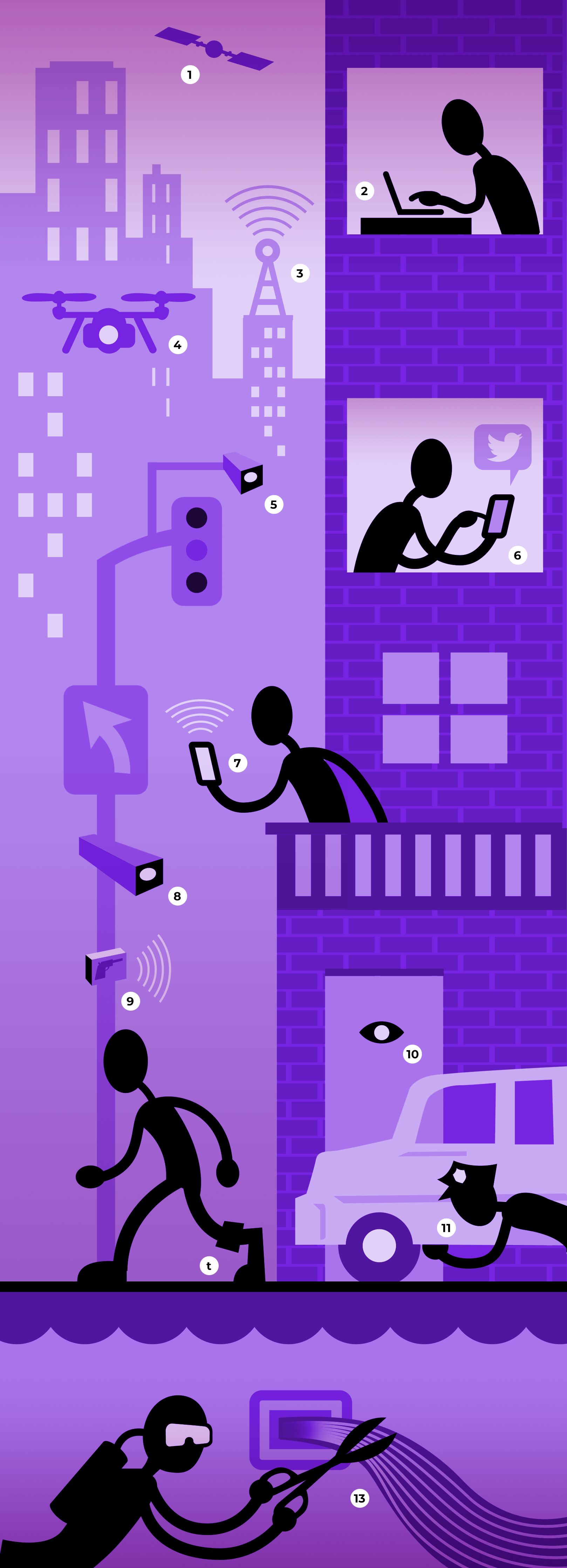
Between the increasing capabilities of local and state police, the creep of federal law enforcement into domestic policing, the use of aerial surveillance such as spy planes and drones, and mounting cooperation between private technology companies and the government, it can be hard to understand and visualize what all this overlapping surveillance can mean for your daily life. We often think of these problems as siloed issues. Local police deploy automated license plate readers or acoustic gunshot detection. Federal authorities monitor you when you travel internationally.

But if you could take a cross-section of the average city block, you would see the ways that the built environment of surveillance—its physical presence in, over, and under our cities—makes this an entwined problem that must be combated through entwined solutions.

Thus, we decided to create a graphic to show how—from overhead to underground—these technologies and legal authorities overlap, how they disproportionately impact the lives of marginalized communities, and the tools we have at our disposal to halt or mitigate their harms.

A cityscape showing 13 types of common surveillance

Going from Top to Bottom:

1. Satellite Surveillance:

Satellite photography has been a reality since the 1950s, and at any given moment there are over 5,000 satellites in orbit over the Earth—some of which have advanced photographic capabilities. While many are intended for scientific purposes, some satellites are used for reconnaissance by intelligence agencies and militaries. There are certainly some satellites that may identify a building or a car from its roof, but it’s unlikely that we could ever reach the point where pictures taken from a satellite would be clear enough or could even be the correct angle to run through face recognition technology or through an automated license plate reader.

Satellites can also enable surveillance by allowing governments to intercept or listen in on data transmitted internationally.

2. Internet Traffic Surveillance

Government surveillance of internet traffic can happen in many ways. Through programs like PRISM and XKEYSCORE, the U.S. National Security Agency (NSA) can monitor emails as they move across the internet, browser and search history, and even keystrokes as they happen in real time. Much of this information can come directly from the internet and telecommunications companies that consumers use, through agreements between these companies and government agencies (like the one the NSA shares with AT&T) or through warrants or orders granted by a judge, including those that preside over the Foriegn Intelligence Surveillance Court (FISC).

Internet surveillance isn’t just the domain of the NSA and international intelligence organizations; local law enforcement are just as likely to approach big companies in an attempt to get information about how some people use the internet. In one 2020 case, police sent a search warrant to Google to see who had searched the address of an arson victim to try to identify a suspect. Using the IP addresses Google furnished of users who conducted that search, police identified a suspect and arrested him for the arson.

See the rest here

Be seeing you

Posted in Uncategorized | Tagged: , , , , , | Leave a Comment »