MCViewPoint

Opinion from a Libertarian ViewPoint

Posts Tagged ‘Shrinkflation’

Shrinkflation and Skimpflation Are Eating Our Lunch | Mises Wire

Posted by M. C. on July 20, 2023

And while firms are reducing the quantity and quality of the food they sell, consumers are also choosing to purchase less food and even lower-quality food. The January 2023 report on consumer inflation sentiment shows that 69.4 percent of respondents “reduced quantity, quality or both in their grocery purchases due to price increases over the last 12 months.”

https://mises.org/wire/shrinkflation-and-skimpflation-are-eating-our-lunch

Jonathan Newman

Economist Jeremy Horpedahl dismissed the silly claim by anticapitalists that capitalism must engineer food scarcity for the sake of profits. He presented a graph of Bureau of Labor Statistics (BLS) data demonstrating a substantial decrease in household food expenditure as a percentage of income—from 44 percent in 1901 to a mere 9 percent in 2021. This is something to celebrate and certainly can be attributed to the abundance of market economies.

But when Jordan Peterson asked, “And what’s happened the last two years?” I went digging. First, I confirmed Horpedahl’s observation: the amount we spend on food as a proportion of our budget has fallen dramatically. Second, I saw what Peterson hinted at: a significant spike in food spending when covid and the associated mess of government interventions hit (figure 1).

Figure 1: Food and personal consumption expenditures, 1959–2023
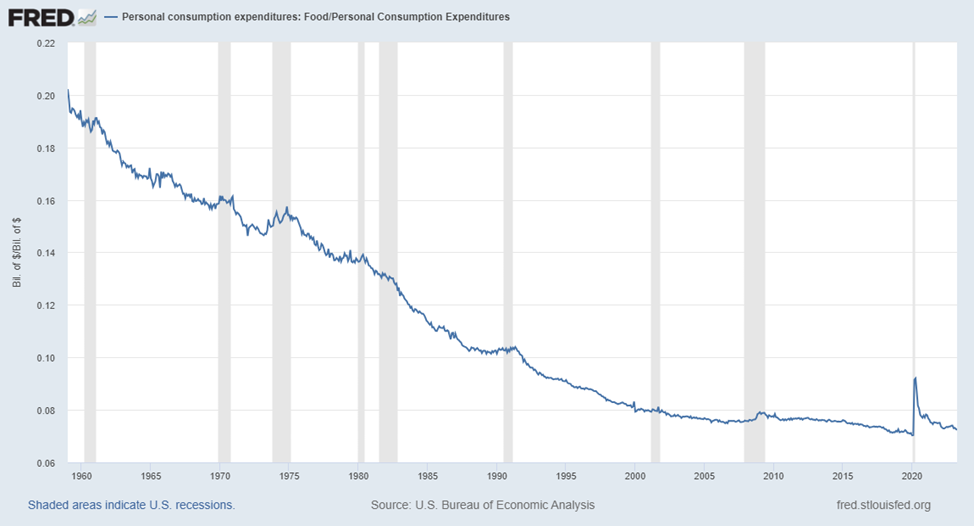
Source: US Bureau of Economic Analysis, FRED.

Interestingly, the spike looks like a blip. Someone oblivious to the events of the past few years might see this chart and say, “Yeah, something strange happened in 2020, but it looks like everything is back to normal.” I’m certain that this doesn’t align with anyone’s experience, however. Even today, no one would say that restaurant visits and grocery store trips cost the same as they did in 2019.

What changed in 2020? Why does this graph not feel right? Assuming the Bureau of Economic Analysis data isn’t totally off (and it is important to be skeptical of government data), why would a January 2023 report on consumer inflation sentiment conclude that “there is a disconnect between the inflation data reported by the government and what consumers say they now pay for necessities”?

The difference lies in the qualitative aspects of our experience as consumers. Spending proportions may have returned to their trend, but that isn’t the whole story. “Shrinkflation” and “skimpflation” have taken their toll on the quantity and quality of the food we enjoy—or maybe the food we tolerate is more apt.

Businesses know that charging higher prices is unpopular, especially when many consumers are convinced that greed is driving price inflation. So businesses resort to reducing the amount of food in the package, diluting the product but keeping the same amount, or otherwise cutting corners in ways that consumers may not immediately notice.

Thankfully, websites such as mouseprint.org document some of these cases:

See the rest here

Be seeing you

Posted in Uncategorized | Tagged: , , , | Leave a Comment »

Toilet Paper Rolls Are Getting Smaller. Blame the Fed. | Mises Wire

Posted by M. C. on July 30, 2021

“Over the years, Edgar Dworsky has documented the downsizing of everything from Doritos to baby shampoo to ranch dressing. ‘The downsizing tends to happen when manufacturers face some type of pricing pressure,’ he says. For example, if the price of gasoline or grain goes up,” Rosalsky explained.

What the NPR scribe misses is inflation’s breakdown of the division of labor. Average folk, not savvy Homo economicus types, have to pump their own gas, scan their own groceries, and, probably worst of all, manage their own retirement funds.

https://mises.org/wire/toilet-paper-rolls-are-getting-smaller-blame-fed

Doug French

A term has been coined for product sellers who shrink their packages, and thus, the amount of product in those packages, keeping the package price the same: shrinkflation. Anyone with a bit of good sense or economics training knows this is another form of price inflation, caused by what used to be the dictionary meaning of inflation; an increase in the supply of money. 

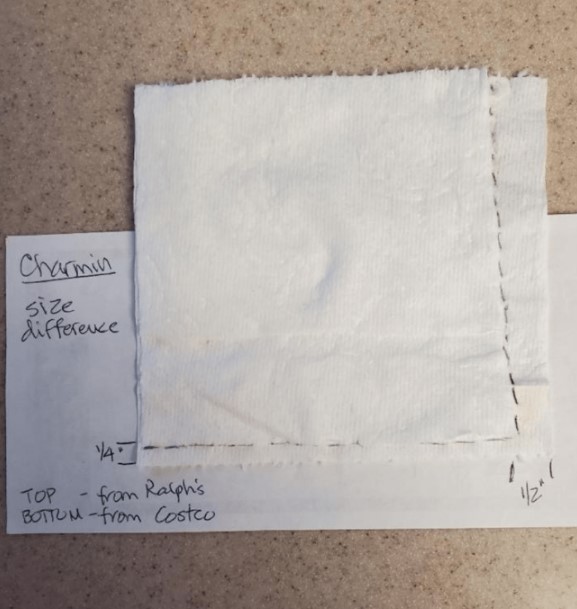
For example, while the average American behind continues to widen, toilet paper has narrowed. A friend’s mother busted out a ruler to confirm her theory. Last year John Hebbe of Fairfax, Virginia, provided photographic proof to the Washington Post: an old roll was 4.5 inches wide, a new roll, 3.75 inches. Of course the new rolls are fatter, for now, causing annoyance with home owners with toilet paper dispensers with the roller too close to the wall to accommodate the fatter rolls. 

Greg Rosalsky wrote for NPR.org, “The original Charmin roll of toilet paper, [Edgar Dworsky, former Massachusetts assistant attorney general,] says, had 650 sheets. Now you have to pay extra for “Mega Rolls” and “Super Mega Rolls”—and even those have many fewer sheets than the original. To add insult to injury, Charmin recently shrank the size of their toilet sheets. Talk about a crappy deal.” 

tp
Source: WBUR.

“Downsizing is really a sneaky price increase,” Dworsky told NPR. “Consumers tend to be price conscious. But they’re not net-weight conscious. They can tell instantly if they’re used to paying $2.99 for a carton of orange juice and that goes up to $3.19. But if the orange juice container goes from 64 ounces to 59 ounces, they’re probably not going to notice.”

Homo economicus is assumed to notice this trickery pokery in neoclassical economics theory. Oliver Kim wrote in The Crimson, “But here’s a confession: Homo economicus is at most a useful fiction—in economic jargon, a model. Human beings do not actually think like Scrooge McDuck, but, in approximation and in aggregate, we often behave like we do.”

“Over the years, Edgar Dworsky has documented the downsizing of everything from Doritos to baby shampoo to ranch dressing. ‘The downsizing tends to happen when manufacturers face some type of pricing pressure,’ he says. For example, if the price of gasoline or grain goes up,” Rosalsky explained.

What the NPR scribe misses is inflation’s breakdown of the division of labor. Average folk, not savvy Homo economicus types, have to pump their own gas, scan their own groceries, and, probably worst of all, manage their own retirement funds.

Since the government has deemed its paper tickets and computer digits to be money, Murray Rothbard wrote, “then the government, as dominant money-supplier, becomes free to create money costlessly and at will. As a result, this ‘inflation’ of the money supply destroys the value of the dollar or pound, drives up prices, cripples economic calculation, and hobbles and seriously damages the workings of the market economy.” That would include the division of labor. 

“As we’re seeing inflation picking up now, that’s why I think you’re going to see more items being downsized,” Dworksy told Rosalsky. “And maybe it’s going to be a double-whammy: We’re going to see some products going up in price at the same time that you’re actually getting less in the package.”

A Charmin spokeswoman, when confronted by reporters at WBUR about shrinking the size of their toilet sheet squares, pulled an explanation out of her you-know-what, suggesting it was the result of “innovations” allowing “consumers to, basically, wipe their butts more efficiently.” 

Rosalsky, writing from NPR La La Land believes, “consumers will start to notice and voice concern and the power of consumer demand will force companies to listen and right-size their products.” Right-size? What’s the right size? 

Don’t blame Charmin, as Ludwig von Mises explained. “[I]f the ruling party does not want to imperil its popularity by heavy taxation, it takes recourse to inflation.”

Consumers should complain to those working at the Eccles Building producing money, not to those in the private market producing toilet paper.  Author:

Doug French

Douglas French is former president of the Mises Institute, author of Early Speculative Bubbles & Increases in the Money Supply, and author of Walk Away: The Rise and Fall of the Home-Ownership Myth. He received his master’s degree in economics from UNLV, studying under both Professor Murray Rothbard and Professor Hans-Hermann Hoppe.

Be seeing you

Posted in Uncategorized | Tagged: , , | Leave a Comment »

Shrinkflation, Inflation’s Sneaky Cousin, Is on the Rise | Mises Wire

Posted by M. C. on July 29, 2021

What is causing this increase in shrinkflation? Well, since shrinkflation is in fact a form of inflation, the short answer is that the same factors have caused inflation. As you may already be aware, many are blaming shortages and disruptions in the supply chain for the recent increases in inflation, but that hardly explains the whole story.

https://mises.org/wire/shrinkflation-inflations-sneaky-cousin-rise

Inflation has been on the rise for the past year and in the last few months it has accelerated. In June 2021, inflation, measured by the Consumer Price Index (CPI), hit the highest level since 2008. By inflation, economists refer to the increase in the general level of prices, which means that prices on average are increasing. The Bureau of Labor and Statistics (BLS) has a basket of goods and services that it tracks and uses to create a measure of the CPI. While inflation is the topic of the day in the news media and everyday conversations, many have not heard about its sneaky cousin, shrinkflation.

The term shrinkflation, is credited to British economist Pippa Malmgren, and refers to the shrinking weight of the products while the price for the package remains the same. This is in effect another form of inflation, since the per unit price of goods increases when products shrink. However, shrinkflation is trickier, since most consumers do not notice it (see here for a few examples of shrinkflation). Shrinkflation is an ongoing process, but we are seeing more of it in the past year, and especially the first half of 2021, as businesses scramble to catch up with increasing costs of production. Shrinkflation is so widespread today that there is a dedicated Reddit page for it.

Many complain about businesses resorting to shrinkflation and regard it as a sneaky way to increase prices. Yet many of the critics do not realize that businesses have no choice but to increase prices. Anyone who is paying attention to prices in the first half of 2021 will know that it is not only the price of consumer goods that it is increasing but also the prices of producer goods. In other words, the inputs used in the production of the goods we consume, including labor, have been getting more expensive. Consequently, businesses in a fight to maintain their profit margins have resorted to increasing prices or shrinking the size or weight of their products.

Normally, the BLS accounts for the weight of the products it tracks, which would allow them to account for shrinkflation, but as the Washington Post reports, the BLS has not been able to do this very well during the pandemic. This means that the current inflation measure, as measured by CPI, is most likely underreporting the extent of current inflation.

What is causing this increase in shrinkflation? Well, since shrinkflation is in fact a form of inflation, the short answer is that the same factors have caused inflation. As you may already be aware, many are blaming shortages and disruptions in the supply chain for the recent increases in inflation, but that hardly explains the whole story.

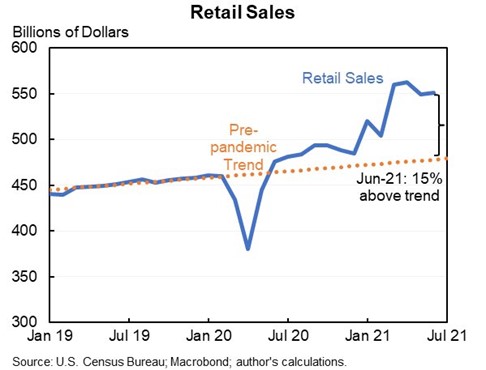
The two main candidates to blame are the Fed and the government. The Fed has printed tremendous amounts of money, which has led to the doubling of its balance sheet since March 2020. This is in fact what inflation is, and this is the cause of what we normally refer to as inflation, which, to be more accurate, is price inflation. In general, we know that the more money we print, holding all else equal, the more inflation we will get, and that is part of what we are seeing now. On the other hand, we have had the federal government spend money at record levels for a peacetime period. This also has led to an increase of demand beyond what one would expect in the circumstances we have been in since spring of 2020. For example, retail sales have increased rapidly and have been above trend since late 2020. While some of this can be seen as catching up after the decrease we saw in the second quarter of 2020, it is definitely gone beyond catching up, as is clear from the graph below. Government spending has become a topic of concern even for mainstream economists like Larry Summers, who is now worried about the economy overheating because of it.

Retail Sales

Lastly, while the supply chain disruptions are blamed on covid-19, it is the lockdowns instituted by governments, in the US and other countries, that are the main culprit behind these supply chain disruptions. The problem with the lockdowns was that they completely ignored the cost-benefit analysis by arbitrarily determining what constituted an essential business and what did not. As you may well know, one can ignore the laws of economics, but not their consequences, and we are now suffering the consequences of these arbitrary lockdowns. The million-dollar question today is, How long will this rising inflation and shrinkflation last? The Fed insists that this inflation is transitory, but many, including BlackRock’s CEO, are concerned that this may not be the case. With the inflation data from June, we have some evidence that inflation may be more than transitory. As can be seen from the graph below, the transitory portion of inflation (base effects) was expected to retreat for June (the bar after the dashed line), but CPI advanced beyond the increase in May (reflected in the green portion of the bar added to the predicted June CPI by Oxford Economics).

US Headline CPI Inflation
  (The graph is modified to show the actual CPI change for June, by adding the green portion of the bar.)

Hence, with all the money that the Fed has printed and is continuing to print, and the increased spending by the federal government, we may well end up seeing higher inflation over the next few years. Whether this will happen or not remains to be seen, but one thing is for sure: the shrinking size and weight of the products is here to stay and it will only get worse as inflation pressures continue to worsen. Author:

Klajdi Bregu

Dr. Klajdi Bregu is an assistant professor of economics at IU South Bend’s Judd Leighton School of Business and Economics and a fellow at the Center for Market Education. Prior to his appointment to the Leighton School faculty, Dr. Bregu taught at the University of Arkansas. He has published research in the Journal of Economic Dynamics and Control and the Southern Economic Journal.

Be seeing you

Posted in Uncategorized | Tagged: , , | Leave a Comment »