MCViewPoint

Opinion from a Libertarian ViewPoint

Posts Tagged ‘Taxation’

Libertarian Party of Pennsylvania-Stamp Act

Posted by M. C. on March 23, 2025

The Stamp Act wasn’t just about taxes—it was about government overreach, economic control, and the denial of individual liberty. The American colonists understood what too many politicians today forget: government will always find excuses to take more from the people unless they are stopped.

Stamp Act

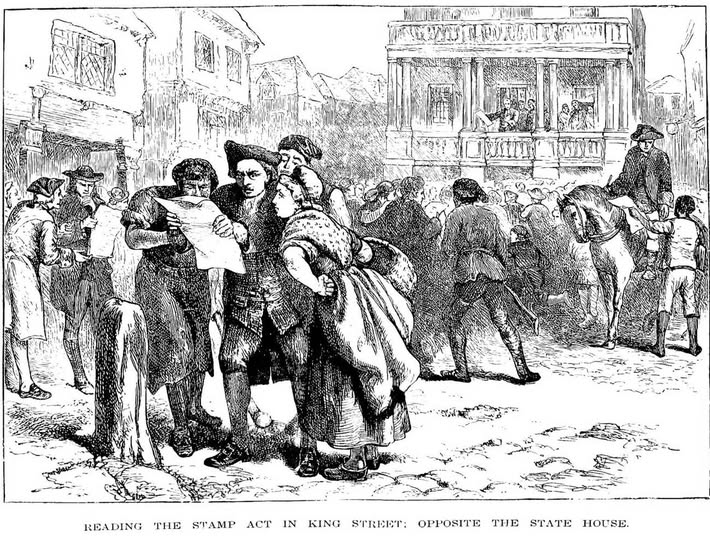
On this day, March 22, 1765, the British Parliament passed the Stamp Act, imposing direct taxes on the American colonies by requiring them to purchase official stamped paper for legal documents, newspapers, and even playing cards. This blatant act of taxation without representation ignited colonial resistance and helped spark the American Revolution.

The Stamp Act wasn’t just about taxes—it was about government overreach, economic control, and the denial of individual liberty. The American colonists understood what too many politicians today forget: government will always find excuses to take more from the people unless they are stopped.

As Libertarians, we continue this tradition of opposing this government overreach. While the common rallying cry was that “taxation without representation” was theft, we take that one step further by declaring that any taxation without consent of the person being taxed is theft. Nobody has the right to the products of your labor and this is true even if many people believe they are. We relentlessly point out that the natural state of government is expansion. Any chance a politician or bureaucrat has to take an inch, they’ll take it, but they will also try for a mile. The tax rates the founding fathers rebelled over are nothing compared to the burdensome tax bill the average American faces every year.

But the founding fathers didn’t just complain about these injustices, they took action. They protested and boycotted and formed groups like the Sons of Liberty to oppose these actions by the British. In less than a year, Britain was forced to repeal the tax.

The Stamp Act may be history, but the fight against government overreach is just as relevant today. Whether it’s taxation, corporate bailouts, or endless regulations, the government continues to take from people while failing at many of their most basic tasks. They would rather spend that money on their pet projects, useless boondoggles, funding ridiculous research, or giving your money to their friends in other countries. The lesson from the Stamp Act is clear, sitting back and complaining won’t make a difference, change comes from action. A small group of dedicated activists took on the most powerful nation of their time and birthed a nation founded on the principles of life, liberty, and property. Are you ready to take action?

Be seeing you

Posted in Uncategorized | Tagged: , , , | Leave a Comment »

Commissions Represent Congresspeople, Not the People

Posted by M. C. on November 15, 2023

The first step is to admit that the majority from both parties has a taxation-without-representation problem. The next steps are to slash spending and repudiate debt.

A debt-commission sideshow would frustrate this course of action that we need from elected representatives. It would provide cover for the worst of them and bring further delay and destruction to us.

Speaker Mike Johnson said early on that his first priority was to fund the national government. He got this priority dead wrong. His first and only priority needs to be to secure our rights.

Upon becoming speaker, Mike Johnson told the current house of representatives, “We are going to establish a bipartisan debt commission to begin working on this crisis immediately.”

Commissions

But commissions are problems. The key to rapidly surfacing better information and increasing freedom is well-advised extensive change, rapidly performed. Commissions are substitutes for action.

Even simple actions that would just move the Overton window towards freedom would beat freezing that window into place right where it is.

Making a commission bipartisan makes it even more intransigent. The 1981-1982 Gold Commission produced a superb minority report but was compromised in a way that was bipartisan—it was compromised both by its Democrats and by its Republicans other than Lewis Lehrman and Ron Paul.

Spending, debt, and other deprivations are the work products produced by the majorities. For a commission to be high-functioning, the commission’s majority would need to be made up of people who are currently in the minority. These people must be intellectually prepared to understand what to do, and emotionally prepared ready lay it out.

In commissions, like in all committees, the more-principled members compromise their principles to cater to the less-principled members. Committees bury accountability. They help make problem behaviors continue forever.

President Reagan would have done far better to have just convened both houses of that earlier congress and insisted that all of them on one side, versus the Gold Commission’s expert witness Murray Rothbard on the other side, simply debate what legislation would best deliver the gold standard that the Constitution already requires.

If Johnson is determined to have his commission, he must staff it so its majority is drawn from the minority of members who will advance actions that the current majority would block. Also, he should commission it to focus not on the symptom, debt, but on the cause, spending.

Spending

An honest appraisal of the problem has to begin with coming clean that governments are the ultimate free-riders. They take enormous fractions of the value we produce. They produce very little. They do this inefficiently, not disciplined by customers. Even at the most elemental level of criminal justice, they at best block proven private adjudication and substitute their monopoly justice. They are parasites.

Across 235 years, congresspeople, both using smaller committees and as committees of the whole, have logrolled pork into massive spending bills, egregiously violating the separation of power by grabbing executive power from presidents and setting themselves up as plural executives.

Their Congressional Budget Office sequesters away their “current-status reports” on appropriation bills, saying only that the office is “currently developing a plan to make more of the account-level analysis of appropriation bills publicly available in an accessible format.”

Congresspeople only selectively release crumbs that make the congresspeople them sound good. The big picture is revealed only after the voting is done and the spending plans are, in practice, irreversible.

By design, then, estimates and data only become visible after significant delays. These delays are what make process control hardest. Legislatures are terrible executives.

Spending could be legislatively limited by any of a number of far-simpler, commonsense processes. Here are examples:

See the rest here

Be seeing you

Posted in Uncategorized | Tagged: , , , , | Leave a Comment »

Trapping Wild Pigs

Posted by M. C. on October 24, 2023

Replace the corn every day. Once they’ve become dependent on the free food, erect a section of fence down one side of the clearing. When they get used to the fence, they’ll begin to eat the corn again. Then you erect another side of the fence.

Continue until you have all four sides of the fence up, with a gate in the final side.

Then, when the pigs enter the pen to feed, you close the gate.

Only a few will have both the insight and temerity necessary to make a dash for the gate as it’s now closing.

by Jeff Thomas

Most of us would like to assume that we’re smarter than pigs, but are we? Let’s have a look.

Pigs are pretty intelligent mammals, and forest-dwelling wild pigs are known to be especially wily.

However, there’s a traditional method for trapping them.

First, find a small clearing in the forest and put some corn on the ground.

After you leave, the pigs will find it. They’ll also return the next day to see if there’s more.

Replace the corn every day. Once they’ve become dependent on the free food, erect a section of fence down one side of the clearing. When they get used to the fence, they’ll begin to eat the corn again. Then you erect another side of the fence.

Continue until you have all four sides of the fence up, with a gate in the final side.

Then, when the pigs enter the pen to feed, you close the gate.

At first, the pigs will run around, trying to escape. But if you toss in more corn, they’ll eventually calm down and go back to eating.

You can then smile at the herd of pigs you’ve caught and say to yourself that this is why humans are smarter than pigs.

But unfortunately, that’s not always so.

In fact, the description above is the essence of trapping humans into collectivism.

Collectivism begins when a government starts offering free stuff to the population. At first, it’s something simple like free education or food stamps for the poor.

But soon, political leaders talk increasingly of “entitlements” – a wonderful concept that by its very name suggests that this is something that’s owed to you, and if other politicians don’t support the idea, then they’re denying you your rights.

Once the idea of free stuff has become the norm and, more importantly, when the populace has come to depend upon it as a significant part of their “diet,” more free stuff is offered.

It matters little whether the new entitlements are welfare, healthcare, free college, or a guaranteed basic wage. What’s important is that the herd come to rely on the entitlements.

Then, it’s time to erect the fence.

Naturally, in order to expand the volume of free stuff, greater taxation will be required. And of course, some rights will have to be sacrificed.

And just like the pigs, all that’s really necessary to get humans to comply is to make the increase in fencing gradual. People focus more on the corn than the fence.

Once they’re substantially dependent, it’s time to shut the gate.

What this looks like in collectivism is that new restrictions come into play that restrict freedoms.

You may be told that you cannot expatriate without paying a large penalty. You may be told that your bank deposit may be confiscated in an emergency situation. You may even be told that the government has the right to deny you the freedom to congregate, or even to go to work, for whatever trumped-up reason.

And of course, that’s the point at which the pigs run around, hoping to escape the new restrictions. But more entitlements are offered, and in the end, the entitlements are accepted as being more valuable than the freedom of self-determination.

Even at this point, most people will remain compliant. But there’s a final stage: The corn ration is “temporarily” cut due to fiscal problems. Then it’s cut again… and again.

See the rest here

Be seeing you

Posted in Uncategorized | Tagged: , , , | Leave a Comment »

Runaway Slaves

Posted by M. C. on July 24, 2023

Forced jury duty in Erie County PA

by Jeff Thomas

I believe it’s safe to say that most all of us sympathise with anyone who’s living in a condition of relative slavery and, if he has the courage to attempt to free himself, we root for him to succeed. Those of us who are the most compassionate would even offer him support in his quest, if we were called upon to do so.

But few of us think about slavery as being a modern institution. We tend to see slaves as victims of a racial divide who suffered disgracefully in times gone by.

So, we should take a look at the definition of slavery. In essence, it’s a state in which the product of an individual’s labour is forcibly taken from him. (His condition may include abuse, bondage, etc., but these are symptoms, not a definition.) The purpose for enslavement is always the same: to obtain the fruits of the slave’s labour, without mutually agreed-upon compensation.

And so, if we look at the bare bones of the definition, we easily recognize that if all of the fruits of our labour are taken from us, we are entirely enslaved. If a portion of those fruits is taken from us, we are partially enslaved.

Taxation is unquestionably, by definition, partial enslavement. It’s safe to say that virtually no one in the present world has ever been asked to sign away to his government the power to tax him. Make no mistake about it – taxation is achieved through force. You don’t wish to pay whatever is demanded? You go to prison.

Throughout history, there have been governments that taxed their minions ever-increasingly, eventually reaching the point that people began to leave the country rather than pay the usurious tax. (Rome declined in the fourth century as countless merchants left to live in the more-primitive north, amongst the barbarians, in order to escape tax enslavement. Similar developments have occurred in other countries throughout history.)

Although, in bygone eras, total slavery was quite common and occurred in every continent at one time or another, in our own time, governments have recognized that partial slavery is more effective – give people the impression that they’re free, whilst taking a major portion of the fruits of their labours from them in the forms of taxation and inflation.

But, at some point, people tend to rebel against slavery.

See the rest here

Be seeing you

Posted in Uncategorized | Tagged: , , , , | Leave a Comment »

(Sales) Taxation is Theft

Posted by M. C. on February 7, 2023

https://rumble.com/v28l6bm-sales-taxation-is-theft.html

Be seeing you

Posted in Uncategorized | Tagged: , | Leave a Comment »

Taxation=Theft – Doug Casey’s International Man

Posted by M. C. on January 17, 2023

But, there’s a significant difference in the US tax haven states and the tax havens overseas. Overseas havens are open to anyone, including the local populations. The US-based havens are open to anyone except Americans.

https://internationalman.com/articles/taxation-theft/

by Jeff Thomas

Theft is defined as “the taking of another person’s property or services without that person’s permission or consent.”

Almost invariably, governments pass tax laws and set tax rates without any consultation with the citizenry. Further, no final approval is sought by the citizenry that they consent to the tax or the rates. It is simply imposed.

Most of us tend not to regard taxation as theft, yet, by definition, that’s exactly what it is.

But some countries, notably the US, go further in disguising the theft, by stating that the payment of tax is “voluntary.” I personally am not aware of a single instance in which an individual or corporation decided not to pay a tax and, if discovered, was allowed to go unpunished. A typical penalty is a fine equal to the tax amount, plus compounded interest on both the tax and the fine. Such a condition is anything but voluntary.

The US also has a tradition of treating the payment of tax as being “patriotic.” Avoiding tax is deemed unpatriotic—therefore, citizens should take pride in paying tax and, in fact, many Americans do claim that they’re proud to pay tax. It would also seem likely that some resent taxation, but want to appear patriotic, whilst others truly wear taxation as a hair shirt with pride.

However, if we define taxation as what it is—theft—it would be far less likely that either of these factions would be taking this position. After all, no one takes pride in being robbed

Some countries (again, notably the US) describe tax havens as jurisdictions that seek to undermine the tax regimes of other jurisdictions. As such, the havens are harassed and threatened by the latter and referred to as criminal money-laundering centres.

Well, let’s clear the air on that one while we’re at it.

A tax haven is quite simply a jurisdiction that has a low-tax or no-tax regime. It either steals less of people’s money than high-tax jurisdictions, or steals none of their money.

See the rest here

Be seeing you

Posted in Uncategorized | Tagged: , , | Leave a Comment »

The Government Culture of Death

Posted by M. C. on June 2, 2022

But absent that waiver, the government cannot infringe upon rights without engaging in monstrous theft. And government theft has consequences. Whether it calls its theft “taxation” or “regulation,” one can understand Nietzsche’s aphorism that the government exists by lying and stealing.

By Andrew P. Napolitano

When the German philosopher Friedrich Nietzsche proclaimed that God was dead, he didn’t mean it literally, as that would have been impossible. He meant that God’s creatures have so failed to acknowledge Him and relate to Him, it is as if He decided to end His own existence.

Stated differently, Nietzsche recognized that Christianity had ceased to be influential in contemporary life. Though properly rejected as a madman, he reminded the world that the loss of virtue can only be sustained from the bottom up, not from the top down.

He meant that, for all the power the financial and governmental elites have, none of their valueless impulses would prevail were they not accepted by the majority or a determined minority.

He made these observations in 1886, during a time of relative peace but little freedom in Europe. His sentiments are just as valid in America today, where there is neither peace nor freedom.

People usually get the government they fear, whether it be Hitler’s willing executioners, Putin’s willing dupes or America’s willing subserviates.

Thus, when cultural and financial elites craft a government based on nihilism — a belief in nothing but power — when everything the government says is a lie, when everything the government has it has stolen, when the one thing the government does well is engage in violence, the result is a culture of death.

America today epitomizes a culture of death.

At home, America is at war with itself. The government permits the slaughter of babies in the womb and fails to prevent the slaughter of babies in a government classroom.

And America is at war abroad. The federal government has just sent cash and military hardware worth $56 billion to its vassal state, Ukraine. That amount rivals the annual military budget of Russia and is greater than the annual budget of the entire Ukraine government.

What’s going on?

What’s going on is the American rejection of the core Judeo-Christian value of the intrinsic worth of every person, and the tragic failure of American government at all levels to take rights seriously.

Because the government glorifies violence — constant wars, an annual defense budget larger than the next dozen countries combined including Russia and China, the adulation of the military, the encouragement and financing of abortions, and the use of the death penalty — it undermines the value of human life and sets a tone whereby because the government kills with impunity, violence becomes a personal tool.

Is it any wonder that deranged people pick up where the government has left off? For a person filled with hate and incapable of reason living in a society that rejects the intrinsic worth of every human life, is it very much of a leap from killing babies in the womb to killing strangers in a supermarket or a classroom?

Thomas Jefferson argued that the only moral purpose of government is to protect individual rights.

What is a right? A right is an indefeasible claim against the whole world that originates in our humanity. Thus the right to live, to worship or not to worship, to think as you wish, to say what you think, to publish what you say, to associate or not to associate, to acquire property voluntarily, to defend your life and property, to travel and to be left alone are rights that are inherent in our nature. Rights are above the law. Like the color of our eyes, they are immune from the lawmaking power.

The government, which is an artificial entity based on a monopoly of force in a geographic area, may not morally interfere with our rights unless we waive them. A house burglar waives his rights when he violates the property rights of the owner or legal occupant of the house.

But absent that waiver, the government cannot infringe upon rights without engaging in monstrous theft. And government theft has consequences. Whether it calls its theft “taxation” or “regulation,” one can understand Nietzsche’s aphorism that the government exists by lying and stealing.

See the rest here

Be seeing you

Posted in Uncategorized | Tagged: , , , , | Leave a Comment »

TGIF: Inflation Is Evil | The Libertarian Institute

Posted by M. C. on October 16, 2021

Imagine if the government had to fight its decades-long wars with open taxation. Would Americans stand for global intervention if every penny of the trillion-dollar military had to be paid to the Internal Revenue Service? The poor military contractors might have to find other things to produce, maybe even things that consumers really want.

https://libertarianinstitute.org/articles/tgif-inflation-is-evil/

by Sheldon Richman

When will Americans demand that the government denationalize money and free the market to do what it does better than anything else: serve the general welfare rather than the special interests?

It’s hard to know what it would take to bring this about, but inflation talk is once again in the air, and that’s bad. Worse, it’s in the shops. It had to happen after years of Fed Reserve’s money creation, through the banking system, in the name of stimulating this or stimulating that. Forget the printing press. All the Fed has to do is buy up oodles of bank assets (government debt and bad private assets), leaving those institutions with billions of conjured-up dollars in their computer accounts. Eventually the funny money would get out among us and do its damage. It had to happen sooner or later. Only the schedule was in doubt.

So why was the monetary system ever trusted to politicians and their bureaucratic appointees in the first place? The idea that a free society cannot provide sound money was an article of faith based on no evidence, like the idea that a free society cannot provide roads or law and order. The alleged failures of market-based money were really the result of government intervention. The “authorities” could never resist tampering whenever they saw the chance. Power is a strong drug.

Inflation is insidious. When central-bank policy robs people of their purchasing power by reducing the value of money, life gets harder. It’s obviously worse for the most vulnerable: the low- and fixed-income members of society, who can least afford the rise in the cost of living. But inflation does so much more. Savings melt away for most people, wreaking havoc with their ability to plan and to take care of themselves.

Even that does not exhaust the ways that the government’s central bank harms us. Prices rise, but not uniformly as though the “price level” were a real thing rather than a construct. What counts are relative prices (interest rates are prices too), which in the unmolested market reflect the relative changing of supply and demand. Market prices are indispensable for signaling that some things are being overproduced and while others are being underproduced. Since Fed-created money enters the economy at particular points in society, it changes relative prices in ways that differ from what would have taken place with market-based money. More havoc in the planning of production that would otherwise have served the general welfare.

Expectations change because of Fed policies, and those new expectations lead to employer and employee decisions that will turn out to be wrong when the inflation ends. When the Fed becomes nervous that things are getting out of hand, it will, as the saying goes, step on the brakes. Then many people will suffer anew from the recession, the great revelation of all the mistakes made under the government-distorted signals. And that’s not the end: the recession will be the excuse for new government interventions, which will only introduce further distortions. Never let a crisis pass without increasing power–that’s the politicians’ motto.

Does this sound like fun? Of course it doesn’t, but that’s what the state has done to us over and over. It keeps happening because government officials gain (though not necessarily in the traditional way), and they are good at blaming others for the bad effects. Economics is not intuitive, especially monetary economics.

Can we hope that the politicians and those who profit from their interventions will let go of the power? Why would they unless they had no choice? Inflation is magic: it, along with the power to borrow, enables our rulers to keep the support of constituencies without the explicit taxes they’d have to levy if the central bank did not exist. (Borrowing might still be an option but also might be more limited without central banking.) To put it another way, inflation is taxation by stealth, embezzlement rather than armed robbery. We pay for the largess the government bestows on special others, but much of it appears from thin air. When people pay the bill at the retail counter, most of them won’t know the government is to blame. That’s just evil.

Imagine if the government had to fight its decades-long wars with open taxation. Would Americans stand for global intervention if every penny of the trillion-dollar military had to be paid to the Internal Revenue Service? The poor military contractors might have to find other things to produce, maybe even things that consumers really want.

We owe it to ourselves and future generations to change this madness once and for all.

Be seeing you

Posted in Uncategorized | Tagged: , , | Leave a Comment »

Consent of the Governed? | Robert Higgs

Posted by M. C. on June 19, 2021

I raise this question because in regard to the so-called social contract, I have often had occasion to protest that I haven’t even seen the contract, much less been asked to consent to it. A valid contract requires voluntary offer, acceptance, and consideration. I’ve never received an offer from my rulers, so I certainly have not accepted one; and rather than consideration, I have received nothing but contempt from the rulers, who, notwithstanding the absence of any agreement, have indubitably threatened me with grave harm in the event that I fail to comply with their edicts.

To be GOVERNED is to be kept in sight, inspected, spied upon, directed, law-driven, numbered, enrolled, indoctrinated, preached at, controlled, estimated, valued, censured, commanded, by creatures who have neither the right, nor the wisdom, nor the virtue to do so.

https://blog.independent.org/2010/06/01/consent-of-the-governed/

Robert Higgs

What gives some people the right to rule others? At least since John Locke’s time, the most common and seemingly compelling answer has been “the consent of the governed.” When the North American revolutionaries set out to justify their secession from the British Empire, they declared, among other things: “Governments are instituted among Men, deriving their just Powers from the Consent of the Governed.” This sounds good, especially if one doesn’t think about it very hard or very long, but the harder and longer one thinks about it, the more problematic it becomes.

One question after another comes to mind. Must every person consent? If not, how many must, and what options do those who do not consent have? What form must the consent take ― verbal, written, explicit, implicit? If implicit, how is it to be registered? Given that the composition of society is constantly changing, owing to births, deaths, and international migration, how often must the rulers confirm that they retain the consent of the governed? And so on and on. Political legitimacy, it would appear, presents a multitude of difficulties when we move from the realm of theoretical abstraction to that of practical realization.

I raise this question because in regard to the so-called social contract, I have often had occasion to protest that I haven’t even seen the contract, much less been asked to consent to it. A valid contract requires voluntary offer, acceptance, and consideration. I’ve never received an offer from my rulers, so I certainly have not accepted one; and rather than consideration, I have received nothing but contempt from the rulers, who, notwithstanding the absence of any agreement, have indubitably threatened me with grave harm in the event that I fail to comply with their edicts. What monumental effrontery these people exhibit! What gives them the right to rob me and push me around? It certainly is not my desire to be a sheep for them to shear or slaughter as they deem expedient for the attainment of their own ends.

Moreover, when we flesh out the idea of “consent of the governed” in realistic detail, the whole notion quickly becomes utterly preposterous. Just consider how it would work. A would-be ruler approaches you and offers a contract for your approval. Here, says he, is the deal.

I, the party of the first part (“the ruler”), promise:

(1) To stipulate how much of your money you will hand over to me, as well as how, when, and where the transfer will be made. You will have no effective say in the matter, aside from pleading for my mercy, and if you should fail to comply, my agents will punish you with fines, imprisonment, and (in the event of your persistent resistance) death.

(2) To make thousands upon thousands of rules for you to obey without question, again on pain of punishment by my agents. You will have no effective say in determining the content of these rules, which will be so numerous, complex, and in many cases beyond comprehension that no human being could conceivably know about more than a handful of them, much less their specific character, yet if you should fail to comply with any of them, I will feel free to punish you to the extent of a law made my me and my confederates.

(3) To provide for your use, on terms stipulated by me and my agents, so-called public goods and services. Although you may actually place some value on a few of these goods and services, most will have little or no value to you, and some you will find utterly abhorrent, and in no event will you as an individual have any effective say over the goods and services I provide, notwithstanding any economist’s cock-and-bull story to the effect that you “demand” all this stuff and value it at whatever amount of money I choose to expend for its provision.

(4) In the event of a dispute between us, judges beholden to me for their appointment and salaries will decide how to settle the dispute. You can expect to lose in these settlements, if your case is heard at all.

 In exchange for the foregoing government “benefits,” you, the party of the second part (“the subject”), promise:

(5) To shut up, make no waves, obey all orders issued by the ruler and his agents, kowtow to them as if they were important, honorable people, and when they say “jump,” ask only “how high?”

Such a deal! Can we really imagine that any sane person would consent to it?

Yet the foregoing description of the true social contract into which individuals are said to have entered is much too abstract to capture the raw realities of being governed. In enumerating the actual details, no one has ever surpassed Pierre-Joseph Proudhon, who wrote:

To be GOVERNED is to be kept in sight, inspected, spied upon, directed, law-driven, numbered, enrolled, indoctrinated, preached at, controlled, estimated, valued, censured, commanded, by creatures who have neither the right, nor the wisdom, nor the virtue to do so. To be GOVERNED is to be at every operation, at every transaction, noted, registered, enrolled, taxed, stamped, measured, numbered, assessed, licensed, authorized, admonished, forbidden, reformed, corrected, punished. It is, under pretext of public utility, and in the name of the general interest, to be placed under contribution, trained, ransomed, exploited, monopolized, extorted, squeezed, mystified, robbed; then, at the slightest resistance, the first word of complaint, to be repressed, fined, despised, harassed, tracked, abused, clubbed, disarmed, choked, imprisoned, judged, condemned, shot, deported, sacrificed, sold, betrayed; and, to crown all, mocked, ridiculed, outraged, dishonored. That is government; that is its justice; that is its morality. (P.-J. Proudhon, General Idea of the Revolution in the Nineteenth Century, trans. John Beverley Robinson. London: Freedom Press, 1923, p. 294)

Nowadays, of course, we would have to supplement Proudhon’s admirably precise account by noting that our being governed also entails our being electronically monitored, tracked by orbiting satellites, tased more or less at random, and invaded in our premises by SWAT teams of police, often under the pretext of their overriding our natural right to decide what substances we will ingest, inject, or inhale into what used to be known as “our own bodies.”

So, to return to the question of political legitimacy as determined by the consent of the governed, it appears upon sober reflection that the whole idea is as fanciful as the unicorn. No one in his right mind, save perhaps an incurable masochist, would voluntarily consent to be treated as governments actually treat their subjects.

Nevertheless, very few of us in this country at present are actively engaged in armed rebellion against our rulers. And it is precisely this absence of outright violent revolt that, strange to say, some commentators take as evidence of our consent to the outrageous manner in which the government treats us. Grudging, prudential acquiescence, however, is not the same thing as consent, especially when the people acquiesce, as I do, only in simmering, indignant resignation.

For the record, I can state in complete candor that I do not approve of the manner in which I am being treated by the liars, thieves, and murderers who style themselves the Government of the United States of America or by those who constitute the tyrannical pyramid of state, local, and hybrid governments with which this country is massively infested. My sincere wish is that all of these individuals would, for once in their despicable lives, do the honorable thing. In this regard, I suggest that they give serious consideration to seppuku. Whether they employ a sharp sword or a dull one, I care not, so long as they carry the act to a successful completion.

Addendum on “love it or leave it”: Whenever I write along the foregoing lines, I always receive messages from Neanderthals who, imagining that I “hate America,” demand that I get the hell out of this country and go back to wherever I came from. Such reactions evince not only bad manners, but a fundamental misunderstanding of my grievance.

I most emphatically do not hate America. I was not born in some foreign despotism, but in a domestic one known as Oklahoma, which I understand to be the very heart and soul of this country so far as culture and refinement are concerned. Moreover, for what it is worth, some of my ancestors had been living in North America for centuries before a handful of ragged, starving white men washed ashore on this continent, planted their flag, and claimed all the land they could see and a great deal they could not see on behalf of some sorry-ass European monarch. What chutzpah! I yield to no one in my affection for the Statue of Liberty, the Rocky Mountains, and the amber waves of grain, not to mention the celebrated jumping frog of Calaveras County. So when I am invited to get out of the country, I feel like someone living in a town taken over by the James Gang who has been told that if he doesn’t like being robbed and bullied by uninvited thugs, he should move to another town. To me, it seems much more fitting that the criminals get out.

Robert Higgs is Retired Senior Fellow in Political Economy at the Independent Institute, author or editor of over fourteen Independent books, and Founding Editor of Independent’s quarterly journal The Independent Review.
Posts by Robert Higgs | Full Biography and Publications

Be seeing you

Posted in Uncategorized | Tagged: , , , , | Leave a Comment »

How Empires End – Doug Casey’s International Man

Posted by M. C. on April 20, 2021

Taxes, taxes, taxes

https://internationalman.com/articles/how-empires-end/

by Jeff Thomas

Experience hath shewn, that even under the best forms of government those entrusted with power have, in time, and by slow operations, perverted it into tyranny.” – Thomas Jefferson

Histories are generally written by academics. They, quite naturally, tend to focus on the main events: the wars and the struggles between leaders and their opponents (both external and internal). Whilst these are interesting stories to read, academics, by their very nature, often overlook the underlying causes for an empire’s decline.

Today, as in any era, most people are primarily interested in the “news”—the daily information regarding the world’s political leaders and their struggles with one another to obtain, retain, and expand their power. When the history is written about the era we are passing through, it will reflect, in large measure, a rehash of the news. As the media of the day tend to overlook the fact that present events are merely symptoms of an overall decline, so historians tend to focus on major events, rather than the “slow operations” that have been the underlying causes.

The Persian Empire

When, as a boy, I was “educated” about the decline and fall of the Persian Empire, I learned of the final takeover by Alexander the Great but was never told that, in its decline, Persian taxes became heavier and more oppressive, leading to economic depression and revolts, which, in turn led to even heavier taxes and increased repression. Increasingly, kings hoarded gold and silver, keeping it out of circulation from the community. This hamstrung the market, as monetary circulation was insufficient to conduct business. By the time Alexander came along, Persia, weakened by warfare and internal economic strife, was a shell of an empire and was relatively easy to defeat.

The Tang Dynasty

Back then, I also learned that the Tang Dynasty ended as a result of the increased power amongst the eunuchs, battles with fanzhen separatists, and finally, peasants’ revolts. True enough, but I was not taught that the dynasty’s expansion-based warfare demanded increases in taxation, which led to the revolts. Continued warfare necessitated increasing monetary and land extortion by the eunuchs, resulting in an abrupt decrease in food output and further taxes. Finally, as economic deterioration and oppression of the citizenry worsened, citizens left the area entirely for more promise elsewhere.

Is there a pattern here? Let’s have a more detailed look—at another empire.

The Spanish Empire

In 1556, Philip II of Spain inherited what was regarded as Europe’s most wealthy nation, with no apparent economic problems. Yet, by 1598, Spain was bankrupt. How was this possible?

Spain was doing well but sought to become a major power. To achieve this, Philip needed more tax dollars. Beginning in 1561, the existing servicio tax was regularised, and the crusada tax, the excusado tax, and the millones tax were all added by 1590.

Over a period of 39 years (between 1559 and 1598) taxes increased by 430%. Although the elite of the day were exempt from taxation (the elite of today are not officially exempt), the average citizen was taxed to the point that both business expansion and public purchasing diminished dramatically. Wages did not keep pace with the resultant inflation. The price of goods rose 400%, causing a price revolution and a tax revolution.

Although Spain enjoyed a flood of gold and silver from the Americas at this time, the increased wealth went straight into Philip’s war efforts. However, the 100,000 troops were soon failing to return sufficient spoils to Philip to pay for their forays abroad.

In a final effort to float the doomed empire, Philip issued government bonds, which provided immediate cash but created tremendous debt that, presumably, would need to be repaid one day. (The debt grew to 8.8 times GDP.)

Spain declared bankruptcy. Trade slipped to other countries. The military, fighting on three fronts, went unpaid, and military aspirations collapsed.

It is important to note that, even as the empire was collapsing, Philip did not suspend warfare. He did not back off on taxation. Like leaders before and since, he instead stubbornly increased his autocracy as the empire slid into collapse.

Present-Day Empires

Again, the events above are not taught to schoolchildren as being of key importance in the decline of empires, even though they are remarkably consistent with the decline of other empires and what we are seeing today. The very same events occur, falling like dominoes, more or less in order, in any empire, in any age:

  1. The reach of government leaders habitually exceeds their grasp.
  2. Dramatic expansion (generally through warfare) is undertaken without a clear plan as to how that expansion is to be financed.
  3. The population is overtaxed as the bills for expansion become due, without consideration as to whether the population can afford increased taxation.
  4. Heavy taxation causes investment by the private sector to diminish, and the economy begins to decline.
  5. Costs of goods rise, without wages keeping pace.
  6. Tax revenue declines as the economy declines (due to excessive taxation). Taxes are increased again, in order to top up government revenues.
  7. In spite of all the above, government leaders personally hoard as much as they can, further limiting the circulation of wealth in the business community.
  8. Governments issue bonds and otherwise borrow to continue expansion, with no plan as to repayment.
  9. Dramatic authoritarian control is instituted to assure that the public continues to comply with demands, even if those demands cannot be met by the public.
  10. Economic and social collapse occurs, often marked by unrest and riots, the collapse of the economy, and the exit of those who are productive.
  11. In this final period, the empire turns on itself, treating its people as the enemy.

The above review suggests that if our schoolbooks stressed the underlying causes of empire collapse, rather than the names of famous generals and the dates of famous battles, we might be better educated and be less likely to repeat the same mistakes.

Unfortunately, this is unlikely. Chances are, future leaders will be just as uninterested in learning from history as past leaders. They will create empires, then destroy them.

Even the most informative histories of empire decline, such as The Decline and Fall of the Roman Empire, by Edward Gibbon, will not be of interest to the leaders of empires. They will believe that they are above history and that they, uniquely, will succeed.

If there is any value in learning from the above, it is the understanding that leaders will not be dissuaded from their aspirations. They will continue to charge ahead, both literally and figuratively, regardless of objections and revolts from the citizenry.

Once an empire has reached stage eight above, it never reverses. It is a “dead empire walking” and only awaits the painful playing-out of the final three stages. At that point, it is foolhardy in the extreme to remain and “wait it out” in the hope that the decline will somehow reverse. At that point, the wiser choice might be to follow the cue of the Chinese, the Romans, and others, who instead chose to quietly exit for greener pastures elsewhere.

Editor’s Note: The US government is overextending itself by interfering in every corner of the globe. It’s all financed by massive amounts of money printing. However, the next financial crisis could end the whole charade soon.

The truth is, we’re on the cusp of a global economic crisis that could eclipse anything we’ve seen before. That’s exactly why New York Times best-selling author Doug Casey and his team just released a guide that explains what could come next and what you can do about it.. Click here to download the PDF now.

Be seeing you

Posted in Uncategorized | Tagged: , , , , | 2 Comments »