MCViewPoint

Opinion from a Libertarian ViewPoint

Posts Tagged ‘Thomas Jefferson’

TGIF: On the Pursuit of Happiness

Posted by M. C. on July 5, 2024

The equation, however, is invidious. It suggests that other people necessarily are impediments to one’s happiness and thus one should sacrifice one’s happiness at least to some extent. But why would anyone believe that “selfishness”—making the most of one’s life by holding it as one’s ultimate value—entails the disvaluing of other people? It’s crazy on its face. Rand, like the ancient Greeks, understood that he who cares about only himself demonstrates that he doesn’t care enough.

https://libertarianinstitute.org/articles/tgif-pursuit-happiness/

by Sheldon Richman

declaration

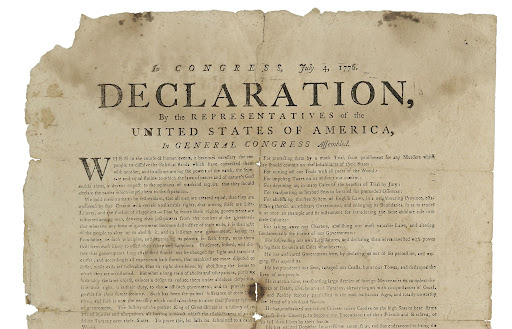
The most remarkable phrase in the Declaration of Independence, whose anniversary we just celebrated, is the pursuit of happiness. Looking back 248 years, that phrase may strike the modern ear as strange for a political document. But it apparently did not seem that way to Americans in 1776. The second paragraph told the world:

We hold these truths to be self-evident, that all men are created equal, that they are endowed by their Creator with certain unalienable Rights, that among these are Life, Liberty and the pursuit of Happiness.

The term among these indicates that Thomas Jefferson and the Second Continental Congress did not think that life, liberty, and the pursuit of happiness were our only unalienable rights. But the pursuit of happiness made the brief enumeration, which speaks volumes.

The first thing to note is that Jefferson did not write that we had a right to happiness, but only the right to pursue it. Legal scholar and historian Carli N. Conklin of the University of Missouri School of Law states in “The Origin of the Pursuit of Happiness”:

[T]he pursuit of happiness is not a legal guarantee that one will obtain happiness, even when happiness is defined within its eighteenth-century context. It is instead, an articulation of the idea that as humans we were created to live, at liberty, with the unalienable right to engage in the pursuit.

Through historical investigation, Conklin shows that contrary to common belief, the phrase was no “glittering generality” (in Carl Becker’s phrase) back them but rather was a term of substance.

I trust no one will take seriously that the omission of property from the list of examples means that Jefferson et al. thought property unimportant. Of course, it did not mean that. We know that the people behind the Declaration understood the deep importance of private property to life, liberty, and the pursuit of happiness. A possible reason for not listing it is that property was often used differently from the way we use it today. While we say, “That’s my property,” an 18th-century person might say, “I have a property in that,” although today’s usage was hardly unknown back then. James Madison, who was not a member of the Continental Congress but who had a lot of say about property, used the word both ways. However, here are examples of what he called “the larger and juster meaning” of the word:

[A] man has a property in his opinions and the free communication of them. [Emphasis added.]

He has a property of peculiar value in his religious opinions, and in the profession and practice dictated by them.

He has a property very dear to him in the safety and liberty of his person.

He has an equal property in the free use of his faculties and free choice of the objects on which to employ them. [Emphasis added.]

In a word, as a man is said to have a right to his property, he may be equally said to have a property in his rights.

It’s widely known that Jefferson and other founders were deeply influenced by John Locke,

See the rest here

Be seeing you

Posted in Uncategorized | Tagged: , | Leave a Comment »

TGIF: Jefferson on Not Trusting the State

Posted by M. C. on August 27, 2022

free government is founded in jealousy and not in confidence; it is jealousy & not confidence which prescribes limited Constitutions to bind down those whom we are obliged to trust with power

by Sheldon Richman 

Libertarian Institute

thomas jefferson

Regardless of written constitutions and the laws on the books, individual liberty is always at risk. And as liberty goes, so goes our capacity to live well, to achieve the good life as rational, virtuous social beings.

The danger comes from left and right, both of which aspire to have a body of elders impose narrow cultural and moral norms on everyone, overriding our right to think for ourselves. (Progressives and National Conservatives have a lot in common in that regard, even if they differ on what is to be imposed.)

This point about the fragility of liberty was well understood by the Irish politician, judge, and orator John Philpot Curran (1750-1817), who said: “The condition upon which God hath given liberty to man is eternal vigilance; which condition if he break, servitude is at once the consequence of his crime and the punishment of his guilt.”

As often happens, variations of this insight have been attributed to other people, most famously Thomas Jefferson, who is widely and apparently erroneously thought to have said more pithily: “The price of liberty is eternal vigilance.” Curran has missed out on the credit he deserves.

At any rate, we have a problem. Although liberty is never safe from political ambition or even good intentions, most people are understandably absorbed in raising their families, earning their livelihoods, and just plain living. Thinking about liberty, much less exercising vigilance, has a low priority — if it is on their agendas at all. I’m not finding fault; it’s just a fact.

Hence the need for a degree of specialization. Libertarians to one extent or another specialize in keeping watch over liberty and drawing the public’s attention to dangers from governments and nongovernment sources. These aren’t entirely two separate categories because if an influential segment of the public comes to believe that liberty must be curtailed, such sentiment could find its way into the halls of power. For example, if enough people decide that offensive words or obscene images are equivalent to violent acts, politicians may take up that cause and prohibit so-called hate speech and the like. This has happened in Great Britain, where citizens can be visited by the police, fined, and compelled to take a sensitivity course for posting something on social media that allegedly made someone feel anxious. So far, thanks to the tradition of free speech and press recognized in the First Amendment, that does not happen in the United States. But we mustn’t rest on our laurels. A violation could be just around any corner, and we can’t be sure from which direction it will come.

Although Jefferson did not say, “The price of liberty is eternal vigilance.” we know he believed it. We know this because of his 1798 Kentucky Resolutions, which he wrote anonymously for the state legislature in opposition to the Alien and Sedition Acts of that year. The Acts were passed by the Federalist party-controlled Congress under Federalist President John Adams. (Jefferson, who was not a Federalist, was the vice president at the time.) As one description of the Acts puts it:

The Resolutions by Jefferson and Madison were provoked by the Alien and Sedition Acts adopted by a Federalist-dominated Congress during the Quasi-War with France; those Acts gave the president the authority to deport any alien whom he thought a threat and made it illegal to criticize the president or the Congress. Dozens of people were prosecuted under the Sedition Act, with prosecutions targeted at newspaper editors who favored the new Democratic-Republican party – Jefferson’s party. Seeing such political prosecutions of free speech as a fundamental threat to the republic, Jefferson referred to this period as a “reign of witches.”

Federalist support for the Acts was also fueled by Jeffersonian sympathy for the French Revolution. The government’s fears about French influence in the United States had reached a fevered pitch.

In his Kentucky Resolutions — a second, shorter resolution written by an unknown person passed in 1799 — Jefferson invoked the principle that the Constitution delegated only certain limited powers to the national government and therefore the states individually could check that government whenever it broke through the limits. Hence, the document declared the Alien and Sedition Acts  “void and of no force” and requested their repeal. (Jefferson’s draft called for nullification, but that language did not make the final document. It did make the second version, however.)

In making his case, Jefferson wrote something that more people need to understand,

See the rest here

Be seeing you

Posted in Uncategorized | Tagged: , | Leave a Comment »

The Character of American Individualism

Posted by M. C. on March 26, 2022

Country is a concept of peace, of balance, of living and letting live. But State is essentially a concept of power.… And we have the misfortune of being born not only into a country but into a State.…

https://mises.org/library/character-american-individualism

Murray N. Rothbard

Individualism, and its economic corollary, laissez-faire liberalism, has not always taken on a conservative hue, has not always functioned, as it often does today, as an apologist for the status quo. On the contrary, the revolution of modern times was originally, and continued for a long time to be, laissez-faire individualist. Its purpose was to free the individual person from the restrictions and the shackles, the encrusted caste privileges and exploitative wars, of the feudal and mercantilist orders, of the Tory ancien régime.

Tom Paine, Thomas Jefferson, the militants in the American Revolution, the Jacksonian movement, Emerson and Thoreau, William Lloyd Garrison and the radical abolitionists—all were basically laissez-faire individualists who carried on the age-old battle for liberty and against all forms of State privilege. And so were the French revolutionaries—not only the Girondins, but even the much-abused Jacobins, who were obliged to defend the Revolution against the massed crowned heads of Europe. All were roughly in the same camp. The individualist heritage, indeed, goes back to the first modern radicals of the 17th century—to the Levellers in England, and to Roger Williams and Anne Hutchinson in the American colonies.

The conventional historical wisdom asserts that while the radical movements in America were indeed laissez-faire individualist before the Civil War, that afterwards, the laissez-fairists became conservatives, and the radical mantle then fell to groups more familiar to the modern Left: the Socialists and Populists. But this is a distortion of the truth. For it was elderly New England Brahmins, laissez-faire merchants and industrialists like Edward Atkinson, who had financed John Brown’s raid at Harper’s Ferry, who were the ones to leap in and oppose the US imperialism of the Spanish-American War with all their might.

No opposition to that war was more thoroughgoing than that of the laissez-faire economist and sociologist William Graham Sumner or than that of Atkinson who, as head of the Anti-Imperialist League, mailed antiwar pamphlets to American troops then engaged in conquering the Philippines. Atkinson’s pamphlets urged our troops to mutiny, and were consequently seized by the US postal authorities.

In taking this stand, Atkinson, Sumner, and their colleagues were not being “sports”; they were following an antiwar, anti-imperialist tradition as old as classical liberalism itself. This was the tradition of Price, Priestley, and the late-18th-century British radicals that earned them repeated imprisonment by the British war machine; and of Richard Cobden, John Bright, and the laissez-faire Manchester School of the mid-19th century. Cobden, in particular, had fearlessly denounced every war and every imperial maneuver of the British regime. We are now so used to thinking of opposition to imperialism as Marxian that this kind of movement seems almost inconceivable to us today.

Murray Rothbard by Evan Wondolowski

By the advent of World War I, however, the death of the older laissez-faire generation threw the leadership of the opposition to America’s imperial wars into the hands of the Socialist Party. But other, more individualist-minded men joined in the opposition, many of whom would later form the core of the isolationist Old Right of the late 1930s. Thus, the hardcore antiwar leaders included the individualist Senator Robert LaFollette of Wisconsin and such laissez-faire liberals as Senators William E. Borah (Republican) of Idaho and James A. Reed (Democrat) of Missouri. It also included Charles A. Lindbergh, Sr., father of the Lone Eagle, who was a congressman from Minnesota.


This article is excerpted from The Betrayal of the American Right, chapter 2, “Origins of the Old Right I: Early Individualism” (2007).

https://mises.org/library/character-american-individualismSee the rest here

Author:

Murray N. Rothbard

Murray N. Rothbard made major contributions to economics, history, political philosophy, and legal theory. He combined Austrian economics with a fervent commitment to individual liberty.

Be seeing you

Posted in Uncategorized | Tagged: , , , | Leave a Comment »

The Last Americans To Believe in the Voluntary Union of the States

Posted by M. C. on March 11, 2022

One wonders what the world would think today if say, Vladimir Putin’s generals decimated entire Ukrainian cities occupied only by women and children in this way, after which they were given “honors” and hailed as heroes by Putin himself.

By Thomas DiLorenzo

“If there is to be a separation [i.e., secession of New England], then God bless them [the two countries] both, & keep them in the union if it be for their good, but separate them if it be better.”

  • Thomas Jefferson, Letter to John C. Breckenridge, Aug. 12, 1803, regarding the New England secession movement

“No state . .  can lawfully get out of the union . . . acts against the authority of the United States are insurrectionary . . .”

  • Abraham Lincoln, First Inaugural Address

“Extermination, not of soldiers alone, that is the least of the trouble, but the people [of the South].”

  • Letter from General Sherman to his wife, July 31, 1862, explaining his purpose in the war

Anyone who knows anything about the War to Prevent Southern Independence has heard of General Sherman’s “march to the sea” through Georgia, a pleasant euphemism for all the rape, pillage, plunder, murder, arson, and terrorism of the civilian population by Sherman’s “bummers,” under his direct, personal supervision.  It wasn’t just a pleasant springtime march through the South with bands playing “Yankee Doodle” and “John Brown’s Body.”  Less known, however, is what Sherman’s rapists, plunderers, and murderers did in South Carolina.  A new book by Karen Stokes entitled South Carolina in 1865 compiles letters and diaries by South Carolinians of the day describing what happened when Sherman’s “army” went through Columbia, Charleston, and other South Carolina towns.  (Stokes is an archivist at the South Carolina Historical Society).

Since South Carolina was considered to be the birthplace of the Southern secession movement (A half century after the 1801-1814 New England secession movement culminating in the Hartford Secession Convention of 1814), Sherman had an especially murderous hatred for the people of that state.  In other words, the previous generation of Yankees believed what all Americans believed – that the union was voluntary; the people of the free and independent states were sovereign; that they created the Constitution of the federal government as an instrument to serve them by delegating certain powers to it; and that that they reserved the right to reassume those powers should the federal government interfere with their “happiness.”  Secession was “the” principle of the American Revolution, declared Massachusetts Senator Timothy Pickering, the leader of the New England secession movement who also served as George Washington’s secretary of war and secretary of state. As such, they debated secession for fourteen years, but in the end remained in the union.

The next generation of Yankees sought to destroy the voluntary union of the founding fathers, and they did.  They did not “exterminate” all of the Southern people, as Sherman desired to do as seen in the above letter to his wife, but they did manage to murder one fourth of the Southern male population of military age, maiming for life more than double that number.  Karen Stokes quotes a Walter B. Edgar who reflected shortly after the war of how “Some 60,000 sons of Carolina entered military service . . . .  Of these, 21,146 (35 percent) were killed, a percentage twice that of England, France, Germany, and Russia in World War I when Europe ‘lost’ a generation.”

But South Carolina in1865 is about how Sherman waged total war on the civilian population of South Carolina after the Confederate Army had evacuated.  It was truly an orgy of rape, pillage, plunder, and arson.  In Columbia and Charleston, rockets were set off to announce the beginning of the war crime sprees, proving that Sherman himself, and all the rest of the Union Army high command, including Lincoln, knew of it, orchestrated it, and approved of and celebrated it.  “About six in the evening their work of destruction began,” wrote Josephine LeConte in a letter to her son on Feb. 28, 1865.  She was referring to how Sherman’s “bummers” set fire to almost every single home and building of any kind in Columbia.  “One or two rows of buildings skirting the town are all that are left by that Vandal horde,” she wrote.

The Yankees, meanwhile, made their first stop at any and all liquor stores, and had a riotous good time burning down the town populated by women and children and elderly men.  “As each house was enveloped in flames,” wrote Mrs. LeConte, “their demonic yells of delight coupled with the shrieks and screams of widows and orphans who sought the lawn for asylum in front of our house for protection beggars description.”  Hospitals and churches were not spared either, she wrote.

See the rest here

Be seeing you

Posted in Uncategorized | Tagged: , , , , , | Leave a Comment »

A Real Presidential Speech: Jefferson’s First Inaugural

Posted by M. C. on March 10, 2022

If you’re like me – and absolutely couldn’t stomach the imperial speech from Joe Biden earlier this week – I’ve got a refreshing change of pace for you.

Today in history – on March 4, 1801 – President Thomas Jefferson gave his first inaugural address after winning a bitter campaign for President of these United States.

During the campaign, he noted that the nation’s newspapers were “teaming with every falsehood they can invent for defamation.” John Adams, who was seeking re-election on the Federalist ticket, was labeled a monarchist; Vice President Jefferson was called an atheist; both candidates were declared enemies of the Constitution.

Sounds familiar, doesn’t it?

After a tie in the Electoral College and 36 votes in the House of Representatives to break that tie with his former running-mate Aaron Burr, Jefferson knew he had his work cut out for him.

So he started his Inaugural with a great deal of humility – noting that he would do his best to fulfill the duties of the monumental task at hand, but find all his guidance in the Constitution, which he would rely on “under all difficulties.”

From there, he said, “it is proper you should understand what I deem the essential principles of our government, and consequently those which ought to shape its administration.”

There are 13 of them, which you can read below with the text copied from Jefferson’s draft wherever possible. I covered this all in more detail to commemorate the anniversary of his speech on March 4 – in this Path to Liberty episode from our archives (click here)

  1. Equal and exact justice to all – whatever state of persuasion, religious or political
  2. Peace commerce and honest friendship with all nations, entangling alliances with none
  3. Support of state governments as the most competent administration for domestic concerns – and surest bulwarks against anti-republican tendencies
  4. preservation of the General government in its whole constitutional vigor, as the sheet anchor of our peace at home, and safety abroad
  5. Republican majoritarianism instead of an appeal to force
  6. a well disciplined militia, our best reliance in peace, and for the first moments of war, till regulars may relieve them
  7. the supremacy of the civil over the military authority
  8. economy in the public expence
  9. honest payment of our debts and sacred preservation of the public faith
  10. encouragement of agriculture, and of commerce as its handmaid
  11. the diffusion of information
  12. freedom of religion; freedom of the press; and freedom of person
  13. trial by juries impartially selected

On top of this great list – he mentioned the word “PEACE” seven times in his short speech, and even suggested that government should exist only to enforce the non-aggression principle.

At this link you can find the audio and video versions of the show, and some important reference links for you to check out:
https://blog.tenthamendmentcenter.com/2020/03/thomas-jeffersons-first-inaugural-address-13-essential-principles/

At this point, we probably all realize it’s almost impossible to imagine any politician in modern times making a presentation like Jefferson did. But that doesn’t mean we should ignore it – in fact, I believe this should be our standard.

EDITOR’S NOTE: This is today’s Tenther newsletter, which everyone in the nullification movement gets daily or weekly. Be one of them.

Michael Boldin

Michael Boldin [send him email] is the founder of the Tenth Amendment Center. He was raised in Milwaukee, WI, and currently resides in Los Angeles, CA. Follow him on twitter – @michaelboldin and Facebook.

Be seeing you

Posted in Uncategorized | Tagged: , | Leave a Comment »

Liberals’ Love Affair with Leviathan

Posted by M. C. on February 21, 2022

Perhaps nothing symbolizes the new liberal creed more vividly than the New York City Council’s recent unanimous vote to remove the statute of Thomas Jefferson from New York City Hall, where it had resided for more than a century. In 1799, Jefferson warned fellow Americans: “Let no more be heard of confidence in man, but bind him down from mischief by the chains of the constitution.” It is regrettable that many liberals now have as much hostility to constitutional restraints on presidents and federal agencies as they had to that statue of Jefferson.

by James Bovard

The election of Joe Biden as president magically transformed all federal agencies, ensuring that their iron fists no longer posed any peril to the American people. Or at least that seems to be what many Biden supporters, liberals, and Democrats now believe.

I stumbled upon that new catechism on a cold morning last November. I ambled online after breakfast and saw that “Deep State” was a Twitter trending topic. I tossed out my two cents: “Don’t forget how NYTimes & many liberals heaped praise on the Deep State in 2019 for its role in the first Trump impeachment.” I attached a link to my 2019 USA Today article headlined, “As the deep state attacks Trump to rave media reviews, don’t forget its dark side.” New York Times editorial writer Michelle Cottle had hailed the Deep State as “a collection of patriotic public servants,” and Washington Post columnist Eugene Robinson captured the Beltway’s verdict: “God bless the Deep State!”

The mob rules on social media

Alas, I quickly learned that I was a hopeless reactionary. Apparently, since President Trump condemned the Deep State, that proves that it doesn’t exist. And since a Democrat now occupies the White House, any mention of the Deep State is apparently a grave offense. Twitter user DoinTimeOnEarth responded to my tweet: “Why don’t you shut up & do some good instead of spreading lies?”

Twitter is a fount of wisdom because so many of its users are omniscient. Someone with the Twitter name “What?” howled: “USATODAY has gone crazy…. And no, I am not going to read a bunch of jackass nonsense before re-tweeting with this comment.” My story had 23 links to news stories, analyses, and government reports on the Deep State scandals, including Bush-era torture, National Security Agency abuses, drone killings of innocent foreigners, and other abuses of power and secrecy. The piece included links to three New York Times articles confirming the Deep State’s role in spurring the first impeachment of President Trump.

Twitter user herself “Nom of the Plume” huffed: “Liberals don’t believe in the ‘deep state.’ It goes against our radical values of being sane and educated.” I replied: “So being a smug ‘educated’ liberal means believing federal agencies don’t pervasively violate the law & Constitution? When did gullibility become a badge of political sophistication?” My response failed to placate my critics. Nom of the plume commented: “No I won’t try to have a rational conversation with irrational people…. You are extremists and terrorists.” The fact that the Justice Department Inspector General concluded that FBI agents deceived the Foreign Intelligence Surveillance Court to justify illegally surveilling the 2016 Trump presidential campaign had apparently been expunged from all historical memory — at least among progressives.

On Twitter, “likes” are the highest form of logic, and re-tweets are irrefutable truth.     Some Twitter users refuted my articles by posting rows of laughing emojis. Others debunked my errors with meme photos such as a photo of a screw next to a baseball. Some of the names of Twitter respondents reeked of piety. “Covfefe_au_lait is FULLY VAXXED+BOOSTER” sneered that “anyone who uses the phrase [Deep State] sounds ridiculous.” Mike Burridge scoffed: “I see the Right has no supply chain disruptions for stupidity. Shelves fully stocked with ignorance.” Another user growled: “Did you brew your coffee with paint thinner this morning? This is the most absolutely ridiculous thing I’ve seen this week.”

Facts don’t matter on Twitter

But it wasn’t simply that I was ignorant. Instead, my comment on the Deep State was sufficient proof of my mental illness.

See the rest here

Be seeing you

Posted in Uncategorized | Tagged: , , , , , | Leave a Comment »

No, the American Republic Was Not Founded on Slavery | Mises Wire

Posted by M. C. on October 31, 2020

Thomas Sowell in his highly recommended text Black Rednecks and White Liberals described the intense political environment the founding fathers endured in their quest to outlaw slavery:

William G. Clarence Smith in his intriguing publication Islam and the Abolition of Slavery details the venom leveled at emancipation in Islamic territories: “Asked to give up his slaves in 1861, the sultan of Magindanao replied ‘that he would rather give up his wife and children than his slaves, for lacking the latter he would cease to be a sultan.’”

https://mises.org/wire/no-american-republic-was-not-founded-slavery?utm_source=Mises+Institute+Subscriptions&utm_campaign=78690a2aec-EMAIL_CAMPAIGN_2020_10_02_06_25_COPY_01&utm_medium=email&utm_term=0_8b52b2e1c0-78690a2aec-228343965

Lipton Matthews

Journalistic propaganda is a powerful instrument of indoctrination. Without evidence, foul ideas can easily penetrate mainstream discourse. For instance, recently it has become fashionable to posit that slavery is America’s original sin. To sensible people, this is a risible claim, because there is nothing particularly American about slavery. But revisiting the history of slavery in non-Western societies in Asia and Africa would do little to change the minds of America’s critics. A more appropriate strategy would be to contrast the opinions of the Founding Fathers on slavery with those of leaders in other countries. Only after undertaking this task will we be able to judge America.

In a larger historical context, asserting that some of the American founders owned slaves does not make them appear remarkable, because for most of history slavery was a normal institution. Therefore, in retrospect, they are to be seen as the products of a peculiar time. What matters is not that they possessed slaves, but their revolutionary views on slavery during an era when it was universally embraced and their attempts at dismantling the system. 

Thomas Jefferson in the original draft of the Declaration of Independence was exceptionally caustic in his critique of George III for imposing the slave trade on the colonies:

He [George III] has waged cruel war against human nature itself, violating its most sacred rights of life and liberty in the persons of a distant people who never offended him, captivating & carrying them into slavery in another hemisphere or to incur miserable death in their transportation thither. This piratical warfare, the opprobrium of infidel powers, is the warfare of the Christian king of Great Britain. Determined to keep open a market where Men should be bought and sold, he has prostituted his negative for suppressing every legislative attempt to prohibit or restrain this execrable commerce. And that this assemblage of horrors might want no fact of distinguished dye, he is now exciting those very people to rise in arms among us, and to purchase that liberty of which he has deprived them, by murdering the people on whom he has obtruded them: thus paying off former crimes committed against the liberties of one people, with crimes which he urges them to commit against the lives of another.

Of profound importance in this statement is that Jefferson capitalized the word men. To historian M. Andrew Holowchak this indicates that “philosophically and unequivocally Jefferson considered Blacks as men, not chattel.” However, such a remonstration of slavery was deleted by the Continental Congress to achieve a compromise with Southern states. Like now, tradeoffs formed a crucial aspect of the political process. Those seeking to berate the Founding Fathers lack a proper understanding of history and politics. Thomas Sowell in his highly recommended text Black Rednecks and White Liberals described the intense political environment the founding fathers endured in their quest to outlaw slavery:

Many who have dismissed the anti-slavery words of the founders of the American republic as just rhetoric have not bothered to check the facts of history. Washington, Jefferson, and others did not just talk. They acted. Even when they acted within the political and legal constraints of their times, they acted repeatedly[,] sometimes winning and sometimes losing….When Jefferson drafted a state constitution for Virginia in 1776, his draft included a clause prohibiting any more importation of slaves and, in 1783, Jefferson included in a new draft of a Virginia constitution a proposal for the gradual emancipation of slaves. He was defeated in both these efforts. On the national scene, Jefferson returned to the battle once again in 1784, declaring slavery illegal in all western territories of the country. The bill lost by one vote, that of a legislator too sick to come and vote. Afterwards, Jefferson said that the fate of millions unborn was hanging on the tongue of one man and heaven was silent in that awful moment.

Contemporary observers fail to acknowledge that the hostile political climate at the time limited what the Founding Fathers could achieve. Moreover, they had to contemplate the most feasible route to abolition. Emancipating slaves, if all legislators agreed, was easy, yet one had to confront the political difficulties one encounters in abolition without a clear plan. In a letter to Robert Morris, George Washington displays his penchant for the destruction of slavery provided that it was guided by a sound plan: “I can only say that there is not a man living who wishes more sincerely than I do, to see a plan adopted for the abolition of it; but there is only one proper and effectual mode by which it can be accomplished, and that is by Legislative authority; and this, as far as my suffrage will go, shall never be wanting.”

But not everyone was a pragmatist. Due to their personal convictions, some patriots were incensed by slavery, and they took personal steps to emancipate slaves. Men like Oliver Ellsworth and Roger Sherman fall into this category. Whereas the will of George Washington stipulated the emancipation of enslaved laborers, Benjamin Franklin liberated his slaves during his lifetime. So far, we have discussed the views of the Founding Fathers on slavery. Now let us contrast them with those of leaders of different societies to determine which positions were more enlightened.

William G. Clarence Smith in his intriguing publication Islam and the Abolition of Slavery details the venom leveled at emancipation in Islamic territories: “Asked to give up his slaves in 1861, the sultan of Magindanao replied ‘that he would rather give up his wife and children than his slaves, for lacking the latter he would cease to be a sultan.’” He continues: “The Sultan of Sulu wrote to the American authorities in 1902, insisting that slaves were held ‘according to Moro law, custom and the Mohammedan religion,’ in that order. Moreover, ‘slaves are part of our property. To have this property taken away from us would mean a great loss to us.’”

Similarly, historian Robin Law reminds us of the militant reaction of the Dahomean elite when the British began pressuring the government to disband the slave trade: “King Glele told British missionary Peter Bernasko in 1860 that ‘war, bloodshed (i.e. human sacrifice) and slave selling had been left to him by his father, he could not avoid them.” Law also notes that the assault on the slave trade “implied the demilitarization of the Dahomian state and this in turn implied an attack on human sacrifice, which in Dahomey was bound up with the culture of militarism.”

The examples provided suggest that slavery underpinned the cultural fabric of several non-Western societies. Furthermore, it is evident that following the abolition of slavery in America its leaders placed pressure on other countries to terminate the practice. So, in a strange sense, we may say that American imperialism helped to topple slavery. Likewise, based on our survey an objective analysis of historical positions on slavery should illustrate that America’s founding fathers were not only more progressive, but exhibited a moral disposition absent in most places. Therefore, in contrast to the utterances of critics, what is distinct about America is not slavery, but rather its strident antislavery ideology despite slavery’s universal acceptance. Author:

Contact Lipton Matthews

Lipton Matthews is a researcher, business analyst, and contributor to mises.org, The Federalist, and the Jamaica Gleaner. He may be contacted at lo_matthews@yahoo.com or on Twitter (@matthewslipton).

Be seeing you

Posted in Uncategorized | Tagged: , , , | Leave a Comment »

Jefferson on the Family and Liberty | Mises Wire

Posted by M. C. on August 17, 2020

Jeff Deist argues in a similar vein:

It scarcely needs to be said that family has always been the first line of defense against the state, and the most important source of primary loyalty—or divided loyalty, from the perspective of politicians. Our connection with ancestors, and our concern for progeny, forms a story in which the state is not the main character. Family forms our earliest and hence most formative environment—and at least as an ideal, family provides both material and emotional support. Happy families actually exist.

But government wants us atomized, lonely, broke, vulnerable, dependent, and disconnected. So of course it attempts to break down families by taking kids away from them as early as possible, indoctrinating them in state schools, using welfare as a wedge, using the tax code as a wedge, discouraging marriage and large families, in fact discouraging any kind of intimacy not subject to public scrutiny, encouraging divorce, etc. etc.

https://mises.org/wire/jefferson-family-and-liberty

Thomas Jefferson has valuable things to say about two key criticisms of the free market. I learned about these from reading C. Bradley Thompson’s America’s Revolutionary Mind (Encounter Books, 2019) Thompson has done an immense amount on research on the thought of the leading figures of the American Revolution, and I urge everyone to read this excellent book.

Many critics of the free market say that it is unfair that some people are much wealthier than others. Isn’t it largely a matter of luck how well you do? If so, shouldn’t the state take steps to benefit those who aren’t successful? This is a line of thought I’ve often written about, so I’ll just give one example of it. The late G.A. Cohen states the position in this way, in his Rescuing Justice and Equality (Harvard University Press, 2008):

People with greater-than-average talents and abilities should not in justice receive more wealth and income than others, even if their work is more productive and valuable than their less-fortunately-endowed coworkers. People do not deserve the abilities by which they surpass others, and my own animating conviction…[is] that an unequal distribution whose inequality cannot be vindicated by some choice or fault or desert on the part of (some of) the relevant affected agents is unfair, and therefore, pro tanto, unjust, and that nothing can remove that particular injustice.

Jefferson does not agree. People have a natural right to benefit from their industry and talents, and it is wrong for the state to take money from the rich to help the poor. He says,

To take from one, because it is thought that his industry…has acquired too much, in order to spare to others who…have not exercised equal liberty or skill, is to violate arbitrarily the first principle of association, the guarantee to everyone of a free exercise of liberty, and the fruits acquired by it.

Someone might object to Jefferson in this way: Aren’t there some people who are so badly off that they need help in order to survive? Shouldn’t they be guaranteed at least a minimum by the state?

Again, Jefferson doesn’t agree. Rights in his view are purely negative. Someone’s being poor does not give him a right to the labor or property of others. Further, “the forced sharing of property would likewise cause all generosity, benevolence, and charity to wither on the vine. If such ‘noble principles’ were destitute of objects and exercise,’ Jefferson added, they would ‘forever lie dormant’” (quoted in Thompson, America’s Revolutionary Mind).

What I’ve said so far describes a familiar libertarian position, but now I’d like to turn to something more controversial. One of the standard criticisms of the free market point of view is that it treats individuals as isolated atoms who view other people only as means to the pursuit of their selfish ends. You can certainly find people who do adopt this view, but Mises and Rothbard do not. Lew Rockwell notes in Against the Left:

Today, the fundamental threat to liberty comes from leftist programs to promote absolute equality. In this chapter, we will first describe egalitarianism in general terms and then discuss one of its main, and most dangerous, manifestations. This is the attempt to destroy the traditional family, the hallmark of civilization….In order to maintain a free society, it is essential that the traditional family, i.e., the union of one man and one woman in marriage, in most cases to raise a family, be preserved. Ludwig von Mises offers some profound insights on this matter.

Jeff Deist argues in a similar vein:

It scarcely needs to be said that family has always been the first line of defense against the state, and the most important source of primary loyalty—or divided loyalty, from the perspective of politicians. Our connection with ancestors, and our concern for progeny, forms a story in which the state is not the main character. Family forms our earliest and hence most formative environment—and at least as an ideal, family provides both material and emotional support. Happy families actually exist.

But government wants us atomized, lonely, broke, vulnerable, dependent, and disconnected. So of course it attempts to break down families by taking kids away from them as early as possible, indoctrinating them in state schools, using welfare as a wedge, using the tax code as a wedge, discouraging marriage and large families, in fact discouraging any kind of intimacy not subject to public scrutiny, encouraging divorce, etc. etc.

On this issue, Jefferson supports the family rather than the atomized individual. Here I need to confess a deception. I truncated a passage I quoted earlier from Jefferson, not to give a false idea of its contents, but rather to hold in reserve something I wanted to emphasize later. The full quotation from Jefferson is

To take from one, because it is thought that his industry and that of his fathers has acquired too much, in order to spare to others who, or whose fathers have not exercised equal liberty or skill, is to violate arbitrarily the first principle of association, the guarantee to everyone of a free exercise of liberty, and the fruits acquired by it. (emphasis added)

In his second inaugural address, Jefferson said:

With those, too, not yet rallied to the same point, the disposition to do so is gaining strength; facts are piercing through the veil drawn over them; and our doubting brethren will at length see, that the mass of their fellow citizens, with whom they cannot yet resolve to act, as to principles and measures, think as they think, and desire what they desire; that our wish, as well as theirs, is, that the public efforts may be directed honestly to the public good, that peace be cultivated, civil and religious liberty unassailed, law and order preserved; equality of rights maintained, and that state of property, equal or unequal, which results to every man from his own industry, or that of his fathers. (emphasis added)

Jefferson’s view would get him into trouble with contemporary egalitarians. They think it is especially “arbitrary from the moral point of view” that some people have advantages because of their family. Jefferson sees matters differently.

Author:

Contact David Gordon

David Gordon is Senior Fellow at the Mises Institute, and editor of The Mises Review.

Be seeing you

Posted in Uncategorized | Tagged: , , , | Leave a Comment »

Why They Despise and Smear Thomas Jefferson – LewRockwell

Posted by M. C. on July 28, 2020

Alexander Hamilton, who happens to have been Jefferson’s enemy. Hamilton favored a powerful centralized government that he believed could and should control the economy, enrich the powerful elite, and dominate the states. If this sounds familiar, it is because that is exactly what the establishment and the left want today. Jefferson deeply opposed this, favoring decentralization, states’ rights, and economic freedom. In fact, in 1798, Jefferson wrote the Kentucky Resolution, promulgating the idea that states could nullify unconstitutional federal laws. The thought of this is horrifying to today’s establishment,

https://www.lewrockwell.com/2020/07/derek-dobalian/why-they-despise-and-smear-thomas-jefferson/

By

Every few months the American people are treated to new attacks on Thomas Jefferson. Are these new attacks? No, they are just recycled ones that the left, and the establishment in general, continue to exaggerate and use to defame one of the greatest intellectuals who ever lived. Recently, there have been increasing calls to tear down his statues and rename schools named after him. Why? Well they give a few different reasons, all of them being frivolous and deceitful. The main charge, of course, is that Thomas Jefferson owned slaves. Of course, this was at a time when slavery was widely accepted and most of Jefferson’s contemporaries also participated in the practice. You may hear the left trash Washington for owning slaves, but you’ll never hear the establishment doing so. They only target Jefferson. Why would this be? Jefferson actually personally opposed slavery and took more action than Washington did to end its practice. In Jefferson’s original draft of the Declaration of Independence, he condemned King George for enslaving people and violating their “sacred rights.” Further, when Jefferson was president, he banned the international slave trade. These actions were far greater anti-slavery steps than George Washington ever took, or any slaveholding founding father for that matter. Yet, we are constantly barraged with seething statements of hatred of Jefferson calling him the worst names in the English language. We get articles from the Smithsonian entitled “The Dark Side of Thomas Jefferson” and Monticello, Jefferson’s own estate, calling him a terrible hypocrite.

Next, in order to worsen the original attack, they tell us that Jefferson actually had many children with one of his slaves. But this is a lie, and the liars who promote it know this. An objective look at the evidence would never lead one to accept the conclusion that Jefferson fathered children with one of his slaves. That is why no actual historian took the assertion seriously until very recently (when the leftist mob began demanding it be stated as historical fact).

Thus, we must ask why they smear Thomas Jefferson? If the charges against him are so clearly fraudulent, there must be a reason why they despise him (and uphold other founders). When we look at who they promote and praise among the founders, we can see what the answer is. So, which founder do they consistently promote? Anyone living in American society today knows the answer: Alexander Hamilton, who happens to have been Jefferson’s enemy. Hamilton favored a powerful centralized government that he believed could and should control the economy, enrich the powerful elite, and dominate the states. If this sounds familiar, it is because that is exactly what the establishment and the left want today. Jefferson deeply opposed this, favoring decentralization, states’ rights, and economic freedom. In fact, in 1798, Jefferson wrote the Kentucky Resolution, promulgating the idea that states could nullify unconstitutional federal laws. The thought of this is horrifying to today’s establishment, as they would lose a lot of power if it were put into practice. Thus, the necessity to demonize the great disciple of liberty becomes clear. Discredit the man, discredit his ideas. Finally, one of the great characteristics of Thomas Jefferson was that, unlike many other advocates of liberty, he was radical and combative. He actually fought for his principles and wasn’t afraid to denounce those who promoted statism. For example, in speaking of Hamilton, he stated that “if history stoops to notice him” it will be as “a person who worked to destroy liberty.” The establishment hates those who tell the truth about powerful elites and expose them in the public square. Thus, the great intellectual must be silenced, and the only way to do this is to assassinate his character.

In conclusion, this is a usual case of mediocre men trying to disparage a great man after his death because it brings them more power. And power is what they crave.

Be seeing you


Posted in Uncategorized | Tagged: , , , , | 2 Comments »

HOW POROUS SHOULD AMERICA’S BORDERS BE? THOMAS JEFFERSON’S THOUGHTS ON IMMIGRATION

Posted by M. C. on July 27, 2019

“[N]o endeavor”, he said, “should be spared to detect and suppress” this sort of im- migrant. (2) So much for blind liberality. Not every immigrant is a friend of America. Jefferson was no fool. He had other concerns too.

https://proconservative.net/PCVol5Is272FarrellImmigrationInsecurity.shtmlBy Steven M. Farrell

You and I are “melting pot” people; citizens, that is, of that country set apart by Heav- en to receive those in search of the good life–those from from every nation, kindred, tongue, and people. As such, we, of all people, ought to recognize the value of a liberal [generous, not strict] immigration policy.

President Thomas Jefferson, a descendent of immigrants, presiding over a nation of immigrants, thought so. In his first annual message, dated, December 8, 1801, he asked of those who thought to impose an extremely arduous course to citizenship for the im- migrant (a 14 years residency requirement), a few probing questions:

    “Shall we refuse the unhappy fugitives from distress that hospitality which the savages of the wilderness extended to our fathers arriving in this land? Shall op- pressed humanity find no asylum on this globe? The Constitution, indeed, has wisely provided that, for admission to certain offices of important trust, a resi- dence shall be required sufficient to develop character and design. But might not the general character and capabilities of a citizen be safely communicated to eve- ry one manifesting a bona fide purpose of embarking his life and fortunes perma- nently with us?” (1)

The advocates of today’s liberal immigration policies, or of far more radical proposals for open borders, might feel inclined to thus quote Jefferson, and feel justified.

Yet they had better do so with caution. President Jefferson also suggested that America balance her open arm policy “with restrictions, perhaps, to guard against the fraudulent usurpation of our flag; an abuse which brings so much embarrassment and loss on the genuine citizen, and so much danger to the nation of being involved in war”.

“[N]o endeavor”, he said, “should be spared to detect and suppress” this sort of im- migrant. (2) So much for blind liberality. Not every immigrant is a friend of America. Jefferson was no fool. He had other concerns too.

In his Notes on the State of Virginia (1787), Jefferson reflects:

    “It is for the happiness of those united in society to harmonize as much as possi- ble in matters which they must of necessity transact together. Civil government being the sole object of forming societies, its administration must be conducted by common consent.
    “Every species of government has its specific principles. Ours perhaps are more peculiar than those of any other in the universe. It is a composition of the freest principles of the English Constitution, with others derived from natural right and natural reason. To these nothing can be more opposed than the maxims of abso- lute monarchies. Yet from such we are to expect the greatest number of emi- grants.” (3)

Jefferson warns, nearly prophetically:

    “They will bring with them the principles of the governments they leave, imbibed in their early youth; or, if able to throw them off, it will be in exchange for an un- bounded licentiousness, passing, as is usual, from one extreme to another. It would be a miracle were they to stop precisely at the point of temperate liberty. These principles, with their language, they will transmit to their children. In pro- portion to their numbers, they will share with us the legislation. They will infuse into it their spirit, warp and bias its directions, and render it a heterogeneous, in- coherent, distracted mass.” (4)

There is theory; and then there is reality. Jefferson was schooled in both. He knew that, to every liberal law, there were some reasonable limits.

We need artisans, he admitted, but not enemies. We want true freedom seekers to come, but without “extraordinary encouragements.” (5)

What would Thomas Jefferson, therefore, think of an immigration policy today that, with flashing lights invites the non-working masses of the world to come–to come from countries that hate us, to a feast of “free” food, “free” health care, “free” education, “free” social security benefits, and free and instant voter registration cards? It is hard to see Jefferson calling it anything but extraordinarily unwise, and extraordinarily rev- olutionary. Jefferson would have proposed something better–a policy liberal in its ex- tension of the blessings of liberty to those who desired it, and conservative in its eco- nomic and political common sense.

Be seeing you


Posted in Uncategorized | Tagged: , | Leave a Comment »