Let there be no doubt, in foreign policy terms “leadership” is the bipartisan and benign euphemism for America First nationalism. And that usually means some sort of war. Biden already has his warriors in place from the Obama years: Bloody Susan Rice, Blinken at State, Lloyd Austin as Secretary of Defense. There will be others filling in the mid ranks as those principals call in their former deputies, who call theirs.
As Trump leaves office the only president to have not started a new war since WWII—and Joe Biden, who supported so many of America’s wars, including (vice-) presiding over the second and third Iraq Wars, heads into office—the talk is again what should be the most terrifying words anyone outside the US could hear: More American Leadership. Thing is, we haven’t cleaned up the leftovers from the last bout of leadership yet.
President-Elect Biden pulls no punches about how he feels about Trump’s lack of war, saying “Trump has abdicated American leadership in mobilizing collective action to meet new threats. This is the time to tap the strength and audacity that took us to victory in two world wars and brought down the Iron Curtain.” His SecState-nominee Antony Blinken used the word “leadership” in a speech 16 times. Biden himself wrote an essay in Foreign Affairs titled “Why America Must Lead Again.” Introducing his national security nominees, Biden said “America is back, ready to lead the world.”
Let there be no doubt, in foreign policy terms “leadership” is the bipartisan and benign euphemism for America First nationalism. And that usually means some sort of war. Biden already has his warriors in place from the Obama years: Bloody Susan Rice, Blinken at State, Lloyd Austin as Secretary of Defense. There will be others filling in the mid ranks as those principals call in their former deputies, who call theirs.
The problem with America’s leadership spurts is that they are often left uncompleted. They are played for US domestic political consumption and leave behind a mess someone else has to clean up when politics shift. Worst of all, no one in America seems to ask those overseas who are about to be freed, liberated, encouraged to revolt, or otherwise enlightened by the arrival of the American Empire if they indeed want any leadership today.
So maybe before spewing out any new leadership, Biden could start by cleaning up some of the leadership he and others left behind. Start with Iraq.
Quick, Jeopardy-style, when did the Iraq War end? Correct answer of course is “What is never.” America wrecked the place from the air in 1991, then invaded by land in 2003. Those American troops mostly left in 2010, then returned in 2014, and today loiter like dropouts in the high school parking lot in unknown but relatively small numbers. The American Embassy in Iraq, physically still the size of the Vatican and once the largest embassy in the world in diplomatic headcount, sits mostly empty with a security guard-to-diplomat ratio that would embarrass any Twitter warrior.
You would wish that was all, but the horrors of the Iraq Wars are such that even bodies already buried find their way to the surface. Among the many US atrocities few today know about (Google “Haditha Massacre,” “Mahmudiyah rape,” “Abu Ghraib torture”) loom the Nisour Square murders.
On a hot as hell September 16, 2007, Blackwater mercenaries hired by the State Department as security killed 17 Iraqi civilians—including two children—and injured 20 in Nisour Square, central Baghdad. The US lied and prevaricated for years, until finally the truth slithered out that none of the Iraqis were armed, the Blackwater guys panicked, and their so-called defensive fire was beyond any legitimate rule of war.
The State Department tried to intervene, allowing the defendants to claim State’s own Diplomatic Security officers had offered them on-the-street immunity in return for later recanted testimony (Nisour Square wasn’t the only time State lied to cover for Blackwater). It took seven years until a US court convicted four Blackwater employees. All four were pardoned by Trump in December 2020.
“That was years ago” say many of the same Americans willing to connect a police shooting today to the first slaves arriving on this continent in 1619. Though the average American might vaguely remember something bad happened with Blackwater, every Iraqi knows what Nisour Square stands for: American invasion, false promises of freedom, arrogant use of power. The same way Vietnamese know My Lai and thousands of other such incidents whose names never made it into the American press. Or perhaps how the remaining scraps of the Lakota people still reference Wounded Knee. No reckoning allowed save the marvelous sleight of hand of America’s fragile memory.
`”These are what Obi-Wan Kenobi called ‘the economics of politics.’ Right here, bare-ass naked for everyone to see exactly what’s going on here.”— Scott Horton
Using war for private profit goes all the way to the top of the political hierarchy, as Horton reminds us by referring to the case of senators Lindsay Graham, John McCain, and Joseph Lieberman, who tried to sell armored personnel carriers to Qaddafi mere months before they pushed for his death.
President Trump has recognized the two castes in the military, the top brass who “want to do nothing but fight wars so that all of those wonderful companies that make the bombs and make the planes and make everything else stay happy” and the enlisted men who “love” him because “we’re getting out of the endless wars”
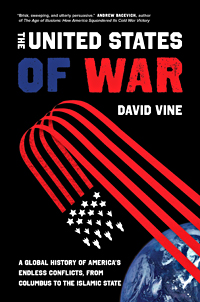
In his new book,The United States of War, David Vine cites research by the US Army showing that since the 1950s, a US military presence has correlated with the US military starting conflicts. Vine modifies a line from Field of Dreams to refer not to a baseball field but to bases: “If you build them, wars will come.”
If, like me, you have the unfortunate habit of pointing out the dishonesty of the cases made for various wars, and you begin to persuade people that the wars are not actually for the eradication of the weapons of mass destruction that they proliferate, or the elimination of the terrorists that they generate, or the spreading of the democracy that they stifle, most people will soon ask “Well, then, what are the wars for?”
At this point, there are two common mistakes. One is to suppose there’s a single answer. The other is to suppose that the answers must all make rational sense. A basic response that I’ve given a gazillion times is that wars are for profit and power and pipelines, for control of fossil fuels and territories and governments, for electoral calculations, career advancement, and media ratings, payback for campaign “contributions,” for the inertia of the current system, and for an insane, sadistic lust for power and xenophobic malevolence.
We know that wars do not correlate with population density or resource scarcity or any of the factors used by some in U.S. academia to try to pin the blame for wars on their victims. We know that wars hardly overlap at all with the locations of the manufacture of weapons. We know that wars do correlate strongly with the presence of fossil fuels. But they correlate with something else as well that provides a different sort of answer to the question of what the wars are for: bases. I mean, we’ve all known for decades now that the latest US permawars consist largely of coating various countries with bases, and that the goals include the maintenance of some number of permanent bases and oversized embassy-fortresses. But what if the wars are not only motivated by the goal of new bases, but also driven in significant part by the existence of current bases?
In his new book, The United States of War, David Vine cites research by the US Army showing that since the 1950s, a US military presence has correlated with the US military starting conflicts. Vine modifies a line from Field of Dreams to refer not to a baseball field but to bases: “If you build them, wars will come.” Vine also chronicles countless examples of wars begetting bases begetting wars begetting bases that not only beget yet more wars but also serve to justify the expense of more weapons and troops to fill the bases, while simultaneously producing blowback – all of which factors build momentum toward more wars.
Vine’s previous book was Base Nation: How US Military Bases Abroad Harm America and the World. This one’s full title is The United States of War: A Global History of America’s Endless Conflicts, From Columbus to the Islamic State. It’s not, however, a detailed account of every US war, which would require many thousands of pages. It’s also not a move away from the topic of bases. It’s a chronicle of the role bases have played and still play in the generation and conduct of wars.
There is, in the back of the book, a long list of US wars, and of other conflicts that for some reason are not labeled wars. It’s a list that rolls on steadily from before the beginning of the United States to today, and that doesn’t pretend the wars against Native Americans didn’t exist or weren’t foreign wars. It’s a list that shows distant wars around the globe long-predating the completion of “manifest destiny” to the US west coast, and shows small wars happening in numerous places at once and right through the occurrence of major wars elsewhere. It shows short wars and extremely long wars (such as a 36-year war against the Apache) that render obscene the constant announcements that the current war on Afghanistan is the longest US war ever, and that render ridiculous the idea that the past 19 years of war is something new and different. While the Congressional Research Service once claimed the United States had been at peace for 11 years of its existence, other scholars say the correct number of peaceful years is zero thus far.
The mini-U.S. suburban paradises sprinkled across the globe as military bases are gated communities on steroids (and Apartheid). Their residents are often immune from criminal prosecution for their actions outside the gates, while the locals are only admitted within to do the yard work and cleaning. The travel and conveniences are great perks for military recruits and for budget-controlling Congress members touring base world. But the notion that the bases serve a protective purpose, that they do the opposite of what Eisenhower warned of, is just about upside down from reality. One of the main products of US bases in other people’s countries is the bitter resentment that Vine reminds us pre-U.S. residents felt toward the British military occupation of North American colonies. Those British troops behaved lawlessly, and colonists registered just the sorts of complaints of looting, rape, and harassment that people who live near US bases have been lodging for many decades now.
US foreign bases, far from first sprouting up in 1898, were built by the budding new nation in Canada prior to the 1776 Declaration of Independence and grew rapidly from there. In the United States there are over 800 current or past military sites with the word “fort” in their names. They were military bases in foreign territory, as were countless other locations without “fort” in their current names. They preceded settler colonists. They provoked blowback. They generated wars. And those wars generated more bases, as the frontier was pushed ever outward. During the war for independence from Britain, as during most major wars that most people have heard of, the United States went right on waging numerous smaller wars, in this case against Native Americans in the Ohio Valley, western New York, and elsewhere. Where I live in Virginia, monuments and elementary schools and cities are named for people credited with expanding the US empire (and Virginia’s empire) westward during the “American Revolution.”
Neither base construction nor war-making has ever let up. For the War of 1812, when the US burned the Canadian Parliament, after which the British burned Washington, the US built defensive bases around Washington, D.C., that did not serve their purpose remotely as well as most US bases around the world do. The latter are designed for offense, not defense.
Ten days after the War of 1812 ended, the US Congress declared war on the North African state of Algiers. It was then, not in 1898, that the US Navy began establishing stations for its ships on five continents – which it used during the 19th century to attack Taiwan, Uruguay, Japan, Holland, Mexico, Ecuador, China, Panama, and Korea.
The US Civil War, fought because the North and South could agree only on endless expansion but not on the slave or free status of new territories, was not only a war between North and South, but also a war fought by the North against the Shoshone, Bannock, Ute, Apache, and Navajo in Nevada, Utah, Arizona, and New Mexico – a war that killed, conquered territory, and forced thousands into a military-run concentration camp, Bosque Redondo, of the sort that would later inspire the Nazis.
New bases meant new wars beyond the bases. The Presidio in San Francisco was taken from Mexico and used to attack the Philippines, where bases would be used to attack Korea and Vietnam. Tampa Bay, taken from the Spanish, was used to attack Cuba. Guantanamo Bay, taken from Cuba, was used to attack Puerto Rico. And so on. By 1844, the US military had access to five ports in China. The U.S.-British Shanghai International Settlement in 1863 was “Chinatown reversed” – much like US bases across the globe right now.
Prior to WWII, even including much of the base expansion of WWI, many bases were not permanent. Some were, but others, including most in Central America and the Caribbean, were understood to be temporary. WWII would change all that. The default status of any base would be permanent. This began with FDR’s trading of old ships to Britain in exchange for bases in eight British colonies – none of which had any say in the matter. Neither did Congress, as FDR acted alone, which created a horrible precedent. During WWII the United States built and occupied 30,000 installations on 2,000 bases on every continent.
A base in Dhahran, Saudi Arabia, was supposedly for fighting the Nazis, but after Germany surrendered, the base construction was still completed. The oil was still there. The need for planes to land in that part of the globe was still there. The need to justify the purchase of more planes was still there. And the wars would be there as surely as rain follows storm clouds.
WWII was only ever partially ended. Huge military forces were kept permanently stationed abroad. Henry Wallace thought the foreign bases should be handed over to the United Nations. Instead he was quickly shuffled off the stage. Vine writes that hundreds of “Bring Back Daddy” clubs were formed across the United States. They didn’t all get their way. Instead the radical new practice was begun of shipping families off to join their patriarchs in permanent occupations – a move largely aimed at reducing rapes of local residents.
Of course, the US military was significantly reduced after WWII, but not nearly to the extent it had been after other wars, and much of that was reversed as soon as a war could be started up in Korea. The Korean war led to a 40% increase in overseas US bases. Some might call the war on Korea an immoral horror or a criminal outrage, while others would call it a tie or a strategic blunder, but from the point of view of base construction and the establishment of weapons-industry power over the US government, it was, exactly as Barack Obama claimed during his presidency, a tremendous success.
Eisenhower spoke of the military industrial complex corrupting the government. One of many examples offered by Vine is that of US relations with Portugal. The US military wanted bases in the Azores, so the US government agreed to support Portugal’s dictator, Portuguese colonialism, and Portuguese NATO membership. And the people of Angola, Mozambique, and Cape Verde be damned – or rather, let them build up hostility toward the United States, as a price to pay for keeping the United States “defended” by a global array of bases. Vine cites 17 cases of US base construction displacing local populations around the world, a situation that exists side-by-side with US text books claiming that the age of conquest is over.
NATO served to facilitate the construction of US bases in Italy, which Italians might never have stood for had the bases been called “US bases” rather than being marketed under the false banner of “NATO bases.”
Bases have continued to proliferate around the globe, with protests usually following. Protests against US bases, often successful, often not successful, have been a major part of the past century of world history rarely taught in the United States. Even the well-known peace sign was first used at a protest of a US military base. Now bases are spreading across Africa and up to the borders of China and Russia, while US culture grows accustomed to ever more routine wars fought by “special forces” and robot planes, nuclear weapons are being built like mad, and militarism is unquestioned by either of the two big US political parties.
If the wars are – in part – for the bases, shouldn’t we still ask what the bases are for? Vine recounts Congressional investigators concluding that many of the bases are kept in place by “inertia.” And he recounts various military officials indulging in fear (or, more accurately, paranoia) that sees aggressive war creation as a form of defense. These are both very real phenomena, but I think they depend on an overriding drive for global domination and profit, combined with a sociopathic willingness (or eagerness) to generate wars.
Something that I never think any book focuses on enough is the role of weapons sales. These bases create weapons customers – despots and “democratic” officials who can be armed and trained and funded and made dependent upon the US military, making the US government ever more dependent upon the war profiteers.
Andrei Martyanov has argued that the U.S. military simply has no idea what a really big war is. Its peer wars off stage (since 1812) made it stronger; its home wars were profitable thefts. It believes wars are easy, quick, profitable, successful. Self delusion in war is defeat: post 1945 U.S. wars are failure delusionally entered into. To quote Fred Reed again:
– Fred Reed (who probably learned this in Vietnam)
According to a popular Internet calculation, the United States of America has not been at war with somebody for only 21 years since 1776. Or maybe it’s only 17 years. Wikipedia attempts a list. It’s a long one. You’d think that a country that had been at war for that much of its existence, would be pretty good at it.
One cannot avoid asking when did the USA last win a war. You can argue about what “win” looks like but there’s no argument about a surrender ceremony in the enemy’s capital, whether Tokyo Bay or Berlin. That is victory. Helicopters off the Embassy roof is not, pool parties in a U.S. Embassy is not, “Black Hawk down” is not. Doubling the USSR’s record in Afghanistan is not. Restoring the status quo ante in Korea is not defeat exactly, but it’s pretty far from what MacArthur expected when he moved on the Yalu. When did the USA last win a war? And none of the post-1945 wars have been against first-class opponents.
And few of the pre-1941 wars were either. Which brings me to the point of this essay. The USA has spent much of its existence at war, but very seldom against peers. The peer wars are few: the War of Independence against Britain (but with enormous – and at Yorktown probably decisive – help from France). Britain again in 1812-1814 (but British power was mostly directed against Napoleon). Germany in 1917-1918, Germany and Japan 1941-1945.
Most American opponents have been small fry.
Take, for example, the continual wars against what the Declaration of Independence calls “the merciless Indian savages, whose known rule of warfare is an undistinguished destruction of all ages, sexes, and conditions“. (Starting, incidentally, a long American tradition of depicting enemies as outside the law and therefore deserving of extermination.) The Indians were brave and skilful fighters but there were always too few of them. Furthermore, as every Indian warrior was a free individual, Indian forces melted away when individuals concluded that there was nothing in it for them. Because there were so few warriors in a given nation, Indian war bands would not endure the sort of casualties that European soldiers did. And, always in the background, the carnage from European diseases like the smallpox epidemic of 1837 which killed tens of thousands in the Western nations. Thus, whatever Indian resistance survived could usually be divided, bought off, cheated away and, if it came to a fight, the individual Indian nation was generally so small and so isolated, that victory was assured. The one great attempt to unite all the western nations was Tecumseh’s. He understood that the only chance would come if the Indians, one united force, showed the Americans that they had to be taken seriously. He spent years trying to organise the nations but, in the end, the premature action of his brother Tenskwatawa led to defeat of his headquarters base in 1811. Tecumseh himself was killed two years later fighting a rear-guard action in Ontario. It is because defeats of American forces were so rare that Little Big Horn has passed into legend; but the American casualties of about 250 would have been a minor skirmish a decade earlier. And the victory led to nothing for the Indians anyway; they lost the Black Hills and were forced into reservations. Brave and spirited fighters, but, in the end, no match for industrialised numbers.
The USA fought several wars against Spain and Mexico, gaining territory as it did. Despite the occasional “last stand” like The Alamo, these were also one-sided. The Spanish-American War is the outstanding example: for about 4000 casualties (half from disease), the USA drove Spain completely out of the Americas and took the Philippines, obliterating the Spanish Fleet at Manila Bay. More easy victories over greatly outmatched adversaries.
The other group of wars the U.S. was involved in before 1941 were the empire-gathering wars. One of the first was the takeover of the independent and internationally-recognised Kingdom of Hawaii; the sugar barons organised a coup against Queen Liliuokalani with the help of troops from U.S. warships and no shooting was necessary. Not so with the long bloody campaign in the Philippines, forgotten until President Duterte reminded the world of it. And there were many more interventions in small countries; some mentioned by Major General Smedley Butler in his famous book War is a Racket.
Minor opponents indeed.
Andrei Martyanov has argued that the U.S. military simply has no idea what a really big war is. Its peer wars off stage (since 1812) made it stronger; its home wars were profitable thefts. It believes wars are easy, quick, profitable, successful. Self delusion in war is defeat: post 1945 U.S. wars are failure delusionally entered into. To quote Fred Reed again:
The U.S. Army once really studied war and produced first-class studies of the Soviet performance in the Second World War. These studies served two purposes: introducing Americans who thought Patton won the war to who and what actually did and showing how the masters of the operational level of war performed. Now it’s just silliness from think tanks. A fine example of fantasy masquerading as serious thought is the “Sulwaki Corridor” industry of which this piece from the “world’s leading experts… cutting-edge research… fresh insight…” may stand as an amusing example. The “corridor” in question is the border between Lithuania and Poland. “Defending Suwalki is therefore important for NATO’s credibility and for Western cohesion” and so on. The authors expect us to believe that, in a war against NATO, Russia would have any concern about the paltry military assets in the Baltics. If Moscow really decided it had to fight NATO, it would strike with everything it had. The war would not start in the “Suwalki Corridor” – there would be salvoes of missiles hitting targets all over Europe, the USA and Canada. The first day would see the destruction of a lot of NATO’s infrastructure: bases, ports, airfields, depots, communications. The second day would see more. (And that’s the “conventional” war.) Far from being the cockpit of war, the “Suwalki Corridor” would be a quiet rest area. As Martyanov loves to say: too much Hollywood, too much Patton, too many academics saying what they’re paid to believe and believe to be paid. The U.S. has no idea.
And today it’s losing its wars against lesser opponents. This essay on how the Houthis are winning – from the Jamestown Foundation, a cheerleader for American wars – could equally well be applied to Vietnam or any of the other “forever wars” of Washington.
The resiliency of the Houthis stems from their leadership’s understanding and consistent application of the algebra of insurgency.
The American way of warfare assumes unchallenged air superiority and reliable communications. What would happen if the complacent U.S. forces meet serious integrated air defence and genuine electronic warfare capabilities? The little they have seen of Russian EW capabilities in Syria and Ukraine has made their “eyes water“; some foresee a “Waterloo” in the South China Sea. Countries on Washington’s target list know its dependence.
The fact is that, over all the years and all its wars the U.S. has rarely had to fight anybody its own size or close to it. This has created an expectation of easy and quick victory. Knowledge of the terrible, full out, stunning destruction and superhuman efforts of a real war against powerful and determined enemies has faded away, if they ever had it. American wars, always somewhere else, have become the easy business of carpet bombing – rubblising – the enemy with little shooting back. Where there is shooting back, on the ground, after the initial quick win, it’s “forever” attrition by IED, ambush, sniping, raids as commanders come and go. The result? Random destruction from the air and forever wars on the ground.
There is of course one other time when the United States fought a first-class opponent and that is when it fought itself. According to these official numbers, the U.S. Civil War killed about 500,000 Americans. Which is about half the deaths from all of the other U.S. wars. Of all the Americans killed in all their wars – Independence, Indians, Mexico, two world wars. Korea, Cold War, GWOT – other Americans killed about a third of them.
Unfortunately for America, he followed through with this policy in 2018. Though he promised that by pulling out of the deal the US would get a far better deal in its place, the truth is Trump’s Iran policy has produced nothing but negative results. The Iranians have not knuckled down under the weight of Pompeo’s pressure, and putting regime change specialists like Elliot Abrams in charge of Iran policy has just moved us closer to an unnecessary war.
Iran is not a threat to the United States, no matter what lies the neocons put forth.
The US foreign policy establishment has for decades been dominated by neoconservative interventionists and falsely-named “humanitarian” interventionists. These people believe that because the United States is the one “exceptional nation,” no conflict anywhere in the world could possibly be solved without our butting our noses into it.
One of President Obama’s few foreign policy successes was to work with European countries on a deal that would see a reduction of sanctions on Iran in exchange for a series of Iranian moves demonstrating its abandonment of a nuclear weapon.
The American neocons as well as the hardliners in Saudi Arabia and Israel were furious at the compromise, but for a couple of years it showed real promise. Trade between Europe and Iran was increasing and there was no evidence that Iran was reneging on its obligations. Even American companies were looking to Iran for business opportunities. Whenever goods flow between nations, war becomes less likely.
President Trump has had problems with policy consistency throughout his first term in office. But, unfortunately, his few policy consistencies have been the most ill-advised ones. On the campaign trail Trump relentlessly attacked Obama’s Iran policy and promised to pull the US out of the JCPOA Iran agreement.
Unfortunately for America, he followed through with this policy in 2018. Though he promised that by pulling out of the deal the US would get a far better deal in its place, the truth is Trump’s Iran policy has produced nothing but negative results. The Iranians have not knuckled down under the weight of Pompeo’s pressure, and putting regime change specialists like Elliot Abrams in charge of Iran policy has just moved us closer to an unnecessary war.
Iran is not a threat to the United States, no matter what lies the neocons put forth.
These past two weeks the weakness in the US “maximum pressure” policy toward Iran has been exposed for the world to see. First, Pompeo spent the summer lobbying European nations to support a US motion in the UN Security Council to extend an arms embargo against Iran. As Iran has been judged in compliance with the Iran deal, the arms embargo is scheduled to be lifted in October. Pompeo’s diplomatic skills did not produce the desired results: not a single party to the Iran nuclear deal voted with the US to extend the embargo.
Undeterred, the Trump Administration is now determined to trigger the “snap-back” sanctions on Iran, which means if Iran is judged to be in violation of the Iran nuclear agreement all the previous sanctions would snap back into place.
But there’s a problem with this: because the US has formally withdrawn from the Iran agreement it has no legal standing to trigger the “snap-back” of UN sanctions on Iran. If you take your marbles and go home, you don’t get to still dictate the rules of the game.
Last week Pompeo attempted to trigger the “snap-back” and was laughed out of the room by the countries who have remained in the deal.
US policy toward Iran is an unwise consistency and the Trump Administration is hopelessly floundering on the bad advice of the neocons. They want nothing more than war on Iran. But the American people do not. It’s time to end this failed policy of confrontation with Iran.
As the writer “Moon of Alabama” has said, “European countries do not fear China or even Chinese spying. They know that the U.S. is doing similar on a much larger scale. Europeans do not see China as a threat and they do not want to get involved in the escalating U.S.-China spat. . . Every nation spies. It is one of the oldest trades in this world. That the U.S. is making such a fuss about putative Chinese spying when it itself is the biggest sinner is unbecoming.”
President Trump faces trouble, and he is handling it in a dangerous way. Our economy is reeling, as the Fed pours out billions of dollars in a futile effort to avert disaster. We know to our cost that politicians, faced with crisis at home, provoke war “to busy giddy minds with foreign quarrels.”
Unfortunately, this is just what Trump is doing. According to a CNN news report on Friday, May 28, “President Donald Trump launched a blistering attack on Beijing Friday, naming misdeeds that range from espionage to the violation of Hong Kong’s freedoms, and announced a slew of retaliatory measures that will plunge US-China relations deeper into crisis.
‘They’ve ripped off the United States like no one has ever done before,’ Trump said of China, as he decried the way Beijing has ‘raided our factories’ and ‘gutted’ American industry, casting Beijing as a central foil he will run against in the remaining months of his re-election campaign.
Trump called out China for ‘espionage to steal our industrial secrets, of which there are many,’ announced steps to protect American investors from Chinese financial practices, accused Beijing of ‘unlawfully claiming territory in the Pacific Ocean’ and threatening freedom of navigation.
The President also blasted Beijing for passing a national security law that fundamentally undermines Hong Kong’s autonomy, announcing that going forward the US will no longer grant Hong Kong special status on trade or in other areas and instead will apply the same restrictions to the territory it has in place with China. Trump outlined that the US will strip Hong Kong of the special policy measures on extradition, trade, travel and customs Washington had previously granted it.”
Let’s look at Hong Kong first, as this is the issue most likely to get the American public roused up. “Isn’t it terrible,” some people will say, “that the Chinese government has rounded up and imprisoned rioters against its authority in Hong Kong?” In answer to this, you need to bear in mind a key fact. The American government instigated the Hong Kong protests, and egged them on in a direct challenge to the Chinese government. As Tony Cartalucci, Bangkok-based geopolitical researcher and writer, especially known for the online magazine “New Eastern Outlook,” pointed out last September, “even US policymakers have all but admitted that the US is funnelling millions of dollars into Hong Kong specifically to support ‘programs’ there. The Hudson Institute in an article titled, ‘China Tries to Blame US for Hong Kong Protests’ would admit:
A Chinese state-run newspaper’s claim that the United States is helping pro-democracy protesters in Hong Kong is only partially inaccurate, a top foreign policy expert said Monday.
Michael Pillsbury, senior fellow at the Hudson Institute, told Fox News National Security Analyst KT McFarland the U.S. holds some influence over political matters in the region.
The article would then quote Pillsbury as saying:
We have a large consulate there that’s in charge of taking care of the Hong Kong Policy Act passed by Congress to insure democracy in Hong Kong, and we have also funded millions of dollars of programs through the National Endowment for Democracy [NED] … so in that sense the Chinese accusation is not totally false.
A visit to the NED’s website reveals an entire section of declared funding for Hong Kong specifically. The wording for program titles and their descriptions is intentionally ambiguous to give those like US Secretary of State Mike Pompeo plausible deniability.
However, deeper research reveals NED recipients are literally leading the protests.”
Given this provocative US behavior, the Chinese government could not back down. As Pat Buchanan warned back in December: “There is another issue here — the matter of face.
China has just celebrated the 70th anniversary of the Revolution where Mao proclaimed, ‘China has stood up!’ after a century of foreign humiliations and occupations.
Can Xi Jinping, already the object of a Maoist cult of personality, accept U.S. intervention in the internal affairs of his country or a city that belongs to China? Not likely. Nor is China likely to accede to demands for greater sovereignty, self-determination or independence for Hong Kong.
This would only raise hopes of the city’s eventual escape from its ordained destiny: direct rule by Beijing when the 50-year China-U.K. treaty regarding the transfer of Hong Kong expires in 2047. For Xi to capitulate to the demands of Hong Kong’s demonstrators could cause an outbreak of protests in other Chinese cities and bring on a crisis of the regime.”
In thinking about what to do, we need to be guided by the wisdom of Murray Rothbard. He long ago pointed out that we should oppose American intervention into foreign countries. It isn’t our job to act as a world rights enforcing agency. We should mind our own business. As he put it, “We must say rather that, given the unfortunate existence of the State, we must limit and reduce its power, anywhere and everywhere, and wherever possible. We must try constantly to abolish or at least lower taxes-whether for ‘defense’ or for anything else-and never, never advocate any tax increase. Given the existence of the State, we must try to abolish, and if not abolish to limit and reduce, its internal power-its internal exercise of taxation, counterfeiting, police state aggression, controls, regulations, or whatever. And similarly, we must try to abolish its external power-its power over the citizens of other States. The criminal State must be reduced as much as we can everywhere-whether it be in its internal or external power. In contrast to the usual right-wing partiality for – foreign over domestic intervention, we must recognize that foreign intervention tends to be far worse.”
What Murray said about intervention in Eastern Europe when it was under communist control applies perfectly to our situation: “Now don’t misunderstand me; I have not abandoned moral principle for cynicism. My heart yearns for ethnic justice, for national self-determination for all peoples. . . . But, to paraphrase Sydney Smith’s famous letter to Lady Grey, please let them work this out for themselves! Let us abandon the criminal immorality and folly of continual coercive meddling by non-Eastern European powers (e.g. Britain, France, and now the U.S.) in the affairs of East Europe. Let us hope that one day Germany and Russia, at peace, will willingly grant justice to the peoples of East Europe, but let us not bring about perpetual wars to try to achieve this artificially.”
Trump’s complaints about China’s trade policies again ignore the role of American provocation. Eric Margolis identifies the core fallacy in Trump’s strategy: “Trump’s wars are economic. They deploy the huge economic and financial might of the United States to steamroll other nations that fail to comply with orders from Washington. Washington’s motto is ‘obey me or else!’ Economic wars are not bloodless. Imperial Germany and the Central Powers were starved into surrender in 1918 by a crushing British naval blockade.
Trade sanctions are not making America great, as Trump claims. They are making America detested around the globe as a crude bully. Trump’s efforts to undermine the European Union and intimidate Canada add to this ugly, brutal image.
Trump’s ultimate objective, as China clearly knows, is to whip up a world crisis over trade, then dramatically end it – of course, before next year’s elections. Trump has become a master dictator of US financial markets, rising or lowering them by surprise tweets. No president should ever have such power, but Trump has seized it.
Trade wars rarely produce any benefits for either side. They are the equivalent of sending tens of thousands of soldiers to be mowed down by machine guns on the blood-soaked Somme battlefield in WWI. Glory for the stupid generals; death and misery for the common soldiers.”
Trump also mentioned Chinese claims of territory in the Pacific Ocean. He ignored the fact that the South China Sea belongs to them, not to us, yet we send our ships there and insist we have a right to control what happens there. Also, a great deal of China’s industry and agriculture is privately owned, so an attack on China would be an attack on private property. Both the neocons and the nationalist “Right” want war with China. We should aim at peace instead, as Murray Rothbard and Ron Paul have taught us.
It is ironic that Trump accused China of industrial espionage. The US has for decades spied and monitored governments and industries all over the world, of course including China.
As the writer “Moon of Alabama” has said, “European countries do not fear China or even Chinese spying. They know that the U.S. is doing similar on a much larger scale. Europeans do not see China as a threat and they do not want to get involved in the escalating U.S.-China spat. . . Every nation spies. It is one of the oldest trades in this world. That the U.S. is making such a fuss about putative Chinese spying when it itself is the biggest sinner is unbecoming.”
The Chinese people are highly productive and intelligent, and their success doesn’t depend on industrial espionage against the United States. Rather than condemn the Chinese, Trump should commend them for their monumental steps toward a free market, with unprecedented economic growth, after suffering the carnage of Maoist communism.
Trump spoke about suing the Chinese for the damage caused by the Covid-19 epidemic. As I wrote in an article last month, “There is good reason to believe that the coronavirus epidemic is part of an American biological warfare campaign against China and Iran. The brilliant physicist Ron Unz, who has time and time again been proved right by events, makes this case in a scintillating analysis.”
Even if the US didn’t do this, it would be highly irregular to sue a nation just because a virus began there. Besides, if America wants to go that route, wouldn’t many countries have grounds to sue America for what the American government did to them? What about Iraq, which has suffered from US bombing and blockades in a war now widely admitted to be a mistake? What about people all over the world who have been killed with arms supplied to foreign governments by the US?
Rather than stir up trouble with China, President Trump should promote free trade. How can it help the people of Hong Kong to deny them its free port, with no tariffs on imports or exports? America needs to confront its domestic crisis, brought on by the terrible lockdown and financial irresponsibility. War with China will only make our present crisis immeasurably worse.
Yes, the American Empire will fall, but it won’t be due to outside threats. It will be due to the abandonment of falsely espoused values, of internal strife and divisiveness, of mass corruption, of political upheaval, of monetary suicide, and of collective immorality.
This is the real America, not the land of the free and home of the brave, but a collective mob of ignorant sheep awaiting the slaughter due to their own weakness and stupidity.
He who joyfully marches to music in rank and file has already earned my contempt. He has been given a large brain by mistake, since for him the spinal cord would fully suffice. This disgrace to civilization should be done away with at once. Heroism at command, senseless brutality, deplorable love-of-country stance, how violently I hate all this, how despicable and ignoble war is; I would rather be torn to shreds than be a part of so base an action! It is my conviction that killing under the cloak of war is nothing but an act of murder. ~ Albert Einstein–“Mein Weltbild (My World-view)”. Essay by Albert Einstein, 1931.
War is an act of murder at every level, and at every turn a criminal undertaking. Aggressive war is simply killing without just cause, and every war begun as self-defense has turned quickly into aggression at the first moment possible, usually the first day. In the case of the United States, no war is or has ever been about real self-defense, meaning every war was aggressive and criminal murder. The common people claim patriotism in order to hide from this truth, they claim national pride, which is nothing more than state worship, and they rally round the flag as if that could protect them from being complicit in the slaughter of innocents. Those who support aggressive war are simply immoral fools.
When any government or political power structure is in place, there is only one option to avoid war, and that is that none submit to the lies of the state, and none participate in the killing of others on orders. Those that would send the children of others to die in war should volunteer to die themselves, but they are the true cowards among us, and always hide in the shadows when the killing they caused begins. They are only capable of handing out medals posthumously to the families of those they used as fodder for their own benefit and political agendas. All in the Executive Branch, all in Congress, all in any fascist political partnerships that profit from war, and all those who claim false intelligence to stoke the fires of conflict, all these and more should be the first and only causalities of any war. No man of worth has the right to ask others to die in his stead for the state.
All war is immoral, illegitimate, and senseless, but due to government existence at every level, it is the lifeblood of the state. The power of the state lies in its ability to control all of society, for without that control, society would take care of itself, and would have no need for rulers or wars. But through fear, division, and greed, the people can be convinced to go along, and accept the lie that they are doing so voluntarily because they believe the absolute nonsense of “We the people.” This is the biggest lie of all.
No nation-state is valid, as all states tend to seek a hierarchal structure of power, specifically in the name of protecting the common man collectively with profoundly restrictive laws. No free individual has need for such false protection. The beginning of this American experiment to create a powerful state was said to be about freedom of the individual, while all along, the hierarchy of power became more and more evident. What started out as a few separate colonies quickly became separate states with a new ruling class, and then one nation-state was formed and centralized, with allegiance to the flag of the United States of America. This progression was intended all along, and so the sought after tyrannical state came to fruition. Today we live as slaves in a society with a ruling structure akin to a fascist oligarchy. This is now a nation that is in constant war, and has become the largest and most murderous empire in the history of the world.
We are told every day that we are at great risk from dangerous threats from afar. We are told that terrorists are out to get us all, and that we need to allow the government and its hired murderers in the military to prosecute war around the world. We are told America is great, and that God is on our side. We are told that we must pay taxes so that the war machine can grow and save us from these constant threats. We are told to applaud and worship those that do the killing in our names. We are told not to question the state’s motives, and not to expose the truths about these wars of aggression because that may cause dissent and harm our “national security.”
These are all lies. This is all propaganda. The facts are the opposite of what this propaganda presents, and it is much of the rest of the world that could make these claims because of U.S. aggression. In other words, “the enemy is us.” The U.S. is the terrorist state, the U.S. is the thief that steals our property, and the U.S. is the greatest threat to the world. The U.S. is secure, but its targets in war are not, and have a real and legitimate national security risk.
All empires eventually fail, and cease to exist. This one is no different, except that it will be one of the shortest empires in history. The U.S. is the world’s only current empire, and without a forced stop to this madness, it will end in financial ruin, in riots and civil unrest, in war, and with more and more bloodshed.
Yes, the American Empire will fall, but it won’t be due to outside threats. It will be due to the abandonment of falsely espoused values, of internal strife and divisiveness, of mass corruption, of political upheaval, of monetary suicide, and of collective immorality. Collectivism breeds empire and allows it to flourish, and because of the loss of individual thought, it becomes the internal disease that leads to the extermination of that empire. This is the real America, not the land of the free and home of the brave, but a collective mob of ignorant sheep awaiting the slaughter due to their own weakness and stupidity.
H.L. Mencken defined it perfectly nearly a century ago when he said, “the whole aim of practical politics is to keep the populace alarmed (and hence clamorous to be led to safety) by an endless series of hobgoblins, most of them imaginary.”
Donald Trump’s recent assassination of Iranian Maj. General Qassem Soleimani was not an exceptional act of madness by a deranged president. It was instead the continuation of a long, unfortunate American tradition. Military aggressiveness has been a feature of U.S. foreign policy for a very long time.
As I detail in my book Crimes and Cover-Ups in American Politics: 1776-1963, Americans love to portray themselves as the “greatest,” the “good guys” in each of their nearly continuous foreign skirmishes. While it certainly appears to any disinterested observer that we are the initiator in most, if not all, of these conflicts, the official mantra is that we are never at fault. We are only defending ourselves, even if the opponent is smaller and weaker to a laughable degree, as it usually is.
Abraham Lincoln set so many horrific precedents, and his manipulation of events that resulted in the South technically firing the first shot at Fort Sumter, paved the way for false flags like “Remember the Maine” in 1898, the sinking of the Lusitania which “forced” us to enter World War I, the “sneak” attack on Pearl Harbor, the Gulf of Tonkin incident which is now universally acknowledged to have never happened, the “weapons of mass destruction” lie under Dubya Bush, and many other less obvious ones.
Each time one of these false flags occurred, or stories demonizing the latest flavor of the month in some far-flung land appeared in our state-run media, the overwhelming majority of the American people swallowed the propaganda. H.L. Mencken defined it perfectly nearly a century ago when he said, “the whole aim of practical politics is to keep the populace alarmed (and hence clamorous to be led to safety) by an endless series of hobgoblins, most of them imaginary.”
In just the past few decades, this “endless series of hobgoblins” has included Fidel Castro, Daniel Ortega, Manuel Noriega, Saddam Hussein, Muammar Gaddafi, Slobodan Milosevic, Osama Bin Laden, Kim Jong-un, Bashar al-Assad, Vladimir Putin, and now Qassem Soleimani. Soleimani was that rarity; a bogeyman who literally came out of nowhere to be suddenly categorized as one of the world’s most dangerous characters. Who had even heard of him before he was assassinated by our forces? And how did he cause the “hundreds” of deaths of Americans which are now routinely attributed to him? Hundreds of Americans were killed in Iran by this guy? Are there even hundreds of Americans in Iran presently?
And, like all modern bogeymen, Soleimani has been described as a “bully.” Alex Jones, now a pathetic shell of what he once was, declared that we couldn’t keep letting Iran “push us around.” Exactly how has Iran ever “pushed us around?” And how do you describe an officer with a military that is only a fraction of ours, in size and power, as a “bully?” That is like Mike Tyson assaulting a kindergartner, claiming they “started it,” and thereafter castigating him as a “bully.”
We definitely “started it” with Iran with the 1953 overthrow of their democratically elected Prime Minister Mohammad Mosaddegh…
Our founders never intended for America to have a standing army. They certainly never envisioned a monstrosity like the military industrial complex and its nefarious intelligence agencies. But the public doesn’t seem to mind. Give them the pomp of a good flyover or cannon blast. Watch them tear up at staged reunions between soldiers and their young children. They used to call it bread and circuses.
There are no voices for peace with a large public platform, unless you count Tulsi Gabbard, who has her own questionable baggage. But there are millions willing to beat the war drums when ordered to do so. Mark Twain, who said so many memorable things, noted that “God created war so that Americans would learn geography.” So perhaps it does serve a constructive purpose, although Americans still seem woefully ignorant about geography (and pretty much everything else).
Sun Tzu, who wrote The Art of War, is still quoted widely by our sociopathic leaders in business and government. John F. Kennedy’s timeless 1963 commencement address at American University, where he advocated for peace as no other American president ever has, was probably the final nail in his coffin, on the other hand.
John Quincy Adams spoke for virtually every American leader during the revolutionary era when he said, “America does not go abroad in search of monsters to destroy.” Our leaders have constructed a foreign policy that does nothing else.
When asked in an interview why he spends the bulk of his time criticizing his own government, Noam Chomsky replied:
“My own concern is primarily the terror and violence carried out by my own state, for two reasons. For one thing, because it happens to be the larger component of international violence. But also for a much more important reason than that: namely, I can do something about it.
Depending on whose political echo chamber I happen to be arguing with on a given day, one common criticism I run into a fair bit which many of my readers have surely also encountered is that I put all my energy into criticizing the foreign policy of the United States and its allies.
“You’re not anti-war, you’re only anti-AMERICAN wars!” they say, as though they’re delivering some kind of devastating slam-dunk point. “If you’re so antiwar, why don’t you criticize Assad’s war in Syria? If you’re such an anti-imperialist, show me where you’ve ever once criticized Russian imperialism, or Chinese imperialism?”
The argument being that someone who opposes US-led warmongering isn’t really motivated by a desire for peace and an opposition to war unless they’re also voicing opposition to all other violent governments in the world. If you’re only criticizing US imperialism and not the imperialism of other nations, you must be motivated by something far more sinister, perhaps a hatred for the United States of America.
I have three responses to this feeble line of argumentation, which I’ll list here for the benefit of anyone else who’d like to make use of them:
1. People making this argument never apply its own logic to themselves.
Nobody criticizes all misdeeds by all governments everywhere in the world. If you run into someone making this “you have to criticize all bad governments or your criticisms are invalid” argument on Twitter, just do an advanced search for their Twitter handle plus “Duterte” or “Sisi” or one of the other US-allied tyrants who the mainstream media haven’t spent years demonizing, and you’ll find that they’ve never made a single mention of those leaders the entire time they’ve had that account.
What this proves, of course, is that they don’t actually practice the belief that all misdeeds by all governments are equally worthy of condemnation. What they actually practice is the belief that one ought to criticize the governments they hear their television criticizing: Russia, China, Syria, Iran, etc. The governments the US State Department and the CIA don’t like. The disobedient governments. The governments which have resisted absorption into the blob of the US-centralized empire.
They don’t put the logic of their own argument into practice because it is impossible to put into practice. Everyone’s only got so much time in the day, so you have to choose where to put your focus. I personally choose to put my focus on the single most egregious offender in warmongering and imperialism. Which takes us to:
2. The US empire is by far the worst warmongering imperialist force on the planet.
US-led regime change interventionism is literally always disastrous and literally never helpful. This is an indisputable fact. Imperialists get very frustrated when I take my stand there in arguments online, because it is an unassailable position. That’s usually when the ad hominems start flying.
All things are not equal. This isn’t something you should have to explain to grown adults, but such is the nature of propaganda. It is true that other governments do evil things; as far as I can tell this becomes pretty much a given as soon as a government is allowed to have a military force and keep important secrets from its citizenry. Obviously Russia, China and other unabsorbed governments are no exception to this rule. But the US is worse, by orders of magnitude.
No other nation comes anywhere remotely close. No other nation is circling the planet with hundreds of military bases and engaged in dozens of undeclared military operations. No other nation has cultivated a giant globe-sprawling empire in the form of tightly knit alliances with powerful murderous governments like the UK, Israel and Saudi Arabia. No other nation is constantly laboring to sabotage and undermine any government which refuses to be absorbed into military and economic alliance with it using sanctions, staged coups, covert CIA operations, color revolutions, economic manipulations, propaganda, the arming of dissident militias, and launching full-scale military invasions. Only the US and the nations that its cancerous empire has metastasized into are doing anything like that on anywhere near the scale.
So since I, like everyone else, only have enough time in the day to oppose so many different evils in the world, I choose to pour my energy into opposing the single most egregious offender. An offender which doesn’t get nearly enough opposition, in my opinion.
3. I have a special responsibility for the evils of the empire in which I live.
When asked in an interview why he spends the bulk of his time criticizing his own government, Noam Chomsky replied:
“My own concern is primarily the terror and violence carried out by my own state, for two reasons. For one thing, because it happens to be the larger component of international violence. But also for a much more important reason than that: namely, I can do something about it. So even if the US was responsible for 2% of the violence in the world instead of the majority of it, it would be that 2% I would be primarily responsible for. And that is a simple ethical judgment. That is, the ethical value of one’s actions depends on their anticipated and predictable consequences. It is very easy to denounce the atrocities of someone else. That has about as much ethical value as denouncing atrocities that took place in the 18th century.”
When people here in Australia ask about what I do for a living, I sometimes jokingly tell them I write about Australian foreign policy, which means that I write about US foreign policy. I’ve written many times about how Australia functions as Washington’s basement gimp, an impotent vassal which functions as little more than a US military/intelligence asset in terms of meaningful international affairs.
So all I really am doing here is applying Chomsky’s philosophy to the reality of an empire in which sovereign nations do not exist to any meaningful extent; as a member of a state within that empire I focus on US government malfeasance in the same way I would if I were living in Alaska or Hawaii.
All I’m doing is pointing my personal skill set at what I see as the biggest problem in the world: a murderous empire in which I happen to reside and therefore bear special responsibility for opposing. Which is simply the only sane stand for anyone to take, in my opinion.






 MCViewPoint