MCViewPoint

Opinion from a Libertarian ViewPoint

Archive for the ‘Uncategorized’ Category

Why shouldn’t Brazilians burn down trees? – spiked

Posted by M. C. on August 24, 2019

NASA has attempted to counter the hysteria. Its data suggests that, while the number of fires might be larger than in the past few years, ‘overall fire activity’ in the Amazon is ‘slightly below average this year’. How striking that the people who wave around NASA reports when making their case that mankind has had a terrible impact on the planet are ignoring NASA’s reports that there is less fire in the Amazon this year in comparison with the past 15 years.

Anti-capitaism, anti-people. Look to the Club of Rome.

How about realistic alternatives for Brazilian economic growth? Factories instead of farms?

https://www.spiked-online.com/2019/08/23/why-shouldnt-brazilians-burn-down-trees/

Brendan O’Neill

The Western hysteria over the rainforest fires is riddled with colonial arrogance.

Every now and then the environmentalist mask slips. And we get a glimpse of the elitist and authoritarian movement that lurks beneath the hippyish green facade. The hysteria over the rainforest fires in Brazil is one of those moments. As well-off, privileged Westerners rage against Brazil for having the temerity to use its resources as it sees fit, and as they even flirt with the idea of sending outside forces to take charge of the Amazon, we can see the borderline imperialist mindset that motors so much green thinking. In the space of a few days, greens have gone from saying ‘We care about the planet!’ to ‘How dare these spics defy our diktats?’. And it is a truly clarifying moment.

You don’t have to be a fan of Brazilian president Jair Bolsonaro, and spiked certainly isn’t, to feel deeply uncomfortable with the Western outrage over his policy on the rainforest. Observers claim the Amazon is experiencing its highest number of fires since records began. That those records only began in 2013 should give the Western hysterics pause for thought – this isn’t the historically unprecedented End of Days event they claim it is. There are always fires in the Amazon, some started by nature, others by human beings logging or clearing land for farming. Some of the current fires were started by people who need wood or land – how dare they! – while others are just part of the natural cycle.

More tellingly, NASA has attempted to counter the hysteria. Its data suggests that, while the number of fires might be larger than in the past few years, ‘overall fire activity’ in the Amazon is ‘slightly below average this year’. How striking that the people who wave around NASA reports when making their case that mankind has had a terrible impact on the planet are ignoring NASA’s reports that there is less fire in the Amazon this year in comparison with the past 15 years.

The Brazil-bashers will not be convinced by reason. To them, the fact that there have been 74,000 fires in the Amazon between January and August is proof that human beings – well, stupid Brazilians – are plunging the planet into a fiery doom that will make Revelations look like a fairy story in comparison. The earth is ‘being killed’, greens wail. ‘Our house is burning. Literally’, says French president Emmanuel Macron, committing the grammar crime of saying ‘literally’ when he surely means ‘virtually’. Unless the Elysée Palace really is on fire?

Leonardo DiCaprio says ‘if the Amazon goes, we the humans will go’. So Brazil is killing us all. Bolsonaro, by giving a green light to development in the rainforest, is holding a gun to mankind’s head, apparently. No wonder Macron has suggested holding an international conference on how to save the rainforest, while some greens have said we need to intervene. Westerners going overseas to rescue natural resources from the ignorant natives? Yes, that went so well in the past…


This expresses one of the key ideas in the environmentalist movement – that the developing world cannot possibly industrialise and modernise as much as the West has, because if it does the planet will die. Hence eco-Westerners’ fury with ‘filthy’ China, their loathing of Modi’s promises of modernity in India, and now their rage against Bolsonaro for elevating economic development over natural conservation. They cannot believe these idiot foreigners are defying green ideology and seeking the kind of progress we Westerners already enjoy.

Indeed, the current fuming over Bolsonaro and the rainforest fires has been a long time coming. When he spoke at Davos in January, one headline summed up the response: ‘Bolsonaro alarms climate activists with pro-business speech.’ Environmentalists were horrified, the Guardian reported, that Bolsonaro ‘stressed that protecting his country’s unique ecosystem has to be consistent with growing the economy’. That is, Bolsonaro had the gall to suggest that the eco-sanctification of the entire rainforest ran counter to Brazil’s own need to develop – via agriculture, logging, urban expansion, and so on – and therefore a better balance would have to be struck between protecting ecosystems and achieving economic growth…

For years, green-leaning NGOs have been swarming Latin America and using their clout to demonise and even try to reverse economic development. And Latin Americans rightly experience this as an assault on their sovereignty and aspirations. As early as 1972, UNESCO and WWF were writing to the Brazilian president, Emílio Garrastazu Médici, and warning him to halt economic activities in the rainforest. In the 1980s, there was an intensification of efforts by NGOs and outside forces to keep the rainforest as sacred ground that Brazilians shouldn’t interfere with. French president Francois Mitterrand even suggested Brazil should accept relative sovereignty, where a significant part of its territory – the rainforest areas – would be subject to international oversight. As one account describes it, many in Brazil came to see NGOs and others as ‘collaborating with foreign powers against Brazilian economic interests’. And it wasn’t only Brazil. Ecuador and Peru have both expelled foreign-funded NGOs over their agitation against development in forest areas and other natural areas…

Brazil is either a sovereign nation or it isn’t. If it is a sovereign nation, then it has every right to pursue economic growth as it sees fit. The rainforest belongs to Brazilians. A Brazilian approach that boosts economic development while keeping a close eye on the natural environment sounds like a good one. But it horrifies Western greens who are allergic to any kind of meaningful economic development.

Be seeing you

Posted in Uncategorized | Tagged: , , | Leave a Comment »

Winners

Posted by M. C. on August 23, 2019

https://m.facebook.com/story.php?story_fbid=10218446414544094&id=1606012359&sfnsn=mo

Champions

3 of the best. All British. Can you name them?

Image may contain: 3 people, suit

Posted in Uncategorized | Tagged: , | Leave a Comment »

When Eisenhower Republicans Censured Israel—Three Times | The American Conservative

Posted by M. C. on August 23, 2019

They shot every man, woman and child they could find…

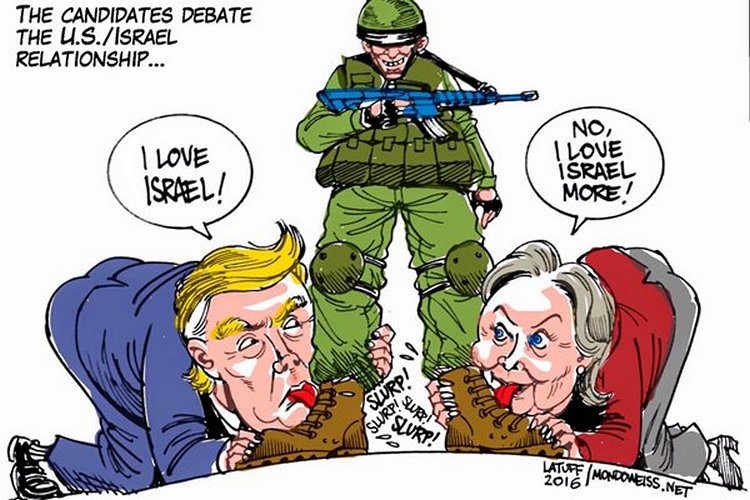
Neither Israel nor Saudi-9/11-Arabia are our friends.

I suspect if we gave Iran a fair shake we would be better off.

https://www.theamericanconservative.com/articles/when-eisenhower-republicans-censured-israel-three-times/

By Derek Leebaert

President Trump and much of his Republican Party have denounced first-term Representatives Ilhan Omar and Rashida Tlaib as “anti-Semites” and for “hating Israel”—labels that Mr. Trump will likely apply to varying degree to Democrats during the 2020 campaign.

Both Democratic congresswomen endorse boycotts, divestment, and sanctions—as well as UN censures of Israel—to support Palestinian rights. The American Israel Public Affairs Committee, among other interest groups, insists that BDS “intends to delegitimize” if not “destroy” Israel, and many politicians in Washington agree.

Yet interestingly, Omar and Tlaib are echoing the Republican Party’s support of censures and repeated threats to apply economic sanctions against the Jewish state from the days of President Dwight Eisenhower.

Eisenhower tightly controlled U.S. foreign policy and was pivotal to the UN Security Council’s censuring of Israel in November 1953, March 1955, and in January 1956. The reasons for each rebukes were similar, as they all involved what Eisenhower believed to be illegal aggression and violence against Israel’s Arab neighbors.

The first Arab-Israeli war had ended in 1949 along shaky armistice lines. The censures thereafter enacted were seeded by Israeli attacks on Jordan, Egypt and Syria. The U.S. threatened sanctions if the aggression continued. Secretary of State John Foster Dulles warned Israel’s ambassador, Abba Eban, against any further attacks while Eisenhower spoke darkly of Israeli “expansion.” He was supported in his position by the UK governments of Winston Churchill and Anthony Eden.

The first U.S.-backed censure in October 1953 followed an Israeli Defense Force attack on the village of Qibya, near Jerusalem on the Jordanian-controlled West Bank. “They shot every man, woman and child they could find,” reported Time magazine, “then turned their fire on the cattle,” while dynamiting houses, a school, and a mosque. Sixty-nine Palestinians lay dead, with no Israeli casualties. Prime Minister Churchill was repulsed by the atrocity and supported Eisenhower’s decision.

In July 1954, a self-described Israeli “terror unit” embedded in Egypt’s still-vibrant Jewish community bombed two U.S. consulate libraries as well as British civilian targets in Cairo and Alexandria. Israel’s goal was to destabilize Egyptian strongman Gamal Abdel Nasser’s government and to pin blame for the attacks on the Muslim Brotherhood. After authorities hanged two of the terrorists in January 1955, Israel retaliated by staging an IDF night attack on Gaza that killed 38 Egyptian soldiers.

The Americans didn’t believe Tel Aviv’s cries of self-defense. Following the incidents in Egypt, the U.S. again led a UN censure of Israel and warned that sanctions were imminent. Subsequently, Egyptian commandos—who had been busy skirmishing with British troops in the Suez Canal zone—responded with their own systematic raids.

In December 1955, an IDF assault against Syrian positions caused Eisenhower and Dulles to react swiftly with another censure resolution. At the United Nations, U.S. Ambassador Henry Cabot Lodge charged that “previous representations by the Council and the United States government have failed to halt the mass of Israeli attacks on its Arab neighbors and the whole Palestine situation has deteriorated as a result.”

Abba Eban insisted that Israel was retaliating, and he asserted that terrorists had killed or wounded 880 Israelis since 1951. The Americans were unpersuaded, and for good reason. The body count that resulted from Israel’s actions included “upward of 2,700 Arab infiltrators, and perhaps as many as 5,000, [who] were killed by the IDF, police, and civilians along Israel’s borders between 1949 and 1956,” writes the eminent Israeli historian Benny Morris, “the vast majority of those killed were unarmed.” He describes the dead as shepherds, farmers, Bedouins, and refugees trying to return to their villages. Within Israel, meanwhile, Palestinians lived under martial law — as they would until 1966…

Crushing Algeria’s rebels was an Israeli priority too, in addition to halting the border violence with Egypt and the flow of Soviet-supplied weapons into the port of Alexandria.

Unlike Arabs, who composed nine-tenths of Algeria’s population, Jews in Algeria were French citizens. The Israelis armed and trained Jewish-Algerian militias, shared intelligence with French officials, and helped break codes between the rebels and Cairo. Furthermore, Israel received its jets, tanks, artillery, ammunition, and napalm-drop equipment from France.

Eisenhower wanted the United States to remain neutral in the Arab-Israeli conflict and he therefore pledged that America would side with the victim of aggression should all-out war erupt.

Leaders of the three nations that invaded Egypt, starting on October 29, didn’t believe him: Britain presumed a special relationship; France concluded he was bluffing; and the Israelis expected Eisenhower to flinch because he faced reelection on November 6. Surely he’d succumb to pressure from Jewish voters. Instead he cut off oil and loans to Britain, among other measures which torpedoed the offensive. In tandem with Dulles, he compelled Anglo-French forces to leave Egypt in December.

Despite U.S. protests, however, Prime Minister David Ben-Gurion declared that Israel had overriding defense priorities and refused to withdraw IDF units from Egyptian terrain.

A curious leak then occurred in Washington on February 17, 1957. It concerned classified details about the war of 1948-1949. At that time, a defense pact still existed between Britain and Egypt. Once Israeli forces had pushed into Egypt in late 1948, London had issued a secret ultimatum for Israel to retreat. Ben-Gurion had regarded it as “a declaration of war.”

The ultimatum had been handed to him on New Years’ Eve 1948-49 by the U.S. ambassador to Israel, James MacDonald, as instructed by Harry Truman. Moreover, Truman, on December 30, had just issued America’s own demand that Israel pull out. Israel did so within a week.

Nearly eight years later, Eisenhower used this incident to show his country that Washington, under the Democrats, had already acted tough indeed toward Ben-Gurion and Israel.

Then came Eisenhower’s promise to go beyond mere UN censures.

On February 20, 1957, President Eisenhower spoke from the Oval Office about U.S. difficulties with Israel. “Should a nation,” he asked, “which attacks and occupies foreign territory in the face of United Nations disapproval be allowed to impose conditions on its own withdrawal?” He was set to push UN sanctions and to halt private U.S. business dealings with Israel, which included the purchase of Israeli bonds. In response, on March 1, Foreign Minister Golda Meir announced a prompt withdrawal from all Egyptian territory…

The last time that Washington placed “the Palestine Question” on the UN Security Council agenda in order to censure Israel was in 1966. On November 12, three Israeli soldiers were killed by a mine along the Jordanian-controlled West Bank border, and three days later Israel launched the largest military operation since Suez. “In hitting Jordan,” concluded President Lyndon Johnson’s national security adviser, Walt Rostow, “the Israelis have done a great deal of damage to our interests and to their own: They’ve wrecked a good system of tacit cooperation.”   The Americans again weighed sanctions, yet “antisemitism” and “delegitimization” were no more to be found among Rostow and his NSC staff than under Eisenhower and Dulles.

The 1967 Arab-Israeli war would alter the landscape. The result is today’s predicament: first, a half-century long military occupation with conditions in the West Bank that South African Nobel laureate Bishop Desmond Tutu describes as “worse than apartheid”; second, Israel’s recurring violations of international law, and of seven decades of U.S. policy, as its settlements expand into occupied territory; and, third, another open-ended body count of Palestinians. Once more, “the vast majority of those killed [have been] unarmed,” such as the 214 shot within Gaza by Israeli snipers throughout the 2018 protests.

In the absence of U.S. leadership, pressures for sanctioning Israel are this time coming from below, as from the two Congresswomen…

Be seeing you

aipac


Posted in Uncategorized | Leave a Comment »

Is The NY Times Preparing Us for a Camp of the Saints Experience? – PaulCraigRoberts.org

Posted by M. C. on August 23, 2019

Baquet’s project has a lot of facts to overcome, but it fits the agenda of Identity Politics, the ruling ideology of the Democratic Party and the American liberal/progressive/left. Be prepared to see many facts shouted down or ignored.

refocusing from Russiagate to Trump-the-racist

Ann Coulter is right-The Times must Die. See here.

https://www.paulcraigroberts.org/2019/08/22/is-the-ny-times-preparing-us-for-a-camp-of-the-saints-experience/

Paul Craig Roberts

Dean Baquet, the executive editor of the New York Times, told the Times’ employees on August 12 that the Times is refocusing from Russiagate to Trump-the-racist. Moreover, Baquet said, the Times is launching the 1619 Project that will “reframe” or reinvent American history. The purpose is to reduce the explanation of the United States to racism and slavery.

What, I wonder, is Baquet going to do when he has to confront the already “reframed” history of the “Civil War,” in which the United States at great expense and hardship and many deaths went to war to free black slaves in the South? How can Baquet reconcile racist white America with the reframed history of the War Against Southern slavery?

Baquet has an agenda, which is to dehumanize and demoralize white Americans so that overwhelmed with guilt they will accept their fate as their country is overrun by non-white immigrants. He has in the works for us a Camp of the Saints experience.

Perhaps Baquet’s plot will fail, but perhaps not. When Cambridge University’s white faculty and administrators accepted non-white political commissars assigned to their persons to insure that non-white people are not offended by offensive facts, words, and concepts, the concept of objective truth was undermined. When truth no longer matters, its place is taken by agenda. Note also that Cambridge has no consideration for white people who might resent the demise of academic freedom and the perversion of their own history in order to make non-whites feel better. Cambridge has abandoned not only academic freedom but also the core population of Great Britain. This suggests that Baquet’s war against truth will go well.

A list of accomplishments of Western Civilization would include the concept of objective truth, which requires free speech and free inquiry, a rule of law that holds government accountable and prevents arbitrary arrest and punishment, evidence-based conclusions, a sense of justice, respect for life and property. We can add others, and there are scientific, technological, artistic, musical, and architectural achievements. But the short list provides the gist of Western Civilization’s achievements. How can the New York Times explain these achievements in terms of racism and slavery? Does Baquet intend to simply erase these achievements? Do they go down the memory hole?

As Baquet believes he can explain President Trump in terms of racism and white supremacy, perhaps he thinks it is no big deal to explain the entire country and its history this way. Baquet’s project has a lot of facts to overcome, but it fits the agenda of Identity Politics, the ruling ideology of the Democratic Party and the American liberal/progressive/left. Be prepared to see many facts shouted down or ignored.

Be seeing you

Hastings on nonviolence: Stealing, getting caught, and ...

Posted in Uncategorized | Tagged: , , , , | Leave a Comment »

Why The New York Times is Unreformable and Must Die – Taki’s Magazine – Taki’s Magazine

Posted by M. C. on August 23, 2019

This is a newspaper that cannot be trusted on anything touching on race. They’re liars and ideologues, not reporters and editors.

Aren’t convinced? See here.

https://www.takimag.com/article/why-the-new-york-times-is-unreformable-and-must-die/print

by Ann Coulter

Even before The New York Times launched its “All Slavery, All the Time” project, no one could accuse that paper of skimping on its race coverage, particularly stories about black males killed by white(ish) police officers.

Here’s one you haven’t heard about. I happened upon it by sheer accident.

Antwon Rose II was a 17-year-old boy shot by an East Pittsburgh police officer in June 2018 after he bolted from a jitney car that had been stopped by the officer. The Times published about a half-dozen stories on Antwon Rose — or as the Times calls him, “Antwon, who was unarmed.”

After the officer was acquitted on all charges in March of this year, the Times ran an article by Adeel Hassan on the verdict.

Here’s what you would learn from the Times:

— Antwon was unarmed.

— Antwon “was in his high school’s honors program.”

— Antwon “played basketball and the saxophone.”

— Antwon “volunteered for a local charity.”

— In 2016, Antwon wrote a poem titled, “I Am Not What You Think!” which included these lines:
I see mothers bury their sons
I want my Mom to never feel that pain.

— A policeman stopped the gold Chevy Cruze Antwon “was riding in” because it “matched the description” of a car “involved” in a drive-by shooting minutes earlier.

— The jury consisted of nine whites and three African Americans.

If you read the Times piece, all you would know is that an honor student who loved his mom … was KILLED for the crime of riding in a car similar to one that had just been used in a crime.

Wow. Just wow.

Here are some of the facts the Times left out:

— The gold Chevy Cruze Antwon fled did not merely “match the description of” a car used in a drive-by shooting: It was the car used in the drive-by shooting, as proved by surveillance video posted online days after the shooting and shown to the jury.

— The video shows 13 shots being fired from the back seat of that exact car, with — according to the prosecutor — Antwon riding in the front seat.

— The backseat passenger, Zaijuan Hester, later pleaded guilty to the drive-by shooting.

— One of the victims of the drive-by shooting told police it was Antwon who shot him. “The beef was between me and him,” William Ross told a Pennsylvania State Police officer. “That car came by, he shot me, I ran to the store.”

— The jitney driver told police that, right before the shooting started, he heard the backseat passenger ask, “Is that him?”

— The gun used in the drive-by was recovered in the back seat of the car.

— A stolen gun was found under Antwon’s seat, an empty magazine in Antwon’s pants pocket, and there was gunpowder residue on Antwon’s hands.

— The car stopped by the officer was riddled with bullet holes.

— The jury that unanimously acquitted the officer was led by an African American foreman, who stoutly defended the verdict.

None of that made it into the Times story on the trial’s conclusion…

There’s no reason to think this isn’t standard operating procedure at the Times. The editors can’t say, OK, OK, that one got past us!

The Times has told wild lies about the racist shooting of Michael Brown in Ferguson, Missouri (false), the racist arrest of Freddie Grey in Baltimore (false), the racist shooting of Trayvon Martin in Florida (false), the racist gang-rape of a black stripper by a Duke lacrosse team (false) and so on.

Antwon Rose’s shooting wasn’t even a flood-the-zone, hair-on-fire story. But the Times lied about it, too.

This is a newspaper that cannot be trusted on anything touching on race. They’re liars and ideologues, not reporters and editors.

Be seeing you

Hastings on nonviolence: Stealing, getting caught, and ...


Posted in Uncategorized | Tagged: , , , | Leave a Comment »

Lindsey Graham’s Blank Check. Why a Defense Agreement With Israel Would Be a Disaster for Americans — Strategic Culture

Posted by M. C. on August 23, 2019

Two world wars began because of unconditional pledges made by one country to come to assistance of another.

I am sure Israel would come to our aid if we were attacked by say…Saudi Arabia.

Remember the Liberty.

https://www.strategic-culture.org/news/2019/08/22/lindsey-grahams-blank-check-why-a-defense-agreement-with-israel-would-disaster-for-americans/

Philip Giraldi


Two world wars began because of unconditional pledges made by one country to come to assistance of another. On July 5, 1914, Kaiser Wilhelm II of Germany pledged his country’s complete support for whatever response Austria-Hungary would choose to make against Serbia after the June 28th assassination of Archduke Franz Ferdinand of Austria by a Serbian nationalist during an official visit to Sarajevo, Bosnia. This fatal error went down in history as Germany’s carte blanche or “blank check,” assurance to Austria that led directly to WW I.

In September 1939, World War II began when Great Britain and France came to the assistance of Poland after the German Army invaded, fulfilling a “guarantee” made in March of that year. What was a regional war, and one that might have been resolved through diplomacy, became global.

One would think that after such commitments were assessed by historians as the immediate causes of two world wars, no one would ever consider going down that road again. But that would be reckoning without Republican Senator Lindsey Graham who has been calling for a “defense treaty” with Israel since last April. In his most recent foray, Graham announced late in July that he is seeking bipartisan support for providing “blank check” assurances to Israeli Prime Minister Benjamin Netanyahu and is hoping to be able to push a complete defense treaty through the Senate by next year.

In making his several announcements on the subject, Graham has been acting as a front man for both Israeli Prime Minister Benjamin Netanyahu and also for The Jewish Institute for the National Security of America (JINSA), which wrote the basic document that is being used to promote the treaty and then enlisted Graham to obtain congressional support.

Speaking to the press on a JINSA conference call, Graham said the proposed agreement would be a treaty that would protect Israel in case of an attack that constituted an “existential threat”. Citing Iran as an example, Graham said the pact would be an attempt to deter hostile neighbors like the Iranians who might use weapons of mass destruction against Israel. JINSA President Michael Makovsky elaborated on this, saying, “A mutual defense pact has a value in not only deterring but might also mitigate a retaliatory strike by an adversary of Israel, so it might mitigate an Iranian response (to an attack on its nuclear facilities).”

JINSA director of foreign policy Jonathan Ruhe added that “An Israeli strike on Iran’s nuclear program would not activate this pact, but a major Iranian retaliation might. – An Israeli unilateral attack is not what the treaty covers, but rather massive Iranian retaliation is what we are addressing.”

Israel has long been reluctant to enter into any actual treaty arrangement with the United States because it might limit its options and restrain its aggressive pattern of military incursions. In that regard, the Graham-JINSA proposal is particularly dangerous as it effectively permits Israel to be interventionist with a guarantee that Washington will not seek to limit Netanyahu’s “options.” And, even though the treaty is reciprocal, there is no chance that Israel will ever be called upon to do anything to defend the United States, so it is as one-sided as most arrangements with the Jewish state tend to be.

As the agreement between the two countries would be a treaty ratified by the Senate, it would be much more difficult to scrap by subsequent administrations than was the Iran nuclear deal, which was an executive action by President Obama. And clearly the statements by Graham, Makovsky and Ruhe reveal this treaty would serve as a green light for an Israeli attack on Iran, should they opt to do so, while also serving as a red light to Tehran vis-à-vis an ironclad US commitment to “defend” Israel that would serve to discourage any serious Iranian retaliation. Given that dynamic, the treaty would be little more than a one-way security guarantee from Washington to Jerusalem.

Furthermore, in outlining what circumstances would trigger US intervention on Israel’s behalf, the JINSA/Graham document cites, inter alia, “the threat or use of weapons of mass destruction.” It also allows Netanyahu to call for assistance after defining as threatening any incident or development “that gives rise to an urgent request from the Government of Israel.” It appears then that Netanyahu could demand that the US attack Iran should he only perceive a threat, however vague that threat might in reality be.

Israeli Prime Minister Benjamin Netanyahu has been claiming Iran is “three to five years” and “possibly weeks” away from a nuclear weapons capability since 1992 and pushing Washington to attack Iran so he obviously would welcome such a treaty for strategic reasons as well as to shore up his upcoming re-election bid. President Trump, with whom Graham has discussed how the agreement would work, has a similar interest in appearing strong for Israel to help his own campaign in 2020.

It is worth noting that in 2010 Netanyahu ordered the Israel Defense Force (IDF) to prepare to strike Iran but ‘Israel’s security chiefs refused: Gabi Ashkenazi, the head of the IDF, and Meir Dagan, the head of the Mossad at the time, believed that Netanyahu and the Defense Minister Ehud Barak were trying to “steal a war” and the order was not carried out. The attacks were also rejected by two ministers, Moshe Yaalon and Yuval Steinitz, which left Netanyahu without the necessary majority to proceed.

Ashkenazi claimed in a 2012 interview about the episode that he was convinced that an attack would be have been a major strategic mistake. Meir Dagan said in 2012, after leaving his role as Mossad chief, that a strike would be “a stupid thing” as the entire region would undoubtedly be destabilized, requiring repeated Israeli and American interventions.

And there are other issues arising from a “defense treaty.” Defense means just that and treaties are generally designed to protect a country within its own borders. Israel has no defined borders as it is both expansionistic and illegally occupying Palestinian land, so the United States would in effect be obligated to defend space that Israel defines as its own. That could mean almost anything. Israel is currently bombing Syria almost daily even though it is not at war with Damascus. If Syria were to strike back and Graham’s treaty were in place, Washington would technically be obligated to come to Israel’s assistance. A similar situation prevails with Lebanon and there are also reports that Israel is bombing alleged Iranian supply lines in Iraq, where the US has 5,000 troops stationed.

The real problem is that the Trump administration is obsessed with regime change in Iran, but it has so far been unable to provoke Iran into starting a conflict. Graham’s proposed treaty just might be part of a White House plan to end-run Congress and public opinion by enabling Israel to start the desired war, whereupon the US would quickly follow in to “defend Israel,” obliged by treaty to do so. What could possibly go wrong? The correct answer is “everything.”


Be seeing you

USS Liberty


Posted in Uncategorized | Tagged: , , , , | Leave a Comment »

What a Nobel Peace Prize, the Federal Reserve, and endless war have in common | The Daily Bell

Posted by M. C. on August 22, 2019

War funding is the main reason the government needs this hidden tax power.

With the help of the Federal Reserve, about $8 trillion of the $22 trillion national debt was spent on the wars in the middle east since 2001.

https://www.thedailybell.com/all-articles/news-analysis/what-a-nobel-peace-prize-the-federal-reserve-and-endless-war-have-in-common/

By Joe Jarvis

It was ten years ago that Congressman Ron Paul released his book, End the Fed.

It immediately shot to number six on the New York Times Bestsellers list.

Paul’s message was that the Federal Reserve was created to bail out banks. It privatized profits for them and socialized losses for the rest of us.

He said the system works against us by killing competition among banks and hiding taxes through inflation.

He’s right. The Federal Reserve can create money out of thin air, and lend it to the government to spend. But increasing the supply of money– when it’s not backed by anything– leads to inflation.

That’s because there are more dollars chasing the same amount of goods in the economy. So every dollar is worth less.

But the government benefits from the value stolen from each existing dollar… because it makes each dollar of government debt worth less in the future. Therefore inflation is just a hidden tax.

War funding is the main reason the government needs this hidden tax power.

In 2009, nominations for the Nobel Peace Prize closed just 11 days after President Obama took office.

Later that year, The Nobel Committee selected Obama to receive the Nobel Peace Prize.

Somehow, they knew that Obama– the new Commander-in-Chief of a nation embroiled in two wars– was truly a peaceful man.

At the same time, the Federal Reserve went to work on “quantitative easing”– a.k.a printing money. Ostensibly to save the country from a recession, the Fed conjured up trillions of new dollars.

But as you know, the wars continued…then they expanded.

The US gave air support to Libyan rebels in 2011, ousting Ghadaffi. Ghadaffi was no angel, but at least the country was stable under his regime. Today Libya is lawless and serves as a breeding ground for terrorism. Open public slave-markets have returned to Libya after being virtually non-existent during Ghadaffi’s four-decade rule.

The same year, America’s Nobel-peace-prize-winning President escalated drone bombings in Yemen which continue to this day, causing countless civilian casualties.

And then the US started bombing Syria, siding with rebels in the fight against Bashir al-Assad. Again, not a great guy. Yet the opposition forces, which the US funneled weapons to, included ISIS…

By 2015, Obama had sent in US ground forces to stop ISIS from gaining a foothold in the country which the US destabilized.

With the help of the Federal Reserve, about $8 trillion of the $22 trillion national debt was spent on the wars in the middle east since 2001.

But it hasn’t helped.

Today, the US is still bombing Yemen, is still at war with Afghanistan, still has troops in Iraq and in Syria, where the civil war continues.

And now you can hear the war drums beating once again, this time for Iran.

The wars have not ended, and neither has the Fed.

Today, the same banks that got us into the 2008-2009 recession exist, because the Federal Reserve helped bail them out.

They engage in the same behavior that got us into the last recession– essentially betting customers’ deposits on toxic investments, without enough reserves to back even a fraction of the potential catastrophic losses.

The US isn’t going to voluntarily end the Fed any more than it will pull out of all its wars and overseas interventions.

But the inflation needed for the war (and created by the Fed) threatens both the perpetual warfare system and the Federal Reserve…

Be seeing you

Commodity Money | Pronk Palisades


Posted in Uncategorized | Tagged: , , , , | Leave a Comment »

When State Governors Tried To Take Back Control of the National Guard | Mises Wire

Posted by M. C. on August 22, 2019

The National Guard actually being used to guard the nation instead of Exxon, Mobil and Boeing.

Not when the pentagram has it’s way.

https://mises.org/wire/when-state-governors-tried-take-back-control-national-guard

A West Virginia state lawmaker plans to re-introduce a bill next session that would require Congress declare war or call forth the state militia before the West Virginia National Guard could be released from state control and sent into combat. Currently, as The Intelligencer (of Wheeling) puts it: “the authority to activate the Guard rests with West Virginia’s governor.”

But this doesn’t quite describe the reality. State governors are expected to send state National Guard troops wherever and whenever the Pentagon orders.

So, in recent decades, whenever states or governors have attempted to have some say over what the Pentagon does with state troops, the Department of Defense has responded with threats.

For example, in the case of McGeehan’s bill:

Leaders with the West Virginia National Guard opposed the “Protect the Guard” measure, and said it could have cost the state millions as military missions would have been deferred to other states if the measure had been enacted.

According to McGeehan, “After the success on Monday, the Adjutant General of the West Virginia National Guard (James Hoyer) — along with the military brass at the Pentagon — aggressively worked behind the scenes to kill the bill,”

The Pentagon threatened to withdraw both federal military spending and materiel from the state, with a National Guard spokesman saying:

If enacted, the (U.S. Department of Defense) couldn’t count on us to be deployable … Missions and projects would go to other states, and there would be a loss of millions of dollars to West Virginia.

This isn’t the first time the Department of Defense has essentially bribed state politicians into buckling under demands for total state acquiescence to Pentagon demands.

The Governors’ Revolt of 1986

In the mid-1980s, the Reagan administration’s use of American troops in Central America had become increasingly controversial. The administration’s policy was being criticized for favoring brutal regimes in the region’s civil wars. Moreover, at barely more than a decade since the end of the Vietnam War, many Americans were less than enthusiastic about another round of US military intervention.

Consequently, many within the Democratic Party were both ideologically and politically motivated to find new ways to oppose the Pentagon’s use of National Guard troops in Central America.

In a report for the US Army War College, Historian Col. James Burgess, Col. Reid K. Beveridge, and Lt. Col. George Hargrove write:

Governor Joseph Brennan of Maine was the first to act. That year, he prohibited the deployment of 48 Maine Army Guardsmen to Honduras. … Brennan’s statement was immediately picked up by a number of other Democratic governors, who either stated they would refuse deployments of their troops or would refuse if tasked for a deployment. Principal among these were Governors Michael Dukakis of Massachusetts, Madeline Kunin of Vermont, Rudy Perpich of Minnesota, Bruce Babbitt of Arizona (although Arizona Guardsmen ultimately deployed), Richard Celeste of Ohio, Richard Lamm of Colorado and [Toney] Anaya of New Mexico. Expressing some reservations at the time also were governors Mario Cuomo of New York and Mark White of Texas.

Needless to say, this was inconvenient for the Pentagon which was used to using state troops to supplement deployments with a minimum of fuss, or any of the checks and balances that are supposed to be used in a federal system…

Moreover, James Webb, the assistant secretary of defense for reserve affairs warned: “the governors’ authority has become a vehicle to debate or influence foreign policy.” Webb also noted that there are historical precedents for governors refusing to send troops when called up, even in times of war.1

The response in Congress consisted of passing what is now known as the Montgomery Amendment.

Congress was reluctant to totally void a governor’s authority over deployment of state troops, as such powers had been recognized since the earliest days of the republic. But in an effort to further limit these powers, the Amendment stated that no governor could withhold a unit from deployment on account of “location, purpose, type or schedule of such deployment.”

Governors did retain powers to deny deployment if that deployment would interfere with state needs for troops, such as quelling civil unrest or providing disaster-relief activities.

But this didn’t end the debate. On January 22, 1987, Governor Rudy Perpich of Minnesota filed suit in US District Court of St. Paul challenging the constitutionality of the Montgomery Amendment, asserting it violates the Militia Clause of the Constitution.

Events Escalate in Ohio

While Perpich v. Department of Defense was working its way toward the US Supreme Court, the controversy between the Pentagon and the governors reached its most tense point in Ohio.

In 1987, the Pentagon ordered the Ohio National Guard adjutant general to deploy survey and engineering teams to Honduras in early 1988. Governor Richard Celeste then intervened and ordered the Guard to not deploy. Given that the state’s adjutant general answers to the governor as his commander-in-chief, the Guard declined the Pentagon’s order.

The Defense Department responded by playing hard ball.

Defense Department personnel began to develop a plan to remove all but a single unit of the National Guard form Ohio. Specifically:

the Ohio Guard grossly underestimated what [National Guard Bureau Chief Lieutenant General Herbert R.] Temple had in mind for them. Most of them apparently believed they stood to lose the engineer brigade headquarters (including one general officer as the commander) and perhaps the subordinate engineer battalions. None, however, dreamed — it seems — that the Ohio National Guard could be made to disappear over a period of a very few months except for only the 73rd Infantry Brigade. And. in particular, that the Ohio Air National Guard could be made to cease to exist.

The primary purpose of all of this was to use the Pentagon’s financial power to take resources out of the state, thus reducing state revenue and economic activity generated by federal spending inside the state. The local media began running stories about how the move would lead to lost jobs.

Moreover, the Pentagon’s move would have forced the state to fund all of its own remaining National Guard units. The bill would have been $256 million.

Eventually, the governor caved, and the Ohio National Guard deployed as the Defense Department wished.

In 1990, the US Supreme Court sided with the Department of Defense, and ruled the Montgomery Amendment was binding.

For the moment, the matter was settled.

Why the Pentagon Has so Much Power Over State Troops

Today, when the militia clause of the Second Amendment is mentioned, it is not uncommon to hear the claim that “the National Guard is the militia.”

This stretches the truth, to say the least.

Today’s National Guard is nothing like the independent state militias that existed throughout the nineteenth century up until the adoption of the Militia Act of 1903. Prior to the 1903 act, state militias were primarily state funded, and were not integrated into the federal government’s military structure except in times of declared war.

The Militia Act created a new type of “militia” which replaced the old decentralized model with a new system in which state National Guard units were to receive federal funding and were to be integrated into the national military as a permanent reserve force.

But even after 1903, the state National Guards retained a high degree of independence compared to today. That was further eroded with the National Defense Act of 1916 which allowed National Guard United to be deployed outside their own states — and even outside the country — for much longer periods of time than had been previously allowed. The 1916 Act further increased federal funding — and thus federal control — over National Guard units.

Another major change came in 1933. At that time, new amendments to the National Defense Act were passed which made members of the National Guard units members of both their state’s National Guard, and the federal military.

Further integration occurred throughout the following decades, culminating with the adoption of the “Total Force Policy” in 1970. According to Burgess, et al., this meant National Guard units became fully “woven into the fabric of the Defense establishment.”…

The Pentagon is used to state governors asking “how high?” whenever being told to jump. But the Pentagon keeps an ace up its sleeve in case any state politicians get uppity. The Pentagon will simply threaten to remove millions of dollars worth of spending from any state which refuses to immediately comply.

So long as most Americans blithely accept whatever new wars and invasions the Pentagon plans, this strategy will probably keep working.

Be seeing you

deep state media

It’s Always About Control


Posted in Uncategorized | Tagged: , , , , | Leave a Comment »

Larry Summers Comes Clean Ahead Of J-Hole, Admits Central Planners Are Impotent | Zero Hedge

Posted by M. C. on August 22, 2019

https://www.zerohedge.com/news/2019-08-22/larry-summers-comes-clean-ahead-j-hole-admits-central-planners-are-impotent

by Tyler Durden

Larry Summers is not one to be shy about sharing his opinion on any and every media channel about just how bad President Trump’s policies are, and how much better everything was in the world under President Obama.

However, in an epic thread of apparent honesty, the former director of the National Economic Council for President Obama took to Twitter to dispel any myths about the omnipotence of central planners and to confirm there’s nothing anyone can do to save the world from doom (especially Jay Powell’s speech tomorrow).

Mea Culpa? Or partisan political pandering to reinforce the “recession is imminent and there’s nothing to stop it and it’s Trump’s fault and that means Trump’s unelectable” narrative?

You decide…

Summers begins his diatribe by addressing the big imminent issue ahead of us:

“Coming into Jackson Hole, economists are grappling with a major issue: Can central banking as we know it be the primary tool of macroeconomic stabilization in the industrial world over the next decade?“

His worry – they are running out of ammo and what ammo they have is losing its mojo…

This limited space for interest rate cuts is true of the US, which has the highest interest rates in the industrialized world. It is even more true of Europe and Japan. 3/

QE and forward guidance have been tried on a substantial scale. We are living in a post QE and forward guidance world. It is hard to believe that changing adverbs here and there or altering the timing of press conferences or the mode of presenting projections is consequential. 4/

Then, Summers goes after central planner over-confidence…

Black hole monetary economics – interest rates stuck at zero with no real prospect of escape – is now the confident market expectation in Europe & Japan, with essentially zero or negative yields over a generation. The United States is only one recession away from joining them. 6/

Everywhere in the industrial world, the risks of a sharp upturn in unemployment appear greater than the risks of a sharp upturn in inflation (even though market expectations of inflation are clearly below 2 percent targets). 7/

The one thing that was taught as axiomatic to economics students around the world was that monetary authorities could over the long term create as much inflation as they wanted through monetary policy. This proposition is now very much in doubt. 8/

Wait, what!!!??

Call it the black hole problem, secular stagnation, or Japanification, this set of issues should be what central banks are worrying about. 10/

In our forthcoming paper, we argue that it minimizes our predicament to see it – as is current consensus – simply in terms of a falling neutral rate, low inflation, and the effective lower bound on nominal rates. Secular stagnation is a more profound issue. 12/

Limited nominal GDP growth in the face of very low interest rates has been interpreted as evidence simply that the neutral rate has fallen substantially. There may well be more to it than that. 13/

We believe it is at least equally plausible that the impact of interest rates on aggregate demand has declined sharply, and that the marginal impact falls off as rates fall. 14/

And then Summers drops the real hammer – rate cuts are useless… or worse, are actually worsening the situation.

It is even plausible that in some cases interest rate cuts may reduce aggregate demand: because of target saving behavior, reversal rate effects on fin. intermediaries, option effects on irreversible investment, and the arithmetic effect of lower rates on gov’t deficits. 15/

If the central problem for macroeconomic stabilization is a falling neutral real interest rate – what might be called “old new Keynesian” economics – monetary policy can achieve full employment if it can get the interest rate low enough. 17/

In contrast under the secular stagnation view we have outlined – what might be called “new old Keynesian” economics – interest rate cuts, even if feasible, may be at best only weakly effective at stimulating aggregate demand and at worst counterproductive.  18/

First, financial instability. The financial crisis had roots in bubbles & excessive leverage caused by efforts to maintain demand after the 2001 recession. Japan’s late 1980s bubble had roots in a low interest rate tight fiscal environment after the 1987 stock market crash. 20/

Second, risks of zombification of firms. Firms that do not face debt service payments are like students who do not have to take tests. They can drift along complacently & ultimately unsuccessfully. And low rates may contribute to increased monopoly power and reduced dynamism. 21/

Third, risks of bank failures. Low rates crowd bank profits and franchise value, making them more vulnerable to adverse shocks at any given level of regulatory capital. 22/

Fourth, risks of further reducing monetary policy effectiveness. To the extent to which rate cuts now “borrow” demand from the future as firms and consumers bring forward investment and durable purchases, low rates now may imply less effective monetary policy in the future. 23/

Summers then goes further – blasting Central planners for claiming they can “contain” the issues…

Obviously fiscal policy needs to be a major focus, especially given what low or negative interest rates mean for the sustainability of deficits. 25/

But the level of demand is also influenced by structural policies: e.g. pay-as-you-go social security, higher retirement ages, improved social insurance, support for private infrastructure investment, redistribution from the high-saving rich to the liquidity-constrained poor. 26/

The high inflation and high interest rates of the 1970s generated a revolution in macroeconomic thinking, policy and institutions. The low inflation, low interest rates and stagnation of the last decade has been longer and more serious and deserves at least an equal response. 27/

But at least he ends on an upbeat note ahead of Jay Powell’s speech tomorrow…NOT!

So, after that 28 tweet thread of self-flagellation, wouldn’t it have been more interesting if Summers had said all that oh, ten years ago?

Be seeing you

Cartoon of the Day: Central Planning #Failure


Posted in Uncategorized | Tagged: , , , , , | Leave a Comment »