As President Donald Trump’s critics focus anew on whether he obstructed justice to thwart Special Counsel Robert Mueller’s investigation, a more flagrant abuse of presidential power is unfolding in plain sight.
For weeks, Trump has continued America’s involvement in the war in Yemen, siding with Saudi Arabia against Congress, the body that the Constitution vests with the power to declare war. The House last month approved a resolution, 247 to 175, directing the president to withdraw the U.S. from the war on Yemen. A bipartisan Senate majority had already approved the same resolution. And the American public has no appetite for a long war in Yemen.
On its own, waging war after an official call from Congress to stop doing so ought to be regarded as a violation of the Constitution that warrants impeachment.
But there’s even more to the Trump administration’s “Saudi Arabia First” foreign policy: Citing a provision in the Arms Export Control Act that allows the president to bypass the legislative approval process in an emergency, the administration is circumventing a block on arms sales to the Saudis.
“We have the constitutional duty to declare war and the responsibility to oversee arm sales that contravene our national security interests,” Democratic Senator Chris Murphy has complained. “If we don’t stand up to this abuse of authority, we will permanently box ourselves out of deciding who we should sell weapons to.”
Congress ought to eliminate the emergency provision. But the provision’s existence does not justify its invocation when there is no actual emergency. Secretary of State Mike Pompeo says the weapons are needed to deter Iran, but that hardly amounts to an immediate crisis.Daniel Larison notes:
The weapons that the U.S. sells to the Saudis and the UAE won’t be used to defend against a supposed Iranian threat, and they won’t be used for deterrence. We know very well that the Saudi and Emirati governments will use the weapons they obtain from the U.S. to continue waging an atrocious war against Yemen, and those weapons will very likely end up being used to kill civilians as so many other U.S.-made weapons have been. Trump is helping to fuel Saudi coalition aggression against a poor country that they have been wrecking and starving for more than four years. This will not avert a war with Iran, but it will help to keep the war on Yemen going.
Put succinctly, the Trump administration unlawfully defied Congress to extend American participation in a war in Yemen, and now it is defying America’s elected representatives again to funnel more weapons to that war’s ringleader.
Perhaps a lawsuit of the sort urged by some legal scholars who believe votes against wars cannot be constitutionally vetoed by the president would prove effective.
“I’m confident these new arms sales provides new momentum for pursuing legal action and legislation that would end U.S. involvement in the war,” Democratic Representative Ro Khanna stated on Twitter. “The lawsuit is important to uphold Congress’ constitutional War Powers & challenge President Trump’s veto of our Yemen WPR.”
But there is a more direct remedy available to Congress. So long as some of its members are invoking alleged obstruction of justice to justify impeachment proceedings, they ought to invoke abuse of the war power, too. The prospect of being removed from office is far more likely than even a successful lawsuit to deter this president and his successors from usurping the legislature’s authority.
Huxley was far more the prophet than Orwell. Infantilize and addle them and you control them – without needing guns. Get them to peck at screens like a sea gull at the beach enraptured by a piece of tinfoil.
You’ve probably seen people driving around in cars covered over – “wrapped” – with advertisements for some service or product and wondered how much the owner got paid to allow his car to be transformed into a mobile billboard.
But he is at least getting paid.
The non-wrapped cars are working, too – but their owners aren’t being compensated with even a coupon for the data being mined from them as they drive. Data about their preferences and habits, which is sold for money to interested parties – who in turn use the information to tailor and personalize the sales pitches they make to the same person who isn’t being cut in on the action.
Who is the action.
You.
Some of this is opt-in and even laudable, or atisn’t objectionable – because you still have the choice to say nope – or because you do get something besides a sales pitch.
For example, Amazon is offering in-car delivery, making it possible to order stuff from the car and have the stuff sent to the car, wherever it happens to be – because Amazon knows where it is via GPS locater technology – and has the stuff you bought put into the car even if you’re not in the car – because you’ve given Amazon the “keys” to your car (remote access to the trunk, etc.).
In California, fuel delivery service is available. Sign up for this and the fuel company you do business with knows when you’re running low – the car lets them know – and sends out a tank truck to top off yours. It’s a nice service for those who are willing to pay a little extra for the convenience – and who don’t mind that a corporation is keeping track of their fuel usage and knows where their car is at any given time. Probably other things, too.
But what if you do mind – and don’t want? And can’t say nope?
Then it’s a problem.
“Connectivity” is like a rip-tide that sweeps everything along with it. Many of us do mind and don’t want to be tracked (and audio/video recorded) by always-on GPS transponders in cell phones and microphones and cameras embedded in our laptops – but good luck finding a phone or laptop without these devices.
And good luck turning them off.
You can say nope – technically – by not having a smartphone or a laptop. But good luck working in the “connected” world without them.
Fate meet acccompli.
GM’s “Marketplace” system is among the latest examples of the connectivity rip tide. It is already standard in a number of new GM vehicles and probably soon all of them. Like air bags and ASS and other things you may not want, you get Marketplace if you buy the car.
In the oleaginous lingo of modern tech-peddling, Marketplace “hosts” for “partners” such as Dunkin’ (no longer Donuts) and ExxonMobile, hoping to steer you their way.
It will work almost exactly like the cookies and pop-ups that plague our desktops and laptops only now we’ll be sales-pitched as we drive.
Of course, this isn’t “distracting” . . . because it’s profitable.
According to a report styled Best Practices for Direct Monetization of Connected Vehicles, the “potential” for making lots of money this way is “very high.”
Which, of course, explains the why.
It has become very hard to make a buck selling cars. Profit margins per sale are in the area of 2-3 percent and sometimes none at all. Electric cars and hybrids are “sold” at a loss.
Trucks and SUVs make up for some of this, but it is becoming harder to make trucks and SUVs because of the carbon dioxide “emissions” and fuel economy fatwas.
So the car companies have bought in to the idea of selling data culled from the vehicles they sell to you. You become the product and the customer.
It is a “business” (in quotes to emphasis the shadiness of being forced to do business) that is estimated to be worth as much as $1 billion annually.
It will be worth even more when we can’t say nope.
This is already the case with the data mined by the Event Data Recorders (EDRs) which are standard equipment in all new cars and have been for years. The data mined includes seat belt usage (or not), speed of the vehicle, braking inputs – and so on. Though the car is yours as a legal technicality the courts have ruled the data can mined by the insurance mafia or the courts without your permission – to be used as evidence against you in civil/criminal proceedings.
In other words, they own the data.
Similarly, John Deere – which will sell you a tractor but retains “rights” to the software that controls it and the data they use to service it – and keep you from servicing it yourself.
It follows from this principle that data regarding our travel habits and personal activities/preferences are likewise the implicit property of the mafia and government – and the tech necessary to mine this is likewise already embedded in most cars built since the mid-1990s and all of them built since the mid-2000s or so.
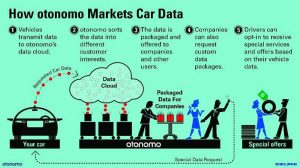
One of the companies pushing to know more about us – and make a buck off us – is the Israeli tech company Otonomo, which is marketing a “data aggregation platform” that can track 500 distinct “data points” from vehicles. These “data points” can then be bundled – anonymously, Otonomo assures – and sold off to . . . interested parties.
These will inevitably include the insurance mafia as well as various government entities.
Both of them already champing at the bit to nix the “anonymous” element in order to tax-by-mile and surcharge according to each “unsafe event” – such as driving faster than the speed limit or accelerating/braking too “aggressively.”
Corporate interests want to know when – and where – you tend to stop for a snack or coffee; where you got your oil changed and bought tires. Did you go the gym today? Did you leave work early yesterday? (Your estranged wife’s lawyer wants to know.)
They’d all very much like to know everything about you. Hackers, too. And they don’t need to ask – or get – permission to data mine your car.
“We liken connected cars to a cellphone on wheels,” explains Otonomo’s chief marketing officer Lisa Joy Rosner. “On our phones, we share our data because we get so much out of it. You get apps that make the phone more . . . interesting.”
Ellipses and italics added.
Interesting indeed.
Most people will probably “sign up” eagerly – as they already do for the various data-mining/monitoring apps they freely download onto their phones. And of course, the phones themselves function exactly like the ankle bracelets applied to house-arrested small-time criminals, to keep track of their whereabouts.
The only distinction being the cell phone owner is still free to roam.
Huxley was far more the prophet than Orwell. Infantilize and addle them and you control them – without needing guns. Get them to peck at screens like a sea gull at the beach enraptured by a piece of tinfoil.
If they never look up, they’ll never notice the eyes upon them – and probably wouldn’t care if they did.
I’m taking the gloves completely off here. I’ve inferred that Americans collectively are pretty gullible and naive. I’ve invoked comparisons to Mike Judge’s movie Idiocracy. But it’s time to simply tell it like it is: the majority of present-day Americans are stupid beyond belief.
This doesn’t include all the increasing number of “awake” people out there, but it certainly does include the newly coined “woke” folk, who seem to be sleeping more soundly than the average American dupe. Ironically, a lot of these “woke” Americans are “mad as hell” but their anger is focused exclusively on Donald Trump. They figure if they can just get him to go away, things will be back to normal. “Normal” being the kind of nonstop corruption I wrote about in Hidden History.
My bleak assessment has some scientific evidence to back it up. Even mainstream sources report that IQ scores all over the world have been dropping for decades. Some estimates put the IQ drop at about 7 points for each subsequent generation born after 1975. These studies were centered in Norway, or other parts of the western world. My guess is that the average American IQ, if anything, has decreased more sharply than that…
Consider all that Americans have permitted over just the last thirty years. They fell for the “invasion” of Kuwait nonsense, and were ready to send their children to die in a place they wouldn’t have been able to locate on a map the week before. They parroted the mainstream media line about Saddam Hussein being a “brutal” madman, when they previously wouldn’t have been able to identify him. They fell for the “babies in incubators” line from the crying young girl, and didn’t blink when she was exposed as the daughter of the Kuwaiti ambassador lobbying for war.
Enough Americans bought Bill Clinton’s obsequious “I feel your pain” charade to elect him president twice. They ignored the growing body count and the outrageous corruption that began in Arkansas during his tenure as governor, as studiously as the fawning mainstream media did.
We crossed one of those important moral lines in the sand when the majority of Americans stood by silently as armored tanks demolished a home (smeared continuously in the media as a “compound”) and poured deadly gas banned by the Geneva Convention inside, killing civilians that included a large number of children. What happened at Waco should have garnered impeachment charges against Bill Clinton, with criminal charges to follow. Instead, the inventor of identity politics was re-elected, and continued to garner almost 100 percent support from Hollywood…
It’s not pleasant to call people stupid. After all, you wind up essentially calling yourself superior, and sounding elitist. But what else can you say about people who bought into the state-sanctioned, mainstream media driven “Russian collusion” conspiracy theory? The same Americans who can’t accept that 9/11 was an “inside job” believe that “the Russians” somehow “hacked” our election and denied us all the wonderful opportunity a Hillary Clinton presidency would have represented.
We’ve known the facts about the lack of intellect in our country for quite a while. All those “person in the street” interviews, done by everyone from Jay Leno to “conspiracy theorist” Mark Dice, demonstrate all too clearly just how ignorant the average American is. Many Americans seem to revel in their stupidity.
If Mike Judge’s film Idiocracy is now seen as an unfortunate prophecy, what does the huge popularity of the movie Dumb and Dumber demonstrate?
The University of Chicago has set the gold standard on free speech and open inquiry. In 2014, it created its “Statement on Principles of Free Expression” (aka the Chicago Principles).
When you send your youngster off to college, you might not mind that they will have to walk on eggshells, respect taboos, snitch on fellow students for politically incorrect jokes and learn to use ad hominem arguments as a means to attack ideas they find “disagreeable.” If that’s your preference, you can choose from a wide variety of America’s top-ranked colleges. If you want to send your youngster to colleges that are seriously committed to civil and diverse debate, pick up a copy of the June 2019 edition of Reason magazine for some guidance.
Professors Debra Mashek and Jonathan Haidt authored “10 Colleges Where You Won’t Have to Walk on Eggshells.” Mashek and Haidt are, respectively, faculty members of Harvey Mudd College and New York University. Haidt is the co-founder of the Heterodox Academy and Mashek is its executive director. Heterodox Academy is nonpartisan and boasts a membership of more than 2,500 faculty and college administrators who advocate for open inquiry and civil disagreement on college campuses and in academic disciplines.
The Mashek and Haidt article discusses 10 colleges in alphabetical order. Among them is Chapman University, whose president, Daniele Struppa, is “an outspoken advocate of academic freedom and freedom of speech.” Struppa has little tolerance for the political correctness so prevalent at most of the nation’s colleges…
Other colleges listed in the Mashek and Haidt article, where students won’t have to walk on eggshells include Arizona State University, Claremont McKenna College, Kansas State University, Kenyon College, Linn-Benton Community College, St. John’s College, University of Richmond and Purdue University. It’s worth noting that Mitch Daniels is president of Purdue University and former two-term governor of the state of Indiana. Daniels and his interim provost Jay Akridge wrote this message to the Purdue community: “At Purdue, we protect and promote the right to free and open inquiry in all matters and guarantee all members of the University community the broadest possible latitude to speak, write, listen challenge and learn.”…
At the end of Professors Mashek’s and Haidt’s article, they come up with a few suggestions for parents. Visit the Foundation for Individual Rights in Education website to find out about a particular college’s agenda to suppress free speech. By all means, check out the Heterodox Academy website. Search the college’s website for terms such as “open inquiry,” “freedom of expression” and “free speech.” Examine the college’s calendar of events to see whether speakers with diverse opinions are invited. Visit the campus. Talk with actual students about their experiences. In this article, Mashek and Haidt give specific questions to ask. I’d add to their list of things to do on a campus visit: Talk to the local police, bartenders and hospital people about the college. They might give you insights that an admissions officer would choose to keep hidden.
The principles of economic thought tells us that investments would flow to places with less capital accumulation, the reason being is that there would be less competition, thus a higher rate of return on investments. Indeed, as Adam Smith noted in the Wealth of Nations, capital accumulation would be the inevitable hindrance to economic growth.
However, this not as we have it in the real world. Many countries, especially those in the Global South, have very little capital, but yet aren’t flooded with investments. The reason for this is simple: there is no assurance that their property and investment would be protected by the law.
Picture this, why would someone invest in a piece of property, plot of land, or share in a business when there is a high probability that a random bandit, even worse, the government, could steal it at any time without assurance of compensation? This is certainly the norm in many authoritarian countries. For example, a report from the Business Anti-corruption Portal described the police in Nigeria “as the most corrupt institution in the country”, as they often impede on businesses and act above the law. If a country wants to attract foreign direct and portfolio investments, there ought to be a framework that holds people accountable to the arbitrary use of force: this is the rule of law.
This also goes hand-in-hand with property rights since the rule of law is the necessary condition under which property rights can be successfully employed. Indeed, as James Robinson points out in his essay, “Property Rights and African Poverty,” the lack of property rights has been the number one obstacle to economic prosperity in Sub-Saharan Africa. This is contrary to most prevalent views which blame the legacies of colonization and also the geographical location of sub-Saharan Africa to its economic shortcomings.
In addition, most of these countries are filled with an abundance of natural resources — for or example the diamonds in Congo, gold in Ghana, and oil in Nigeria — but yet are not flooded with investments. Some commentators have called this phenomenon the “resource curse.” This occurs when governments focus solely on natural resources as a means to get revenue while ignoring other parts of the economy, consequently making the country worse off as a whole.
Although there is some truth in this statement, the fact that these countries don’t possess or uphold a framework of laws which protect persons and property from arbitrary government interference is still the key explanation to this problem. As Thomas Sowell puts it brilliantly in his book, Basic Economics, “ Countries whose governments are ineffectual, arbitrary, or thoroughly corrupt can remain poor despite the abundance of natural resources, because neither foreign nor domestic entrepreneurs want to risk the kinds of large investments which are required to develop natural resources into finished products that raise the general standard of living.”
On the other hand, we could take a country, Hong Kong, which does not have an abundance of natural resources, but has been flooded with capital in recent times. Furthermore, Hong Kong has been continuously ranked as one of the freest places in terms economic freedom by think-tanks such the Fraser Institute and the Heritage Foundation…
It is fair to say that concepts like the rule of law and property rights are not innate to any civilization; indeed, countries like the United States and Britain, which we could say have civil institutions, underwent violent revolutions in order to put these principles in place. This is not to say that current less-economically developed countries need to follow a similar path. Needless to say, there is a need to change the intellectual climate in these nations. This could be done by being less dependent on foreign aid, imposing checks and balances on politicians, and implementing free-market economic policies such as free trade and lower taxes.
Kimberly Del Greco, a deputy assistant director at the FBI, said the bureau has strict policies for using facial recognition. She said it is used only when there is an active FBI investigation or an assessment, which can precede a formal investigation.
This is the same FIB that worked to get Hillary elected.
The same FIB that is trying to unseat a sitting US president.
Trust them? Believe them? NO. Believe the worst? YES.
Kennedy wanted to smash the CIA, the FIB might have been next. He got dead. Robert Kennedy hated Hoover but Robert got dead. Ron Paul got much of what little vote count he received stolen. Remember the Maine.
WASHINGTON (AP) — A government watchdog says the FBI has access to about 640 million photographs — including from driver’s licenses, passports and mugshots — that can be searched using facial recognition technology.
The figure reflects how the technology is becoming an increasingly powerful law enforcement tool, but is also stirring fears about the potential for authorities to intrude on the lives of Americans. It was reported by the Government Accountability Office at a congressional hearing in which both Democrats and Republicans raised questions about the use of the technology.
The FBI maintains a database known as the Interstate Photo System of mugshots that can help federal, state and local law enforcement officials. It contains about 36 million photographs, according to Gretta Goodwin of the GAO.
But taking into account the bureau contracts providing access to driver’s licenses in 21 states, and its use of photos and other databases, the FBI has access to about 640 million photographs, Goodwin told lawmakers at the House oversight committee hearing…
Around the world, governments are hitting on a modish new idea: Turn the internet off. Sometimes they mean it literally.
Methods vary, but the trend is clear enough. Countries are increasingly ordering telecoms and other companies to block network access, shut down messaging services, or otherwise restrict digital applications or websites, usually citing public order or national-security concerns. In extreme cases, internet access can be “blacked out” entirely. Worldwide, such shutdowns rose to 188 last year, up from 75 in 2016.
Expect that regrettable figure to rise. For autocrats, the appeal is obvious. They can use such restrictions to suppress inconvenient news or unwanted opinions, censor political rivals, prevent activists from organizing, and stifle talk of government misdeeds. For instance, after voters cast ballots last year in an election widely seen as corrupt, the government of the Democratic Republic of the Congo blocked all internet access for nearly three weeks. The stated goal — which cost the impoverished country roughly US$3 million a day, according to one calculation — was to prevent “chaos.”…
The problem is that there’s no evidence such bans work. They do nothing to moderate the anger that might lead to violence, and dedicated troublemakers can evade them with VPNs and other technology — or simply by spreading rumors the old-fashioned way. Shutdowns also tend to become a habit: They are imposed in India more often than in all other countries combined, sometimes for bizarre or trivial reasons.
And the drawbacks are severe. Done rashly, internet blockages can impede vital communication, hinder the work of emergency workers, induce public panic, and encourage the spread of rumors in the absence of reliable news coverage. They might even encourage violence. Unsurprisingly, they’re also expensive: By one estimate, India’s shutdowns have cost more than US$3 billion over five years…
In authoritarian countries, where total blackouts are becoming more common,…
Realistically, internet shutdowns are going to get more common in the years ahead. The goal should be to limit them as far as possible, and to raise the costs of government abuse.
New York schools fighting discrimination with discrimination. They must have used the same consultants as Antifa. Antifa fights discrimination with beatings, burning and looting but you have to start somewhere.
Is the program complete when teachers and students come to school wearing bandanas over their faces?
Happy Friday everyone. Here’s our weekly roll-up of some of the most bizarre (and occasionally happy) stories from around the world that we’re following:
NYC schools training teachers to discriminate against white students
A new mandatory, $23 million “anti-bias” program is training New York City school teachers to discriminate against white children, no matter what.
The New York Post recently published remarks from one training session, in which the instructor defined ‘racial equality’ as favoring non-white students over white students, regardless of any other circumstances.
In another session among NYC school superintendents, attendees were asked to discuss various life experiences that inspired them to fight for social justice.
One high-ranking school official– a white, Jewish man, described his family’s experience in the Holocaust and Nazi concentration camps.
He was publicly chastised by his own colleagues, with one woman saying “This is not about being Jewish! This is about black and brown boys of color only. You better check yourself.”
According to a middle school teacher interviewed by the Post, the training teaches ‘replacement thinking’ and encourages educators to become ‘liberated’ from their ‘whiteness’.
CPS agent strip searched young children in their own home
In 2017, a Kentucky mother named Holly Curry popped into a local cafe to buy some muffins. She left her children in the car– it was a cloudy, 67 degrees (about 19C).
Within 10 minutes, the cops were already on site, telling Curry that they were calling in Child Protective Services.
The next day, a CPS official arrived to Curry’s home and demanded entry, claiming that any refusal would result in the forfeit of her children.
The official was allowed inside and began to ask questions of Curry. Then, without asking for Curry’s permission, the investigator took the three children and undressed them all, down to their genitals, to check for bruises and signs of abuse.
Curry was eventually found not guilty of child neglect. But she filed a federal lawsuit to protest this gross perversion and invasion of privacy on the part of government officials.
We’re particularly interested in the outcome of this as it may be an important precedent in either reining in this sort of disgusting abuse of power… or additional license to let it continue unchecked.
Be seeing you
The ISIS head chopper look. Cultural appropriation!