
In this episode, I break down a classic song that contains musical illusions you never noticed, and you’ll never be able to un-hear them again.
https://youtube.com/watch?v=2qRoMDl0tYw&feature=shared
Be seeing you

Enemy of the State-Read the Book-Know the Man
This is not a Safe Space but Baby, I don't care.

"I am not a number, I am a Free Man" - No. 6
 Information Liberation Alex Jones’ Prison Planet Gary North Specific Answers Antiwar The Daily Bell Tenth Amendment Center Economics Policy Journal The American Thinker The New American Lew Rockwell
Posted by M. C. on May 8, 2025
In this episode, I break down a classic song that contains musical illusions you never noticed, and you’ll never be able to un-hear them again.
https://youtube.com/watch?v=2qRoMDl0tYw&feature=shared
Be seeing you
Posted in Uncategorized | Tagged: The Birds, Turn turn turn | Leave a Comment »
Posted by M. C. on May 6, 2025

A Libertarian Review of the First 100 Days
| Understanding the “First Hundred Days” The idea of judging a president by their first 100 days in office dates back to Franklin D. Roosevelt’s New Deal blitz in 1933. Ever since, it’s served as a benchmark for evaluating early priorities, tone, and executive impact. For libertarians, that means asking: Has government grown or shrunk? Have Americans gained more freedom, or lost it? Let’s examine where President Trump’s return to the White House stands on those counts. Help us hold leaders accountable to shrinking government and expanding freedom. >>> |
| Economy Tariffs Return with a Vengeance: Trump’s sweeping tariffs on imports, from allies and adversaries alike, signal a revival of protectionist policy. Markets wobbled, and consumer prices are already rising in key sectors. Tax Cuts Without Spending Cuts: Promises to eliminate taxes on tips and overtime sound good, but without significant spending reductions, they risk compounding the federal debt. Libertarian View: Tariffs are taxes on consumers, not foreign governments. We favor tax relief, but when paired with spending discipline. Fund our fight for free markets! >>> |
| Foreign Policy Ukraine Aid Halted: The administration has halted lethal aid to Ukraine and called on Europe to assume more responsibility. This marks a shift away from interventionist spending. Blank Check to Israel: Simultaneously, the administration continues sending arms to Israel and offering military support without conditions. Libertarian View: We applaud a move toward restraint in Ukraine, but oppose maintaining entanglements elsewhere. America should not be the world’s police force, or arms dealer. Support our push to end America’s role as the world’s police. >>> |
| Domestic Policy & Regulation Executive Order Overload: Over 140 executive orders in the first 100 days alone. Topics range from rolling back DEI mandates to renaming geographic regions and expanding executive authority. DOGE and Downsizing: A new Department of Government Efficiency claims billions in cuts and tens of thousands of federal layoffs, though questions remain about the math. Even with these cuts, overall U.S. spending remains at or near record highs. Libertarian View: Shrinking government is a win. But relying on executive orders instead of legislative change centralizes power, even when the policy is right. Real decentralization requires structural change, not just a reshuffling of bureaucracies. Help us demand real decentralization. >>> |
| Justice & Criminal Reform Mass Pardons: President Trump has pardoned over 1,500 individuals, including non-violent January 6 defendants and Ross Ulbricht. Police Militarization Resurges: Orders to loosen federal oversight of police, re-arm departments with military gear, and expand legal immunity signal a doubling down on authoritarian law enforcement. Support for Foreign Detention Without Trial: The administration has voiced admiration for El Salvador’s mega-prison strategy, locking thousands of people away without trial, and expressed interest in similar approaches, raising serious due process concerns. Libertarian View: We cheer the pardons, especially for peaceful dissenters and victims of the drug war. But we strongly oppose the expansion of the death penalty, militarized policing, and any move toward extrajudicial imprisonment. Liberty demands justice, not vengeance. Fund our work to protect liberty and justice! >>> |
| Education States First, Bureaucracy Last: Moves to decentralize education and restore power to states and parents have gained steam. Simultaneously, the Department of Education is increasing its investigations into universities and revoking student visas for foreign nationals who express support for Palestinians, an alarming violation of free speech, regardless of citizenship. Libertarian View: Education should be free of federal control, full stop. We support school choice and oppose any federal overreach, whether from the left or right. Support our battle for educational freedom. >>> |
| Energy & Environment Paris Accord Abandoned Again: The administration has exited the Paris climate agreement and reversed several “green” federal mandates. Protectionist Energy Tariffs: Tariffs on Canadian oil and other imports contradict the principles of free trade and energy independence. Libertarian View: We support rejecting international regulatory entanglements. But tariffs, even green ones, interfere with market efficiency and raise costs. Your donation drives our energy freedom agenda! >>> |
| Health WHO Withdrawal: Trump has cut ties with the World Health Organization, citing its pandemic failures and lack of transparency. Budget Cuts at HHS: Billions in cuts have been proposed for Health and Human Services, though without broader entitlement reform. Food Color Bans & Autism Registry: Federal regulatory actions have also targeted certain food dyes and floated a national “autism registry” with both raising troubling questions about medical surveillance and government overreach into personal health decisions. Libertarian View: Government should never be in the business of making health decisions for individuals. Whether it’s mandates, registries, or nanny-state bans, the principle remains the same: the state should not be your doctor, nor your dietitian. Donate to keep personal freedom first! >>> |
| Debt & Fiscal Outlook Despite a few headline cuts, a ballooning defense budget and unfunded tax changes threaten to expand an already unsustainable national debt. Libertarian View: Real fiscal responsibility means tackling the root of the problem: entitlements and military spending. Anything else is political theater. Demand real fiscal responsibility, not political theater. >>> |
| Military Defense Budget Soars: A record-setting $1 trillion defense package, new fighter jets, and expanded military bases reveal that the warfare state remains fully funded. Libertarian View: National defense is vital, but the Pentagon is not sacred. We oppose endless growth in military budgets and unconstitutional foreign interventions. Help us challenge bloated defense budgets and endless wars. >>> |
| Immigration Mass Deportation Plan Announced: The administration is rapidly expanding detention facilities and pledging mass deportations of undocumented immigrants, including long-settled workers and families. Asylum Restriction Orders: New policies further limit asylum access, encourage expedited removals, and penalize humanitarian entry. Underlying System Still Broken: Despite aggressive enforcement, there is no serious effort to reform the legal immigration system, leaving in place a byzantine, quota-ridden bureaucracy that incentivizes illegal entry in the first place. Libertarian View: A free society requires the free movement of peaceful people. Mass deportation, militarized borders, and federal centralization of immigration policy are fundamentally at odds with individual liberty. Without real reform that expands legal pathways, the core dysfunctions fueling illegal immigration will remain, and so will the crisis. Help us push for real reform. >>> |
| Libertarian Scorecard |
| Liberty Wins: Mass pardons of peaceful offendersDEI rollbacks and agency cutsPause on Ukraine aidSchool choice emphasisWHO exit and HHS cuts Liberty Losses: Tariffs and protectionism Record use of executive orders$1T defense budget and military buildup Police militarization and civil-liberties erosion Immigration crackdowns without system reform |
| Final Grade: C- Trump’s second term launch is a mixed bag for liberty. While there are signs of positive disruption—some red tape is being slashed, some political prisoners pardoned, some war spending paused—the deeper disease of centralization, fiscal irresponsibility, and state power remains unaddressed. Libertarians should praise the steps toward decentralization, but stay vigilant as power continues to shift, often just from one federal hand to another. |
| Help us continue the fight for Liberty! |
| Be seeing you |
Posted in Uncategorized | Tagged: First 100 Days, Libertarian, Trump Presidency | Leave a Comment »
Posted by M. C. on May 5, 2025
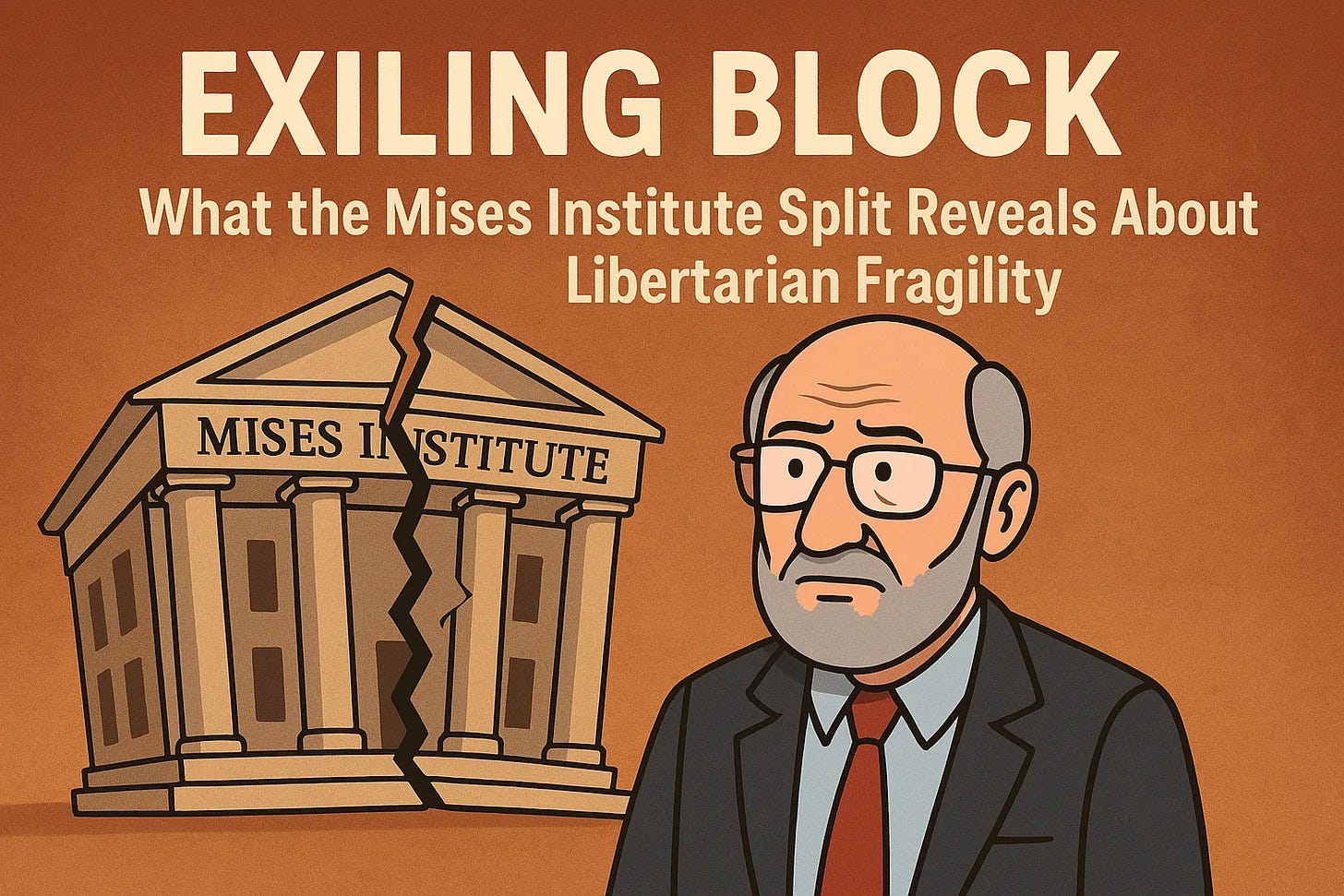
This is a very lengthy dissertation on Libertarian philosophy and the hazards of being true to it and ones self.
For the curious inquiring mind.
https://substack.com/home/post/p-162876132
[I would like to personally thank Walter Block and David Friedman, whom I regard as leading and admirable figures in the libertarian community, for their comments on the draft of this article.
I devoted an entire section of this article to responding to Professor Friedman, in an effort to engage with the thoughtful and valid feedback he offered on my draft. I hope that this critique of a critique reflects nothing more than deep intellectual respect. Any disagreement does not—and cannot—diminish the importance of Professor Friedman, his contributions to economic thought, to libertarian theory, and his personal influence on my own thinking.
I chose to write at length on this topic and to include Professor Block in this post as a gesture of appreciation for his tireless courage in standing by his views, even when doing so went against the grain and came at a high personal cost. Nothing deterred him from doing what he believed was intellectually right. For that reason, he deserves an article dedicated to him.]
Introduction
Intellectual ideas, no matter how meticulously conceived, often take on a life of their own once released into the world. Their trajectory depends not only on the precision of their articulation but also on how they are received, interpreted, and applied by others. While some ideas inspire transformative progress, others fall victim to distortion, misinterpretation, and outright misuse. History shows that intellectual legacies are powerful yet vulnerable – ideas evolve over time and are frequently interpreted in ways their originators never intended. The challenge for any intellectual movement is to preserve the integrity of core principles while allowing healthy evolution in response to new contexts.
Walter Block, a renowned libertarian economist, serves as a cautionary tale of how even well-intended ideas can evolve in unintended and troubling directions. Block’s groundbreaking work Defending the Undefendable (1976) provoked readers by defending the economic utility of socially reviled professions within a free-market framework. His nuanced argument emphasized that as long as these controversial actors operated voluntarily and without coercion, they could play a functional role in the economic system. Block sought to challenge moralistic judgments without undermining the ethical foundations of libertarianism – foundations rooted in the non-aggression principle (NAP) and voluntary exchange. Renowned economists like Murray Rothbard and F. A. Hayek praised Block’s approach; Hayek likened it to a “shock therapy” that, though strong medicine, ultimately “disabuses [readers] of many dear prejudices” ( Defending the Undefendable ). In short, Defending the Undefendable was an audacious defense of liberty’s less popular applications, intended to illuminate how even “unsavory” voluntary interactions can uphold free-market principles.
Over time, however, factions within the libertarian movement radically misinterpreted Block’s ideas. Rather than understanding his defense of controversial economic actors as a thought experiment grounded in voluntaryism, these factions adopted a contrarian absolutism that abandoned the very ethics Block championed. They began to argue that libertarians had a moral obligation to defend the most egregious of actors – even violent regimes or terrorists – so long as those actors opposed a state or authority deemed illegitimate. This nihilistic interpretation betrayed the principles of non-aggression and individual rights, effectively excusing coercion and immorality under the guise of “defending liberty.” Ironically, Block himself would become a victim of this distortion. In 2023, Walter Block was expelled from the Mises Institute – an academic institution he helped shape – after he publicly defended Israel’s right to self-defense against Hamas. Block’s stance, grounded in libertarian principles of non-aggression and the protection of innocent life, clashed with factions that had come to equate all state actions with evil. The very followers who claimed to champion his ideas had weaponized a distorted version of his philosophy to ostracize him.
Here, I attempt to examine the evolution of Block’s ideas and their misinterpretation, situating this phenomenon within the broader context of libertarian thought. I will talk about how thinkers like Murray Rothbard and Hans-Hermann Hoppe – towering figures in libertarian philosophy – influenced a strain of anti-statism so radical that it veered into moral paradox. In tracing these dynamics, I try to maintain the main thesis that Block’s foundational ideas from Defending the Undefendable were misinterpreted by radical factions, turning an intellectual exercise into a caricature of its original intent.
I then address comments made by economist David D. Friedman in response to an earlier draft of this article. Friedman offered a friendly but critical review, raising concerns about the argument’s structure, the sufficiency of its evidence, and the interpretation of Walter Block’s intellectual influence. His critique provided a valuable opportunity for me to sharpen the article’s claims and make it clearer. The main point in my rebuttal is to show that the misinterpretation of Block’s ideas is not merely a matter of contrarian posturing or political alignment, but reflects a deeper philosophical error in the form of a reflexive, anti-state bias that excuses violence when committed by non-state actors.
Finally, I will try to explore a secondary theme; that Block’s plight is not unique: many historical thinkers saw their ideas distorted, often to their own detriment. To underscore this, I draw historical parallels with other thinkers whose theories were co-opted or twisted by later followers – from Nietzsche to Marx – illustrating the recurring dangers of ideas removed from their ethical moorings.
Walter Block’s Defending the Undefendable stands as one of the most provocative and daring works in modern libertarian thought. In it, Block tackled deeply controversial subjects by defending individuals and professions that society often vilifies – pimps, prostitutes, slumlords, blackmailers, drug dealers, and more. His goal was not to celebrate these people’s choices or morality, but to challenge knee-jerk societal condemnations of their economic roles in a free market. Block argued that these actors, so long as they operate without coercion or fraud, engage in voluntary exchanges that can yield mutual benefit. In a free-market context, even disreputable services have willing customers; by fulfilling a demand through voluntary trade, these “villains” provide value (however unseemly it may appear) and thus play a part in the market’s functioning. For example, a slumlord offers housing that, while low-quality, might be the only affordable option for certain tenants – serving a need that would otherwise go unmet. A loan shark, charging high interest to high-risk borrowers excluded from banks, still provides access to credit that can be life-saving for someone with no alternatives. Block’s point was that outlawing or condemning these voluntary arrangements outright often harms the very people society intends to protect, by driving transactions underground or eliminating options for the poorest. In highlighting the often-ignored economic function of such pariahs, Block forced readers to disentangle economic outcomes from moral approval. One can find an exchange mutually beneficial in a strict market sense without endorsing it morally.
Block’s libertarian philosophy is rooted in two foundational principles: the Non-Aggression Principle (NAP) and respect for voluntary exchange. The NAP holds that it is inherently immoral to initiate force or fraud against another person; violence is only justified in defense against aggression. This principle provides the ethical cornerstone for libertarianism, setting a bright-line rule against coercion. Voluntary exchange, meanwhile, is the lifeblood of the free market: if two parties consent to a trade, and neither uses force, then by definition each expects to be better off from the deal – otherwise they wouldn’t agree to it. Mutual consent implies mutual benefit, as Block emphasizes: “In neither case is force or fraud applied”, he writes of both an ordinary business trade and a prostitute’s contract with a client. Together, NAP and voluntarism delineate the domain of legitimate human action in Rothbardian-libertarian eyes. Block’s innovation was to apply these principles to extreme cases that most people overlook or reject out of hand. He asked uncomfortable questions: If a transaction between a prostitute and a customer is voluntary, why is it fundamentally different from any other service for pay? If no one is forced to live in a slum apartment, can we categorically condemn the landlord for offering cheap (if shabby) housing that people freely accept? By pushing these examples, Block sought to demonstrate a broader point: the morality of a free market cannot be judged by our visceral dislike for the participants. What matters is consent versus coercion, not whether we personally approve of the people or services involved.
It is crucial to note that Block’s defense of the “undefendable” was not moral relativism nor an endorsement of crime. He did not argue that all actions undertaken by, say, a pimp or a blackmailer are good or acceptable. If any of these actors resorted to force, fraud, or the violation of rights, Block would firmly condemn them – consistent with libertarian ethics. His defense was carefully circumscribed: he only defended those actions that remained within the bounds of voluntary interaction. For instance, the pimp who uses threats or violence to control prostitutes is initiating aggression and is not defended; but the pimp who simply connects willing adult sex workers with clients in exchange for a fee is, in Block’s view, providing a voluntary mediation service (one might still find it distasteful, but it’s arguably a mutually agreed arrangement). Likewise, Block would never defend a slumlord’s outright negligence or fraud – only the basic fact that providing low-cost, low-quality housing to a willing tenant is a consensual exchange. In essence, Block was drawing a line: society’s visceral moral outrage often lumps together voluntary vice with actual aggression, but libertarians must be careful to only forbid the latter. As he and many classical liberals see it, “victimless crimes” are not crimes at all in a truly free society ( Defending the Undefendable ). Selling sex, drugs, or charging high interest may be sinful or unsavory to some, but if all parties consent, there is no rights-violation – and using the state’s coercive power to stop it would itself violate the NAP.
Block’s intention was as much educational as polemical. Defending the Undefendable uses shock value to jolt readers into questioning their assumptions. It asks us to apply libertarian principles consistently, even when our emotions or social conventions pull us in the opposite direction. By doing so, Block was testing the robustness of libertarian theory: if the free market and non-aggression principles truly promote human welfare, they should hold up even in “extreme” cases. Indeed, Rothbard lauded Block’s book for demonstrating “the workability and morality of the free market” far better than any dry theoretical tome – by “taking the most extreme examples”, Block illustrates that the principles still apply and thus “vindicates the theory”. In other words, if the theory can justify the hard cases, it reinforces its validity for the ordinary cases too. Block’s work served as a bold reminder that libertarianism isn’t just a fair-weather philosophy to be applied only to socially approved activities; it’s meant to be a principled framework, even when it leads to uncomfortable conclusions. This rigorous consistency is part of what Block (following Mises and Rothbard) saw as the moral strength of libertarian political economy.
However, the very boldness and provocative style of Block’s argument left it vulnerable to misinterpretation, especially by readers inclined to ideological extremism. By defending society’s pariahs in economic terms, Block ran the risk that some would miss the nuance and take his thesis too far. Over the decades after 1976, that risk materialized: factions of self-identified libertarians began to twist Block’s ideas into a blanket apologia for anyone labeled “bad” or “enemy” by mainstream society, regardless of whether those actors upheld libertarian ethics. What Block intended as an intellectual exercise – a nuanced defense of voluntary interactions and a critique of legal moralism – was gradually transformed by others into a much more sweeping and unprincipled stance. Before exploring how this distortion occurred, it is necessary to delve into the intellectual climate fostered by two of Block’s major influences and colleagues: Murray Rothbard and Hans-Hermann Hoppe. Both thinkers made enormous contributions to libertarian theory, but both also cultivated a strain of radical anti-statism that, taken to an extreme, helped lay the groundwork for the very misinterpretations that later ensnared Block’s legacy.
Murray Rothbard and Hans-Hermann Hoppe are towering figures in libertarian thought who profoundly shaped the movement’s trajectory. Rothbard (1926–1995), often called the father of anarcho-capitalism, fused Austrian economics with an uncompromising political philosophy that placed individual liberty above all else. Hoppe, a student of Rothbard’s, carried these ideas forward, extending them into cultural and social realms. Both men staunchly opposed state power in virtually all forms, arguing that the state is inherently a coercive monopolist. Their rhetoric and scholarship galvanized generations of libertarians to question the legitimacy of government authority. However, Rothbard and Hoppe’s unwavering anti-statism sometimes led them to morally problematic positions – including an apparent tolerance for oppressive regimes and violent non-state actors, so long as those actors were enemies of Western governments. At times, their ideology even appeared to condemn acts of self-defense by liberal societies, under the logic that “the state can do no right.” These tendencies created a paradox: in fighting the Leviathan of state power, Rothbard and Hoppe could seem to excuse or even endorse other forms of aggression and illiberalism. Understanding this paradox is key to understanding how Block’s more nuanced libertarian vision became entangled with a much harsher, factional stance.
Murray Rothbard was, in the mid-20th century, the chief architect of a radical form of libertarianism that called for eliminating the state entirely. In works like Man, Economy, and State (1962) and For a New Liberty (1973), Rothbard argued that all the functions we assign to government could be provided by voluntary arrangements in a free market. He envisioned a society organized around private property, contract, and the NAP, with defense and law supplied by competing private agencies instead of a coercive state. This vision, known as anarcho-capitalism, was revolutionary. It took classical liberalism’s minimal state to its logical endpoint: no state at all. Intellectually, Rothbard buttressed this position with rigorous economic reasoning and natural-rights ethics. He insisted that taxation is theft, war is mass murder, and state regulation is an assault on freedom. To many libertarians, Rothbard’s purity was (and remains) inspiring – a lodestar of principle in a world full of compromises.
Yet Rothbard’s absolutism about state power sometimes led him into troubling territory when applying his ideas to real-world geopolitics and conflicts. His reflexive stance was anti-interventionist to an extreme: he opposed nearly all use of state force, especially by Western democracies, in international affairs. For example, during the Cold War, Rothbard’s hatred of U.S. imperialism led him to downplay or rationalize the crimes of communist and authoritarian regimes that were adversaries of the West. He infamously wrote in the 1970s that the Soviet Union – despite its brutal domestic tyranny – pursued a “far less adventurous” (i.e., more restrained) foreign policy than the United States ([PDF] LIBERTARIANS AGAINST THE AMERICAN WORLD. A CRITICAL …). In other words, Rothbard suggested that, on the global stage, the USSR was less of an aggressor than the U.S., which implicitly casts the American government as the greater evil. Such analysis was in line with his conviction that U.S. interventions (Vietnam, etc.) were unjust – a conviction often justified – but it failed to equally acknowledge the very real aggression and expansionism by the Soviet state (in Hungary 1956, Czechoslovakia 1968, Afghanistan 1979, and so on). Rothbard’s single-minded focus on opposing “the West” sometimes veered into moral relativism. He would criticize Western or democratic governments for any violence, yet exhibit relative silence or even sympathy regarding violence by dictatorships if it could be framed as “resistance” to Western influence. For instance, Rothbard commented positively on revolutionary movements or strongmen who opposed U.S. interests, whether in the Middle East or Latin America, glossing over their authoritarian deeds. In the 1990s, he controversially embraced aspects of the paleoconservative movement and praised politicians like Pat Buchanan – alliances forged largely over shared opposition to global interventionism and liberal internationalism, despite Buchanan’s own authoritarian nationalist streak.
Perhaps most telling was Rothbard’s stance on wars of self-defense. He took an axiomatically pacifist line that “the libertarian opposes war. Period.” (Walter Block Is a Zionist Extremist, Not a Libertarian | The Libertarian Institute). In his view, virtually no war waged by a state could be morally justified, because war inevitably involves aggression against innocents (e.g. civilians caught in the crossfire). While this absolutist anti-war position stemmed from a noble principle, it led Rothbard to draw no distinction between aggression and defense at the state level. By his logic, a government defending its citizens from external attack was just as guilty of “mass murder” as the aggressor, since any warfare would violate the NAP in practice. This radical symmetry – treating all sides in a conflict as equally culpable simply for engaging in war – is highly problematic. It ignores the crucial matter of who initiated force. Libertarian ethics, properly applied, do recognize the difference: initiating violence is criminal; repelling violence is justified. But Rothbard’s blanket condemnation of all state violence failed to account for cases where force is used to protect innocent lives from aggression. His position offered no practical guidance for how a free society should respond to threats short of dismantling its own military. In effect, Rothbard’s pure anti-statism risked undermining the very defense of liberty if taken literally. It is one thing to say the U.S. should not have entangled itself in foreign wars unjustly; it is another to suggest that no state under any circumstance (even invasion or terror attack) may legitimately use force in response. This extreme view would later influence libertarian factions who opposed Walter Block’s support for Israel’s self-defense, as we will see.
Murray Rothbard’s legacy in libertarianism is double-edged. On one hand, he provided the movement with a robust intellectual foundation and an unyielding devotion to principle. On the other hand, his inability (or refusal) to temper principle with situational nuance created a vulnerability. By treating all manifestations of state power as equally evil, Rothbard inadvertently gave cover to some of the worst enemies of freedom, so long as they were anti-Western or anti-liberal. He demonstrated how a philosophy of liberty could be twisted into a mirror image of the thing it despises: excusing or ignoring tyranny and aggression committed by non-liberal forces. This moral blind spot in Rothbardianism – the failure to distinguish defensive force from aggression, and liberal states from illiberal movements – would have a profound effect on segments of the libertarian movement, including the faction that later turned against Walter Block.
Be seeing you
Posted in Uncategorized | Tagged: Libertarian Fragility, Mises Institute, Walter Block | Leave a Comment »
Posted by M. C. on May 3, 2025
The truth of the matter is that old Uncle Sam has an impotence problem. Locating and destroying mobile missile platforms is a daunting task, especially in the rugged terrain of Yemen. After seven weeks of bombing the Houthis, Uncle Sam’s carrier strike group has failed to quell the Houthis. Not that the US had a great reputation to begin with, but the bombing of civilian targets inside Yemen, which has produced scores of dead women and children, is only fueling greater hatred of the United States.
Since Trump’s 15 March order to renew attacks on Yemen, the US has lost almost $500 million in planes and drones and failed to guarantee safe passage for Israeli vessels daring to enter the Red Sea. Good job, Mr. Hegseth.
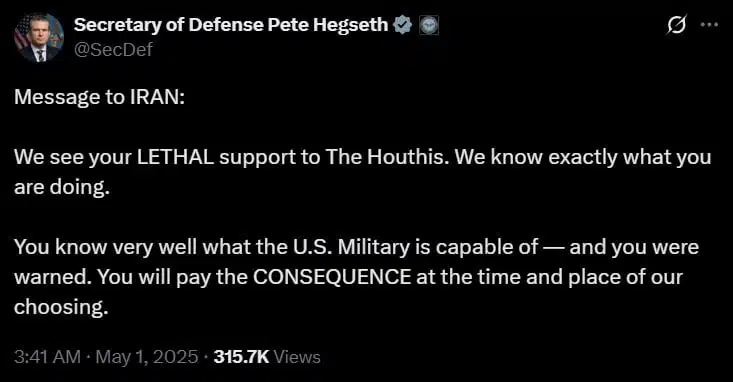
I almost don’t know what to say about Pete Hegseth’s social media post (see above). It is juvenile, counterproductive and dangerous. During my time living in Central America, I learned a very important piece of wisdom… i.e., The fish dies by its mouth. We need a comparable expression for social media posts like this one. Hegseth, like some angry teenager, is upset that Trump’s version of Operation Prosperity Guardian is a bust.
Operation Prosperity Guardian (OPG), which was initiated in December 2023 under the Biden administration, continues to operate under its original name, but has been executed with an intensified ops tempo, as measured by bombing sorties and missile strikes inside Yemen. In February 2025, operational leadership transitioned from Combined Task Force 153 to Destroyer Squadron 50, a U.S. Navy surface warfare unit. The Trump team labored under the false assumption that the Biden folks did not make a serious effort to destroy the Houthis’ arsenal of missiles and drones. The Trumpers believed that they could bomb the Houthis into submission. Instead, the US is demonstrating to all countries in the region the limits of its naval and air power.
Be seeing you
Posted in Uncategorized | Tagged: Houthis, Operation Prosperity Guardian, Yemen | Leave a Comment »
Posted by M. C. on May 2, 2025
Electricity experts point to dangers of grid instability when renewables dominate output
So what happens at night? Is there that much demand reduction? Is industrial demand in Spain low?
Please use the sharing tools found via the share button at the top or side of articles. Copying articles to share with others is a breach of FT.comT&Cs and Copyright Policy. Email licensing@ft.com to buy additional rights. Subscribers may share up to 10 or 20 articles per month using the gift article service. More information can be found here.
https://www.ft.com/content/e6e1fe13-36f7-4fe5-84ba-77717dca68a8?fbclid=IwY2xjawKBrc9leHRuA2FlbQIxMABicmlkETFvOWo1VzQxNk1xcFRVeHA5AR7PlOFRimJEx6ULwZOLcJKjVXCy91xj_ZYF4BPb28YOP0NTRn9VkmVxNKrPLw_aem_PR1XsAwYkJ-8230WUfv9Zg
The inability of Spain’s electricity grid to manage an unusually high supply of solar power was a key factor in Monday’s catastrophic blackout, former regulators and some experts have said. About 55 per cent of Spain’s supply was from solar sources when 15 gigawatts of electricity generation disconnected from the grid within five seconds on Monday afternoon, triggering a wide-ranging shutdown of power systems in Spain and Portugal.
Please use the sharing tools found via the share button at the top or side of articles. Copying articles to share with others is a breach of FT.comT&Cs and Copyright Policy. Email licensing@ft.com to buy additional rights. Subscribers may share up to 10 or 20 articles per month using the gift article service. More information can be found here.
https://www.ft.com/content/e6e1fe13-36f7-4fe5-84ba-77717dca68a8?fbclid=IwY2xjawKBrc9leHRuA2FlbQIxMABicmlkETFvOWo1VzQxNk1xcFRVeHA5AR7PlOFRimJEx6ULwZOLcJKjVXCy91xj_ZYF4BPb28YOP0NTRn9VkmVxNKrPLw_aem_PR1XsAwYkJ-8230WUfv9Zg
Several European experts said Spain appeared to lack enough firm power — readily available, reliable energy supply from sources such as fossil fuels or nuclear that can be reduced or raised — to kick in when the grid’s frequency dropped sharply at 12.33pm on Monday. Frequency, the rate at which electrical current alternates, must be kept stable for the grid to function. Spanish grid operator Red Eléctrica has said it does not know the exact cause of the outage. Chief executive Beatriz Corredor denied renewables “made the system more vulnerable” in an interview with El País on Wednesday. But André Merlin, the founder and former chief executive of France’s grid operator RTE, told the Financial Times: “Two-thirds of [Spain’s electricity] production was made up of non-controllable resources. These non-controllable resources . . . don’t contribute to the stability of the internal electrical system.” Beatriz Corredor Red Eléctrica chief Beatriz Corredor denied renewables ‘made the system more vulnerable’ in an interview with El País on Wednesday a leading former Spanish energy official and International Energy Agency board member, told Spanish television on Wednesday evening that an oversupply of electricity may have initially caused the problem.
Be seeing you
Posted in Uncategorized | Tagged: Blackout, Portugal, solar power, Spain | Leave a Comment »
Posted by M. C. on May 1, 2025
The prevailing approach to international conflicts has a dreary, formulaic aspect: exaggerate the severity of the threat to both international peace and America’s security; portray Washington’s adversary as the epitome of evil; and portray any beleaguered US client as both an innocent victim and a proponent of freedom and democracy.
The only thing Washington has learned in the time since is how to better sell wars to the American people.
-Kyle Anzalone

April 30th marked five decades to the day since America officially lost the Vietnam War.
In a new column, the Institute’s Ted Galen Carpenter explains that over the past 50 years, Washington failed to learn a single significant lesson from that failure:
“Although the bruising experience in Vietnam had apparently induced a somewhat greater level of caution – at least temporarily – among Washington’s political and policy elites with respect to a few specific cases, it had not caused any reconsideration of the foundational assumptions of US foreign policy. In particular, the ‘1930s model’ still dominated elite perceptions about world affairs and America’s proper role in the international system: American opinion leaders were still obsessed with preventing the rise of ‘another Hitler.’ Closely related assumptions were that ‘appeasement’ never works, ‘aggression’ had to be stopped in its tracks as soon as signs of it appeared, and that complex, murky geopolitical struggles could be portrayed as stark conflicts between good and evil. Despite the negative consequences of the Vietnam War, those attitudes remained intact.
[…]
The painful lessons of the defeat in Vietnam have been largely forgotten, and the current generation of US policymakers is at least as reckless as any of its predecessors. The prevailing approach to international conflicts has a dreary, formulaic aspect: exaggerate the severity of the threat to both international peace and America’s security; portray Washington’s adversary as the epitome of evil; and portray any beleaguered US client as both an innocent victim and a proponent of freedom and democracy. Washington’s dishonest propaganda regarding the war between Russia and Ukraine – both corrupt autocracies – is almost a caricature of that strategy.
The litany of Washington’s military interventions and proxy wars since Vietnam – Afghanistan, Lebanon, Grenada, Panama, Kuwait, Somalia, Bosnia, Kosovo, Afghanistan (again), Libya, Syria, Yemen, and most dangerous of all, Ukraine – all convey the extent to which US policy elites and much of the US public have remained impervious to the deeper meaning of the Vietnam debacle. As one cynical observer said to me: ‘The only enduring lesson from the Vietnam War appears to be ‘don’t go to war in a country called Vietnam.’ Such a pervasive failure of policymakers and the American people to learn more substantial lessons may be that horrible conflict’s most tragic and lasting legacy.”
To mark the anniversary of the catastrophic failure in Vietnam, the Quincy Institute for Responsible Statecraft asked a number of notable foreign policy experts, “Was the Vietnam War a mistake or fatal flaw in the system?”
Historian and US Army vet Andrew Bacevich answered
Be seeing you
Posted in Uncategorized | Tagged: Cambodia, laos, Vietnam | Leave a Comment »
Posted by M. C. on May 1, 2025
“As Scott Horton says: No matter who you vote for, you always get John McCain.”
-Kyle Anzalone

Republicans in Congress have unveiled plans to hand the White House $1 trillion – that’s 12 zeroes, $1,000,000,000,000 – to spend on the military.
That’s right, despite promised cuts the federal budget and Elon Musk’s lagging “DOGE” initiative – which promised to slash $2 trillion before settling on a far less ambitious $150 billion – Trump is doing the same old thing: pumping vast sums of American tax dollars into the Washington swamp.
Antiwar.com’s Dave DeCamp elaborates on how your money will be wasted:
“House Republicans unveiled a bill this week that would bring the 2025 US military budget to over $1 trillion.
The 2025 National Defense Authorization Act (NDAA) totaled about $885 billion, and the new supplemental bill drafted by the House and Senate’s armed services committees would add $150 billion, bringing the 2025 military budget to a record-breaking $1.035 trillion.
The bill includes $25 billion for President Trump’s vision to create a new missile defense system for the United States, which he has called the ‘Iron Dome for America’ or the ‘Golden Dome.’ The project would be a boondoggle for US weapons makers and would likely kick off a new global arms race.
Be seeing you
Posted in Uncategorized | Tagged: military budget, Trillion | Leave a Comment »
Posted by M. C. on April 30, 2025
Is Milei perfect? No. No one who puts his pants on one leg at a time can attain such a status. But he is far and away the best thing that has happened to the movement for liberty and economic freedom in a long, long time. All libertarians should tip their hats to him and wish him God speed. No, correction: the entire world should do so.
The president of his country, Javier Milei, is the last best hope for Argentina, and not only in terms of its economics, which promises to be profound. He also introduces for the first time in a long time a sense of ethics and propriety to that neck of the woods. Totalitarianism and socialism are simply morally wrong, not merely only non-efficacious, ineffective, uneconomical. In addition he constitutes a healthy shot in the arm for the psychological well-being of the citizens of this nation. He demonstrates, over and over again, the personal mental benefits of freedom, justice and private property rights. In so doing, he improves their well-being in many other dimensions as well, and immeasurably so.
But the benefits of his efforts will not be limited, by any means, to Argentina alone. And not only to all of Central and South America either. The entire world will be his oyster. If he can rescue Argentina with free enterprise, and so far he is on a direct path to do so, the entire world will be more likely to accept laissez faire capitalism than ever before.
One would think that with so much at stake, all advocates of libertarianism would salute him, would thank him, would congratulate him, would support him, would organize ticker-tape parades in his honor.
If you thought that, you are due for a rude awakening. Hans-Hermann Hoppe, a leading libertarian, instead, cocks a snook at this miracle worker. (I use that phrase advisedly. What else can we call it; imagine, radical free enterprise emanating from the very top of the political system!). Hoppe gives Milei the back of his hand. He criticizes him for doing too little, too late. Why, the president of Argentina has been in power for serval months now, and this nation has still has not yet reached the Galt’s Gulch level of free market capitalism of Ayn Rand’s “Atlas Shrugged” opines Hoppe, in effect.
This world class Austrian economist and libertarian theoretician simply does not understand how difficult it is to turn around a country mired in inflation, socialism, fascism, egalitarianism, wokeism, interventionism, regulationism, price controls.
Be seeing you
Posted in Uncategorized | Tagged: Argentina, Hans-Hermann Hoppe, Javier Milei | Leave a Comment »
Posted by M. C. on April 29, 2025
“She famously said, “When you realize that to produce, you must obtain permission from those who produce nothing;…”
oSpndesrto1ig2hup4t3701aA i3a23m0ll1h514f89 8u Mt:r2tP20ic l ·
On February 2, 1905, in St. Petersburg, the philosopher and writer Alissa Zinovievna, better known to the world of letters as Ayn Rand, was born.
She famously said, “When you realize that to produce, you must obtain permission from those who produce nothing; when you see that money flows to those who deal not in goods but in favors; when you notice that many become rich through bribery and influence rather than by their work, and that the laws do not protect you from them but, instead, they are protected from you; when you discover that corruption is rewarded and honesty becomes a form of self-sacrifice, then you can confidently say, without fear of being wrong, that your society is doomed.”
Her words, which touch on themes of power, corruption, and inequality, continue to resonate as a chilling prediction about the potential decline of society under certain conditions.
Be seeing you
Posted in Uncategorized | Tagged: Alissa Zinovievna, Ayn Rand, Corruption, Power | 1 Comment »
Posted by M. C. on April 29, 2025
It’s great that Sen. Lee compared Kiev and Tel Aviv. After all, both are welfare queens with unstable borders, and both have major problems with their respective ethno-nationalists.
Republican Senator Mike Lee of Utah had a very interesting post on X recently.
The lawmaker, who is opposed to sending more aid to Ukraine, asked whether Americans wanted the country to become “the next Israel,” noting that Kiev expects the United States to provide “long-term” (read “indefinite”) security assistance.
The statement is so interesting because it is an acknowledgement that Tel Aviv is heavily dependent on Washington – first and foremost for weapons and military aid, but also diplomatic cover for its violent, decades-long military occupation of Palestinian lands and property.
For years, top lawmakers have repeated a version of Joe Biden’s “If Israel did not exist, the US would have to invent it” line, suggesting Israel is crucial to US security, with some American lawmakers even asserting that Israel’s defense is more important than protecting the “homeland.”
Be seeing you
Posted in Uncategorized | Tagged: ethno-nationalists, Ukraine, Welfare Queens | Leave a Comment »
 MCViewPoint