Doug Casey: It could be the most dramatic thing that’s happened politically since at least World War II. Anywhere. Why? Because he’s an AnCap libertarian who’d like to abolish the State—or come as close as possible.
International Man: Milei has called central banking and fiat currency a historical fraud. He has vowed to “burn down the central bank” and replace the peso with the dollar and whatever commodity the free market would choose as money. He is favorable to precious metals and Bitcoin.
International Man: Anarcho-capitalist Javier Milei recently won Argentina’s presidential primary. He is now the undisputed front-runner in the upcoming elections.
The outcome took many by surprise. Milei is an outsider who bested the country’s two entrenched establishment parties.
How did this happen, and why should anyone outside of Argentina care?
Doug Casey: It could be the most dramatic thing that’s happened politically since at least World War II. Anywhere. Why? Because he’s an AnCap libertarian who’d like to abolish the State—or come as close as possible. If he’s elected in October, he’ll make every move possible to eliminate—not just reduce—as many government departments as possible as quickly as possible. And most people seem oblivious to it.
Milei was in first place in the primary. Historically, in Argentina, the person who wins the primary wins the general election. There’s only been one exception to that rule. Even more encouraging is his ratings have gone up from 30% to 40% since the primary. It appears his campaign is not just a flash in the pan but a trend that’s building momentum.
Argentina was one of the most prosperous countries in the world a hundred years ago when it was about as free as any country economically. Before Peron, the Argentine GDP equaled the rest of the continent put together. But since the accession of Juan Peron in 1946, it’s consistently gone downhill every year.
Why might that be?
Peron was an overt fan of Mussolini and fascism. Fascism—a word coined by Mussolini—is defined as the complete subordination of corporations and business to the State. After WW2, the word “fascism” was a no-no, so the system was rechristened “Peronism” in Argentina. It’s not a consistent philosophy; it has many mutations. It’s all about businessmen and politicians using each other, through the State, to get rich. The lower classes are made dependent, and the middle class is impoverished. Fascism has little to do with militarism and jackboots; it’s an economic system. Almost every country in the world is fascist today—including the US, the EU, China, and Russia.
Despite the triumph of Peronism, Argentina still has the most classically liberal traditions in all of Latin America. It’s always been the most outward-looking country in Latin America. I’ve always believed it was the most fertile ground for a pro-individual liberty revolution in Latin America. Now, that may be happening.
Oh Canada! Where speech is free…unless government doesn’t like it. Look for his finances to be frozen unless he has already transferred them to a free country.
Clinical psychologist and Daily Wire contributor Dr. Jordan Peterson has been cast into Canadian outer darkness for thought crimes.
And by Canadian outer darkness, we mean “social media sensitivity training” for his controversial (practical) statements, which a panel of three Ontario Divisional Court judges agreed have been “unprofessional.”
According to court documents, the “coaching program” will require Peterson to “reflect on, and ameliorate [his] professionalism in public statements.”
“The order is not disciplinary and does not prevent Dr. Peterson from expressing himself on controversial topics; it has a minimal impact on his right to freedom of expression,” wrote Justice Paul Schabas.
Peterson, a former professor of psychology for the University of Toronto, went viral in 2016 for a lecture in which he condemned the use of pronouns, and slammed Canadian lawmakers over legislation on gender identity or expression, The Federalist Papers reports, citing the BBC.
In making their decision, the court weighed several of Peterson’s controversial comments to decide if they were in compliance with the College’s Standards of Professional Conduct.
The first example cited by the court was a tweet from Jan. 2, 2022, in which Peterson responded to an individual concerned about overpopulation by stating: “You’re free to leave at any point.”
Less than a month later, during an appearance on “The Joe Rogan Experience,” Peterson reportedly referred to a former client of his as “vindictive,” and said that their complaint against him was a “pack of lies.” In the same episode, while speaking about air pollution and child deaths, Peterson reportedly also said: “it’s just poor children, and the world has too many people on it anyways.”
Another controversial comment of Peterson’s was in response to news of actress Elliot Page, formerly Ellen, identifying as a man and undergoing gender-affirming breast removal surgery.
“Remember when pride was a sin? And Ellen Page just had her breasts removed by a criminal physician,” the June 2022 tweet reportedly read. He was consequently suspended from Twitter for misgendering and “deadnaming” the actor. -The Federalist Papers
Reacting to the ruling, Peterson says he’s perplexed by the contradiction in the court decision which initially acknowledges the “fundamental reality of freedom of speech for Canadians,” only to later stipulate that professional organizations like the College of Psychologists can impose restrictions on such freedoms.
‘When you said [FBI informant] Dan is the one who did the training, that is describing the FBI as entrapping your client…’
For instance, at his federal trials last year, Fox was prohibited from introducing as evidence thousands of text messages between FBI informants and their handling agents. Those texts show, among other things, that FBI agents encouraged their informants to kidnap Whitmer.
What do the arresting entrapment agents, the prosecutor and judge have in common? They all work for the same boss.
(Ken Silva, Headline USA) During Tuesday’s opening statements at the trial of three men accused of aiding the 2020 alleged militia plot to kidnap Michigan Gov. Gretchen Whitmer, defense attorney Bill Barnett made accurate statements about an FBI informant involved in the case—describing how the informant, Dan Chappel, became the second in command of a militia, trained his fellow members and encouraged them to commit crimes.
State prosecutor Bill Rollstin objected to Barnett’s factual statements, accusing him of trying to “poison the jury” by arguing that the FBI entrapped his client.
Barnett responded to Rollstin’s claim by arguing that he’s only presenting true facts to the jury.
“I was stating facts that are in the police reports. Everything’s a fact. They don’t want to hear facts in this case,” he said.
Barnett further said that he’s not even arguing that his client, Eric Molitor, was entrapped. Barnett said Molitor didn’t have anything to do with the kidnapping conspiracy and is innocent of any wrongdoing.
“I never once said, ‘entrapment,’” the lawyer said. “I’m sorry I had to tell the whole story that’s not being told here [about FBI informants provoking the plot].”
However, Judge Charles Hamlyn agreed with the prosecution. The judge claimed that by noting that an FBI informant was second in command of a militia supposedly plotting to kidnap Whitmer, Barnett was essentially making an entrapment defense.
“There were a couple times you said the FBI did the training, the FBI was the XO [executive officer], [confidential human source] Dan was the one to organize these guys and did that,” the judge said.
“If you didn’t cross the line, you were right on it,” he added.
“When you said CHS Dan is the one who did the training, that is describing the FBI as entrapping your client.”
The judge’s ruling sparked outrage from those watching the trial, including from the sister of Adam Fox, one of the men who was found guilty last year of plotting against Whitmer.
As the mental shackles and superstitions of obedience-based state worship are cast off, ordinary people regain control over their economic and social destinies, realizing the transformative potential of unrestrained cooperation through the exercise of their natural liberty.
Without the erroneous public perception and judgment of the state as just and necessary and without the public’s voluntary cooperation, even the seemingly most powerful government would implode and its powers evaporate. Thus liberated, we would regain our right to self-defense and be able to turn to freed and unregulated insurance agencies for efficient professional assistance in all matters of protection and conflict resolution.
In contemporary times, the state has assumed an aura of sacred infallibility, commanding zealous and unquestioning devotion from its citizenry. This blind allegiance mirrors the fervent tribal reverence once conferred upon shamans in ancient societies, where faith and tradition superseded rational inquiry. However, unlike those organic, community-rooted systems of old, the modern state’s claimed supremacy stems not from any factual basis or empirical assessment but rather from pervasive myths surrounding its purported omniscience and benign intentions.
The State as Manmade Myth
Despite the prevailing sentiment, the state does not innately possess powers exceeding those held by ordinary individuals. The state is a human invention, devised as an organizational tool to coordinate collective affairs, not as a deity to be worshipped without reservation. And yet the average modern citizen acquiesces without resistance to the state’s declared authority, obeying its often ambiguous dictates as if they were divine commandments inscribed in stone.
Like pagans conducting rituals to appease temperamental spirits, voters today participate in elections and political processes, hoping to shape their nation’s destiny and align it with their own interests. But these efforts primarily serve to perpetuate the mythological legitimacy of the state apparatus, just as pagan rituals functioned to intensify a shaman’s exalted status among the tribe. Neither shamans nor states truly possess the far-reaching powers attributed to them by their faithful adherents. Their authority stems not from empirical facts but from the circulation of persuasive myths and the inculcation of social conditioning.
By recognizing the human origins and agenda-driven mythmaking processes that grant legitimacy to state power, we can begin to fundamentally reevaluate the relationship between the governors and the governed. This shift in perspective empowers us to challenge the sacrosanct prestige of the state and explore alternative organizational forms that prioritize individual autonomy, voluntary cooperation, and spontaneous order.
The Fiction of State Omniscience
The misplaced confidence in state authority is often rooted in an inflated notion of its knowledge and capacities. The state is frequently portrayed as an omniscient, omnipotent entity capable of expertly designing and engineering society, as well as benevolently guiding the masses toward enlightenment. In reality, no singular organization or institution, irrespective of the resources and technological prowess at its disposal, can ever hope to attain total insight into the unfathomably intricate and constantly evolving network that is human civilization.
The belief that imperfect and fundamentally limited human institutions can completely understand and manipulate dynamic social systems is a fiction, a delusion of grandeur. And yet millions of people continue to voluntarily relinquish their personal agency to the mythic idol of the state, placing implicit and unquestioning faith in its imagined omniscience and benevolence. They surrender autonomy over their own lives to participate in the spectacle of elections that promise change yet repeatedly fail to deliver meaningful reform to unseat entrenched interests.
Why are they coming back around for another round of Covid tyranny? Fear is a weapon to gain control. Last time around they generated fear to radically change how America voted. Suddenly everyone was mailed ballots. How closely were they checked? No one knew and no one dared ask. The people who did ask about the election are now facing jail terms.
They want us to shut up while they do it again. Will we?
Just four and a half months since President Biden declared an end to the Covid “emergency,” the media is suddenly full of stories about the return of Covid. This time a new “variant” is being rolled out and the media, in collusion with big Pharma and the fear-industrial complex, are churning out stories about how forced masking is making a comeback.
Also, the “unvaccinated” are again to be denied basic human rights in the name of fighting a virus that the vaccine demonstrably does not protect against.
In short, they are desperately trying to revive the tyranny, insanity, and utter irrationality of the two-year Covid scare. And they are pretending none of us remembers how they destroyed society with their lockdowns, mask mandates, and vaccine mandates. They are hoping that none of us will remember the suicides, lost jobs, broken marriages, increased alcoholism and drug abuse, and the rest of what went along with the world’s experiment with global lockdown.
Even Fauci himself is back – like a moth drawn to the light of publicity. Despite all the scientific evidence that the lockdowns were a disaster, that they did far more harm than good, Fauci has re-emerged with his trademark arrogance and claimed that they were the right thing to do and should be done again if that’s what it takes to force people to take the vaccine. A vaccine that does not work.
They won’t even allow us to mention the spike in all-around mortality or the millions who may have been vaccine-injured the first time around. They want us to think that 20-year-old world-class athletes have always just dropped dead of heart attacks out of the blue. It’s all normal! Don’t question it! What are you, some kind of conspiracy theorist? Are you a science-denier?
Yes, look for a renewal of all those old hollow phrases used to attack those of us who can see with our own eyes and hear with our own ears. Their slogans are meant to silence any debate. The same “experts” like Fauci who claimed “I am the science” are back and they shamelessly demand to silence us again.
The big question is…why? Why are they doing this and how do they think they can get away with it a second time? One reason they believe they can get away with it again is that no one has ever been punished for what they did the first time. The Federal Government made sure that the pharmaceutical companies would not be liable for vaccine damages.
The public figures who openly became monsters, demanding the unvaccinated be drummed out of society and maybe even off the face of the earth have not been shamed or shunned. Politicians who displayed cowardice and worse have not been voted out of office for their treachery.
Why are they coming back around for another round of Covid tyranny? Fear is a weapon to gain control. Last time around they generated fear to radically change how America voted. Suddenly everyone was mailed ballots. How closely were they checked? No one knew and no one dared ask. The people who did ask about the election are now facing jail terms.
They want us to shut up while they do it again. Will we?
Imran Khan may have found out the hard way that not toeing the US line on Ukraine — or anything else — can be dangerous.
This was a major part of why the United States once had so much more global goodwill compared to traditional European powers, as it leveraged its geographic isolation with its economic power to be comparably less threatening than most of its rivals. If Washington is truly serious about showing the world the danger presented by the ambitions of Beijing and Moscow, then U.S. policy should be less threatening to the sovereignty of others than that of its rivals.
When Russia invaded Ukraine in February of last year, Pakistani Prime Minister Imran Khan raised suspicions in Washington for his decision to maintain relations with the Kremlin. In a characteristically unsubtle move, Khan also visited Moscow shortly after the war began. He returned to Islamabad with a chip on his shoulder.
“What do you think of us? That we are your slaves and will do whatever you ask of us? We are friends of Russia and we are friends of the United States,” Khan told a crowd of his supporters. “We are friends of China and Europe, we are not part of any alliance.”
Little did Khan know that these words may have helped bring about the end of his political career. According to Pakistani diplomatic cables published by the Intercept, U.S. officials reacted to Khan’s stance on the war by subtly encouraging his opponents to remove him from power.
While it is doubtful that the United States was the sole or primary actor in the events that would land the prime minister in jail and lead to a military crackdown on the country’s political system (a state of affairs that remains in place today), the cables reveal that opponents of Khan were informed of U.S. anger over Khan’s statements on the Ukraine War and may have moved to oust him with the expectation of being rewarded with closer ties by Washington.
Most of the reactions to this breaking story have understandably focused on the Cold War-like aspect of what seems to be brazen interference in another country’s internal affairs. However, what is in danger of being overlooked is something more fundamental to how so many in D.C. conceptualize foreign policy as a whole.
While it is hardly surprising that Washington would leverage its influence to support a soft regime change of sorts in Islamabad, what is remarkable is the desire to punish a country far away from Europe and the conflict raging in Ukraine for daring to take an “aggressively neutral” stance (the State Department’s terminology, according to the cables) on what to them is a regional conflict far away from their core security concerns.
For the past seventy years, the major US foundations have been the main drivers of socialism, even more so than the state bureaucracies. Something similar can be said about the Bertelsmann Foundation and other German foundations. They also apply a saw with great relish to the capitalist branch that carries us all.
In 1990, socialism seemed to be done once and for all, but the times have changed. In the last twenty years, socialism has again become fashionable beyond the academic fringes. The covid-19 crisis demonstrated how quickly and thoroughly the traditionally free societies of the West may be transformed by small groups of determined and well-coordinated decisionmakers. Top-down central planning of all aspects of human life is today not merely a theoretical possibility. It seems to be right around the corner.
Now, the renaissance of central planning is an intellectual and practical dead end, for the reasons that Ludwig von Mises explained one hundred years ago. But if Mises was right, then how can we explain the renaissance of socialism as a political ideal? To some extent, this might be explained by the fact that new generations are likely to forget the lessons that were learned, often the hard way, by their ancestors. However, there are also other issues at stake. In what follows, I shall highlight two institutional factors that have played a major role: state apparatuses and ownerless private foundations.
1. State Apparatuses
An important driving force of the socialist renaissance has been the constant growth of state organizations. This includes all organizations that are largely financed by the state or thanks to state violence. For example, the so-called public service media are state organizations in this sense. In contrast, the so-called social media networks are mixed forms. It is true that they have received significant state support (for their establishment and for the expansion of the internet infrastructure). But they are also financed through advertising.
Socialism is growing out of the already existing state organizations. The crucial importance of this connection has been emphasized again and again by liberal and conservative theorists. A ministry, an authority, or a state-subsidized television station do not fully belong to the competitive life of ordinary society. Special rules apply. They are funded by taxes and other compulsory contributions. They are literally living at the expense of others. This has two important consequences for the renaissance of socialism.
On the one hand, state organizations are constantly forced to justify their privileged existence and therefore have a special need for intellectual services. Good cobblers and good bakers do not need to convince their customers with verbose theories. Their services speak for themselves. But creating and maintaining a government monetary system or a government pension system requires a constant torrent of words to pacify taxpayers, retirees, and the whole gamut of money users.
On the other hand, these intellectual suppliers typically have a personal agenda. State organizations are irresistibly attractive to ideological do-gooders of all stripes. This becomes clear as soon as we realize what doing good things really means.
Every day private companies and private nonprofit organizations create new products and new services—thousands of attempts at improvements. But their achievements fit into the existing social network. They are contributions that take into account the objectives and individual sensitivities of all other people. Private organizations thrive in competition. By contrast, the ideological do-gooder does not want to care about the sensitivities of other people. But that is only possible if his own income does not depend on those others, and if his plans can also be carried out against the will of the others. And that is exactly what the state, especially the republican state, enables him to do.
From the classical liberal point of view, the republican state should not pursue its own agenda. It should not be private, but public, should only provide the framework for free social interaction. But this theory hurts itself with the horror vacui it provokes. Ownerless goods will sooner or later be homesteaded by someone. Even an abandoned “public” state will sooner or later be taken into possession. History over the past two hundred years has shown that this privatization of the public state does not necessarily have to occur by coup or conquest. It can also grow out of the bosom of the state itself. The domestic staff, the servants of the state, can make themselves its masters.
Abandoned goods hold a magical attraction for people. An abandoned state magically attracts ideological do-gooders into the civil service. They are trying to privatize public space, to transform it into an instrument for their agenda. At first there may not be a consensus among them, but at some point the best-organized and best-connected groups gain the upper hand. The sociologist Robert Michels called this process the iron law of oligarchy.
The bureaucratic oligarchy can influence personnel decisions in terms of its ideology. Their ministry becomes “their” ministry (or their school, their university, their broadcasting service, etc.). It becomes an ideological state apparatus as defined by the French Marxist philosopher Louis Althusser. Through commands and prohibitions, an ideological state apparatus can convey its ideology to the outside world.
Notice that the bureaucratic oligarchy is only a small minority. This explains why the oligarchic ideology is typically a socialist ideology. Only where there is private property is it possible for a minority to undertake anything that might displease other people. But the oligarchs of a republican state cannot assert property rights. The state does not belong to them—they just control it. In order to be able to direct it inexpensively, they must avoid inciting the majority to resist them. The easiest way to do this is through a socialist ideology. Slogans like “We govern ourselves” cover up the real power relations.
A classic case is the French ministry of education, which was appropriated by a coalition of Communists and Christian democrats after the Second World War. In those years, Professors Paul Langevin and Henri Wallon (both members of the French Communist Party) pursued a strategy of centralizing and homogenizing all secondary schools, along with a dumbing down of the entry requirements. With the help of their allies, Langevin and Wallon slowly but steadily filled all the key positions of the ministry with their people while greatly expanding it. Thus, they made “their” ministry resistant to reform. No bourgeois minister has ever dared to make it a “public” institution again. So it has remained in the Communist inheritance to this day. The supposed servants of the commonwealth have become the real rulers, against whom the elected representatives can only grind their teeth.
The Democratic Party grows by playing to such demands and to the groups that support them. It does not arouse woke rage by turning settled, happy people into embattled ideologues and antiwhite bigots. It woos those who are already predisposed in this direction. Where the Democratic Party bears some blame in this matter is by agglutinating the frenetically aggrieved and giving them collective representation. The party also keeps the retribution claimants off each other’s necks as they fight for government benefits.
New York Attorney General Letitia James marches in front of a rainbow banner at New York City’s 2019 Pride Parade. (photo by D.V.S. Ross / via Wikimedia Commons)
On June 3, John Kline posted at the online magazine American Greatness a commentary on the institutional terror that “woke” America and its officials are visiting on hapless Americans. An example of this savage bullying is the treatment that New York Attorney General Letitia James is meting out to political journalist Peter Brimelow and his VDARE foundation. Although Brimelow’s institution operates in West Virginia, it is registered in New York State. Evidence that Brimelow’s foundation is violating the law, according to Kline, is still being hunted up or invented. But since Brimelow’s enterprise is associated with the political right and since James was elected as an avenging angel against the left’s opponents, she is terrorizing (a less graphic word would be inappropriate here) what she has decided is a politically unacceptable foundation.
This political style is not at all unusual in our time and place. A politician like James is popular, indeed a rock star among her voters, precisely because she runs as the nemesis of the right. In a commentary for City Journal, Craig Trainor, a former civil rights attorney in New York City, described James as a “left-wing activist, prone to rhetorical bomb-throwing.” In 2018, she was elected to her position as attorney general in a landslide, promising to go after Trump and his family for manipulating their financial holdings in New York State. Despite her ranting, James has not prosecuted Trump. Though she gave her findings to the Biden Justice Department, even that politically slanted agency found little of value in what she provided.
Trainor views James as the perfect illustration of “the weaponization of government—to harass, punish, ruin, and, if possible, imprison one’s political enemies.” Yet her faithful electorate seem delighted with her behavior. Not incidentally, James polls exceedingly well among blacks, LGBT activists, and feminist voters. It would be fair to say that this is not the case primarily because of her Democratic label. Rather she does well as a Democrat because her party accommodates her politics of grievance. What Trainor calls her “personalized and prejudicial public sentiments” are not a hindrance to her work as a public official—in fact, they explain her appeal to her voters.
I would also defend James and the Democratic Party against a charge the conservative establishment makes against it quite ritualistically by now. Racial minorities and other Democratic constituencies are not the “victims” of their national party; nor have they allowed themselves to be corrupted by this supposedly demonic organization. To a large extent, it is actually the Democratic Party that is the deserving victim of those grievance groups with which it has made an unholy alliance. One of the most provocative parts of Benjamin Ginsberg’s still relevant work, Fatal Embrace: Jews and the State (1993), is where the John Hopkins’ political scientist traces the reconstruction of the Democratic Party starting in the 1960s. What had been traditionally a party of Southern whites and blue-collar Northern ethnics was transformed into a culturally and socially leftist powerhouse.
By the mid-1960s, Democratic Party leaders stood at a crossroads. They could either rally around their more conservative base in both the North and the South, or they could rebuild the party around its more dynamic progressive elements: black civil rights activists and progressive urban Jews. The Democratic Party, according to Ginsberg, chose the latter course, and those more traditionalist demographics that had played major roles in its operation, like Dixiecrats and religious Catholics, became increasingly marginalized. Nominally Catholic Democrats were allowed to have some presence in the party, but were epitomized by such go-along figures as Joe Biden, Chris Dodd, and Robert Casey, Jr. Conservative Northern Democrats like Richard Daley, Sr., Frank Lausche, or Robert Casey, Sr., together with Southern white Democrats, lost influence as the Democratic National Committee vigorously courted civil rights activists and feminists.
The new arrangement did produce tensions, according to Ginsberg. The Jewish and black architects of the new order didn’t always share the same sentiments or loyalties. While the Jewish Democrats were deeply devoted to an expanding public administration and at least the trappings of legality, the black representatives were more into direct action and public denunciations of alleged white racists. And black leftists in the party did not particularly like their Jewish collaborators, a problem that Commentary magazine as well as Ginsberg would underline in the 1970s and 1980s.
One sees the continuation of this tension within the Democratic Party today, for example in the not-quite-natural cooperation between Chuck Schumer in the Senate and Hakeem Jeffries in the House. Despite their shared commitment to the present woke agenda, Schumer depends on the Jewish—even Orthodox Jewish—votes, which he has cultivated over the decades. Moreover, he takes strong Zionist positions, at least partly because he represents New York State, which has a large, influential Jewish electorate. Jeffries is the nephew of the black racial theorist Leonard Jeffries, whom he openly praises, and an admirer of Louis Farrakhan, who specializes in anti-Semitic remarks. Despite these ethnically rooted differences, Jeffries stands with Schumer in his invectives against “MAGA extremists” as the major source of American bigotry. But it may be fair to ask how deep the emotional bond between these two leaders really is, and whether the old tensions that Ginsberg pointed to in the 1980s still lie just below the surface.
Still, the Democratic Party must deal with the implications of the choice it made more than a generation ago, which was to become less and less the party of the working class and more and more the party of grievance groups. This did not happen overnight. There was a process of adaptation by Democratic operatives and Democratic politicians as they assumed their present identity. While in the old Democratic Party the stereotypical enemy was corporate management or a greedy factory owner, in the new party the adversary is the “MAGA extremist” or the white male heterosexual gun owner, whom all Democrats can agree to hate. The preferred foe may also be the white Southerner who shuns mandatory critical race theory training at his workplace and who describes the Confederate flag “as a heritage, not a hate symbol.”
Further, as the grievance groups from whom the Democrats drew votes became more vocally aggrieved, Democratic operatives were forced to keep pace with their electorate. It is simply not the case that these grievance groups became more antiwhite, anti-male, or anti-Christian because the Democrats pushed them in that direction. What may be far truer is that the party has moved with its constituents.
In Chicago earlier this year a radical black Democrat, Brandon Johnson, won the mayoral race against Paul Vallas, a more moderate Democrat who seemed genuinely interested in addressing the city’s soaring criminal violence. Largely because of the black vote, Johnson won the mayoral contest to the consternation of less radical Democrats. Johnson seems even softer on crime than his predecessor, Lori Lightfoot, who was also elected by a heavy black turnout. Democratic voters still receive choices in the Democratic primaries; and at least among blacks, those candidates who are the most indulgent of criminals, like Johnson, Manhattan District Attorney Alvin Bragg, and Philadelphia District Attorney Larry Krasner, usually win. So, let’s not pretend the Democratic Party makes its black electorate vote for candidates who sympathize more with criminals than the police. These voters do that without prompting.
In the New York gubernatorial race, the liberal Democrat Kathy Hochul owed her victory to the fact that over 90 percent of the black vote in the greater NYC area went to her rather than her Republican opponent, Rep. Lee Zeldin. Although Zeldin necessarily ran in New York State as a moderate, his stand on fighting crime may have irritated black voters. Hochul’s reputation as being weak on crime hardly hurt her reputation with this key demographic. Most black voters support those who seek to disempower law enforcing authorities. They seem less critical of the criminals whom their elected officials are bailing out than those who ravage black neighborhoods. The Democratic Party did not produce that attitude; its politicians only exploit it.
In my state of Pennsylvania, a brain-damaged, culturally radical Democrat in a hoodie named John Fetterman beat a very centrist Republican physician, Dr. Mehmet Oz, in the senatorial race last year. Fetterman achieved that goal because his handlers made unrestricted abortion rights a key issue. This attracted an overwhelming majority of college-educated women, who felt that the Republican candidate was committed to taking away their inalienable right to dispose of their unborn children. Fetterman won by a margin of 28 percent or more in the Philadelphia suburbs, thanks mostly to the female vote there. The efforts of The New York Times to attribute his victory to “working class support” verges on the hallucinatory. The attempt made by this unaccomplished heir to a vast family fortune to depict himself as a worker because of his hobo appearance and uncouth manner fooled no one. His white supporters came largely out of the woke affluent class.
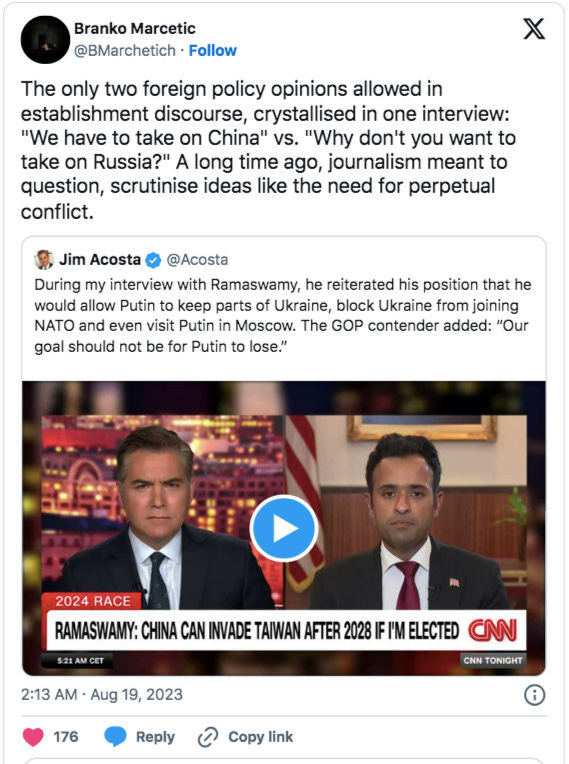
It normally gets obfuscated and manipulated to keep people from looking at it too closely, but that is in fact the argument being presented here. The US empire believes it is the rightful ruler of this planet, and those who are currently shaking their fists at Russia and China for refusing to accept this are fully behind it in that perspective.
It’s ridiculously hypocritical for westerners to condemn Russia and China for responding aggressively to the US empire building up military threats on their borders, because the last time a credible military threat was placed near the border of the United States, the US responded so aggressively that it almost ended the world.
I point out this hypocrisy not because hypocrisy in and of itself is an especially terrible sin — there are much worse things you can be in life than a hypocrite — but to flag the fact that people who think Russia and China should tolerate US actions on their borders that the US would never tolerate on its own borders actually believe the United States should rule the world.
It’s worth spending some time learning about the Cuban Missile Crisis for a number of reasons in the 2020s. First, in a time of soaring hostilities between nuclear-armed governments it’s probably good to have a lucid understanding of how close humanity came to wiping itself out in 1962, and the fact that total nuclear war was averted by a single dissenting decision by a single Soviet officer on a nuclear-armed submarine that was being bombarded by the US navy. Second, in an environment where talk of peace negotiations and compromise are regarded as treasonous Kremlin loyalism it’s good to have an understanding of the fact that the only reason we survived that perilous standoff was because Washington made compromises and pulled its Jupiter missiles out of Turkey and Italy. Third, the Cuban Missile Crisis shows how aggressively the US will respond to a foreign rival placing a military threat near its border.
The Single Dumbest Thing The Empire Asks Us To Believe
The dumbest thing the US-centralized empire asks us to believe is that the military encirclement of its top two geopolitical rivals is a defensive action, rather than an act of extreme aggression.https://t.co/LhZW6sQv9I