MCViewPoint

Opinion from a Libertarian ViewPoint

Archive for the ‘Uncategorized’ Category

Government Spending Will Cause the Next Financial Crisis

Posted by M. C. on January 13, 2025

Keynesians always say that public debt does not matter because the government can issue all it needs and has unlimited taxation power. It is simply false.

Governments cannot issue all the debt they need to finance their deficit spending. They have three clear limits:

https://mises.org/mises-wire/government-spending-will-cause-next-financial-crisis

Mises WireDaniel Lacalle

Crises are never caused by building excessive exposure to high-risk assets. Crises can only happen when investors, government bodies, and households accumulate risk in assets where most believe there is little to no risk.

The 2008 crisis did not occur due to subprime mortgages. Those were the tips of the iceberg. Moreover, Freddie Mac and Fannie Mae, state-owned entities, guaranteed a sizable portion of the subprime mortgage packages, which prompted numerous investors and banks to invest in them. Nobody can anticipate a crisis stemming from the potential decline in the Nvidia share price or the value of Bitcoin. In fact, if the 2008 crisis had been created by subprime mortgages, it would have been absorbed and offset in less than two weeks.

The only asset that can really create a crisis is the part of banks’ balance sheets that is considered “no risk” and, as such, requires no capital to finance their holdings: government bonds. When the price of sovereign bonds swiftly declines, the banks’ balance sheet rapidly shrinks. Even if central banks conduct quantitative easing, the spillover effect on other assets leads to the abrupt destruction of the money base and lending.

The collapse in the price of the allegedly safest asset, government bonds, comes when investors must sell their existing holdings and fail to purchase the new supply issued by the states. Persistent inflation consumes the real returns of previously purchased bonds, leading to the emergence of evident solvency problems.

In summary, a financial crisis serves as evidence of the state’s insolvency. When the lowest-risk asset abruptly loses value, the entire asset base of commercial banks dissolves and falls faster than the ability to issue shares or bank bonds. In fact, banks are unable to increase capital or add debt due to the declining demand for sovereign bonds, as banks are perceived as a leveraged bet on government debt.

Banks do not cause financial crises. What creates a crisis is regulation, which always considers lending to governments a “no-risk,” “no capital required” investment even when solvency ratios are poor. Because the currency and government debt are inextricably linked, the financial crisis first manifests in the currency, which loses its purchasing power and leads to elevated inflation, and then in sovereign bonds.

See the rest here

Be seeing you

Posted in Uncategorized | Tagged: , , , , | Leave a Comment »

The Real Reason Why Todays Music Is Starting To Sound The Same

Posted by M. C. on January 12, 2025

I find this particularly interesting 13:22 – The Loudness Wars

Compression is evil.

Be seeing you

Posted in Uncategorized | Tagged: , | Leave a Comment »

Hail the New King

Posted by M. C. on January 11, 2025

We haven’t been angels either.

By Eric S. Margolis

This exciting week, the man who would be king of everything made his first pronouncements.  Greenland should be purchased by the United States.  Canada should sell itself to the US. The Gulf of Mexico should be renamed ‘Gulf of America.’

Trump has started a scramble of imperial rebranding. France wants the return of what was called the Louisiana Purchase. `We sold it too cheap in 1803 to the United States for only $15 million because we bankrupted ourselves financing the American revolution against the perfidious Brits. We want it back – with interest. We also want parts of Quebec seized by the US.  Vive la France!’

Not to be outdone, Spain and Mexico have joined in a class action suit to demand that the United States hand back the parts of northern Mexico and California it grabbed in the 1840’s.

Mexico was forced to give up over 55% of its land to the Americans.  The late French nationalist leader, Jean Marie Le Pen, whom I interviewed in the 1980’s, told me ‘you Americans stole California from Mexico. Now they are taking it back through immigration.’ A bon mot, as the French say.

Spain has laid claims to California, which it once ruled.  Spain also wants back the Philippines and Cuba.  Holland wants back Manhattan and the upper Hudson Valley.  I attended a fine Dutch school in New York City founded in 1635.

Germany wants back its former colonies of Samoa and the Marshall Islands. Russia demands China return the great naval base at Port Arthur (Lushun). Beijing also wants Moscow to return vast regions of Siberia occupied in the 19th century when China was weak.

India, Pakistan and China all have large counterclaims in the Karakorams and Himalayas. Trump could resolve these festering issues among nuclear-armed nations once he figures out where they are.

As for darkest Africa, don’t even ask. Trump has called these places ‘shit holes’ and he’s not far off the mark.

See the rest here

Be seeing you

Posted in Uncategorized | Tagged: , , | Leave a Comment »

A Sad Punctuation Mark on California’s Demise

Posted by M. C. on January 11, 2025

Surplus supplies sent to Ukraine, fire fighting budget slashed.

The Ron Paul Liberty Report

Be seeing you

Posted in Uncategorized | Tagged: , | Leave a Comment »

The Fall of Syria Explained

Posted by M. C. on January 10, 2025

“But in the shell game of U.S. proxy war, HTS and its leader are Washington’s assets. From 2011, the Americans and their NATO partners used Al Qaeda, ISIS, Jabhat al Nusra Front (later HTS) with ratlines of weapons and fighters from Libya, Turkey and all over the world to descend on Syria to inflict horrors.

“Only last week before the final push on the Syria capital, Damascus, Al-Jawlani, the HTS commander, was given a primetime interview/platform by CNN, the U.S. news channel, to rehabilitate his image as a statesman-like leader instead of being a wanted terrorist. Al-Jawlani says the days when he and his organization were associates of ISIS and Al Qaeda are long gone. And CNN and other Western media do their best to make the claim sound plausible. Ah, such a happy ending!”

Paul Craig Roberts

I have complained about the difficulty of acquiring an understanding of Syria’s sudden disappearance.  Neither the Western nor Russian media provide a believable account. Recently I came across Finian Cunningham’s article,”Syria after 13 years of US State terrorism,” on the website of the Strategic Culture Foundation. https://strategic-culture.su/news/2024/12/10/syria-after-13-years-of-us-state-terrorism-what-do-you-expect/  This site is often difficult to access, because Washington stupidly regards it as Russian disinformation.

On the surface Syria’s sudden collapse looks like Syria’s allies, Russia and Iran, might have sold out Syria.  This perception could prevail to the disadvantage of Russia and Iran as reliable allies, but the real explanation is that the years of economic and trade sanctions the West enforced on Syria, the years of Washington’s proxy war against Syria, the foreign occupation of Syria’s oil and wheat provinces by American and Turkish military forces, thus depriving the government of revenues, hollowed out the Syrian economy and left the Syrian military poorly paid for its services. Syria, Cunningham wrote, fell to “a 13-year war of attrition” on which all the victims on both sides were Arabs. The Syrian people, starved of food, medicines and fuel, with over half the population displaced, suffered high inflation and a destroyed currency, and ran out of ability to resist.

I contacted Finian, an international journalist whom I have known for years and learned much that permits me to provide an explanation of Syria’s destruction.

I begin by withdrawing my suspicions of Russian and Iranian perfidy in Syria’s collapse that I expressed in recent columns and interview on Dialogue Works with Nima https://www.youtube.com/live/NfxD_4DhxFo .  Cunningham agrees that Russia and Iran’s fateful strategic blunder was, having repelled the American proxy forces, halting the conflict before decisively defeating Washington’s terrorist proxies and forcing the few American troops controlling the oil fields out of Syria.  Cunningham has convinced me that Russia and Iran were genuinely blindsided by the sudden collapse of Syria, indicating perhaps intelligence failure and unpreparedness, but not perfidy.

Thirteen years of US and European sanctions and proxy war together with US and Turkish occupation of Syria’s oil and wheat provinces deprived the state of export revenues, leaving the people with blackouts and hyperinflation and the soldiers impoverished and demoralized.  The halt in the conflict prior to the total defeat of the American proxies and eviction of Turkey and Washington from Syria meant that the exhausting multi-year struggle had no payoff for Syria.  For their own reasons Putin and Iran wanted the fighting to stop, and it stopped before Syria achieved any benefit from the success in repelling Washington’s proxy army.  The oil and wheat provinces remained in enemy hands. So the war stopped too soon and the victory was hollow.  

Assad’s ability to govern was crippled by normal Arab corruption and a self-serving bureaucracy. Additionally, Assad was lured by Saudis and oil sheikdoms with false promises of normalizing relations of the Alawite  Syrians with Sunni Arabs.

See the rest here

Be seeing you

Posted in Uncategorized | Tagged: , , , , , | Leave a Comment »

TGIF: Efficient Bureaucracy?

Posted by M. C. on January 10, 2025

The real bosses, in the capitalist system of market economy, are the consumers. They, by their buying and by their abstention from buying, decide who should own the capital and run the plants. They determine what should be produced and in what quantity and quality. Their attitudes result either in profit or in loss for the enterpriser. They make poor men rich and rich men poor. They are no easy bosses.

https://libertarianinstitute.org/articles/tgif-efficient-bureaucracy/

by Sheldon Richman

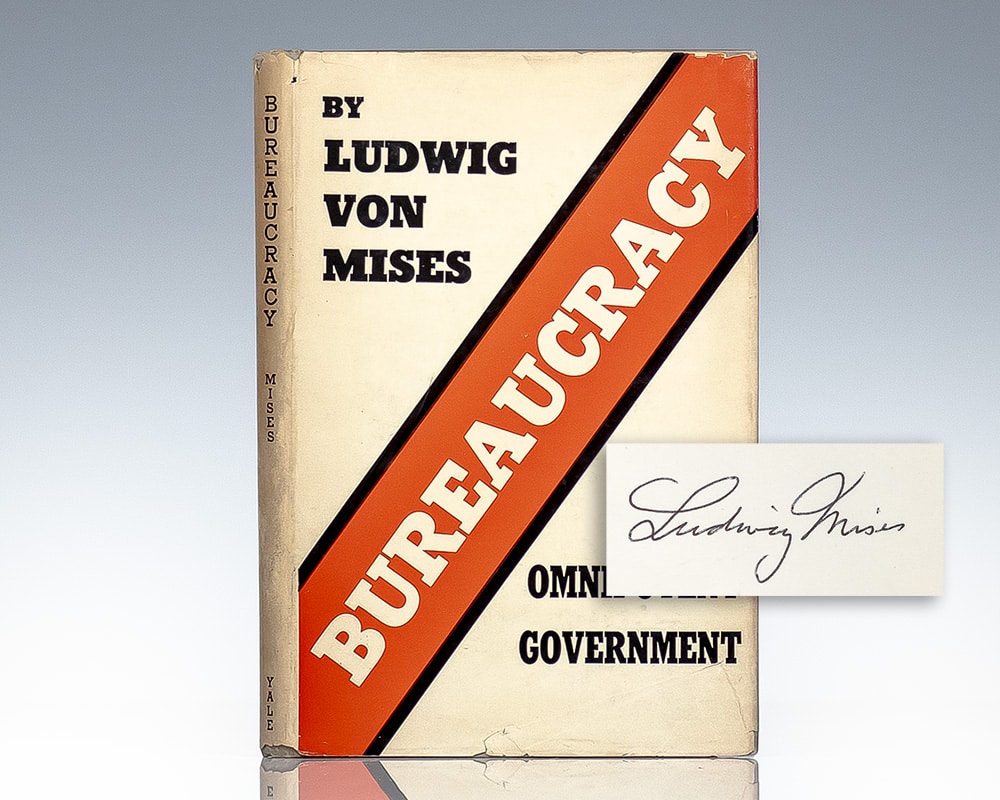
bureaucracy

With all the talk about government efficiency, it would be useful to remind ourselves why bureaucracies differ radically from for-profit businesses. Ludwig von Mises devoted a short but enlightening volume to this subject in 1944, Bureaucracy. Elon Musk and Vivek Ramaswamy, who will co-chair the nongovernmental Department of Government Efficiency, should do some homework by reading that book.

Mises, as an advocate of limited government, did not argue that bureaucracy has no place in a free society. In contrast to anarcho-capitalists, he thought government and therefore some bureaucracy was necessary to protect what he valued most: peaceful social cooperation through the division of labor—that is, the market economy. Violence against persons and property was clearly antithetical to the continuing welfare-enhancing collaboration we call the market process. But Mises did not want bureaucracies trying to do what free, private, and competitive enterprises could do better. Moreover, if the government went beyond its mere peacekeeping duties, it would undermine the market process and make us all less well off despite any good intentions.

Mises began by reminding readers (or perhaps teaching them from scratch) what the free market is and what it accomplishes. It’s a great primer for those who lack the time to read his longer works. He wrote:

Capitalism or market economy is that system of social cooperation and division of labor that is based on private ownership of the means of production. The material factors of production are owned by individual citizens, the capitalists and the landowners. The plants and the farms are operated by the entrepreneurs and the farmers, that is, by individuals or associations of individuals who either themselves own the capital and the soil or have borrowed or rented them from the owners. Free enterprise is the characteristic feature of capitalism. The objective of every enterpriser—whether businessman or farmer—is to make profit.

The uninitiated might ask who runs things. He replied: “The capitalists, the enterprisers, and the farmers are instrumental in the conduct of economic affairs. They are at the helm and steer the ship.”

However, let’s not jump to conclusions about who really runs things, Mises advsed:

But [the capitalists, etc.] are not free to shape [the ship’s] course. They are not supreme, they are steersmen only, bound to obey unconditionally the captain’s orders. The captain is the consumer.

Neither the capitalists nor the entrepreneurs nor the farmers determine what has to be produced. The consumers do that. The producers do not produce for their own consumption but for the market. They are intent on selling their products. If the consumers do not buy the goods offered to them, the businessman cannot recover the outlays made. He loses his money. If he fails to adjust his procedure to the wishes of the consumers, he will very soon be removed from his eminent position at the helm. Other men who did better in satisfying the demand of the consumers replace him.

All the conventional controversy about bosses and workers overlooks the critical point:

See the rest here

Be seeing you

Posted in Uncategorized | Tagged: , , , | Leave a Comment »

My Top 5 Favourite Books

Posted by M. C. on January 9, 2025

sbrebrown

Be seeing you

Posted in Uncategorized | Tagged: | Leave a Comment »

INSANE New York Speech Crackdown Shields ISRAEL ONLY

Posted by M. C. on January 8, 2025

Glenn Greenwald

Be seeing you

Posted in Uncategorized | Tagged: , , | Leave a Comment »

Tariffs Won’t Save the US Dollar

Posted by M. C. on January 7, 2025

With the fiat US dollar having lost well over 98 percent of its purchasing power in terms of gold since President Nixon cut the last links to gold in 1971, calling it “mighty” as Trump did, is a gross exaggeration.

https://mises.org/mises-wire/tariffs-wont-save-us-dollar

Mises WireVincent Cook

In a November 30 Truth Social post, President-elect Trump threatened BRICS states—Brazil, Russia, India, China, South Africa, Iran, Ethiopia, Egypt, and the United Arab Emirates, plus more states in the process of joining—with 100 percent tariffs on their exports to America if they dared to attempt replacing the US dollar as an international trade currency:

The idea that the BRICS Countries are trying to move away from the Dollar while we stand by and watch is OVER. We require a commitment from these Countries that they will neither create a new BRICS Currency, nor back any other Currency to replace the mighty U.S. Dollar or, they will face 100 percent Tariffs, and should expect to say goodbye to selling into the wonderful U.S. Economy. They can go find another “sucker!” There is no chance that the BRICS will replace the U.S. Dollar in International Trade, and any Country that tries should wave goodbye to America.

When one examines international trade data in detail, however, some curious anomalies in Trump’s statements become evident. For one thing, the world needs the BRICS economies for both merchandise exports and imports far more than the world needs America. China (including Hong Kong) all by itself is a bigger importer and far bigger exporter of goods than America. America only accounts for 13 percent of the world’s merchandise imports and less than 9 percent of its merchandise exports. If the world’s economy were to fragment into rival currency/trade blocs, most countries outside of North America would regard access to BRICS markets, not to America’s markets, as being a higher priority.

A NAFTA bloc and its US dollar would be competing on unfavorable terms with a BRICS bloc, a Euro bloc, and maybe a Japanese-led bloc for access to the natural resources and other factors of the less-industrialized countries. Fears of being cut off from natural resources, in turn, incentivizes hostile blocs to turn into hostile military alliances, and for their trade and currency wars to turn into world wars.

For another thing, Trump’s threats mean nothing to states that are already under severe sanctions like Russia and Iran. They export practically nothing to America. It is Chinese manufacturers who have the most to lose by the BRICS bloc antagonizing Trump, with their annual export revenues on the order of $450 billion at stake (about 3/4ths of all BRICS exports to America). However, Chinese dictator Xi has undoubtedly calculated that China’s economy is likely going to be targeted by American statists anyway, so he has every incentive to preemptively create a sanctions-proof international medium of exchange in spite of risks to export markets, just as BRICS has already created an independent wire payments system and an independent multinational credit institution to bypass American-aligned institutions. Trump’s brazen threat only provides more evidence that the American government is not a trustworthy steward of an international monetary system, and thus makes migration away from a dollar-dominated system towards some sort of alternative money even more urgent and compelling for every state that fears arousing Washington’s ire.

Yet another odd thing about Trump’s threat is that trade barriers hurt Americans as well as foreigners. It is not simply that case that big box retailers are filled from floor to ceiling with inexpensive Chinese-made consumer goods that Americans can’t seem to get enough of. The data show that China is a critical supplier of electronics and machinery too, something which American businesses depend heavily on for their own productivity. Tariffs do nothing to address the root causes of America’s deindustrialization, but suddenly cutting off access to Chinese-made capital goods and forcing diversions of scarce inputs to sectors where America lacks comparative advantages to make up for lost imports means tremendous losses of productivity and real incomes for American workers. Tariffs can certainly accelerate the deindustrialization process and the decline of the middle class and make dollar-denominated accounts and assets even more unattractive to foreigners. Carrying out Trump’s threat would be spectacularly counterproductive for the Americans who voted for Trump.

To be sure, a fragmentation of the world’s economy into rival blocs hurts everyone, not just Americans, so Trump’s threat might just be a bluff to gain an advantage in trade negotiations, and won’t do any real damage unless his bluff gets called. Even as a mere negotiating ploy, Trump’s demands don’t make sense. What Trump doesn’t seem to understand is that the continual creation of fiat dollars and dollar substitutes out of thin air hurts everyone too. Continued dependency of the world on fiat dollars is not an acceptable outcome, not even for Americans. Using threats of economic chaos to try to keep the current failing system in place is madness.

Not only are America’s predatory elites (who happen to be fiercely anti-Trump) ruthlessly exploiting the entire world with what former French President Valéry Giscard d’Estaing famously called the American government’s “exorbitant privilege” of fiat dollar creation to commandeer the productivity of others, the use of dollar-denominated US Treasury securities as the principal reserve asset for the world’s banking system means that this system is at risk of a catastrophic collapse in the event of a dollar hyperinflation. The dollar’s role as the leading trade currency is a mere byproduct of the foreign demand for dollar-denominated US Treasury securities. It is this dubious choice of reserve asset as a substitute for gold that poses an existential hyperinflationary threat to the entire global monetary system.

With the fiat US dollar having lost well over 98 percent of its purchasing power in terms of gold since President Nixon cut the last links to gold in 1971, calling it “mighty” as Trump did, is a gross exaggeration.

See the rest here

Be seeing you

Posted in Uncategorized | Tagged: , , , | Leave a Comment »