MCViewPoint

Opinion from a Libertarian ViewPoint

Archive for the ‘Uncategorized’ Category

Federal Appeals Court Finds “Grave Statutory and Constitutional Issues” with Biden’s Vaccination Mandate – PaulCraigRoberts.org

Posted by M. C. on November 10, 2021

https://www.paulcraigroberts.org/2021/11/08/federal-appeals-court-finds-grave-statutory-and-constitutional-issues-with-bidens-vaccination-mandate/

A federal appeals court has blocked the corrupt Biden regime’s private employer “vaccine mandate” on the grounds that “there are grave statutory and constitutional issues with the mandate.” https://www.theepochtimes.com/mkt_breakingnews/federal-court-blocks-biden-administrations-private-business-covid-19-vaccine-mandate_4089942.html?utm_source=News&utm_medium=email&utm_campaign=breaking-2021-11-06-2&mktids=57c5b13448d3d96e931e87904b7ce8d8&est=4CTJyNPTctMThtj2eMjknqwWPbjP846BstSI5Diq0voyDPjrWTy09g%3D%3D

As I reported, OSHA does not have the authority to issue legislation any more than does Biden. The corrupt Biden regime’s effort to bypass Congress has failed for the nonce. Congress should impeach Biden for violating the separation of powers and his oath to uphold the Constitution.

The corrupt Biden regime’s order that the military and government employees must be vaccinated is also illegal. Under the Nuremberg Laws vaccination is a medical intervention requiring informed consent. German doctors who performed medical experiments on humans without their consent were executed for doing so. A person who coerces a vaccination is subject to the death penalty. Indeed, Fauci has in the past coerced experiments on children, causing many deaths as Robert Kennedy documents in his just published book, The Real Anthony Fauci — https://www.booksamillion.com/p/Real-Anthony-Fauci/Robert-F-Kennedy/9781510766808?gclsrc=aw.ds&gclid=EAIaIQobChMIuqPjsOWE9AIVEZfICh2dBgPoEAQYAyABEgIfGPD_BwE — The United States government has provided no explanation why it goes to such extremes to track down elderly former German camp guards but refuses to hold Fauci accountable for the murder of children.

At the current time, there are many hospital, university, and public school administrators who are subject to the death penalty for mandating vaccination. Hopefully there will be trials, conviction and all will be executed. Good riddance.

Biden, the Pentagon chief, and the Joint Chiefs of Staff are also subject to trial and execution for coercing vaccination on military and federal personnel. Hopefully they too will be tried, convicted and executed if found guilty.

Otherwise, it is the rule of law that will be executed as the executive branch morphs into a dictatorship.

Be seeing you

Posted in Uncategorized | Tagged: , , , | Leave a Comment »

The Poor Forgotten Baker – LewRockwell LewRockwell.com

Posted by M. C. on November 10, 2021

The libertarian position on discrimination has nothing to do with racism, sexism, prejudice, bigotry, hate, intolerance, homophobia, or xenophobia and everything to do with freedom.

Anti-discrimination laws are an attack on property rights, freedom of association, the free market, and freedom of thought.

https://www.lewrockwell.com/2021/11/laurence-m-vance/the-poor-forgotten-baker/

By Laurence M. Vance

Earlier this year, Colorado baker Jack Phillips got in trouble again for exercising what he thought was his right in a free country to discriminate. Some libertarians have been strangely quiet about his plight.

In 2013, Phillips, the owner of Masterpiece Cakeshop in Denver, was accused by Colorado’s Civil Rights Commission (CCRD) of discriminating against a homosexual couple because he refused to bake them a cake for their “wedding.” An administrative law judge found in favor of the couple, and this was affirmed by the Commission. The decision was appealed to the Colorado Court of Appeals, which again affirmed the Commission’s decision in 2015. A petition for a writ of certiorari was filed with the Supreme Court in 2016, and was granted in 2017. The Court, in the case of Masterpiece Cakeshop, Ltd. v. Colorado Civil Rights Commission (2018), in a 7-2 vote, ruled in favor of Phillips because “the Commission’s actions here violated the Free Exercise Clause.”

But the radical left wasn’t done with Phillips.

Soon after the Supreme Court decision, Autumn Scardina—who was born and remains a man no matter how many left-libertarians call him a woman—requested that Phillips bake him a cake pink on the inside and blue on the outside to celebrate his birthday and seventh anniversary of his “gender transition” from male to female.

Phillips refused, so Scardina filed a complaint with the CCRD.

CCRD director Aubrey Elenis concluded that there was probable cause that Phillips had unlawfully denied Scardina “equal enjoyment of a place of public accommodation,” and ordered the two to enter mediation. Phillips, represented again by the Alliance Defending Freedom (ADF), sued the state of Colorado in U.S. District Court in Denver for renewing its “crusade” again him because he again refused to bake a cake that would have violated his religious beliefs.

In March 2019, the state Attorney General’s office announced that it and Phillips’ attorneys had “mutually agreed to end their ongoing state and federal court litigation,” including the CCRD action against Phillips.

So Scardina filed a civil suit of his own in state court.

In June of this year, Denver District Court Judge A. Bruce Jones ruled that Phillips violated Colorado anti-discrimination law by refusing to bake the special cake and fined him $500. (I wonder if the judge would have likewise ruled that a Jewish baker who refused to bake a cake for Nazis in honor of Hitler’s birthday and a seamstress who refused to monogram robes for Klan members violated Colorado anti-discrimination law? Of course he wouldn’t.)

For months now I have been watching carefully the libertarian reaction to Phillips’ recent plight. It is almost non-existent from some quarters. And when the right of Phillips to discriminate is mentioned, it is usually tempered by some statement implying that his beliefs are wrong. As one prominent libertarian said back in June: “You may not agree with Phillips’ beliefs—I don’t—but a liberal, pluralistic society requires tolerance for people of different moral beliefs coexisting without using the state to crush dissent out of one another.”

CDC libertarians are so enamored with the Covid-19 vaccine that they have forgotten about the poor baker. They have been so busy telling us that private businesses have the right to require that their customers wear masks, social distance, and get the Covid-19 vaccine that they have ignored Jack Phillips. Never in their life have they talked as much about the right of businesses to discriminate as they have during the past year. But it is usually always in reference to the right of businesses to discriminate against the unmasked and the unvaccinated.

Since CDC libertarians rarely make an unequivocal case for the absolute freedom of discrimination, let me state the libertarian position on discrimination as clearly and succinctly as I can: Since discrimination—against anyone, on any basis, and for any reason—is not aggression, force, coercion, threat, or violence, the government should never prohibit it, seek to prevent it, or punish anyone for doing it.

The libertarian position on discrimination has nothing to do with racism, sexism, prejudice, bigotry, hate, intolerance, homophobia, or xenophobia and everything to do with freedom.

Anti-discrimination laws are an attack on property rights, freedom of association, the free market, and freedom of thought.

Be seeing you

Posted in Uncategorized | Tagged: , , , , , , , | Leave a Comment »

After Afghanistan, Military Spending on Track to Go Up

Posted by M. C. on November 10, 2021

The defeat in Afghanistan offers a chance to rethink America’s war machine, but Congress is on the verge of raising military spending to $740 billion.

https://theintercept.com/2021/11/07/military-spending-pentagon-afghanistan/

Peter Maass

Peter Maass

Around midday on August 15, the president of Afghanistan, Ashraf Ghani, was told by an adviser that Taliban fighters had entered the presidential palace and were looking for him room by room. This was not true, but Ghani, aware that ousted presidents do not have long lives in his country, hurried himself and his wife to a military helicopter and fled for Uzbekistan. Without time to fetch any personal belongings, he left Kabul in plastic sandals and a thin coat, according to a Washington Post account of that day.

Afghanistan was supposed to be the “good war” after 9/11, the one with a legitimate purpose and a happy ending. That also didn’t turn out to be true, but while the war’s momentum favored the Taliban for years, its final act had the suddenness of a guillotine, with a lot more pain. At Kabul’s airport, desperate Afghans clung to the sides of a departing U.S. cargo plane. Panicked families tried to get onto the diminishing number of evacuation flights. And 13 U.S. troops helping keep the airport open were killed in a suicide bombing. Just before midnight on August 30, the last U.S. aircraft and the last U.S. soldier got out of Kabul.

Guess what happened?

To understand the next step, you need to go back to April, when President Joe Biden proposed a $715 billion Pentagon budget for 2022, which represented a 1.6 percent increase from 2021. Progressives like Lee were not pleased — and were even less pleased in late July when the Senate Armed Services Committee added $25 billion to Biden’s proposal. This “plus-up,” as it’s called, raised the budget to $740 billion, a 5 percent increase over the previous year. At that rate, military spending over the next decade would easily exceed $7 trillion, or four times more than the $1.75 trillion Build Back Better program that Biden is trying to push through Congress.

See the rest here

Be seeing you

Posted in Uncategorized | Tagged: , , , , | Leave a Comment »

In a Free Economy, Prices Would be Going down, Not Up | Mises Wire

Posted by M. C. on November 9, 2021

Price indices cannot measure the consequences of monetary inflation because the downward pressure on prices that these innovations exert across the economy operates independently of the upward pressure on prices generated by credit expansion. In other words, the consequences of monetary expansion are far deeper than the rise in consumer prices suggests. When the CPI is low, we pay only a little more for consumer goods than we did the year before. But without monetary inflation, we would be paying significantly less.

https://mises.org/wire/free-economy-prices-would-be-going-down-not

Chris Calton

Whenever politicians and media outlets discuss inflation, they invariably use the Consumer Price Index (CPI) as their measure. The CPI is only one of several price indices on top of the various measures of the money supply that underlie aggregate price changes. Strictly speaking, the CPI does not measure inflation per se, but rather the consequences of monetary expansion on consumer products. In macroeconomics, the CPI is one of the key indicators of economic health, and it is this inflation measure that economists use to calculate real GDP. Naturally, the accuracy of the CPI as a measure of the consequences of credit expansion is critically important, yet the measure is controversial among investors. As Investopedia explains, the CPI is “a proxy for inflation,” and “from an investor’s perspective . . . is a critical measure that can be used to estimate the total return, on a nominal basis, required for an investor to meet their financial goals.”

But if the concern is the effect of monetary expansion, why are we using proxy variables to measure this phenomenon? Proxies are useful when we don’t have accurate data on the variable we want to measure, compelling us to find an imperfect substitute that (we assume) tends to follow from the variable we can’t measure. But we have very accurate measures of the money supply, going back more than a century. We know that other factors affect prices in the economy, so price indices cannot accurately capture the consequences of monetary expansion; they can, we are always told, “approximate” these consequences, but why approximate something we have precise measures of?

To put this into perspective, the average annual rate of change in the money supply (M1) since 1971 is 10.7 percent, while the annual rate of change in the CPI is only 3.9 percent. When we include other price indices, we see similar disparities, such as the dramatic differences between the Producer Price Index and CPI, which I’ve discussed elsewhere. The wide gap in these measures might strain our credulity about how usefully the CPI “approximates” the consequences of inflation, and it raises questions about how we can explain why an 11 percent annualized increase in the money supply over five decades only produced a 4 percent rise in consumer prices.

The Standard Logic of Price Indices

When explaining inflation measures to their students, the typical economics professor will emphasize that we measure a basket of goods—the average of the prices of several hundred items in a given category—in an attempt to capture the “underlying inflation” in the economy. As explained by the Cleveland Federal Reserve:

If a hurricane devastates the Florida orange crop, orange prices will be higher for some time. But that higher price will produce only a temporary increase in an aggregated price index and measured inflation. Such limited or temporary effects are sometimes referred to as “noise” in the price data because they can obscure the price changes that are expected to persist over medium-run horizons of several years—the underlying inflation rate.

The reasoning is superficially sound. Certain factors will affect the prices of specific items in the basket, but the only thing that affects the price of all the items in the basket is the money supply. This, at least, is the standard assumption. Given this assumption, the change in the CPI might lag somewhat behind changes in the money supply as prices take time to adjust, but the measures should track rather closely over long periods.

So why is the CPI so low?

Capital Accumulation and Aggregate Price Levels

Throughout history, we find many innovations in technology and business that lowered the price of entire baskets of goods. Transportation technologies provide the easiest example, from turnpikes, canals, railroads, and steam-powered vehicles in the nineteenth century to semitrucks and shipping containers in the twentieth century. For perspective, the cost of transporting goods from Buffalo to New York City in 1817 was 19.12 cents per ton-mile; by 1850, the cost had dropped to 1.68 cents per ton-mile.1 Because consumer goods (and the components used to make them) have to be transported from factory to warehouse to retailer, any reduction in transportation costs produces a compounding effect in prices across the entire economy.2

Other changes in technology and business organization have a similar economy-wide effect on price levels. Organizational innovations in shipping, such as packet lines and the hub-and-spoke distribution model, also lowered the costs of transporting goods. Communications technology, such as the telegraph and the internet, reduce transaction costs by making it easier to relay information and efficiently allocate resources.

Production innovations, by reducing the cost of manufacturing higher-order goods, similarly lower the price of goods across the economy. Ancient Romans knew how to produce steel, but the Bessemer method for mass producing steel allowed Andrew Carnegie to lower the price of steel so dramatically that steel products went from luxuries to banal household items (not to mention the use of steel in railroads, bridges, and machinery, which lowered the cost of producing and transporting even nonsteel goods). And as with transportation, organizational innovations in production methods, such as interchangeable parts and the assembly-line process, helped make mass production possible for all varieties of consumer goods.

Capital accumulation, of course, is necessary to extend the gains from these innovations across the economy. By delaying consumption and pouring savings into expanded lines of production, investors create a feedback loop that ensures continual gains from new technologies and organizational strategies. Delta may have conceived of the hub-and-spoke model of more cost-efficient transportation for air travel, for example, but it was the entrepreneurial endeavors of Frederick Smith and Sam Walton (founders of FedEx and Walmart, respectively) that adapted this idea to commodity transportation. It was only by slowly reinvesting the profits into their businesses (and compelling their competitors to do the same) that they were able to produce gradual but continuous economic gains.

Price indices cannot measure the consequences of monetary inflation because the downward pressure on prices that these innovations exert across the economy operates independently of the upward pressure on prices generated by credit expansion. In other words, the consequences of monetary expansion are far deeper than the rise in consumer prices suggests. When the CPI is low, we pay only a little more for consumer goods than we did the year before. But without monetary inflation, we would be paying significantly less.

This, in fact, is precisely what occurred through most of the nineteenth century, until the Federal Reserve charter mandated a monetary policy that would stabilize prices, which is a positive-sounding way of describing a policy of propping up prices that would otherwise fall as capital infrastructure expands and productivity increases. Roughly speaking, where we’ve seen a 4 percent annual increase in the CPI since 1971, we should have seen a 7 percent annual reduction in prices (without, it is worth noting, the corresponding reduction in wage rates that only accompanies deflation driven by monetary contraction).

Frédéric Bastiat taught us to consider not only that which is seen, but also that which is unseen when analyzing the consequence of policy. The CPI is merely the observable consequence of monetary expansion on prices, but it serves to mask the far greater unseen consequence: the foregone gains in living standards that should have come from the gradual reduction in prices that results from innovation and capital accumulation.

  • 1. George Rogers Taylor, The Transportation Revolution, 1815–1860 (New York: Harper Torchbooks, 1951), p. 137.
  • 2. When I describe this as a “compounding effect,” I mean that the roughly 2.76 percent annual reduction in transport costs applies to each component used in the manufacture of a single consumer good. The final product, therefore, enjoys the cumulative effect of reduced transportation costs throughout the production process.

Author:

Chris Calton

Chris Calton is an economic historian and a former Mises Research Fellow. He was the writer and host of the Historical Controversies podcast.

Be seeing you

Posted in Uncategorized | Tagged: , , | Leave a Comment »

Watch “The WORST messaging apps for PRIVACY” on YouTube

Posted by M. C. on November 9, 2021

https://youtu.be/47_3_vaUSIU

Be seeing you

Posted in Uncategorized | Tagged: , | Leave a Comment »

bionic mosquito: Cultural Marxism and Critical Theory Today

Posted by M. C. on November 9, 2021

There is only one path possible for the return to some level of sanity, let alone liberty.  It is for the Christian Church and Christian leaders to properly lead in accord with the Scripture and Natural Law.  This is the narrative that sustained the West for centuries; it is the narrative – the only narrative in the history of the world – that gave us something approaching a healthy individual liberty.

http://bionicmosquito.blogspot.com/2021/11/cultural-marxism-and-critical-theory.html

…Critical Theory has come to dominate the academic world.

The Red Trojan Horse: A Concise Analysis of Cultural Marxism, by Alasdair Elder

This is the second of two posts on this book by Elder.  In the first, I covered the chapters in which he examined the history of Cultural Marxism and Critical Theory.  In this post, I will review his comments on the current situation and his proposed solution.

NB: I use the term Cultural Marxism because this is how Elder labels the situation.  I think it is more accurately described as Cultural Gramsci-ism.

Just as Classical Marxism considers that everyone has been fooled by capitalism, Cultural Marxism considers everyone has been fooled by the patriarchy.  Race, gender, sexual orientation, even religion – all are fair game as tools to crush traditional cultural and ethical bounds.

The tactic is always the same: identify a privileged oppressive group; this leads to identifying the underprivileged oppressed group; the oppressive group is then tagged with at least one pathology – an “ism” or a phobia; a victim narrative is established; finally, a feedback loop is established – constant reinforcement of the victim narrative.

This mechanism can be seen in feminism, multiculturalism, transgenderism, etc.   Sound arguments are never presented or addressed; bullying and labeling are the preferred tools.  Per Anita Sarkeesian, “Everything is racist, everything is sexist, everything is homophobic, and you have to point it all out.”

Hypocrisies abound, but these are irrelevant.  Pointing these out is also irrelevant.  Doing so merely demonstrates your phobia, your “ism.”  What is left for the Cultural Marxists is to be for nothing and against everything – ultimately leading to a radical individualism.

This is an individualism, not of responsibility and self-governance, but an individualism of complete isolation, resulting in such a nihilism that the societal fabric is destroyed, and all that is left of the culture is a void.  Total dependence on the state (communism) is all that is left.

This can be seen in many examples.  The nationalization of childhood (it takes a village).  Family life is dull, restrictive, oppressive.  Education is removed, replaced by schooling.  Memorization of facts (if that) instead of developing the ability to use reason in order to think critically. 

Feminism is another, used, finally, as a lever to destroy family – again, leaving children in the hands of the state.  Identity politics, offering power to every “identity” except straight white males.

Elder offers a nice overview of the economics of Cultural Marxism, although I would describe this as the economics of a state willing to leverage the destruction of a culture in order to maximize control.  Monetary and fiscal policy controlled by state actors and bankers, not by individuals acting in a market.  Fiat money, giving the control over the key commodity in a division of labor economy to a small group of central planners.

Elder does offer a chapter on the subject of religion and Cultural Marxism:

It was with very good reason that the progenitors of Cultural Marxism, particularly Georg Lukács and Antonio Gramsci, manifested such a vitriolic loathing for Christian culture. …it is impossible to deny that Christian values have formed the bedrock of Western Civilization.

Unfortunately, as will be seen shortly, Elder does nothing more with this reality. 

It was this cultural tradition that had to be destroyed; Freud’s views on Christianity as a psychologically unhealthy oppressive force would be quite useful for this purpose.

Elder points to the counterculture of the 1960s – the abandonment of traditional sexual mores, the promotion of mysticism and psychedelic “woo.”  As an aside, I recently heard, in a podcast by Tom Holland, a very interesting thought: someday, the 1960s will be seen as a historical turning point much as we today see Luther’s nailing of the ninety-five theses and the Reformation. 

Holland might be right, although I don’t think the effects will be as long lasting.  As violent, maybe; but there is no staying power in continuous deconstruction.

Returning to Elder: the enemy which he spends a good amount of effort on is Islam.  He spends far more time in this chapter on Islam than he does on Christianity.

I don’t know that Islam is any more of an “enemy” than the dozen other tools used by those who want to destroy Western Civilization.  In any case, it is a tool, it isn’t the craftsman. 

He makes an interesting point, and one that points out why continuous deconstruction will consume itself.  As more Muslims come to the West, what will come of transgender rights (and you may fill in any other of the shibboleths of the critical theorists)? 

My thought: deconstruction as a means cannot be satisfied merely with the communism as its end.  Deconstruction is not merely a means; it is the end, the purpose.  It will not be satisfied, as if to say “here, we have reached our goal.” 

There is no goal to reach, because every “achievement” only leads to a new hierarchy that must be deconstructed.  This will be the undoing of this era, but, again, it may be a painful experience for many of us between now and then

In the final chapter, entitled “The Cultural Battlefield,” Elder comes to his solution, or his method of combat.  I must say, it is a disappointing chapter.  After being clear that the Cultural Marxists have won the battle of the narrative, he focusses exclusively on the strategy of fighting with facts.  In speaking of the SJWs as useful idiots:

SJWs usually believe their lies because they are ignorant of any rational arguments to the contrary.

This really is an unbelievable statement.  They either know the arguments but don’t care, or they are screaming whenever someone tries to make a rational argument.  Elder earlier noted that sound arguments are never addressed.

…check the facts and examine statistics, which will always show such [Cultural Marxist] narratives to be false.

Wrong again.  Steven Pinker has made a career of facts and statistics.  He has lost the argument.  Facts and statistics don’t give meaning to life.  People don’t live in a world of facts and statistics; people live in a story, a narrative.  The most powerful story wins.  The West has lost its narrative, not its facts.

Elder is focused on winning one at a time by facts, yet the universities are turning out thousands a year on the other side.

To successfully combat an SJW, the red-pilled rebel must understand the programming, which controls the SJW in question…

Programming doesn’t get altered by facts; it gets altered by a change in the program.  The program is a narrative.  It acts on the facts presented to it in accord with the narrative with which it has been programmed.  Present the same facts to two different programs and you will get two different results.

Conclusion

After spending the entire book discussing how the means of the Cultural Marxists is exercised through the destruction of culture, Elder sees as the solution not some consideration about culture, but a presentation of facts.  It is an unfortunate conclusion. 

You can’t beat programming with facts.  Two individuals with two different “programs” will look at the same facts and come to different conclusion.  This is so obvious on its face; it is almost embarrassing to have to say it.

There is only one path possible for the return to some level of sanity, let alone liberty.  It is for the Christian Church and Christian leaders to properly lead in accord with the Scripture and Natural Law.  This is the narrative that sustained the West for centuries; it is the narrative – the only narrative in the history of the world – that gave us something approaching a healthy individual liberty.

Posted by bionic mosquito at 12:03 AM

Be seeing you

Posted in Uncategorized | Tagged: , | Leave a Comment »

Name 2 Things – LewRockwell LewRockwell.com

Posted by M. C. on November 9, 2021

After hundreds of challenges in dozens of markets from NY to LA to DFW, ATL, DC, and even Toledo (!), only once, a caller in North Carolina got the correct answer: “Nothing”. Zip. Zero. None. No “2 things” or even 1 we “come in contact with on a daily basis” is not taxed, regulated, embargoed, licensed, restricted or prohibited by the Government.”

https://www.lewrockwell.com/2021/11/brian-wilson/name-2-things/

By Brian Wilson

Here’s a little game I used to play with listeners on my talk show. The goal was to compel them to think about the Government, its size, the pervasiveness of its laws, and smothering regulations.

The challenge: Name the 2 things you come in contact with every day that are not taxed, regulated, embargoed, licensed, restricted, or prohibited by the Government

Invariably, the phone lines exploded! Unfortunately, the majority of callers usually misunderstood the most important part of the challenge: “…you come in contact with…”. As a result, ‘contestants’ would name “ love”, “sunrise and sunset” and similar misses. (In a tactile sense, you don’t come in contact with ‘love’ and there is Daylight Saving Time). Others would try “children”, “air”, “water” – as if kids aren’t subject to taxes, compulsory education, and a boatload of age-specific rules; air and water have their own mountain of pollution laws, water and ‘wetlands’ regulations. Invariably, there would come “sex”, “economics”, “Government” – some never having heard of sodomy laws, intangible “economics” and untouchable Government. A few creative folks tried “prayer”. While it is problematic whether one “…comes in contact…” with prayer, just try kneeling with some fellow believers at the Lincoln Memorial in DC. It’s a blessed opportunity to get educated by members of the Park Police.

After hundreds of challenges in dozens of markets from NY to LA to DFW, ATL, DC, and even Toledo (!), only once, a caller in North Carolina got the correct answer: “Nothing”. Zip. Zero. None. No “2 things” or even 1 we “come in contact with on a daily basis” is not taxed, regulated, embargoed, licensed, restricted or prohibited by the Government.”

While it’s been 10 years since the last game, we could play it today with just one small change:

“Name the 2 issues impacting your life on a daily basis that have not originated from Government?”

Consider:

Presidential ‘mandates’, lockdowns, ‘social distancing’, family association, church attendance, school attendance, and school board meetings, now with FBI agents monitoring rightfully outraged parent-terrorists, employment security, unemployment income, taxation, inflation, savings, investments, groceries, gas, dining out, football games, birthday parties, weddings, even funerals continue to be subject to capricious Government intrusion. If you or a loved one serve in the Armed Forces, a separate set of COVID-related Government regulations can cost you your rank, job, and earned benefits. The impact of legally dubious State and Federal government intervention continues unabated as politicians ‘green mail’ corporate entities in place of enabling legislation even to the point of ignoring SCOTUS verdicts.

The answer is still the same: None. The issues roiling our lives today come from Government laws, unconstitutional regulations, illegal restrictions, and policies intruding into every aspect of our daily life.

How does this happen in America, “Land of the Free”?

As a prescient Ayn Rand wrote:

“The only power any government has is the power to crack down on criminals. Well, when there aren’t enough criminals, one makes them. One declares so many things to be a crime that it becomes impossible for me to live without breaking laws.”

Tragically,  Reality is not a radio game; there’s no way to tune out. Think ‘Hotel California’. It’s all happening before our eyes right now, every day: specific, intentional parts of a much bigger plan previously discussed here; Mike Nichols reviews the plan and progress in enlightening detail here.

Since there are no prizes for the correct answer, what to do? Play the game anyway with folks you know. Or don’t know. Their reaction will be telling; a new ‘woke-ness’ may come over them and you just may find some valuable comrades for the days ahead.

Be seeing you

Posted in Uncategorized | Tagged: , | 1 Comment »

Why Not Abandon All Foreign Bases? – LewRockwell LewRockwell.com

Posted by M. C. on November 9, 2021

Why not abandon all foreign military bases, bring all of the troops home (not just the ones in Afghanistan), and stop policing the world? And while we’re at it, turn over all of the DOD golf courses in Japan to the Japanese.

The U.S. global empire of bases and troops is unnecessary to the defense of the United States, a global force for evil, and a drain on U.S. taxpayers. It’s only purpose is to carry out an imperialistic, militaristic, reckless, belligerent, and meddling U.S. foreign policy that is not in the interest of the American people.

https://www.lewrockwell.com/2021/10/laurence-m-vance/why-not-abandon-all-foreign-bases/

By Laurence M. Vance

Neoconservatives—like Michael Rubin at the American Enterprise Institute (“The One Foreign Base Biden Should Abandon”)—haven’t gotten over President Joe Biden’s withdrawal of U.S. troops from Afghanistan.

But Rubin is also upset that “the Biden administration is determined to hold on to the one base that America should have abandoned a decade ago.” This is Incirlik Air Base in Turkey.

Rubin maintains that during the Cold War, Incirlik was crucial. But even though “the base supported U-2 surveillance flights, U.S. operations during the 1958 Lebanon crisis, the 1991 liberation of Kuwait, and, most recently, the fight against the Taliban,” Incirlik—which “also hosts approximately 50 nuclear weapons”—is “now a strategic liability” instead of “a strategic asset.”

Turkey “is as much an enemy as an ally.” President Erdogan cannot be trusted. “Every American serviceman, contractor, and family at Incirlik are potential hostages.” “Incirlik now risks a repeat of the 1979 Iran hostage crisis.” An American “departure from Incirlik” would not “affect U.S. operations.” The United States should use the “Mihail Kogalniceanu air base in Romania” or the “Souda Bay Naval Base” in Greece. It would not be “irresponsible” to leave “an obsolete base.”

Rubin is right. The United States needs to “end the U.S. military presence in Turkey.”

But here is a better idea: Why not abandon all foreign bases?

According to the Department of Defense’s (DOD) Base Structure Report: “The DoD manages a worldwide real property portfolio that spans all 50 states, 8 U.S. territories with outlying areas, and 45 foreign countries. The majority of these foreign sites are located in Germany (194 sites), Japan (121 sites), and South Korea (83 sites).” Incredibly, the DOD is “one of the Federal government’s larger holders of real estate managing a global real property portfolio that consists of over 585,000 facilities (buildings, structures, and linear structures), located on 4,775 sites worldwide and covering approximately 26.9 million acres.” The DOD has acknowledged the existence of about 800 U.S. military bases in 80 countries, but we know from the work of Nick Turse, David Vine, and the late Chalmers Johnson that that number could be over 1,000. The United States has about 95 percent of the world’s foreign military bases. “Red” China has just one.

There are also about 175,000 active duty U.S. troops overseas in over 170 countries and territories. World War II ended in 1945, and yet the United States still maintains tens of thousands of troops in Germany and Japan.

Why not abandon all foreign military bases, bring all of the troops home (not just the ones in Afghanistan), and stop policing the world? And while we’re at it, turn over all of the DOD golf courses in Japan to the Japanese.

The U.S. global empire of bases and troops is unnecessary to the defense of the United States, a global force for evil, and a drain on U.S. taxpayers. It’s only purpose is to carry out an imperialistic, militaristic, reckless, belligerent, and meddling U.S. foreign policy that is not in the interest of the American people.

Be seeing you

Posted in Uncategorized | Leave a Comment »

We’re “Very Sorry” – Bank Of England Governor Apologizes To Brits For Crushing Their Standard Of Living | ZeroHedge

Posted by M. C. on November 9, 2021

“We’ve never seen a shock of this kind and the big thing we are seeing at the moment is the furlough scheme is coming off, there is going to be an increase in taxes on National Insurance [and] universal credit was just cut.

“So, the central bank really hasn’t a lot of clue what is going on.”

https://www.zerohedge.com/personal-finance/were-very-sorry-bank-england-governor-apologizes-brits-crushing-their-standard

Tyler Durden's Photoby Tyler Durden

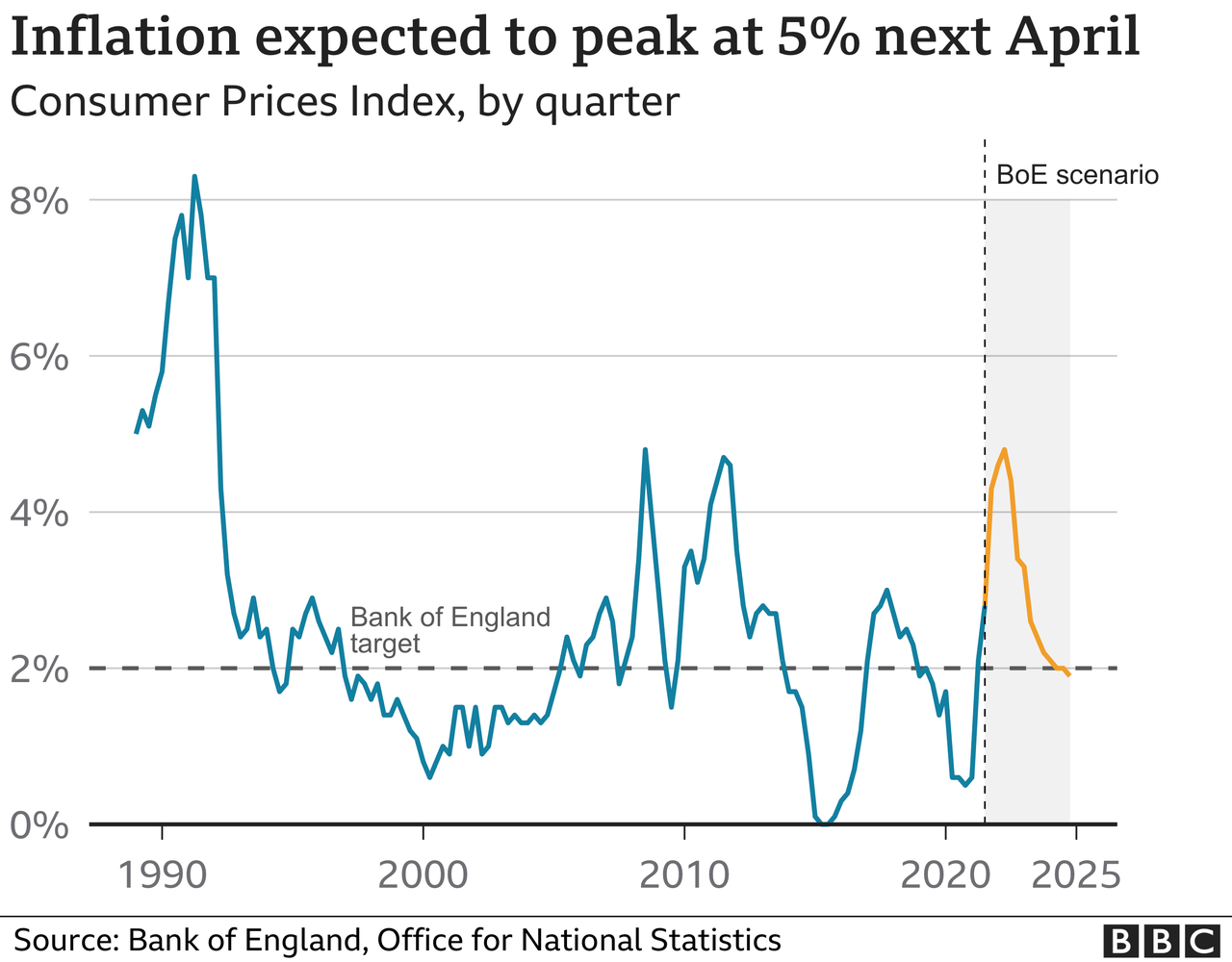
In an odd moment of truthful admission – that absolutely will not be heard in the US – The Bank of England governor has said he is “very sorry” that UK inflation is rising amid forecasts the cost of living could increase as much as 5%.Andrew Bailey told the BBC that households were already feeling the impact of rising prices.

“I’m very sorry that’s happening,” he said.“None of us want to see that happen.”

Inflation is currently ahead of the Bank of England’s 2% target at 3.1%. There are expectations it could rise to 5% by next April.Mr Bailey said:

“Inflation is clearly something that bites on people’s household income. I’m sure they’re already feeling that in terms of prices that are going up.”

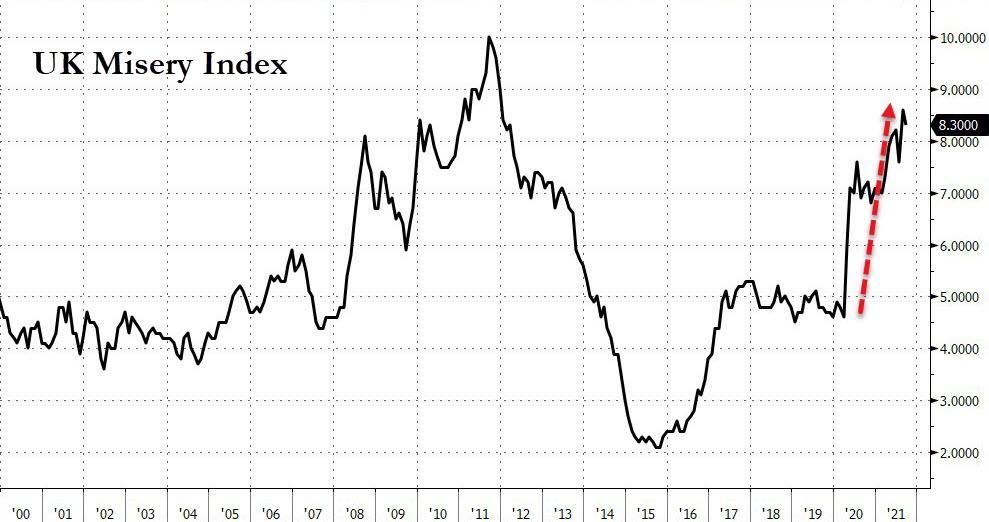
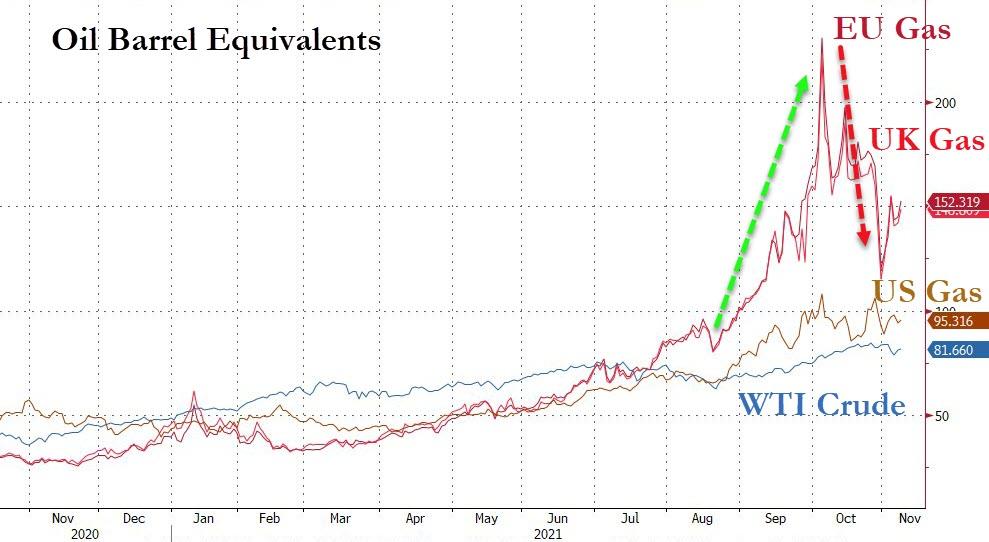
While real wages soared during the pandemic as supply of free-money dominated the suppressed-demand for goods/services – all thanks to government intervention – that is all unwinding now and real wage gains are rapidly slowing…Source: BloombergThis has helped push UK’s “Misery Index” to its highest in a decade…Source: BloombergAnd arguably things are about to get far more serious as the choice between heating your home and feeding your family is a real one for many Brits…Along those lines, commenting on the decision not to raise borrowing costs this month. Mr Bailey said:

“Putting interest rates up, I’m afraid, isn’t going to get us more gas.”

Finally, Danny Blanchflower, a former member of the MPC who is now an economics professor at Dartmouth College in the US, warned that trusting what The Bank says may be a mistake:“We have no historical precedent for what’s happened,” he said.”We’ve never seen a shock of this kind and the big thing we are seeing at the moment is the furlough scheme is coming off, there is going to be an increase in taxes on National Insurance [and] universal credit was just cut.“So, the central bank really hasn’t a lot of clue what is going on.”He concluded rather ominously: “This is a really big uncertain world and everybody should tread cautiously. I’m afraid I have to say… you have to take what the governor of the Bank of England and the Monetary Policy Committee said with a very large pinch of salt.”

Be seeing you

Posted in Uncategorized | Tagged: , , | Leave a Comment »

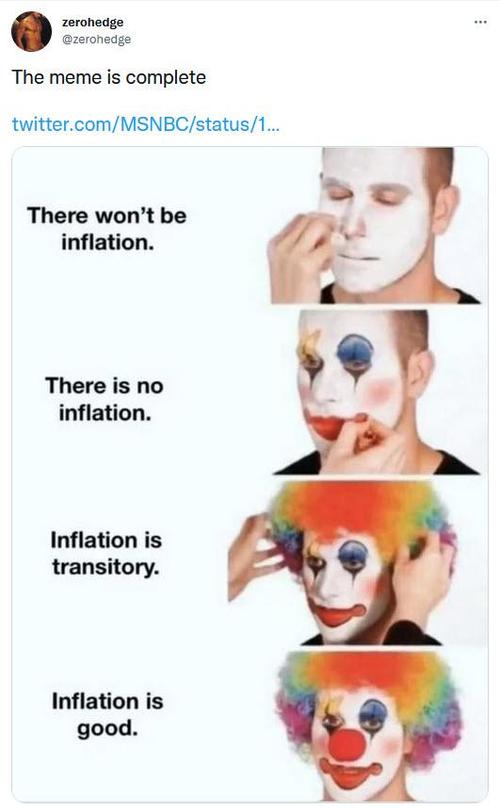
MSNBC Goes Full Clowntard: Gaslights That Inflation Is A “Good Thing”, Deletes Tweet After Angry Backlash | ZeroHedge

Posted by M. C. on November 9, 2021

https://www.zerohedge.com/economics/msnbc-goes-full-clowntard-claims-inflation-good-thing-families-struggle-soaring-prices

Tyler Durden's Photoby Tyler Durden

While millions of Americans are suffering from runaway, galloping inflation everywhere (to avoid the dreaded “H” word that made Jack Dorsey every lib’s enemy #1) from the gas pump to the grocery store aisle – which of course affects low-income individuals the most, MSNBC has gone up to bat for the Biden administration, deploying their best pretzel-logician to explain why all this inflation is literally – wait for it – good. First, the now-deleted tweet…

Nevermind that in September, a Kroger executive warned in that grocery prices were about to get nasty, and the company will be “passing along higher cost to the customer where it makes sense to do so.” Or that Nestle CFO Francois-Xavier Roger said blistering inflation would likely continue into next year – telling the crowd at a Barclays consumer staples conference: “If we talk of 2022, it is likely that input cost inflation will be higher next year than this year.” Or that Atlanta Fed President Raphael Bostic admitted last month that inflation is not transitory (and even has a swear jar collecting dollar bills for every time some gaslighter utters the word “transitory”).Or that agricultural input costs from fertilizer to feed have gone through the roof – thanks to soaring natural gas prices of all things.Or labor shortages throughout the supply chain – including US ports and the trucking industry – including those who refuse to take the Covid-19 vaccine.Or just read this from Bank of America:

“Meanwhile on Main Street: cost of living rising…wages rising; food (coffee @ 7-year high, wheat @ 13-year high), energy (BofA forecast $120/bbl Brent next 6 months), shelter (US rents up 9% YoY), wages annualizing 6% past 6 months; US core CPI currently 4.0% YoY, likely to be 5-6% spring’22.”

Nope. You see, the inflation we’re seeing today is a good thing, according to MSNBC’s James Surowiecki, whose financial background is a Ph.D. in American history and being a writer at The Motley Fool and The New Yorker.Their rationale: people spent less and saved more during the pandemic (more disposable income), and the stock market (which most American’s still don’t participate in) went apeshit.

Even though millions of Americans lost their jobs, enhanced unemployment benefits and stimulus payments left many of them better off, not worse. And the stock market, after initially falling, boomed.

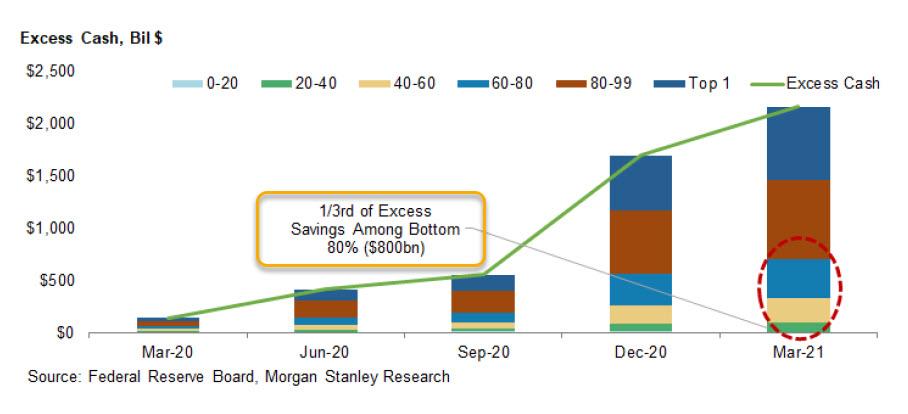
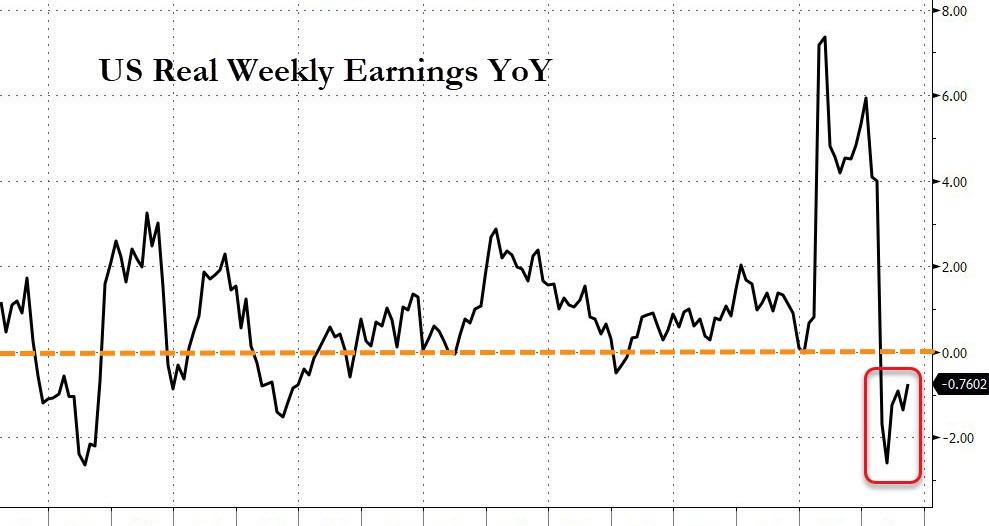
Which of course is just propaganda, because as Morgan Stanley explained so simply even MSNBC columnists could understand, the “bottom 80%” of the population retained just a third of the $2 trillion in so-called excess savings. And without jobs, most have already burned through whatever money they had saved up. In other words, the bulk of government handouts ended up – you guessed it – in the hands of the ultra rich who never needed it!Facts be damned, MSNBC’s propaganda continued: “American consumers are, relatively speaking, flush, and it’s that strong demand for goods and services that is sending prices higher.”BUT (and totally couldn’t be the primary reason, could it?), “it’s taking manufacturers and food producers time to increase supply after cutting back production during the pandemic,” and as a result, “When you have high demand, and relatively low supply, prices go up.””The inflation we’re seeing is not, then, some mysterious affliction that’s descended on the economy. It’s the predictable product of the economy’s rapid recovery, and its costs have been offset, to a large degree, by robust wage growth and government policies.”Except, when adjusted for inflation, real weekly earnings are negative.

Meanwhile, even the notorious optimistic Wall Street is starting to tell the truth, with Goldman warning that things are going to get a lot worse before they get better.Not surprisingly, after getting ratio’ed in a furious backlash, MSNBC did the only thing it could and deleted its tweet, as its latest attempt at mass gaslighting propaganda went terribly wrong.

Be seeing you

Posted in Uncategorized | Tagged: , , , | Leave a Comment »