There is now in the US a vast industry funded with $1.3 trillion developing “usable” nuclear weapons. All sorts of private contractors, scientific laboratories, the Pentagon are involved. In other words, the vast sum is widely spread resulting in a massive influential institutionalized interest that prevents nuclear disarmament.
Professor Chossudovsky points out that the politicians funding this doomsday exercise have no conception of the consequences of using nuclear weapons (some of which have been declared “peace weapons”) and that there is neglect of the risks introduced by artificial intelligence.
Mind your own business, Francis. You’ve got plenty of it.
In a CBS interview, the Infallible One has pronounced, “The Migrant has to be received.” Meaning: let them all in, and then sort them out, one at a time. After they’re in America, do a case by case exam and decide whether to keep each one or send him back.
I’m not kidding. That’s the Pope’s considered position.
See, only two or three migrants come across the whole border every week. And at that small dusty depot, US ICE personnel can casually make phone calls to law enforcement in any of 25 different foreign countries and obtain comprehensive background reports on these people. Uh-huh.
That’s the Pope’s picture.
“They must be received.”
Why? According to what principle?
Is the Vatican taking in Mex cartel members? Is the Vatican providing rooms for military-age men from China, Nigeria, Panama, Venezuela, Haiti?
Is Francis an actual Pope, or is he a front man for Alejandro Mayorkas, Joe Biden, and Merrick Garland?
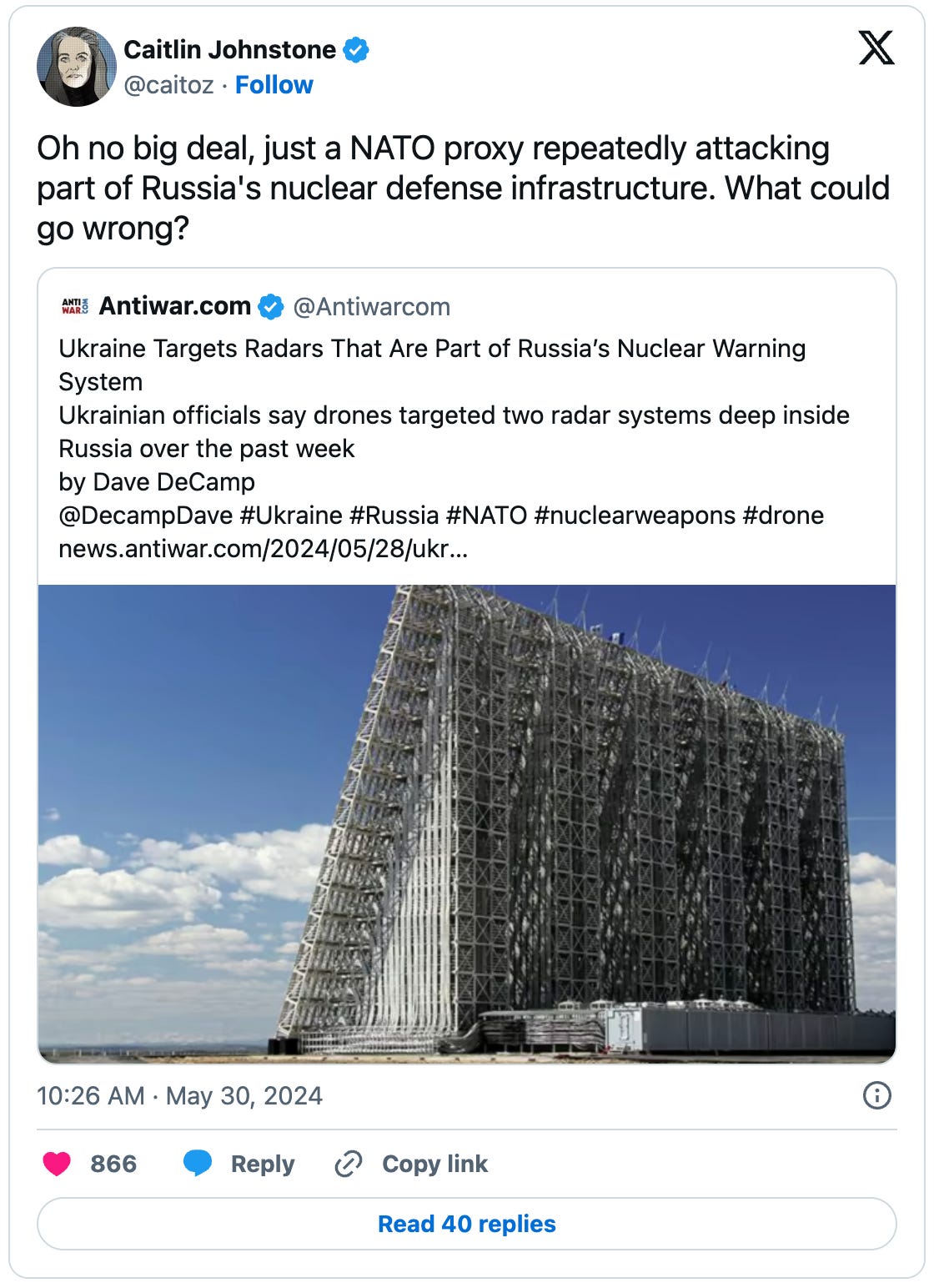
Oh no big deal, just a NATO proxy repeatedly attacking part of Russia’s nuclear defense infrastructure. What could go wrong? https://t.co/RysGjsVAF1— Caitlin Johnstone (@caitoz) May 30, 2024
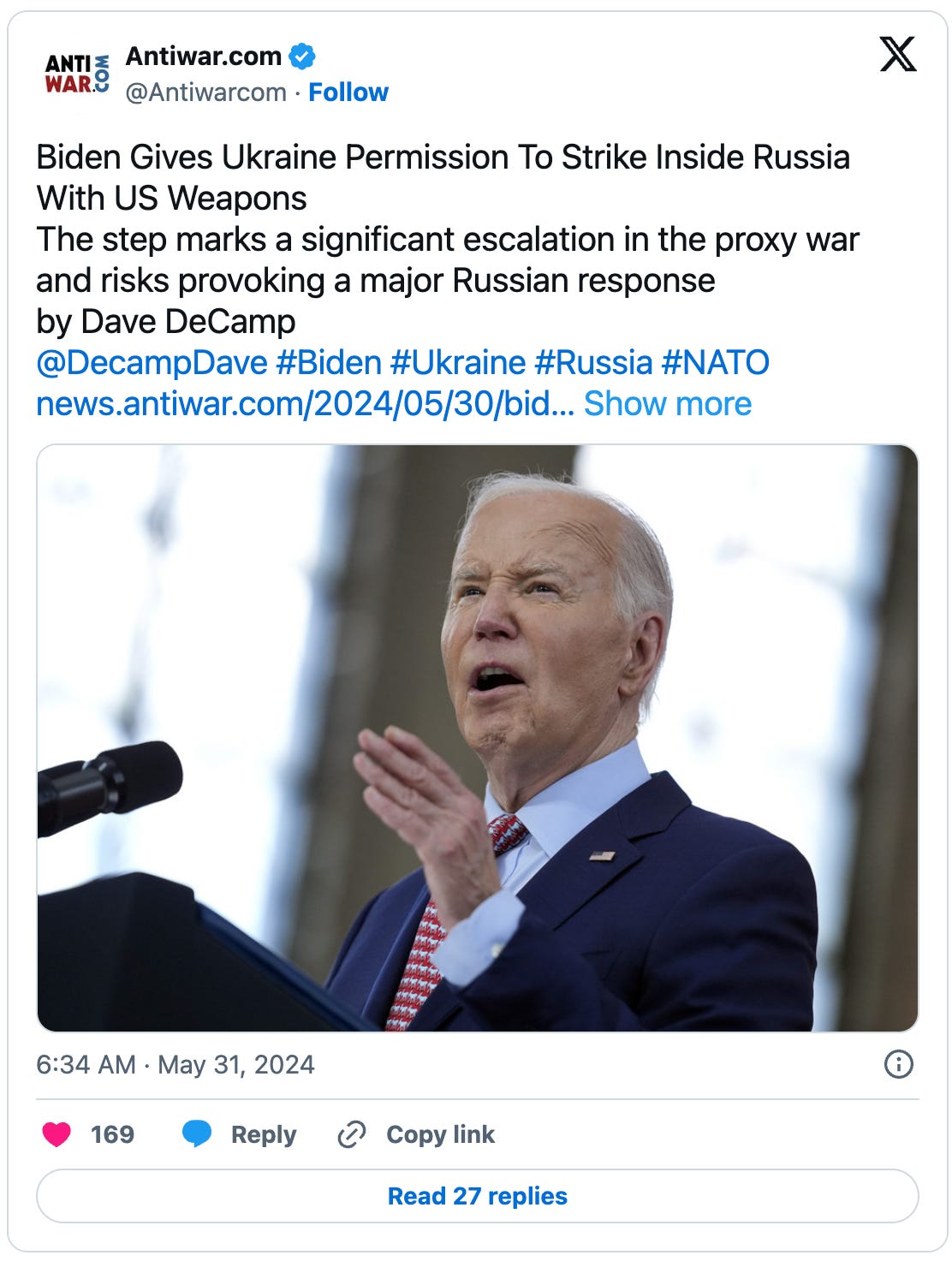
In a new report from Politico titled “Biden secretly gave Ukraine permission to strike inside Russia with US weapons” which cites multiple anonymous US officials, the article’s authors correctly describe the new White House authorization as a “stunning shift the administration initially said would escalate the war by more directly involving the U.S. in the fight.”
This report comes shortly after an article by The New York Times titled “From Allies and Advisers, Pressure Grows on Biden to Allow Attacks on Russian Territory,” in which David E Sanger accurately forecast that “Biden is edging toward what may prove to be one of his most consequential decisions in the war for Ukraine: whether to reverse his ban on shooting American weapons into Russian territory.”
Politico reports that the approval for these attacks is limited to “solely near the area of Kharkiv,” but, again, these escalations were once unthinkable even for this administration, and every time a new escalation is authorized the warmongers are already well on their way to pushing for a further one. We will surely see increasing calls for Biden to authorize US-backed strikes deeper into Russian territory in the coming weeks.
This new development comes just after we learned that Ukraine has been repeatedly attacking Russia’s early warning systems for incoming nuclear strikes, with Ukrainian drones targeting Russian radar sites hundreds of miles from Ukrainian-controlled territory.
Just a few years ago if I had told you that a NATO proxy would soon be attacking Russia’s nuclear defense infrastructure, you’d probably have assumed we’d be pretty close to another Cuban Missile Crisis-level nuclear standoff, and that it would be receiving high levels of alarm and attention. But this report is barely in the news, and hardly anyone in the west even knows it’s happening.
Oh no big deal, just a NATO proxy repeatedly attacking part of Russia's nuclear defense infrastructure. What could go wrong? https://t.co/RysGjsVAF1
This also comes as Reuters reports that France is preparing to send “several hundred” troops to Ukraine to train Ukrainian forces, which of course means we may soon be seeing the armed forces of a NATO power getting killed by the Russian military.
Either China is very strong, he says, “in which case antagonizing China over issues directly in its backyard is stupid; or actually China is quite weak in which case antagonizing China in its backyard is unnecessary and counterproductive.” He continues, “In any event is hard to hard to imagine how the life of the average American would be improved by courting conflict with China, while it is quite easy to imagine countless ways in which it could be made worse.”
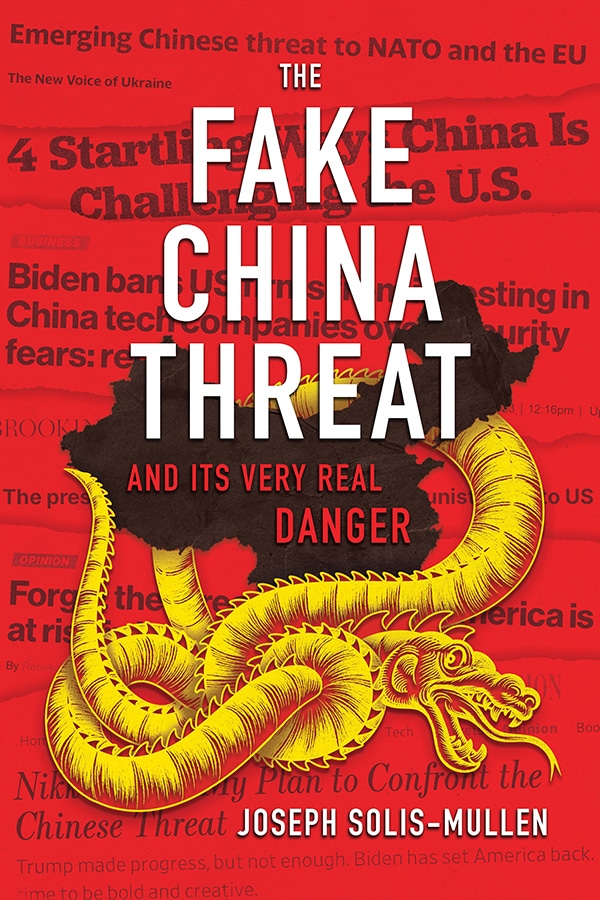
At times a book is convincing not only because its arguments are sound but also because of the author’s identity. It would be no surprise to encounter a book penned by a socialist or Sinophile that takes on the false portrait of China that graces the U.S. media. But Joseph Solis-Mullen, the author of The Fake China Threat And Its Very Real Danger, is neither socialist nor Sinophile.
Solis-Mullen is a libertarian in the mold of Randolph Bourne and Justin Raimondo. Hence, he is classified as a conservative in our impoverished political taxonomy. But his book is not written to appeal to people of any single political outlook. It is written with only one thing in mind, the interest of the American people and, dare I say, of humanity in general, China included. Hence it is of great utility for people across the political spectrum who sense that our people are being hoodwinked by fake China threats. It may answer your questions on China or those of your friends in ways understandable to the average American.
The Fake China Threat is Ubiquitous—and Dangerous
Solis-Mullens explains the purpose and scope of the fake China Threat as follows:
“On the one hand, (the fake China Threat) serves as a legitimating device, a new reason for continually climbing defense budgets…and for the continued meddling…in the affairs of other states…
“On the other hand, the fake China Threat serves as a convenient scapegoat for the end results of the bad policies that Washington has itself authored and for decades pursued. America deindustrialized? China’ fault. Millions of Americans hooked on drugs? China’s fault. The Saudis and Iranians don’t want the Americans around anymore? China’s fault. Et cetera.”
“There is one element of truth to the fake China Threat, however; the existence of an independent China (or Russia) is a threat to Washington’s accustomed ability to do more or less whatever it wants, wherever it wants. But the existence of an independent China is already a fact. Refusal on the part of Washington to accept it will cause more than theoretical problems, and therein lies the real danger.” [Emphasis Added]
To remedy that “real danger” is the purpose of this book as the author explains in these words:
A picture emerges of an aspirational Western industry captured lock, stock, and barrel by secretive, coal-loving Beijing. It’s a worry for the West’s economic development, never mind energy security and climate action. If solar is anything to go by, the great transition seems less based on data than a mixture of blind faith and vested interests.
China has the world over a barrel in more ways than we have been led to believe.
It isn’t so much that China has the biggest resources of these minerals. Rather it has the refining capacity to produce these materials. Note that most of these “lesser known base metals” don’t occur naturally on their own (like copper or tin), rather they occur concurrent with other minerals and are essentially a by-product of refining common base metals. Of course, refining minerals is a messy, polluting, and energy intensive business that few countries want to engage or allow. In doing so, they open themselves up to national security issues.
All rather interesting, but what I’d like to point out is that there exists the probability that this all becomes weaponised. Reducing or entirely eliminating supply of these critical resources to “non-friendly” nations is increasingly becoming a real threat. That in itself would entail significant supply disruptions, higher costs of production (much higher), and subsequent acceleration of stagflation.
The New vs the Old Economy
We thought we had it all before with the TMT bubble of 2000 (goodness, that is now 24 years ago). But history has been rewritten highlighting the extreme performance of one theme against another. Real assets are more out of favour compared to financial assets than at any time since the 1920s. Some random charts we found on the information superhighway providing illustrative view of what we’re saying.
Any relationship in the chart above to the one below?
OK, let’s put it another way. What if the US 10-year yield is 10% 10 years from now? How do you think real assets would have performed vs financial assets?
Just a reminder of how out of favour materials and energy are compared to the broader market. Granted this is over a year old, but not much has changed since then.
We recall a couple of years ago when Tesla had a greater market cap than the S&P 500 energy sector and Microsoft had bigger market cap than the S&P Materials and Energy sectors combined. Seems like not much has changed on a global scale.
Taking out Saudi Aramco, Microsoft, and Apple have about the same market cap as the global energy sector.
A Think Piece on Solar Panels
Finally someone who has dug deep into the assumptions:
You really have to read the article. It’s a humdinger. But first, a warning to the tree huggers who buy the concept that paying more taxes to multiple home owning, jet setting globalists in order to eliminate a gas that is 0.04% of the atmosphere and for which all plants are dependent upon. My friends and colleagues over at International Man said it well:
Naturally, I reject these articles because our editorial policy and our mission is to publish articles that actually support peace, freedom, and Austrian Economics. It’s not our job to publish articles opposed to these things. After all, for writers and readers who don’t like what the Mises Institute stands for, they can read and publish articles at National Review, The Washington Post, The New York Times, Commentary, and countless other neoconservative or social-democrat publications that are more than happy to tell readers that radical laissez-faire and non-interventionist foreign policy are terrible.
In case you haven’t read it lately—or perhaps you’ve never read it—the mission statement of the Mises Institute states that the Institute “exists to promote teaching and research in the Austrian school of economics, individual freedom, honest history, and international peace, in the tradition of Ludwig von Mises and Murray N. Rothbard.”
For those who find this mission statement too non-specific, I recommend consulting the decades’ worth of commentary and research published by the Institute over the forty-plus years of the Institute’s existence. For anyone who has bothered to read any significant portion of this body of work, the Mises Institute’s mission and editorial positions over the past four decades are no mystery.
In my ten years as an editor at the Mises Institute, however, I’ve been often surprised by how many self-described “supporters” of the Institute don’t actually agree with its mission. For example, it’s remarkable how many article submissions I have received over the years in which the author attacks our core editorial positions.
These articles often have titles like “Why the Austrian School is wrong about X.” ”X” is some fundamental tenet of the Austrian School that is supposedly “disproven” in 900 words by the would-be columnist who generally demonstrates almost no understanding of the Austrian School at all.
I also receive article submissions which take the form of “the libertarian/free-market case for Y” in which Y is a position—usually a morally repugnant one—that is utterly opposed to what Mises Institute scholars have been publishing here for decades. This sort of submission usually—but not always—centers on foreign policy and advocates for the latest war or “humanitarian” intervention.





 MCViewPoint