MCViewPoint

Opinion from a Libertarian ViewPoint

Archive for the ‘Uncategorized’ Category

They Said Things Would Be Much Worse in States without Lockdowns. They Were Wrong. | Mises Wire

Posted by M. C. on March 20, 2021

In other words, the dire predictions surrounding states that first canceled stay-at-home orders have been spectacularly wrong. Many lockdown enthusiasts will now do what the LA Times did: quibble over small differences between Florida and California to show that California did a little bit better. New York, of course, will just be completely ignored.

https://mises.org/wire/they-said-things-would-be-much-worse-states-without-lockdowns-they-were-wrong

Ryan McMaken

Like nearly all US states, Georgia imposed a stay-at-home order in March 2020 in response to demands from public health officials claiming a stay-at-home order would lessen total deaths from covid-19.

But unlike most states, Georgia ended its stay-at-home order after only five weeks, and proceeded to lower other restrictions quickly.

The legacy media responded with furious opposition. For example, an article in The Atlantic declared the end of Georgia’s lockdown to be an “experiment in human sacrifice.” The Guardian approvingly quoted one Georgian who insisted the end of the stay-at-home order was “reckless, premature and dangerous.”

A few weeks later, other states began to end their stay-at-home orders and to end other restrictions as well. Florida was the largest among these states.

Shortly thereafter the Daily Beast declared that the scaling back of restrictions in Georgia and Florida was “terrifyingly premature,” and quoted one expert who insisted, “If you lift the restriction too soon, a second wave will come, and the damage will be substantial both medically and economically. We don’t want to throw away the sacrifices we have made for weeks now.”

All this hyperbole about human sacrifice and recklessness leads us to conclude that states which ended lockdowns quickly must have experienced far worse numbers of deaths from covid than states which maintained lockdowns longer. Indeed, when it came to lockdowns, we were told, the longer the better. Ideally, lockdowns shouldn’t be loosened up at all until everyone can be vaccinated.

But things didn’t turn out that way. Experts have scrambled to come up with explanations for why this is the case, but the fact remains some of the most strict states (i.e., New York and Massachusetts) have covid deaths at far worse rates than the “reckless” states like Georgia and Florida.

Moreover, with little to show for their lockdowns in terms of “public health,” these states with extreme lockdowns also have some of the worst unemployment rates. This occurred in spite of the fact that experts insisted that a failure to impose lockdowns would doom a state’s economy to later economic disaster.

State-to-State Comparisons Aren’t Helping the Prolockdown Narrative

A year after stay-at-home orders began, even the usual media outlets are being forced to recognize the outcomes aren’t what was predicted. The Associated Press reported earlier this week:

California and Florida both have a COVID-19 case rate of around 8,900 per 100,000 residents since the pandemic began, according to the federal Centers for Disease Control and Prevention. And both rank in the middle among states for COVID-19 death rates—Florida was 27th as of Friday; California was 28th.

Connecticut and South Dakota are another example. Both rank among the 10 worst states for COVID-19 death rates. Yet Connecticut Gov. Ned Lamont, a Democrat, imposed numerous statewide restrictions over the past year after an early surge in deaths, while South Dakota Gov. Kristi Noem, a Republican, issued no mandates as virus deaths soared in the fall….

Like Florida, Missouri had no statewide mask mandate, ended business restrictions last June and has a cumulative COVID-19 death rate similar to California’s.

Even the LA Times was forced to admit this reality, although they insisted that when you consider the higher levels of poverty and “overcrowding” in California—translation: California is a filthy breeding ground for disease—California should have had far worse rates than Florida for covid deaths. Thus, the LA Times concludes, “California better controlled the virus.”

The LA Times goes on to point to the fact Florida’s covid death rate, while similar, is nonetheless 6 percent higher than California’s, and this translates to three thousand deaths that presumably wouldn’t have happened if Florida had adopted lockdown rules similar to California.

But the numbers don’t stack up so well in favor of lockdowns if we use the LA Times‘s method to make other comparisons. For example, New York’s total deaths-per-million rate is 67 percent higher than Florida’s. Translated into raw numbers, that means if Florida were like New York, Florida would have experienced 54,000 deaths instead of the 33,000 that the CDC now attributes to covid in Florida. (New Jersey’s outcomes are even worse than New York’s.)

Similarly, if Florida were like Massachusetts in its outcomes, Florida would have experienced 54 percent more deaths.

If the LA Times is going to claim overcrowding should translate into more death in California, it should also note that Florida fares worse than California in terms of median age and incidence of obesity. Since advanced age and obesity are major factors in covid hospitalizations and deaths, we might conclude it is Florida, and not California, that is primed for especially bad covid numbers.

(According to the CDC, Florida and New York are evenly matched in terms of obesity, Florida has more obesity than Massachusetts, and Florida has the highest median age of them all.)

And what about Georgia, that experiment in human sacrifice? Well, the CDC reports Georgia’s total deaths-per-million rate at 1,720. That’s worse than California’s rate of 1,400, but Georgia is still far and away better than New York, New Jersey, and Massachusetts, which have rates of 2,530, 2,690, and 2,400, respectively.

What about Economic Performance?

Meanwhile, it is likely that the economies of Florida and Georgia have suffered less. Although the Daily Beast assured us that the “damage will be substantial both medically and economically” if a state ends lockdowns “too soon,” we now find that the unemployment rates in Florida and Georgia are 4.8 and 5.1, respectively.

In California, the picture is quite different, where the unemployment rate now sits at 9 percent. New York doesn’t fare much better, with an unemployment rate of 8.8 percent. New Jersey clocks in at 7.9 percent.

In other words, the dire predictions surrounding states that first canceled stay-at-home orders have been spectacularly wrong. Many lockdown enthusiasts will now do what the LA Times did: quibble over small differences between Florida and California to show that California did a little bit better. New York, of course, will just be completely ignored.

As one doctor at UC San Francisco admitted: “One might’ve expected that the Floridas of the world would’ve done tremendously worse than the Californias of the world … ” Places like Florida and Georgia were supposed to be overwhelmed by an absolute tsunami of death if they were “reckless” in ending covid restrictions. That didn’t happen.

Author:

Contact Ryan McMaken

Ryan McMaken (@ryanmcmaken) is a senior editor at the Mises Institute. Send him your article submissions for the Mises Wire and The Austrian, but read article guidelines first. Ryan has degrees in economics and political science from the University of Colorado and was a housing economist for the State of Colorado. He is the author of Commie Cowboys: The Bourgeoisie and the Nation-State in the Western Genre.

Be seeing you

Posted in Uncategorized | Tagged: , , , | Leave a Comment »

Biden’s Rescue Plan Won’t Reduce Poverty | Mises Wire

Posted by M. C. on March 20, 2021

The Urban Institute’s study claims that the Rescue Plan will reduce the number of people in poverty in 2021 “by about 16 million, from over 44 million to 28 million.” This will be accomplished, according to the study, because the plan will increase “aggregate net resources” for households currently under the poverty line by $87 billion, or an average of about $3,850 per family.

The report, however, gives away the game early on. “Our analysis does not include the macroeconomic effects of the policy changes.” This is often referred to as a “static” analysis.

This admission alone should be enough to dismiss the Urban Institute’s findings.

https://mises.org/wire/bidens-rescue-plan-wont-reduce-poverty

Bradley Thomas

Imagine thinking the government can reduce poverty.

For most readers of this website, the thought is laughable. And for good reason. The government has no resources of its own. Every dollar it spends it must first either tax, borrow, or print. Taxing and borrowing redirect money from the voluntary, productive sector of the economy to the hands of politicians. Printing new money erodes the value of currency already held by citizens, harming low-income households disproportionately, while distorting important market signals like interest rates that are vital to coordinating the economy’s complex patterns of production and exchange.

Nevertheless, the Urban Institute—a highly influential and deep-pocketed left-leaning think tank—just released a report claiming that the recently passed American Rescue Plan will reduce the poverty rate by one-third in 2021.

Major media outlets like the Washington Post and CNN wasted little time in reporting on the study’s findings.

The report’s methodologies and assumptions, however, are highly questionable and cast doubt on the legitimacy of its conclusions.

The Urban Institute’s study claims that the Rescue Plan will reduce the number of people in poverty in 2021 “by about 16 million, from over 44 million to 28 million.” This will be accomplished, according to the study, because the plan will increase “aggregate net resources” for households currently under the poverty line by $87 billion, or an average of about $3,850 per family.

The report, however, gives away the game early on. “Our analysis does not include the macroeconomic effects of the policy changes.” This is often referred to as a “static” analysis.

This admission alone should be enough to dismiss the Urban Institute’s findings. Assuming that the massive changes to the money supply, government debt, and incentives to work, spend, or save will have no effect on behavior or other “macroeconomic effects” like price inflation is wholly unrealistic.

For starters, how many households will fall back below the poverty level when price inflation pushes up the cost of living, especially the cost of common household needs like groceries, gas, and utilities?

In January, grocery prices were already up 3.7 percent year over year, the largest such increase in a decade, with beef leading the way with an 8 percent rise.

Gas prices are up more than fifty cents per gallon already this year, and are expected to surge beyond three dollars a gallon this summer. Oil prices are up more than 20 percent this year, and continue to climb.

Add in a “rescue plan” of $1.9 trillion, most (if not all) of which will be newly created fiat currency, and price increases should be expected to accelerate still further. The rescue plan will cost nearly $5,800 for every man, woman, and child in the country (more than $23,000 per family of four). Yet according to the Urban Institute’s calculations, even those households targeted for the greatest amount of relief will receive on average $3,850 per family.

Basic math indicates that low-income households will struggle to keep pace with the rising cost of living, even with the financial relief.

More specifically, the Urban Institute attempts to evaluate the impact of four specific measures contained in the rescue plan.

Unemployment Benefits

The plan will add another twenty-five weeks of federal benefits, along with an additional $300 a week. This would continue to be in addition to the normal state unemployment insurance benefits, which average about $300 per week.

At an annualized rate, a household with two people collecting an average of $600 per week in UI benefits would be receiving the equivalent of more than $62,000 per year, nearly matching the national median household income of $68,703.

This obviously provides strong incentives for people not to work, and to hold out for ideal, well-paying job opportunities that may never materialize. Fewer people actively working means lower amounts of production, which limits the quantity of available goods and services. A limited supply of goods and services being chased by a dramatically increasing amount of dollars will help to drive up prices more significantly.

Discouraging work and productive activity is the opposite of helping to alleviate poverty.

And what about the longer-term effects on the recipients once the benefits expire? How much more difficult will it be for them once again to find work after another six months of being out of the workforce? The Urban Institute leaves such questions unaddressed.

SNAP Benefits

The Urban Institute report also estimates that the extension of increased Supplemental Nutrition Assistance Program (SNAP) benefits would serve to reduce poverty by one-tenth of a percentage point.

The assumption here again is that the value of the benefits isn’t being traded off against higher food prices, an assumption that is naïve at best and intellectually negligent at worst. The higher cost of living may force more people below the poverty line than the benefits would enable to exceed it.

“Stimulus” Checks

Of the four measures analyzed in the Urban Institute’s report, the “stimulus” checks of $1,400 for most Americans are predicted to “produce the largest projected poverty reduction.”

The checks are purported to provide “relief” to families enduring financial struggles thanks to the covid lockdowns. But in spite of the significant spikes in unemployment, especially concentrated in the fields of hospitality and leisure, the majority of people receiving the stimulus checks will have suffered little to no interruption in their incomes.

Once again, however, the Urban Institute simply adds in the stimulus check amounts to low-income households’ incomes and declares that the additional income will propel many households above the poverty threshold with the assumption that the stimulus checks will have no other “macroeconomic effects” like price inflation.

Child Tax Credit

Finally, the study claims that the Rescue Plan’s child tax credit increase from $2,000 to $3,600 or $3,000 (depending on the age of the child) will “substantially boost the income of families with children.”

I recall Nancy Pelosi describing $1,000 tax cuts for working Americans as “crumbs” in 2018. But now a similar amount is described by the Urban Institute as a substantial boost in income.

Nevertheless, even though on the margins this additional income from the credit could push some families above the measured poverty rate, it remains irresponsible for the Urban Institute to merely wish away the negative impact of rising prices on low-income households in their analysis.

Only Productivity Reduces Poverty

Claims that government can “boost” the economy, or “create” jobs, or reduce poverty should be met with harsh skepticism.

With no resources of their own, the government can at best rearrange jobs, incomes, or patterns of production. But even more likely, the process of doing so will hamper economic progress, destroy jobs on net, and exacerbate poverty.

As John Chamberlain, the late economic historian, stated, “Poverty in society is overcome by productivity, and in no other way. There is no political alchemy which can transmute diminished production into increased consumption.”

Government “stimulus” or “relief” plans are long on encouraging more spending of newly created dollars, but short on encouraging actual production. The combination makes for a perfect recipe for price inflation, but not poverty reduction.

The fact that a report like the one produced by the highly esteemed Urban Institute must resort to such damning assumptions to conclude that the Relief Plan will reduce poverty bolsters my point. Author:

Bradley Thomas

Bradley Thomas is creator of the website EraseTheState.com, and is a libertarian activist and writer with nearly fifteen years of experience researching and writing on political philosophy and economics.

Be seeing you

Posted in Uncategorized | Tagged: , , , | Leave a Comment »

Democracy Cannot Be A License To Steal

Posted by M. C. on March 19, 2021

Democracy is useful for the peaceful transfer of power. However, in an of itself, Democracy does not equal “Freedom.” In fact, neither the Declaration of Independence, nor The U.S. Constitution mention the word “Democracy” anywhere. Is it a coincidence that the U.S. Constitution is almost completely ignored at the same time that America is considered a “Democracy”?

Be seeing you

Posted in Uncategorized | Tagged: , | Leave a Comment »

Talking About Stoicism 114 Decomposing a Melody Into Notes

Posted by M. C. on March 19, 2021

Analyze your problems

Posted in Uncategorized | Tagged: , | Leave a Comment »

Biden Says Mask Wearing Must Continue Until Everyone Has Learned Complete Obedience To Government

Posted by M. C. on March 19, 2021

Funny until you realize this IS the goal. Whomever happens to be president isn’t the issue.

https://babylonbee.com/news/biden-says-we-all-will-have-to-keep-wearing-masks-until-absolutely-everyone-has-learned-complete-obedience-to-the-government?fbclid=IwAR3Is_DtwAjcplUvTPnagYVFzAIEIuSEKwlAEk5izI3hTJKwfDCBR5Bmq3k

WASHINGTON D.C.—A big question on everyone’s mind is when they will finally be able to stop wearing masks. President Joe Biden recently clarified this issue, saying people will be able to stop wearing masks as soon as absolutely everyone “has learned complete obedience to the government.”

“Both the federal and local governments have given you lots of different rules,” Biden told the press, “and all we want is for you to follow them unquestioningly. When people are still saying, ‘this rule is arbitrary,’ or, ‘this doesn’t make any sense with known science,’ then you’re still not ready and will have to keep wearing your masks.”

Biden further explained that removing mask mandates has nothing to do with how many people are vaccinated or anything else scientific or rational. “This is about demonstrating that you will do whatever we say whenever we say it,” Biden said. “When people are still talking about ‘liberty,’ then you’re just not ready. When the Constitution is in ashes, then you have my permission to die… to take off your mask, I mean.”

Some reporters tried to ask questions, but this only further angered Biden, as he had told them there would be no questions, and those reporters were forced to double-mask as penance.

Be seeing you

Posted in Uncategorized | Tagged: , | 1 Comment »

EconomicPolicyJournal.com: LSD-Trip Commentary From Paul Krugman; I Had to Play it Back Three Times

Posted by M. C. on March 19, 2021

Krugman did say that the 1970s stagflation was “more myth than reality.”

So I went to a real authoritative economics text, the college textbook written by Krugman and his wife Robin Wells, Macroeconomics. This is what it has to say about the 1970s:

Stagflation was the scourge of the 1970s: the two deep recessions of 1973-1975 and 1979-1982 were both accompanied by soaring inflation.

https://www.economicpolicyjournal.com/2021/03/lsd-trip-commentary-from-paul-krugman-i.html

Paul Krugman, Fareed Zakaria and Larry Summers

This past Sunday, Paul Krugman appeared on the CNN show, “Fareed Zakaria GPS.”

He was there to debate Larry Summers about the Biden $1.9 trillion spending package. Quite correctly, Summers warned about the potential price inflationary consequences of the spending.

As per usual, Krugman’s commentary sounded as though he could have been an added line to the lyrics for White Rabbit. By defending the massive spending bill as non-inflationary, he could have easily been mistaken for a past adviser to Gideon Gono when he was Zimbabwe’s central banker.

But the most remarkable Krugman stunner during the show was that for some odd reason he sought to deny the stagflation of the 1970s. It was like he was having an extended Joe Biden moment.

He actually said that 1970s stagflation was “more myth than reality” (stagflation is simultaneously climbing unemployment and price inflation).

The first time, I heard it, I thought I missed something. Since I record all major news talk shows on my YouTube TV for moments just like this, I replayed his comment 3 times. I did hear correctly the first time. 

Krugman did say that the 1970s stagflation was “more myth than reality.”

So I went to a real authoritative economics text, the college textbook written by Krugman and his wife Robin Wells, Macroeconomics. This is what it has to say about the 1970s:

Stagflation was the scourge of the 1970s: the two deep recessions of 1973-1975 and 1979-1982 were both accompanied by soaring inflation.

And that was the case. Unemployment and inflation during the period were the highest in the more than 70 years surrounding the period. (Red lined year in the charts below).

Unemployment Rate 1950-2019

Consumer Price Inflation 1950-2020

Krugman really just makes things up. It doesn’t appear to matter that it contradicts fact or what he said before. I am beginning to think he is a Leninist-opportunist, either that or he is tripping on a steady dose of real bad acid.

 –RW

Be seeing you

Posted in Uncategorized | Tagged: , , | Leave a Comment »

On The Verge Of A Global Crisis: One Bank Warns Of A “Biblical” Surge In Food Prices | ZeroHedge

Posted by M. C. on March 19, 2021

https://www.zerohedge.com/markets/verge-global-food-crisis-one-bank-warns-biblical-rally-food-prices

Tyler Durden's Photoby Tyler Durden

By Michael Every and Michael Magdovitz of Rabobank

Biblical, Lean, and Mean: ‘Dreams’ of an agri-commodity super-cycle

Then Pharaoh said to Joseph: “Behold, in my dream I stood on the bank of the river. Suddenly seven cows came up out of the river, fine looking and fat; and they fed in the meadow. Then behold, seven other cows came up after them, poor and very ugly and gaunt, such ugliness as I have never seen in all the land of Egypt. And the gaunt and ugly cows ate up the first seven, the fat cows. When they had eaten them up, no one would have known that they had eaten them, for they were just as ugly as at the beginning. So I awoke.”

– Genesis 41:17-21

Summary

  • Key feed and food prices have been pulled to 9-month and 7-year highs 
  • We explore the ‘dream’ of Biblical scarcity; its origins and impacts; and draw comparisons with Joseph, the trader and central planner who avoided starvation for ancient Egypt
  • One point is clear: global food insecurity falls heaviest on lower income, importing nations, who spend a far greater share of their income on food than the richer ones
  • The Fed would play an ironic role in this process even as it embraces fighting poverty and inequality alongside inflation
  • This could exacerbate (geo)political risk – potentially even regarding institutional architecture

Our Base Commodity Call

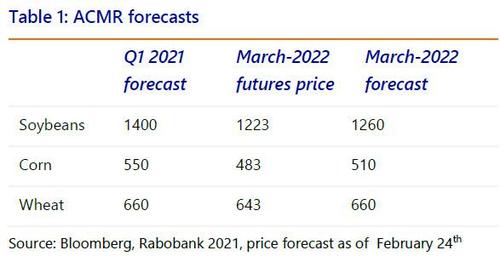
At time of writing, our forecasts for three of the world’s key agri commodities, soybeans, corn, and wheat are as follows:

The First Big Commodity Call

In the Bible, Joseph interpreted Pharaoh’s dream as meaning great abundance for seven years would be followed by an equal famine. He was then entrusted with ensuring Egypt’s storehouses were full of grain so the country could survive – which he, and it, did.
In short, Joseph made the first agri commodity cycle call, where survival came before profits. Today we have seed technology, automated agriculture, and global markets. Yet we still have lean and fat years for reasons meteorological, logistical, political, and geopolitical. This report will try to do several things:

  1. Summarise price action in key agri commodities to consider if we are seeing anything unusual – we will show we are, reflected in our elevated base price forecasts;
  2. Disaggregate and define the main drivers of these price movements. While the agri market is very old, new developments could produce striking new price patterns;
  3. Imagine what a Biblical scarcity would look like, putting forward simplified assumptions to estimate what each of them in isolation could do to food prices;
  4. Look at global food insecurity to ascertain how many countries are suffering already and would do so in the scenario that prices rise higher; and
  5. Consider the worrying (geo)political implications.

1) Supplies Shaken, not Stored

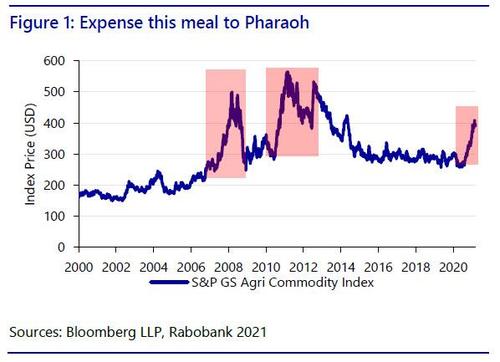
For key feed and food commodities, the message for markets and institutions is a simple one: they are going up. The S&P global agricultural index is up for a 9th straight month, to its highest level in 7 years (see Figure 1). Even though we are coming off a low base of comparison, which helps the base effects, the last period to see such a rapid rise was 2011, and prior to that 2007.

When we look at key commodities one by one the picture is similar, whether it is grains, vegetable oils, dairy, meat, or sugar (see Figure 2). This correlation makes sense, especially as many of these products share characteristics, are complementary, or are planted on the same land.

See the rest here

Be seeing you

Posted in Uncategorized | Leave a Comment »

The Rutherford Institute :: MODEL LETTER: Parental Reservation of Rights – Remote Learning Surveillance |

Posted by M. C. on March 19, 2021

“Remote learning should not justify the expansion of draconian zero tolerance policies to encompass so-called ‘violations’ that take place in students’ homes and home environments. Nor should remote learning be used as a backdoor means of allowing government officials to conduct warrantless surveillance into students’ homes and home environments,”

https://www.rutherford.org/publications_resources/legal_features/model_letter_parental_reservation_of_rights_remote_learning_surveillance

The Rutherford Institute has issued a precautionary “opt out” letter as a means by which families whose children are taking part in remote learning / virtual classes might assert their Fourth Amendment privacy rights and guard against intrusive government surveillance posed by remote learning technologies. The Institute released its model “Parental Reservation of Rights – Remote Learning Surveillance” letter in the wake of a growing number of incidents in which students have been suspended and reported to police by school officials for having toy guns nearby while taking part in virtual schooling.

“Remote learning should not justify the expansion of draconian zero tolerance policies to encompass so-called ‘violations’ that take place in students’ homes and home environments. Nor should remote learning be used as a backdoor means of allowing government officials to conduct warrantless surveillance into students’ homes and home environments,” said constitutional attorney John W. Whitehead, president of The Rutherford Institute and author of Battlefield America: The War on the American People. “While COVID-19 has undoubtedly introduced significant challenges for the schools, the protocols adopted for navigating these circumstances demand a heightened degree of caution lest government officials heedlessly, needlessly and unlawfully violate key constitutional safeguards established to protect the citizenry against invasive and warrantless intrusion into the home.”

See the model letter here

Be seeing you

Posted in Uncategorized | Tagged: , , | Leave a Comment »

The Rutherford Institute :: Digital Trails: How the FBI Is Identifying, Tracking and Rounding Up Dissidents by John W. Whitehead & Nisha Whitehead |

Posted by M. C. on March 19, 2021

According to USA Today, the FBI is relying on the American public and volunteer cybersleuths to help bolster its cases.

This takes See Something, Say Something snitching programs to a whole new level.

https://www.rutherford.org/publications_resources/john_whiteheads_commentary/digital_trails_how_the_fbi_is_identifying_tracking_and_rounding_up_dissidents

By John W. Whitehead & Nisha Whitehead

“Americans deserve the freedom to choose a life without surveillance and the government regulation that would make that possible. While we continue to believe the sentiment, we fear it may soon be obsolete or irrelevant. We deserve that freedom, but the window to achieve it narrows a little more each day. If we don’t act now, with great urgency, it may very well close for good.”—Charlie Warzel and Stuart A. Thompson, New York Times

Databit by databit, we are building our own electronic concentration camps.

With every new smart piece of smart technology we acquire, every new app we download, every new photo or post we share online, we are making it that much easier for the government and its corporate partners to identify, track and eventually round us up.

Saint or sinner, it doesn’t matter because we’re all being swept up into a massive digital data dragnet that does not distinguish between those who are innocent of wrongdoing, suspects, or criminals.

This is what it means to live in a suspect society.

The government’s efforts to round up those who took part in the Capitol riots shows exactly how vulnerable we all are to the menace of a surveillance state that aspires to a God-like awareness of our lives.

Relying on selfies, social media posts, location data, geotagged photos, facial recognition, surveillance cameras and crowdsourcing, government agents are compiling a massive data trove on anyone and everyone who may have been anywhere in the vicinity of the Capitol on January 6, 2021.

The amount of digital information is staggering: 15,000 hours of surveillance and body-worn camera footage; 1,600 electronic devices; 270,000 digital media tips; at least 140,000 photos and videos; and about 100,000 location pings for thousands of smartphones.

And that’s just what we know.

More than 300 individuals from 40 states have already been charged and another 280 arrested in connection with the events of January 6. As many as 500 others are still being hunted by government agents.

Also included in this data roundup are individuals who may have had nothing to do with the riots but whose cell phone location data identified them as being in the wrong place at the wrong time.

Forget about being innocent until proven guilty.

In a suspect society such as ours, the burden of proof has been flipped: now, you start off guilty and have to prove your innocence.

For instance, you didn’t even have to be involved in the Capitol riots to qualify for a visit from the FBI: investigators have reportedly been tracking—and questioning—anyone whose cell phones connected to wi-fi or pinged cell phone towers near the Capitol. One man, who had gone out for a walk with his daughters only to end up stranded near the Capitol crowds, actually had FBI agents show up at his door days later. Using Google Maps, agents were able to pinpoint exactly where they were standing and for how long.

All of the many creepy, calculating, invasive investigative and surveillance tools the government has acquired over the years are on full display right now in the FBI’s ongoing efforts to bring the rioters to “justice.”

FBI agents are matching photos with drivers’ license pictures; tracking movements by way of license plate toll readers; and zooming in on physical identifying marks such as moles, scars and tattoos, as well as brands, logos and symbols on clothing and backpacks. They’re poring over hours of security and body camera footage; scouring social media posts; triangulating data from cellphone towers and WiFi signals; layering facial recognition software on top of that; and then cross-referencing footage with public social media posts.

It’s not just the FBI on the hunt, however.

They’ve enlisted the help of volunteer posses of private citizens, such as Deep State Dogs, to collaborate on the grunt work. As Dinah Voyles Pulver reports, once Deep State Dogs locates a person and confirms their identity, they put a package together with the person’s name, address, phone number and several images and send it to the FBI.

According to USA Today, the FBI is relying on the American public and volunteer cybersleuths to help bolster its cases.

This takes See Something, Say Something snitching programs to a whole new level.

The lesson to be learned: Big Brother, Big Sister and all of their friends are watching you.

They see your every move: what you read, how much you spend, where you go, with whom you interact, when you wake up in the morning, what you’re watching on television and reading on the internet.

Every move you make is being monitored, mined for data, crunched, and tabulated in order to form a picture of who you are, what makes you tick, and how best to control you when and if it becomes necessary to bring you in line.

Simply liking or sharing this article on Facebook, retweeting it on Twitter, or merely reading it or any other articles related to government wrongdoing, surveillance, police misconduct or civil liberties might be enough to get you categorized as a particular kind of person with particular kinds of interests that reflect a particular kind of mindset that might just lead you to engage in a particular kinds of activities and, therefore, puts you in the crosshairs of a government investigation as a potential troublemaker a.k.a. domestic extremist.

Chances are, as the Washington Post reports, you have already been assigned a color-coded threat score—green, yellow or red—so police are forewarned about your potential inclination to be a troublemaker depending on whether you’ve had a career in the military, posted a comment perceived as threatening on Facebook, suffer from a particular medical condition, or know someone who knows someone who might have committed a crime.

In other words, you might already be flagged as potentially anti-government in a government database somewhere—Main Core, for example—that identifies and tracks individuals who aren’t inclined to march in lockstep to the police state’s dictates.

The government has the know-how.

See the rest here

ABOUT JOHN W. WHITEHEAD

Constitutional attorney and author John W. Whitehead is founder and president The Rutherford Institute. His books Battlefield America: The War on the American People and A Government of Wolves: The Emerging American Police State are available at www.amazon.com. He can be contacted at johnw@rutherford.org. Nisha Whitehead is the Executive Director of The Rutherford Institute. Information about The Rutherford Institute is available at www.rutherford.org.

Be seeing you

Posted in Uncategorized | Tagged: , , , , | Leave a Comment »

The Never-Ending Battle between Leviathan and Liberty | Mises Wire

Posted by M. C. on March 19, 2021

https://mises.org/wire/never-ending-battle-between-leviathan-and-liberty

James Bovard

The notion that Americans will always be free is part of the catechism that is force-fed to public school students. For hundreds of years, philosophers, politicians, and reformers have touted a law of history that assures the ultimate triumph of freedom. “Oppressed people cannot remain oppressed forever. The urge for freedom will eventually come,” Martin Luther King Jr. wrote in his famous “Letter from Birmingham Jail.”

But few political follies are more hazardous than presuming that one’s liberties are forever safe. None of the arguments on why liberty is inevitable can explain why it has not yet arrived. Most of the human race existed with little or no freedom for 95+ percent of recorded history. If liberty is God’s gift to humanity, then why were most people who ever lived on Earth denied this divine bequest?

Many efforts at limiting state power have failed almost immediately. In the thirteenth century, oppressed English nobles revolted and sought to bind their kings in perpetuity. King John signed the Magna Carta in 1215, petulantly accepting a limit to his prerogative to pillage everything in his domain. While the Magna Carta is celebrated nowadays as the dawn of a new age, it failed to even bind the king who signed the document. The ink on his signature was barely dry before King John brought in foreign forces and proceeded to slaughter the barons who forced his signature. King John died just after his vengeance commenced, providing a respite for Englishmen. In the final realm, the Magna Carta was simply a political pledge that was honored only insofar as private courage and weaponry compelled sovereigns to limit their abuses.

History is a chronology of nations pillaged by reckless regimes. English kings recited coronation oaths that limited their power. Such oaths were as binding as a congressional candidate’s campaign promises. Rampaging kings sometimes converted smouldering discontent into a raging fire of resistance. Historian Thomas Macaulay summarized England’s path to its Glorious Revolution of 1688: “Oppression speedily did what philosophy and eloquence … failed to do.” King James II was ousted in 1688 and Parliament speedily enacted laws to curb all subsequent monarchs.

The United States was the first government to be created with strict limitations on its power, enshrined in the Constitution. As James Madison wrote in the Federalist Papers, “If men were angels, no government would be necessary. If angels were to govern men, neither external nor internal controls on government would be necessary.” The Founders included numerous checks and balances in the Constitution to restrain political ambition. But they were never so naïve as to presume that a parchment barrier would keep American liberty safe in perpetuity.

Within the first decade of the nation’s existence, Congress and President John Adams enacted the Alien and Sedition Acts, which destroyed freedom of the press and speech. Thomas Jefferson responded by writing a resolution in 1799 that warned, “Free government is founded in jealousy, not confidence…. In questions of power, then, let no more be heard of confidence in men, but bind him down from mischief by the chains of the Constitution.” Senator John Taylor, in his 1821 book Tyranny Unmasked, scoffed at presuming “our good theoretical system of government is a sufficient security against actual tyranny.”

See the rest here

Author:

James Bovard

James Bovard is the author of ten books, including 2012’s Public Policy Hooligan, and 2006’s Attention Deficit Democracy. He has written for the New York Times, Wall Street Journal, Playboy, Washington Post, and many other publications.

Be seeing you

Posted in Uncategorized | Tagged: , , , | Leave a Comment »