
https://babylonbee.com/video/35
Bee seeing you

Enemy of the State-Read the Book-Know the Man
This is not a Safe Space but Baby, I don't care.

"I am not a number, I am a Free Man" - No. 6
 Information Liberation Alex Jones’ Prison Planet Gary North Specific Answers Antiwar The Daily Bell Tenth Amendment Center Economics Policy Journal The American Thinker The New American Lew Rockwell
Posted by M. C. on March 18, 2021
Posted in Uncategorized | Tagged: President Biden, Secret Service | Leave a Comment »
Posted by M. C. on March 18, 2021
By Joe Jarvis
Follow me on alternative video sites:
Earlier this year, a fitness magazine tweeted “It’s a great day to burn off those Christmas calories.”
It’s hard for me to think of a tweet LESS controversial. And yet, a psychologist led the woke mob, responding that the language was “hugely concerning and problematic,” because it casts exercise as a punishment, and not a normal part of everyday life. Other Twitter mobsters jumped on the bandwagon to call out the tweet.
This is where we are at. There is nothing you can say that a proper social justice warrior couldn’t twist to be offensive in one shape or form– a micro-aggression against one of many victim groups.
I don’t know about you, but that’s made me police what I say less. If I can’t win, why bother even trying? And that, in essence, is the solution– but I’ll get back to that.
Political correctness is nothing new. But it’s clearly been escalating in recent years.
For instance, we’re now supposed to believe that gender is a social construct, BUT you can get gender confirming surgery by altering your sex organs. So gender doesn’t correspond to sex, but by changing sex characteristics, you can confirm that your gender corresponds to your sexual appearance…
And when someone declares themselves the opposite gender, we are expected to pretend they have changed sex– a biological impossibility, since sex is denoted by X and Y chromosomes, which at this point in scientific development, cannot be changed.
It’s basically Orwellian double-think, where you are supposed to believe two contradictory “facts” at the same time. But just saying all this would make countless SJWs label me “transphobic,” as if I had some problem with the people themselves, as opposed to the psychological operation being run on the masses.
Which, by the way, the victims I am most concerned about are the young, vulnerable trans people convinced to make permanent body and life altering medical decisions– many who later come to regret it– egged on by people who don’t care the slightest about actually helping these people feel more comfortable in their own skin, and only care about pushing a social agenda.
That’s just one example.
You certainly can’t actually address any political issues in a rational conversation.
Militarized police have too much power, are not held accountable due to qualified immunity, the thin blue gang code of silence, and powerful police unions. Civil asset forfeiture is a complete violation of the Fourth Amendment.
ALSO, Black Lives Matter, the organization, is an admittedly Marxist front with motives far beyond police accountability. Raise your fist in solidarity, or you’re a white supremacist, right? Simple as that. You’re either with us or you’re against us.
One of the biggest things I value in the people around me is the ability to have a rational discussion despite disagreements. And I make sure to retain those friends and peers.
But it seems like the general public can barely have a conversation these days. We might be able to talk about the weather without arguing, maybe.
Except it would probably veer into a climate change debate, which yet again, cannot be addressed rationally. I care about the environment and think less pollution will obviously be a good thing. And yet, it would be insane to give governments and bureaucrats the power to destroy capitalism and enslave humanity to allegedly stop climate change.
And of course, the COVID dictators delivered the master-stroke in dividing society, testing mass compliance with illegal government mandates, making everyone suspicious of each-other, and providing a great excuse to rat out your neighbors to the Gestapo.
And also, it might make sense to protect grandma from the virus– not lock healthy people inside for a year. Imagine if all the effort and resources it took to shut down society went to protecting the most vulnerable, instead of oppressing young healthy people in an essentially 0% risk category.
That would have beat the virus and solved the problem. But it wouldn’t have given politicians the power they crave. To them, that would have been allowing a good crisis to go to waste.
We are told to cover our faces, which is dehumanizing and makes everything more difficult. People are harder to understand, it’s harder to communicate, and the depth of conversations break down.
Don’t talk to strangers, don’t meet new people, don’t mingle– those are all potentially infected disease carriers, do you want to die, or worse, asymptomatically spread the virus and kill your mother?! No? Swear off all social contact.
Are you one of those people who hesitates to inject a brand new vaccine with unknown long term consequences, and concerning side effects? We’ll label you an anti-vaxer, and anti-science. And no, you can’t talk about this rationally, it has to be an emotionally charged condemnation of the selfish people who don’t care if they murder their parents.
But the real kicker in all of this was how COVID-lockdowns have made us compartmentalize. The politicians have tried to convince us to shun the family, friends, and support groups we do get along with.
The amount of fear being spewed from the corporate media made families fight over who was invited to holiday parties, and who was the dirtiest among them, likely to spread COVID.
Out of work people are dependent on government handouts. Isolated people are dependent on government support structures.
And, isolated targets are easier to take out.
That is where conquer comes in.
As a mob, storming the Capitol or burning down a police station feels safe. But the mob’s not there for you when you’re getting prosecuted. That’s the basic idea behind compartmentalization of society.
And they have divided people so well, that one side cheers when the other is finally conquered.
For example, some of the same people who wanted abolish the police last summer, enthusiastically support police breaking up parties and arresting the maskless in the name of COVID.
The big tech companies also moved to conquer this year. They apparently started to believe the propaganda that they were monopolies. So they arrogantly moved to conquer all those who haven’t adopted the correct opinions yet.
First it was the Trump supporters, Parler, and Facebook/ Twitter purges. And the left suddenly believed that private businesses have the right to refuse service.
Then the tech companies came for the Wall Street Bets crowd when they threatened to make the hedge funds lose money. Retail investors were shut down by Reddit, purged from Discord, and blocked from buying certain stocks on Robinhood.
But these tech companies moved to big, too early, and their attempt to conquer will have the opposite effect. It decentralized their targets, and scattered them across alternative social media and messaging apps. In many cases, apps that include encryption and that don’t harvest user data, at least to the same extent.
They gave people a great reason NOT to trust them, and hastened the need for alternatives. They pushed people to their competitors. I personally stopped using Google Docs, and started posting all my videos to Bitchute, LBRY, and Rumble.
And When it comes to the stock market, this is just a jolt for cryptocurrencies hosted on a decentralized blockchain– not so easily shut down by NASDAQ, Etrade, and Robinhood.
Of course they will continue to try to conquer, but you can take your power back by adopting alternatives to the big tech companies.
It might seem count-intuitive that spreading across apps and platforms could help avoid being conquered. After all, isn’t that a tactic of division?
But think of it instead as guerrilla warfare. It was easy to conquer a group who all used Facebook, or all use the US dollar, or all vote Republican. But how do you conquer when the enemy is everywhere and nowhere all at once?
Shut down a single app or platform, another springs up. Crash a cryptocurrency through market manipulation, there’s always another waiting to compete.
Therefore a solution is to be a leader in one of these decentralized nodes of opposition power to the establishment elites. You can build and maintain support networks of likeminded people. Likeminded in whatever way that means to you, because we are not all after the same thing. Give people a rallying point, or a gathering place for whatever your particular cause or interest is.
Keep the social interaction going. Start clubs. All the better if they teach and trade important skills.
Organize a group to drill together. Create a skill exchange where one person teaches pickling, and another foraging, or one teaches marketing, and another bookkeeping. Set up trade networks at the local level, and even emergency response for a safety net.
Now I realize you may not feel that you have enough likeminded people around you. So mix technological outreach with in person contact.
It may be hard work, but I bet you could build a group almost anywhere.
I have always been more interested in curating the type of people I am around.
And this gets me back to my, “stop caring” comment at the beginning, in response to the elites’ attempts to divide us.
I care less and less about watching what I say, because by telling the truth and speaking my mind, like-attracts-like. I am naturally calling together a group of people who have things in common, who get along, who are on the same page.
So if you hate the direction cancel-culture is going, the best thing you can do it ignore it entirely. This will naturally repulse the Social Justice Warriors, and attract people who think you are brave for saying some basic truths which have somehow become taboo.
I am going to articulate this idea better in an upcoming video about self selecting your friends, lovers, and audience– so make sure you subscribe and hit that bell so you’ll be notified.
You can help protect us from BIG TECH DE-PLATFORMING by joining our email list.
This is the single biggest way to ensure we can’t be silenced for speaking out against censorship, and the elite/ cabal’s plans for a “Great Reset”– their New World Order meant to render you impoverished and powerless.
Plus, when you subscribe, you immediately receive TWO FREE TACTICAL REPORTS:
1. Four Ways The Elite Control You
2. How to Infiltrate the Elite and Take Their Power for Yourself
Posted in Uncategorized | Tagged: Divide-and-Conquer, Elites | Leave a Comment »
Posted by M. C. on March 18, 2021
https://www.theadvocates.org/human-respect-tests/?mc_cid=536a36ce48
How respectful are you?
3 to 10 questions depending on how you score.
See to what extent your beliefs are respectful or coercive.
See how your beliefs compare to your friends. Pick Your Political Type Or take the political quiz

Libertarians seek to maximize human freedom and minimize coercion in personal or economic matters.Libertarian Test

Progressives usually embrace freedom of choice in personal matters, but advocate for significant government coercion to control the economy and redistribute wealth.Progressive Test

Conservatives tend to favor economic freedom, but frequently support laws to restrict personal behavior that violates “traditional values.”Conservative Test

Moderates tend to prefer a “middle ground” regarding the use of coercion and government control, whether of the economy or of personal behavior. Moderate Test

Authoritarians want the government to have a great deal of power over the economy and individual behavior.Authoritarian Test
Posted in Uncategorized | Tagged: human respect | Leave a Comment »
Posted by M. C. on March 18, 2021
Like Terrorists, Sanctioning Governments Intentionally Harm Civilians
https://starkrealities.substack.com/p/advocates-of-economic-sanctions-mirror
Efforts to restore American and Iranian compliance with the 2015 nuclear deal—formally called the Joint Comprehensive Plan of Action (JCPOA)—are at an impasse.
President Biden has declared there will be no relaxing of smothering economic sanctions on Iran unless the country first returns to full compliance with the deal. Iran, which began exceeding nuclear enrichment thresholds in response to America’s total withdrawal from the deal under President Trump, wants the United States to begin easing sanctions first.
As that chess game continues, there’s something missing from op-ed pages, network news studios and the House and Senate chambers: a fundamental debate about the morality of economic sanctions.
If we reduce economic sanctions to a general characterization that encompasses both ends and means, we arrive at a truth that is as damning as it is incontrovertible:
If that has a familiar ring, perhaps it’s because “the intentional use of violence against civilians in order to obtain political aims” is one definition of terrorism.
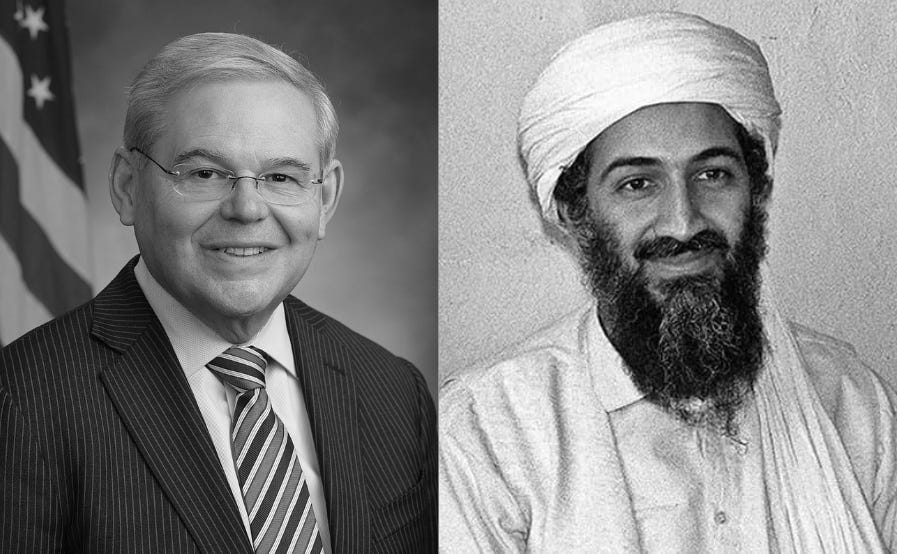
That’s not to say “sanctions” and “terrorism” are interchangeable terms. However, both practices center on willfully harming civilians to accomplish political goals.
Some resist the fact that al Qaeda and other terrorist groups are principally motivated by political goals. That’s understandable, given establishment media grossly underreports terrorist motivations.
The resulting vacuum is filled with reflexive and false assumptions—for example, that Muslim terrorists are principally motivated by religion—or deliberately misleading government claims, like President George W. Bush’s baseless assertion that al Qaeda terrorists “hate our freedoms.”
Through various written and recorded pronouncements, Osama bin Laden made al Qaeda’s political motivations clear. His aims included the withdrawal of U.S. forces from the Middle East, and termination of U.S. support of the region’s dictators and the government of Israel.
The political nature of terrorism was particularly apparent in the 2004 Madrid train bombings. The attacks came three days before Spain’s general election, and a video received by Spanish authorities said the attacks were punishment for the country’s participation in the occupation of Iraq.
On election day, the shaken Spanish population gave an upset victory to the Socialist party, and the newly elected prime minister immediately pledged to withdrawal Spanish troops from Iraq.
Those examples focus on al Qaeda and its kin, but terrorists of all religions, ethnicities and nationalities have political aims. An exhaustive study of worldwide suicide bombing by University of Chicago Professor Robert Pape found nearly all such attacks seek “to compel modern democracies to withdraw military forces from territory that the terrorists consider to be their homeland.”
In a hearing earlier this month, Senate foreign relations committee chairman Bob Menendez (D-NJ), who has been one of Capitol Hill’s most prolific authors of Iran sanction legislation, praised sanctions as part of “our arsenal of peaceful diplomacy.”
Perhaps it was a Freudian slip that led him to oxymoronically place his supposedly “peaceful” sanctions inside an “arsenal”—in their effect, there’s little difference between imposing economic sanctions and mining Iranian harbors.
Of course, “peaceful” isn’t the favorite adjective of sanction advocates. When boasting about their handiwork, Menendez and others invariably use a far more appropriate descriptor: “crippling.” Barack Obama @BarackObamaVP Biden on Iran: “These are the most crippling sanctions in the history of sanctions. Period.”October 12th 2012758 Retweets220 Likes
Officials assure us that sanctions are meant to cripple governments, but any honest observer understands that’s achieved by first crippling the country’s economy.
Since the concept of economic harm is somewhat abstract, it’s easy for Americans to limit their visualization of that harm to a downward slope on a gross domestic product chart, failing to appreciate what economic warfare means to the everyday lives of individual humans.
Occasionally, though, American media provides a window on the harms being visited upon the Iranian people.
Consider a 2019 Los Angeles Times story, “Middle-Class Iranians Resort to Buying Rotting Produce as U.S. Sanctions Take Toll.” Reading the title alone would give most Americans a far better appreciation of sanctions’ real-world impact. The article provides other examples, such as a single mother forced by skyrocketing prices into abandoning her apartment and moving into her mother’s one-bedroom dwelling.
While the U.S. sanctions regime provides exceptions for Iran’s import of food and medicine, other limitations on the flow of Iranian money—and vendors’ and bankers’ fears of accidentally running afoul of U.S. restrictions—often render those exceptions meaningless.
As a result, sanctions can have profound consequences for Iran’s sick. Among other observations, a 2019 report by Human Rights Watch found:
The report also noted Iranians were finding it harder to acquire imported eye drops, “causing suffering for the large number of patients affected by chemical weapons during the Iran-Iraq war.”
Exasperatingly, many of those eye patients are being victimized by the U.S. government for a second time: During the Iran-Iraq War, American intelligence officials provided targeting information to the Iraqi military, fully aware Saddam Hussein’s forces would attack with chemical weapons.
See the rest here
Be seeing you
Posted in Uncategorized | Tagged: Al Qaeda, economic sanctions, Iran, JCPOA, President Biden, terrorists | Leave a Comment »
Posted by M. C. on March 18, 2021
The poll responses also raise questions about the role of Harris, who was so widely disliked as a presidential candidate in her own right that she actually dropped out of the Democratic primaries before states began voting, after Hawaii congresswoman Tulsi Gabbard exposed some of the stains on the California senator’s record on the debate stage.
https://www.rt.com/usa/518412-biden-harris-decisions-presidential/
Helen Buyniski is an American journalist and political commentator at RT. Follow her on Twitter @velocirapture23 and on Telegram
As many Americans believe someone other than President Joe Biden is making the important day-to-day decisions in the White House as believe Biden’s the man in charge, according to a recent Rasmussen poll.
Just 47% of American voters believe President Joe Biden is actually calling the shots regarding his presidential duties, according to a Rasmussen poll published on Tuesday. That’s the same number of respondents – 47% – who believe other officials, like Vice President Kamala Harris, are making those decisions behind the scenes.
The poll results certainly raise an eyebrow or two, given the widespread discussion of Biden’s mental state ahead of November’s election. Rumors that the 78-year-old politician – the oldest man to be elected president in US history – suffered from dementia or some other incapacitating mental condition were widespread in the runup to November’s vote, fueled by frequent gaffes in which Biden seemed to forget where (and when) he was, as well as important names and events.
In one particularly egregious slip-up, he referred to former President Barack Obama – under whom he served as vice president and whose reputation he essentially ran on – as “President My Boss,” laughing it off after a strained pause.
The poll responses also raise questions about the role of Harris, who was so widely disliked as a presidential candidate in her own right that she actually dropped out of the Democratic primaries before states began voting, after Hawaii congresswoman Tulsi Gabbard exposed some of the stains on the California senator’s record on the debate stage. In a year where the country’s reckoning with police abuses featured front and center among election issues, Harris’ term as California’s top prosecutor suggested she was in every way the wrong woman for the job.
Having covered up for dirty cops, advocated for the imprisonment of truant children’s moms, suppressed exonerating evidence, let mortgage fraudsters off the hook, and kept nonviolent prisoners locked up past their parole dates in order to use them to fight wildfires on the cheap, Harris had nothing in common with the image overhaul Democratic voters seemed to be seeking in their 2020 candidate, in Gabbard’s estimation. Sneaking her into the White House as Biden’s diversity-box-checking sidekick – a role she was clearly selected to play after Biden promised to specifically name a “woman of color” as his VP candidate – represents little more than a slap in the face to voters, especially those progressive Democrats of color who elected Biden under the (false) understanding they were being offered a chance to renegotiate their relationship with the police.
Further muddying the waters, the media establishment – so keen to dig up scandal in the Trump White House – has contented itself in the early days of Biden’s presidency to report on dog-bite injuries and self-congratulatory speeches, minimizing coverage of Harris seemingly horning in on more important presidential duties.
The VP took Biden’s place in a recent phone call with Israeli PM Benjamin Netanyahu, as well as recent calls with Canadian PM Justin Trudeau, French President Emmanuel Macron, Australian PM Scott Morrison, and World Health Organization chief Tedros Adhanom Ghebreyesus. According to CNN, Harris is making a point of “beefing up” her work on foreign policy and national security – two key fields for any candidate seeking the presidency. The VP’s frequent Freudian slips – in which she has referred to a “Harris administration” – and the media’s fawning over everything from her footwear to her favorite songs suggest a made-to-order leader delivered without the benefit of a vote.
Be seeing you
Posted in Uncategorized | Tagged: bait & switch, Harris, Harris administration, Rasmussen poll | Leave a Comment »
Posted by M. C. on March 18, 2021
Outlaw’s attorneys allege the city and its police department turned a blind eye to unconstitutional practices by homicide detectives – withholding evidence that indicated someone else’s guilt and intimidating and paying witnesses to provide false statements – that hampered Outlaw’s ability to get a fair trial and violated his civil and constitutional rights.
https://erietimes-pa-app.newsmemory.com/?publink=0baf235b8
Claudia Lauer ASSOCIATED PRESS PHILADELPHIA – Donald Outlaw had already spent 15 years in prison for murder when he found out the man he was convicted of killing had told police with his dying breath that someone else named ‘Shank’ had shot him.
Outlaw filed a federal lawsuit Wednesday against the city of Philadelphia and the two detectives who investigated the killing of Jamal Kelly in 2000. The lawsuit is just the latest example of justice now being sought over faulty or crooked police investigations and prosecutions in the city from decades before.
Outlaw’s attorneys allege the city and its police department turned a blind eye to unconstitutional practices by homicide detectives – withholding evidence that indicated someone else’s guilt and intimidating and paying witnesses to provide false statements – that hampered Outlaw’s ability to get a fair trial and violated his civil and constitutional rights.
‘Mr. Outlaw’s wrongful incarceration was the direct result of egregious misconduct by Defendants,’ his attorneys wrote in the lawsuit filed in the U.S. Eastern District of Pennsylvania.
‘Defendants improperly used their power and position to coerce witnesses into making false statements and identifications, and to offer sworn testimony that they knew to be false,’ the attorneys wrote. ‘Defendants also withheld exculpatory evidence that would have demonstrated Mr. Outlaw’s innocence and deliberately disregarded information and evidence that would have demonstrated flaws in the case against him.’
At Outlaw’s trial in 2004 – four years after Kelly was killed – the victim’s dying declaration that ‘Shank’ did it was never disclosed. Statements from four witnesses who had recanted or said they signed but never read the officers’ written statement were still read to jurors, with prosecutors claiming Outlaw had intimidated them out of testifying, Outlaw’s attorneys said.
In addition to the city, the lawsuit names the two detectives, Jeffrey Piree and Howard Peterman. Outlaw’s attorneys say Piree investigated the cases of three other men exonerated in recent years by the conviction integrity unit of the Philadelphia prosecutor’s office.
A city spokesperson did not immediately comment on the lawsuit. A phone call to a listing for Piree went unanswered, and a message left at a listing for Peterman was not immediately returned Wednesday.
Twenty-one people have been exonerated in Philadelphia since the end of 2016, 18 of whom were released after investigations by the conviction integrity unit since 2018, when District Attorney Larry Krasner took office.
Several other exonerated men have filed claims of withheld exculpatory evidence, coercion of witnesses and intimidation that led to false statements.
After years of appeals, Outlaw’s attorneys with the Pennsylvania Innocence Project persuaded the court to open a file that included the dying declaration and a letter from a witness saying he had hoped to be released from incarceration in exchange for his testimony.
Outlaw’s wife, Monique Solomon-Outlaw, also posted fliers asking anyone with information to come forward. That was more than 15 years after the shooting, but a witness did come forward saying she saw someone else fire the fatal shots.
That new witness testified in 2019 with another witness from the first trial, who recanted his testimony and described how detectives had helped him concoct the story against Outlaw. A judge freed him on bail.
At first, prosecutors planned to retry Outlaw. But other prosecutors in the integrity unit decided there was not enough evidence, and the case was dropped.
Outlaw, who declined to be interviewed about the lawsuit, has been working with the Philadelphia Anti-Drug/Anti-Violence Network, said his attorney Josh Van Naarden, a founding partner at VSCP Law.
The lawsuit seeks compensation for the time spent in jail – the missed chance at educational, personal and life experiences. Pennsylvania is one of about 15 states that don’t have formalized compensation programs for people exonerated and freed from prison.
Philadelphia has also seen more civil lawsuits over wrongful incarceration. At the end of last year, the city had paid out more than $35 million over three years, including a $9.8 million settlement with a man freed after spending more than three decades behind bars for a murder he did not commit.

Donald Outlaw, shown with wife Monique Solomon-Outlaw, was exonerated after spending over 15 years in prison for murder. He filed a federal lawsuit Wednesday against the city of Philadelphia and two homicide detectives for wrongful prosecution and incarceration. Donald Outlaw & Monique Solomon-Outlaw via AP
Be seeing you
Posted in Uncategorized | Tagged: Donald Outlaw, Larry Krasner, Philadelphia, Shank | Leave a Comment »
Posted by M. C. on March 18, 2021
Taxes are just additional costs of doing business. We know who pays for them in the end.
By
Now that the coronavirus relief package is actually law, it is onto infrastructure for the Biden administration and its razor-thin Democratic majority in Congress. But infrastructure legislation will come with strings attached — very hefty new taxes.
The White House will propose $1 trillion worth of new taxes, according to Sarah Bianchi, head of U.S. public policy and political strategy at Evercore ISI and the former director of economic and domestic policy for then Vice President Joe Biden.
Officials including Treasury Secretary Janet Yellen have started suggesting what will be in the White House plan. Bianchi says hiking the corporate tax rate to 28% from 21%, establishing a global minimum tax and raising what’s called the global intangible low-taxed income rate to 21% will be in his plan. The plan will probably include nearly doubling capital-gains taxes on those with income over $1 million, and likely will include taxing unrealized gains at death, ending carried interest and raising the top individual income-tax rate.
Other possibilities include restoring the 2009 estate tax policies, limiting individual deductions, phasing out some business income deductions and establishing a financial transactions tax.
Quarter of the way there
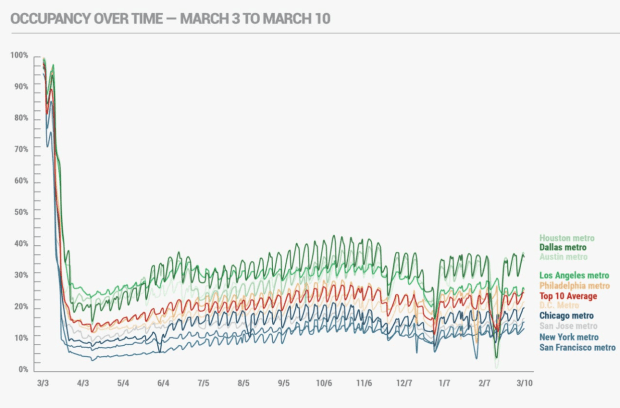
Kastle Systems, a provider of office security services, has been using its keycard and fob data to track office occupancy. Half of the cities measured saw increases in building occupancy last week, bringing the 10-city national average up to 25%, up 0.2% from the week before. Houston has the top occupancy at just over 37%.
Steven Goldstein is based in London and responsible for MarketWatch’s coverage of financial markets in Europe, with a particular focus on global macro and commodities. Previously, he was Washington bureau chief, directing MarketWatch’s economic, political and regulatory coverage. Follow Steve on Twitter: @MKTWgoldstein.
Be seeing you
Posted in Uncategorized | Tagged: Biden Administration, Janet yellen, New Taxes | Leave a Comment »
Posted by M. C. on March 18, 2021
As containers carry goods from China to the US and rush to return empty to bring more, the moment provides a glimpse into a potentially precarious arrangement between the two countries. While the US presently consumes itself into debt and liabilities, China has leveraged its productive surpluses from this relationship into increasingly influential assets that may strengthen its position and further challenge the US, and perhaps even the dollar itself.
https://mises.org/wire/what-shipping-container-shortage-reveals-about-us-china-trade
Despite the record unemployment rate, widespread hardship to businesses, strains on the healthcare system, political turmoil, and general disruption to daily life in 2020, US consumers have managed to ramp up their habit of buying things. Demand for physical goods replaced some of the previous demand for in-person service-related experiences and much of that demand was met with a surge of imports from China as domestic production slowed down due to lockdown measures. Up until recently, global supply chains managed to find their footing and could meet demand, but news has emerged that reveals stresses on the world’s shipping infrastructure and uncovers clues about the economic outlook.
Global logistical networks recently began to suffer from a shortage of shipping containers as demand has suddenly risen. Freight rates from China to the US have jumped by 300%. The container situation has become so extreme that hundreds of thousands of containers have been sent off empty from US ports, mostly to China as exporters demand empty containers with increasing urgency. An estimated 177,938 containers, were rejected from loading US export items at the ports of Los Angeles and New York/New Jersey alone and then sent across the Pacific.
The recent imbalance of shipping containers illustrates the latest state of affairs surrounding the US and Chinese economies. As exports of consumer goods from Asia eclipse exports of mostly commodity and raw materials from the US—in this case, even blocking US agricultural exports from having shipping containers to reach foreign markets—the trade deficit between the two countries may become more important to these highly competitive economies.
The Austrian perspective on the US trade deficit has long been that given the continued relative productivity of the US economy, foreign desires to invest in the US, and demand for the dollar abroad, the trade deficit is a ‘pseudo-problem.’ The US competitive advantage vis-à-vis other countries in recent decades has made running a trade deficit highly probable and even favorable for Americans as they enjoy the consumption of cheaper imports.
Thus far, the parties involved have been satisfied with this arrangement as US consumers bring in goods at favorable prices and producers receive a reliably stable world reserve currency: the US dollar. However, the underlying conditions particular to the US economy in relation to China may be changing. There are two aspects of the US-China trade deficit that merit attention. The first is the effect of net consumption by the US coupled with dovish monetary and fiscal policies whereas the second is what China plans to do with US dollars accumulated through exports.
On the US side of the equation, easy money from the central bank coupled with fiscal stimulus extended to consumers has juiced buying activity as the lockdowns have forced people to stay home and spend. It’s no wonder that shipping containers are rushing to get back to China. With the US taking big hits to production and foreign investment in 2020, along with explosive increases in the money supply, critical questions arise regarding the nature of this trade deficit and how long the status quo can continue as the country pushes the boundaries of its exorbitant privilege. Indeed, the health of the dollar itself as it relates to trade deficits would be an indicator to watch in coming years.
In running a trade surplus with the US, China has traditionally exchanged its US dollars for US Treasuries to add to its balance sheet and to maintain its export advantage. In recent years, however, China has reduced its holdings in Treasuries. This trend has also coincided with massive spending on the part of China in the last decade on the Belt and Road Initiative (BRI) infrastructure and trade corridor project which involves 71 countries across Eurasia and Africa that encompass two-thirds of the global population and one-third of world GDP.
Given the continued global dollar demand, it would be shrewd for China to use accumulated dollars to acquire foreign assets and invest in projects that have the potential to generate future income. The trade war with the US in recent years has driven China to deepen its flow of trade toward surpluses with other emerging markets and forge strategic global relations.
As containers carry goods from China to the US and rush to return empty to bring more, the moment provides a glimpse into a potentially precarious arrangement between the two countries. While the US presently consumes itself into debt and liabilities, China has leveraged its productive surpluses from this relationship into increasingly influential assets that may strengthen its position and further challenge the US, and perhaps even the dollar itself.
Originally published by the Austrian Economics Center. Author:
Weimin Chen is a research assistant at the Austrian Economics Center and is a manager and project/events coordinator at the International Student Center’s Arts for Peace Initiative in New York City.
Be seeing you
Posted in Uncategorized | Tagged: Container Shortage, Trade Deficits, US-China Trade | Leave a Comment »
Posted by M. C. on March 17, 2021
Amala Ekpunobi grew up in a leftist home and worked as an organizer for the political left. She never questioned the narrative — until she discovered the racism she thought she was fighting against was being perpetuated by her side. “We are bringing back segregation in this country, and people will sell it to you that we are doing it in a positive manner…it perpetuates the same racist narrative that they are trying to run away from.” Amala shares her story of questioning leftist ideology, which ultimately led to changing her mind.
Be seeing you
Posted in Uncategorized | Tagged: Amala Ekpunobi, leftist home, organizer | Leave a Comment »
Posted by M. C. on March 17, 2021
None of this means there is no place for legislation. What it does mean is that lawmakers should be keenly aware that every human action has both intended and unintended consequences. Human beings react to every rule, regulation, and order governments impose, and their reactions result in outcomes that can be quite different than the outcomes lawmakers intended.
https://fee.org/articles/the-cobra-effect-lessons-in-unintended-consequences/


Every human decision brings with it unintended consequences. Often, they are inconsequential, even funny. When Airbus, for example, wanted to make its planes quieter to improve the flying experience for travelers, it made its A380 so quiet that passengers could hear, with far too much clarity, what was happening in the plane’s bathrooms. Other times unintended consequences have far-reaching, dramatic effects. The US health care system is a case in point. It emerged in its present form in no small part because of two governmental decisions.
First, wage and price controls during World War II caused employers to add health insurance as an employee benefit. Why? The law prohibited employers from raising wages, so to attract workers, they offered to provide health insurance. Then, in 1951, Congress declared that employer-provided health insurance benefits would not count as taxable income. This made it cheaper for employees to take raises in the form of increased tax-free insurance benefits rather than in the form of increased taxable wages.
Unintended consequences happen so often that economists call them “Cobra Problems,” after one of the most interesting examples.
Consequently, not only do workers now receive health insurance through their employers (unlike, for example, their car and home insurance), but those insurance plans also tend to be more luxurious than what they would have been had Congress never given them special tax treatment. These two political decisions helped to create the health care system we now have, a system that nearly everyone agrees is broken.
No one set out to create a broken system, no more than anyone ever set out to make bathroom noises more conspicuous on airplanes. These were unintended consequences. And you can see them everywhere when you know to look.
Unintended consequences happen so often that economists call them “Cobra Problems,” after one of the most interesting examples.
In colonial India, Delhi suffered a proliferation of cobras, which was a problem very clearly in need of a solution given the sorts of things that cobras bring, like death. To cut the number of cobras slithering through the city, the local government placed a bounty on them. This seemed like a perfectly reasonable solution. The bounty was generous enough that many people took up cobra hunting, which led exactly to the desired outcome: The cobra population decreased. And that’s where things get interesting.
As the cobra population fell and it became harder to find cobras in the wild, people became rather entrepreneurial. They started raising cobras in their homes, which they would then kill to collect the bounty as before. This led to a new problem: Local authorities realized that there were very few cobras evident in the city, but they nonetheless were still paying the bounty to the same degree as before.In the end, Delhi had a bigger cobra problem after the bounty ended than it had before it began.
City officials did a reasonable thing: They canceled the bounty. In response, the people raising cobras in their homes also did a reasonable thing: They released all of their now-valueless cobras back into the streets. Who wants a house full of cobras?
In the end, Delhi had a bigger cobra problem after the bounty ended than it had before it began. The unintended consequence of the cobra eradication plan was an increase in the number of cobras in the streets. This case has become the exemplar of when an attempt to solve a problem ends up exacerbating the very problem that rule-makers intended to fix.
There is, of course, nothing special about cobras. The same sort of thing happened in the late 1980s in Mexico City, which was at the time suffering from extreme air pollution caused by cars driven by its 18 million residents. The city government responded with Hoy No Circula, a law designed to reduce car pollution by removing 20 percent of the cars (determined by the last digits of license plates) from the roads every day during the winter when air pollution was at its worst. Oddly, though, removing those cars from the roads did not improve air quality in Mexico City. In fact, it made it worse.
Come to find out, people’s needs do not change as a result of a simple government decree. The residents of Mexico City might well have wanted better air for their city, but they also needed to get to work and school. They reacted to the ban in ways the rule-makers neither intended nor foresaw.
The people released their cobras into the streets, except this time the cobras were cars.
Some people carpooled or took public transportation, which was the actual intent of the law. Others, however, took taxis, and the average taxi at the time gave off more pollution than the average car. Another group of people ended up undermining the law’s intent more significantly. That group bought second cars, which of course came with different license plate numbers, and drove those cars on the one day a week they were prohibited from driving their regular cars. What kind of cars did they buy? The cheapest running vehicles they could find, vehicles that belched pollution into the city at a rate far higher than the cars they were not permitted to drive. The people released their cobras into the streets, except this time the cobras were cars.
These examples of unintended consequences aren’t aberrations. Unintended consequences arise every time an authority imposes its will on people. Seat belt and airbag laws make it less safe to be a pedestrian or cyclist by making it safer for drivers to be less cautious. Payday lending laws, intended to protect low-income borrowers from high lending rates, make it more expensive for low-income borrowers to borrow by forcing them into even more expensive alternatives.
Requirements that corporations publicize how much they pay their CEOs in order to encourage stockholders to reduce CEO pay resulted in lesser-paid CEOs demanding more pay. Three-strikes laws, intended to reduce crime, increase police fatalities by giving two-time criminals a greater incentive to evade or even fight the police. The Americans With Disabilities Act gives employers an incentive to discriminate against the disabled by not hiring them in the first place so as to avoid potential ADA claims. Electrician licensing requirements can increase the incidence of injury due to faulty electrical work by reducing the supply of electricians, thereby encouraging homeowners to do their own electrical work.
But perhaps nothing illustrates the scope of the potential problems arising from unintended consequences better than Venezuela’s terrible game of whack-a-mole that began with the 1976 nationalization of its oil industry. The government’s intent was to keep oil profits in the country. And that’s how it went—for a while.
But when the government takes over a once-private industry, the profit incentive to maintain physical capital is lost, and physical capital deteriorates. The deterioration plays out over a decade or so, and that’s what made it appear—at least for a while—that unlike everywhere else socialism had been tried, Venezuela’s socialism was working. But as the oil industry’s physical capital broke down, oil production fell. Coincidentally, it was around this time that oil prices fell also—a fact socialism’s supporters point to as the real culprit. The ultimate unintended consequence of Venezuela’s nationalizing its oil industry was slavery.
That is without question incorrect given that no other oil-producing nation suffered what Venezuela was to suffer.
As oil revenues and production plummeted, Venezuela’s government acted the way governments inevitably do when revenues disappear. It borrowed and taxed as much as it could, and then it started printing money. The printing led to the unintended consequence of inflation, then prices rose so high that people could no longer afford food. To respond to this unintended consequence, the government imposed price controls on food. But this created a new unintended consequence wherein farmers could no longer afford to grow food. And so the farmers stopped growing food. Finally, the government forced people to work on farms in order to assure food production.
The ultimate unintended consequence of Venezuela’s nationalizing its oil industry was slavery.
None of this means there is no place for legislation. What it does mean is that lawmakers should be keenly aware that every human action has both intended and unintended consequences. Human beings react to every rule, regulation, and order governments impose, and their reactions result in outcomes that can be quite different than the outcomes lawmakers intended. So while there is a place for legislation, that place should be one defined by both great caution and tremendous humility. Sadly, these are character traits not often found in those who become legislators, which is why examples of the cobra problem are so easy to find.
Posted in Uncategorized | Tagged: Cobra Effect, Hoy No Circula, oil industry, Unintended Consequences Everywhere, US health care, Venezuela | Leave a Comment »

