MCViewPoint

Opinion from a Libertarian ViewPoint

Archive for the ‘Uncategorized’ Category

Erie Times E-Edition Article-NOTICE OF ELECTION

Posted by M. C. on February 26, 2021

No mail in ballots, no multi-week voting season, no third party candidates, no third party write ins.

https://erietimes-pa-app.newsmemory.com/?publink=1d769ec59

NOTICE IS HEREBY GIVEN THAT A MUNICIPAL PRIMARY ELECTION WILL BE HELD AT THE REGULAR POLLING PLACES IN THE VARIOUS ELECTION DISTRICTS OF THE COUNTY OF ERIE, COMMONWEALTH OF PENNSYLVANIA ON TUESDAY, MAY 18, 2021 BETWEEN THE HOURS OF 7:00 O’CLOCK AM AND 8:00 O’CLOCK PM, PREVAILING TIME, AT WHICH TIME REGISTERED AND ENROLLED ELECTORS OF THE DEMOCRATIC AND REPUBLICAN PARTIES WILL ASSEMBLE AND VOTE, ACCORDING TO LAW, FOR THE NOMINATION OF CANDIDATES FOR THE FOLLOWING PUBLIC OFFICES.

MEMBERS OF OTHER POLITICAL PARTIES OR THOSE WITH NO AFFILIATION, MAY ALSO VOTE YES OR NO, FOR THE THREE PROPOSED AMENDMENTS TO THE PENNSYLVANIA CONSTITUTION.

See here for the rest

Be seeing you

Posted in Uncategorized | Tagged: | Leave a Comment »

Why “Stakeholder Capitalism” Is a Disaster for Entrepreneurs | Mises Wire

Posted by M. C. on February 25, 2021

We cannot take for granted that the heart of a peaceful and prosperous economic system is respect for private ownership of property by individuals. Private property rights need to be strictly delineated in an objective and absolute way. When ownership of property is shared with “society,” as in stakeholder capitalism, there will be inexorable conflict. Because stakeholder capitalism is built on a collectivist version of property rights, free market advocates should fully denounce it.

https://mises.org/wire/why-stakeholder-capitalism-disaster-entrepreneurs

Thomas Spain

During the 1990s there was a legal and philosophical idea, championed by Milton Friedman among others, that a corporation exists to serve the interests of the shareholders, being that they are the rightful owners of the corporation. Progressive thought leaders responded with the countertheory of stakeholder capitalism. Under stakeholder theory the shareholders have a stake in the success of the firm, but the firm also has a competing obligation to other entities deemed “stakeholders.” Stakeholders are employees, customers, suppliers, and the community. While this theory is presented as a commonsense truism, it has one specific foundational flaw: it dilutes and undermines the principle of private property.

To own a thing in principle is to have control over its use. An owner of a company, in a market system, has ultimate discretion over and responsibility for how the assets of the company are used. In a joint-stock company, the decision-making is shared by the various owners of shares. But in stakeholder capitalism, all of the stakeholders have influence in company decisions. Therefore, stakeholders are de facto joint owners of the corporation, and advocates of stakeholder capitalism would seek to make this ownership a legal reality.

When stakeholder capitalism is expounded by its advocates, it’s easy to believe that it is not as much a social theory as simply good advice. Businesses seek to develop mutually beneficial relationships that will last into the long term. As a means to that end, it is good business practice to maximize the contentedness of your employees, deal honestly with your suppliers, survey the needs of your customers, and keep a good image in the community. However, stakeholder capitalism goes beyond good practice by putting government power on the side of the stakeholders.

We can see what the joint ownership of stakeholders looks like in practice. For employee stakeholders, control would mean union representation on the corporate board. For supplier stakeholders, industry oversight associations would oversee contracts, making them impossibly difficult to terminate while outlawing any market choice. Customers would be represented by consumer protection bureaus. And community stakeholders would mean democratic approval of business actions by government committees.

While in the free market stakeholders vote directly with their dollars, in stakeholder capitalism the nominal stakeholders never exercise their ownership stake directly. Rather they are represented indirectly or bureaucrats are imbued with the authority to interpret their desires. The driving force behind the stakeholder capitalism philosophy is precisely that it creates opportunities for political actors to assert disproportionate control over the economy’s resources. Rather than create real wealth for society, politicians and bureaucrats use their social ownership of companies to extort economic resources for their purposes.

In such an environment, entrepreneurial decisions are reduced to a political process. The entrepreneur is made impotent to improve the status quo, because any intrepid decision will be vetoed by political stakeholders who fear to lose. Prices can never rise. Wage rates must always rise. Risk must be averted. Nothing must be allowed that would inconvenience the community or make anyone uncomfortable.

Recently, the most dangerous aspect of stakeholder capitalism has been its amalgamation with the climate change agenda. Any minute decision a business makes will infinitesimally affect the climate for people all over the globe. Therefore, the concept of a community stakeholder is expanded to the entire world, eliminating individual and local sovereignty. Under a climate change regime, decisions as small as remodeling an office building will be as politically charged as the ongoing Keystone Pipeline fiasco.

Clearly, many of the principles of stakeholder capitalism have been implemented in different ways for a long time, including politicized unions, regulatory schemes, and extortion of campaign contributions. But the threat to private property has also worsened in the US in recent years. In particular, politicians openly extort corporations with the threat of targeted regulation, like the Big Tech companies are facing over fake news and censorship. Socialist bureaucracies have unaccountable authority to investigate and persecute businesses, like suing petroleum companies for vague climate change damages. Large investment firms use their customers’ accounts as leverage to push politically driven reforms that are not in the financial interest of the account holders, like divesting from fossil fuels. Not to mention corporate leaders are swarming to affirm every social justice fad.

We cannot take for granted that the heart of a peaceful and prosperous economic system is respect for private ownership of property by individuals. Private property rights need to be strictly delineated in an objective and absolute way. When ownership of property is shared with “society,” as in stakeholder capitalism, there will be inexorable conflict. Because stakeholder capitalism is built on a collectivist version of property rights, free market advocates should fully denounce it.

Author:

Thomas Spain

Posted in Uncategorized | Tagged: , , | Leave a Comment »

Breaking: Biden Bombing Syria! – RPI 25 Feb Update

Posted by M. C. on February 25, 2021

Buckle up. These are going to be very trying times for non-interventionists

https://mailchi.mp/ronpaulinstitute/syriabomb?e=4e0de347c8

Dear Friends:

According to breaking news reports, including by Reuters, President Biden has ordered and the Pentagon has carried out military airstrikes on Syria, attacking a structure inside the country that the US government claims houses “Iranian-backed” militia.

US missiles struck tonight near the Syrian town of Al-Bukamal, on the Iraqi border. The strike is said to be in retaliation for recent rocket attacks against US facilities in Iraq. After another rocket attack earlier this month, the US State Department pointed the finger at Iran and threatened a US military response.

The Iraqi parliament voted in January, 2020, to expel US troops from the country after then-President Trump ordered the assassination of Iranian General Qasem Soleimani. The US government ignored the vote of the democratically-elected Iraqi parliament, however Trump later announced his decision to pull US troops out of Iraq. 

President Biden wasted no time in reversing Trump’s disengagement strategy for the Middle East. After just over a month in office, President Biden is re-igniting the failed US intervention launched in 2014 against Syria under the Obama Administration.

Within 24 hours of Biden being inaugurated commander-in-chief, US military convoys began pouring into northern Syria. His Administration, from Secretary of State Tony Blinken on down, enthusiastically supported the US “regime change” policy for Syria under President Obama – a policy that only benefitted al-Qaeda and its affiliates in the region,

Earlier this month it was reported that the US was building a new military base in Syria, near the Iraq and Turkey borders. New military bases carry with them new missions, so there is plenty of reason to believe that Biden plans to return the US to the “Assad must go” policy of his former boss.

Biden coming out of the gate with bombs blazing should be of little surprise to those who have watched his early foreign policy appointments. For example, he tapped noted neocon and aggressive interventionist Dana Stroul to head his Middle East Desk at the Pentagon and no doubt this airstrike at least indirectly reflects her influence and that of many others like her who have taken up positions in the Biden Administration.

Stroul hails from the AIPAC-founded “think tank,” the Washington Institute for Near East Policy (WINEP), where, as former CIA official Phil Giradi writes, “she has been the Shelly and Michael Kassen Fellow in the Institute’s Beth and David Geduld Program on Arab Politics.” She is an extreme Iran hawk and has advocated and worked for regime change in Syria and US retention of large areas of Syrian territory.

So within a month of assuming office, President Biden looks to be on the cusp of launching a new Middle East war. Will a Left-Right-and-beyond peace coalition emerge to challenge the hawks driving this new push to war? We must remain open to any alliance and be willing to put other issues of potential disagreement aside. There are plenty of antiwar progressives who will increasingly find themselves uncomfortable with this Administration. We must be willing to work with them in good faith.

Buckle up. These are going to be very trying times for non-interventionists!
  Please Donate Now!
Thank you for your support!
Sincerely yours,

Daniel McAdams
Executive Director
Ron Paul Institute for Peace and Prosperity

Be seeing you

Posted in Uncategorized | Tagged: , , , , | Leave a Comment »

The Politically Incorrect Guide to the Great Depression & the New Deal

Posted by M. C. on February 25, 2021

Based on the Regnery Publishing book “The Politically Incorrect Guide to the Great Depression & the New Deal.” Get the book at: https://www.regnery.com/9781596980969…​ Use promo code PIG50 to receive 50% off any PIG book when you buy “The Politically Incorrect Guide to the Great Depression & the New Deal.” In the second episode of “The Politically Incorrect Guide” Tom Woods & Michael Malice demolish widespread myths about the Great Depression and the New Deal. Tom & Michael explain how the New Deal worsened the very problems it aimed to solve, that capitalism didn’t cause the Great Depression (the Federal Reserve did), and that World War II prolonged rather than ended the Great Depression. The first season of “The Politically Incorrect Guide” includes ten episodes and will release throughout 2021. Each covers the undiscussed facts and stories about history, culture, and social movements, purged from today’s mainstream education system. Tom Woods penned the very first book in the series, “The Politically Incorrect Guide to American History,” which was a New York Times bestseller.

Be seeing you

Posted in Uncategorized | Tagged: , , , | Leave a Comment »

US: Ex-policeman implicates NYPD, FBI in Malcolm X murder | Civil Rights News | Al Jazeera

Posted by M. C. on February 25, 2021

Letter written by former undercover NYPD policeman alleges his department and the FBI covered up details of the killing.

https://www.aljazeera.com/news/2021/2/21/ex-new-york-policeman-implicates-nypd-and-fbi-in-malcolm-x-murder

A former New York City police officer has, before his death, implicated the NYPD and FBI in the murder of civil rights leader Malcolm X on February 21, 1965.

A letter written by ex-undercover NYPD policeman Raymond Wood alleges his department and the FBI covered up details of the assassination, saying he was ordered to infiltrate the civil rights movement and had members of Malcolm X’s security detail arrested shortly before the killing. Keep readingMalcolm X assassination investigation under new scrutinyManhattan DA reviewing investigation of Malcolm X assassinationMalcolm X is still misunderstood – and misusedBack to the future: BLM overcomes Obama and returns to Malcolm X

On February 21, 1965, minister and civil rights activist Malcolm X, 39, was shot dead inside Harlem’s Audubon Ballroom in New York by assassins identified as members of the Nation of Islam. Three men were convicted of murder and imprisoned, and all were eventually paroled.

“I participated in actions that in hindsight were deplorable and detrimental to the advancement of my own Black people. My actions on behalf of the New York City Police Department were done under duress and fear,” said Reggie Wood, a relative who read Raymond’s letter aloud at a press conference on Saturday.

The letter said the arrests carried out in February 1965 by Wood meant Malcolm X did not have security at the entrance to the Audubon Ballroom where he was speaking that day.

It is unclear when Wood died, but he did not want the letter made public until after his death, saying he feared repercussions from authorities if he came forward with his allegations, according to Reggie Wood.

‘Terrible tragedy’

Ilyasah Shabazz, one of Malcolm X’s three daughters, said the new accusations should prompt further investigation.

“Any evidence that provides greater insight into the truth behind that terrible tragedy should be thoroughly investigated,” she said.

The NYPD said in a statement the Manhattan District Attorney initiated a review several months ago.

“The NYPD has provided all available records relevant to that case to the District Attorney. The department remains committed to assist with that review in any way,” it said.

The FBI did not issue a statement.

Malcolm X’s three daughters, alongside Wood’s family and civil rights lawyer Ben Crump, urged that the case be immediately re-opened.

MEDIA ALERT: @AttorneyCrump & Reggie Wood to hold news conference on 2/20 at 12:30 ET to deliver new evidence regarding the assassination of Malcolm X to his daughters & the Manhattan DA following a deathbed declaration from Ray Wood, an undercover police officer at the time. pic.twitter.com/xadqNs5mlR

— Ben Crump Law, PLLC (@BenCrumpLaw) February 19, 2021

“Ray Wood, an undercover police officer at the time, confessed in a deathbed declaration letter that the NYPD and the FBI conspired to undermine the legitimacy of the civil rights movement and its leaders,” a statement from Crump’s office said.

“Without any training, Wood’s job was to infiltrate civil rights organizations and encourage leaders and members to commit felonious acts. He was also tasked with ensuring that Malcolm X’s security detail was arrested days prior to the assassination, guaranteeing Malcolm X didn’t have door security while at the Audubon Ballroom, where he was killed on Feb. 21, 1965.”

The director of communications for the Manhattan District Attorney’s office released a statement saying: “Our office’s review of this matter is active and ongoing.”

Three Nation of Islam members were convicted in Malcolm X’s murder but last year the Manhattan DA began a review of those convictions after meeting with representatives of the Innocence Project.

Be seeing you

Posted in Uncategorized | Tagged: , , , , | 1 Comment »

‘Papers, Please’: Vaccine Passports Have Officially Arrived – LewRockwell

Posted by M. C. on February 25, 2021

https://www.lewrockwell.com/2021/02/joseph-mercola/papers-please-vaccine-passports-have-officially-arrived/

By Joseph Mercola

Mercola.com

For a weary public longing to get back to normalcy, vaccine passports represent a tantalizing carrot, being dangled as a mechanism for freedom. By showing proof that you’ve received a COVID-19 vaccine, perhaps you can once again board an airplane and travel freely, attend a concert or enjoy a meal in your favorite restaurant, just like you used to.

Except, being required to present your “papers” in order to live your life isn’t actually freedom at all — it’s discrimination, and even a move toward technocratic fascism, one that’s setting the stage for increased surveillance and erosion of your privacy.

Nonetheless, this blatant move toward an ever-increasing surveillance state is being welcomed by many who have been led to believe the passports are necessary to protect public health and safety.

Vaccine Passports Are in Development

See the rest here

Be seeing you

Posted in Uncategorized | Tagged: , , | Leave a Comment »

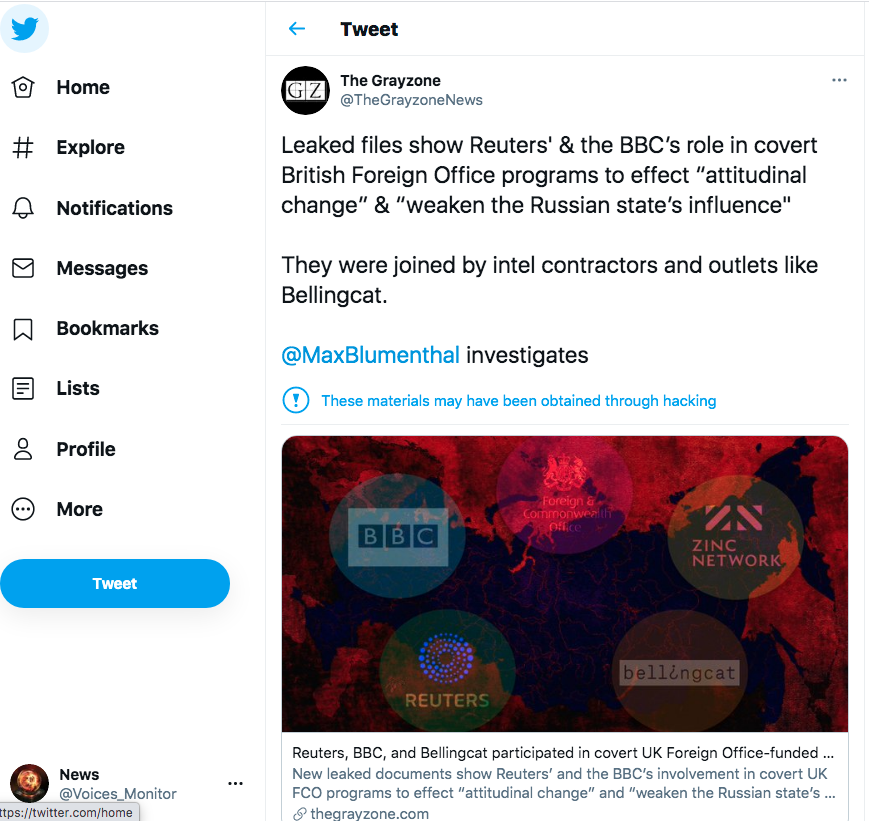
Twitter’s discrediting of leaked docs that show UK’s covert activities against Russia is a shocking case of media manipulation — RT Op-ed

Posted by M. C. on February 25, 2021

Therefore, what might be described as ‘public interest journalism’, which involves the leaking of confidential documents, is only valid if it compliments one side of the argument as opposed to the other. Deception, censorship and state-led misinformation campaigns are never to be queried if the UK or the US or behind them, while the distinction between ‘criminal’ and ‘whistleblower’ is upheld completely according to preference.

https://www.rt.com/op-ed/516459-twitter-discrediting-leaked-docs/

Tom Fowdy

Tom Fowdy

is a British writer and analyst of politics and international relations with a primary focus on East Asia.

On some platforms, whistleblowing is only considered an acceptable form of journalism when it exposes enemies of the West. Twitter’s labelling of a Grayzone story that reflected badly on Britain shows the double standards at play.

Earlier this week, journalist Max Blumenthal published a series of leaked documents from the British Foreign Office on his news website the Grayzone, revealing that the BBC and the Reuters Foundation had participated in a covert programme targeting Russia and its neighbours, seeking to push political change within the country. 

Former Labour MP Chris Williamson commented on the findings, noting, “These revelations show that when MPs were railing about Russia, British agents were using the BBC and Reuters to deploy precisely the same tactics that politicians and media commentators were accusing Russia of using.”

For those familiar with the BBC and its history as an extension for British foreign policy goals, the leaks are not a surprise. However, that does not mean the news was met with a warm welcome. 

Shunned by the mainstream media, the Grayzone report was subsequently targeted by Twitter, with each link being tagged with a warning stating: “These materials may have been obtained through hacking.” 

RT

The warning led to an information page stating: “The use of hacks and hacking to exfiltrate information from private computer systems can be used to manipulate the public conversation.”

Although the warning was not carried on some subsequent retweets, at the time of publication it was still present on Grayzone’s original tweet.

Twitter’s accusation is a classic case of it jumping to conclusions, as there is nothing at all to suggest the leaks were a product of hacking. However, this attitude is a direct manifestation of the enormous double standards at play in response to this kind of journalism. 

Whistleblowing and leaks which reveal secrets from enemy states constitute a form of journalism and reporting which deserves to be praised. But to many governments in the West, especially those in the United States and the United Kingdom, leaking is considered out of bounds when they are on the receiving end. It is as if the standards they preach to other countries – in particular, transparency and freedom of information – suddenly don’t count.

In exploring this phenomenon, the cases of Julian Assange and Edward Snowden are good places to start. If these men were Chinese, Russian or Iranian, they would be widely celebrated and lauded by the mainstream media as heroes and martyrs who have been subjected to state oppression for simply daring to reveal the truth, as was the case with doctor Li Wenliang and ‘citizen journalist’ Zhang Zhan in Wuhan. 

Yet because Assange and Snowden are Western, and in turn directly challenged the US-led security establishment with their leaks on surveillance and various atrocities, they are treated differently, as criminals and fugitives. The mainstream media minimize the coverage accordingly, and make sure their cause or work cannot gain public sympathy. State action against them is not given scrutiny.

In the simplest terms, we see a scenario where whistleblowing against the US and its allies is bad, but whistleblowing against designated enemies is good. And so, Twitter is following suit with this logic in its decision to now target articles by the Grayzone as apparent ‘hacking’. 

It perfectly illustrates this very binary mode of thought that those who leak documents against the British government are not fuelled by a desire to advocate truth or transparency, but malicious motivations to spread misinformation and influence public opinion. 

Is Twitter saying that it is best the public don’t know how the BBC is essentially being weaponized as a front for British foreign policy? That the notion of public interest essentially does not matter if a given revelation has political ramifications that might be considered undesirable for the West? Or that other journalism is not designed to influence views on a particular subject? So, some secrets are better kept? 

Twitter itself is becoming an increasingly unreliable platform on this front. Donald Trump’s presidency has changed the game, from beginning to end. The enormous controversy of the so-called ‘Russiagate scandal’ and then the Capitol riot in January proved to be two enormous turning points which have tipped the platform towards growing regulation and outright censorship. 

This would be understandable, if it were not so one-sided. The site’s proliferation of ‘state affiliated media’ labels – which unfairly target certain countries, and not others – as well as its warning labels, are all directly consolidating a status quo advocated by Western powers that only they possess a ‘valid’ notion of truth. In turn, everyone who seeks to criticize their narratives is simply promoting falsehoods and is fuelled by bad intent. 

Therefore, what might be described as ‘public interest journalism’, which involves the leaking of confidential documents, is only valid if it compliments one side of the argument as opposed to the other. Deception, censorship and state-led misinformation campaigns are never to be queried if the UK or the US or behind them, while the distinction between ‘criminal’ and ‘whistleblower’ is upheld completely according to preference. 

These documents were a massive discovery. If China had been caught doing the same thing it would be front-page news, but instead we have Twitter trying to bury the truth. The Grayzone findings deserve to be shared as widely as possible.

Like this story? Share it with a friend!

Be seeing you

Posted in Uncategorized | Tagged: , , , , , , | Leave a Comment »

bionic mosquito: Aquinas and Human Action

Posted by M. C. on February 25, 2021

Free will is not a power preceding the intellect and will.  It is a capacity proceeding from intellect and will operating together or jointly.  Intellect and will each make their contribution, and from this comes free will.

Of course, free will proceeds from will.  Free will also proceeds from the intellect – the capacity to know the truth.  The will and the intellect must act together.  This isn’t a different truth for each of us.  It is the truth of our objective end as human beings.

http://bionicmosquito.blogspot.com/2021/02/aquinas-and-human-action.html

Aquinas on the Stages of Human Action, Fr. James Brent, O.P. (Part 1; Part 2)

Following are some notes from this two-part talk (all quoted items are paraphrases, hopefully reasonably accurate):

It is taken for granted that human agents have free will or free agency – we have the experience, day to day, of being confronted with options and being able to opt between such options.  This offers a truncated picture, a picture of lower appetites.

This is David Hume’s “reason,” when he wrote: “Reason is, and ought only to be the slave of the passions, and can never pretend to any other office than to serve and obey them.”  It is the reason of lower appetites – if one can even call it reason.

Human beings also have higher appetites, to perceive the order of reality: reason.  We have the ability to live according to the reality perceived by reason.  Life goes beyond fulfilling our lower appetites; it is about living in accord with the reality of reason – integrating our passions according to reason.  There is more to being human than merely fulfilling our lower appetites.

Why is this so?

Reality is a world of form and finality: entities – the things of nature – have substantial forms and final ends.  We do not live in a mechanistic universe.  All human action is for the sake of an end – a proximate end, but also an ultimate end.  The ultimate end is happiness. (Fr. Brent will define this later)

There is an objective end for human beings as human beings.  Proper reason aims toward this objective end.  Without an objective end, or purpose…well, this is the world we certainly occupy today, where every behavior – including murder – is justifiable and justified.

No, reason, in any human sense, is not merely a slave to the passions.

Humans, unlike other animals, act based on intellect and will.  To varying degrees, other animals lack these same abilities.  Intellect is the capacity to know the truth, including the truth about the good – and there is a true, objective answer to this question of what is good – what brings us happiness.  We are able to know the truth about the good; Augustine calls this “wisdom.”

It is interesting: those who do not hold that there is objective value and objective truth at the same time have difficulty stating what is good.  The best they can do is to say avoid evil – with evil usually defined as “don’t be Hitler.”  By that standard, we are all pretty much saints.

Free will is not a power preceding the intellect and will.  It is a capacity proceeding from intellect and will operating together or jointly.  Intellect and will each make their contribution, and from this comes free will.

Of course, free will proceeds from will.  Free will also proceeds from the intellect – the capacity to know the truth.  The will and the intellect must act together.  This isn’t a different truth for each of us.  It is the truth of our objective end as human beings.

The will cannot not will happiness.  Every human being desires to be happy; this is not a matter of free choice.  By nature, we want to be happy – the ultimate end, beatitudo.  We might err in what constitutes happiness, but this is an error of the intellect. 

It is everyone’s answer to the question: what do you want, what do you want in life, what do you want for your children?  I want to be happy; I want my children to be happy.  But not everyone holds the proper definition of happiness – this is due to an error of the intellect.  And it is on this point that Thomas will say (I believe I have this right) that we have free will toward our proper ends – because free will proceeds from knowing the truth.

Our free choices regard means; the end – happiness, beatitudo – is not subject to this same free choice.

A wide variety of means are available to us when pursuing any given end – even the ultimate end.  In the means, we have free choice.  In the ends – we have the objective reality that we are human, made with a purpose, or telos.

Yes, it is an ethical story – according to Thomas, we are embedded in an ethical story.  The question of “why be moral?” makes no sense to Thomas.

It doesn’t make sense because we are created with an objective end.  To act toward that end is moral; to act contrary to it is immoral.  So…why be moral?  What else can we be?  Ask a lion why he acts as a lion; ask a rock why it acts as a rock.  It isn’t a moral issue; each acts according to its nature – just as humans do when acting with a proper intellect – the knowledge of the truth.

Fr. Brent then goes on to give some detail of twelve “steps” of the human act:  the first four steps regard identifying ends; the next four regard identifying the means – and it is only in the means where free judgement (in the Thomistic understanding) is available to us. 

This is why those who dismiss the notion of objective ends are able to say, without concern: “the ends justify the means.”  It is also true for those who hold to objective truth – the ends do justify the means.  But in both cases, the ends also define the means that are acceptable – and this is where an important difference lies. 

If the ends are not based on objective truth, then nothing binds the means.  If the ends are bound by objective truth, while superficially one might describe the situation as being bound in our means, in actuality we act in free will.  The ultimate end can only be achieved by good means.

The final four steps regard execution; the end and means have been identified, it is left to execute and to judge the success or failure.

Conclusion

How do you prove that leading the just life (proper ends) is better than leading the unjust life?  He says, long story – just go read Plato’s Republic!

Plato would write of two camps: “the friends of the forms” and “the earth-bound giants.” 

The friends of the forms believe in form and finality, the earth-bound giants believe everything is composed merely of matter and things come about by chance – and they have a certain ethic that goes with it. 

It seems Plato would not be surprised that this discussion is continuing 2400 years after he lived:

Between these two camps there is perpetual and undying warfare.

Posted by bionic mosquito

Be seeing you

Posted in Uncategorized | Tagged: , , , | Leave a Comment »

Who Owns Your Face? – LewRockwell

Posted by M. C. on February 25, 2021

https://www.lewrockwell.com/2021/02/andrew-p-napolitano/who-owns-your-face/

By Andrew P. Napolitano

After listening to Dr. Anthony Fauci suggest last weekend that we should expect to be wearing two masks on our faces everywhere we go until the end of 2022, I began thinking again about first principles.

Fauci is entitled to express his opinions. Yet, because he is the president’s chief adviser on COVID-related medical matters, I cringed when I heard what he said. Was this a trial balloon or did he mean it literally? Are these suggestions or will they become commands with the purported force of law?

Because the Constitution is the supreme law of the land, it governs the government wherever it goes and whatever it does. The original purpose of the Constitution was twofold: to establish the federal government and to limit its regulatory and taxing powers to the 17 discrete powers articulated in Article I.

The former took place in 1789 when the Constitution was ratified. The latter has been a dismal failure.

The federal government recognizes next to no limits to its powers, no matter which political party controls Congress and the White House. The feds believe that they can right any wrong, tax any event and regulate any behavior — subject only to the express prohibitions in the Constitution. Even when there is a prohibition, such as, “Congress shall make no law … abridging the freedom of speech,” Congress has found ways around it. To the federal government, “no law” does not mean “no law.” Just ask the folks who have been prosecuted for their speech.

This is known as the Wilsonian model, named after President Woodrow Wilson, who advanced it shamelessly. All of his presidential successors have done the same.

Before Wilson, for the most part, and except for the Civil War years, the federal government recognized the limitations imposed upon it by the Constitution and, for the most part, stayed within their confines. This is known as the Madisonian model, named after President James Madison who wrote the Constitution and the Bill of Rights.

The first eight amendments in the Bill of Rights articulate negative rights. That is, the amendments don’t grant rights; they restrain the government from interfering with rights that already existed when the amendments were ratified. The Fifth and the 14th Amendments expressly require that the government prove fault and harm at a jury trial before it can interfere with property rights.

See the rest here

Andrew P. Napolitano [send him mail], a former judge of the Superior Court of New Jersey, is the senior judicial analyst at Fox News Channel. Judge Napolitano has written nine books on the U.S. Constitution. The most recent is Suicide Pact: The Radical Expansion of Presidential Powers and the Lethal Threat to American Liberty. To find out more about Judge Napolitano and to read features by other Creators Syndicate writers and cartoonists, visit creators.com.

Be seeing you

Posted in Uncategorized | Tagged: , , , , , | Leave a Comment »

“Weapons of Mass Destruction”: The Last Refuge of the Global Interventionist | Mises Wire

Posted by M. C. on February 25, 2021

https://mises.org/wire/weapons-mass-destruction-last-refuge-global-interventionist

Ryan McMaken

The threat of “nuclear proliferation” remains one of the great catch-all reasons—the other being “humanitarian” intervention—given for why the US regime and its allies ought to be given unlimited power to invade foreign states and impose sanctions at any given time.

We saw this at work during the run-up to the 2003 invasion of Iraq. It was said that nuclear weapons were among the “weapons of mass destruction” being developed or harbored by Saddam Hussein’s regime. Thus, it was “necessary” that the United States invade Iraq and enact regime change.

It is now very clear, of course, that the Bush-Cheney administration was lying and there was no credible evidence that Iraq’s long-defunct nuclear program had been revived.

But let’s say for the sake of argument that Iraq was well on its way to developing a nuclear weapon in early 2003. Would it have become “necessary” for the US to invade Iraq and install a de facto puppet regime that would agree to not develop nuclear weapons?

The question is relevant, of course, because interventionists are now making the same claims about Iran as were made about Iraq in 2003.

The conventional thinking among neoconservatives and other interventionists in Washington is that yes, the United States is always justified in invading foreign states if it prevents nuclear proliferation. If this is not done, we are told, the new nuclear state will surely use its new weapons, or at least threaten to use them for purposes of blackmail. 

Unfortunately for the interventionists, history has repeatedly shown this claim to be tenuous at best. Since 1945, as more and more states have become part of the “nuclear club,” each new member has failed to live up to the predictions that proliferation will quickly lead to geopolitical destabilization and war.

This has become more important in recent years, as humanitarian interventions have apparently lost their cache with the American public. In recent years, Washington has tried to drum up support for regime change invasions in both Venezuela and Syria, yet those efforts failed to catch on.

Threat of nuclear proliferation, then, likely offers the last hope for the interventionists when it comes to regime change in Iran.

Those Guys Are Crazy!

Perhaps the most-used argument made against tolerating proliferation often rests on the idea that most regimes are too insane, irrational, or incompetent to manage nuclear weapons responsibly—however one might define “responsible” stewardship of weapons that exist to destroy entire metropolitan populations.

The claim is thus made that regimes in Iran, Iraq, and North Korea—to name just three examples—are likely to be unrestrained by the instinct of self-preservation and that thus we cannot apply traditional theories of nuclear deterrence to these regimes.

Yet, this theory has yet to amass any evidence to support it. Are we to believe that the Soviet and Chinese regimes have always been headed by eminently sane people? After all, as John Mueller notes,

the weapons have proliferated to large, important countries run by unchallenged monsters who, at the time they acquired the bombs, were certifiably deranged: Josef Stalin, who in 1949 was planning to change the climate of the Soviet Union by planting a lot of trees, and Mao Zedong, who in 1964 had just carried out a bizarre social experiment that resulted in an artificial famine in which tens of millions of Chinese perished.

Mueller suggests that it is incumbent on the opponents of an Iranian bomb to show that Iran’s leaders are less sane than Stalin.

Some might nevertheless claim (however implausibly) that Muslims are somehow more naturally murderous than Stalin. Yet we might note that this doesn’t explain how the Islamic Republic of Pakistan—an occasional military dictatorship—has somehow refrained from using its nuclear arms against its hated rival India.

In actual experience, regimes that acquire a bomb tend to moderate their behavior. As Kenneth Waltz points out:

every new nuclear state has behaved exactly the way the old nuclear states have behaved. One can describe the way all nuclear states have behaved in one word: responsibly. When the United States contemplated the Soviet Union one day having its own nuclear weapons, we were horrified by the prospect. How could we live? How could the world live with such a country as the Soviet Union—which we saw as bent on world domination—having nuclear weapons? And when China developed its own nuclear weapons, we repeated the same way of thinking—“My God! China? China is crazy!”

But in fact, if you think of the Cultural Revolution, China took very good care of its nuclear weapons. They ensured that they would not fall under the hands of the revolutionaries and came through that horrible ten-year period. The fact is that people worry that a new nuclear country, once it gets a nuclear shield, would then begin to behave immoderately or irresponsibly under the cover of its own nuclear weapons. Well, that has never happened. Every country that has had nuclear weapons has behaved moderately.

(Of course, by “moderately” he only means in terms of provoking full-scale war with rivals.)

In any case, the notion that regimes that acquire nuclear warheads then go off the deep end has yet to be observed in real life.

This is why, in a 2012 forum for PBS, John Mearsheimer noted that if Iran were to acquire nuclear weapons, this would likely stabilize the region rather than destabilize it:

I think there’s no question that a nuclear-armed Iran would bring stability to the region, because nuclear weapons are weapons of peace. They’re weapons of deterrence.

And because nuclear weapons are useful only for deterring attacks, they cannot be used for so-called nuclear blackmail:

We have created this myth in this country over the past few years in talking about Iran that any country that acquires nuclear weapons can blackmail other countries or use those nuclear weapons for offensive purposes. We have a lot of theory and a huge amount of empirical evidence, 67 years now, which show that no country with nuclear weapons can blackmail another country, as long as somebody is protecting that country or it has its own nuclear weapons.

Rather, in the case of Iran, according to Waltz, if the goal is stability in the region, that answer lies in ending Israel’s nuclear monopoly in the region—which has been a source of enduring instability. In the July/August 2012 issue of Foreign Affairs, Waltz observed:

Israel’s regional nuclear monopoly, which has proved remarkably durable for the past four decades, has long fueled instability in the Middle East. In no other region of the world does a lone, unchecked nuclear state exist.

Of course, it is easy to understand why Israel wants to remain the sole nuclear power in the region and why it is willing to use force to secure that status. In 1981, Israel bombed Iraq to prevent a challenge to its nuclear monopoly. It did the same to Syria in 2007 and is now considering similar action against Iran. But the very acts that have allowed Israel to maintain its nuclear edge in the short term have prolonged an imbalance that is unsustainable in the long term. Israel’s proven ability to strike potential nuclear rivals with impunity has inevitably made its enemies anxious to develop the means to prevent Israel from doing so again. In this way, the current tensions are best viewed not as the early stages of a relatively recent Iranian nuclear crisis but rather as the final stages of a decades-long Middle East nuclear crisis that will end only when a balance of military power is restored.

Nuclear Arms Offer a Solution to Threats of Regime Change

Indeed, the case of Israel is not unique in the sense that the United States provokes the same sort of instability worldwide.

The United States has either carried out regime change or threatened to do so in a number of cases. This means those countries targeted by the US are highly motivated to acquire arms, which these regimes correctly see as the only reliable deterrent against US invasion. Waltz continues: 

There is only one way that a country can reliably deter a dominant power, and that is by developing its own nuclear force. When president Bush identified the countries that he said constituted an “axis of evil”—namely, Iraq, Iran, and North Korea—and then proceeded to invade one of them—namely, Iraq—that was certainly a lesson quickly learned by both Iran and North Korea. That is to say, that if a country wants to deter the United States it has to equip itself with nuclear force. I think we all have seen that demonstrated very clearly.

In other words, it is the United States, and to a lesser extent the State of Israel, which have created situations in which states become highly motivated to acquire nuclear arms for defensive reasons.

If the US really wanted to reduce the likelihood of regimes like Iran and North Korea seeking and expanding nuclear capabilities, the US would disavow its doctrine of regime change explicitly. It would also renounce the notion of an “axis of evil” and cut back the US’s nuclear arsenal to a force designed for minimum deterrence.

Until that happens, the United States itself remains a primary motivation for nuclear armament among regimes that have run afoul of the Washington establishment.

This, however, is unlikely to happen, because a perpetual stance of antiproliferation and regime change pays many dividends in Washington. It keeps the Pentagon’s budget sky-high, and it allows the regime to claim it is enforcing worldwide peace, even while it remains a source of instability.

In the sloppy world of public debates over foreign policy, this appears to many voters to make sense. As Mueller has suggested, it’s easy to just keep pushing the panic button and then taking the credit for the fact that World War III has yet to break out:

Alarmists have one great advantage. If their alarm proves to be justified, they will look like prophets. If nothing happens, they can claim that this desirable condition has been the result of efforts their alarmism has inspired. Thus, when New York Police Department Commissioner David Cohen is asked how he knows whether his extensive counterterrorism programs (which have had an almost perfect record of not finding any terrorists) have been successful, he curtly responds, “They haven’t attacked us.” Reporting this comment, reporters Matt Apuzzo and Adam Goldman note that “the absence of a terrorist attack has been the silver‐bullet argument for national security pro‐fessionals.” Although it is a “flawed argument” logically, they continue, it has been “nearly irrefutable” politically. The dodge, then, is, (1) we are trying to keep them from attacking; (2) they haven’t attacked; therefore (3) it must be our efforts that have kept them from doing so.

The question we must ask ourselves, however, is: At what cost?

How many more countries will the United States bomb or invade in the name of wiping out weapons of mass destruction? We’ve already seen the side effects of these efforts. Not only are hundreds of thousands of human beings killed in these wars—as was the case in Iraq—but these conflicts also create immense refugee and immigration crises while creating power vacuums. ISIS, for example, would have never gained much success at all had the US not destroyed Saddam’s secularist Ba’athist regime in Iraq.

These costs are sure to be studiously ignored. Whether we’re talking about global warming or covid-19, or “weapons of mass destruction,” the strategy today is that we must trust the regime to take whatever drastic steps it wishes or else we face an existential threat. We must adopt environmental regulations that would force billions of Africans and Asians back into poverty “or else.” We must destroy civil liberties and impose lockdowns on countless millions “or else.” We must carry out regime change in yet another country “or else.”

This narrative has worked wonders for regimes seeking ever more power. They won’t abandon this strategy any time soon. Author:

Contact Ryan McMaken

Ryan McMaken (@ryanmcmaken) is a senior editor at the Mises Institute. Send him your article submissions for the Mises Wire and The Austrian, but read article guidelines first. Ryan has degrees in economics and political science from the University of Colorado and was a housing economist for the State of Colorado. He is the author of Commie Cowboys: The Bourgeoisie and the Nation-State in the Western Genre.

Be seeing you

Posted in Uncategorized | Tagged: , , , , , | Leave a Comment »