


Archive for the ‘Uncategorized’ Category
V For Vendetta Speech – Seeds of Revolution! HD
Posted by M. C. on December 19, 2020
Posted in Uncategorized | Tagged: Good evening, London, Seeds of Revolution, V for Vendetta | Leave a Comment »
A “Case” You Probably Didn’t Read About – EPautos – Libertarian Car Talk
Posted by M. C. on December 19, 2020
It is established fact – the “science” – that 13-year-olds like the girl who is the schoolmate of my friend’s son – are at less risk of dying from ‘Rona than they are of being killed in a car accident. Yet on the putative basis of an hysterically exaggerated “risk,” they are being abused in a manner that would have earned those responsible a felony conviction as recently as this same time last year.
Forced to stay at home. Forced to wear a muzzle – the sort of thing formerly applied to dangerous animals and for that reason just as degrading but without the justification. Denied their friends. Denied their outlets, such as team sports and just “hanging out” freestyle.
https://www.ericpetersautos.com/2020/12/18/a-case-you-probably-didnt-read-about/
By eric
A friend in Georgia called to let me know a junior high school student who attends the same school as her 13-year-old son tried to kill herself the other day. She was found hanging from a cord she’d wound over the shower head in her parents’ home. She was despondent over being denied her life – and so decided to take it.
The good news is she was discovered in time and is still alive.
The bad news is there are many such “cases” – including the premature deaths-by-neglect of elderly people who haven’t got the ‘Rona but lost the will to live – and stopped eating or just faded away from depressive ennui resulting from being “locked down” in nursing homes for the past six-plus-months, by decree of the Gesundheitsfuhrers.
Mammals need the warmth and companionship of other mammals. Take that away – “lock them down”- and you sentence them to a slow but certain death, beginning with their spirit and ending with the mortification of their bodies.
This is not a minor inconvenience, a temporary and necessary sacrifice. It is an outrageous, criminal assault on the physical and psychological well-being of hundreds of millions of people (in this country alone) in the name of a fatuous hyper-precautionary Sickness Cult that regards a slight risk of a bad cold to most as finger-wagging justification – and you’d better not object to any of it.
It has worked – so far – because most people are kind and generous and no one wants to be accused of harming other people, let alone actually harming them. But it begins to wear thin, as the enjoining and finger-wagging waxes even as the evidence mounts that the damage being done is sickeningly disproportionate to the threat asserted.
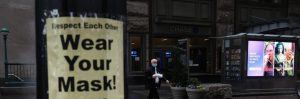
Questioning is beginning.
It is reasonable to alert people who come to eat at a restaurant that certain dishes may contain peanuts so that those who have allergies to peanuts can avoid those dishes. It is ridiculous to insist that all restaurants establish Peanut Free Zones for the sake of those with peanut allergies.
It is tyrannical to decree it.
My gym has been open for the past four months and almost no one wears the Holy Rag as the gym is a secular joint; people come there to exercise, not perform religious rituals. Notwithstanding this heresy, no one is sick. Probably in no small measure because they are exercising – and breathing freely – both tending to improve one’s health.

But gyms around the country are “locked down” – denying more people than the number of people who’ve allegedly died of the ‘Rona (as opposed to with it, but actually because of old age compounded by poor health) access to the means by which to maintain and improve their physical as well as psychological health.
Being able to go out – and go within. To see your friends – and see their faces. To deny this to people is inhuman. To deny it to them in the name of what, for 99.8 percent of them, amounts to nothing more than than the slight threat of a bad cold is something worse.
Particularly as regards children such as the one who almost took her life, mentioned earlier.
It is established fact – the “science” – that 13-year-olds like the girl who is the schoolmate of my friend’s son – are at less risk of dying from ‘Rona than they are of being killed in a car accident. Yet on the putative basis of an hysterically exaggerated “risk,” they are being abused in a manner that would have earned those responsible a felony conviction as recently as this same time last year.

Forced to stay at home. Forced to wear a muzzle – the sort of thing formerly applied to dangerous animals and for that reason just as degrading but without the justification. Denied their friends. Denied their outlets, such as team sports and just “hanging out” freestyle.
Fear the Bogeyman! Don’t Question! Wear a Mask!
It is child abuse – or would have been so described, this time last year.
This wears on kids, especially (see here) for whom six months might as well be six years as their time-sense is different than that of adults. If it seems as if this will never end to us – adults – imagine how it feels to a 13-year-old. Also, we have next year. They only get one shot at 7th grade.
Or their senior prom.
It is not hard to understand why kids feel their lives are over before they’ve even gotten started.
Just as it is easy to understand why many elderly people, imprisoned in “homes” and denied contact with their families (phone calls don’t suffice) despair of living.
https://www.youtube.com/embed/dKnjxT5HRJQ
And just give up.
How did it happen that such control over our lives came to pass? It came in a blizzard storm of orchestrated terror, a manufactured emergency that has been maintained not with “science” and the free consent that an actual emergency would voluntarily engender – but by decrees that rely on threats.
Issued by people who exempt themselves.
Life is becoming the equivalent of owning a car you’re not allowed to drive; of having a spouse you may not touch. A life you may not live. It is killing us.
And kids, too.
. . . .
Be seeing you
Posted in Uncategorized | Tagged: Case, muzzle, Rona, Sickness Cult | Leave a Comment »
To Mitigate Racial Inequity, the CDC Wants To Vaccinate Essential Workers Before the Elderly – Reason.com
Posted by M. C. on December 19, 2020
Part of the reason for this, according to a CDC report, is to mitigate and racial and ethnic “health inequities.” Older Americans are disproportionately white, whereas the essential worker category includes a larger percentage of racial minorities and low-income people.
“Older populations are whiter, ” Harald Schmidt, a professor of ethics and health policy at the University of Pennsylvania, told The New York Times. “Society is structured in a way that enables them to live longer. Instead of giving additional health benefits to those who already had more of them, we can start to level the playing field a bit.”
https://reason.com/2020/12/18/vaccine-cdc-essential-workers-elderly-racial-covid-19/
Deaths from COVID-19 are overwhelmingly concentrated among the elderly, and thus it would seem obvious that vaccinating older Americans should be a top priority. Yet the Centers for Disease Control and Prevention (CDC) have released guidance suggesting that millions of essential workers should receive the vaccine before many people 65 and older.
Part of the reason for this, according to a CDC report, is to mitigate and racial and ethnic “health inequities.” Older Americans are disproportionately white, whereas the essential worker category includes a larger percentage of racial minorities and low-income people.
“Older populations are whiter, ” Harald Schmidt, a professor of ethics and health policy at the University of Pennsylvania, told The New York Times. “Society is structured in a way that enables them to live longer. Instead of giving additional health benefits to those who already had more of them, we can start to level the playing field a bit.”
It’s not as if there’s a consensus that this is the right thing to do. The Times notes that this approach “runs counter to frameworks proposed by the World Health Organization, the National Academies of Sciences, Engineering, and Medicine, and many countries, which say that reducing deaths should be the unequivocal priority and that older and sicker people should thus go before the workers, a view shared by many in public health and medicine.”
Indeed, this is a prime example of progressive thinking on racial justice leading otherwise intelligent people to take a position that actually hurts racial minorities. While it’s true that the 65-and-up demographic is somewhat whiter than the general population, there are still millions of elderly people of color, and they have by far the greatest risk of dying from COVID-19—the age skew of the disease’s victims is extreme. A policy of vaccinating police officers, firefighters, and grocery store employees before the elderly is clearly suboptimal, even from the standpoint of just trying to save as many people of color from dying as possible.
“The decision here is to not prioritize vaccinating them, but to instead vaccinate a different, less vulnerable group of people and then assert that this creates some kind of abstract collective racial benefit,” notes Matt Yglesias in a terrific post on this subject. “There have been a lot of takes lately about woke liberals prioritizing symbolic racial issues over the concrete needs of non-white people, but this idea really takes the cake.”
As Yglesias explains in greater detail:
Basically, if you take 1,000 prime-age Americans you’d expect to have 150 African-Americans in the pool versus about 100 if you take 1,000 senior citizens. So in that sense, vaccinating essential workers promotes racial equity because you’re giving shots to more Black people. But since the infection fatality rate for senior citizens is at least 10 times the rate for non-seniors, you’re not actually saving Black people’s lives this way. You’re opting for a strategy that leads to more Black deaths and more white deaths than the “vaccinate seniors first” strategy, but deciding that it’s better for equity and this is what ethics requires.
There are other problems with vaccinating essential workers before senior citizens, in that the former is an expansive and debatable category. Depending on who gets counted, some 70 percent of the workforce can be deemed essential, though restricting it to just “front line” workers gets that percentage down significantly, according to the Times. And while it’s true that vaccinating people in the workforce who are most likely to spread the disease to others could be a sound strategy for ultimately preventing deaths, this is a complicated approach and the current supply of vaccines is inadequate.
Yglesias recommends vaccinating health care workers, and then going by age: 85 and up, then 80 and up, then 75 and up, etc. This idea has a lot of merit, especially when the vaccine supply remains limited.
Ultimately, it’s up to the states to determine who gets vaccinated first; the CDC’s guidance is only a recommendation. Still, it’s regrettable that the CDC has embraced an approach to racial equity that might keep people in need of the vaccine from getting it first.
Be seeing you
Posted in Uncategorized | Tagged: CDC, Essential Workers, health care workers, Racial Inequity | Leave a Comment »
How the State Spreads Mass Hysteria | Mises Wire
Posted by M. C. on December 19, 2020
Fifth, the state sometimes actively wants to instill fear in the population, thereby contributing to the making of mass hysteria. In fact, during the first months of the corona epidemic, an internal paper of the German Department of the Interior was leaked to the public. In the paper, the experts recommend that the German government instill fear in the German population. The paper recommends increasing fear with three communication measures…
https://mises.org/wire/how-state-spreads-mass-hysteria
The history of mass hysteria, or mass sociogenic illness is fascinating. Cases of mass hysteria have been documented since the Middle Ages. Let me just mention a few of the more recent cases.
When a radio play by Orson Welles, War of the Worlds, was broadcasted in 1938 shortly after the suspension of the Munich agreement, the play allegedly caused panic among listeners, who thought that they were under attack by Martians. Another intriguing case is an episode of a Portuguese TV show called Strawberries with Sugar. In the episode, the characters were infected by a life-threatening virus. After the show, more than three hundred students reported similar symptoms as the ones experienced by the TV show characters such as rashes and difficulty breathing. Some schools even closed. The Portuguese National Institute for Medical Emergency concluded that the virus did not exist in reality and that the symptoms were caused by mass hysteria.
Similarly, on Emirates flight 203 in September 2018, dozens of passengers started to believe they were sick after observing other passengers with flu-like symptoms. As a consequence of the panic, the whole flight was quarantined. In the end only a few passengers had a common cold or the seasonal flu.
It is well known that there exist nocebo effects, which are the opposite of placebo effects. Due the placebo effect, a person recovers from an illness because she expects to do so. When we suffer a nocebo effect, on the other hand, we get ill just because we expect to become ill.1 In a self-fulfilling prophecy, the expectation can cause the symptoms. Anxiety and fear exacerbate this process.2
Mass hysteria can cause people to have symptoms. Moreover, hysteria, be it collective or not, makes people behave in ways that prudent persons not affected by the hysteria would likely consider absurd. It is open for empirical research to investigate if and to what extent the world has been suffering from mass hysteria during the covid-19 epidemic.3 We all have seen people hoarding toilet paper, wearing masks while driving alone in cars, or have heard stories of people virtually not leaving their houses for months. We also know people who are scared by the virus even though their own risk of death is minuscule.
While investigating the possibility of a corona mass hysteria is certainly interesting, I would like to focus here on a more fundamental question; namely, the extent to which the existence of the state can exacerbate mass hysteria. Certainly, there can be cases of mass hysteria in a free society, due to the negativity bias of the human brain. We focus on negative news and suffer psychological stress when we think we are not in control. This may happen also in a free society when negative news prevail. Yet in a free society there exist certain self-corrective mechanisms and limits that make it more difficult for mass hysteria to spiral out of control.
As a corrective mechanism, there exist well-known strategies to reduce fear and anxiety. In a free society people are free to make use of these strategies. One can release tension from one’s body through sports and exercises. Moreover, it is essential to find distractions from the negative news and socialize. In a free society these distractions abound.
It is true that hysteria can lead people to inflict enormous harm on themselves and others. Yet in a free society there exists an essential limit to the havoc caused by mass hysteria, and this limit is private property rights. In a free society mass hysteria cannot lead to a massive violation of private property rights by the state, simply because the state does not exist.
Moreover, while anyone in a health hysteria may voluntarily close his business, wear a mask, or stay at home, in a free society no one can force others who do not succumb to the hysteria to close their businesses, wear masks, or quarantine. A small minority who continue to live their normal lives and are free to do so can be a wake-up call to those who succumbed to the mass hysteria, especially the borderline cases. Imagine that a small group of people continues to go shopping, to work, to breath freely, to meet with friends and family, and that they do not die. Others may then follow their example and the group of hysterics shrinks.
While the destruction inflicted by mass hysteria is limited by private property rights in a free society, such limits do not exist when there is a state.4 Indeed, a well-organized group that has succumbed to mass hysteria may get control of the state apparatus and impose measures on the rest of the population and inflict untold harm. The possibility of mass hysteria is an important reason why the institution of the state is so dangerous.
Moreover, while in a free society there are mechanisms that reduce mass panics, mass hysteria can be exacerbated by the state for several reasons:
First, the state can and, as in the case of the covid-19 epidemic, does prohibit and diminish those activities that reduce fear and anxiety, such as sports and diversion. The state actually fosters social isolation, contributing to anxiety and psychological strain, ingredients that spur mass hysteria.
Second, the state takes a centralized approach to dealing with the source of the hysteria, in our case the perceived threat of a virus. The state imposes its solution, and in consequence there is no or very reduced experimentation to solve the problem. People who have not succumbed to the hysteria and oppose the state’s approach are suppressed. They cannot demonstrate alternative ways to confront the “crisis,” because these alternative ways are prohibited by the state. As a consequence, groupthink increases and the hysteria feeds itself, as no alternatives are shown to people.
Third, in a state, the media is often politicized. News outlets and social media platforms have close relationships with the state. Media outlets may be directly owned by the state, as are public TV channels, they may need state licenses to operate, they may look for the goodwill of state agencies, or may simply be staffed with people who were educated in state schools. These news agencies and social media platforms engage in massive negative news campaigns, intentionally scare people, and suppress alternative information. If people listen to, watch, or read negative and one-sided stories all day, their psychological stress and anxiety increases. Mass hysteria sponsored by a biased media sector may run out of control.
Fourth, negative news from an authoritative source is especially harmful for psychological health and produces anxiety. If there exists in society an institution of total power such as the state that intervenes in the lives of people from birth to death,5 the announcements of its representatives acquire weight. Many people attach great authority to these representatives and to the warnings of state institutions. So, when a doctor such as Anthony Fauci speaks in the name of the state and tells the people to worry and wear masks, it becomes easier for mass hysteria to develop than would be the case in a decentralized society.
Fifth, the state sometimes actively wants to instill fear in the population, thereby contributing to the making of mass hysteria. In fact, during the first months of the corona epidemic, an internal paper of the German Department of the Interior was leaked to the public. In the paper, the experts recommend that the German government instill fear in the German population. The paper recommends increasing fear with three communication measures. First, the authorities should emphasize the breathing problems of covid-19 patients, because the human beings have a primordial fear of death by suffocation, which can easily trigger panic. Second, fear should also be instilled in children. Children could get infected easily when meeting with other children. They should be told that when they in turn infect their parents and grandparents these could suffer a distressful death at home. This measure intends to invoke feelings of guilt. Third, authorities should mention the possibility of unknown long-term irreversible damage after a corona infection and the possibility of the sudden deaths of people who were infected. All these measures were intended to increase fear in the population. Fear, at the end, is the foundation of every government´s power. As H.L. Mencken put it:
The whole aim of practical politics is to keep the populace alarmed (and hence clamorous to be led to safety) by menacing it with an endless series of hobgoblins, all of them imaginary.
To sum up: mass hysteria is possible in a free society, but there are self-correcting mechanisms. The harm such hysteria may inflict is limited by the enforcement of private property rights. The state amplifies and exacerbates mass panics, causing tremendous havoc. What are local, limited, and isolated outbreaks of mass hysteria in a free society the state can convert into a global mass hysteria. Unfortunately, there is no limit to the damage mass hysteria can do to life and liberty if it takes hold of the government, as the state does not respect private property. The unscrupulous violation of basic liberties during the corona epidemic is a case in point. The possibility of mass hysteria is another reason why the state is such a dangerous institution to have.
- 1. In a famous case a man tried to suicide himself. He thought he was swallowing twenty-nine capsules of an experimental drug. However, they were in reality placebos. But he was thinking he would be killing himself. He arrived at the hospital with extreme low blood pressure and other serios symptoms. When the doctor of the medical trial arrived and told him that he had taken just placebos, the man recovered within fifteen minutes.
- 2. During the Spanish flu panic contributed to deaths that otherwise would not have occurred.
- 3. Keep in mind that the psychological strain on and the anxiety suffered by the population during the lockdowns was tremendous.
- 4. For the psychology of masses and their irrationality see the classical work of Gustave Le Bon.
- 5. A related point regards the consequences that come with a population that stopped believing in God and started to believe in the state instead. When people turn away from religion and stop believing in a life after death, they start to fear death more. A strong fear of death is another factor contributing to panics, disorders, and mass hysteria. As Erik von Kuehnelt-Leddihn has put it: “It is difficult to fear death if one is very pious. It is difficult not to worship health if one fears death. It is difficult to enforce general health without large scale state intervention and it is equally difficult to imagine increased state intervention without a loss of liberties.” The Menace of the Herd or Procrustes at Large (Milkwaukee, WI: Bruce Publishing Company, 1943), pp. 38–39.
Author:
Philipp Bagus is professor at Universidad Rey Juan Carlos. He is a Fellow of the Mises Institute, an IREF scholar, and the author of numerous books including In Defense of DeflationandThe Tragedy of the Euro, and is coauthor of Blind Robbery!, Small States. Big Possibilities.: Small States Are Simply Better!, and Deep Freeze: Iceland’s Economic Collapse.
Be seeing you
Posted in Uncategorized | Tagged: mass hysteria, nocebo effects, State, Strawberries with Sugar, War of the Worlds | Leave a Comment »
On the Liberty of the Ancients Compared with That of the Moderns | Mises Institute
Posted by M. C. on December 19, 2020
It follows from what I have just indicated that we can no longer enjoy the liberty of the ancients, which consisted in an active and constant participation in collective power. Our freedom must consist of peaceful enjoyment and private independence. The share that in antiquity everyone held in national sovereignty was by no means an abstract presumption as it is in our own day. The will of each individual had real influence: the exercise of this will was a vivid and repeated pleasure. Consequently the ancients were ready to make many a sacrifice to preserve their political rights and their share in the administration of the state. Everybody, feeling with pride all that his suffrage was worth, found in this awareness of his personal importance a great compensation.
This compensation no longer exists for us today.
https://mises.org/library/liberty-ancients-compared-moderns
[This lecture was given by the Swiss-French thinker Benjamin Constant in 1819. The French title is “De la liberté des anciens comparée à celle des modernes.”]
Introduction by Ralph Raico
“He loved liberty as other men love power,” was the judgment passed on Benjamin Constant by a 19th-century admirer.
His great public concern, all throughout his adult life, was the attainment of a free society, especially for his adopted country, France; and if a (by no means uncritical) French commentator exaggerated in calling him the inventor of liberalism,1 it is nevertheless true that in the second and third decades of the 19th century, when liberalism was the specter haunting Europe, Constant shared with Jeremy Bentham the honor of being the chief theoretical champion of the creed.
His influence—particularly because his involvement in French politics under the Restoration regime gave him a platform in the most attentively watched legislature on the Continent—was widespread; he had important groups of followers in France, Italy and south Germany, and disciples as far away as Russia.2
The comparison of Constant with Bentham is one worth making in detail, although this will not be attempted here. While each can be taken as representative of one of the great streams of early 19th century liberal thought, their differences were almost as significant as their similarities. Bentham (and his disciples) refined the rationalist and utilitarian position of most of 18th-century French liberalism; Constant, on the other hand, occupied himself with breaking through this mold, and attaching liberalism to the romantic and historicist thought emerging into prominence in his day, especially in Germany. Associated with this is his effort, which was to be repeated in differing forms by Tocqueville and Acton, to end the centuries-old hostility between Christianity and liberal thought, and to turn religious faith to the advantage of the free society, now confronting new and peculiarly dangerous enemies.
For 19th-century liberalism, the question of the nature of the political organization of classical antiquity had at least two important aspects. In the first place, the Jacobin and Napoleonic periods, by their free use of the rhetoric and of some of the outward political forms of antiquity, had suggested that classical republicanism might be connected with anti-liberal movements. In the second place, for any liberal exploring the connection between freedom and Christianity, the thought and practice of ancient politics becomes immediately relevant, as representing the state of affairs in the Western world before the introduction of Christianity.
As a recent historian of the intellectual background of Jacobinism has said: “The strongest influence on the fathers of totalitarian democracy was that of antiquity, interpreted in their own way.”3 What was of particular concern to the post-Revolutionary liberal was that many had accepted the incessant protestations of love of liberty on the part of the Leaders of the Mountain at face value;4 this in turn had led to a rejection of liberty by all those who were disgusted by the course of French political developments after about 1792.
Many persons were tempted to conclude that the tyrannical acts of Jacobins and other revolutionary groups were somehow connected with an “excess” of liberty, and resolved that in the future Jacobin tyranny would be avoided by a ruthless suppression of all liberal demands. Thus the question of the true meaning of ancient liberty was of direct political consequence in Constant’s own time.
On the Liberty of the Ancients Compared with that of the Moderns
Gentlemen,
I wish to submit for your attention a few distinctions, still rather new, between two kinds of liberty: these differences have thus far remained unnoticed, or at least insufficiently remarked. The first is the liberty the exercise of which was so dear to the ancient peoples; the second the one the enjoyment of which is especially precious to the modern nations. If I am right, this investigation will prove interesting from two different angles.
Firstly, the confusion of these two kinds of liberty has been amongst us, in the all too famous days of our revolution, the cause of many an evil. France was exhausted by useless experiments, the authors of which, irritated by their poor success, sought to force her to enjoy the good she did not want, and denied her the good that she did want. Secondly, called as we are by our happy revolution (I call it happy, despite its excesses, because I concentrate my attention on its results) to enjoy the benefits of representative government, it is curious and interesting to discover why this form of government, the only one in the shelter of which we could find some freedom and peace today, was totally unknown to the free nations of antiquity.
I know that there are writers who have claimed to distinguish traces of it among some ancient peoples, in the Lacedaemonian republic for example, or amongst our ancestors the Gauls; but they are mistaken. The Lacedaemonian government was a monastic aristocracy, and in no way a representative government. The power of the kings was limited, but it was limited by the ephors, and not by men invested with a mission similar to that which election confers today on the defenders of our liberties. The ephors, no doubt, though originally created by the kings, were elected by the people. But there were only five of them. Their authority was as much religious as political; they even shared in the administration of government, that is, in the executive power. Thus their prerogative, like that of almost all popular magistrates in the ancient republics, far from being simply a barrier against tyranny became sometimes itself an insufferable tyranny.
The regime of the Gauls, which quite resembled the one that a certain party would like to restore to us, was at the same time theocratic and warlike. The priests enjoyed unlimited power. The military class or nobility had markedly insolent and oppressive privileges; the people had no rights and no safeguards.
In Rome the tribunes had, up to a point, a representative mission. They were the organs of those plebeians whom the oligarchy—which is the same in all ages—had submitted, in overthrowing the kings, to so harsh a slavery. The people, however, exercised a large part of the political rights directly. They met to vote on the laws and to judge the patricians against whom charges had been leveled: thus there were, in Rome, only feeble traces of a representative system.
This system is a discovery of the moderns, and you will see, gentlemen, that the condition of the human race in antiquity did not allow for the introduction or establishment of an institution of this nature. The ancient peoples could neither feel the need for it, nor appreciate its advantages. Their social organization led them to desire an entirely different freedom from the one this system grants to us. Tonight’s lecture will be devoted to demonstrating this truth to you.
First ask yourselves, gentlemen, what an Englishman, a Frenchman, and a citizen of the United States of America understand today by the word “liberty.”
For each of them it is the right to be subjected only to the laws, and to be neither arrested, detained, put to death, or maltreated in any way by the arbitrary will of one or more individuals. It is the right of everyone to express his opinion, choose a profession and practice it, to dispose of property, and even to abuse it; to come and go without permission, and without having to account for his motives or undertakings. It is everyone’s right to associate with other individuals, either to discuss their interests, or to profess the religion that he and his associates prefer, or even simply to occupy their days or hours in a way that is most compatible with his inclinations or whims. Finally it is everyone’s right to exercise some influence on the administration of the government, either by electing all or particular officials, or through representations, petitions, demands to which the authorities are more or less compelled to pay heed. Now compare this liberty with that of the ancients.
The latter consisted in exercising collectively, but directly, several parts of the complete sovereignty; in deliberating, in the public square, over war and peace; in forming alliances with foreign governments; in voting laws, in pronouncing judgments; in examining the accounts, the acts, the stewardship of the magistrates; in calling them to appear in front of the assembled people, in accusing, condemning or absolving them. But if this was what the ancients called liberty, they admitted as compatible with this collective freedom the complete subjection of the individual to the authority of the community. You find among them almost none of the enjoyments we have just seen form part of the liberty of the moderns. All private actions were submitted to a severe surveillance. No importance was given to individual independence, neither in relation to opinions, nor to labor, nor, above all, to religion. The right to choose one’s own religious affiliation, a right that we regard as one of the most precious, would have seemed to the ancients a crime and a sacrilege.
In the domains that seem to us the most useful, the authority of the social body interposed itself and obstructed the will of individuals. Among the Spartans, Therpandrus could not add a string to his lyre without causing offense to the ephors. In the most domestic of relations the public authority again intervened. The young Lacedaemonian could not visit his new bride freely. In Rome, the censors cast a searching eye over family life. The laws regulated customs, and as customs touch on everything, there was hardly anything that the laws did not regulate.
Thus among the ancients the individual, almost always sovereign in public affairs, was a slave in all his private relations. As a citizen, he decided on peace and war; as a private individual, he was constrained, watched and repressed in all his movements; as a member of the collective body, he interrogated, dismissed, condemned, beggared, exiled, or sentenced to death his magistrates and superiors; as a subject of the collective body he could himself be deprived of his status, stripped of his privileges, banished, put to death, by the discretionary will of the whole to which he belonged.
Among the moderns, on the contrary, the individual, independent in his private life, is, even in the freest of states, sovereign only in appearance. His sovereignty is restricted and almost always suspended. If, at fixed and rare intervals, in which he is again surrounded by precautions and obstacles, he exercises this sovereignty, it is always only to renounce it.
I must at this point, gentlemen, pause for a moment to anticipate an objection that may be addressed to me. There was in antiquity a republic where the enslavement of individual existence to the collective body was not as complete as I have described it. This republic was the most famous of all: you will guess that I am speaking of Athens. I shall return to it later, and in subscribing to the truth of this fact, I shall also indicate its cause. We shall see why, of all the ancient states, Athens was the one that most resembles the modern ones. Everywhere else social jurisdiction was unlimited. The ancients, as Condorcet says, had no notion of individual rights. Men were, so to speak, merely machines, whose gears and cog-wheels were regulated by the law. The same subjection characterized the golden centuries of the Roman Republic; the individual was in some way lost in the nation, the citizen in the city. We shall now trace this essential difference between the ancients and ourselves back to its source.
All ancient republics were restricted to a narrow territory. The most populous, the most powerful, the most substantial among them, was not equal in extension to the smallest of modern states. As an inevitable consequence of their narrow territory, the spirit of these republics was bellicose; each people incessantly attacked their neighbors or was attacked by them. Thus driven by necessity against one another, they fought or threatened each other constantly. Those who had no ambition to be conquerors, could still not lay down their weapons, lest they should themselves be conquered. All had to buy their security, their independence, their whole existence at the price of war. This was the constant interest, the almost habitual occupation of the free states of antiquity. Finally, by an equally necessary result of this way of being, all these states had slaves. The mechanical professions and even, among some nations, the industrial ones, were committed to people in chains.
The modern world offers us a completely opposing view. The smallest states of our day are incomparably larger than Sparta or than Rome was over five centuries. Even the division of Europe into several states is, thanks to the progress of enlightenment, more apparent than real. While each people, in the past, formed an isolated family, the born enemy of other families, a mass of human beings now exists, that under different names and under different forms of social organization are essentially homogeneous in their nature. This mass is strong enough to have nothing to fear from barbarian hordes. It is sufficiently civilized to find war a burden. Its uniform tendency is towards peace.
This difference leads to another one. War precedes commerce. War and commerce are only two different means of achieving the same end, that of getting what one wants. Commerce is simply a tribute paid to the strength of the possessor by the aspirant to possession. It is an attempt to conquer, by mutual agreement, what one can no longer hope to obtain through violence. A man who was always the stronger would never conceive the idea of commerce. It is experience, by proving to him that war, that is the use of his strength against the strength of others, exposes him to a variety of obstacles and defeats, that leads him to resort to commerce, that is to a milder and surer means of engaging the interest of others to agree to what suits his own. War is all impulse, commerce, calculation. Hence it follows that an age must come in which commerce replaces war. We have reached this age.
I do not mean that amongst the ancients there were no trading peoples. But these peoples were to some degree an exception to the general rule. The limits of this lecture do not allow me to illustrate all the obstacles that then opposed the progress of commerce; you know them as well as I do; I shall only mention one of them.
Their ignorance of the compass meant that the sailors of antiquity always had to keep close to the coast. To pass through the pillars of Hercules, that is, the straits of Gibraltar, was considered the most daring of enterprises. The Phoenicians and the Carthaginians, the most able of navigators, did not risk it until very late, and their example for long remained without imitators. In Athens, of which we shall talk soon, the interest on maritime enterprises was around 60%, while current interest was only 12%: that was how dangerous the idea of distant navigation seemed.
Moreover, if I could permit myself a digression that would unfortunately prove too long, I would show you, gentlemen, through the details of the customs, habits, way of trading with others of the trading peoples of antiquity, that their commerce was itself impregnated by the spirit of the age, by the atmosphere of war and hostility that surrounded it. Commerce then was a lucky accident, today it is the normal state of things, the only aim, the universal tendency, the true life of nations. They want repose, and with repose comfort, and as a source of comfort, industry. Every day war becomes a more ineffective means of satisfying their wishes. Its hazards no longer offer to individuals benefits that match the results of peaceful work and regular exchanges.
Among the ancients, a successful war increased both private and public wealth in slaves, tributes and lands shared out. For the moderns, even a successful war costs infallibly more than it is worth. Finally, thanks to commerce, to religion, to the moral and intellectual progress of the human race, there are no longer slaves among the European nations. Free men must exercise all professions, provide for all the needs of society.
It is easy to see, gentlemen, the inevitable outcome of these differences. Firstly, the size of a country causes a corresponding decrease of the political importance allotted to each individual. The most obscure republican of Sparta or Rome had power. The same is not true of the simple citizen of Britain or of the United States. His personal influence is an imperceptible part of the social will that impresses on the government its direction.
Secondly, the abolition of slavery has deprived the free population of all the leisure that resulted from the fact that slaves took care of most of the work. Without the slave population of Athens, 20,000 Athenians could never have spent every day at the public square in discussions. Thirdly, commerce does not, like war, leave in men’s lives intervals of inactivity. The constant exercise of political rights, the daily discussion of the affairs of the state, disagreements, confabulations, the whole entourage and movement of factions, necessary agitations, the compulsory filling, if I may use the term, of the life of the peoples of antiquity, who, without this resource would have languished under the weight of painful inaction, would only cause trouble and fatigue to modern nations, where each individual, occupied with his speculations, his enterprises, the pleasures he obtains or hopes for, does not wish to be distracted from them other than momentarily, and as little as possible.
Finally, commerce inspires in men a vivid love of individual independence. Commerce supplies their needs, satisfies their desires, without the intervention of the authorities. This intervention is almost always—and I do not know why I say almost—this intervention is indeed always a trouble and an embarrassment. Every time collective power wishes to meddle with private speculations, it harasses the speculators. Every time governments pretend to do our own business, they do it more incompetently and expensively than we would.
I said, gentlemen, that I would return to Athens, whose example might be opposed to some of my assertions, but will in fact confirm all of them. Athens, as I have already pointed out, was of all the Greek republics the most closely engaged in trade, thus it allowed to its citizens an infinitely greater individual liberty than Sparta or Rome.
If I could enter into historical details, I would show you that, among the Athenians, commerce had removed several of the differences that distinguished the ancient from the modern peoples. The spirit of the Athenian merchants was similar to that of the merchants of our days. Xenophon tells us that during the Peloponnesian war, they moved their capitals from the continent of Attica to place them on the islands of the archipelago. Commerce had created among them the circulation of money.
In Isocrates there are signs that bills of exchange were used. Observe how their customs resemble our own. In their relations with women, you will see, again I cite Xenophon, husbands, satisfied when peace and a decorous friendship reigned in their households, make allowances for the wife who is too vulnerable before the tyranny of nature, close their eyes to the irresistible power of passions, forgive the first weakness and forget the second. In their relations with strangers, we shall see them extending the rights of citizenship to whoever would, by moving among them with his family, establish some trade or industry.
Finally, we shall be struck by their excessive love of individual independence. In Sparta, says a philosopher, the citizens quicken their step when they are called by a magistrate; but an Athenian would be desperate if he were thought to be dependent on a magistrate. However, as several of the other circumstances that determined the character of ancient nations existed in Athens as well; as there was a slave population and the territory was very restricted; we find there too the traces of the liberty proper to the ancients. The people made the laws, examined the behavior of the magistrates, called Pericles to account for his conduct, sentenced to death the generals who had commanded the battle of the Arginusae. Similarly ostracism, that legal arbitrariness, extolled by all the legislators of the age; ostracism, which appears to us, and rightly so, a revolting iniquity, proves that the individual was much more subservient to the supremacy of the social body in Athens, than he is in any of the free states of Europe today.
It follows from what I have just indicated that we can no longer enjoy the liberty of the ancients, which consisted in an active and constant participation in collective power. Our freedom must consist of peaceful enjoyment and private independence. The share that in antiquity everyone held in national sovereignty was by no means an abstract presumption as it is in our own day. The will of each individual had real influence: the exercise of this will was a vivid and repeated pleasure. Consequently the ancients were ready to make many a sacrifice to preserve their political rights and their share in the administration of the state. Everybody, feeling with pride all that his suffrage was worth, found in this awareness of his personal importance a great compensation.
This compensation no longer exists for us today. Lost in the multitude, the individual can almost never perceive the influence he exercises. Never does his will impress itself upon the whole; nothing confirms in his eyes his own cooperation. The exercise of political rights, therefore, offers us but a part of the pleasures that the ancients found in it, while at the same time the progress of civilization, the commercial tendency of the age, the communication amongst peoples, have infinitely multiplied and varied the means of personal happiness.
It follows that we must be far more attached than the ancients to our individual independence. For the ancients when they sacrificed that independence to their political rights, sacrificed less to obtain more; while in making the same sacrifice! we would give more to obtain less. The aim of the ancients was the sharing of social power among the citizens of the same fatherland: this is what they called liberty. The aim of the moderns is the enjoyment of security in private pleasures; and they call liberty the guarantees accorded by institutions to these pleasures .
See the rest here
Author:
Benjamin Constant \(1767–1830\) was born in Switzerland and became one of France’s leading writers, as well as a journalist, philosopher, and politician. His colorful life included a formative stay at the University of Edinburgh; service at the court of Brunswick, Germany; election to the French Tribunate; and initial opposition and subsequent support for Napoleon, even the drafting of a constitution for the Hundred Days. Constant wrote many books, essays, and pamphlets. His deepest conviction was that reform is hugely superior to revolution, both morally and politically. Sir Isaiah Berlin called Constant “the most eloquent of all defenders of freedom and privacy” and believed to him we owe the notion of “negative liberty,” that is, what Biancamaria Fontana describes as “the protection of individual experience and choices from external interferences and constraints.” To Constant it was relatively unimportant whether liberty was ultimately grounded in religion or metaphysics—what mattered were the practical guarantees of practical freedom—“autonomy in all those aspects of life that could cause no harm to others or to society as a whole.”
Be seeing you
Posted in Uncategorized | Tagged: 19th-century liberalism, Benjamin Constant, Jacobinism, Liberty | Leave a Comment »
Determined To Kill Businesses That Survived Lockdowns, New York Plans Minimum Wage Hike Later This Month
Posted by M. C. on December 18, 2020
I might buy some moving company stock.
In an apparent effort to finish off the businesses that survived the nightmare that was 2020, New York will go ahead with a planned minimum wage increase at the end of the month.
The New York Department of Labor announced Wednesday that it will move forward with plans to hike the state’s minimum wage on December 31. Under the state’s phased-in minimum wage increase that started in 2016, businesses in New York City are already required to pay workers a minimum of $15 per hour. On December 31, the minimum wage in Long Island and Westchester County will increase by $1 to $14 per hour, and the minimum wage across the rest of the state will jump from $11.80 to $12.50 per hour.
The Labor Department had considered postponing the minimum wage hikes in light of the COVID-19 pandemic and associated government-mandated shutdowns that have crushed businesses across New York. The unemployment rate in New York state has been above 10 percent nearly every month since March, and as many as one-third of New York City’s small businesses may have permanently closed due to the pandemic. With new statewide economic lockdowns announced in recent weeks (and Gov. Andrew Cuomo threatening even more in the near future), those figures are likely to get gloomier before they improve.
Seems like a great time to make it more expensive to employ people, right?
Greg Biryla, New York director of the National Federation of Independent Business (NFIB), told the Rochester Democrat & Chronicle that the Cuomo administration’s reasoning for approving the minimum wage hike “defies logic.” Even with assistance from the state and federal governments, 39 percent of NFIB members say they could be out of business in the next year.
The infuriating thing is that the state is well aware of the additional burden it is creating—the Cuomo administration just doesn’t seem to care. A report commissioned by the labor department to review the potential costs of hiking the state’s minimum wage in the middle of a pandemic and economic crisis notes that “COVID-19 has dramatically changed the economic landscape, casting doubt on whether the capacity to absorb minimum wage increases without adverse impact can continue over the near-term.”
But the analysts add that “Anecdotally, our research has found examples of job openings upstate offering wages well above $12.50,” and conclude that “these examples could be interpreted as evidence that upstate businesses are able to offer the wages necessary to attract the workers they need.”
Yes, they discard piles of actual economic data because they found anecdotal evidence that businesses can afford to pay higher wages—and so all must.
F. A. Hayek famously wrote that politicians and bureaucrats will always lack the necessary knowledge to run the economy as well as the market can. That’s often true. But here’s an example of bureaucrats having all the information necessary to make what should be a very easy decision to postpone a minimum wage hike until the pandemic passes and unemployment falls—and the amount of knowledge doesn’t matter as long as Cuomo’s administration is determined to ignore reality.
Be seeing you
Posted in Uncategorized | Tagged: Cuomo, lockdowns, minimum wage, New York | Leave a Comment »
An 11-year-old changed election results on a replica Florida state website in under 10 minutes | PBS NewsHour Weekend
Posted by M. C. on December 18, 2020
An 11-year-old boy on Friday was able to hack into a replica of the Florida state election website and change voting results found there in under 10 minutes during the world’s largest yearly hacking convention, DEFCON 26, organizers of the event said.
Thousands of adult hackers attend the convention annually, while this year a group of children attempted to hack 13 imitation websites linked to voting in presidential battleground states.
The boy, who was identified by DEFCON officials as Emmett Brewer, accessed a replica of the Florida secretary of state’s website. He was one of about 50 children between the ages of 8 and 16 who were taking part in the so-called “DEFCON Voting Machine Hacking Village,” a portion of which allowed kids the chance to manipulate party names, candidate names and vote count totals.
Here’s the DefCon Voting Machine Hacking Village roundup of discoveries for the day! Day 1 / Part 1 pic.twitter.com/ovQs7uX7jK
— DEFCON VotingVillage (@VotingVillageDC) August 11, 2018
Nico Sell, the co-founder of the the non-profit r00tz Asylum, which teaches children how to become hackers and helped organize the event, said an 11-year-old girl also managed to make changes to the same Florida replica website in about 15 minutes, tripling the number of votes found there.
Sell said more than 30 children hacked a variety of other similar state replica websites in under a half hour.
“These are very accurate replicas of all of the sites,” Sell told the PBS NewsHour on Sunday. “These things should not be easy enough for an 8-year-old kid to hack within 30 minutes, it’s negligent for us as a society.”
Sell said the idea for the event began last year, after adult hackers were able to access similar voting sites in less than five minutes.
“So this year we decided to bring the voting village to the kids as well,” she said. 
About 50 children participated in the DEFCON hacking event for children on Friday and Saturday. More than 30 of them were able to hack into replicas of secretaries of states, where vote tallies are posted. Photo courtesy of r00tz Asylum
In a statement regarding the event, the National Association of Secretaries of State said it is “ready to work with civic-minded members of the DEFCON community wanting to become part of a proactive team effort to secure our elections.” But the organization expressed skepticism over the hackers’ abilities to access the actual state websites.
“It would be extremely difficult to replicate these systems since many states utilize unique networks and custom-built databases with new and updated security protocols,” it read. “While it is undeniable websites are vulnerable to hackers, election night reporting websites are only used to publish preliminary, unofficial results for the public and the media. The sites are not connected to vote counting equipment and could never change actual election results.”’
But Sell said the exercise the children took part in demonstrates the level of security vulnerabilities found in the U.S. election system.
“To me that statement says that the secretaries of states are not taking this seriously. Although it’s not the real voting results it’s the results that get released to the public. And that could cause complete chaos,” she said. “The site may be a replica but the vulnerabilities that these kids were exploiting were not replicas, they’re the real thing.”
“I think the general public does not understand how large a threat this is, and how serious a situation that we’re in right now with our democracy,” she said.
Matt Blaze, a professor of computer and information science at the University of Pennsylvania who helped organize the “hacking village,” said that thousands of adults including voting security experts also tried to access voting machines and other voting software currently being used in U.S. elections today to become “more knowledgeable about voter technology.”
He also noted that the children who participated in their own challenge last week were dealing with replicas that were in many cases created to be even more formidable to access than the actual websites used by secretaries of states across the nation.
“It’s not surprising that these precocious, bright kids would be able to do it because the websites that are on the internet are vulnerable, we know they are vulnerable,” he said. “What was interesting is just how utterly quickly they were able to do it.”
Left: Two 11-year-old children, shown here, were able to hack into a replica of the Florida secretary of state on Friday during the annual hacking conference, DEFCON. Photo courtesy of r00tz Asylum
By —
Michael D. Regan is an Associate Multimedia Producer for PBS NewsHour Weekend.
Be seeing you
Posted in Uncategorized | Tagged: DEFCON 26, Election Results, Emmett Brewer, r00tz Asylum, Voting Machine Hacking Village | Leave a Comment »
The real pandemic is an outbreak of PCR testing « Jon Rappoport’s Blog
Posted by M. C. on December 18, 2020
https://blog.nomorefakenews.com/2020/12/17/the-real-pandemic-is-an-outbreak-of-pcr-testing/
by Jon Rappoport
I keep hammering on the test because it is the main piece of public fakery that holds this whole pandemic illusion in place.
If it falls, the illusion disappears.
In numerous past articles, I’ve shown the PCR test is useless and deceptive, from several angles.
Recently, I wrote about a Florida directive, issued by the governor and his department of public health: it forces labs to reveal the number of cycles at which each PCR test is run. [1]
A cycle is a quantum leap in amplification of the original sample taken from the patient.
Anthony Fauci himself has asserted that 35 cycles or higher makes the test result useless. Yet the FDA and the CDC recommend running the test at up to 40 cycles. This has opened the door to millions of false positives. [2] [3]
The cherry on the cake? Test labs never tell doctors or their patients how many cycles are deployed in the test. [4]
My first point today is this: if other states wake up and follow Florida’s lead, the whole false edifice of the test would collapse.
My second point: at labs all over the country (and the world), thousands and thousands of PCR tech employees understand the con, the hustle, and the crime—because they are participating in it EVERY DAY.
They are all silent.
If 20 of them stepped forward and told the truth, we would see the PCR test wobble and the fakery called “case numbers” and “pandemic” and “lockdowns” start to crumble.
These PCR techs would confess that they’re running the test at 40 cycles and therefore the results are MEANINGLESS.
So we need pressure on these PCR techs. Lots and lots of pressure. From us. From court cases. From every source we can muster.
The PCR techs are good Germans. They’re complicit and silent. THIS HAS TO END.
In 1992, strategist James Carville helped Bill Clinton win the presidency by suggesting that, coming out of a recession, the campaign should use the slogan, “It’s the economy, stupid!” It worked like a charm.
Now, the slogans/memes should be: IT’S THE CYCLES, STUPID! and IT’S THE TEST, STUPID!
The test spits out false positives like a fire hose, creating the impression of escalating COVID case numbers, which are used as the rationale for the lockdowns and the economic devastation.
Without those fake numbers, the authorities have NOTHING.
So get busy. Get the message about the tests out to one and all. Be relentless. Don’t curl up into a ball when people reject what you’re communicating. Keep going. Expose the fraudulent test cycles. Point to the PCR techs at labs as complicit enablers in the ongoing crime.
Here is my article from several weeks ago about Fauci and the test:
Smoking gun: Fauci states COVID test has fatal flaw; confession from the “beloved” expert of experts [5]
The COVID delusion is finished, blown apart
by Jon Rappoport
December 17, 2020
OK, here we go. Smoking gun. Jackpot.
Right from the horse’s mouth. Right from the man we’re told is the number-one COVID expert in the nation. What Fauci says is golden truth.
Well, how about THIS?
July 16, 2020, podcast, “This Week in Virology”: Tony Fauci makes a point of saying the PCR COVID test is useless and misleading when the test is run at “35 cycles or higher.” A positive result, indicating infection, cannot be accepted or believed.
Here, in techno-speak, is an excerpt from Fauci’s key quote (starting at about the 4-minute mark [3]):
“…If you get [perform the test at] a cycle threshold of 35 or more…the chances of it being replication-confident [aka accurate] are miniscule…you almost never can culture virus [detect a true positive result] from a 37 threshold cycle…even 36…”
Each “cycle” of the test is a quantum leap in amplification and magnification of the test specimen taken from the patient.
Too many cycles, and the test will turn up all sorts of irrelevant material that will be wrongly interpreted as relevant.
That’s called a false positive.
What Fauci failed to say on the video is: the FDA, which authorizes the test for public use, recommends the test should be run up to 40 cycles. Not 35.
Therefore, all labs in the US that follow the FDA guideline are knowingly or unknowingly participating in fraud. Fraud on a monstrous level, because…
Millions of Americans are being told they are infected with the virus on the basis of a false positive result, and…
The total number of COVID cases in America—which is based on the test—is a gross falsity.
The lockdowns and other restraining measures are based on these fraudulent case numbers.
Let me back up and run that by you again. Fauci says the test is useless when it’s run at 35 cycles or higher. The FDA says run the test up to 40 cycles, in order to determine whether the virus is there. This is the crime in a nutshell.
If anyone in the White House has a few brain cells to rub together, pick up a giant bullhorn and start revealing the truth to the American people.
“Hello, America, you’ve been tricked, lied to, conned, and taken for a devastating ride. On the basis of fake science, the country was locked down.”
If anyone in the Congress has a few brain cells operating, pull Fauci into a televised hearing and, in ten minutes, make mincemeat out of the fake science that has driven this whole foul, stench-ridden assault on the US economy and its citizens.
All right, here are two chunks of evidence for what I’ve written above. First, we have a CDC quote on the FDA website, in a document titled [6]: “CDC 2019-Novel Coronavirus (2019-nCoV) Real-Time RT-PCR Diagnostic Panel For Emergency Use Only.” See pdf page 38 (doc page 37). This document is marked, “Effective: 12/01/2020.” That means, even though the virus is being referred to by its older name, the document is still relevant as of Dec 2020. “For Emergency Use Only” refers to the fact that the FDA has certified the PCR test under a traditional category called “Emergency Use Authorization.”
FDA: “…a specimen is considered positive for 2019-nCoV [virus] if all 2019-nCoV marker (N1, N2) cycle threshold growth curves cross the threshold line within 40.00 cycles ([less than] 40.00 Ct).”
Naturally, MANY testing labs reading this guideline would conclude, “Well, to see if the virus is there in a patient, we should run the test all the way to 40 cycles. That’s the official advice.”
Then we have a New York Times article (August 29/updated September 17) headlined: “Your coronavirus test is positive. Maybe it shouldn’t be.” [4] Here are money quotes:
“Most tests set the limit at 40 [cycles]. A few at 37.”
“Set the limit” would usually mean, “We’re going to look all the way to 40 cycles, to see if the virus is there.”
The Times: “This number of amplification cycles needed to find the virus, called the cycle threshold, is never included in the results sent to doctors and coronavirus patients…”
Boom. That’s the capper, the grand finale. Labs don’t or won’t reveal their collusion in this crime.
Get the picture?
I hope so.
If a lawyer won’t go to court with all this, or if a judge won’t pay attention and see the light, they should be stripped of their jobs and sent to the Arctic to sell snow.
SOURCES:
[1] https://blog.nomorefakenews.com/2020/12/08/florida-forces-labs-to-report-number-of-pcr-test-cycles/
[3] https://www.youtube.com/watch?v=a_Vy6fgaBPE
[4] nytimes.com/2020/08/29/health/coronavirus-testing.html
[5] https://blog.nomorefakenews.com/2020/11/06/smoking-gun-fauci-states-covid-test-has-fatal-flaw/
[6] https://www.fda.gov/media/134922/download
Jon Rappoport
The author of three explosive collections, THE MATRIX REVEALED, EXIT FROM THE MATRIX, and POWER OUTSIDE THE MATRIX, Jon was a candidate for a US Congressional seat in the 29th District of California. He maintains a consulting practice for private clients, the purpose of which is the expansion of personal creative power. Nominated for a Pulitzer Prize, he has worked as an investigative reporter for 30 years, writing articles on politics, medicine, and health for CBS Healthwatch, LA Weekly, Spin Magazine, Stern, and other newspapers and magazines in the US and Europe. Jon has delivered lectures and seminars on global politics, health, logic, and creative power to audiences around the world. You can sign up for his free NoMoreFakeNews emails here or his free OutsideTheRealityMachine emails here.
Be seing you
Posted in Uncategorized | Tagged: Anthony Fauci, case numbers, CDC, cycles, lockdowns, pandemic, PCR test | Leave a Comment »
No more boys or girls? America’s oldest medical journal says birth cert sex designations ‘HARMFUL for trans’ and must be ABOLISHED — RT USA News
Posted by M. C. on December 18, 2020
https://www.rt.com/usa/510018-medical-journal-trans-birth-certificates/
An article published in the New England Journal of Medicine argues that having birth certificates display gender could harm “intersex and transgender people,” leading to concerns that the NEJM could have been pranked or hacked.
“Sex designations on birth certificates offer no clinical utility, and they can be harmful for intersex and transgender people,” says the abstract of the article, authored by doctors Vadim M. Shteyler and Eli Y. Adashi, and lawyer Jessica A. Clarke, and tweeted out by NEJM on Thursday.
Sex designations on birth certificates offer no clinical utility, and they can be harmful for intersex and transgender people. Moving such designations below the line of demarcation would not compromise the birth certificate’s public health function but could avoid harm.— NEJM (@NEJM) December 17, 2020
“Moving such designations below the line of demarcation would not compromise the birth certificate’s public health function but could avoid harm,” the trio argue in the article, titled ‘Failed Assignments’ and published on December 12.
While the rest of the article is behind NEJM’s paywall, the tweet quickly got ratioed by an incredulous public, wondering if the journal had been hacked, or if it the article was a prank by ‘Titania McGrath’, a famous ‘woke’ online persona invented by a British comedian.
How bizarre. I don’t see Dr. @TitaniaMcGrath listed there…— Gavin Hart (@SarcySuchas) December 17, 2020
That was my thought. This has to be a joke.— Anecdotitis (@violet4436) December 17, 2020
Shteyler and Adashi are affiliated with Brown University in Providence, Rhode Island, while Clarke lists as her affiliation the Vanderbilt University Law School in Nashville, Tennessee.
Dating back to 1812 and operating under its current name since 1928, the NEJM is the oldest continuously published medical journal in the world, and is considered one of the most prestigious peer-reviewed publications in the US.
That hasn’t prevented it from wading deep into controversial political waters, however. In October, the journal issued a veiled political endorsement of the Democrats in the upcoming US election, echoing Joe Biden’s talking points about the Covid-19 pandemic without naming any names.
At the end of September, the NEJM published a study advocating for mandatory vaccinations against Covid-19 under penalty of job loss or home confinement, but stopping short of criminal charges as they would “disadvantage the poor” and minorities.
Think your friends would be interested? Share this story!
Be seeing you
Posted in Uncategorized | Tagged: intersex, New England Journal of Medicine, transgender | Leave a Comment »
After Lee, It’s Lincoln’s Turn – LewRockwell
Posted by M. C. on December 18, 2020
Was Lee really the racist and traitor of his haters’ depiction, deserving of the gallows rather than being honored for how he sought to sever the Union? Perhaps the last word should go to a president who still revered Lee as late as 1960, Dwight Eisenhower:
https://www.lewrockwell.com/2020/12/patrick-j-buchanan/after-lee-its-lincolns-turn/
First, they came for the Confederates. And that purge is far from over.
Jefferson Davis Highway in Arlington, named for the president of the Confederacy, has been re-christened Richmond Highway.
An Arlington group is calling for the removal of Robert E. Lee’s name from Lee Highway to be replaced by “Mildred & Richard Loving Avenue.” The Lovings were an interracial couple who challenged and helped overturn Virginia’s anti-miscegenation law in the Warren Court.
This month, the statue of Gen. Thomas J. “Stonewall” Jackson was removed from the campus of Virginia Military Institute, where Jackson taught before leading Confederate troops at the First Battle of Bull Run.
Jackson would die of friendly fire after his victory at Chancellorsville in 1863. Had he been with Lee at Gettysburg, two months later, that most decisive battle of the Civil War might have had a different outcome.
But the cultural-Marxist revolution has moved far beyond Davis, Lee and Jackson. Out west, it is Abraham Lincoln’s turn.
A renaming committee of the San Francisco school district wants the Great Emancipator’s name removed from Lincoln High School for crimes against Native Americans.
Our 16th president ordered the Navajo tribe off their Arizona lands into New Mexico, resulting in a forced march of 450 miles. He approved the hanging of 38 Dakota Indians who had fought in the Dakota War in Minnesota in 1862, the largest mass execution in U.S. history.
Lincoln’s Homestead and Pacific Railway acts led to the loss of large swaths of tribal lands.
Other names to be removed from San Francisco schools include those of George Washington, Herbert Hoover and Sen. Dianne Feinstein. In 1984, Mayor Feinstein allowed a Confederate Battle Flag to be flown at City Hall.
As one looks down the list of greats whose statues are to be pulled down and names removed from public buildings, there seems to be a single common great sin for which none can be forgiven.
The unpardonable heresy? Columbus, Washington, Jefferson, Madison, Monroe, Jackson, Polk, Lee, Teddy Roosevelt, Wilson and Lincoln disbelieved in the equality of all races, peoples, cultures and civilizations. And these men lived and acted in conformity with this disbelief.
Lincoln detested slavery but did not believe in social and political equality between the races. As he conceded to Stephen Douglas in one of their 1858 debates, “We cannot, then, make them equal.”
Still, between 1789 and 1960, a republic led by those men, who preached but did not practice equality, built the greatest nation in history.
Ever victorious in war, with the mightiest manufacturing base and the highest standard of living on earth, America was by the day of JFK the envy of mankind.
Yet, since Jamestown in 1607, we had been governed by men who disbelieved in equality and disregarded the suggestion that, “All men are created equal.”
That proposition first appeared in a Declaration of Independence written by a member of Virginia’s landed aristocracy who owned scores of slaves and described the Indians against whom we fought as “merciless savages” in that same document signed on July 4, 1776.
For Lee, the dishonors do not stop. A Virginia history commission just voted to replace the general’s statue in the U.S. Capitol with a statue of Barbara Rose Johns, a teenager who, in 1951, led a strike at her high school to demand the same benefits white kids were receiving.
Was Lee really the racist and traitor of his haters’ depiction, deserving of the gallows rather than being honored for how he sought to sever the Union? Perhaps the last word should go to a president who still revered Lee as late as 1960, Dwight Eisenhower:
“General Robert E. Lee was… one of the supremely gifted men produced by our Nation. He believed unswervingly in the Constitutional validity of his cause which until 1865 was still an arguable question in America; he was a poised and inspiring leader, true to the high trust reposed in him by millions of his fellow citizens; he was thoughtful yet demanding of his officers and men, forbearing with captured enemies but ingenious, unrelenting and personally courageous in battle, and never disheartened by a reverse or obstacle. Through all his many trials, he remained selfless almost to a fault and unfailing in his faith in God. Taken altogether, he was noble as a leader and as a man, and unsullied as I read the pages of our history.
“From deep conviction, I simply say this: a nation of men of Lee’s calibre would be unconquerable in spirit and soul. Indeed, to the degree that present-day American youth will strive to emulate his rare qualities, including his devotion to this land as revealed in his painstaking efforts to help heal the Nation’s wounds once the bitter struggle was over, we, in our own time of danger in a divided world, will be strengthened and our love of freedom sustained.
“Such are the reasons that I proudly display the picture of this great American on my office wall.”
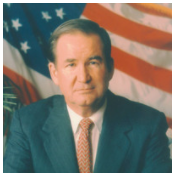
The Best of Patrick J. Buchanan Patrick J. Buchanan is co-founder and editor of The American Conservative. He is also the author of Where the Right Went Wrong, and Churchill, Hitler, and the Unnecessary War. His latest book is Nixon’s White House Wars: The Battles That Made and Broke a President and Divided America Forever See his website.
Be seeing you
Posted in Uncategorized | Tagged: Abraham Lincoln, Confederates, cultural-Marxist, Dwight Eisenhower, Robert E. Lee | Leave a Comment »

