When I was a teen who knew nothin’ about nothin’ I remember watching the NBC economics editor (NBC’s expert!) talk about the then current situation. Even I could see he wasn’t telling us anything.
The NBC’s economics editor’s inciteful final analysis was “no one really knows what will happen, but it could get worse before it gets better”.
Media analysts have maintained their well deserved stature.
If you’re like most people, you probably assume that the U.S. Food and Drug Administration is funded by the U.S. government and therefore isn’t catering to private industries.
The agency itself certainly tries to present itself as independent from the industries it regulates but, in reality, legal loopholes have led to the FDA receiving money from, and being captured and corrupted by, private interests.
While the FDA itself does not accept corporate money, it does receive money funneled via a nonprofit foundation, which in turn receives money from other nonprofits funded by private interests. It’s really all a façade because the end result is the same. Those donating the money ultimately end up with the ability to pull strings, when needed.
There is neither a strategic need for—nor any real safeguard against—presidential sole authority over the nuclear arsenal. This reality should push the public towards common-sense reform.
Former Defense Secretary William J. Perry lambasted the policy of presidential sole authority over the nation’s nuclear weapons, saying it was “in complete contrast with the Constitution, which reserved for Congress the right to declare war.”
The issue of nuclear control was back in the news after President Donald Trump’s bout with the coronavirus in early October, during which time he was taken to Walter Reed Medical Center and given a variety of treatments, including an experimental drug cocktail and a steroid with mood-altering side effects.
Despite this, Trumpdid not relinquish control over the nation’s nuclear arsenal throughout the episode. This raised eyebrows in the national security community, where many thought the president should temporarily delegate nuclear authority to the vice president, as other chief executives have done in the past.
“To state the obvious, we should not entrust nuclear launch authority to someone who is not fully lucid,” Ploughshares Fund’s Tom Collina wrote in an op-ed published by the Bulletin of Atomic Scientists. “A nuclear crisis can happen at any time, including at the worst possible time. If such a crisis takes place when a president’s thinking is compromised for any reason, the results could be catastrophic.”
Collina and Perry argued that the reason we still tolerate sole authority anyway has to do with two sweeping myths about the nuclear weapons system.
“The first myth is the reason we have sole authority and can’t possibly get away from it is because we need the president to make a decision about nuclear launch within minutes,” Collina explained on a recent episode of Press the Button. This line of thinking argues that the speed and accuracy of adversary intercontinental ballistic missiles require that U.S. missiles immediately get airborne, otherwise they risk being destroyed in the ground.
But according to Collina, this logic falls apart when you play it out. “Let’s say that there is an alert that hundreds of nuclear weapons are coming in,” he said. “There are two options, that’s it’s a false alarm or it’s real. If it’s a false alarm, the last thing you want to do is launch quickly, because then the United States has just started a nuclear war.”
“If it’s real, our launching quickly will not stop that attack.” But neither will that attack prevent a devastating US counterstrike. In any conceivable scenario, the American fleet of nuclear submarines would still be at large, ready to launch a massive retaliatory blow hours or even days later. In other words, we simply would not need the president to make a frantic decision on the spot.
The second myth surrounds a “very persistent misunderstanding that the military brass can step in and stop” a nuclear launch order from an unhinged president. This gets the danger fundamentally wrong, said Perry and Collina. “People tend to think about a president in the middle of the day, with no international crisis, just deciding to launch the nukes,” the latter explained. “That’s not a very realistic scenario.”
“The scenario we’re most worried about is there is an alert that we’re under attack, so we have a time crunch scenario,” said Collina. “And in that kind of situation it’s very unlikely that, if the president were to decide to launch, the military brass would try and slow that process down.”
It also intrinsically misunderstands the relationship between the military and the president, argued the former defense secretary—even in a non-crisis scenario. “The military stepping in is a highly unlikely scenario,” said Perry. The air force officers tasked with actually launching the intercontinental ballistic missiles would be “very unlikely to challenge [the president’s] order.”
“They understand that the president has access to information that they do not have access to, and that’s why he has the authority instead of them,” he continued. “And so, if they think there’s something wrong with his command, the first thing they think is that ‘this is because the president knows something I don’t know.’”
Taken together, said Perry and Collina, the truth behind these myths reveals that there is neither a strategic need for—nor any real safeguard against—presidential sole authority over the nuclear arsenal. This reality should push the public towards common-sense reform.
“We have to ask ourselves, at what point does a president’s inability to think clearly affect his ability to have nuclear authority?” Collina asked. “And more broadly, should the president have that authority at all?”
“Why did we trust, in this case, the future of the world to one person with COVID on heavy medication? Does that make sense?”
Zack Brown is a policy associate at Ploughshares Fund, a global security foundation.
If you are truly on an honest journey to find the right path for your own personal behavior, then rigorously applying the NAP (Non-Aggression Principle) to all facets of your life leads you to shedding the precepts of the necessity of the coercive state to shape and hold society together.
There’s an old joke that runs through hard core libertarian circles that goes something like this.
An overly earnest newbie at a Libertarian Party meeting one night during a lull in a heated discussion of comma placement in a new rule change proposal asks, “What’s the difference between an anarchist and a minarchist?”
The grizzled party chair looks up from his copy of Rothbard’s The Ethics of Liberty and replies, “About two years.”
And I can tell you that that joke, like all good jokes has a nugget of deep truth in it. Embracing Minarchism is the toe-dip into the Non-Aggression Principle (NAP). It’s your first tentative step into the scarier world of imagining it without a state.
And it’s a position that’s comforting. But it is also rife with contradictions. Those contradictions weigh on a person who is trying to live up to the ideal of the NAP.
If you are truly on an honest journey to find the right path for your own personal behavior, then rigorously applying the NAP to all facets of your life leads you to shedding the precepts of the necessity of the coercive state to shape and hold society together.
Anarchy in the You ‘Kay?
Because you begin to see the break points, the fault lines of our society in NAP terms. For me, I quickly no longer gave credence to the idea that in order for my individual rights to express themselves I have to submit to a human authority with a granted monopoly power on the use of aggressive force, which the NAP itself stands in opposition to.
At the core of all collectivist thinking is this basic tautology that your rights stem from the negotiation of what others define them as. Only by submitting to a higher human authority over you can you have a hope of retaining any of them, so you need to negotiate them down from the ideal.
Sound complicated? That’s because it is and it’s also insane.
A far simpler interpretation is to state I have a right to life. I have a claim of ownership of myself. Any abrogation of that claim of ownership and right to it by an aggressor is wrong.
Clear, concise, powerful.
Once you come to that conclusion and are willing to apply it consistently then you can become comfortable with freeing your mind of the need for the state.
But it also comes with responsibility. How do you defend those rights? Will you defend every assault on them no matter how minor?
But here’s better questions, ones Marxist will always throw at you to trip you up…
If you don’t defend yourself against a minor theft, say a pen or a coffee mug, was your right to property taken from you? Do you still have it in practical terms if you can’t defend against a murderer?
The answers are, in order, No and Yes. Just because the property was taken or the threat made, you always reserve the right to express the right to defend it.
That you choose not to is… wait for it…
… also your right.
“If you choose not to decide, you still have made a choice.”
Neil Peart – Free Will
That leads to basic economic questions like: Should you always do so? When is forgiveness or acceptance better than retribution?
Is it worth my precious time to chase down a guy who sold me a fake watch rather than chalk it up to experience and go about my other business?
These are basic questions that form the filter on which to view the world around you and are the basic seeds of the growth from being mired in the inconsistencies of Minarchism and blossoming into the flower of Anarchism.
The Right Stuff
It leads you to conclusions about how to find ways to minimize, not eliminate, coercive forces on your life. That we live in a world circumscribed by tyrants constantly climbing over each other for the power to tyrannize is irrelevant. They may in real terms suppress the expression of your right to life but it most certainly doesn’t negate it.
You can always choose to say, “No.”
Notice to this point I haven’t spent one word talking about implementation or politics. Because implementing these ideas isn’t a system to be imposed. That, itself, is a violation of the NAP, the idea of imposing Anarchy is a Collectivist perversion of the process.
We’re seeing this in the hyper-violent rioting of Antifa and BLM wanting to impose their new system that they call anarchy at the point of a gun and an open-ended wrench.
Anarcho-Capitalism isn’t a political system, it is a behavioral model and a filter with which to view the world. It is a philosophy whose name implies an internal vision of the world we want rather than the world we have.
And that filter is an incredibly powerful tool to analyze the world — especially economics and politics as both lie at the intersection of behavioral dissonances within a given population.
It is also a personal goal most people share — the best versions of ourselves possible. Where the differences lie along the political landscape is the extent to which taking on the responsibility of fixing problems which are not ours leads to violence, i.e. the State and before that revolution.
And that leads to the next two-year process, the one of realizing that there is no Utopia where sin is expunged, theft conquered and sociopathy eliminated.
There is only the minimization of these things because people are capable of tremendous generosity and tremendous violence. All of us. At all times.
Sometimes simultaneously.
And the real struggle is coming to terms with that fear. Fear drives Communists to overreach and hubris. AnCaps are driven by the acceptance of their limitations.
Only a culture which reinforces this idea of personal responsibility for one’s actions rather than glorifying thieves as winners will put us back on the right path rather than the wrong one.
Given where we are right now, that’s going to take a heckuva lot more than two years.
Louie did not offer specific prescriptions for Erie’s economic recovery except the need for stimulus. House Democrats first put forward their proposals for the next round of COVID-19 stimulus funding long months ago. So it is galling that the wrangling — with Senate Republicans and the White House divided on the scale and focus of the funding — continues.
The pandemic has plunged another 8 million Americans into poverty.
Not one word about ending lockdowns, getting people back to work, re-opening businesses.
“Free” money. That is the best the Behrend Economic Research Institute and Gannett Times…err…Erie Times-News have to offer.
The issue: Erie economic downturn Our view: Stimulus overdue
President Donald Trump promised exuberant crowds at Erie International Airport Tuesday night the ‘greatest economic year’ in history. It is happening right now, he said.
Perhaps he should have stayed longer in Erie rather than cut the visit — which he said he made only to ask for votes — short. Trump boasted that historic unemployment rates at the outset of the pandemic had dropped to 7.8%. But in Erie, as reporter Jim Martin detailed, the pace of recovery lags. In August the seasonally adjusted unemployment rate was 11.2%, far above the then-national rate of 8.4%. Wabtec Corp. announced new layoffs just before Trump’s visit.
Not all of the data is in to complete the Erie Leading Index, but Penn State Behrend Professor Ken Louie said it appears for the first time in a decade that Erie’s economy is moving from expansion to decline. The Penn State Behrend Economic Research Institute of Erie tracks eight indicators to detect changes in the local economy.
The trend is not surprising given the wrecking ball the pandemic took to the global economy. But the time to take command of this carnage, confront the virus comprehensively and steer the country to recovery is past due.
Louie did not offer specific prescriptions for Erie’s economic recovery except the need for stimulus. House Democrats first put forward their proposals for the next round of COVID-19 stimulus funding long months ago. So it is galling that the wrangling — with Senate Republicans and the White House divided on the scale and focus of the funding — continues.
The pandemic has plunged another 8 million Americans into poverty.
People face hunger and eviction and local and state governments risk insolvency and the prospect of layoffs and suspended services. Entities key to the recovery, from small businesses to the airlines, teeter on ruin.
As Louie said, ‘It isn’t as easy as it sounds to turn things around.’
Stimulus funds must be used to track and mitigate the virus and shore up those workers and industries who have paid a toll to keep Americans safe. States and local governments that face crippling tax revenue shortfalls need help now. As the Philadelphia Inquirer reported, Pennsylvania confronts a $4.5 billion deficit.
The president and Congress must act with Americans, not the upper hand, in mind.
It appeared Wednesday that the White House and House Speaker Nancy Pelosi were nearing agreement, while Senate Majority Leader Mitch McConnell tried and failed to pass a package less than half the size of the $2.2 trillion and $1.9 trillion packages eyed by Pelosi and the White House, respectively.
It is welcome to see the president join with Democrats to seek a package that matches the scale of the need.
Delivering relief to the American people is a winning strategy for both sides.
Surely, this all strikes the prolockdown policymakers as rather exhausting. It would be far easier if it were unnecessary to address the fact that jurisdictions like Sweden and Georgia have failed to produce the bloodbaths that were promised.
This could all be solved by imposing a single, uniform global policy an every regime, as directed by global technocrats. This “solution” is apparently already in the works.
In an article last week for the Financial Times, Richard Milne examined the issue of Sweden’s “dissent” when it came to policy responses to the spread of covid-19. The article is essentially a hit piece on Sweden, containing all the usual strategies of portraying the Scandinavian nation as an irresponsible outlier.
Sweden, of course, famously refrained from imposing lockdowns on its population, while relying on targeted isolation for vulnerable populations.
The fact Sweden refused to go along with other states, which, as Milne put it, “as country after country imposed lockdown restrictions on their populations rarely seen outside wartime” apparently dismayed the global media and politicians from other countries who demanded global lockdowns.
The result was a nearly endless stream of media stories about how Sweden’s response to covid-19 was disastrous. These comparisons, of course, conveniently omitted the fact that Sweden experienced better outcomes than numerous countries that imposed draconian lockdowns, including Belgium, the UK, Spain, and Italy. Moreover, as cases and hospitalizations are growing again in these prolockdown nations, Sweden has yet to show any resurgence as of October 2020.
Even more frustrating for the global pushers of lockdowns is the fact that the Swedish policy is “enjoying strong support” and “most of the criticism still comes from outside the country.”
It is quite likely that the leaders of large states and international organizations aren’t terribly fond of this sort of independence still enjoyed by nation-states in these matters.
The relentless drive to discredit the Swedish response is one indicator, and another is the growing chorus of calls for stronger “global governance” in matters of infectious disease.
Politicians, think tanks, and left-wing publications are all pushing for strong international institutions to “coordinate” responses to pandemics. But this then raises a question: Just how much coordination should there be, and how much of the sovereignty of individual states must be destroyed in the process?
These questions ought to highlight the dangers of global political centralization, and this has been illustrated by the global media’s focus on attacking Sweden for its “noncompliance” in the global drive for lockdowns. If one medium-sized country’s refusal to go along with the global “expert” will arouse this sort of vicious counterattack, it stands to reason that any reasonably powerful global institution with powers to impose health policy would happily crush any state that sought to go its own way.
After all, just consider how much easier it would be for global health bureaucrats to manufacture a narrative favorable to their own version of events if Sweden hadn’t done what it did. Without the example of Sweden, it would be far easier for politicians to claim that the death toll in the absence of coerced lockdowns would be double, triple, or even ten times larger than the death tolls experienced in countries with harsh lockdowns.
“Yes, Spain has experienced a terrible death toll in spite of our strict lockdowns,” the pundits might say. “But things would have been five times worse without the lockdowns!” Without Sweden, there would have been no national-level counterexample to point to.
Any situation that contradicted the asserted “you get either a harsh lockdown or an incalculable bloodbath” story would be largely hypothetical. But things didn’t turn out that way. Because of this, we must expect the calls for ever-greater global “coordination” and “governance” to increase. While few of these efforts will ever explicitly call for actual “global government,” the ultimate destination will be—as has been the case with the EU—a global bureaucracy that can demand compliance and implementation of mandates handed down by the governing bodies of these new and strengthened global organizations.
Calls for More Global Governance
From the very beginning of the announced pandemic earlier this year, there have been calls for greater international “coordination.” In May, former British prime minister Tony Blair called for member countries to give the World Health Organization “much greater heft and weight.” In June, current British prime minister Boris Johnson called for the creation of a NATO-like organization that could produce “a radical scaling up” of global responses to disease. Ex-prime minister Gordon Brown has also expressed similar views.
Many global NGOs, of course, have expressed similar sentiments. The Center for Global Development (CGD), for example, concluded in April:
we need strong multilateral institutions and stronger global governance. As the President of Ethiopia put it in his letter to the G20: “These challenges cannot be adequately addressed (…) by one country; they require a globally coordinated response. Just as the virus knows no border, our responses also should not know borders.” (emphasis in original)
While this all sounds very voluntary and collaborative on every level, the far-left Jacobin has noted that these plans all remain rather toothless unless these organizations are given coercive powers. In a July article explicitly pushing for a global democratic government, Leigh Phillips writes:
Some of this agenda could be achieved straightforwardly enough through interstate treaties rather than a new global executive. However, much of it would require real governmental authority for the new body, not least the ability to compel national governments to obey its directives, even if Blair — always the savvier public relations operator of the Brown-Blair duo — makes no explicit mention of the term “world government.”…
The world is already “governed” by some 1,000 treaties and agencies that involve varying levels of finance and enforcement. For these centrists, moving toward a world government would not be a revolution so much as the next logical step, accelerated by the pandemic and the accompanying economic downturn.
Eliminating Local Control
Pandemics, of course, provide the perfect rationale for demanding an end to sovereignty at the level of nation-states. If the refrain is “the virus knows no border,” then it naturally follows that countries unwilling to adopt the “correct” antipandemic policies must be forced to comply. After all, any independence in this matter could be construed as one nation endangering all its neighbors.
Thus, in the new schema, an “uncooperative” country like Sweden would essentially forfeit its sovereignty by not adopting “recommendations” handed down by global health experts. The fact that Sweden’s policy has been pushed by a democratically elected government to a generally approving electorate would be immaterial. All that would matter would be the mandates handed down by a distant global bureaucracy.
Naturally, an international organization with powers like these would also eliminate subnational independence within the nation-states themselves.
In the United States, for example, seven states never locked down at all: Utah, Wyoming, North Dakota, South Dakota, Nebraska, Iowa, and Arkansas. All of these states have experienced covid-19 deaths per million at rates well below those of states that enacted harsh lockdowns—especially New York and New Jersey. Deaths also remain far lower by this measure in many states that enacted either short or weak lockdowns, including Texas, Georgia, and Florida.
Moreover, like Sweden, these jurisdictions continue to provide counterexamples to the “lockdown or die” claims coming from states that did impose draconian lockdowns. For example, when Georgia was among the first states to end its lockdown—long before most states in the northeastern United States— the The Atlantic declared it an “ experiment in human sacrifice.” Clearly, several months later, this prediction continues to be wildly incorrect. In Georgia, covid-19 deaths per million are still less than half of what they are in New York. And hospitalizations continue to decline. But even if total deaths do double and the rate is eventually similar to that in New York, we’re still left with the question: Why bother locking down at all if the outcome is the same?
Naturally, this outcome would be embarrassing for advocates of lockdowns, so this sort of local sovereignty and independence would need to be eliminated by the global protectors of “public health.”
Were there a global, uniform lockdown policy, of course, prolockdown reporters and politicians would have to worry about being contradicted by “renegade” jurisdictions. Lockdowns would only be allowed to end in ways that suited the agendas of policymakers at the WHO, or whatever far-off governments were making policy for every state, town, region, and nation worldwide.
Inventing New Explanations
The usual narrative having failed in the case of Sweden, prolockdown critics have attempted other explanations. One is that population density is lower in Sweden, so therefore, it will have lower deaths per million. But new research suggests the data is, at best, inconclusive on that matter. While density is likely a factor of some kind, there’s no evidence it is a factor to the extent that would be necessary to explain why Sweden has performed better than the UK and Spain, for instance.
Another theory is that the Swedes have voluntarily practiced social distancing so studiously that this explains away the apparent failure of the “forced lockdown or die” narrative.
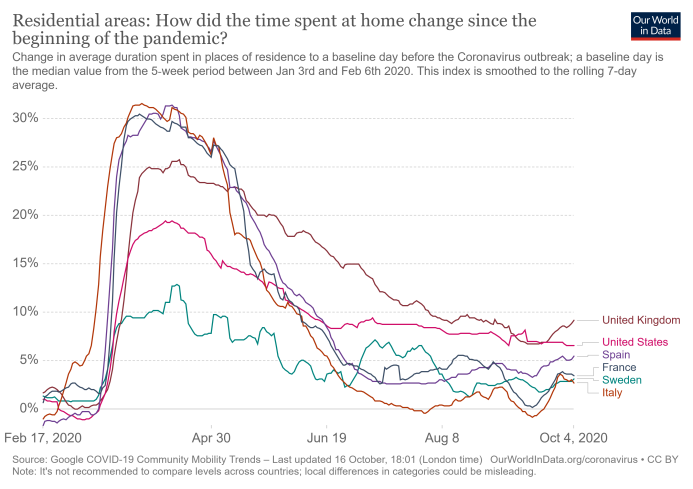
In fact, the Google Community Mobility Trends data suggests that Sweden socially distanced less than many European countries that imposed harsh lockdowns, yet had more deaths per capita than Sweden. In other words, the usual explanations proffered by lockdown enthusiasts fail to explain the reality.
Surely, this all strikes the prolockdown policymakers as rather exhausting. It would be far easier if it were unnecessary to address the fact that jurisdictions like Sweden and Georgia have failed to produce the bloodbaths that were promised.
This could all be solved by imposing a single, uniform global policy an every regime, as directed by global technocrats. This “solution” is apparently already in the works.
LAS VEGAS, NV—Progressives expressed their anger and confusion this weekend as President Donald Trump was seen putting a wad of $20 bills in the offering bucket at International Church of Las Vegas.
In the video, Trump is seen reaching into his pocket and pulling out some money of his own free will. There are no IRS agents nearby making sure he gives his fair share. Nobody even has a gun to his head. Then, entirely of his own volition, he puts the money in the bucket.
Most liberals just didn’t know what to make of the bizarre occurrence.
“He’s giving money, and there isn’t even a law that says he has to!” screamed one woman on TikTok into her iPhone as she drove around Portland. “WAKE UP AMERICA! AHHHHHHHHHHHHHHHHHHHH!!!” She then drove into a pond.
Liberals were similarly confused by people not wearing masks or social distancing, thereby taking responsibility for their own health and well-being after assessing risks and coming to a conclusion regarding whether or not they should go to a large religious gathering.
The father of Kamala Harris is Donald Harris, an immigrant from Jamaica, who taught economics at Stanford University.
He received a Bachelor of Arts degree from London University in 1960. Six years later he received a Doctor of Philosophy degree from the University of California- Berkeley. He retired from Stanford as a professor emeritus of economics in 1998.
He joined the Stanford faculty in 1972 and his focus according to the University was “exploring the analytical conception of the process of capital accumulation and its implications for a theory of growth of the economy, with the aim of providing thereby an explanation of the intrinsic character of growth as a process of uneven development.”
In other words, there is nothing to indicate in his Stanford profile that he is a Marxist. The words Marx, Marxist, Marxism are nowhere to be found on his profile.
Indeed, when I first looked at his profile when Kamala was in the primaries, I passed him off as an unimpressive affirmative action hire.
He was a special hire all right but the fact that he is Jamaican was a bonus, there is no question he was viewed as an “alternative economist” Marxist hire.
This was the headline from The Stanford Daily when Harris was offered his post.:
The newspaper clip reads:
Marxist Offered Economics Post By KEN MCLAUGHLIN
Don Harris, a prominent Marxist Professor, has been offered a full professorship in the Economics Department here, Department Chairman James Rosse confirmed yesterday. Rosse said Harris has not yet accepted the offer, but he “expects to hear from him this week.”
Harris who still holds a tenured position at the University of Wisconsin, has served as a visiting Professor here, and is currently teaching at the University of the West Indies in Kingston, Jamaica.
The appointment is the direct result of student pressure in recent years to hire more faculty who favor an “alternative approach” to economics, said Economics Prof. John Gurley, who now teaches the only undergraduate course in Marxist economics.
Gurley said the appointment of Harris was the culmination of the six-month “round-the-world” search for the most qualified Marxist professor available
Exceptionally good
Gurley called Harris “an exceptionally good teacher, outstanding researcher and one of the leading young people in Marxist economics.”
One knowledgeable source told the Daily that some senior faculty members were very hesitant hiring Harris, but they gradually yielded tp student pressure.
A conservative economics faculty member, who wished to remain anonymous said he was “not part of the decision and it would not be fair to say anything. “
He also added that “as far as I’m concerned Harris is not in the same field I’m in.”
Alternatives
The department, Gurley said, looked for economists who espoused not only Marxists viewpoints, but other alternative perspectives as well.
Libertarian economists, who advocated untrammeled laissez-faire capitalism,for exa
mple, were considered in the selection, he claimed
Gurley said the search included those knowledgeable about socialist economies even if they didn’t sympathize with a Marxist system.
At Stanford, Harris was one of the key faculty members behind a then-new program, “Alternative Approaches to Economic Analysis” as a field of graduate study at Stanford University.
Marx was the theorist of economic growth par excellence. He concieved of the capitalist economy as an inherently expansionary system having an inner logic of its own. It was his purpose to discover the abstract and general principles underlying the operation of this form of society and the contradictions it entailed, so as to account for its process of change and supersession. Out of this scientific endeavor, Marx developed an integrated system of analysis with a distinctive method and quite specific formulation of the laws of motion of the capitalist economy. Others, after Marx, have attempted to elaborate upon and develop further this system of analysis, recognizing the changing conditions of capitalism as it develops. Specific elements of Marx’s own formulation as concerns, for instance, the law of the falling tendency of the rate of profit and a tendency of the organic composition of capital to rise, are subject to an ongoing debate within the Marxian tradition. The system of analysis is also incomplete in some of its essentials. Nevertheless, the Marxian system remains today as a powerful basis upon which to construct a theory of growth of the capitalist economy appropriate to modern conditions. Accordingly, an attempt is made below (see Chapters 3 and 10) to develop some elements of the Marxian theoretical system that are relevant to this purpose.
And that is how the daddy of Kamala rolls.
Kamala received a Bachelor’s degree from Howard University where she double-majored in political science and (ahem) economics and chaired Howard’s economics society.
Charismatic politicians, like criminal psychopaths, exhibit a failure to accept responsibility for their actions, have a high sense of self-worth, are chronically unstable, have socially deviant lifestyles, need constant stimulation, have parasitic lifestyles and possess unrealistic goals.
“Politicians are more likely than people in the general population to be sociopaths. I think you would find no expert in the field of sociopathy/psychopathy/antisocial personality disorder who would dispute this… That a small minority of human beings literally have no conscience was and is a bitter pill for our society to swallow — but it does explain a great many things, shamelessly deceitful political behavior being one.”—Dr. Martha Stout, clinical psychologist and former instructor at Harvard Medical School
There is no difference between psychopaths and politicians.
Nor is there much of a difference between the havoc wreaked on innocent lives by uncaring, unfeeling, selfish, irresponsible, parasitic criminals and elected officials who lie to their constituents, trade political favors for campaign contributions, turn a blind eye to the wishes of the electorate, cheat taxpayers out of hard-earned dollars, favor the corporate elite, entrench the military industrial complex, and spare little thought for the impact their thoughtless actions and hastily passed legislation might have on defenseless citizens.
Charismatic politicians, like criminal psychopaths, exhibit a failure to accept responsibility for their actions, have a high sense of self-worth, are chronically unstable, have socially deviant lifestyles, need constant stimulation, have parasitic lifestyles and possess unrealistic goals.
It doesn’t matter whether you’re talking about Democrats or Republicans.
Political psychopaths are all largely cut from the same pathological cloth, brimming with seemingly easy charm and boasting calculating minds. Such leaders eventually create pathocracies: totalitarian societies bent on power, control, and destruction of both freedom in general and those who exercise their freedoms.
Once psychopaths gain power, the result is usually some form of totalitarian government or a pathocracy. “At that point, the government operates against the interests of its own people except for favoring certain groups,” author James G. Long notes. “We are currently witnessing deliberate polarizations of American citizens, illegal actions, and massive and needless acquisition of debt. This is typical of psychopathic systems, and very similar things happened in the Soviet Union as it overextended and collapsed.”
In other words, electing a psychopath to public office is tantamount to national hara-kiri, the ritualized act of self-annihilation, self-destruction and suicide. It signals the demise of democratic government and lays the groundwork for a totalitarian regime that is legalistic, militaristic, inflexible, intolerant and inhuman.