MCViewPoint

Opinion from a Libertarian ViewPoint

Archive for the ‘Uncategorized’ Category

SCIENCE FRAUD: Florida Gov. DeSantis calls for investigation into why people are testing “positive” for coronavirus tests they never received – NaturalNews.com

Posted by M. C. on July 25, 2020

https://www.naturalnews.com/2020-07-24-desantis-investigation-people-testing-positive-coronavirus-never-tested.html

(Natural News) After learning that waves of people who were never even tested for the Wuhan coronavirus (COVID-19) received mysterious “positive” results, Florida Gov. Ron DeSantis, a Republican, decided to call for an investigation into the matter to get to the bottom of it.

According to reports, Gov. DeSantis has asked the state’s Department of Health to look into the situation further. He announced that it makes no sense whatsoever that people who were never even evaluated by a practitioner are now receiving anomalous positive test results that are being used by some to push for more lockdowns and mask-wearing.

“For that to come back positive, when there was no specimen submitted, is problematic,” DeSantis is quoted as saying. “So I’ve heard it enough to be concerned about it.”

As we recently reported, many of Florida’s testing laboratories have been submitting boatloads of false positives to the official government databases, which has majorly skewed the state’s infection statistics.

Now it appears as though people who were never even tested are being told, possibly at random, that they have the coronavirus, which further skews the official statistics and makes it seem as though “spikes” of infection are occurring when they are actually not.

“I asked the Department of Health to look at that because I heard it, too,” DeSantis added about these strange anomalies. “If you can give us, if people that have told you that are willing to provide their name, we’re interested in investigating this because it’s ridiculous.”

The official coronavirus narrative is collapsing like a house of cards

Local Florida news affiliate FOX 35 News has confirmed that many people are reporting similar occurrences in their families. People all across the Sunshine State say that they are “testing positive” for the Wuhan coronavirus (COVID-19) when they never even got tested, and now they are demanding answers.

“How does someone test positive for coronavirus if they have never been tested?” the news outlet asks. “Reports of this happening have been pouring in to FOX 35 News since we began investigating COVID-19 data.”

What appears to be happening in some instances is that people show up to get tested, fill out a form, but leave before ever getting tested because the lines are too long. Later on down the road, these same folks receive notifications by email or by phone that they tested positive, even though they never even got tested.

“If you’re somebody that this has happened to, you’re going to come forward and give us the details, because I think that that needs to be corrected,” says Gov. DeSantis.

As of this writing, Florida supposedly has some 369,834 positive cases of the coronavirus, though this number is now being called into question by these new revelations. How many people truly have the virus when some labs are reporting 100 percent positive test results, for instance, or when people who were never tested are being told that they tested positive?

The world may never know the full answer to this question, though hopefully, DeSantis’ investigation will uncover why this is all happening, and what the motive is behind it.

“We’ve seen suppressed negatives, egregious double-counting, fake positives, and conflation of dying WITH COVID as opposed to dying OF COVID,” wrote one Breitbart News commenter, highlighting the many sham elements associated with the plandemic. “Then to top it off, tortured interpretations of the data, tainted as it is, to maximize, ‘Get Trump!’”

“Lies, damned lies and statistics. Brought to you by (wait for it …) the ‘experts,’” this same commenter added.

More of the latest on the coronavirus plandemic is available at Pandemic.news.

Sources for this article include:

Breitbart.com

NaturalNews.com

Be seeing you


Posted in Uncategorized | Tagged: , , , , , , , , , , , , , , , , , | 1 Comment »

Jobless Thursday – LewRockwell

Posted by M. C. on July 25, 2020

That’s right. They are not really even hiding the data, but the business press has been house-trained for so long to report only good news and positive deltas that not one in a thousand reporters has ever even seen Wolf Richter’s charts (which he has been publishing weekly since May) because they obviously repudiate the V-shaped recovery narrative.

So when you look at the total (and correct) unemployment picture, you see that the labor market has been treading water for nine weeks.

https://www.lewrockwell.com/2020/07/david-stockman/jobless-thursday/

By

David Stockman’s Contra Corner

Maybe it is time to don our tinfoil hat. Here’s the flat-out lie the WSJ reported this morning in response to the weekly unemployment claims release. It sure did make you think that the jobs picture is improving by the week:

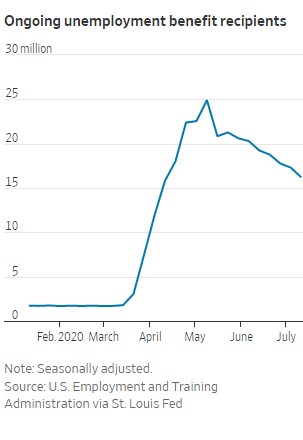
The number of people receiving benefits through regular state programs, which cover the majority of workers, decreased by 1.1 million to 16.2 million for the week ended July 11. The decline extends the recent trend, with the number receiving benefits the lowest reading since the week ended April 11.

Just to make sure you grasped the good news, the WSJ added this chart for good measure:

Actually, there was no improvement at all this week!

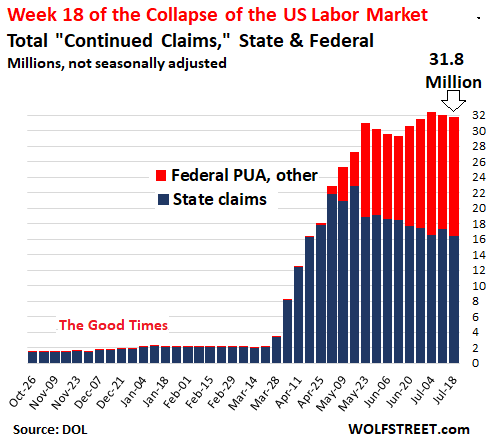
And what remains is the greatest labor market disaster in history. As Wolf Richter observed in his excellent post on the heels of the DOL (Department of Labor) report:

If you read this morning or heard on the radio that 16.2 million people were claiming unemployment insurance – the “continued claims” – and you thought that there were only 16.2 million people who claimed unemployment benefits, you fell victim to lazy misreporting in the media, by reporters or bots that didn’t read the Labor Department’s press release beyond the second paragraph.

Not even close, of course. The true number is 31.8 million, just a tad below the peak two weeks ago, and implying that fully 20% of the US labor force is unemployed.

It’s all in the report, but apparently the Wall Street Journal reporter – we are speaking to you Eric Morath – was either too lazy to read below the second paragraph, or too dimwitted to see that even as the blue bars (state UI beneficiaries) have been falling slightly per the WSJ’s misleading chart above, the red bars (the Federal PUA and PEUC beneficiaries) have been rising rapidly and are still at record levels.

So when you look at the total (and correct) unemployment picture, you see that the labor market has been treading water for nine weeks.

Moreover, when you cross-check these DOL data with its June report on the total civilian labor force, you get an answer that the stock market cheerleaders who claim to be the business press wouldn’t approach by a country mile. To wit, the civilian labor force as of June was 159.9 million and the number of workers currently at home collecting the dole is 31.8 million.

Whether by the old math or the new, that computes to an unemployment rate of 19.9% and it’s a figure that has not been seen since the dark days of the 1930s.

It’s hard to believe, of course, that reporters are this lazy, but you can’t gainsay the obvious. As Wolf Richter further noted,

The issue is that the claims under federal programs are new, established by the CARES Act, and the Labor Department just inserts them further down in the press release, and then it provides a total of state and federal claims further down – the 31.8 million – instead of putting the total in the first line of the first paragraph so that even lazy reporters or lazily programmed bots, who’ve for years reported only the first two paragraphs, can see it.

That’s right. They are not really even hiding the data, but the business press has been house-trained for so long to report only good news and positive deltas that not one in a thousand reporters has ever even seen Wolf Richter’s charts (which he has been publishing weekly since May) because they obviously repudiate the V-shaped recovery narrative.

For want of doubt, however, here is Wolf Richter’s explanation of what’s in the red portion of the bars above. It both underscores the absolute disaster caused by Dr. Fauci’s Lockdown Nation and also explains why Washington politicians are now sweating bullets as they argue over re-upping Everything Bailout 4.0.

Self-evidently, without the $75 billion per month that Uncle Sam is firehosing into the smoldering ruins of the labor market via these special Federal UI programs, there would already be riots in the streets that would make the recent Minneapolis altercations looks like small potatoes:

Unemployment insurance under federal programs.

Pandemic Unemployment Assistance (PUA): 13.18 million continued claims. PUA covers contract workers, the self-employed, and others – the “gig workers”: During the week, 974,999 new claims were added by 48 states.

This means initial claims under state and federal programs combined this week totaled 2.35 million (1.37 million initial state claims plus 974,999 initial PUA claims), a huge number of people newly out of work!

The total number of people claiming benefits under the PUA program declined to 13.18 million, from 14.28 million last week, as more workers that had been receiving PUA benefits were dropped from the rolls, likely because they’d started working again.

Pandemic Emergency Unemployment Compensation (PEUC): 940,113 continued claims, about flat with the prior week. PEUC covers people who don’t qualify for other programs.

These continued claims under the PUA and PEUC programs, plus workers under programs for federal employees and newly discharged veterans, plus workers covered by all remaining programs are represented by the red columns in the first chart above.

So the most generous thing you can say without going full-retard tin foil hat is that the DOL is employing misdirection in order that some impertinent member of the financial press doesn’t shout out loud the obvious. Namely, how do you square the above flat-lined total UI claims of more than 30 million per week since mid-May, with the monthly unemployment data showing a 5.3 million reduction of unemployed workers between April and June.

Better still, if there were really only 17.75 million unemployed workers in all of the USA as of June, who, pray tell, are the additional 14 million Americans that are drawing unemployment checks week after week?

Total US Unemployed Workers Per BLS Monthly Report Read the rest of this entry »

Posted in Uncategorized | Tagged: , , , | Leave a Comment »

Erie Times E-Edition Article – Pa. positive virus cases above 1,000 again

Posted by M. C. on July 25, 2020

Erie Times-News dutifully regurgitates this every day. Yet as the ET-N knows to ask but never does:

Yes the data is released in a day but what does the data represent? One day last week or a whole months data taken 2 months ago. As the ET-N itself has reported there are issues with knowing when tests were submitted.

As I have told the ET-N, the Erie County Health Department told me they don’t know whether they ever received contaminated CDC COVID test kits. No one else is asking, no one is telling, no one cares.

Quality Assurance seems unimportant.

The positives include anyone exposed to an infected person but not actually tested positive. Do they include positive antibody tests as well?

All we get is a number.

Florida and Texas are having data reliability issues regarding incredibly high positive rate reports, people dying for non-disease reasons, car and motorcycle accidents, and those never having having taken a test getting positive result notices.

Is PA’s QA any better?

It will be years, if ever, before we get the truth.

COVID Ca$h

https://erietimes-pa-app.newsmemory.com/?publink=0542278f0

From wire reports

HARRISBURG — Pennsylvania produced another day of more than 1,000 new confirmed coronavirus cases Friday, fueled by positive tests in Philadelphia and the Pittsburgh area as the state fights to tamp down rising case counts.

The Department of Health reported 1,213 additional confirmed virus cases — the most in a single-day report since May — and 22 new deaths. The virus has infected more than 105,000 people in Pennsylvania since the beginning of the pandemic. More than 7,100 have died, most of them in nursing homes.

Of the new positive cases, more than one-third are from Philadelphia and Allegheny County, the department said.

In July, Pennsylvania’s 14-day rate of new cases per 100,000 residents has increased by more than 50%, from below 60 to above 90.

The seven-day positivity rate — based on the Health Department’s daily public disclosures of the number of people who are newly confirmed to be positive and the number of people who tested negative — has gradually increased in July, from about 4.5% to 5.8%.

Deaths have declined from June to July, although hospitalizations are on the rise in July, according to state data.

Also Friday: Quarantine list: Pennsylvania officials have added two new states to a travel advisory that asks anyone coming from one of 20 potential coronavirus hotspots to self-quarantine for 14 days.

Missouri and Wyoming were added to an updated rundown that was released on Friday, July 24. The self-quarantine is not enforceable, and police are not stopping any out-ofstate travelers at borders. Airport questionnaires are not required, either.

“That’s up to each individual to, if you’ve gone to a state that we identify as a state that is of concern, and we keep changing that every week, then, you owe it to yourself, to your family, to your loved ones, to your co-workers, to self-quarantine,” Gov. Tom Wolf said during a news conference on Friday.

“It’s very fluid,” Wolf said.

“It’s really something that we’re doing to try to bring information to folks so that they can make informed decisions on their own. If they don’t care about their family or their co workers; I think a majority of people aren’t there.”

Here is the full list of states from the health department: Alabama, Arizona, Arkansas, California, Florida, Georgia, Idaho, Iowa, Kansas, Louisiana, Mississippi, Missouri, Nevada, North Carolina, Oklahoma, South Carolina, Tennessee, Texas, Utah and Wyoming.

Show moves: The Pennsylvania National Horse Show will be will be held at the Bob Thomas Equestrian Center in Tampa, Florida. The move stems from the coronavirus pandemic, which has caused the closure of the PA Farm Show Complex & Expo Center, where the event has been held since its founding in 1946.

Be seeing you

Posted in Uncategorized | Tagged: , , | 1 Comment »

Americans Are Buying Guns in Record Numbers. The Washington Post Isn’t Pleased. | Mises Wire

Posted by M. C. on July 24, 2020

Note the careful use of language here, though: the gun purchases are “associated” with an increase in gun violence, since causality cannot be established. Indeed, near the bottom of the Post article, the author admits:

The authors [of the Brookings and UC reports] caution that a study of this nature cannot prove causality, particularly at a time of massive social upheaval in a country dealing with an unprecedented public health crisis as well as a nationwide protest movement.

Of course, if one is already committed to the idea that guns cause crime, it makes perfect sense that millions of Americans in early 2020—after passing a criminal background check—will buy guns, and then almost immediately use those guns to commit crimes.

https://mises.org/wire/americans-are-buying-guns-record-numbers-washington-post-isnt-pleased

Social scientists have been trying for many years to blame homicides on the presence of guns. A favorite tool in this quest is the use of studies that show a correlation between gun ownership and crime. These studies are then reported as “evidence” that the presence of guns causes crime.

But there’s always been a problem with this attempt at showing causality between guns and homicides: causality can just as plausibly go the other way. That is, in times and places where the local population feels they are in danger of being crime victims, people are more likely to purchase guns for protection. So, rather than saying “guns cause crime,” we should be saying “crime causes guns.”

New Gun Purchases Soar as Uncertainty and Violence Increase

We’re likely seeing this phenomenon at work now.

In recent months, according to the firearm industry’s trade group National Shooting Sports Foundation (NSSF), Americans have purchased millions of guns:

The early part of 2020 has been unlike any other year for firearm purchases—particularly by first-time buyers—as new NSSF® research reveals millions of people chose to purchase their first gun during the COVID-19 pandemic.

Fox News reports:

Gun sales have skyrocketed during the past three months, and a record-breaking 80.2 percent increase in sales was reported in May compared to last year, according to the shooting foundation. April’s data showed a 71.3 percent increase from 2019, and there was an 85.3 percent increase in March, according to information previously released by Small Arms Analytics and Forecasting.

Many new gun owners during this period feared general unrest as a result of the government-mandated lockdowns. Potential first-time buyers still on the fence about buying a firearm in May were perhaps confirmed in their fears by the riots that erupted after the killing of George Floyd by Minneapolis police officers. Then, in the wake of the riots, serious violent crime appeared to spike. It was widely reported, for instance, that homicides in New York City spiked “21 percent in first six months of 2020.” Crime in other cities increased as well, ranging from a jump of over 200 percent in Nashville to 23 percent in Kansas City, Missouri.

Naturally, seeing these news stories, many potential gun owners are more likely to conclude that they need a gun for personal protection. This is especially true when combined with a perception that police organizations cannot be relied upon to engage in crime prevention and enforcement. And this has indeed been the perception in many places where police have appeared unwilling to intervene in June’s riots.

Many normal people would see these events as an illustration of how gun purchases result from fears over crime and uncertainty.

But now, perhaps predictably, left-wing media organizations like the Washington Post are trying to turn this narrative around: people aren’t buying guns as a reaction to violence and social disarray, the Post insists. All those new gun purchases are what’s causing the violence in the first place.

Says the Post:

Americans purchased millions more guns than usual this spring, spurred in large part by racial animosity stoked by widespread protests over the killing of George Floyd in Minneapolis, as well as anxiety over the effects of the covid-19 pandemic.

That gun-buying binge is associated with a significant increase in gun violence across the United States.

The Post cites two new reports, one from the Brookings Institution and another from the University of California, both of which conclude that the rise in gun purchases has likely caused more “gun violence.”

Note the careful use of language here, though: the gun purchases are “associated” with an increase in gun violence, since causality cannot be established. Indeed, near the bottom of the Post article, the author admits:

The authors [of the Brookings and UC reports] caution that a study of this nature cannot prove causality, particularly at a time of massive social upheaval in a country dealing with an unprecedented public health crisis as well as a nationwide protest movement.

Of course, if one is already committed to the idea that guns cause crime, it makes perfect sense that millions of Americans in early 2020—after passing a criminal background check—will buy guns, and then almost immediately use those guns to commit crimes.

Moreover, it’s unclear that the two studies referenced by the Post article even imply that homicides result from more gun purchases.

The Brookings study, for instance, is more of an op-ed than a study. It’s simply a review of some past events which were followed by surges in gun purchases, including the Sandy Hook and Parkland shootings. This appears to be true indeed, and is a helpful reminder that people do often purchase firearms in light of concerns over personal safety, or at least in light of concerns about future access to firearms.

The UC study is a bit more specific, but even this is far too general to be of any use in concluding that gun purchases lead to violence. Because of data limitations, the UC report, of course, doesn’t establish that the people who bought firearms this year are responsible for any increase in crime that may be occurring. But it’s not even established that surges in gun purchases correlate with surges in crime at the city or neighborhood levels. This is critical, since trends in homicides are not really on a statewide or even metro-wide level. Homicide trends in the US tend to be dominated by homicides in a relatively small number of cities and neighborhoods. For example, the homicide rate in Baltimore is ten times that of the US overall. But this doesn’t mean homicides in Maryland are remarkably high.

So, have firearms purchases surged near the neighborhoods in Chicago, New York, and Kansas City where surges in crime have also occurred? It’s possible, since people bordering the most violent neighborhoods may feel the most at risk. On the other hand, it’s also entirely possible that firearms sales are occurring in places relatively distant from the places with surging homicides. The UC study only appears to give a state-level reading on this. In other words, the study really tells us very little.


Author:

Contact Ryan McMaken

Ryan McMaken (@ryanmcmaken) is a senior editor at the Mises Institute. Send him your article submissions for the Mises Wire and The Austrian, but read article guidelines first. Ryan has degrees in economics and political science from the University of Colorado and was a housing economist for the State of Colorado. He is the author of Commie Cowboys: The Bourgeoisie and the Nation-State in the Western Genre.


Be seeing you

Posted in Uncategorized | Tagged: , , , | Leave a Comment »

Stoicism Can Be Tough

Posted by M. C. on July 24, 2020

Tougher for some than others!


Be seeing you

Posted in Uncategorized | Tagged: , | Leave a Comment »

The Evil, Immoral, Vicious, and Hypocritical Embargo Against Cuba – The Future of Freedom Foundation

Posted by M. C. on July 24, 2020

A dark irony, of course, is that the embargo has enabled the U.S. government to wield and exercise the same type of economic control over the American people that the Cuban socialist regime exercises over the Cuban people. It’s called adopting socialism to oppose socialism.

https://www.fff.org/2020/07/20/the-evil-immoral-vicious-and-hypocritical-embargo-against-cuba/?utm_source=FFF%2BDaily&utm_campaign=ddd8480a92-FFF%2BDaily%2B07-20-2020&utm_medium=email&utm_term=0_1139d80dff-ddd8480a92-317323329

by

The banality of evil that characterizes the U.S. national security state is demonstrated perfectly by the continuation of its deadly economic embargo against Cuba, which has been ongoing for some 60 years.

What’s the point of the embargo? After all, the Pentagon’s, CIA’s, and NSA’s official enemy Fidel Castro died years ago. Why continue to intentionally inflict harm on the Cuban people?

And make no mistake about it: Inflicting harm on the Cuban people is the purpose of the embargo. Its aim is to impoverish or starve Cubans into ousting their post-Castro regime and installing another pro-U.S. right-wing brutal dictatorship similar to the one that Castro ousted from power in the Cuban revolution.

In fact, the first embargo that the U.S. implemented against Cuba was during the reign of the crooked, corrupt, and brutal pro-U.S. right-wing dictatorship of Fulgencio Batista. That was an arms embargo. U.S. officials didn’t want weaponry imported into Cuba because that might enable the Cuban people to oppose Batista in a violent revolution.

During his reign, Batista partnered with the Mafia, the premier criminal organization that was smuggling drugs into the United States. As part of their partnership agreement, Batista let the Mafia operate gambling casinos in Cuba. As part of that cozy relationship, Batista would have his henchmen kidnap underaged girls in Cuba and turn them over to the Mafia, which would then provide them as perks to the high-rollers in its casinos. That’s one of the things that brought on the Cuban Revolution.

That’s the guy that the U.S. national-security state was hell-bent on keeping in power. Thus, it should surprise no one that the CIA, like Batista, later entered into partnership with the Mafia, knowing full well that the Mafia was engaged in massive criminal activity. The purpose of the CIA-Mafia partnership was assassination. They were working together to assassinate Castro.

It stands to reason that the Mafia would try to assassinate Castro. It has lost all its casinos to Castro’s nationalization. And it was in the business of killing people.

But the U.S. government? In the business of murder? And in partnership with the biggest criminal organization in the world?

Don’t forget something important here: Castro, Cuba, and the Cuban people have never attacked the United States or even threatened to do so. No invasion. No terrorist attacks. No assassinations.

In fact, it has always been the other way around. In the more than six decades of bad relations between Cuba and the U.S., it has always been the U.S. government that has been the aggressor. An invasion, terrorist attacks, assassination attempts, and the embargo, all on the part of the U.S. government.

U.S. national-security state officials always justified such actions under the notion that Cuba was the spearhead of a worldwide communist conspiracy to take over the United States, one that was supposedly based in Moscow. It was always a ridiculous notion but that was the mindset of CIA, NSA, and Pentagon officials during the Cold War — that Cuba’s communist regime posed a grave threat to U.S. “national security.”

But the Cold War ended more than 30 years ago. Do the CIA, NSA, and Pentagon still think that the United States is in danger of falling to the Cuban communists?

Of course not. Now, it’s just sheer viciousness. Now, it’s just a matter of doing everything possible to oust the current regime in Cuba from power and restoring a Batista-like dictatorship, one that will be loyal and deferential to the Pentagon, the CIA, and the NSA.

The viciousness is demonstrated by the fact that the embargo doesn’t just criminalize Americans who do business with Cuba. It also targets foreign companies who do so. If they are caught doing so, they are targeted for prosecution or economic banishment here in the United States. In the minds of U.S. officials, it’s more imperative than ever to squeeze as many Cubans as possible into death and suffering.

Needless to say, the embargo has made things significantly worse for the Cuban people during the COVID-19 crisis. That’s fine with U.S. officials. The more Cubans who die, the greater the chance of an internal regime-change operation.

Sure, there is no doubt that Cuba’s socialist economic system is a major factor in the economic suffering of the Cuban people. But there is also no doubt that the U.S. embargo has served as the other side of a vise that has squeezed the economic lifeblood out of the Cuban people.

A dark irony, of course, is that the embargo has enabled the U.S. government to wield and exercise the same type of economic control over the American people that the Cuban socialist regime exercises over the Cuban people. It’s called adopting socialism to oppose socialism.

When will the evil, immoral, vicious, and hypocritical U.S. embargo against Cuba be lifted? When a critical mass of the American people, including those who go to church every Sunday, have a crisis of conscience and demand that it be lifted.


This post was written by:


Jacob G. Hornberger is founder and president of The Future of Freedom Foundation. He was born and raised in Laredo, Texas, and received his B.A. in economics from Virginia Military Institute and his law degree from the University of Texas. He was a trial attorney for twelve years in Texas. He also was an adjunct professor at the University of Dallas, where he taught law and economics. In 1987, Mr. Hornberger left the practice of law to become director of programs at the Foundation for Economic Education. He has advanced freedom and free markets on talk-radio stations all across the country as well as on Fox News’ Neil Cavuto and Greta van Susteren shows and he appeared as a regular commentator on Judge Andrew Napolitano’s show Freedom Watch. View these interviews at LewRockwell.com and from Full Context. Send him email.

Be seeing you


Posted in Uncategorized | Tagged: , , , , , , , | Leave a Comment »

Hard Head, Soft Heart – Taki’s Magazine

Posted by M. C. on July 24, 2020

The fact is that, by whatever process they arrived at their present situation (and by no means all of them have had no chance in life), their present situation is pitiable. They do not deserve charity—it is in the nature of charity that it is given without desert—but it should at least be considered, though we often refuse it on the grounds that it will do them no good, or will even do them harm because they will use it only to repeat their foolishness. (Nothing is easier than to find a pretext not to be charitable.) What we need, then, is a soft heart but a hard head. More common among us is a soft head but a hard heart. In an age of exhibitionism, a soft head often passes for a good heart.

https://www.takimag.com/article/hard-head-soft-heart/

Theodore Dalrymple

Walking through Paris yesterday, I saw the following slogan daubed on a wall:

Coronavirus: Inequality Equals Comorbidity

I doubt that this was done by someone completely without education. Indeed, I would be prepared to place a small bet that, to the contrary, whoever did it had a university degree.

Nevertheless, what he wrote was not only inaccurate but inaccurate in a very significant way, insofar as it implied, and was intended to imply, that inequality was a factor that causes the illness occasioned by coronavirus.

It is true, of course, that the relatively poor in France, as elsewhere in the world, were more affected, and more severely affected, by it than the rich. There is nothing unusual in this: There are very few diseases, especially infectious, that strike the rich more and worse than the poor, and this is so even in countries that are rich overall.

But is the cause inequality in itself? It is, rather, the conditions in which the relatively poor live: overcrowding, poorer diet, dirtier work, and so forth. A society in which everyone was equal but lived in the conditions in which the poorest now live would not be healthier or better able to resist coronavirus than the society we actually have, rather the reverse. In other words, it would be as true to say that inequality is a precondition for health as it is to say that it is a comorbidity of coronavirus, both propositions being absurd and misleading.

The confusion is a common one. An analogous confusion is that between equity and equality, where by equality is meant equality of outcome. Medical journals are particularly prone to this confusion, or perhaps I should say (to be accurate) that I am particularly prone to notice it in them. A recent opinion piece in the Journal of the American Medical Association, written by an eminent black cardiologist in the wake of the Black Lives Matter movement, was only the latest to elide the two concepts.

Equity is the quality of fairness or justice (again, related concepts, but far from identical, it being unfair that I am not more handsome than I am, but not unjust). Equality is the identity of persons in some respect or other, and even where it is a reasonable aspiration, as in equality before the law, it is rarely fully accomplished in practice.

“Nothing is easier than to find a pretext not to be charitable.”

Furthermore, it is rarely acknowledged (though it is also perfectly obvious) that while equity and justice are desirable, they are not the only qualities that are desirable, and in some instances may actually be undesirable. We should always bear in mind Hamlet’s response to Polonius when the latter says that he will treat the actors who have come to Elsinore as well as they deserve: Use every man after his desert, and who should ’scape whipping? And if justice entails using every man after his desert, as surely it must, justice would require a universal whipping for Mankind, but few except evangelical sadomasochists would propose such an eventuality because it was in accordance with the dictates of justice.

Moreover, it is perfectly obvious that justice and equality of outcome of material conditions are completely incompatible. If of two men of very similar backgrounds one works very hard and the other is a complete idler, it would be unjust if they were rewarded with the same standard of living—an equality brought about by transferring the fruits of the labor of the first of the two men to the second.

Hamlet, having established that we should not necessarily be better off if there were universal justice (it being a common but unfounded prejudice that if there were justice in the world, we should all be better off), goes on to add:

Use them [the actors come to Elsinore] after your own honour and dignity. The less they deserve, the more is your bounty.

In other words, charity and decency have their claims as well as justice.

Walking through London as I sometimes do, I have noticed a curious fact: that the homeless sleeping in doorways are rarely from ethnic minorities, as they should be if poverty alone were the explanation of homelessness, for ethnic minorities (at least some of them, not all, the variation itself a fact of some interest and importance) are disproportionately poor.

Many of the homeless are drug-addicted or alcoholic. Investigation of their life history would reveal that they have often behaved very badly or foolishly. They will have caused misery, often a great deal of it, to others around them. But who, when asked for money by them, would reply, “You have got your just deserts, you are taking the consequences of your own conduct”?

The fact is that, by whatever process they arrived at their present situation (and by no means all of them have had no chance in life), their present situation is pitiable. They do not deserve charity—it is in the nature of charity that it is given without desert—but it should at least be considered, though we often refuse it on the grounds that it will do them no good, or will even do them harm because they will use it only to repeat their foolishness. (Nothing is easier than to find a pretext not to be charitable.) What we need, then, is a soft heart but a hard head. More common among us is a soft head but a hard heart. In an age of exhibitionism, a soft head often passes for a good heart.

All of this is but an illustration of Pascal’s great dictum that should be inscribed over the gates of every university, that we should labor to think well, for thinking well is the principle or precondition of morality. Fuzzy thought, the substitution of supposedly generous ideas for real reflection, is to be combatted not by equal but opposite sloganeering, but by rational argument. It is not only liberty the preservation of which imposes the duty of eternal vigilance: The preservation of reason imposes it as well. So far, we are not making a very good job of it.

Be seeing you


Posted in Uncategorized | Tagged: , | Leave a Comment »

Is the West Repeating India’s Mistakes? – LewRockwell

Posted by M. C. on July 24, 2020

This toxic effect is even more apparent in government. This “reservation” policy offers the majority of government jobs to those from the lower caste, with accelerated promotions. The lower caste people, once in power, turn their back to their communities and merely show off their influence in expectation of reverence. They have no skill to feel proud of anyway, so all they feel proud of is their position and their perceived status, which is effectively monetized through rampant corruption. This has been a significant factor in rapidly degrading Indian institutions.

All these affirmative action policies have been an unmitigated disaster for the country. They were designed by populist politicians who care not a bit for the citizens, certainly not for those in the lower caste. The caste system, and more importantly, the general tribalism of Indians is oppressive, but these simplistic, nonsensical laws have made the situation far worse.

https://www.lewrockwell.com/2020/07/claudio-grass/is-the-west-repeating-indias-mistakes/

By

ClaudioGrass.ch

Interview with Jayant Bhandari: Part I

Following the publication of our last conversation with Jayant Bhandari, I received a lot of interesting feedback and remarks. The common denominator of all those comments was the astonishment of many Western readers at the real conditions and dynamics on the ground in India. In fact, I was surprised myself by how little we actually know and understand about a country so vast, so populous and so potentially influential on the world’s geopolitical stage. The coverage we receive by Western media is often so superficial, ahistorical and frequently biased, that it deceives us into believing we roughly understand the politics and social problems there, when in reality we are entirely clueless. This dangerous illusion of knowledge in turn comes to shape our beliefs and opinions, leads us to false conclusions and causes us to make erroneous generalizations.

Overall, the recent tensions and the riots that started in the US and spread throughout the West, all seemed to have the notion of inequality and social injustice at their core. Groups were pitted against other groups and all kinds of deep divisions in society came to the surface. In search of a parallel in modern history, to examine and to learn from, I thought of India and its caste system. From an outsider’s perspective, it seemed to me that a lot of the same issues and problems arose there too and a lot of the same solutions were already tried, albeit in a massively larger scale. So, I decided to turn to Jayant again, to understand that system more clearly and more objectively, to see if that parallel really holds up and if so, what are the lessons that the West can learn from India’s policies and their results? Having lived and worked in both worlds, he is far better equipped than most to assess these issues and even though he has strong views that go well beyond and very often contradict mainstream narratives, his insights, based on direct, first-hand experiences, certainly challenge commonly held beliefs and can set the stage for deeper debates. After all, different perspectives, dissenting views and free dialogue are the prerequisites and the main ingredients for an enlightened civilization.

Jayant is a globetrotting institutional investment consultant, who has amassed extensive international experience in the mining and natural resource sector. Apart from his investment insights, he has published numerous interesting analyses on political, cultural and social issues, while he also runs a yearly seminar in Vancouver, “Capitalism & Morality”.

Claudio Grass (CG): India has been routinely making headlines for all the wrong reasons. Its citizens’ poor quality of life, lack of public services and infrastructure and violent incidents in the streets often feature in international media coverage, prompting many Indians to criticize what they see as unfair reporting. Do you think there really is a negative bias against the country in the West?

Jayant Bhandari (JB): In just about every human development metric, India is worse than sub-Saharan Africa. The conditions in India are a lot worse and far more backward than what you see in the media and what you imagine when you’re reading these headlines. The reports and images that reach you cannot convey the ever-present smell of human waste, the unceasing noise, the feeling of people constantly violating your space and the daily reality of dysfunction and failure at every conceivable level. For the majority of Indians, life is no better today than what it was in medieval times. Perhaps it is even worse now, with pollution, over-population, and the alien lifestyle of “modern living” added to the mix.

Corruption, tribalism, and “might-is-right” are the governing principles in society. The police, the politicians, the courts, and the criminals are all in bed together. The bureaucrat will humiliate you, extract bribes, and expect god-like reverence from you. The work ethic and lack of integrity are so bad that if you give away bribes too early, your work won’t get done. Citizens must grovel, prostrate, and bow down with folded hands. Every time I have to deal with those in the government, I use an agent to avoid the degradation that every citizen must face.

Contrary to conventional wisdom, the citizens—men or women—are not innocent. While the government gets most of the blame, it is merely a symptom of the underlying cultural disease. The real problem is Indian tribal ways, superstitious, irrational and circular thinking, and the absence of moral and rational mental anchors. This is the root of all of India’s problems and why it is not and will not be a functioning civilization.

People with the slightest bit of power will exploit it and become predatory. If you need a taxi, be assured that the driver will overcharge you and exploit you to the extent he can. The more power the individual has, the worse his conduct becomes. And this is not a case of a “few bad apples”, but the reality of day to day life in India. As men and those from the higher castes tend to get all the blame, I should hastily add that women also have a solid track record as aggressors and they often commit the worst atrocities on other women, especially those from the lower castes, who routinely engage in caste-related violence.

The dystopia is far broader, deeper, more entangled, and complex than what most people can ever imagine from the outside. And I haven’t seen any positive change since the IT and the educational revolution started. If anything, the cultural situation is even worse now.

So, why do Indians see any honest reporting of the problems in the country as unfair? Well, it’s because they’re deeply tribal. Their sense of identity is hinged to your perception about their caste, religion, sect, language, or the country as a whole. Fairness, justice, and the suffering of their fellow citizens are of no interest to them. All they care about is what others, especially the outsiders, think of them. If you feel that this thinking is no different from that which exists behind honor killings, you are on track to understanding the Indian mind. And they take this mentality with them when they leave, as this defensiveness only intensifies once they have moved to the West.

CG: Very frequently, the reports in Western media identify India’s caste system as the source of all these evils. Inequality, extreme poverty and lack of opportunity is blamed on the social and economic isolation that the lower castes seem to suffer from those “higher-born”. However, there have been important changes and government interventions to this system over the last decades, so how accurate is this narrative in 2020?

JB: Whining, complaining, playing the victim card, and a grievance-based culture is the most comfortable option for those who cannot make it in life. It helps them extract unearned resources and hope for an easy life. It enables them to pass the blame onto others, so that they can enjoy some emotional comfort, believing their failures are not their own and that they could not have done well in life anyway. But this attitude also disempowers them, perpetuates their misery and eventually worsens their feeling of impotence, low self-esteem, and psychological subservience.

Of course, the media, the shallow-thinking intellectuals, journalists, and social activists play along, for siding with the weaker party is not only politically correct, but can also be quite profitable. Intellectuals, who lack a real-life experience and are ridden with envy and bile against any semblance of actual success, agitate the underclass. Nowhere in the world are the underprivileged so prone to blaming their situation on those who are successful. It is this intellectual “Middle Class” that is the prime agitator.

The caste system exists, but it is a part of a much bigger problem. Indians are tribal and are constantly positioning themselves in the pecking order. The lower you go in the food chain, the worse it becomes. The lower caste people are the worst perpetrators of the caste system.

Most media presentations of caste issues in India, especially those aimed at foreign audiences, follow a passive narrative, leaving you to assume that it must be the higher caste that is the oppressor, and thus responsible for all that is wrong in Indian society. However, this view is as ahistorical and as it is factually groundless. The statistics speak for themselves. Most caste problems arise out nothing else but a lower-caste group subjugating another lower-caste group to show who among them is higher. As for all those horrific reports you see in Western media about caste-related violence, the vast majority of these atrocities are committed strictly within the lower castes, not by the imagined “oppressor” class.

Also, you might have heard of the Hindu-fanatic Prime Minister of India. Both he and the President are from the lower caste. One would have expected this to have made a dent in the oppressor-oppressed narrative, but, of course, it didn’t and oppression has only increased under their regime.

The real reasons for the chronic backwardness of India are much more mundane and “pedestrian” and as such, they don’t really support that timeless, romantic fairytale of rich and privileged villains against poor but noble underdogs. What is really to blame is the utter lack of skills, lack of work ethic, absence of integrity and honesty in work and social relations, tribalism, belief in might-is-right, and a lack of reason and moral values. In all this, the caste system is only one of the symptoms, which, as I said, gets worse among those in the lower castes. For this reason, any caste-based solution to India’s problems is simplistic and makes the problem worse by adding fuel to the fire.

CG: The reforms and legislative measures that the state has enforced over the years in order to break down caste barriers have been quite drastic. There has been a massive effort to lift the lower castes socioeconomically, including subsidies, quotas, reserved seats in parliament and places in universities. How do you assess the results of these policies? Have they achieved their stated aims in promoting social harmony and economic prosperity for all?

JB: In a tribal society, where no one trusts anyone, social harmony will always be an illusion. Subsidies, quotas, and the like, have enabled a massive grievance-based culture to emerge in the country. You cannot make a community proud and honorable by giving them free stuff. The affirmative action policies have trapped those of the lower castes in low-level thinking: being beggars and servile, being lazy, and expecting free stuff.

I went to a catholic school in India. Until I got to university, I did not know much about the caste system. It simply never was, per se, a dominant issue in urban areas and it still isn’t. I went to one of the top engineering colleges in India. The affirmative action policy, called the “reservation system” in India, allocates a majority of seats to the lower castes. Compare the 78% entrance marks that I had to attain to be admitted with the close-to-zero scores that those who joined from the lower caste had. As can be expected, the net effect of this was to make their self-esteem worse and to render any professional relationship between us impossible.

Predictably, they kept on failing, and many of them stayed in the college for a decade or more. I personally knew of a student who had been there for thirty-five years. They had been artificially placed in a position with challenges that they were not prepared for and were not equipped to handle. In effect, they’d been set up for failure. Eventually, after being stuck for many years, unable to pass exams and finish their degrees, the administration simply did it for them. They graduated them and waived them through, in order to get them out and clear the bottleneck for the next batch to enter. The situation is the same in medical colleges, rendering those degrees basically meaningless. Knowing these practices have been going on for so long, producing dangerously unqualified professionals, what hope does a lower-caste doctor have of being trusted by a patient? How confident would you be if you had to go under the knife in a public hospital in India?

But it goes even deeper than that. Very early in my university days, I realized that if, for whatever reason, someone from a lower caste filed a police report against me, on his word alone, the laws would have required the police to arrest me without a warrant or possibility of bail. In a country where simple cases drag on for decades, I would have been barred from getting a passport or a job. Why should I take such a risk by befriending or even interacting with someone from a lower caste, when I could avoid the risk altogether by keeping my distance? So you see, the very laws that were supposed to erase caste barriers actually ensured that the distance between groups would grow wider.

This toxic effect is even more apparent in government. This “reservation” policy offers the majority of government jobs to those from the lower caste, with accelerated promotions. The lower caste people, once in power, turn their back to their communities and merely show off their influence in expectation of reverence. They have no skill to feel proud of anyway, so all they feel proud of is their position and their perceived status, which is effectively monetized through rampant corruption. This has been a significant factor in rapidly degrading Indian institutions.

All these affirmative action policies have been an unmitigated disaster for the country. They were designed by populist politicians who care not a bit for the citizens, certainly not for those in the lower caste. The caste system, and more importantly, the general tribalism of Indians is oppressive, but these simplistic, nonsensical laws have made the situation far worse.

Of course the caste system is ugly and unjust. But it is only one of many destructive forces and problems, and it is merely symptomatic of a chronic disease that runs way deeper. As for its actual role in today’s society, it is ridiculously overstated. Although it can be a hindrance, it is no longer a decisive factor, certainly not in cities. India is wretched, miserable, and backward because the society wallows in regressive thinking, of which, as I said, the caste system is only one factor.

In the upcoming second part, we explore the similarities between India’s experience with policies that promised social change and equality and the debates we’re having in the West, as well as their wider implications for the economy and for society at large.

————-

This article has been published in the Newsroom of pro aurum, the leading precious metals company in Europe with an independent subsidiary in Switzerland.

Claudio Grass is an independent precious metals advisory based out in Switzerland.

This work is licensed under a Creative Commons Attribution 4.0 International License.

Be seeing you
 

Posted in Uncategorized | Tagged: , , , , | Leave a Comment »

The controlled demolition of Western Civilization – Claudio Grass, Precious Metal Advisory In Switzerland

Posted by M. C. on July 24, 2020

Ron Paul wrote the following the other day: “Governments have no right or authority to tell us what business or other activity is “essential”. Only in totalitarian states does the government claim this authority. We should encourage all those who are standing up peacefully and demanding an accounting from their elected leaders. They should not be able to get away with this.”

This is what it is all about. Full control of the ones living off taxes over the ones who have to pay them.

https://claudiograss.ch/2020/06/the-controlled-demolition-of-western-civilization/?preview=true&_thumbnail_id=5041

Please forgive me that I don’t talk about the flue called “Corona”. I truly believe it is a deception and will be remembered as the attempt to destroy the private economy as well as the capitalistic system. What we are witnessing during this “corona-crisis” is simply unprecedented. It is nothing short of a blatant attempt to destroy the private sector, the capitalist system and the financial sovereignty of every citizen. The state denies the right of every individual to work, to put food on the table, to provide for their families and to take personal responsibility for their own choices. On a societal level, is nothing less than the transformation into a technocratic, big data “new normal” that already exists in China and this Orwellian nightmare is already our new and sad reality.

Ron Paul wrote the following the other day: “Governments have no right or authority to tell us what business or other activity is “essential”. Only in totalitarian states does the government claim this authority. We should encourage all those who are standing up peacefully and demanding an accounting from their elected leaders. They should not be able to get away with this.”

This is what it is all about. Full control of the ones living off taxes over the ones who have to pay them. Maybe you remember my latest article in the previous edition of this magazine when I summarized the definition of capitalism from a Marxist perspective: “the workers spend what they earn and the capitalists earn what they spend”. This is how the original Marxist thinkers defined capitalism. You might have understood that in their eyes the individual is the worker and when everything is under government control, the politicians and bureaucrats become the real capitalist. It is important to understand that the term “capitalism” has been purposefully misdefined and hijacked from the beginning by Marxist thinkers. Six weeks ago, this was just a theory, but now it already turned into reality. The corona scare shows just how fearful certain cultures and civilizations have become.

Welcome to the “new normal”

Anyone who believes that the world will look the same in a few months’ time and that we will go back to normal, has not understood what this is all about. They have also not understood the importance of all the rights and the liberties that we are “temporarily” giving away to governments and institutions and the likelihood of ever getting them back. History clearly shows that “emergency” restrictions and concessions have a way of sticking around long after the crisis is over and becoming a permanent fact of life. We already see this process take shape today: The World Economic Forum, among others, has already introduced a proposal about an “Immunity Passport” and a “Digital ID”, including health monitoring to trace every interaction with other people to assure “social distancing” will be part of the new normal. If concepts like that are implemented, you can be sure that you will end up in a scenario where governments and bureaucrats can at any time shut down your business again, and order you, your colleagues or employees to self-quarantine until your health rating will switch from red, yellow to green again. Man becomes nothing more than an algorithm, while data-driven rating systems dominate his life and can at any time lock him away for several days.

How could you possibly run a small business under these circumstances? How can you plan anything if you and your employees might be pulled out of work at any moment? Another aspect of these measures of course is that people will mistrust each other, as all kinds of interactions are deemed dangerous and physical proximity is perceived as a health risk. This is the end of interpersonal relationships, but also the end of a free society as we know it.  Under such circumstances, only large “too big to fail-corporations” and crony-capitalists might survive, but for a small shop owner, it will be the end. This paves the way for the chronic normalization and mass implementation of “Universal Basic Income”, based on the fraudulent and totalitarian principles of “Modern Monetary Theory”. 

The ones who have not realized yet that the world has already changed, only need to think about the idea of boarding a plane in the coming months. Is normalcy really just around the corner and do you really expect people to be allowed and to be willing to get on a plane as we did a few weeks ago? The idiotic worldwide lockdown and the forced restriction of the free movement of people, goods and services have already destroyed huge parts of the global economy and the international division of labor. On a practical level, all that these catastrophic measures, based on the “pretense of knowledge”, will achieve is to drastically limit our living standards, along with our liberties and social cohesion.

How will the coming weeks look like? 

First of all, the global deflation that has been triggered over the past few months will have a devasting impact on an already extremely fragile and hugely indebted financial system. This global economic freeze is unlike anything we’ve ever seen before and therefore its precise effects cannot yet be estimated. However, I believe that the majority of the individuals in the current system are going to suffer serious losses over the coming months and many of them will lose everything. When private business can be shut down on a whim and without any kind of due process, the concept of private property simply does not exist anymore. Of course, it still has to be seen which countries will be implementing this “new normal” as quickly and as harshly as the Chinese model, however, if we the people don’t oppose this, we will end up in an economic system which will be steered and planned from the top. This is what awaits at the end of this road, if citizens are incapable of thinking for themselves and instead delegate their decisions and personal responsibility to the state.

Is there an alternative?

Here is where my outlook turns a little more optimistic: digital technology is highly asymmetrical, and skewed in favor of the individual. A centralized, hierarchical structure is very fragile when compared to a decentralized, versatile alternative.

Let me give you a list of very simple examples:

Are you concerned about censorship? Rest assured, restrictions on free speech and other crimes of conscience have become unenforceable. Their unenforceability is becoming increasingly obvious. For every platform that decides to collaborate with authorities and stifle free speech, a dozen alternatives pop up that respect and foster it.

Are you concerned about privacy and surveillance? Rest assured, unless you voluntarily disclose your personal information on Facebook or Twitter, you can protect your personal privacy as well as a head of state, if you want to. You can choose not to carry a mobile phone, or to modify it. You can encrypt your private data so well that no government goon will be able to access it. You can transact with your peers in near 100% privacy.

Are you concerned about financial repression? Rest assured, there is always physical gold, the ultimate store of wealth, and cryptocurrencies represent a superior medium of exchange. Those are the two functions of money. How can capital controls still be a thing, in a world where there are bitcoin and dozens of alternatives that are well beyond the reach of these measures?

You see, we don’t need to decapitate the king if we can simply ignore him. The true revolution of this age will not be a collective movement, but a sum of individual revolutions. People opting out. If there’s suddenly no reason to listen to the tyrant, if his proclamations suddenly become unenforceable, why continue living by them?

In certain professions, one can already produce value from any location, and avoid all parasitic third-party interventions, whether governmental or otherwise. A producer of intangible goods (like a software developer, a composer, an author, etc.) can theatrically be in a quiet valley, transact only in cryptocurrency, have no private data, file, picture or document accessible to anyone but himself, and pay whatever taxes he deems appropriate. His reality and his physical body are de facto disconnected, so he may keep his physical body in the place he prefers.

So what does all this mean?

The digital age has a philosophy attached to it and there is such a thing as the philosophy of the Internet. Of course, this philosophy is written by no single individual. Nobody has the authority to edit or claim his version as the absolute truth unilaterally. It is instead an amalgamation of ideas and a result of spontaneous and continuous evolution.

This new philosophy of liberty, is a mix of classical liberalism and the hacker culture, resulting in what is called crypto-anarchism. Its core ambition can be summarized as: “Total transparency for institutions, full privacy to individuals.”

This philosophy is gaining ground. Tools are being developed allowing people to opt-out, to ignore the parasitical intermediaries and the tyrants. A new conscience of individual freedom is growing, fueled by the hacker culture. People worried about Facebook or Google abusing their position should remember AOL and Myspace, and realize regulation is the enemy, especially if it purports to protect us. And whenever regulation is enacted, you can count on courageous and anonymous developers to propose the means to ignore it, to make it null and void.

Humanity is winning. The most beautiful thing is we don’t know exactly how this free market of ideas will better civilization, much like we couldn’t have predicted the exact impact of the printing press (or writing before it). So pessimists have a dialectical advantage, because they reason as central planners, and they are able to describe an envisioned future, however wrong.

We, the friends of liberty, are philanthropists. We love that real progress cannot be planned. Even though we can’t know what path free individuals will take, and thus can’t predict how and when beauty will emerge, we trust in the superiority of unplanned initiative, of distributed intelligence. We know in the end it produces more splendor.

Therefore, my advice to you is to start reducing your exposure to the current system by moving into hard assets stored in sounder jurisdictions such as Switzerland or Liechtenstein, which still respect private property rights. Focus on private currencies backed up by hard assets (such as precious metals and base metals) whereby the property title can be traded independently of the current banking system.

This is not the end of the corona crisis, not even close – the real fight for our individual liberty has only just started!

Stay free!

Claudio Grass, Hünenberg See, Switzerland

Originally published under www.executive-global.com

This work is licensed under a Creative Commons Attribution 4.0 International License.

Be seeing you


Posted in Uncategorized | Tagged: , , , | Leave a Comment »

A Walk in Prague: Contemplating the West’s Achievement – LewRockwell

Posted by M. C. on July 24, 2020

Walking among these marvels one cannot but feel immense love, gratitude and appreciation for the civilization that enabled flawed human beings to create artefacts of such splendor and beauty. At the same time, there is a creeping feeling of nostalgia. One fears we may be living in the twilight of the Great Western Tradition. In the United States and across Europe its values and spirit have come under an attack it may not be able withstand, mainly due to the listlessness and apathy of its heirs.

https://www.lewrockwell.com/2020/07/vasko-kohlmayer/a-walk-in-prague-contemplating-wests-achievement/

By

It was good to visit Prague once again. Known as the “City of a Hundred Spires,” it truly is a marvelous place. Positioned in the center of Europe on the banks of the meandering Vltava, it has been long acknowledged to be among the most beautiful on the continent. This surely means something, for Europe is home to many stunning cities: Rome, Florence, Athens, Paris, Vienna, Cologne, Venice, Bern. The list goes on…

Panoramic cityscape of Prague by Jan Fidler

In almost all of these great cities you can still locate their ancient heart – usually a square – where in times past the elders would come together to confer on the affairs of their community. It was also a point where the people would gather to take part in their civic life. Prague’s ancient heart is called the Old Town Square. This stately plaza – in which the mixture of architectural styles bears witness to the wealth of its history – is presided over by the Old Town Hall, a medieval structure built out of large limestone blocks. An imposing watchtower was completed above it in 1364. Standing at nearly seventy meters tall, its peak was the highest point in the city through the medieval age. Crowned with a steeple roof flanked by four turrets, the whole structure is exquisitely balanced. Constructed without the aid of motors or electric tools in an era when most people did not expect to live past the age of forty, the edifice is a testimony to the indomitability of the human soul. By creating something so robust and charming, its builders clearly wanted to leave behind something that would transcend the ephemerality of their personal existence. In this they surely have succeeded. The balance and dignity of their creation take breath away even centuries after the hands of those who built it had turned to dust. But even though the builders are long gone, they still speak to us through the stone testaments they left behind. Contemplating their handiwork, one cannot but stand in awe of the people whose skill and determination brought an edifice of such grandeur into being.

Incorporated into the south side of the Old City Hall is another triumph of the human spirit: the magnificent Prague Astronomical Clock. The Orloj, as it is also often called, was mounted more than 600 years ago. It has the distinction of being the third oldest clock of its kind built in Europe and the oldest one that is still in service. A marvel of human ingenuousness, it displays, among other things, four different times simultaneously: Central European, Old Bohemian, Babylonian and Celestial.

The Great Astronomical Clock of Prague (the Orloj)

During the summer the stone pavement under the Clock is normally taken by throngs of tourists who gaze up dumbstruck with wonder. This year, however, the square is much quieter, because of the restrictions imposed on international travel by the coronavirus. But no worldly event or happening can stop time’s inexorable flow, which the Orloj keeps tracking ceaselessly. As the legendary Czech singer Karel Gott once sang: “Time’s flight is frenzied. I cannot catch it nor can you.” A long-time resident of Prague, the singer must have looked many times at the Great Clock as did so many generations of residents before him. Time caught up with Karel Gott last year, as it will with each one of us one day. Of this the Orloj reminds us twenty-four times a day. At the top of every hour, the south side wall of the Old Townhall becomes the host to an extraordinary kinetic spectacle. A skeleton that stands on the Clock’s right side pulls a string which sounds a bell. The blue star-covered shutters on the two windows above move sideways, and we see a procession of the twelve apostles – the faithful disciples of Jesus of Nazareth – making their solemn round. Each hour the ancient mechanism unfailingly performs this deeply symbolic pageant. Time and death, ephemerality and transcendence, fragility and resilience, limitation and hope all come into play on the thick walls of that grand old structure. There the complex machinery momentously reenacts the drama of the human condition with a pathos that touches the soul in a way that is difficult to put into words.

About two hundred and fifty meters north of the Clock, on a boulevard called Pařížská Ulice, is an emporium of Patek Philippe. Patek Philippe, a Swiss watch-making company founded in 1832, has its manufacturing facilities in the Vallée de Joux along France’s eastern border. Renowned for its beautifully designed timepieces of high complexity, some of Patek’s models consist of more than 1,300 individual components. Amazingly, Patek’s skilled watchmakers are able assemble all those parts into miniature machines that fit in a case that is only some four centimeters across and one and a half centimeters thick. These little wonders can simultaneously display seconds, minutes, hours, days of week, date, moon phases, power reserve and a second time zone among other functions. In addition, some models also double up as highly accurate chronographs. Marvels of design, engineering and technology, they bear testimony to their makers’ tremendous ingenuity, skill and patience. So great is their technical virtuosity that they make it possible for a person to wear what is in essence a miniature Orloj on one’s wrist. These timepieces, however, are not only phenomenal mechanical contraptions, they are also objects of great beauty that testify to the refinement and taste of their creators. A Patek timepiece is always as much a mechanical wonder as it is an object of art.

A vintage Patek Philippe perpetual calendar chronograph with moon phase

The Prague Astronomical Clock and the Patek Philippe store are less than three hundred steps from each other. Both of them were brought into existence by the same impulse: The need of a forward-looking, goal-oriented civilization to keep track of time. And they both met that need with great ingenuity and style. But even though the two are very close in terms of physical distance, it took a journey of more than half a millennium to get from one to the other. Patek came out with its ultra-complicated series called the Grandmaster Chime in 2014. Its unveiling took place six centuries after the Orloj’s inaugural peal announced to the world that its minute hand had completed its first revolution. In that long expanse of time, Western civilization led the world on a path of progress in nearly every area of human endeavor: technology, science, art, commerce, philosophy, politics.

This progress was made possible largely because a historically strange idea gradually took root in the West. The idea was that human beings – regardless of their social status or accident of birth – are of equal intrinsic worth and deserve the same rights and considerations. Ours was the first civilization to believe in this revolutionary notion. The idea grew haltingly at first, and it took centuries to implement it fully. But eventually the West managed – after a long struggle – to devise a system of institutions and laws that translated this ideal into practical reality. For the West’s humanness and boldness to acknowledge the dignity of the ordinary man, “ordinary” men enriched our civilization beyond measure. As the domain of personal autonomy and freedom gradually expanded, gifted individuals could increasingly realize their inborn talents and their subsequent accomplishments advanced the cause of mankind in nearly every sphere of human existence. Leonardo da Vinci, Michael Faraday, Francisco Goya, Immanuel Kant, Johann Sebastian Bach, Rembrandt, Ludwig van Beethoven as well as many other outstanding human beings were not born into high status or great privilege. Had they been born into a different civilizational stream, it is quite likely most of them would not have had the necessary space and freedom to develop their talents in the way they did. And the world would be much poorer for it.

One of the great steps forward in man’s march toward freedom was taken by the bearers of the Western Tradition who sailed from Europe to the New World. There, after breaking away from their transatlantic overlords, American colonists for the first time in history set out to build a society that was consciously based on the recognition that all men are created equal. It took nearly two hundred years to translate this ideal fully into reality, but it was accomplished at last. Because of its willingness to self-correct and pay whatever price it took to set things right, America blossomed in the second half of the 20th century into the freest, most prosperous and technologically advanced society in history. It also led the world in the struggle against the forces of totalitarian darkness which sought to sacrifice the autonomy of the individual on the altar of collectivist utopia.

Prague’s Old Town Hall and the Astronomical Clock, America’s Declaration of Independence and its Constitution, and a Patek Philippe’s Grandmaster Chime are some examples of great Western achievement. They are products of a civilization humane enough to acknowledge the dignity of all and wise enough to allow room for inquiry and the questioning of dogma. It is because of these qualities that its outstanding individuals could think of the rights of man, investigate the movement of stars and the flow of time, construct engines and space rockets, and create artefacts of great beauty and sophistication. Ours is not a perfect civilization, but none ever was. Everything considered, however, ours is unquestionably a magnificent one. We should draw upon its centuries of wisdom and be grateful for what our ancestors achieved as they struggled – often in very difficult circumstances – against the limits of nature and the human condition. Their stupendous achievements are laid out for all of us to see and make use of. The Sistine Chapel, The Rembrandts, the Goyas, the van Goghs, the great astronomical clocks on the walls of old European townhalls, the plays of Shakespeare, the magnificent cathedrals and so much more can all be enjoyed and admired at little or no cost. And even though most of us may not be able to afford a Patek Philippe, just contemplating its sheer elegance and finesse is a reward enough in itself. Knowing that somewhere in a Swiss valley there quietly work master watchmakers who possess the skill and taste to create objects of this kind cannot but fill one’s heart with satisfaction and pride in the Tradition that has made this possible.

If you walk from Prague’s Old Town Square eastward down a street called Celetná and then make a sharp right turn, you will soon happen upon the Estates Theatre. Built in the late part of the 18th century, it is widely considered to be one of the most beautiful historical theatre buildings in Europe. But apart from being a jewel of neo-classical architecture, the theater also has the distinction of hosting one of the great cultural events in history. On a late autumn day, October 29, 1787, a thirty-one-year-old Wolfgang Amadeus Mozart made his way into the building to conduct the premiere of his newly completed operatic score which he called Don Giovanni. It was here 233 years ago that the world first heard his haunting masterpiece, one of the high points of humanity’s cultural history. The sounds teased out by Mozart’s baton from the symphony orchestra – which is another great western invention – kept the audience spellbound throughout. The premiere turned out to be a great success. Observed one music critic: “Connoisseurs and musicians say that Prague has never heard the like.” And how could they? Mozart’s Don Giovanni is unlike any other piece of music ever written. From the overture’s thundering D minor cadence through the great Leporello aria to the chilling finale, this operatic masterpiece is a supreme achievement of human creativity. Like the medieval builders of the Old Town Hall Tower, the vivacious Austrian, too, created his time-transcending marvel in the face of mortality and limitation. Barely four years after that triumphant Prague premiere, the broken body of that stupendous genius was buried anonymously in a common grave on the outskirts of Vienna. He was just thirty-five years old.

The Estates Theater

The Old Town Square, the Great Astronomical Clock, the Patek Phillipe display and the Estates Theater are all in their own way symbolic of human progress which has been led by the West for the better part of the last one thousand years. Within a short walking distance of one another, these are just four of a number of priceless treasures that can be found within less than two square miles of this beautiful European city. We could go on and speak of its other jewels such the Charles Bridge, the Prague Castle, St. Vitus Cathedral, the Powder Gate, Malá Strana and the Golden Lane. Each of them has its own fascinating story engendered by the vibrancy of the great civilization which gave them birth. Perhaps we will speak of them one day too, but what has been said so far is sufficient for what we are trying to put across.

Walking among these marvels one cannot but feel immense love, gratitude and appreciation for the civilization that enabled flawed human beings to create artefacts of such splendor and beauty. At the same time, there is a creeping feeling of nostalgia. One fears we may be living in the twilight of the Great Western Tradition. In the United States and across Europe its values and spirit have come under an attack it may not be able withstand, mainly due to the listlessness and apathy of its heirs. But whatever the future may hold, those who still care should try their best to stand for what is right, good and precious, because to allow it to be slandered, pulled down and burnt would be a great loss indeed.

Be seeing you


Posted in Uncategorized | Tagged: , , , | Leave a Comment »