MCViewPoint

Opinion from a Libertarian ViewPoint

Archive for the ‘Uncategorized’ Category

Can This Pandemic Usher in a New Era? – LewRockwell

Posted by M. C. on March 28, 2020

But Trump should go further, turn the tables, and seize this crisis to do what he was elected to do — impose a new foreign policy.

Isolate America, not from the world, but from the world’s wars.

The coronavirus is the enemy Saddam Hussein never was. And the ayatollahs never had tens of millions of Americans “sheltering in place.”

What the coronavirus crisis tells us is not that we should turn our backs on the world but that, in engaging with the world, we should put our own interests first, as every nation in the world is doing now.

https://www.lewrockwell.com/2020/03/patrick-j-buchanan/can-this-pandemic-usher-in-a-new-era/

By

To fight the coronavirus at home, France is removing all military forces from Iraq.

When NATO scaled back its war games in Europe because of the pandemic, Russia reciprocated. Moscow announced it would cancel its war games along NATO’s border.

Nations seem to be recognizing and responding to the grim new geostrategic reality of March 2020: The pandemic is the real enemy of us all, and while we fight it, each in his own national corner, we are in this together.

Never allow a serious crisis to go to waste, said Barack Obama’s chief of staff Rahm Emanuel during the financial crisis.

Emanuel was echoed this month by House Majority Whip Rep. James Clyburn, who called the coronavirus crisis “a tremendous opportunity to restructure things to fit our vision.”

What Clyburn had in mind is what Democrats advanced as their alternative to the $2.2 trillion emergency bill. It was designed to force President Trump either to swallow it whole or to take responsibility for vetoing a critical transfusion of federal funds to keep the economy alive.

Among the items stuffed in the Democrats’ proposal:

A $15-an-hour minimum wage imposed on companies receiving funds. Blanket loan forgiveness of $10,000 for students. New tax credits for solar and wind energy. Full funding of Planned Parenthood. Federal dollars for fetal tissue research.

$300 million for PBS, which has been promoting the LBGT agenda to school kids. Mandating “diversity” on corporate boards as a condition of companies receiving funds. Election “reforms” to increase Democratic turnout. Insistence that airlines, to get a bailout, offset carbon emissions from jet engines. $35 million for the Kennedy Center.

Majority Leader Mitch McConnell and congressional Republicans ash-canned almost the leftist wish list.

But Trump should go further, turn the tables, and seize this crisis to do what he was elected to do — impose a new foreign policy.

Isolate America, not from the world, but from the world’s wars.

The New York Times and Washington Post editorialized Thursday for an easing of the economic sanctions we have imposed on Iran.

This would be a humanitarian gesture when Iran is suffering more than any country in the Middle East from the virus. More than that, it would be a statement that America is not at war with the Iranian people.

This unilateral gesture by Trump, asking nothing in return except negotiations, would put the onus for Iran’s isolation squarely with the ayatollah and his regime.

As for Vladimir Putin’s cancellation of war games in response to NATO’s cancellation, Trump could seize upon this as an opening to engage Russia as candidate Trump promised to do.

Does anyone believe Putin wants a war with NATO?

Should he do so, does anyone think Italy and Spain, two of the largest NATO allies, but both suffering greatly in the coronavirus crisis, would invoke Article V and declare war on Russia?

When Hitler was our foe, America created a wartime alliance with Stalin in the common cause of crushing the Axis powers. Liberals and leftists yet defend the Popular Front between the democracies and Stalin. If we could unite with Bolsheviks to defeat Nazis, surely we can join with Iran’s rulers to cope with and crush the coronavirus.

When, if ever, will there be a better time to make good on Trump’s campaign pledge to extricate America from the wars in Syria, Iraq and Afghanistan?

Consider also the Korean Peninsula.

Kim Jong Un has been testing rockets again over the Sea of Japan.

Transfixed by the coronavirus crisis, however, the world is paying him no attention. We should make a final offer to Kim Jong Un to pull our U.S. forces from South Korea and lift sanctions for verifiable reductions and restraints on his nuclear arsenal.

We are ready for a deal. But If Pyongyang refuses to talk, we should tell him we are going home and are allowing South Korea and Japan to develop their own nuclear weapons. And let Kim deal with them.

The coronavirus pandemic is the greatest crisis since the Cuban missile confrontation of 1962. After that crisis, John F. Kennedy sought to use the world’s brush with Armageddon to establish a detente with the Soviet Union of the Communist dictator who had put the missiles in Cuba.

Following our Cold War victory, we have not done that. Instead, we plunged into wars that were none of our business to deal with imagined threats and advance utopian causes like establishing Jeffersonian democracy in lands where tribalism and dogmatism are rooted in the very soil.

The coronavirus is the enemy Saddam Hussein never was. And the ayatollahs never had tens of millions of Americans “sheltering in place.”

What the coronavirus crisis tells us is not that we should turn our backs on the world but that, in engaging with the world, we should put our own interests first, as every nation in the world is doing now.

Be seeing you


Posted in Uncategorized | Tagged: , , , | Leave a Comment »

The NIH had 13 years to prepare for coronavirus but still didn’t – American Thinker

Posted by M. C. on March 28, 2020

Twelve and a half years ago, in October 2007, researchers at the University of Hong Kong published an article entitled “Severe Acute Respiratory Syndrome Coronavirus as an Agent of Emerging and Reemerging Infection.”  The introduction, whi…h looked back at SARS, described how China was a coronavirus Petri dish…As much as 87.5% of biomedical research is wasted or inefficient,

On Thursday, John Solomon published a scathing article about the NIH’s costly failures:…

As much as 87.5% of biomedical research is wasted or inefficient,…50 out of every 100 medical studies fail to produce published findings, and half of those that do publish have serious design flaws. And those that aren’t flawed and manage to publish are often needlessly redundant.

https://www.americanthinker.com/blog/2020/03/the_nhs_had_13_years_to_prepare_for_coronavirus_but_still_didnt.html

By Andrea Widburg

If there’s one thing the coronavirus experience has taught us, it’s that bureaucracies don’t function as well as they’re supposed to.  In New York, the bureaucracy opted to spend $500 million on illegal aliens instead of on ventilators.  Likewise, during the Obama administration, after the 2009 H1N1 epidemic, the Obama administration, despite warnings, never bothered to replenish stockpiles of N95.

It turns out now that the NIH was also doing the bureaucratic equivalent of twiddling its thumbs when it should have been acting to prepare America for the next pandemic.  It’s sheer luck — mixed in with Trump’s foresight about China and good management skills — that Johns Hopkins, in late 2019, ranked America as the best prepared country in the world for handling a pandemic.

Twelve and a half years ago, in October 2007, researchers at the University of Hong Kong published an article entitled “Severe Acute Respiratory Syndrome Coronavirus as an Agent of Emerging and Reemerging Infection.”  The introduction, which looked back at SARS, described how China was a coronavirus Petri dish and warned that there could be a repeat of a SARS-style pandemic based upon Chinese food and lifestyle practices (emphasis added):

Severe acute respiratory syndrome (SARS) coronavirus (SARS-CoV) is a novel virus that caused the first major pandemic of the new millennium (89, 180, 259). The rapid economic growth in southern China has led to an increasing demand for animal proteins including those from exotic game food animals such as civets. Large numbers and varieties of these wild game mammals in overcrowded cages and the lack of biosecurity measures in wet markets allowed the jumping of this novel virus from animals to human (353, 376). Its capacity for human-to-human transmission, the lack of awareness in hospital infection control, and international air travel facilitated the rapid global dissemination of this agent. Over 8,000 people were affected, with a crude fatality rate of 10%. The acute and dramatic impact on health care systems, economies, and societies of affected countries within just a few months of early 2003 was unparalleled since the last plague. The small reemergence of SARS in late 2003 after the resumption of the wildlife market in southern China and the recent discovery of a very similar virus in horseshoe bats, bat SARS-CoV, suggested that SARS can return if conditions are fit for the introduction, mutation, amplification, and transmission of this dangerous virus (45, 190, 215, 347). Here, we review the biology of the virus in relation to the epidemiology, clinical presentation, pathogenesis, laboratory diagnosis, animal models or hosts, and options for treatment, immunization, and infection control.

The National Institutes of Health is the government agency primarily responsible for biomedical and public health research.  After SARS and, again, after H1N1, the NIH, along with the CDC, should have been paying close attention to illnesses emerging in China and other third-world countries.

It’s important to note in this regard that China’s risky practices were not so esoteric that the NIH and CDC couldn’t reasonably have been expected to know about them.  In November 2017, two years before the coronavirus reared up in China, Smithsonian Magazine was asking, “Is China Ground Zero for a Future Pandemic?”  Although the article was concerned with diseases originating with birds, it still stated pertinent facts relevant to all animal-to-human viruses:

But China is uniquely positioned to create a novel flu virus that kills people. On Chinese farms, people, poultry and other livestock often live in close proximity. Pigs can be infected by both bird flu and human flu viruses, becoming potent “mixing vessels” that allow genetic material from each to combine and possibly form new and deadly strains. The public’s taste for freshly killed meat, and the conditions at live markets, create ample opportunity for humans to come in contact with these new mutations.

If the NIH wasn’t paying attention to China, what was it doing?  It was doing fun and trendy stuff, the bureaucratic equivalent of playing video games instead of working.  On Thursday, John Solomon published a scathing article about the NIH’s costly failures:

On a steamy summer day inside the lecture auditorium of the storied National Institutes of Health headquarters, Dr. Michael Bracken delivered a stark message to an audience that dedicated its life, and owed its living, to medical research.

As much as 87.5% of biomedical research is wasted or inefficient, the respected Yale University epidemiologist declared in a sobering assessment for a federal research agency that spends about $40 billion a year on medical studies.

He backed his staggering statistic with these additional stats: 50 out of every 100 medical studies fail to produce published findings, and half of those that do publish have serious design flaws. And those that aren’t flawed and manage to publish are often needlessly redundant.

The same article points out that, in the time since the Hong Kong study emerged, the NIH spent millions on drunk monkeys, fat lesbians, television’s effects in Vietnam, soap operas for people with HIV, and querying whether alcohol drives stupid gambling decisions.

The best thing that could come out of the coronavirus experience would be for the media to be permanently damaged and discounted.  The next best thing would be for Trump to have the wind at his back when he ultimately shrinks and revamps America’s overweight, lazy, expensive, and ineffective bureaucracy.

Be seeing you

'Due to funding cuts, the Government has supplied us with its very own doctor!'

‘Due to funding cuts, the Government has supplied us with its very own doctor!’


Posted in Uncategorized | Tagged: , , , | Leave a Comment »

Dr. Fauci Concedes the Coronavirus Mortality Rate May Be Much Closer to a Very Bad Flu – Ice Age Now

Posted by M. C. on March 28, 2020

Truthful data may come out eventually. Let us hope it is in our lifetimes.

https://www.iceagenow.info/dr-fauci-concedes-the-coronavirus-mortality-rate-may-be-much-closer-to-a-very-bad-flu/

The case fatality rate is far, far lower than we’ve been lead to believe.

____________

On Thursday Dr. Fauci co-authored a report on the coronavirus in the New England Journal of Medicine.

The report, entitled “Covid-19 — Navigating the Uncharted”, was co-authored by Anthony S. Fauci, M.D., H. Clifford Lane, M.D., and Robert R. Redfield, M.D.

Here’s a direct quote from that report:

“If one assumes that the number of asymptomatic or minimally symptomatic cases is several times as high as the number of reported cases, the case fatality rate may be considerably less than 1%. This suggests that the overall clinical consequences of Covid-19 may ultimately be more akin to those of a severe seasonal influenza (which has a case fatality rate of approximately 0.1%) or a pandemic influenza (similar to those in 1957 and 1968) rather than a disease similar to SARS or MERS, which have had case fatality rates of 9 to 10% and 36%, respectively.2“

Please note that the case fatality rate is not ten percent, not five percent, not even one percent, but far, far lower than that.

According to the authors, the case fatality rate is only 0.1 percent (only one-tenth of one percent).

Are we willing to destroy America over a bad case of the flu?

See report in the New England Journal of Medicine:
https://www.nejm.org/doi/full/10.1056/NEJMe2002387

Thanks to Stephen Bird for this link

Be seeing you


Posted in Uncategorized | Tagged: , , , , , | 1 Comment »

The US and Britain Are Now Getting a Tragic Sample of the Weapons They Unleashed Against Iran – LewRockwell

Posted by M. C. on March 28, 2020

The British tech team told me they had been secretly sent to Saddam Hussein’s Iraq by Britain’s Ministry of Defense and Britain’s MI6 Secret Intelligence Service to help Iraq’s military develop and deploy biological weapons…

A popular joke among western journalists in Baghdad went, ‘of course Saddam Hussein has weapons of mass destruction. We have the delivery receipts.’

Many of these attacks were targeted by US satellites positioned over Iraq.  US Air Force officers worked closely with their military counterparts Iraq.

The moral of this terrible story, and the current worldwide epidemic, is to immediately ban all chemical and biological weapons everywhere.  Destroy all chem/bio warfare plants everywhere, including the US, Russa, China, India and Israel.

https://www.lewrockwell.com/2020/03/eric-margolis/the-us-and-britain-are-now-getting-a-tragic-sample-of-the-weapons-it-unleshed-against-iran/

By

Special for LewRockwell.com

The world is getting sick from the spreading COVID-19 virus.  North Americans and Europeans are now as horrified as Chinese by the invisible killer that has put their hospitals under siege.

They are also getting a grim foretaste of what biological warfare would be like.  Those not cowering in terror in their homes would likely be amazed to learn that some of their governments are still churning out highly toxic chemical and biological agents in hidden factories.

But surely our lily white democracies don’t stoop to making poison gas and germs?

Back in 1990-91, I was based in Baghdad covering the first of the Gulf Wars. The US was threatening to attack Iraq for daring to invade oil-rich Kuwait, which used to be part of Iraq until ‘detached’ by the British Empire. At the same time, the eight-year Iran-Iraq War had just ended in a bloody stalemate. The US and Britain had pressed Saddam Hussein’s Iraq to invade Iran, seize its oil wealthy and overthrow the Islamic government in Tehran.

Facing a US-British invasion, Saddam Hussein ordered all foreigners in Iraq rounded up and confined to tourist hotels. Among the foreigners, I discovered four British scientific technicians who had been sent, or ‘seconded,’ to a newly built biowarfare chemical complex south of Baghdad at Salman Pak. They were then trucked to Baghdad as hostages against a US attack.

I managed to slip into the compound that held them and talked for hours over mugs of tea. The British tech team told me they had been secretly sent to Saddam Hussein’s Iraq by Britain’s Ministry of Defense and Britain’s MI6 Secret Intelligence Service to help Iraq’s military develop and deploy biological weapons for use against numerically superior Iranian forces on the Central Front, Al-Faw Peninsula, and again Kurdish rebels in the north.

The bio weapons included Anthrax, botulism, Q fever and tularemia that attacks the eyes, throat, skin and lymph nodes. Salman Pak also produced quantities of nerve and mustard gasses used against Iranian infantry formations.

Most raw materials for the germ and gas came from Europe. Feeder stocks for the germ/poison gas weapons came from the main UC chemical warfare plans at Ft. Detrick, Maryland.

A popular joke among western journalists in Baghdad went, ‘of course Saddam Hussein has weapons of mass destruction. We have the delivery receipts.’

The times Iraq deployed its chemical/bio weapons against Iran, the results were nightmarish: blinded soldiers choking to death, unable to unable to breathe; soldiers with their skin peeling off; dead mothers holding babies in their arms.  Many of these attacks were targeted by US satellites positioned over Iraq.  US Air Force officers worked closely with their military counterparts Iraq.

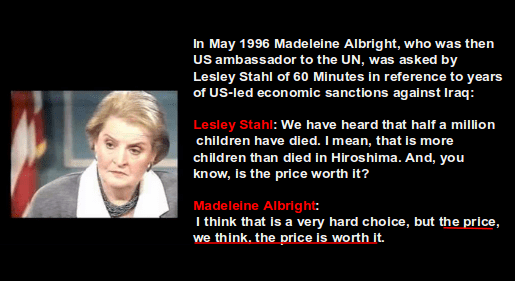
To this day, there remain tens of thousands of maimed, blinded, crippled Iraqi soldiers.  It was Iraq’s version of World War I, cheerfully financed by the US, Saudi Arabia and Kuwait.  Iraq’s once thriving economy is mostly in ruins.  US and British bombing even destroyed most of Iraq’s sewage systems, water reserves, hospitals and bridges. Contaminated water alone killed 500,000 Iraqi children, according to the UN, a price ‘worth paying’ said US Secretary of State Madeleine Albright.

The moral of this terrible story, and the current worldwide epidemic, is to immediately ban all chemical and biological weapons everywhere.  Destroy all chem/bio warfare plants everywhere, including the US, Russa, China, India and Israel.

The COVID-19 virus is merely a taste of what a real biological war would be like.  Many around the world who bear us ill cannot help but take notice how the world’s richest, mightiest nation can be brought to its knees by some invisible bugs.

When President Trump fulminates against China over COVID-19, he should be advised that the anthrax and other germ weapons used against Iraq in 1990 originated at Fort Detrick, just 50 miles NW of the White House, a mere one hour drive if traffic is not too heavy.

Be seeing you

madeleine-albright


Posted in Uncategorized | Tagged: , , , , , , | 1 Comment »

Politicians Have Used This Crisis to Remind Us They’re Mostly Wannabe Dictators | Mises Wire

Posted by M. C. on March 28, 2020

https://mises.org/wire/politicians-have-used-crisis-remind-us-theyre-mostly-wannabe-dictators?utm_source=Mises+Institute+Subscriptions&utm_campaign=e2d30b9f17-EMAIL_CAMPAIGN_9_21_2018_9_59_COPY_01&utm_medium=email&utm_term=0_8b52b2e1c0-e2d30b9f17-228343965

The virus has unleashed petite tyrants to haunt their tiny jurisdictions, using the cover of crisis to arrogate powers belonging to the people.

Witness Robert J. Taylor, mayor of Ostrander, Ohio (population: 643 in the 2010 census), who just declared his village to be in a “state of emergency.” Along with this declaration, the self-righteous mayor instructed constituents to get their news from “trusted sources, which may not include social media in many cases.”

In addition, he admonished them to “Also, please look out for your neighbors and the elderly, in particular.”

Sure, petty nonsense from a petty man. But he also added this, “As warranted, additional measures may be taken until the threat from this virus has subsided.”

So, should our equally petty governor adopt enabling acts and deputize mayors, so to speak, Taylor will gleefully nail decrees on the telephone poles lining either side of main street (really, the only street in his village). And, should those decrees not be given the respect he deems sufficient, he will employ the full force of the apparatus of coercion and compulsion: the state. Measures must always be enforced.

As Hayek showed in his seminal work, Road to Serfdom, “the worst” rise to the top in centrally planned states. However, those trying to move up in a burgeoning centrally planned state can be as evil, given the chance. So, in many ways, the difference between the evil leader on top and those deeper in the nomenklatura is not one of degree, but of opportunity.

I have no idea what drives folks like Taylor—what is truly in their hearts. Nevertheless, the study of human action allows me to assess his actions as means to achieve desired ends. Folks like Taylor use politics as the means to their personal ends. What those ends are, I can only guess, although I do know that he is acting for a reason—a reason, I claim, that does not consider the best interests of his constituents.

Maybe, in an attempt to position himself for the next higher office, he is playing to the media, looking for a guest spot on some local news show—he is already getting local newspaper headlines. Maybe he has aspirations to be county commissioner or governor. Who knows? We do know that he acted, and acted for a reason.

You may object that Taylor really hasn’t instituted some quarantine lockdown or shuttered business, as Ohio governor DeWine has. Taylor is just a shout in the wind. Yet, I believe there is more here. And I fully expect a viral outbreak of similar declarations from other petite officials.

Taylor most certainly read pronouncements from big city mayors. And, if you are in the minors and want to play in the big leagues (should the big leagues ever be allowed to play again), you always need to hit to the fence. Home runs get you noticed, not the odd grounded single. And if each swing further annuls liberty, it’s the old eggs to omelets shrug. Nothing else.

Years ago, I was a petite (possibly petty as well) elected official. I witnessed “the worst” rise to higher office. I always wondered how my fellow school board members would have acted if provided a slightly longer leash. For some, I think, Taylor serves as an example.

Maybe I would have acted the same way with a longer leash, or, better yet, a longer leash and a “crisis” with panicked, loud voices crying for leadership and action.

Yes, Hayek was right, “the worst” rise to the top. However, I believe that there is a codicil as well. Many of “the worst” on their way up are constrained by their current office. Likely, they will not see the top. But that doesn’t mean that, given the opportunity, they would not mimic those who have made it all the way.

The solution, even in a time of “crisis,” is not a haunting state and its officials, petite or otherwise. It is liberty.


Be seeing you


Posted in Uncategorized | Tagged: , , , | Leave a Comment »

COVID-19: The “Experts” Have No Crystal Ball | Mises Wire

Posted by M. C. on March 27, 2020

To believe in the utility of central planning you must be able to fall for the idea that someone somewhere has a crystal ball. Individual freedom is not only moral, it provides utility and risk mitigation in moments of crisis, precisely like the one we now face.

American federalism provides for fifty experiments. Individual freedom in America provides for 330 million experiments. Some win, some lose. That’s life. Authoritarianism that drags everyone down a common path merely ensures that all will eventually lose.

https://mises.org/wire/covid-19-experts-have-no-crystal-ball?utm_source=Mises+Institute+Subscriptions&utm_campaign=9b99efe5d7-EMAIL_CAMPAIGN_9_21_2018_9_59_COPY_01&utm_medium=email&utm_term=0_8b52b2e1c0-9b99efe5d7-228343965

On the night of Tuesday, November 8, 2016, and in the wee hours of Wednesday, November 9, 2016, Donald Trump became US president-elect. I am not aware of a single media source that predicted that. Many predicted Hillary Clinton would win. Some stayed out of the fortune-telling game.

The most striking thing was the lack of admission running up to election night that the experts were all making guesses. “Of course they were making guesses, no one has a crystal ball,” the rational observer might say, but petabytes have been dedicated to making the social sciences and all of their guesswork appear like, well, “science.” That means that it’s all very measurable and clear, when it actually isn’t.

Science, on the other hand, is science. Observable details can be used to solidify hypotheses into theory. Sometimes facts are even arrived at, though theory is usually the best a scientist can hope for.

And then there is the murky area between the two, where scientists use models to predict the future.

This starts to look a lot like when psephologist (election scientist), sabermetrician, and prognosticator Nate Silver in the weeks and months before the 2016 election replaced the term “algorithm” with the suggestion of fact, or referenced a peer-reviewed, proprietary model that one is supposed to believe tells the future. There is no question that the vast portion of social scientists who make predictions want their model to be seen as a crystal ball. “Algorithm” is a fancy word for “guess.” “Model” is a fancy word for “guess.”

The work is built on presumptions that are not philosophically or logically solid, but then a lot of math is used to cover up the illogical and unsteady foundations.

Hundreds of academic authors that I encounter over the course of a year cannot have a logically sound conversation or write logically sound arguments. They fail at the foundation of their arguments, yet proceed to built atop that unsteady foundation, knowing that few will notice. This is intellectual dishonesty, also known as lying. So rooted they are in the social scientist’s belief that their field is a science and that modeling can plausibly predict the future that some may not even be aware of the fundamental shortcomings of such a professional outlook. Yes, perhaps they themselves do not even notice the lie that they profess.

There are economists that put lots of math on top of bad presumptions. Metrics can be incredibly valuable in understanding a discipline or theory. When the logical foundation is faulty, though, the metrics may simply be window-dressing that adds legitimacy where none belongs. Complicated terminology can have the same purpose. Laymen have long understood that con-artist politicians, con-artist salesmen, and con-artist academics alike have opaque jargon, the use of which seems to demonstrate an unwillingness to be understood.

Warwick McKibbin and Roshen Fernando of Australian National University, the authors of a paper about the tens of millions who will die from coronavirus that has been widely cited in the media (“The Global Macroeconomic Impacts of COVID-19: Seven Scenarios“) show off their crystal ball.

To their credit, the corona prognosticators did a good job of stating pretty clearly: “We don’t really know what we are talking about; we are really just guessing” (actual quote: “These results are very sensitive to the assumptions in the model, to the shocks we feed in and to the assumed macroeconomic policy responses in each countries [sic]”), and “Our scary death counts are not reliable and are not even the focus of our work or this paper, we are doing this to provide some sort of economic estimate for people to start working with” (actual quote: “The goal is not to be definitive about the virus outbreak but to provide important information about a range of possible economic costs of the disease. At the time of writing this paper, the probability of any of these scenarios and the range of plausible alternatives are highly uncertain. In the case where COVID-19 develops into a global pandemic, our results suggest that the cost can escalate quickly”).

They also openly admit, “Our intent is to profess political support for global bureaucratic structures in health and medicine and to call for shifts toward better funded and socialized medical systems” (Actual quote: “Many governments have been reluctant to invest sufficiently in their health care systems, let alone public health systems in less developed countries….This study indicates the possible costs that can be avoided through global cooperative investment in public health in all countries”).

The most important takeaway from the paper is not a prognostication, but an observation from the past, the notion that social contagion is the great ill that results from an outbreak, not the contagion itself: “From studying many outbreaks, the real risk is not the disease but public and governmental reaction to the fear of the disease,” (Actual quote: “The fear of an unknown deadly virus is similar in its psychological effects to the reaction to biological and other terrorism threats and causes a high level of stress, often with longer-term consequences (Hyams et al., 2002). A large number of people would feel at risk at the onset of a pandemic, even if their actual risk of dying from the disease is low.”)

If you read the 44-page paper, uncertainty around the data and biases are disclosed by the authors.

But the media took it and ran with it for a salacious headline. The Chicken Littles of the world ran with it. The politicians, emergency services, military, and public health bureaucrats, seeking greater control for themselves, ran with it.

This is all predictable. What is far from predictable is whether you or I will believe any of this salacious nonsense. We don’t need to fall for it. We can look at the prognostication of 15 million deaths by corona, along with anyone who cites it as if it were fact, and challenge them quietly or openly as a heretofore discredited and unreliable person using an unreliable source in a moment where reliable journalism and sources are so badly needed.

Generations, centuries, millennia of humans around the globe have known what November 2016 reminded an entire country of: no one has a crystal ball.

Let us not forget this valuable lesson so quickly.

Will you be a willing megaphone to Chicken Little? Will you laugh at the nonsense, or will you be among those who chase Chicken Little into the henhouse where he belongs?

Whatever you choose, any person lying to you—economist, social scientist, prognosticator—deserves the same skeptical treatment across disciplines, because charlatans find their way into every discipline.

No matter how much modeling they do, the underlying truth is that no one has a crystal ball. Everyone is guessing. The experts didn’t know in 2016 how the election would shape up. The experts don’t know now how corona will shape up. Don’t sacrifice basic liberties to an expert claiming to have a crystal ball. Don’t sacrifice your basic sense of self to an expert claiming to have a crystal ball. Don’t offer the power of your fear, the power of your belief, and certainly not the power of your trust to an expert claiming to have a crystal ball.

Skepticism is the proper tool to use with any holder of any crystal ball. That is true, regardless of the complexity of the algorithm that they claim shows irrefutable proof of what the future will bring one day from now, one year from now, or one century from now.

The future is unknown to us and investing all of a society’s options in one path is detrimental to a successful outcome. One way that free societies have long prospered is by allowing individuals to produce many varying paths, some of which work, some of which fail. That is the risk mitigation method of freedom and individual choice. A single, unified path that no one may oppose removes a great deal of risk mitigation and forces many to make a single bet on a single path. That is a truly foolish idea given the fact that no one has a crystal ball.

To believe in the utility of central planning you must be able to fall for the idea that someone somewhere has a crystal ball. Individual freedom is not only moral, it provides utility and risk mitigation in moments of crisis, precisely like the one we now face.

American federalism provides for fifty experiments. Individual freedom in America provides for 330 million experiments. Some win, some lose. That’s life. Authoritarianism that drags everyone down a common path merely ensures that all will eventually lose.

Be seeing you


Posted in Uncategorized | Tagged: , , , | Leave a Comment »

Called the “Greatest Photo In Racing”

Posted by M. C. on March 27, 2020

One mile tracks are fast but half mile is where the action is.

Handlebars full lock, steer with the throttle and a Ken Maley “shoe”.

What don’t you see on the front?

https://i0.wp.com/goodsparkgarage.com/wp-content/uploads/2012/03/crossed_rex.jpg

https://i0.wp.com/goodsparkgarage.com/wp-content/uploads/2012/03/crossed_rex.jpg

The above pic of Rex Beauchamp at Louisville is touted as “The Greatest Photo in Racing” in a 1980 article by Joe Scalzo in Motorcyclist Magazine. Legend has it that it was taken by a corner worker with direction given by the credited photographer, Dan Mahony (Dan worked a camera further down the track).

Be seeing you

Ken Maily

The “Shoe Man”

Posted in Uncategorized | Tagged: , , , | Leave a Comment »

How U.S. Foreign Policy Can Help Defeat Coronavirus | The National Interest

Posted by M. C. on March 27, 2020

https://nationalinterest.org/blog/skeptics/how-us-foreign-policy-can-help-defeat-coronavirus-137307

U.S. foreign policy can help defeat the novel coronavirus if our government is willing to foster positive international relations and abandon pointless conflicts that sap our strength.

by Bonnie Kristian

Sen. Tom Cotton’s statement on the novel coronavirus pandemic started with the standard encouragement we expect from public officials in times of crisis. “I have every confidence America will once again marshal the resolve, toughness, and genius of our people to overcome [this] serious threat to our health and well-being,” he said. But then the Arkansas senator continued, saying “we will hold accountable those who inflicted it on the world.” Shortly thereafter, responding to a tweet which interpreted the line to mean “China will pay for this,” Cotton simply wrote, “Correct.”

What sort of retaliation Cotton has in mind isn’t clear—though his reckless, military-first foreign policy record suggests troubling possibilities. But whatever Cotton’s agenda, a posture of international antagonism is exactly the wrong idea in a moment like this. U.S. foreign policy can help us face and overcome COVID-19 if our government is willing to engage in productive, realistic diplomacy instead of aggression and to stop wasting limited resources on useless overseas adventurism which fosters chaos abroad and does nothing for our security at home. Now is the time for cooperation and peace.

Voices across the political spectrum have urged an end to partisan blaming and shaming in our domestic coronavirus response, but Washington should stop trying to score political points over the crisis in foreign policy, too. Trump administration officials and congressional leaders who insist on adding criticism of China to every public comment on COVID-19 are not benefiting public health. A defensive and angry Beijing is less likely to share literally vital information with us and more likely to pump out anti-American propaganda. Escalating U.S.-Chinese tension is dangerous for ordinary people in both countries, even if it never reaches the point of military conflict.

“A lot of these emotional and punishment policies will over time come back to bite us,” Paul Haenle, who worked with China as a former National Security Council official in the George W. Bush and Barack Obama administrations, told Politico. “It is in the United States’ interests to prevent the epidemic from becoming a global pandemic,” Haenle argued in a recent essay. “Especially during this uncertain and challenging time for the bilateral relationship, it is vital that channels of communication stay wide open and that the United States puts its best foot forward.”

That’s certainly the case with China, but it’s also important where our European allies are concerned. Strong historic ties can fray or even break if good diplomatic relationships are not maintained under such duress. President Trump’s reported attempt—confirmed by Berlin—to buy exclusive access to a German company’s developing COVID-19 vaccine for American use only was a ghastly and unethical misstep. Germans are predictably furious that Trump would try to exclude them from vaccine access, particularly as the company in question intends to produce the vaccine “for the whole world, not for individual countries.” This is the kind of unforced error that can and must be avoided going forward.

Just as crucial as these diplomatic measures are re-prioritizing our use of limited resources. Nearly two decades of war in Afghanistan, Iraq, Syria, Yemen, and elsewhere in the Middle East and North Africa have been costly, counterproductive, and deadly for American troops and innocent local populations alike. It was unwise to continue fighting these endless wars before the novel coronavirus appeared. Now, this interventionist foreign policy is a “luxury” we cannot afford. Washington must exit these conflicts immediately and allow local political processes to negotiate sustainable resolutions that account for the unique cultural and religious factors in play. Wasting precious resources on needless wars in a time of pandemic is truly indefensible.

Fears about the effects of COVID-19 may prompt some in Washington to want to lash out at other nations, whether through rhetorical, economic, or military means. An emotional reaction in such a troubling time is understandable, yet it will only make matters worse. U.S. foreign policy can help defeat the novel coronavirus if our government is willing to foster positive international relations and abandon pointless conflicts that sap our strength.

Be seeing you


Posted in Uncategorized | Tagged: , , , , | Leave a Comment »

Fredrickson: Don’t let constitutional rights be a victim of this virus | Opinion | news-journal.com

Posted by M. C. on March 27, 2020

https://www.news-journal.com/opinion/fredrickson-don-t-let-constitutional-rights-be-a-victim-of/article_ac663588-6d5d-11ea-bd73-6bd78fe4d483.html

Courts across the country are grappling with how to continue operations in the face of the threat posed by the COVID-19 pandemic, in particular how to comply with the requirements of the Speedy Trial Act for criminal defendants. While most of Congress’ attention is focused on how to respond to the looming financial meltdown, the Trump Justice Department is floating language to be included in one of the relief packages to address the burden on the judiciary. Some of the department’s proposal are sensible; others would be dangerous incursions on fundamental constitutional rights.

The department’s draft language, as reported by Politico, seeks modification of the Federal Rules of Criminal Procedure to allow greater use of videoconferencing, even at times without the defendant’s agreement. With COVID-19’s rapid transmission between individuals, and the danger it poses to certain groups of people, such a move might have some merit. Similarly, the Justice Department’s proposal to extend the statute of limitations in criminal and civil cases during an emergency “and for one year following the end of the national emergency” has some merit, though an additional year is excessive. The courts too are facing a significant slowdown as staff works remotely and others are getting sick.

But the Justice Department’s request doesn’t stop there. Instead, the department has also included an idea that should be immediately rejected: letting federal court chief judges halt all court proceedings during an emergency. This provision would apply to “any statutes or rules of procedure otherwise affecting pre-arrest, post-arrest, pre-trial, trial, and post-trial procedures in criminal and juvenile proceedings and all civil process and proceedings.” In its draft language shared with Congress, the Justice Department argues that the new provision would ensure more consistency in the procedures adopted in different courthouses.

What is most chilling about this proposal is what it would do to habeas corpus, the constitutional guarantee that a detained person has the right to appear in court for a determination of whether his or her detention is lawful. The Justice Department language would allow a judge to order someone who had simply been arrested, but not charged or convicted, to be held until the judge determines the emergency is over.

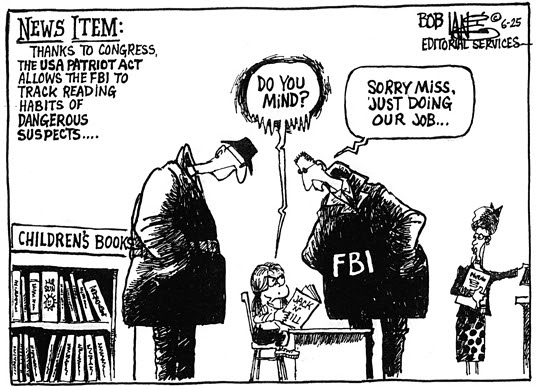
This proposal is chillingly reminiscent of the Bush administration’s overreach in the aftermath of 9/11. In 2001, it moved quickly to send Congress legislation to address the economic impact of the terrorist attack and strengthen national security authorities, all of which Congress passed with little dissent. The USA Patriot Act, one of the most far-reaching proposals, was passed into law less than two months after the attack, granting greatly expanded surveillance and deportation powers to federal law enforcement. The Patriot Act both broadened the definition of immigrants who were deportable and eliminated many procedural protections for such individuals. Any immigrant “certified” a threat to national security could be detained indefinitely.

The American Civil Liberties Union and others challenged that provision, arguing it was unconstitutional to allow the indefinite detention of individuals arrested and not charged with a terrorism offense if they had an immigration status violation — like overstaying a visa — but could not return to their home country.

Though the Supreme Court has not ruled definitively on the constitutionality of indefinite detention, in June 2003, the Justice Department’s inspector general affirmed the arrests and detentions of hundreds of immigrants, mostly Arab, Muslim or South Asian men, had been “indiscriminate” and “haphazard” and the Immigration and Naturalization Service (the predecessor to Immigration and Customs Enforcement) had been regularly detaining individuals not linked to criminal activity or terrorism.

Now, Trump’s Justice Department is seizing on the pandemic as an excuse to push for a major rollback in civil liberties. President Donald Trump has shown an admiration for autocrats around the world, from Russia’s Vladimir Putin to Turkey’s Recep Tayyip Erdogan. It is a classic move of such leaders to use a crisis to advance policies they have long supported. Indeed. Trump has already instituted tighter border restrictions because of covid-19 and further limited asylum applications.

Even if Congress does not agree to the new detention policy, Trump is endowed, as president, with other authorities he can use now that must be closely scrutinized. Even a president admired for his leadership during crisis, Franklin D. Roosevelt, ordered people of Japanese ancestry on the West Coast to be put in internment camps. After 9/11, Congress gave the Bush administration almost everything it asked for, resulting in flawed legislation with vast civil liberties violations. We must demand Congress not forget those lessons.


Be seeing you

covertress: The USA Patriot Act


Posted in Uncategorized | Tagged: , , , , | Leave a Comment »

A Homeschooling Guide for Public Schoolers – The Organic Prepper

Posted by M. C. on March 27, 2020

https://www.theorganicprepper.com/a-homeschooling-guide-for-public-schoolers/

by Kara Stiff

My heart goes out to all the parents who were never planning to homeschool, but nevertheless find themselves teaching their children at home today. I chose this beautiful, crazy life, and I completely understand why some people wouldn’t choose it. But here we are. We have to do what we have to do. You don’t want them to fall behind. You don’t want to lose your mind.

Believe it or not, it’s a golden opportunity.

Caveat: these are only my personal thoughts. I’m not a professional educator, just a parent successfully homeschooling.

This advice is only for people whose greatest hurdle right now is remaining sane with the little ones. This is a high bar to clear, to be sure, but some people are facing the little people plus big financial problems, they’re sick or working through mental health issues, or they’re managing other emergencies. In those cases, if you’re keeping everyone more or less fed and warm then you’re succeeding, and you don’t need me to tell you to forget the rest for as long as necessary.

For everyone else, I do have a little advice. I’m sure you’re getting support from your school district, which is excellent. Worrying about what to teach is often a new homeschooler’s first and biggest concern. But deciding what to teach is actually the easy part, and now it’s mom, dad, uncle or grandma doing the really hard part: actually sitting with the kid, helping/making him or her do the work.

First, I think you can safely let go of the worry that you may not be a good enough teacher because you’re a terrible speller, or you think you’re bad at math. It’s good to know these things about yourself so they can be addressed, but the truth is that how great you personally are at division isn’t necessarily a predictor of success. Neither is how well you explain things, or even how well you demonstrate looking things up, although that is a priceless skill to impart to inquiring minds. To my mind, the most important skill for successful homeschooling is:

Controlling your own frustration

We adults are fantastically knowledgeable and amazingly skilled. No, really, we are! So we forget how hard it is to do seemingly simple things for the first time. I remember sitting in my college biochemistry class, listening to the professor say:

“Come on you guys, this is easy!”

Folks, I’m here to tell you that biochemistry isn’t easy for most people who are new to it, especially people who just drug themselves out of bed five minutes ago, possibly with a touch of a hangover. And reading isn’t easy for a five-year-old, and multiplication isn’t easy for an eight-year-old.

The parent has to slow down, go through it again, redirect the child’s attention for the hundredth time and explain the material in a different way, preferably without pulling out their own hair. You can develop these skills. Even if you’re new to it, and you don’t find it easy.

When it just isn’t working, the parent has to know when to shift gears and let it rest. Preserving your relationship with the child is always very important, but it’s doubly so when you’re home with them all day every day.

I think I can safely say that all homeschool parents want to scream sometimes. Many of us have threatened to send our kids to public school at one point or another (or maybe once a week). It doesn’t make you a bad parent or even a bad teacher, it just makes you human. In the last week, I have seen a bunch of public school parents join my online homeschool groups, and the outpouring of sympathy, support and good ideas from homeschool parents makes me tear up. We’re here for you. Get in touch.

Run your day in a way that works for YOU

Just because they’re usually in school for six or eight hours a day doesn’t mean you have to school them for six or eight hours a day. That schedule is a crowd control measure instituted for the good of society, not for the good of children.

My children are homeschooled primarily because I think a kid should spend a lot of time outside moving around, and there just aren’t enough hours in the day to do that and public school. My own public school experience was pretty different from the norm today, with much less homework and much more self-direction, but still, I feel that I didn’t get enough practice directing my own attention. Research backs me up on this: kids who get many hours of freedom develop excellent executive function, which not only makes them a valuable employee but also helps them run their own life someday.

At my house, we do about an hour of formal school work per day, six or seven days a week. The rest of the time the kids help me with gardening and animal care, climb trees and play in the creek, draw and write and read things on their own or together, and make stuff out of Legos. They have an hour of screen time each afternoon just so they will sit down and be quiet, usually a documentary. David Attenborough is definitely this house’s biggest celebrity. We’re also accustomed to spending several days of the week with other homeschool families, although obviously that is curtailed now due to social distancing.

Learning doesn’t stop when we leave the table, because kids are unstoppable learning machines when they’re not too tired or stressed out. I’m always available to answer questions and help look stuff up, and the questions are pretty frequent. An adult reads to them (or they read to us) books of their choosing at bedtime, and sometimes just after dinner, too. It’s also a pretty common occurrence in my house for a child to see an adult reading a novel, a piece of nonfiction, or The Economist, and request to have it read aloud to them, which we do. They also sometimes watch me balance the household budget.

The schedule that works best for your family might look very different from ours, and that is good. Children are people. People have very different needs, and one of the charms of schooling at home is that you can arrange things in a pretty good compromise to meet everyone’s needs. An hour or two of focused one-on-two attention per day is plenty of time for my four- and seven-year-olds to get well ahead of grade level on reading, writing, and math.

Older kids obviously need more time to get through the volume of work they’re expected to do. They can also be more equal partners in directing the learning process, though. My high school placed great emphasis on self-directed learning, and some of the classes I got the most out of were the ones I designed for myself.

This might be a great opportunity for your older kid or teenager to quickly finish their spelling so they can finally study volcanoes in-depth like they’ve always wanted to do. Or maybe they want to rush through the math, so they can work on their comic book. If they have a passion for it I guarantee they’ll be learning something important, and now you have the freedom to let them explore it.

Can we just not?

Read the rest of this entry »

Posted in Uncategorized | Tagged: , , , , , | Leave a Comment »