MCViewPoint

Opinion from a Libertarian ViewPoint

Archive for the ‘Uncategorized’ Category

The Power of Viruses and the Power of You – LewRockwell

Posted by M. C. on February 20, 2020

People must be able to imagine power is SOMEWHERE. They don’t believe they have it themselves. So why not invoke images of power in a venue which results in a strange allegiance:

“I’ll see and feel power in a fearful threat to me. I’ll sign on and remain loyal, no matter what. I’ll cling to my threat, and I’ll feel rising fear and strange rising joy together.”

That’s the speeding train, the warning, the tracks.

That’s the virus.

Jon Rappaport has been kicked out of WordPress for violating some policy. Don’t know the details.

https://www.lewrockwell.com/2020/02/jon-rappoport/the-power-of-viruses-and-the-power-of-you/

By

Jon Rappoport’s blog

“I saw a horror movie and somehow it was the greatest experience of my life.”

In this article, I depart, for a moment, from the strategy of citing evidence in my coverage of the “China epidemic.” (For my series of articles on the “China epidemic,” click here.)

Instead, I want to make a few brief notes on the subject of power.

For many or most people, there is a kind of programming in the mind which urges the acceptance of viruses as powerful. This programming results in visceral emotional reactions toward microbes.

The collection of sensations would be something like: riding on a train heading toward a possible break in the tracks. Each person on board has been warned. No one is sure whether the tracks, a few miles in the distance, have actually been ripped apart. The train’s engineer in the cab isn’t stopping.

There is fear, of course. But there is also something else. An almost wild feeling. Where does it comes from? It comes from the realization that power is SOMEWHERE. Where? In the potential break in the tracks.

People don’t often experience a sensation of power. For that reason, they don’t want to minimize the importance of the tracks up ahead. They don’t want to throw away that feeling. At some level, they believe that, if they do throw it away, there will be no power anywhere. And THAT would provoke panic.

The idea that they might be coddling an ILLUSION—and the whole warning they received was a monstrous fabrication to begin with—well, this prospect is entirely out of the question. That couldn’t be, under any circumstances. That would be too, too much.

If you were so foolish as to approach such a person and suggest he could, first and foremost, look to his OWN power, he would stare at you as if you were speaking a language from another planet. To say that your advice, under the circumstances—the speeding train, the tracks, the warning—was inappropriate…this would be a vast understatement.

If a person, for whatever reason, believes he has no significant power, he searches for it elsewhere. If he can find a train, a warning, and danger, he’ll climb onboard. It’s far, far better than nothing.

In our society and present culture, of course, the thought that the individual has a great deal of inherent power, and a right to it, is on the wane. That ship, to go to another metaphor, is taking on lots and lots of water.

Typical sociopaths in high places, and their bootlickers, apply basic psychology they don’t teach in fifty-thousand-dollars-a-year colleges: People must be able to imagine power is SOMEWHERE. They don’t believe they have it themselves. So why not invoke images of power in a venue which results in a strange allegiance:

“I’ll see and feel power in a fearful threat to me. I’ll sign on and remain loyal, no matter what. I’ll cling to my threat, and I’ll feel rising fear and strange rising joy together.”

That’s the speeding train, the warning, the tracks.

That’s the virus.

Be seeing you


Posted in Uncategorized | Tagged: , , , | Leave a Comment »

Scandal-Ridden OPCW Now Using Twitter’s “Hide Replies” Function – Caitlin Johnstone

Posted by M. C. on February 20, 2020

https://caitlinjohnstone.com/2020/02/19/scandal-ridden-opcw-now-using-twitters-hide-replies-function/

When Twitter first implemented its “hide replies” function last year I published an article warning that it could be used by establishment narrative managers to marginalize dissident voices and diminish the relatively egalitarian nature of the platform. When I wrote it I was imagining the function being used by overt manipulators like cable TV pundits and Washington Post columnists, and think tank operatives like Neera Tanden who vocally supported the implementation of the function.

What I absolutely was not expecting, as paranoid and conspiracy-minded as I am, was a highly regarded UN-associated international chemical watchdog group using the function for that purpose.

As of this writing, if you go to the Twitter account for the Organisation for the Prohibition of Chemical Weapons (OPCW), you’ll see this tweet at the second from the top:

If you log on to Twitter and go to that tweet and click this little button, it will take you to a section of “hidden replies” which aren’t visible on the main tweet.

You will not be surprised to learn that the tweet which the OPCW’s Twitter account has chosen to hide is critical of the organization:

That “#wikileaksdoumareport” hashtag in the hidden tweet refers to the leaks which have been pouring out from the OPCW adding to the mountain of evidence that the US, UK and France bombed the Syrian government in 2018 as a retaliation for a chemical weapons attack in the town Douma which did not occur. Whoever is in charge of the OPCW’s Twitter account does not like the lowly commoners talking about this on their page.

Here’s an OPCW tweet from a week ago which has the same issue:

Click the same little button to view hidden replies and you’ll see three of them on this one, again all discussing the scandal-ridden Douma investigation:

It doesn’t seem to happen if you’re not logged on to your account, and seems to express differently on different browsers, but if you log in and scroll through the OPCW Twitter page you’ll find many tweets with hidden replies, almost all of which directly pertain to the Douma scandal.

The OPCW tweet which appears to have the largest number of replies is the smear job they released earlier this month attacking the whistleblowers whose leaks poked giant holes in the official Douma narrative. This smear job has been ripped to shreds in an article by Grayzone‘s Aaron Maté, who in his trademark style systematically debunks the organisation’s attempts to spin the whistleblowers as incompetent outsiders who tried to manipulate the Douma investigation for no clear reason.

If you go to that OPCW tweet and scroll down you’ll see dozens of spaces where replies ought to be, with the message “This reply was hidden by the original Tweet author,” meaning hidden by the author of the initial top tweet by the OPCW. I’ve archived screenshots of the entire thread here as it looks from my account as of this writing, but here’s a small sample of what the top of the replies section looks like on that tweet:

I myself posted the reply that got the most likes and retweets back when the OPCW first shared its smear job, but in a strange twist on Twitter’s “hide replies” function it doesn’t show up in the main thread or in its “hidden replies” section. Other users also say they can’t see it in either section. So as things are right now it looks like some posts in threads with a large number of hidden replies are just disappeared entirely, which is all the more incentive for narrative managers to use it.

There are already many users in the comments objecting to the OPCW yet again making use of opacity to silence dissident voices, and understandably so. Ever since the first Douma leak in May 2018 this organisation has been stonewalling journalists, refusing to answer crucial questions, smearing its own investigators and denying them a platform to speak, all after hiding from the public the fact that there had been large amounts of internal dissent regarding its Douma investigation. This dissent included unanimous agreement between four toxicologists that no chlorine attack occurred in Douma, and reports that some 20 OPCW inspectors had voiced objections to the way the Douma investigation was taking place.

The OPCW had no business hiding all this information from the public about an event which led to an act of war against a sovereign nation, and it has no business hiding the public’s attempts to demand more information be brought into the light.

These deliberate acts of obfuscation make no sense if you look at the OPCW as an independent international investigative body whose sole interest is truth and the elimination of chemical weapons, but they make perfect sense if you see it as a narrative management apparatus of the US-centralized empire. The US government already has an established history of manipulating the OPCW into facilitating the advancement of pre-existing regime change agendas in the Middle East, and not one but two whistleblowers have separately attested that US government officials were brought in by OPCW leadership (in violation of the organisation’s supposed independence) to persuade them that the Syrian government had committed a chemical weapons attack.

The Organisation for the Prohibition of Chemical Weapons is acting like a narrative management operation because that is what it has become: a tool to help the US-centralized empire spin narratives favorable to pre-existing regime change agendas like the one it has long had for the Syrian government. That’s how it behaves, so we should ignore all narrative spin and assume that that’s what it is until its behavior changes. As long as it continues walking like a duck and quacking like a duck, we should continue to assume that it’s a duck.

The OPCW has been hiding replies on Twitter, yes. But at least it has stopped hiding what it is.

_______________________________

Thanks for reading! The best way to get around the internet censors and make sure you see the stuff I publish is to subscribe to the mailing list for my website, which will get you an email notification for everything I publish. My work is entirely reader-supported, so if you enjoyed this piece please consider sharing it around, liking me on Facebook, following my antics on Twitter, checking out my podcast on either Youtube, soundcloud, Apple podcasts or Spotify, following me on Steemit, throwing some money into my hat on Patreon or Paypal, purchasing some of my sweet merchandise, buying my new book Rogue Nation: Psychonautical Adventures With Caitlin Johnstone, or my previous book Woke: A Field Guide for Utopia Preppers. For more info on who I am, where I stand, and what I’m trying to do with this platform, click here. Everyone, racist platforms excluded, has my permission to republish or use any part of this work (or anything else I’ve written) in any way they like free of charge.

Posted in Uncategorized | Tagged: , , , | 1 Comment »

Of Two Minds – The World Is Awash in Oil, False Assurances, Magical Thinking and Complacency as Global Demand Careens Toward a Cliff

Posted by M. C. on February 20, 2020

Yet the entire risk-on / global growth story is based entirely on desires not needs . The vast majority of demand isn’t for a pressing need, it’s for euphoric aspirational consumption , spending intended to make the buyer larger than they really are, in their own self-image and in the image they present to the world in the brands they display, the cafes they dine in, etc. etc.

Since the world is awash in false assurances, magical thinking and complacency, we might ask: what’s the market value of these disconnected-from-reality fantasies? There’s no pricing mechanism for such intangibles, of course, but should counting the number of fairies on the head of a pin give way to a new appreciation of risk and a pervasive awareness of uncertainty, then global demand will fall off a cliff as desires are set aside indefinitely.

https://oftwominds.cloudhostedresources.com/?ref=https%3A%2F%2Fwww.lewrockwell.com%2F&url=https%3A%2F%2Fwww.oftwominds.com%2Fblogfeb20%2Fworld-awash2-20.html

Charles Hugh Smith

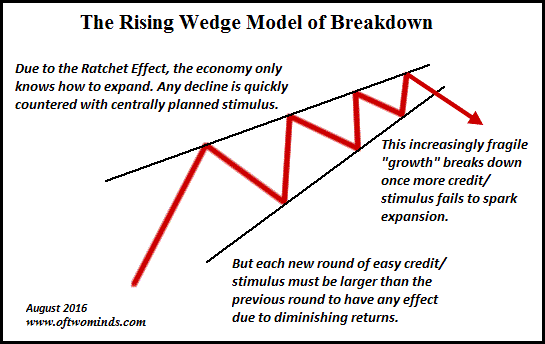
This collapse of price will manifest in all sorts of markets that are based on debt-funded purchases of desires rather than a warily prudent priority on needs .

Since markets are supposed to discover the price of excesses and scarcities, it’s a mystery why everything that is in oversupply is still grossly overpriced as global demand slides off a cliff: oil, semiconductors, Uber rides, AirBNB listings and many other risk-on / global growth stories are still priced as if pre-Covid-19 demand was still guaranteed.

Punters are still buying semiconductor stocks based on out-of-touch projections that are the equivalent to counting the number of fairies on the head of a pin, ignoring the fundamental reality that very few people actually need a new mobile phone, vehicle, laptop, refrigerator, etc.

It boils down to confidence and certainty. People pursue what they desire but don’t need when they’re brimming with confidence in the future, bolstered by an animal-spirits euphoria that their income and wealth will continue rising–a sense of certainty anchored by a belief that their economic world is essentially without risk.

When confidence dissipates and is replaced by fear and uncertainty, desires lose their luster and needs take precedence. When you’re afraid of getting a deadly virus or losing your livelihood, status symbols and frivolous spending no longer top the agenda.

Yet the entire risk-on / global growth story is based entirely on desires not needs . The vast majority of demand isn’t for a pressing need, it’s for euphoric aspirational consumption , spending intended to make the buyer larger than they really are, in their own self-image and in the image they present to the world in the brands they display, the cafes they dine in, etc. etc.

Since the world is awash in false assurances, magical thinking and complacency, we might ask: what’s the market value of these disconnected-from-reality fantasies? There’s no pricing mechanism for such intangibles, of course, but should counting the number of fairies on the head of a pin give way to a new appreciation of risk and a pervasive awareness of uncertainty, then global demand will fall off a cliff as desires are set aside indefinitely.

In a world of bogus projections and rigged statistics, plunging demand for oil is one of the few reality-based measures available. One of the games being played is whenever a reality-based measure is discovered–electricity consumption, satellite images of empty parking lots, etc.–authorities immediately limit access to the measures and/or unleash a tsunami of counter-narratives to discredit the real-world evidence that global demand is cratering.

Since oil is the master resource for the industrialized, interconnected global economy, it’s tough to argue that declining consumption of oil doesn’t matter.

When demand craters, producers must restrict supply or price will crater, too. The problem with oil and everything else that’s now in over-supply / over-production is that producers can’t survive either a sustained drop in price or a sustained drop in production. Since both are equally fatal, producers have every incentive to keep producing and hope that somebody else lowers their production to keep prices high.

Alas, no producer is willing to fall on their sword to keep prices unnaturally elevated. And so excess production continues apace until price collapses.

This collapse of price will manifest in all sorts of markets that are based on debt-funded purchases of desires rather than a warily prudent priority on needs.

My COVID-19 Pandemic Posts

Be seeing you

Winter in YoToronto ‒ Yo Toronto

Posted in Uncategorized | Tagged: , , , , | Leave a Comment »

Occam’s Butter Knife – Taki’s Magazine

Posted by M. C. on February 20, 2020

But, just as a glass is both part full and part empty simultaneously, observers will also inevitably disagree over whether to call the findings of physical anthropology and population genetics precise or fuzzy.

Why? Because both are true.

https://www.takimag.com/article/occams-butter-knife/

Steve Sailer

In contrast to Angela Saini’s acclaimed but dismal 2019 work of science denialism, Superior: The Return of Race Science, Adam Rutherford’s 2020 book How to Argue With a Racist: History, Science, Race and Reality benefits from Rutherford’s lively prose style. The British science writer likes to illustrate his arguments with interesting examples, a stratagem that wouldn’t seem too much to ask of an author, but which is increasingly difficult to find these days as conventional wisdom (which Rutherford labors hard to embody) becomes ever more anti-empirical.

Despite blustering on his Twitter bio, “Back off man, I’m a scientist,” Rutherford appears to have largely transitioned from being a geneticist to being a science pundit in the mode of Neil deGrasse Tyson and Richard Dawkins. But that’s not a dishonorable career path.

And Rutherford is adept at writing. For example, Rutherford’s book is quite a bit more interesting than a snooze-worthy essay last year, “Race, genetics and pseudoscience: an explainer,” that he coauthored with three academics.

His coauthors were then crushed humiliatingly in Twitter debates by sports fans much more knowledgeable about the pervasive racial patterns in sports than they are. But Rutherford, a rugby enthusiast, at least knows a fair amount about athletics, so he puts up a more cunning fight on this topic in his own book because he’s not being dragged down by his colleagues’ ignorance.

In fact, I find Rutherford’s writing rather like mine in form. Of course, the difference is that I point out facts in order to increase knowledge, while Rutherford is trying to decrease knowledge by denying realities.

Rutherford starts off his chapter on sports, “Black Power,” by forthrightly admitting of Allan Wells’ gold medal in the 1980 Olympic 100-meter dash:

Not only was this the last time a white man won the Olympic 100 meters, it was the last time that white men competed in the final….

Many pages later he delivers his big argument pooh-poohing this extraordinary racial gap in the 100-meter dash:

If people of West African ancestry have a genetic advantage, why are there few West African sprinters…?

But it turns out there are quite a few very fast West African sprinters, although no superstars yet of the magnitude of Usain Bolt or Carl Lewis. Of the 143 men in history who have run 100 meters in under 10.00 seconds flat, 134 have been of at least half sub-Saharan descent. Twelve have been Nigerian-born (three running under the colors of richer countries, including Francis Obikwelu, the 2004 silver medalist for Portugal). That makes Nigeria the No. 3 sprinting country in the world after the U.S. (57) and Jamaica (19). There are also two Ghanaians and two from Ivory Coast who have broken the ten-second barrier.

Besides the sixteen West Africans, there have also been eight southern Africans (although one identifies as a Cape Coloured, a recent racial group that has emerged over the past few centuries from the admixture of whites, blacks, Bushmen, and Malays).

So men born in sub-Saharan Africa make up one-sixth of all those who have run 100 meters in under ten seconds.

But why don’t they make up five-sixths? Because, as Francis Galton noted, nurture matters as well as nature. Apparently, Africans don’t flourish in highly African countries as well as they do in countries under more white influence.

“Lately, there have been interesting discoveries about the deep history of current populations, but few if any shockers about today’s races.”

One of Rutherford’s strategies is to toss out facts, then argue that their seeming randomness undermines those evil racists’ simplistic ideas: Instead, it’s all very complicated. Thus he sums up his section on race in team sports:

None of the numbers makes a great deal of sense if biological race is your guiding principle, and patterns in relation to ethnicity are terribly inconsistent both between sports and within them.

Yet, a careful, informed reader will notice how frequently his own factoids backfire on him. For example:

In top flight American football, the proportion of black players is around 70 percent, but like rugby, that is a game where there are highly specialized positions with different skills and physical attributes….

And the running velocity requirements versus technical expertise demands of positions correlate closely with the race of the players. For example, all the starting cornerbacks in the NFL are black, but none of the placekickers are.

But in the Center position within the linemen, whites outnumber blacks 4:1. Why? We don’t know, but it does not appear to have anything to do with genetics.

Well, actually, it does. Centers, being in the center of the line, need the least foot speed of any linemen. Centers also need good brains because they are in charge of telling their fellow offensive linemen what to do. Journalist Mark Bowden, author of Black Hawk Down, wrote a 2004 article in The Atlantic titled:

A Beautiful Mind: As the Philadelphia Eagles’ Hank Fraley demonstrates, the behemoth who snaps the ball must also be one of the most mentally nimble players on the field

According to the late sportswriter Paul D. Zimmerman, in 1984 centers had the second-highest average IQ scores (108) on the Wonderlic test that the NFL makes all draft prospects take. (The lowest scores are for running backs.)

Rutherford goes on:

In Major League Baseball—a sport which requires sprinting and powerful throwing and hitting—African Americans make up less than 10 percent of players.

Yet in baseball, the same pattern of African-Americans being found at positions where foot speed is necessary is found. Black Americans are about ten times as likely to be outfielders as pitchers or catchers, two highly technical positions that don’t demand any running on defense.

Back when baseball was segregated before 1947, the Negro League had to supply its own pitchers and catchers, so the Jackie Robinson Era featured outstandingly skilled black pitchers and catchers such as Satchel Paige and Roy Campanella. But as black youths have lost interest in baseball in favor of football and basketball, blacks have declined faster as pitchers and catchers, two positions where intensive coaching is crucial, than as outfielders, where natural skill is relatively more important.

As my longtime readers know, I can go on like this roughly forever pointing out subtle racial patterns in sports. Therefore I’ll leave off at this point and return to the larger questions raised by Rutherford’s book.

Rutherford’s contradictory goals of standing loyally by his colleagues who subscribe to today’s Race Does Not Exist dogma but simultaneously not letting himself get easily dunked on by randos on Twitter lead him into immediate logical trouble on page one of his new book. He and his friends had asserted last year:

Research in the 20th century found that the crude categorizations used colloquially (black, white, East Asian etc.) were not reflected in actual patterns of genetic variation….

The truth is closer to the opposite: The immense advances in 21st-century genomics have largely validated 20th-century colloquialisms like black, white, East Asian, etc.

Note that we don’t have a lot of new population groupings of living humans discovered only by the latest DNA technology. It’s hard to notice dogs that don’t bark, so let me belabor this point a bit. You don’t see Harvard geneticist David Reich announcing that, say, unbeknownst to all previous observers, it turns out that the closest living relations to Samoans are actually Mohawks and Basques, while Tongans are most closely linked to Inuit, Samaritans, and Khoisan.

Instead, what is found over and over is that the old anthropologists going all the way back to Linnaeus and Blumenbach in the 18th century tended to arrive at fairly reasonable frameworks for how the human races’ ancestral diversity could be conceptually organized. Lately, there have been interesting discoveries about the deep history of current populations, but few if any shockers about today’s races.

Why? Because what we can see is the product of the genes we can’t see. So the arrival of genome sequencing primarily just confirmed what sharp-eyed observers had already noticed about who is related to whom.

Of course, there remain in population genetics, as in all sciences, the inevitable lumper vs. splitter controversies, just as the Environmental Protection Agency’s biologists grapple with the difficult question of whether wolves are a separate species from dogs and coyotes for purposes of the Endangered Species Act. And if wolves in general are a separate species, then are “red wolves” their own distinct species or subspecies worthy of protection or merely hybrids of wolves and coyotes?

But the EPA never has to deal with any surprises in which DNA proves wolves are actually more related to cats than to dogs. Analogously, Reich hasn’t found much about the world’s current races that would have stunned L.L. Cavalli-Sforza in the 1990s or Carleton Coon in the 1960s.

Likewise, the fact that people often disagree on what to name various racial groups no more discredits the concept of race than the fact that Americans can’t agree on whether to call our biggest cat a cougar, a panther, a painter, a mountain lion, or a puma means that the Endangered Species Act shouldn’t apply to it.

Moreover, we can’t expect observers to conclusively agree upon how many races there are, just as humans can’t agree upon how many different extended families they personally belong to.

After all the number crunching of DNA in this century, what woke science writers such as Rutherford deride as “traditional and colloquial folk taxonomies of race,” such as that blacks and East Asians are different racial groups, have wound up being vindicated. In fact, How to Argue With a Racist demonstrates that nobody can write a book that claims to debunk race without using these extraordinarily useful racial terms. Hence, poor Rutherford has to announce on his page one:

I will be using words such as “black” and “East Asian” while simultaneously acknowledging that they are poor scientific designations for the immense diversity within these billions of people. It is an irony that we roughly know what these descriptors mean colloquially while they are potentially incoherent in terms of scientific taxonomy.

It is an irony indeed. In fact, Occam’s Razor would suggest that the reason common terms for major races are so essential to Rutherford in writing his book is because they actually exist.

And buried in a long paragraph on page 55, Rutherford gets around to grudgingly admitting, en passant, that what the most sophisticated race realists believe is true is…well, true:

The genetic differences between us, small though they are, account for much, but not all, of the physical variation we can see or assess. The diaspora from Africa around 70,000 years ago and continual migration and mixing since, means that we can see that there is structure within the genomes that underlies our basic biology. Very broadly, that structure corresponds with land masses, but within those groups there is huge variation, and at the edges and within these groups, there is continuity of variation.

In other words, the great land masses of Earth, usually referred to as continents, tend to be home to physically and genetically distinguishable ancestral groups. And our eyes, our genealogical histories, and our DNA scans can further distinguish smaller racial groups within each continental-scale race. For example, Blackfoot Indians near the Canadian border tend to be quite tall, while Guatemalan Indians tend to be quite short.

Modern DNA tests, much like your lying eyes, can often locate with some degree of precision where within a continent your ancestors long lived.

But, just as a glass is both part full and part empty simultaneously, observers will also inevitably disagree over whether to call the findings of physical anthropology and population genetics precise or fuzzy.

Why? Because both are true.

Moreover, as Rutherford rightly notes, on the land borders of the great expanses, continental-scale races tend to bleed into each other. For example, the indigenous people of Western Eurasia are of the Caucasian race, while the natives of Eastern Eurasia are of the Mongolian race, but in the middle are visibly hybrid populations like the oppressed Uyghurs of Xinjiang. Similarly, while black sub-Saharans and olive-skinned Caucasians native to North Africa are quite distinctive, each oasis across the Sahara tends to have a varying admixture of the two great races depending upon its latitude.

I would add, however, that some geographic barriers to gene flow were extremely formidable until fairly recent times. For instance, although we know that Vikings briefly sojourned in Canada about a thousand years ago, we’ve yet to find definitive genetic evidence that anybody alive today is descended from a man and woman who were born on opposite sides of the Atlantic before the 15th-century Age of Exploration.

It’s not impossible that, say, ancient Phoenician sailors in the Atlantic were blown by storms to the Americas where they found wives and left us living descendants. But nobody has found anything proving that. The closest thing to this is the puzzling recent find that a few tribes in the Amazon have a tiny percentage of their DNA reminiscent of remote Andaman Islanders in the Indian Ocean on the far side of the world.

Due to the 53-mile-wide Bering Strait, the Pacific Ocean was less impermeable than the Atlantic before Columbus, but the number of population exchanges between the Old World and New World was extremely limited.

In contrast, the tropical Indian Ocean was much less daunting to human migration and trade. In prehistoric times, Southeast Asians made it all the way to Madagascar off the coast of Africa.

But even in this vast region, disease and altitude limited how much one group could blend into the next. For example, the Himalayas create a quite sharp racial divide between East Asians and South Asians. East Asians, such as the famous Sherpa mountain climbers, actually live on both sides of Mt. Everest. But Tibetans in Nepal stopped penetrating deeply into South Asia because they dislike altitudes below about a mile of elevation. They are more susceptible to hot-weather diseases than are South Asians, who in turn are not adapted by evolution like the Tibetans are to thriving at high altitudes.

But after making the reluctant admissions quoted above, Rutherford feels compelled to end his paragraph with trumpet blasts of double-dumbed-down fealty to political correctness:

Of all the attempts over the centuries to place humans in distinct races, none succeeds. Genetics refuses to comply with these artificial and superficial categories…. Racial differences are skin deep.

Rutherford’s absolutism is obviously scientifically inappropriate for talking about human relatedness. In reality, when it comes to determining who is more related to whom—after all, the essence of race is who your relatives tend to be—it’s all relative.

In summary, Rutherford’s book shows that no matter how skilled an arguer you might be, it’s hard to win an argument in the long run when you’re wrong.

Be seeing you

U.S. Census Bureau is dropping its use of the word “Negro ...

Number 1 race is Human


Posted in Uncategorized | Tagged: , , , , , , , , | Leave a Comment »

Why Governments Hate Secession | Mises Wire

Posted by M. C. on February 20, 2020

This is partly due to the fact state organizations—that is, the people who control them—have little motivation to give up the benefits conferred by bigness. States that control larger geographic areas and larger populations have greater ability to project their power and get more power.

https://mises.org/wire/why-governments-hate-secession

When the Soviet Union began its collapse in 1989, the world witnessed decentralization and secession on a scale not seen in Europe since the nineteenth century.

Over the next several years, puppet regimes and states-in-name-only broke away from Soviet domination and formed sovereign states. Some states which had completely ceased to exist—such as the Baltic states—declared independence and became states in the own right. In total, secession and decentralization in this era brought about more than twenty newly independent states.

This period served as an important reminder that human history is not, in fact, just a story of ever increasing state power and centralization.

Since then, however, the world has seen very few successful secession movements. A handful of new countries have come into being over the past twenty years, such as East Timor and South Sudan. But in spite of many efforts by separatists worldwide, there have been few changes to the lines on the maps.

This has certainly been the case in Europe and the Americas, where from Quebec to Scotland to Catalonia to Venice demands for independence have been met with trepidation and sometimes outright threats of violence from central governments.

Countries Don’t Like to Get Smaller

This is partly due to the fact state organizations—that is, the people who control them—have little motivation to give up the benefits conferred by bigness. States that control larger geographic areas and larger populations have greater ability to project their power and get more power.

Greater size means a larger frontier that can act as a physical buffer between the state’s enemies and the state’s economic core. Physical size is also helpful in terms of pursuing self-sufficiency in both energy production and agriculture. More land means greater potential for resource extraction and acreage devoted to food production. From the state’s perspective, these activities are good things because they can be taxed or expropriated.

In terms of population size, state control over larger populations means more human workers to tax, and, potentially, more highly productive urban workers. Historically at least, larger populations also provided personnel for military uses.

Thus, states that control large territories and populations are able to directly control larger and more diverse economies within their borders. This means more tax revenue, which in turn means greater military capability. Naturally, state organizations are not inclined to abandon these advantages lightly, even when secession movement express a desire that they do so.

Why States Sometimes Get Smaller

Sometimes, though, states are forced to contract in size and scope. This usually happens when the cost of maintaining the status quo becomes higher than the cost of allowing a region to gain autonomy.

Historically, the cost of maintaining unity is raised through military means. Examples of this tactic being successfully employed include the cases of the United States, the Republic of Ireland, and some of the successor states of Yugoslavia.

But secession and decentralization have also often been achieved through bloodless or near bloodless means. This was the case in Iceland and throughout most of the post-Iron Curtain states.

Bloodless secession movements, however, only occur when the parent state is weakened by larger events beyond the secession movement itself. Iceland, for example, seceded in 1944, when World War II ensured that Denmark was in no position to object. The post-Soviet states seceded when the Soviet state had been rendered impotent by decades of economic decline and (in 1991) a failed coup. Nor is it a coincidence that India gained independence from the United Kingdom in the years immediately following World War II. It is likely the UK could have held on to India through military means indefinitely, but this would have come at a very high cost to the British economy and standard of living.1

It is possible to envision largely “amicable” separations. The model for this is the separation of Canada, Australia, and New Zealand from the the United Kingdom. But even in these cases, British control over these Commonwealth states’ foreign policy was not totally abandoned until after World War II, when the British state had been weakened by depression and war. Moreover, the British state assumed that these newly independent states would remain highly reliable geopolitical and economic allies indefinitely. Thus, the geopolitical cost of separation was perceived to be low.

Mega-States Are the Ideal State

In cases where the seceding state is perceived to have differing cultural, economic, or geopolitical interests—which is true of the overwhelming majority of cases—the parent state is, all else being equal, likely to meet demands for secession with much hostility.

Although liberal ideology has diminished the perception among much of the world’s population that bigger is better, most government agents—who are by nature decidedly illiberal—see things differently. For them, the ideal state is most certainly a large state.

Those who delight in the generous application of state violence have noticed that it is not a coincidence the world’s most powerful states—e.g., the US, Russia, China—are those that control large populations, large economic centers, and large geographic areas with sizable frontiers. The combination of these three factors in various configuration ensures that existential threats to the regime are few and far between. Russia’s relatively small economy—only a fraction of the size of Germany’s economy—is mitigated by its enormous geographical frontiers. Its economy is nonetheless large enough to maintain a nuclear arsenal. China’s per capita wealth is quite small, but Chinese territory and the sheer size of its overall economy ensures protection from foreign attack. The US’s enormous economy and its huge ocean frontiers render it essentially immune to all existential threats other than large-scale nuclear war.

Large states such as these are limited only by the defensive capabilities of other states, and by the threat of domestic unrest and resistance. As Ludwig von Mises noted in Liberalism, states can take only as much power as their populations are willing to give it. There are limits to the public’s generosity.

Totalitarian States Require Bigness

This relationship between bigness and state power has been illustrated in the fact totalitarian states are virtually always large states.

In her book The Origins of Totalitarianism, Hannah Arendt examines a number of nontotalitarian dictatorships that sprang up in Europe before the Second World War. These included (among others) the Baltic states, Hungary, Portugal, and Romania. In many of these cases, Arendt contends the regimes attempted to turn themselves into totalitarian regimes, but failed. This was largely due to their lack of size:

Although [totalitarian ideology] had served well enough to organize the masses until the movement seized power, the absolute size of the country then forced the would-be totalitarian ruler of masses into the more familiar patterns of class or party dictatorship. The truth is that these countries simply did not control enough human material to allow for total domination and its inherent great losses in population. Without much hope for the conquest of more heavily populated territories, the tyrants in these small countries were forced into a certain old-fashioned moderation lest they lose whatever people they had to rule. This is also why Nazism, up to the outbreak of the war and its expansion over Europe, lagged so far behind its Russian counterpart in consistency and ruthlessness; even the German people were not numerous enough to allow for the full development of this newest form of government. Only if Germany had won the war would she have known a fully developed totalitarian rulership.

Arendt was not an economist, but had she been one, she might have noted that the necessity of size is so central to totalitarian regimes because they are so economically inefficient. Contrary to promises of machine-like efficiency made by advocates of ever more powerful states, totalitarian states are absurdly wasteful both in terms of capital and human life. The same is true—to varying extents—for all regimes. But as the most centrally-planned ones—whether totalitarian or not—quickly become economic basket cases, large size is necessary. A smaller state would quickly exhaust its capital and its population, and the regime would collapse. Size can provide the appearance of sustainability for longer.

Cultural factors cannot be ignored, however. Arendt concedes this process of collapse can be drawn out longer in societies that are more ideologically tolerant of it:

Conversely, the chances for totalitarian rule are frighteningly good in the lands of traditional Oriental despotism, in India and China…

That region’s relative tolerance for despotism is enabled by local ideologies that foster a “feeling of superfluousness,” which according to Arendt “has been prevalent for centuries in the contempt for the value of human life.”

Continued Movement toward Smaller States

Fortunately for humanity, the trend in the world today is toward smaller states. As numerous scholars have noted, the average number of states in the world is larger now than at any other time in recent centuries. Moreover, the rise of global trade has lessened the benefits of imperialism and expanding a state’s frontiers and population. As Mises observed, freedom in trade negates the need for a state to acquire more of the world’s wealth through militaristic or imperialistic methods. States often still seek economic “self-sufficiency,” but the cost of this is so high, and the benefits of open trade so enticing, that more states are willing to accept trade as a substitute for “lebensraum.” This can already be observed, as globalization has allowed small states to thrive, and small states have even acted to force greater discipline on large states through tax competition.

There are certainly exceptions to this. Some small states, such as North Korea, have maintained an economically isolationist and totalitarian stance—fueled both by internal paranoia and by real perennial threats issued by its enemies (especially the US), in the case of the latter. For the most part, however, the spread of markets (and promarket ideology) has raised the opportunity cost of militaristic expansion from the state’s perspective. If offered the chance to expand at low cost, though, virtually all regimes would take the opportunity in a heartbeat. And this is why we will likely continue to see regimes enthusiastically resist secession within their own borders. States don’t have many opportunities to expand their territories and populations. So they’re not about to sign off on secession lightly. Nevertheless, new economic realities, wars, and demographic shifts may certainly affect the equation in coming years. And then we may again see a redrawing of maps of a sort not seen since the end of the Cold War.

Be seeing you

THE 2012 ELECTION AND TOTALITARIANISM |TOTUS

Ron Paul in Maine


Posted in Uncategorized | Tagged: , , , , , | Leave a Comment »

Blago Is Free – LewRockwell

Posted by M. C. on February 20, 2020

His real “crime”, in the eyes of the monstrous Obama and his henchman Rahm Emmanuel, was that he refused to appoint the man Obama picked as his successor.

https://www.lewrockwell.com/2020/02/lew-rockwell/blago-is-free/

By

On Tuesday, February 18, President Trump with excellent judgment commuted the 14 year prison sentence of former Illinois Governor Rod Blagojevich, aka “Blago.”

“We have commuted the sentence of Rod Blagojevich,” Trump said. “He’ll be able to go back home with his family after serving eight years in jail. That was a tremendously powerful, ridiculous sentence in my opinion. And in the opinion of many others.”

The President thus brought to an end a disgraceful episode in American politics. After Barack Obama was elected President in 2008, his seat as Senator from Illinois became vacant. Blago was charged with trying to sell the seat.

If in fact Blago tried to sell the seat, he was just  practicing the dirty, rotten business of politics in the normal crooked fashion for Chicago and America. But out of all the corrupt pols, why did a federal prosecutor target a sitting governor, wiretap him, not allow him to use the wiretaps to defend himself, and send him to jail for 14 years?  His real “crime”, in the eyes of the monstrous Obama and his henchman Rahm Emmanuel, was that he refused to appoint the man Obama picked as his successor.

The indictment against Blago was unconstitutional. As the distinguished historian and authority on the Constitution Kevin Gutzman pointed out in an article written for LRC on January 6, 2009, “Interestingly, one might note that the statute Fitzgerald is enforcing against the governor bases Congress’s claim of power to criminalize corruption in state office on the Constitution’s Commerce Clause. One really wonders at the idea that conspiring to sell Jesse Jackson, Jr. a Senate seat is interstate commerce. No one takes this idea seriously; rather, it is based on a common lawyers’ corruption — yes, corruption — of language. On simple federal arrogation of state power. This corruption has far more far-reaching consequences than anything Blagojevich is accused of having done.”

The indictment and trial were gross miscarriages of justice, as President Trump has said. Harvey Silverglate in an article written in 2011 gave the best analysis of the whole rotten business: “The most controversial charge Blagojevich faced was that he planned to sell Barack Obama’s U.S. Senate seat. But Fitzgerald decided to come out swinging, terminated the wiretaps on Blagojevich’s home and office, arrested the then-sitting governor, held a sensational press conference, and called it a wrap before this alleged sale would have even taken place. Fitzgerald was obviously unwilling to wait out the unfolding situation to see if the governor was really serious about “selling” the seat to the highest bidder.

Had Blagojevich actually followed through with the sale of a Senate seat, Fitzgerald’s heavy-handed prosecutorial approach might have been justified. But in light of the fact that no seat was sold, and that these appointments are regularly used for political benefit, the reasonable doubt that a crime was actually committed would appear to be overwhelming. For a US Attorney who is known for “crossing his T’s and dotting his I’s,” you have to wonder why Fitzgerald didn’t spring into action after the sale of the seat, once the dirty deal was done. Blagojevich’s own writing may give us a clue. Blagojevich claims in his memoir, “The Governor,” that the goal of the Senate appointment was to get a political opponent out of the way, not to sell the seat for cash. If this scenario is to be believed, then Fitzgerald went forward with the case when he did because, had he waited until after the seat was filled, there would not have been a case since the seat would have been awarded not for cash, but for quite traditional political advantage.

One of the most shocking, and seemingly damning, sound bites that came from the wiretaps was Blagojevich’s assertion that Obama’s Senate seat was “a [expletive] valuable thing. You don’t just give it away for nothing.” A U.S. Attorney whose last few cases ended unfavorably might be interested in spinning this quote to seem as though a cash transaction was being arranged in exchange for the Senate seat. However, if Blagojevich were looking to use the seat for his political benefit, then his statement would be crass, but would also be evidence that he was operating within the parameters of the law. The type of political maneuvering engaged in by the then-governor may seem to the average citizen (or juror, for that matter), to be less than wholesome, perhaps even a bit sneaky, but if every unwholesome or sneaky maneuver were a crime, we would not be able to build the prisons quickly enough to meet demand.”

Why didn’t Fitzgerald wait? Joe Hall, writing on February 19 in Gateway Pundit has a good explanation. He says that Blago was set up by Mueller, Comey, and the Deep State Gang and that President Trump’s release of Blago may be intended to send the Gang the message that he will fight them. Hall cites investigative reporter Marty Waters, who said last August “that the Deep State, led by Comey and Mueller, did the same thing with the fraudulent Mueller investigation sham as they did in the past.  They create distraction, diversion and disinformation. In the early 2000’s they created Plamegate to distract and divert from the billions lost in Iraq and the weapons of mass destruction narrative that got the US into the war.  In the mid-2000’s, they created the Rezco/Blagogate scandals to cover up for Obama’s corrupt actions early in his administration and while in the US Senate.  The Mueller investigation distracted from the many crimes involving Obama and the Clintons and was in the same mold as the prior sham investigations.”

Hall sums up and concludes: “Of course Mueller was the Head of the FBI throughout most of the 2000’s and before Comey took over the now corrupted institution  Also, Comey claimed Fitzgerald was his attorney after it was suspected that Comey shared classified information with Fitzgerald during the Russian hoax scandal.”

After Trump commuted Blago’s sentence, Governor of Illinois J.B. Pritzker condemned the President’s decision. He said; “Illinoisans have endured far too much corruption, and we must send a message to politicians that corrupt practices will no longer be tolerated. President Trump has abused his pardon power in inexplicable ways to reward his friends and condone corruption, and I deeply believe this pardon sends the wrong message at the wrong time.”

Pritzker’s self-righteous moralizing is ironic.  According to a story in the Chicago Tribune published May 31, 2017, “Pritzker, a billionaire businessman with political ambitions, told Illinois Gov. Rod Blagojevich he was “really not that interested” in the U.S. Senate seat the governor was dealing in late 2008. Instead, Pritzker offered his own idea: Would Blagojevich make him Illinois treasurer?”

Blago is no angel, but I can’t help liking him. I admire his spirit. He refused to cave to Obama and the higher-ups. Now that he is out, he is free to tell us where the bodies are buried. You can be sure he knows a lot and with the commutation, the Feds can’t shut him up anymore.  Blago has Obama on the ropes, and fortunately for those of us who care about truth, he is a skilled boxing champ.

Be seeing you

212002_0


Posted in Uncategorized | Tagged: , , , | Leave a Comment »

Michael Bloomberg Proposed Ban on Baby Formula as NYC Mayor

Posted by M. C. on February 19, 2020

Ironically, a 1997 lawsuit filed against Bloomberg and his company alleged that he told an employee who disclosed her pregnancy to him that she should “kill it” in order to protect her career at his firm.

Progressives looking out for you.

Because you are too dumb to take care of yourself.

This tells you something about the American Academy of Pediatrics.


https://www.breitbart.com/politics/2020/02/18/nyc-mayor-michael-bloomberg-proposed-ban-baby-formula/

by Dr. Susan Berry

As New York City mayor, Michael Bloomberg demanded that mothers breastfeed their babies and insisted hospitals keep baby formula under lock and key.

In 2012, the current Democrat presidential candidate created the “Latch On” initiative, which exerted control over a mother’s decision on how to feed her baby.

The Daily Mail reported at the time:

Mayor Bloomberg has demanded that hospitals stop handing out baby formula to persuade more new mothers to breastfeed their babies.

The New York City health department will monitor the number of formula bottles being given out and demand a medical reason for each one.

More than half of the city’s hospitals agreed to institute the Latch On program. Subsequently, those hospitals ended the practice of distributing free bags of formulas and baby bottles to new mothers.

With the support of the American Academy of Pediatrics, the campaign was presented as a health initiative for both mother and baby.

“With this initiative the New York City health community is joining together to support mothers who choose to breastfeed,” said Thomas Farley, city health commissioner.

WTVR reported Bloomberg defended the initiative, claiming it would make people healthier.

The proposed ban on baby formula arrived soon after another one on sugary drinks in large containers to control obesity. In 2008, Bloomberg also banned trans-fats in city restaurants and demanded menus display calories contained in each food item.

“Most of the public health officials around the country think that this is a great idea,” Bloomberg said of the baby formula initiative. “I gather that the immunities that a mother has built up get passed along to the child, so the child is healthier.”

However, some mothers complained about the campaign.

“It’s up to the mother to choose what’s right for her and her child,” said Lisa Tacy, according to WTVR. “I don’t think the government should be doing anything to prevent the mom from being a mother and making her own decisions.”

Ironically, a 1997 lawsuit filed against Bloomberg and his company alleged that he told an employee who disclosed her pregnancy to him that she should “kill it” in order to protect her career at his firm.

Be seeing you

The Greatest 'Yo Mama' Jokes In The History Of The ...


Posted in Uncategorized | Tagged: , , , , | Leave a Comment »

Kafka comes to The Hague – Mail Online – Peter Hitchens blog

Posted by M. C. on February 19, 2020

As we shall see, he has had long and distinguished service at the OPCW and was highly-regarded by them right up till the moment when he challenged attempts to exclude his work from consideration.

https://hitchensblog.mailonsunday.co.uk/2020/02/someone-has-been-telling-lies-about-a-and-b-kafka-comes-to-the-hague.html

| PETER HITCHENS

The Show Trial of A and B.

Kafka comes to The Hague

Why you should be worried

You might think that when two honest men, with nothing to gain and much to lose, speak the truth about a major scandal in a body which might one day decide between world war and peace, that the world would immediately do the right thing.

You would be utterly wrong.

In the movies, the dissenters would quickly be recognised as the heroes of the story, their bosses would admit to doing wrong. The media would celebrate their courage. And the matter would be set right.

But the case of the Organisation for the Prohibition of Chemical Weapons (OPCW) shows that it would be foolish to expect that to happen. The OPCW is an agency of the UN. It exists to ensure impartial and rigorous inspection of the alleged use of chemical weapons. But it is now charged with being neither impartial nor rigorous.

An important story has been widely ignored, to the lasting shame of Western journalism. The organisation involved has made no move to correct the wrong. The individuals involved have been unfairly attacked by their own former employer.

Politicians have continued to repeat claims based on documents which have been gravely challenged, as if nothing had happened.


A summary of what happened

Fact: Leaks from the OPCW last summer, whose source has never been identified, showed that the OPCW had sidelined and suppressed key information undermining its own public conclusion that it was ‘reasonable’ to believe that chlorine gas had been used in warfare in Syria in April 2018.


A real expert


The leak cited work done by an OPCW inspector named Ian Henderson. Mr Henderson is a Chemical Engineer who studied at the universities of Witwatersrand and Durban and has considerable experience in ballistics thanks to military service as an artilleryman. He now lives in Australia. He is entirely non-political.

As we shall see, he has had long and distinguished service at the OPCW and was highly-regarded by them right up till the moment when he challenged attempts to exclude his work from consideration.


Unintentional


Fact: Asked about the Henderson disclosure, the OPCW stated that it was mounting a leak enquiry, so unintentionally confirming that the documents were genuine.

Not long afterwards, Mr Henderson was escorted from the OPCW building. This happened after he declined to take part in what he called a ‘witch-hunt’ against his colleagues. He has always said that he did not leak the material.


The second leak

Fact: Further evidence of wrongdoing emerged late last autumn, when another senior inspector at the OPCW identified himself to a panel of experts as ‘Alex’.

His testimony, reported by the website ‘Counterpunch, stated that the suppression of key information had gone much further. As confirmed by documents later published by Wikileaks, evidence which cast even more doubt on the chlorine gas verdict was filleted out of the reports eventually published by the OPCW.


Three mysterious Americans


‘Alex’ also recounted how astonishingly, a group of Americans had been introduced to the investigation team, and had more or less told them that chlorine had been used. Ian Henderson later confirmed that this wholly improper meeting had in fact taken place.


‘Make it sound like we found something’


At one point Mr Henderson had been told by a colleague: ‘we have been told by the first floor [the seat of power at the OPCW] that we have to make it sound like we found something’.

There had been serious internal rows in the OPCW about this censorship, fiercely over-ridden by senior officials. Inspectors had complained about being sidelined and having their work excluded from published reports. But they could get nowhere —as the OPCW has no agreed system in which would-be whistleblowers can access formal procedures. There was little the dissenters could do. But quite large numbers of OPCW staff must by then have been aware of the dissent.

In a statement which Ian Henderson addressed to the Security Council last January he makes claims that are quite astonishing. It describes his attempts to communicate his unease to the OPCW management.


“You will never get to the Director-General, and if you try and go around me to get to him, there will be consequences”


‘In the weeks following the incident, I attempted to redress the situation internally in a way that would not damage the credibility of the TS. This included the following: • I held discussions and meetings with the Chief of Cabinet, the (newly-joined) Director of Inspectorate, Head of Operations, Head of the Office of Confidentiality and Security, Director of the Office of Strategy and Policy, and the Acting Director of the Office of Internal Oversight. • I requested a meeting with the Director-General, as I thought the situation was serious enough to warrant him being made aware of it. The request for [a] meeting was denied and I was informed by a senior manager that “you will never get to the Director-General, and if you try and go around me to get to him, there will be consequences”. I shall identify the senior manager verbally, in his presence, should this be required. • I drafted a memorandum to the Director-General, through the Director of Inspectorate’.


Dossier


Henderson compiled a complete dossier of everything that was wrong with the Douma investigation. It was reviewed by the Chief of Cabinet but was not delivered to the DG. Henderson says, ‘I deposited a dossier with the Acting Director of the Office of Internal Oversight, together with a memorandum requesting an investigation by OIO into the situation of the FFM report. Months later I was informed that nothing would be done, as this was now seen as outside the scope of the activities of the Office of Internal Oversight.’

Slightly Foxed

By November 24th it was clear that the scandal was now out in the open.

Tucker Carlson, of Fox News, had interviewed Jonathan Steele about the revelations of ‘Alex’. The London Mail on Sunday carried the story prominently on Sunday 24th November, as did La Repubblica of Rome. Robert Fisk of ‘the Independent’ took up the case. Spectator America also covered it. The major news agencies made small references to it, one of which confirmed the authenticity of a crucial leaked e-mail.

The Sound of Silence

But most major media maintained an almost total silence about them. Meanwhile, on social media, sources sympathetic to the OPCW spread doubts about the validity of the leaks.

For weeks, the OPCW made no official response to these revelations.

Then, on 6th February the OPCW held a briefing for member states, in which it presented the outcome of its inquiry into the actions of two inspectors and an alleged breach of confidentiality. This was reported in a series of documents https://www.opcw.org/media-centre/news/2020/02/opcw-independent-investigation-possible-breaches-confidentiality-report


Who Shall Guard the Guardians?


One UK newspaper, ‘the Guardian’, reported this development thus:

https://www.theguardian.com/world/2019/nov/25/chemical-weapons-watchdog-opcw-defends-syria-report-after-leaks


The OPCW documents took the form of a show trial of both these individuals, conducted in their absence. Inspector A had said he would only participate in the investigation if the OPCW’s chief, Fernando Arias, was given a copy of his original complaint against what he saw as misuse of information. This was refused. Inspector B wished to bring his own lawyer. This also was refused. Both dissenters had tried repeatedly to take their concerns to Mr Arias, but they were blocked by senior management where the NATO powers which have been keen to intervene in Syria are well-represented.

Ad Hominem

The attack was almost entirely ad hominem, claiming, totally inaccurately, that they played a minor role, that they did not know the full story, that they had behaved in an underhand fashion. It did not in fact challenge the veracity of any of the leaks (for the simple reason that they are all true), but instead sought to belittle the two dissenters, who it referred to as ‘Inspector A’ and ‘Inspector B’.

Kafka Calls

These names make the whole thing sound like a mixture of Franz Kafka, Harold Pinter, J.B.Priestley and Inspector Morse. And Kafka, as so often, has provided the atmosphere of injustice, menace and obscurity.

But the claims made by the OPCW were shocking to those who actually know about the case. I am in a privileged position, I have spoken at length to Ian Henderson, who has been ‘outed’ beyond recall and who is obviously ‘Inspector A’. The identity of ‘Inspector B’ remains unrevealed.

I have since been in contact with both of them, receiving their detailed rebuttals to the charges made against them. It is my plan to publish these rebuttals in full at some point.


Telling the Security Council


But for the moment I will mainly refer readers to the written statement made by Ian Henderson to the UN Security Council. His ultimate employers, at a recent special session which discussed the case. He also made a briefer filmed statement. You may read the written document in full here:

https://thegrayzone.com/wp-content/uploads/2020/02/Henderson-Testimony-UN.pdf


Oh yes, he was: Inspector A was a member of the FFM


But first let us hear Inspector A’s response to the repeated claim that he was not a member of the OPCW FFM (Fact Finding Mission) which went to Douma in April 2018. Here is his own answer: The OPCW have claimed ‘Inspector A was not a member of the FFM, and his name is not included in the mandates issued for FFM deployments.

‘A: Wrong, and misleading. When the first team was assembled, Inspector A was on a mission in Nepal. Therefore, obviously, he couldn’t be on the mandate for the team first deploying. When he returned to HQ, it was agreed at the operational level that there was a need to add critical experience and expertise to the FFM. He was then notified to the Syrian Arab Republic as an addition to the FFM team and he joined them. Documents support this.’


This Doesn’t Quite Add Up


I might add to this that the Final Report of the FFM (Annex 6, para 11)  says:

https://www.opcw.org/sites/default/files/documents/2019/03/s-1731-2019%28e%29.pdf

‘On 4 June, FFM team members tagged and sealed the cylinders from Locations 2 and 4, and documented the procedure.’

Now, there is no doubt that ‘Inspector A’ is Ian Henderson, whose name was on the leak which was investigated.

In his recent report to the UN Security Council he says :

‘I was the sub-team leader for the visit to “Site 8”, to further inspect and photograph the cylinders removed from Locations 2 and 4, and to apply tags/seals to them.’

This would seem to be a conflict. The OPCW’s own report says that FFM members tagged and sealed the cylinders. Mr Henderson was among those who did so and indeed led the team. In that case, surely, he must have been a member of the FFM.


Outstanding Professionals


This pretence that A and B are unimportant marginal figures is very odd. Both had in fact been considered outstanding professionals for the OPCW throughout their careers, and have many written notes commending the quality of their work. They were rehired – something the OPCW very rarely does – because the OPCW needed their experience.

The OPCW says they were rehired on a lower grade from the one they had previously held. It does not say that this was because the old higher grade had been abolished, and so it was no reflection on the two men’s skills and competence.


Underhand or Not?


THE OPCW also accuses Inspector A of underhand behaviour:


‘In July 2018, Inspector A, without proper authorisation, contacted companies about conducting an engineering

study on the cylinders found at two locations in Douma. When this became known to the team leader of the

FFM, Inspector A was instructed to refrain from making contact with any external third parties. The

investigation found that Inspector A did not accept this and decided that he was going to complete his study

alone—without informing the FFM team leader.’


Inspector A maintains that he behaved entirely properly and provided a detailed explanation of events in his statement to the UN Security Council (link above) beginning at paragraph 21.

Among many other attacks on the two inspectors is one which suggests that much of the investigation into the Douma incident was carried on after they had left or were no longer involved.


Only one visit to Douma

In fact there was only one OPCW visit to Douma and both A and B were deeply involved in it. Later work was done by an almost entirely different team, in what the OPCW calls ‘Country X’ which is almost certainly Turkey. No new information about chemical or ballistic or engineering matters was obtained on those deployments. And it was the suppression of important parts of the initial research, at Douma in April 2018, that caused the inspectors to dissent.

During this visit, Inspector A was in Douma, while Inspector B was in Damascus overseeing the technical and scientific operation. Inspector B *would* have been in Douma if his requests for the necessary security training (essential for such a risky deployment and very hard to complete at short notice) had not been turned down by the OPCW some time before. He was in close touch with the inspectors in Douma and was able to pass on his experience to them through secure communication. Inspector B is in fact one of only 4 inspectors (out of 10) who was present in Damascus for the entire duration of the investigation (14 April to 3 May). The team leader himself, who wrote the final report, left after 3 days, before the investigation ever began, which by an extension of the logic implied, invalidates the team leader’s contribution to the final report.

Inspector B was the planner and coordinator of all the scientific and technical activities on site. He was part of the sub-team involved in the negotiations with the Syrian authorities, participated in the interview process, wrote the on-site progress reports for the previous Director General, was the chief drafter of the original interim report, and with Inspector A, the most experienced inspector in the team. In fact, his 17 years’ experience as an inspector far outnumbers the average for the team.

Inspector B was the only organic chemist in the team and the recognised specialist in the OPCW when it came to chemical weapons production. As testimony to this, in his annual performance appraisals, it is cited by his supervisors that “he demonstrates a knowledge and skill in chemistry which is not possessed by others in the TS” (PMAS 2010), “I can say without fear of being unfair to others that you have been the professional in the TS that has contributed the most to the knowledge and understanding of CW chemistry applied to inspections. You produced a lot of knowledge and unselfishly shared every bit of what you know with others, enthusiastically” (PMAS 2017)’


There is more


I include these facts (a small sample of a 20,000 word dossier I have compiled on this matter) to indicate in just how many ways the OPCW’s attack on these two men is unfair and undeserved.

Perhaps even more important, the OPCW response does not in fact challenge their original concerns, which remain, about the investigation process and the report on Douma. These are that chemical, ballistics and engineering evidence from Douma itself, as well as evidence from external expert toxicologists, were known to the OPCW before the final report but suppressed by it because it would undermined its conclusion that said:


‘Regarding the alleged use of toxic chemicals as a weapon on 7 April 2018 in Douma, the Syrian Arab Republic, the evaluation and analysis of all the information gathered by the FFM—witnesses’ testimonies, environmental and biomedical samples analysis results, toxicological and ballistic analyses from experts, additional digital information from witnesses—provide reasonable grounds that the use of a toxic chemical as a weapon took place. This toxic chemical contained reactive chlorine. The toxic chemical was likely molecular chlorine.


A weak conclusion


Careful readers will note the weakness of the conclusion. ‘Reasonable grounds that the use of a toxic chemical took place’ is a very weak verdict. It is doubts that are usually reasonable. Grounds need to be demonstrable, as the burden of proof must lie with those who make the allegation, in any serious inquiry. As for ‘the toxic chemical was likely molecular chlorine’ this is also a remarkably weak and diffident statement, especially if it is being used to justify a large multinational military intervention (as it is).


It seems to me that the facts and expert opinions which the OPCW had suppressed in its published documents were, even so, unintentionally expressed in the weakness and vagueness of this conclusion.

Be seeing you


Posted in Uncategorized | Tagged: , , , , , , | Leave a Comment »

At Stake – Kunstler

Posted by M. C. on February 19, 2020

I have a theory about the McCabe case: The Attorney General has taken the rinky-dink “lying to the FBI” charge off the table. It has become a liability, virtually the emblem for government misconduct, and Mr. Barr is getting rid of it in these matters. It has already caused too much mischief, insulted Americans’ sense of justice, and damaged the DOJ’s standing.

https://kunstler.com/clusterfuck-nation/at-stake/

James Howard Kunstler

A miasma of consternation lay heavy across the Potomac swamp late last week when former FBI Acting Director Andrew McCabe was let off the hook for lying to his own bureau while, elsewhere across DC, the distinguished Lt. General Flynn was still fighting for his life against exactly the same charge after three years of dilatory maneuvers by the DOJ to conceal their prosecutorial malfeasance in the case… and then the sketchy Roger Stone matter entered a twilight zone of jiggery-pokery that appeared to climax in a staged ruse by his four prosecutors to lure the Attorney General, Mr. Barr, into a trap.

You are forgiven for failing to follow all the twists and turns in this latest installment of what might now be called CoupGate, a summation of the seditious campaign to overthrow the president, which already has gone through so many gates — SpyGate, RussiaGate, MuellerGate, UkraineGate, WhistleblowerGate — that Mr. Trump looks like he’s spent three years training for the giant slalom in the next winter Olympics. A localized Civil War is underway in the Department of Justice now. Mr. Barr is in the middle, getting it from both sides.

The AG has apparently partitioned the DOJ into two separate realms: the now-identified corps of coupsters working desperately to keep their asses covered in an unraveling conspiracy, and Mr. Barr’s group attempting to account fairly for all that has happened, while salvaging what’s left of the outfit’s institutional legitimacy. Too much documented evidence of crime is out there in the public domain to dismiss these activities as a “conspiracy theory.” The trouble is, so many were involved from so many branches and agencies, that fully prosecuting every angle of it could bring down the permanent bureaucracy like the Jenga tower it has become.

The decision to let Mr. McCabe skate on the lying rap infuriated those demanding accountability for government lawyers-gone-wild, since even the DOJ Inspector General, Mr. Horowitz, cited serial instances of his “lacking candor” in more than one report, and “Andy” seems to have been a pivot-man for the FBI in the early-and-middle phases of the coup — along with his DOJ counterpart, former Deputy Attorney General Rod (“I’ll wear a wire”) Rosenstein.

I have a theory about the McCabe case: The Attorney General has taken the rinky-dink “lying to the FBI” charge off the table. It has become a liability, virtually the emblem for government misconduct, and Mr. Barr is getting rid of it in these matters. It has already caused too much mischief, insulted Americans’ sense of justice, and damaged the DOJ’s standing. Note, Andrew McCabe has been let off only on this charge, stemming from only one particular IG referral; he may well yet be liable for more serious charges-to-come. From here on, there will be no more rinky-dink lying charges against any of those implicated in the coup, only the most serious charges, and only those that add up to a solid case.

The coup has been so broad, deep, and thick that I predict cases will have to be brought under the RICO statutes in batches for different groups in separate agencies and branches of government. For instance, there is the Intel Mob, including former CIA Director John Brennan, former Director of National Intel (DNI) James Clapper, current Intel IG Michael Atkinson, so-called whistleblower (he that cannot be named, E*** C**********) and International Man of Mystery Joseph Mifsud. There is the gang from the State Department who helped engineer UkraineGate, including former Ambassador Marie Yovanovitch, former Sec’y of State John Kerry, and others. There is that big herd of rogue lawyers in the DOJ and its stepchild, the FBI, the names widely disseminated by now, Comey, Strzok, Baker, Boente, Carlin, Clinesmith, et al. There’s Robert Mueller and his henchpersons, Andrew Weissmann, Jeannie Rhee, et al. There’s another band of seditionists in Congress that includes Mark Warner of the Senate Intel Committee, the now notorious idiot Adam Schiff over in the House, and staffers who worked for both. There’s a bunch in the Pentagon’s Office of Net Assessment that paid over a million dollars to Alternate International Man of Mystery (actually, CIA asset) Stefan Halper to run entrapment schemes against people working for Mr. Trump. There’s a swarm from Barack Obama’s White House, including Valarie Jarrett, Susan Rice, Samantha Powers, Alexandra Chalupa, former Vice-President Joe Biden and the former President himself. And finally, there is the 800-pound-gorilla over in the Democratic Party thicket, namely Hillary Clinton, and those connected to her and her charity fraud, the Clinton Foundation, which is the real and actual predicate for the whole sordid affair — a list that includes Viktor Vekselberg of Russia’s Skolkovo project, $25-million donor Russian oligarch Victor Pinchuk, Russian aluminum magnate Oleg Deripaska, and Dmitri Alperovich of CrowdStrike, (Russian collusion, anyone?) as well as rascally freelancers such as Christopher Steele, Glenn Simpson of Fusion GPS, the shadowy Nellie Ohr, lawyer/lobbyist Adam Waldman, and Hillary errand boys Sidney Blumenthal and Cody Shearer. The stories behind those names are all over the web, in case you want to edify yourself.

Now, perhaps, you can see the scope of this big hot mess, and deduce the degree of difficulty that William Barr faces in attempting to set it all straight. He has to carefully select those who will be charged and probably not bother with some of the bit players. The charges are going to have to be serious, and the cases must be strong. It is a gigantic job of work, and rather delicate business considering the explosive potential to a government whose credibility is already pretty shredded. Failure to attend to it may turn a mere bureaucratic civil war into a genuine citizen rebellion featuring some of the 300-million-odd firearms at large in the republic. I believe Mr. Barr is aware of what’s at stake and will behave honorably.

Be seeing you

212002_0


Posted in Uncategorized | Tagged: , , , , , , , , , | Leave a Comment »

The Rutherford Institute :: Compliance 101: Gun-Toting Cops Endanger Students and Turn the Schools into Prisons | By John W. Whitehead |

Posted by M. C. on February 19, 2020

For example, in Florida, a cop assigned to River Ridge High School as a school resource officer, threatened to shoot a student attempting to leave school for a morning orthodontist appointment.

In Pennsylvania, school officials called in the cops after a 6-year-old with Down syndrome pointed a finger gun at her teacher.

Welcome to Compliance 101: the police state’s primer in how to churn out compliant citizens and transform the nation’s school’s into quasi-prisons through the use of surveillance cameras, metal detectors, police patrols, zero tolerance policies, lock downs, drug sniffing dogs, strip searches and active shooter drills.

https://www.rutherford.org/publications_resources/john_whiteheads_commentary/compliance_101_gun_toting_cops_endanger_students_and_turn_the_schools_into_prisons

By John W. Whitehead

“Every day in communities across the United States, children and adolescents spend the majority of their waking hours in schools that have increasingly come to resemble places of detention more than places of learning.”—Investigative journalist Annette Fuentes

Just when you thought the government couldn’t get any more tone-deaf about civil liberties and the growing need to protect “we the people” against an overreaching, overbearing police state, the Trump Administration ushers in even more strident zero tolerance policies that treat children like suspects and criminals, greater numbers of school cops, and all the trappings of a prison complex (unsurmountable fences, entrapment areas, no windows or trees, etc.).

The fallout has been what you’d expect, with the nation’s young people treated like hardened criminals: handcuffed, arrested, tasered, tackled and taught the painful lesson that the Constitution (especially the Fourth Amendment) doesn’t mean much in the American police state.

For example, in Florida, a cop assigned to River Ridge High School as a school resource officer, threatened to shoot a student attempting to leave school for a morning orthodontist appointment.

In Pennsylvania, school officials called in the cops after a 6-year-old with Down syndrome pointed a finger gun at her teacher.

In Kentucky, a school resource officer with the sheriff’s office handcuffed two elementary school children with disabilities, ages 8 and 9. A federal judge made the sheriff’s office pay more than $300,000 (of taxpayer money) to the families, ruling that the handcuffing of  the students “was an unconstitutional seizure and excessive force.”

Welcome to Compliance 101: the police state’s primer in how to churn out compliant citizens and transform the nation’s school’s into quasi-prisons through the use of surveillance cameras, metal detectors, police patrols, zero tolerance policies, lock downs, drug sniffing dogs, strip searches and active shooter drills.

If you were wondering, these police state tactics have not made the schools any safer.

Rather, they’ve turned the schools into authoritarian microcosms of the police state, containing almost every aspect of the militarized, intolerant, senseless, overcriminalized, legalistic, surveillance-riddled, totalitarian landscape that plagues those of us on the “outside.”

Two years after President Trump announced his intention to “harden” the schools, our nation’s children are reaping the ill effects of gun-toting, taser-wielding cops in government-run schools that bear an uncomfortable resemblance to prisons.

America’s schools are about as authoritarian as they come.

From the moment a child enters one of the nation’s 98,000 public schools to the moment he or she graduates, they will be exposed to a steady diet of:

  • draconian zero tolerance policies that criminalize childish behavior,
  • overreaching anti-bullying statutes that criminalize speech,
  • school resource officers (police) tasked with disciplining and/or arresting so-called “disorderly” students,
  • standardized testing that emphasizes rote answers over critical thinking,
  • politically correct mindsets that teach young people to censor themselves and those around them,
  • and extensive biometric and surveillance systems that, coupled with the rest, acclimate young people to a world in which they have no freedom of thought, speech or movement.

Young people in America are now first in line to be searched, surveilled, spied on, threatened, tied up, locked down, treated like criminals for non-criminal behavior, tasered and in some cases shot.

In my day, if you talked back to a teacher, or played a prank on a classmate, or just failed to do your homework, you might find yourself in detention or doing an extra writing assignment after school.

That is no longer the case.

Nowadays, students are not only punished for minor transgressions such as playing cops and robbers on the playground, bringing LEGOs to school, or having a food fight, but the punishments have become far more severe, shifting from detention and visits to the principal’s office into misdemeanor tickets, juvenile court, handcuffs, tasers and even prison terms.

Students have been suspended under school zero tolerance policies for bringing to school “look alike substances” such as oregano, breath mints, birth control pills and powdered sugar.

Look-alike weapons (toy guns—even Lego-sized ones, hand-drawn pictures of guns, pencils twirled in a “threatening” manner, imaginary bows and arrows, even fingers positioned like guns) can also land a student in hot water.

Even good deeds do not go unpunished.

One 13-year-old was given detention for exposing the school to “liability” by sharing his lunch with a hungry friend. A third grader was suspended for shaving her head in sympathy for a friend who had lost her hair to chemotherapy. And then there was the high school senior who was suspended for saying “bless you” after a fellow classmate sneezed.

In South Carolina, where it’s against the law to disturb a school, more than a thousand students a year—some as young as 7 years old—“face criminal charges for not following directions, loitering, cursing, or the vague allegation of acting ‘obnoxiously.’ If charged as adults, they can be held in jail for up to 90 days.”

These outrageous incidents are exactly what you’ll see more of if the Trump Administration gets its way.

Increasing the number of cops in the schools only adds to the problem.

Thanks to a combination of media hype, political pandering and financial incentives, the use of armed police officers (a.k.a. school resource officers) to patrol school hallways has risen dramatically in the years since the Columbine school shooting.

Indeed, the growing presence of police in the nation’s schools is resulting in greater police “involvement in routine discipline matters that principals and parents used to address without involvement from law enforcement officers.”

Funded by the U.S. Department of Justice, these school resource officers (SRO) have become de facto wardens in elementary, middle and high schools, doling out their own brand of justice to the so-called “criminals” in their midst with the help of tasers, pepper spray, batons and brute force.

In the absence of school-appropriate guidelines, police are more and more “stepping in to deal with minor rulebreaking: sagging pants, disrespectful comments, brief physical skirmishes. What previously might have resulted in a detention or a visit to the principal’s office was replaced with excruciating pain and temporary blindness, often followed by a trip to the courthouse.”

The horror stories are legion.

One SRO was accused of punching a 13-year-old student in the face for cutting the cafeteria line.

That same cop put another student in a chokehold a week later, allegedly knocking the student unconscious and causing a brain injury.

In Pennsylvania, a student was tasered after ignoring an order to put his cell phone away.

When 13-year-old Kevens Jean Baptiste failed to follow a school bus driver’s direction to keep the bus windows closed (Kevens, who suffers from asthma, opened the window after a fellow student sprayed perfume, causing him to cough and wheeze), he was handcuffed by police, removed from the bus, and while still handcuffed, had his legs swept out from under him by an officer, causing him to crash to the ground.

Young Alex Stone didn’t even make it past the first week of school before he became a victim of the police state. Directed by his teacher to do a creative writing assignment involving a series of fictional Facebook statuses, Stone wrote, “I killed my neighbor’s pet dinosaur. I bought the gun to take care of the business.” Despite the fact that dinosaurs are extinct, the status fabricated, and the South Carolina student was merely following orders, his teacher reported him to school administrators, who in turn called the police.

What followed is par for the course in schools today: students were locked down in their classrooms while armed police searched the 16-year-old’s locker and bookbag, handcuffed him, charged him with disorderly conduct disturbing the school, arrested him, detained him, and then he was suspended from school.

Not even the younger, elementary school-aged kids are being spared these “hardening” tactics.

On any given day when school is in session, kids who “act up” in class are pinned facedown on the floor, locked in dark closets, tied up with straps, bungee cords and duct tape, handcuffed, leg shackled, tasered or otherwise restrained, immobilized or placed in solitary confinement in order to bring them under “control.”

In almost every case, these undeniably harsh methods are used to punish kids—some as young as 4 and 5 years old—for simply failing to follow directions or throwing tantrums.

Very rarely do the kids pose any credible danger to themselves or others.

Unbelievably, these tactics are all legal, at least when employed by school officials or school resource officers in the nation’s public schools.

This is what happens when you introduce police and police tactics into the schools.

Paradoxically, by the time you add in the lockdowns and active shooter drills, instead of making the schools safer, school officials have succeeded in creating an environment in which children are so traumatized that they suffer from post-traumatic stress disorder, nightmares, anxiety, mistrust of adults in authority, as well as feelings of anger, depression, humiliation, despair and delusion.

For example, a middle school in Washington State went on lockdown after a student brought a toy gun to class. A Boston high school went into lockdown for four hours after a bullet was discovered in a classroom. A North Carolina elementary school locked down and called in police after a fifth grader reported seeing an unfamiliar man in the school (it turned out to be a parent).

Police officers at a Florida middle school carried out an active shooter drill in an effort to educate students about how to respond in the event of an actual shooting crisis. Two armed officers, guns loaded and drawn, burst into classrooms, terrorizing the students and placing the school into lockdown mode.

If these exercises are intended to instill fear and compliance into young people, they’re working.

As journalist Dahlia Lithwick points out: “I don’t recall any serious national public dialogue about lockdown protocols or how they became the norm. It seems simply to have begun, modeling itself on the lockdowns that occur during prison riots, and then spread until school lockdowns and lockdown drills are as common for our children as fire drills, and as routine as duck-and-cover drills were in the 1950s.”

The toll such incidents take on adults can be life-altering, but when such police brutality is perpetrated on young people, the end result is nothing less than complete indoctrination into becoming compliant citizens of a totalitarian state.

Schools acting like prisons.

School officials acting like wardens.

Students treated like inmates and punished like hardened criminals.

This is the end product of all those so-called school “safety” policies, which run the gamut from zero tolerance policies that punish all infractions harshly to surveillance cameras, metal detectors, random searches, drug-sniffing dogs, school-wide lockdowns, active-shooter drills and militarized police officers.

Unfortunately, advocates for such harsh police tactics and weaponry like to trot out the line that school safety should be our first priority lest we find ourselves with another Sandy Hook.

What they will not tell you is that such shootings are rare.

As one congressional report found, the schools are, generally speaking, safe places for children.

In their zeal to crack down on guns and lock down the schools, these cheerleaders for police state tactics in the schools might also fail to mention the lucrative, multi-million dollar deals being cut with military contractors such as Taser International to equip these school cops with tasers, tanks, rifles and $100,000 shooting detection systems.

Indeed, the transformation of hometown police departments into extensions of the military has been mirrored in the public schools, where school police have been gifted with high-powered M16 rifles, MRAP armored vehicles, grenade launchers, and other military gear. One Texas school district even boasts its own 12-member SWAT team.

According to one law review article on the school-to-prison pipeline, “Many school districts have formed their own police departments, some so large they rival the forces of major United States cities in size. For example, the safety division in New York City’s public schools is so large that if it were a local police department, it would be the fifth-largest police force in the country.”

The ramifications are far-reaching.

There can be no avoiding the hands-on lessons being taught in the schools about the role of police in our lives, ranging from active shooter drills and school-wide lockdowns to incidents in which children engaging in typically childlike behavior are suspended (for shooting an imaginary “arrow” at a fellow classmate), handcuffed (for being disruptive at school), arrested (for throwing water balloons as part of a school prank), and even tasered (for not obeying instructions).

Instead of raising up a generation of freedom fighters—which one would hope would be the objective of the schools—government officials seem determined to churn out newly minted citizens of the American police state who are being taught the hard way what it means to comply, fear and march in lockstep with the government’s dictates.

So what’s the answer, not only for the here-and-now—the children growing up in these quasi-prisons—but for the future of this country?

How do you convince a child who has been routinely handcuffed, shackled, tied down, locked up, and immobilized by government officials—all before he reaches the age of adulthood—that he has any rights at all, let alone the right to challenge wrongdoing, resist oppression and defend himself against injustice?

Most of all, how do you persuade a fellow American that the government works for him when, for most of his young life, he has been incarcerated in an institution that teaches young people to be obedient and compliant citizens who don’t talk back, don’t question and don’t challenge authority?

Peter Gray, a professor of psychology at Boston College, believes that school is a prison that is damaging our kids, and it’s hard to disagree, especially with the numbers of police officers being assigned to schools on the rise.

Students, in turn, are not only finding themselves subjected to police tactics such as handcuffs, leg shackles, tasers and excessive force for “acting up” but are also being ticketed, fined and sent to court for behavior perceived as defiant, disruptive or disorderly such as spraying perfume and writing on a desk.

Clearly, the pathology that characterizes the American police state has passed down to the schools.

Now in addition to the government and its agents viewing the citizenry as suspects to be probed, poked, pinched, tasered, searched, seized, stripped and generally manhandled, all with the general blessing of the courts, our children in the public schools are also fair game for school resource officers who taser teenagers and handcuff kindergartners, school officials who have criminalized childhood behavior, school lockdowns and terror drills that teach your children to fear and comply, and a police state mindset that has transformed the schools into quasi-prisons.

Don’t even get me started on the “school-to-prison pipeline,” the phenomenon in which children who are suspended or expelled from school have a greater likelihood of ending up in jail. One study found that “being suspended or expelled made a student nearly three times more likely to come into contact with the juvenile justice system within the next year.”

By the time the average young person in America finishes their public school education, nearly one out of every three of them will have been arrested. Nearly 40 percent of those young people who are arrested will serve time in a private prison, where the emphasis is on making profits for large megacorporations above all else.

Indeed, this profit-driven system of incarceration has also given rise to a growth in juvenile prisons and financial incentives for jailing young people. In this way, young people have become easy targets for the private prison industry, which profits from criminalizing childish behavior and jailing young people.

None of these tactics are making our communities or schools any safer, and they’re certainly not contributing to environments in which learning flourishes. Incredibly, despite the fact that the U.S. invests more money in public education (roughly $13,000 per child per year) than many other developed countries, we rank around the middle of the pack in science, math and reading, and behind many other advanced industrial nations.

Without a doubt, change is needed, but that will mean taking on the teachers’ unions, the school unions, the educators’ associations, and the police unions, not to mention the politicians dependent on their votes and all of the corporations that profit mightily from an industrial school complex.

As we’ve seen with other issues, any significant reforms will have to start locally and trickle upwards.

For starters, parents need to be vocal, visible and organized and demand that school officials 1) adopt a policy of positive reinforcement in dealing with behavior issues; 2) minimize the presence in the schools of police officers and cease involving them in student discipline; and 3) insist that all behavioral issues be addressed first and foremost with a child’s parents, before any other disciplinary tactics are attempted.

As I make clear in my book Battlefield America: The War on the American People, if you want a nation of criminals, treat the citizenry like criminals.

If you want young people who grow up seeing themselves as prisoners, run the schools like prisons.

If, on the other hand, you want to raise up a generation of freedom fighters, who will actually operate with justice, fairness, accountability and equality towards each other and their government, then run the schools like freedom forums.

Remove the metal detectors and surveillance cameras, re-assign the cops elsewhere, and start treating our nation’s young people like citizens of a republic and not inmates in a police state penitentiary.

Be seeing you

The school-to-prison pipeline, explained - YouTube


Posted in Uncategorized | Tagged: , , , , | Leave a Comment »