MCViewPoint

Opinion from a Libertarian ViewPoint

The Right AOC on Point: Exposing the real racism in math instruction debate

Posted by M. C. on August 11, 2021

Bill and Melinda Gates in action

John Locke Foundation CEO Amy Cooke, “The Right AOC,” critiques a recent document that argues precise mathematics instruction is racist. Contact Amy at therightaoc@johnlocke.org. Follow her at https://www.facebook.com/TheRightAOC​…​ and https://twitter.com/TheRightAOC​​​​​​.

Be seeing you

Posted in Uncategorized | Tagged: , , | Leave a Comment »

Watch “stop your stupid” on YouTube

Posted by M. C. on August 11, 2021

https://youtu.be/s3_4_iBKiwU

Be seeing you

Posted in Uncategorized | Tagged: | Leave a Comment »

Who Is Joe Manchin? | Mises Institute

Posted by M. C. on August 11, 2021

https://mises.org/power-market/who-joe-manchin

Robert Aro

He may not be a household name, but the letter Senator Joe Manchin (D) from West Virginia wrote to the Federal Reserve chair Thursday is worthy of consideration. The notable part is where he writes:

With the recession over and our strong economic recovery well underway, I am increasingly alarmed that the Fed continues to inject record amounts of stimulus into our economy by continuing an emergency level of quantitative easing (QE) with asset purchases of $120 billion per month of Treasury securities and mortgage backed securities.

Recall that the shortest recession in US history, all of two months, ended last April, as announced by the National Bureau of Economic Research in July. Perhaps the delay in reporting the recession data, or the surprisingly short span of the recession helped prompt the senator’s frustration? He continues:

The Fed has sustained $120 billion per month in asset purchases since June 2020, despite increasing vaccination rates to combat the virus and additional fiscal stimulus from Congress in the ARP [American Rescue Plan]. The record amount of stimulus in the economy has led to the most inflation momentum in 30 years, and our economy has not even fully reopened yet.

At the time of writing, the Fed’s balance sheet stood at $8.2 trillion, which is an increase of over $4 trillion since the formal start of the recession last year. He goes on to say that continual stimulus, coupled with further fiscal stimulus, will lead to “unavoidable inflation taxes” Americans cannot afford. He concludes that

it is imperative we begin to understand that long term policy responses tailored for an economic depression, like the Great Depression and Great Recession of 2008, may not be what is required for today’s economy and could result in higher than desired inflation if not removed in time.

The letter is hardly perfect. He doesn’t convey all the nuances, such as the issues with inflation, the Fed’s role in causing booms and busts, etc. And ultimately, he commends the Fed for their intervention, though he questions why it’s continuing this long. It’s understandable, as he’s a senator, not an economist, and may not even be aware of the over-a-century-long history of Austrian economics. However, he seems aware that something isn’t quite right and correctly notes that it’s the Fed’s actions which hurt a lot of Americans.

Albeit small, when someone in the Senate takes an interest in the Fed’s activities and even questions their behavior, it is a step in a better direction. If the ninety-nine other senators and more average citizens question the Fed, it could create opportunities to invoke societal change, to severely limit, and potentially erase the state entirely … one day.

As for the Fed’s response, as reported by Politico:

A Fed spokesperson said the central bank received Manchin’s letter and planned to respond.

We will continue to monitor the situation and look forward to hearing more from the Fed. Until then, let’s consider another question: Where do all the mainstream economists stand with the Fed’s intervention in the free market?

Across the USA, there are a handful of Ivy League schools and countless institutions of higher learning that all teach economics. They each have a roster of academics who get paid to continually study, teach, and write about economics. But the silence from these “intellectuals” remains deafening. It’s almost as if the mainstream academic community didn’t understand what the Fed is doing and therefore remains silent. Or maybe they do understand but don’t care to warn the public. If the latter is true, it could be due to the intellectuals’ comfort and security, which is handsomely paid for by the state. As Hans-Hermann Hoppe once said, the state offers the intellectual “a warm, secure, and permanent berth in its apparatus.”

How difficult is it for the truth, freedom, and liberty to compete with that?

Be seeing you

Posted in Uncategorized | Tagged: , , , , , | Leave a Comment »

Eviction Moratorium: A Postmortem on Private Property | The Libertarian Institute

Posted by M. C. on August 11, 2021

A dangerous precedent has been established. If eviction moratoriums are deemed a lawful intervention, why shouldn’t the seizing of private property be used to quell future “crises”?

https://libertarianinstitute.org/articles/eviction-moratorium-a-postmortem-on-private-property/

by Michael Milano

At the beseeching of congressional Democrats and the fanatical urgings of Nancy Pelosi, who called the extension of the federal eviction moratorium a “moral imperative,” the Centers for Disease Control and Prevention (CDC) has issued a new nationwide ban on evictions for counties with heightened levels of coronavirus community transmission. This latest CDC order comes in spite of President Biden’s candid admission that “the bulk of the constitutional scholarship says it’s not likely to pass constitutional muster.” In The Ethics of Liberty, Murray Rothbard attests that the “right to contract is strictly derivable from the right of private property.” If private property is a keystone for prosperous societies and a fundamental tenant of common law, what happens in the aftermath of the vitiation of millions of private contracts?

A brief recap. In March 2020 under the CARES Act, an eviction moratorium was applied to all dwelling units participating in federal assistance programs. Invoking the Public Health Service Act of 1944, the CDC broadened the moratorium to cover all rental properties countrywide in September 2020. The CDC’s unprecedented unilateral expansion was rationalized as a reasonable measure to combat the spread of COVID-19 by preventing crowded living conditions that would stem from mass evictions and by facilitating self-isolation. This decree, initially slated to end after three months, had been extended on five separate occasions. Rent protection programs have additionally been enacted at the state level. In some states these eviction moratoriums are scheduled to expire over the upcoming weeks. In others, they are set to continue indefinitely.

In consonance with the ethos of a free society, the United States Constitution is a document grounded in natural rights, conceived to protect private property. The Founding Fathers did not include a universal pandemic exception. The Fifth Amendment states that no one shall be “deprived of life, liberty, or property, without due process of law,” but does permit private property to be expropriated with just compensation (e.g., eminent domain). The Fourteenth Amendment guarantees due process protection at the state level. According to the Contract Clause, no state “may pass a law impairing the obligation of contracts.” During the eviction moratorium however, contractual obligations were voided, property was despotically taken with no compensation, and liberty was deprived without a hearing.

For many painstaking months, landlords have been stripped of their rights to freely use their property, while being forced to fulfill legal duties for squatters. Courts at the district level ruled the CDC’s edict unconstitutional, yet the moratorium persisted. In June 2021, the Supreme Court chimed in, allowing the eviction moratoriums to stand in the case of Alabama Association of Realtors v. Department of Health and Human Services. However, Justice Brett Kavanaugh clearly stated that the CDC exceeded its authority, that congressional authorization would be required for a moratorium extension, and that his deciding vote was cast only due to the fact that a few weeks remained before the moratorium was set to expire. Nevertheless, in open defiance of the Supreme Court ruling, the CDC issued their slightly scaled back, 60 day ban on evictions, at the beginning of August.

A dangerous precedent has been established. If eviction moratoriums are deemed a lawful intervention, why shouldn’t the seizing of private property be used to quell future “crises”? Will the current fallout include landlords abandoning the industry, or will rents be raised to offset uncertainty risks as speculated by Jeff Deist? How do members of a society continue to confidently form agreements when the trust associated with contract enforcement erodes?

When taking this all into account, proponents of strict constitutionalism are inevitably forced to reconcile their philosophy in the face of a swelling regulatory state, led by power mongering aspiring autocrats, who perceive the founding documents as ignorable relics. None of this should be overly surprising given that politicians and bureaucrats are perversely incentivized to perpetually expand the size of government. In spite of illusions of separated powers, regardless of whether the reigns are wielded by Democrats or Republicans, when the state is the ultimate arbiter, even in cases involving itself, justice becomes an empty abstraction distributed to gain political favor.

Applying one set of ethical standards to the citizenry and another to the state is hypocrisy and downright immoral. In a system that preserves property rights, a creditor may grant a debtor forgiveness solely for obligations between the two parties. As Lysander Spooner wrote in No Treason: The Constitution of No Authority:

A man’s natural rights are his own, against the whole world; and any infringement of them is equally a crime; whether committed by one man, or by millions; whether committed by one man, calling himself a robber, or by millions calling themselves a government.

Michael Milano is an entrepreneur in the midst of penning his first novel. He earned his PhD from The Ohio State University. His areas of interest include Austrian economics, crypto-assets, evolutionary biology, and stoicism.

Ben seeing you

Posted in Uncategorized | Tagged: , , , | 2 Comments »

Doug Casey on Why Almost Nothing is Cheap – International Man

Posted by M. C. on August 11, 2021

Let’s dismiss the foolish and anachronistic idea of saving dollars in a bank as well. So what can you save with in today’s monetarily distorted world? The answer is “useful things,” mainly household commodities. I’m not sure exactly how bad the Greater Depression will be or how long it will last, but it makes all the sense in the world to stockpile usable things in lieu of monetary savings.

Above all, this isn’t the time for business as usual. You’ll notice that “Working in a conventional job” didn’t occur on the list above. And I pity the poor fools working for some corporation and hoping things get better.

https://internationalman.com/articles/doug-casey-on-why-almost-nothing-is-cheap/

by Doug Casey

Stocks, bonds, and urban property—conventional investments—aren’t cheap in today’s investment world.

Because of the trillions of currency units that governments all over the world have created since the start of the crisis in 2007, financial assets are grossly overpriced. Meanwhile, real wages are slipping rapidly among those who are working, and—regardless of what official figures say—a large portion of the population is unemployed or underemployed. The next chapter in this sad drama will include a rapid rise in consumer prices.

We are in a financial no-man’s land. That said, what you should do with your time and money presents some tough alternatives. “Saving” is compromised because of depreciating currency and artificially low interest rates. “Investing” is problematical because of a deteriorating economy, unpredictable and increasing regulation, and rising taxes. “Speculation” is the best answer, of course, and I cover what that means elsewhere. But it may not suit everyone as a methodology.

There are, however, several other alternatives to dealing with the question, “What should I do with my time and money now?” They include active business, entrepreneurialism, innovation, “hoarding,” and agriculture. There’s obviously some degree of overlap with these things, but they are essentially different in nature.

Active Business

Warren Buffet’s success notwithstanding, relatively few large fortunes have been made by investing. Most are made by creating, building, and running a business. But the same things that make investing hard today are going to make active business even harder. Sure, there will be plenty of people out there to hire—but in today’s litigious and regulated environment, an employee is a large potential liability as much as a current asset.

Business itself is seen as a convenient milk cow by bankrupt governments—and it’s much easier to tap small businesses than taxpayers at large. Big business (which I’ll arbitrarily define as companies with at least several thousand employees) actually encourages regulation and taxes because their main competition is from small businesses: namely, you. Big business is much more able to absorb the cost of new regulation and can hire lobbyists to influence its direction. Businesses that are “too big to fail” can count on government help.

You certainly don’t want to be an employee, but running an active business is increasingly problematical. Unless it’s a special situation, I’d be inclined to sell a business, take the money, and run. It’s Atlas Shrugged time.

Entrepreneurialism

An entrepreneur is “one who takes between,” looking at the French roots of the word. Buy here for a dollar, sell there for two—a good business if you can do it with a million widgets, hopefully, all at once and on credit. An entrepreneur ideally needs few employees and little fixed overhead.

Just as a speculator capitalizes on distortions in the financial markets, an entrepreneur does so in the business world. The more distortions in the market, the more bankruptcies and distress sales, the more variation in prosperity and attitudes between countries, and the more opportunities for the entrepreneur.

The years to come are going to be tough on investors and businessmen but full of opportunity for speculators and entrepreneurs. Keep your passport current, your powder dry, and your eyes open. I suggest you reform your thinking along those lines.

Innovation

The two mainsprings of human progress are saving (producing more than you consume and setting aside the difference) and new technology (improved ways of doing things).

Innovation takes a certain kind of mind and skill set. Not everyone can be an Edison, a Watt, a Wright, or a Ford. However, with more scientists and engineers alive today than have lived in all history put together, you can plan on lots more in the way of innovation.

What you want to do is put yourself in front of innovation; even if you aren’t the innovator, you can be a facilitator—something like Steve Ballmer was to Bill Gates—which will give you an excuse to hang out with the younger generation and play amateur venture capitalist.

This argues for two things. One is reading very broadly (but especially in science) so that you can more easily make the correct decision as to which innovations will be profitable. The other is building enough capital to liberate your time to try something new and perhaps put money into start-ups.

Hoarding

In the days when gold and silver were day-to-day money, “saving” was actually identical to “hoarding.” The only difference was the connotation of the words.

Today you can no longer even hoard copper coins because (unbeknownst to Boobus americanus) there’s very little copper left in the penny. It’s now 97.5% zinc. It will soon disappear from circulation anyway.

Let’s dismiss the foolish and anachronistic idea of saving dollars in a bank as well. So what can you save with in today’s monetarily distorted world? The answer is “useful things,” mainly household commodities. I’m not sure exactly how bad the Greater Depression will be or how long it will last, but it makes all the sense in the world to stockpile usable things in lieu of monetary savings.

The things I’m talking about could be generally described as “consumer perishables.” Instead of putting $10,000 extra in the bank to be inflated away, go out and buy things like motor oil, ammunition, light bulbs, toilet paper, cigarettes, liquor, soap, sugar, and dried beans. There are many advantages to doing this.

Taxes – As these things go up in price and you consume them, you won’t have any resulting taxes, as you would for a successful investment.

Volume Savings – When you buy a whole bunch at once, especially when Walmart or Costco has them on sale, you’ll greatly reduce your cost.

Convenience – You’ll have them all now and won’t have to waste time getting them later, especially if they’re no longer readily available. Expect shortages in the years ahead.

There are hundreds of items to put on the list and much more to be said about the whole approach. The idea is basically that of my old friend John Pugsley, which he explained fully in his book The Alpha Strategy. Take this point very seriously. It’s something absolutely everybody can and should do.

Agriculture

During the last generation, mothers wanted their kids to grow up and be investment bankers. That thought will be totally banished soon and for a long time. I suspect farmers and ranchers will become the next paradigm of success after being viewed as backward hayseeds for generations.

Agriculture isn’t an easy business, and it has plenty of risks. But there’s always going to be a demand for its products. Margins are low or non-existent at the moment. Corn, soy, coffee, cotton, and other agricultural commodities are currently selling for only a bit more than their cost of production, which is unsustainable. This means bargains are available now. Eventually, margins will go way up. There’s still plenty of potential farmland around the world that’s wild or fallow, but politics is likely to keep it that way. The population won’t be growing that much (and will be falling in the developed world), but some people will be wealthier and want to eat better. You want the kind of food that people with money prefer.

I’m not crazy about commodity-type foods, like wheat, soy, and corn; these are high-volume, industrial-style foods, subject to political interference. And they’re not important as foods for wealthy people, which is the profitable part of the market. Niche markets with niche products are the way to fly.

I suggest upmarket specialty products like exotic fruits and vegetables, fish, dairy, and beef. The problem is that in “advanced” countries like the US, national, state, and local governments often make small commercial producers’ lives absolutely miserable. Maybe you can grow stuff, but it’s extremely costly in terms of paperwork and legal fees to sell it, especially if the product is animal-based—meat, milk, cheese, and such. Niche foods are, however, potentially a very good business. Eternal optimist that I am, I see one of the many benefits of the impending bankruptcy of most governments as again making it feasible to grow and sell food locally.

Above all, this isn’t the time for business as usual. You’ll notice that “Working in a conventional job” didn’t occur on the list above. And I pity the poor fools working for some corporation and hoping things get better.

Editor’s Note: A severe financial hurricane far greater than what we’ve seen in 2007 is on the horizon. And most investors won’t be prepared for what’s coming. That’s why Doug Casey and his team have prepared a timely video that addresses the coming crisis and what you could do to protect yourself.

Be seeing you

Posted in Uncategorized | Tagged: , , , , , | Leave a Comment »

In Defense of CO2: Astro-Climatology, Climategate, and Common Sense Revisited – LewRockwell

Posted by M. C. on August 11, 2021

https://www.lewrockwell.com/2021/08/no_author/in-defense-of-co2-astro-climatology-climategate-and-common-sense-revisited/

By Matthew Ehret

In Defense of CO2: Astro-Climatology, Climategate and Common Sense Revisited

According to such modern climate experts as Bill Gates, Greta Thunberg, Michael Bloomberg, Mark Carney, Al Gore, Alexandria Ocasio Cortez, Prince Charles and Klaus Schwab, carbon dioxide must be stopped at all cost. Images of submerged cities, drowning polar bears and burning deserts taking over civilization flash before our eyes repeatedly in schools, mainstream media and films.

The Paris Climate Accords demand that all nations reduce their emissions to pre-industrial levels and the upcoming COP27 Summit in the UK will certainly demand that these reductions be made legally binding and enforceable by new global governance mechanisms.

But is CO2 really the existential threat it is being made out to be?

I would like to take a few moments to entertain the hypothesis that we may be drinking some poisonous Kool-Aid in a modern-day Jonestown cult and we are just minutes away from a hearty “bottoms up”.

While some of the questions and facts you are about to read are considered heretical in certain quarters, I think that history has shown that it is only by permitting the mind to question sacred cows at the risk of being denounced as “heretical” that any creative progress can made. With this thought in mind, I will venture the risk and only ask that you accompany me for this thought experiment with an open mind.

A Preface on Climategate

Back in November 17, 2009, a major scandal erupted when the 61 Mb of emails internally circulated among the directors and researchers at East Anglia University’s Climate Research Unit (CRU) were made public. To this day, it has not been verified if the scandal occurred via an internal leak or a hack, but what was verified throughout the hundreds of emails between director Phil Jones and the teams of climatologists staffing the CRU, was that vast scales of fraud were occurring. Jones himself was caught red handed[1] demanding that data sets be ignored and massaged in order to justify the climate models that had all been used to sell the idea that CO2 was driving startling rates of warming.

East Anglia’s CRU is the world’s foremost center of data set centralization and climate model generation which feed directly into the UN’s Independent Panel on Climate Change (IPCC) and which in turn feeds into every major NGO, school, corporation and government. The other central control point of data selection and model generation (for both climate change and covid-19 data sets) is an Oxford-based operation called “Our World In Data”, funded in large measure by the UK government and Bill Gates[2].

Climategate couldn’t have come at a worse time, as the COP15 Climate Summit was scheduled for December 2009 where the world’s first legally binding carbon reduction treaties were expected to finalize an end to sovereign nation states. The terrible publicity of climategate essentially caused the event to become a big goose egg, as Chinese and Indian delegates refused to play along, and ensured that all teeth were removed from any binding carbon caps[3].

In December 2009, former chief economic advisor to Putin, Dr. Andrei Illarionov stated that Russia had sent data to East Anglia’s CRU from 476 meteorological stations covering over 20% of the globe’s surface hosting a wide range of data from as far back as 1865 to 2005. Dr. Illarionov explained[4] that he was dismayed to see that Phil Jones and the CRU entirely ignored the data from all but 121 stations, and from those stations they did use, they artificially cherry-picked data that gave off the false result that temperatures between 1860-1965 were 0.67 degrees colder than they truly were while temperatures from 1965-2005 were made artificially high.

After being suspended for a few months, a UK review panel absolved Jones from his transgressions and re-installed him into his old position of carbon data gatekeeper at the CRU.

Development Greens the Earth

See the rest here

Be seeing you

Posted in Uncategorized | Tagged: , , , , , , | Leave a Comment »

Berlin To Vote On Confiscating Rental Properties From Corporations | ZeroHedge

Posted by M. C. on August 11, 2021

Perhaps not too surprising since Berlin was long the capital of the communist version of Germany, it is still a striking observation that half of the population in one of Europe’s most influential cities is planning to do away with private property – maybe not entirely at first, but once you start expropriating apartments under the pretext of “the greater good” you will never stop.

https://www.zerohedge.com/markets/berlin-vote-confiscating-rental-properties-corporations

Tyler Durden's Photoby Tyler Durden

In a time when ultra-left progressives, socialists and liberals across the US are quietly gathering in corners and testing the public mood with suggestions that the next logical step in the US transformation to a socialist utopia is expropriation of assets, Germany is actively moving toward seizing (read confiscating) rental properties from corporate landlords to provide housing to provide cheap (or free) housing to the masses, and it has Lorena Jonas to thank for this sharp turn to the left.

Jonas – a generously tattooed “goth” resident of Germany’s capital  – has spent the past eight years fighting landlord rent rises in her trendy Berlin district but as the FT reports, her latest battle will affect not just her neighbors but hundreds of thousands of tenants across the city, and potentially impact landlord-tenant relationships across the globe.

Jonas has been involved in a radical campaign urging Berlin’s city government to expropriate 240,000 properties from Germany’s biggest publicly listed residential landlords, accusing them of squeezing out lower income, long-term residents through shoddy maintenance and jacked-up rents.

She is hardly alone: having collected more than 350,000 petition signatures, their proposal which targets corporate landlords with more than 3,000 apartments each, will be voted on in a local referendum in September. Amazingly, polls suggest nearly half of Berliners support expropriation, which would force the companies to sell their properties to the city government at a “fair” price.

Perhaps not too surprising since Berlin was long the capital of the communist version of Germany, it is still a striking observation that half of the population in one of Europe’s most influential cities is planning to do away with private property – maybe not entirely at first, but once you start expropriating apartments under the pretext of “the greater good” you will never stop.

“What does it mean that my flat is now a commodity on the stock market, where the goal is to draw as much profit as possible for shareholders?” said Jonas, who lives in a property in Kreuzberg owned by Berlin’s biggest listed landlord Deutsche Wohnen, the main target of the campaign. “These questions are now resonating across Berlin, and beyond.”

Well, what it means is that apartments exist. If developers knew ahead of time that assets which they invested billions to develop would be taken away on a whim – i.e., socialism – they would never have been built leading to a far more dire result.

Alas, having learned nothing from the tragic lessons of the past, Berliners are pushing on and bracing for a fight with Germany biggest corporate landlords. Although small compared with the vast US publicly listed residential sector, corporate landlords such as DW are on the rise across Europe, as the world’s biggest property investors hunt for the stable income which the rental business can provide. As a result, the market capitalization of Europe’s publicly listed residential property sector has grown from €3.5bn in 2006 to nearly €85bn at the end of July this year, according to the European Public Real Estate Association.

Maybe – just maybe – all these disgruntled renters should take a detour to Frankfurt where the ECB has enabled this unprecedented housing bubble across Europe. But alas, when it comes to figuring out cause and effect, central banks are somehow completely untouchable, as if the broader population has some allergy to conceptualizing what printing money as a business model entails.

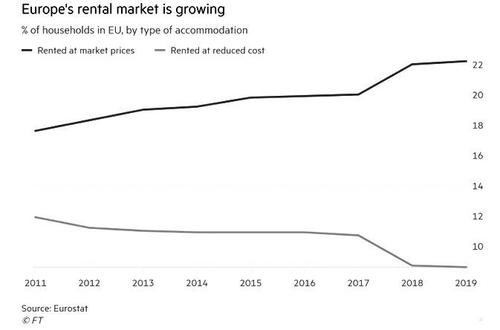
In any case, back to Germany where more than half of Germans rent their homes – the second highest rate among OECD countries – and as house prices rise around the world courtesy of central bank bubble-blowing making home ownership less affordable, the ranks of renters are swelling elsewhere too. Across the EU nearly a quarter of households lived in market-priced rented accommodation in 2019, the latest figures available, according to Eurostat.

And so, unable to overhaul a monetary system that is broken at its core, the local are taking the easy if suicidal way out:

“Unless we find some mechanism of continuing to transfer property from landlords to tenants [via home ownership] . . . you get a more unequal society split between the people with equity in housing and those without,” said Yolande Barnes, a professor at University College London’s Bartlett Real Estate Institute.

She is of course describing a core tenet of Marxism. If only she could tell us how every single Marxist experiment in human history has ended.

The good news it so far few cities have proposed measures as radical as those in Berlin’s September ballot. But many face similar problems: companies and entrepreneurs buying up and renovating old properties, then selling off units at lucrative mark-ups.

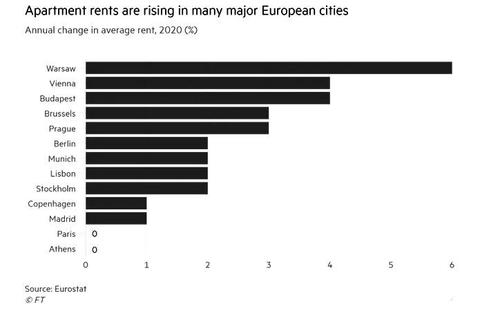
Then again, that the latest socialist revolution is starting in Berlin is probably not a surprise: once known for anarchist squatters’ communes and freewheeling techno clubs, the city has become an attractive investment. Existing buildings’ rents have shot up by as much as 43% over the past five years, making it increasingly unaffordable for the 86% of Berliners who rent.

Furthermore, nearly 125,000 of the city’s rental units were converted into owner-occupied homes between 2011 and 2020, according to recently published estimates by Berlin’s senate, further shrinking the market, as buyers – their bank accounts swollen thanks to central bank generosity – went on a buying spree. Last year was the biggest yet: 19,310 units vanished from the rental market.

But how is this Marxist proposition even possible in a “western” city? Simple: as the FT explains, the expropriation initiative is based on Article 15 of the German constitution, which says “land, natural resources, and means of production” can be reclaimed for public ownership, in exchange for compensation; of course, it has never before been tested in practice.

See the rest here

Posted in Uncategorized | Tagged: , , , | 1 Comment »

CDC Forced To “Adjust” Sunday’s Florida “Record” COVID Count Lower By Almost 50% After State Health Department Cries Foul On Data

Posted by M. C. on August 11, 2021

https://www.zerohedge.com/markets/cdc-forced-adjust-sundays-florida-covid-case-count-lower-almost-50-after-state-health

Tyler Durden's Photoby Tyler Durden

The CDC has been forced to “adjust” its Covid-19 case tracker for Florida after the state’s health department took to Twitter earlier this week to call out incorrect data.

As of Tuesday, the CDC “was working with the state’s health department” to get the data right, according to a report from Fox News. 

Florida’s health department called out the incorrect CDC information publicly, stating earlier this week: “Wrong again. The number of cases @CDCgov released for Florida today is incorrect. They combined MULTIPLE days into one. We anticipate CDC will correct the record.”

Wrong again. The number of cases @CDCgov released for Florida today is incorrect. They combined MULTIPLE days into one. We anticipate CDC will correct the record. https://t.co/nbKnBNLzvU — Florida Dept. Health (@HealthyFla) August 10, 2021

The CDC had reported 28,317 new Covid cases on Sunday, but had “adjusted” the number to 19,584 cases by Tuesday, the report says. Florida’s health department claimed that there were 15,319 cases on Sunday a number that is almost 50% lower than the CDC’s originally reported number. 

“On Tuesday, the U.S. Centers for Disease Control and Prevention reported the state has surpassed 20,000 for its 7-day average of new cases, a day after the federal agency misreported numbers given by the Florida Department of Health by combining data from the last three days into two,” Fox reported on Wednesday, after first pointing out the data discrepancy earlier in the week.

Florida’s hospitalizations were up by more than 1,110 to 14,787 on Tuesday. 

Recall, earlier this week we noted that Governor Ron DeSantis was threatening to withhold salaries from school officials who defied his mask mandate ban. 

According to a statement issued by DeSantis’ office – just days after his threat to cut funding resulted in a ‘pause’ on a proposed mask mandate in Broward County – one potential consequence for defiant school officials would be a loss of income.

“With respect to enforcing any financial consequences for noncompliance of state law regarding these rules and ultimately the rights of parents to make decisions about their children’s education and health care decisions, it would be the goal of the State Board of Education to narrowly tailor any financial consequences to the offense committed. For example, the State Board of Education could move to withhold the salary of the district superintendent or school board members, as a narrowly tailored means to address the decision-makers who led to the violation of law,” reads the statement.

…unintentional? Too late to correct all those Sunday morning political shows ‘gloating’ over DeSantis’ state outbreak.

Be seeing you

Posted in Uncategorized | Tagged: , , , | Leave a Comment »

Holocaust Survivor Slams Demonization Of Unvaccinated

Posted by M. C. on August 11, 2021

Politico fact-checker advocates violence against Rand Paul

A survivor of the Nazi Holocaust delivers a powerful speech slamming the view that somehow the unvaccinated are unclean and spreading disease in society – she remembers such tactics from her horrible past in Nazi Germany! Also today, Rand banned, Abbott’s mask battles, Swiss police rebel, and more…

Be seeing you

Posted in Uncategorized | Tagged: , , | Leave a Comment »

Interim Operational Considerations for Implementing the Shielding Approach to Prevent COVID-19 Infections in Humanitarian Settings | CDC

Posted by M. C. on August 11, 2021

Prison Camps

https://www.cdc.gov/coronavirus/2019-ncov/global-covid-19/shielding-approach-humanitarian.html

Posted in Uncategorized | Tagged: , , , | Leave a Comment »