


Self-Ownership and the Right to Self-Defense
Posted by M. C. on March 29, 2024
By Wanjiru Njoya
How extensive is a man’s right of self-defense of person and property? The basic answer must be: up to the point at which he begins to infringe on the property rights of someone else. . . . It follows that defensive violence may only be used against an actual or directly threatened invasion of a person’s property—and may not be used against any nonviolent “harm” that may befall a person’s income or property value. (emphasis added)
It is by no means straightforward to decide what “directly threatened invasion” means in specific cases.
Self-defense is an ancient common law right under which necessary and reasonable force may be used to defend one’s person or property. As Sir Edward Coke expressed it in 1604: “The house of every one is to him as his Castle and Fortress as well for defence against injury and violence . . . if thieves come to a man’s house to rob him, or murder, and the owner or his servants kill any of the thieves in defense of himself and his house, it is no felony, and he shall lose nothing.”
The meaning of reasonable force has always been heavily context dependent, considering the facts of the case including the intentions of the parties. If a trial were to become necessary in the scenario described by Coke, the court would have to establish that the intruders were indeed thieves intent on robbery or murder, or at any rate that the homeowner reasonably believed this to be the case. The use of force to defend oneself from an attack inherently carries the risk of causing the attacker’s death, making it necessary to ascertain that this was not merely a homicide masquerading as self-defense. Otherwise, anyone could shoot another and argue that he thought it was an intruder, as happened in the Oscar Pistorius case.
If the attacker shoots first, it is clearly not unreasonable to shoot back. Difficult cases arise where the attacker is unarmed or armed only with the natural weapons of his own fists. The old common law rule, as reported by the Michigan Law Review in 1904, was that
it was not necessary the assault should have been made with a deadly weapon, but that an assault with the fists alone, if there was apparent purpose and ability to inflict death or serious bodily injury, was sufficient to justify the killing in self-defense. . . . a mere battery by the fists alone, will not justify an homicide, even where there is a great disparity of physical power, without a plain manifestation of felonious intent.
The felonious intent of the attacker (intention to inflict death or serious bodily injury) has long been treated as key to justifying killing the attacker, and such intention could only be judged in all the circumstances of the case. Mere words would not suffice, as one might shout, “I’ll kill you!” with neither felonious intent nor ability, and conversely an intention and ability to kill may be exhibited clearly without any words being uttered.
In the context of comparative law, Uwe Steinhoff controversially goes further to argue that self-defense ought to be lawful even if the attacker did not use his fists: “An attack need not involve physical force; rather, an attack is every threat of violation or actual violation of an interest that is protected by law (that is, of a right) insofar as this threat stems from human action.” Steinhoff distinguishes between an “attack” and “harm” as in his view one is still entitled to defend oneself against an attack without waiting to see the degree of harm, if any, that might result from the attack.
Imagine a scenario where a weak and puny man launches himself at a weightlifting champion with intention to cause harm, only for the attacker’s fists to bounce ineffectually off his victim (as happened once to Arnold Schwarzenegger). In Steinhoff’s view, the victim in this case, bigger and stronger than his attacker though he may be, would nevertheless have a right to defend himself with a reasonable degree of force.
The aim in mentioning these examples is not to comment on the current law, which is too heavily circumscribed by legislation and case law to permit brief summary. The aim here is instead to highlight some of the difficulties in ascertaining the boundaries of self-defense. Legislative rules are typically detailed and encompass numerous conditions and exceptions.
For example, in New York, “deadly physical force” generally cannot be used unless
“the actor reasonably believes that such other person [the attacker] is using or about to use deadly physical force. Even in such case, however, the actor may not use deadly physical force if he or she knows that with complete personal safety, to oneself and others he or she may avoid the necessity of so doing by retreating.”
That is easy to state, but in reality, how would one “know that with complete personal safety” violence can be avoided by retreating? In many circumstances where deadly force is used or threatened, there are no guarantees of “complete personal safety.” In Steinhoff’s example, it is rarely clear that there is no other way to save Snow White other than by taking out the evil queen: “Yet one is certainly allowed to tackle the evil queen with physical force in order to prevent her from giving the apple to Snow White if there is no other way to save Snow White.”
Be seeing you
Posted in Uncategorized | Tagged: common law, deadly physical force, Self-defense, Self-Ownership | Leave a Comment »
Doug Casey on What’s Really Going On in Haiti
Posted by M. C. on March 28, 2024
by Doug Casey
One thing is for sure: What happens in Haiti should have absolutely nothing to do with the US because none of it’s good. Perhaps Las Vegas’s slogan, “What happens in Vegas, stays in Vegas,” can be restated as “What happens in Haiti, stays in Haiti.” More likely, though, it will be “Coming to a location near you!”
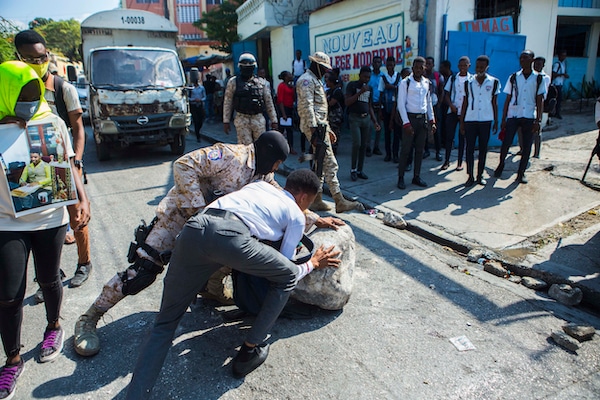
International Man: After Haiti’s president was assassinated in 2021, Ariel Henry—a US ally—began serving as the acting head of the country even though there was no election.
Recently, Henry flew to Africa to ask the Kenyan government to send soldiers to help fight the armed groups increasingly taking control in Haiti.
Before he could return, the armed groups took control of most of the country, and Henry recently resigned.
What’s your take on the situation?
Doug Casey: Chaos is par for the course in Haiti. I’ve been there a half-dozen times since 1970 and have come to realize that you have to put the current chaos in the context of Haiti’s history, which is basically one disaster and tragedy after another. Let me give you a brief rundown, starting with its independence after the French Revolution.
The eviction of the French, starting in 1791, resulted in their first real bloodbath after the slaves overthrew their masters. The place was a slave colony from the very beginning and one of the richest places in the hemisphere due to sugar production. The French lost 50,000 soldiers trying to regain control of the island, killing about 350,000 Haitians. Napoleon decided to cut his losses and write the place off. Haiti was off to a bad start.
Incidentally, it was the only slave revolt in all of history that resulted in an independent country. But Haiti has always had bad habits as a result of its history.
After independence, the next ruler, JJ Desallines, massacred about 5,000 remaining whites in 1805. Subsequent rulers styled themselves as kings or emperors for the rest of the 19th century, occupying themselves with wars with the Spanish speakers in what became the Dominican Republic on the eastern side of the island.
In 1824, about the same time Liberia was founded as an alternative colony for blacks, 6,000 US slaves were exported to Haiti. But most of them thought it was just too brutal and returned to slavery or poverty in the US.
After a horrible century, Haiti had a 20-year respite when it was occupied by US Marines from 1915 to 1934. It was a time of some order and development, although several thousand Haitians who resented the white occupiers were killed.
As soon as the Marines left, the Trujillo regime in the Dominican Republic massacred about 30,000 Haitians living there. It was apparently quite grisly; Haitians were hacked with machetes and driven into the sea to be eaten by sharks. Dominicans and Haitians maintain poor relations to this day.
Then came the election of Francois “Papa Doc” Duvalier in 1957. Duvalier used his credentials as a voodoo houngan to his advantage. Fear and psychological warfare, combined with the threat of violence, kept a lid on the pressure cooker during his exotic reign.
Haiti’s history has been one of almost unremitting bloodshed, poverty, disasters, and oppression. But a country’s history is different from day-to-day life. Especially for the relatively few members of the middle and upper classes, I’d say it was pleasant enough…
International Man: Doug, having spent time there, you are familiar with Haiti in a way most people aren’t.
What’s really going on?
Be seeing you
Posted in Uncategorized | Tagged: Ariel Henry, Haiti | Leave a Comment »
Serfdom under the TSA
Posted by M. C. on March 28, 2024
That’s because the TSA has a catchall offense that is comparable to “disorderly conduct.” It enables the TSA to levy a fine of up to $14,000 for anyone who “interferes” with inspectors. Like with “disorderly conduct,” it’s an entirely subjective offense, meaning that they can pretty much fine anyone who objects or protests with “interference.”
The biggest thing about the TSA experience, however, is not the abuse, harassment, intrusions, and fines. The biggest thing is that it reminds us of our lives as serfs. Federal officials are the masters, and we are their servants. We exist to serve them, not the other way around. When they issue orders to us, we are expect to immediately and quietly obey, just like people in the military.
By now, I’m sure that most Americans have their own personal stories about TSA abuse. The U.S. government’s takeover of airport security after the 9/11 attacks has made flying an unpleasant experience.
This past weekend, I was flying back to Virginia. A TSA agent took my carry-on suitcase aside and opened it up. She then pulled out a container of talcum powder. She spent around 5 minutes intensely examining it and then testing it. Up to that point, it was simply a matter relating to the talcum powder. No agent was hassling me ,and I was just waiting for the testing of the talcum powder to be completed.
I nonchalantly and innocently said to her, “So, I’m curious as to whether it’s bad to bring talcum powder with me.” Well, that was obviously a wrong thing to say. I think you’re expected to keep your mouth shut and not question anything they do.

In what appeared to me to be an effort to teach me a lesson, another TSA agent approached me and informed me that I was now going to be subjected to a complete pat-down search. Even worse, he advised me that it was going to be conducted by a trainee, who was about 70 years old. The trainee was obviously nervous, given that his boss was right there watching him. The trainee patted down almost every square inch of my body. For example, I was wearing a button-down dress shirt. He had me turn around and he curled my shirt collar backwards, presumably to see if I had a gun hidden there. (I didn’t.)
In the meantime, the talcum-powder lady decided that she needed to needed to go through my entire suitcase. She even removed my wallet and my cellphone and set them down on the counter in front of me. When I asked if I could retrieve them, a third agent declared, “Not yet! Leave them there!”
I got the distinct impression that they might be hoping that I would express some sort of objection or protest. I’m not stupid. I didn’t say anything else. That’s because the TSA has a catchall offense that is comparable to “disorderly conduct.” It enables the TSA to levy a fine of up to $14,000 for anyone who “interferes” with inspectors. Like with “disorderly conduct,” it’s an entirely subjective offense, meaning that they can pretty much fine anyone who objects or protests with “interference.”
Be seeing you
Posted in Uncategorized | Tagged: Serfdom, tsa | Leave a Comment »
The West’s Technofeudalism Versus the BRICS Growth Forecast
Posted by M. C. on March 28, 2024
So, with no advantage to offer India, or even Europe, other than weapons to protect against fantasy or generated enemies, the United States is in a real pickle. And the worse things get, the more mainstream media, the think tanks, and puppet leaders holler “Democratic Values!”
https://journal-neo.su/2024/03/27/the-wests-technofeudalism-versus-the-brics-growth-forecast
Author: Phil Butler
You’ll find an important Russia-India story on page 28 of the Google News results, to care about what’s really happening between the two BRICS nations. Many reading this may not know that India’s Prime Minister Narendra Modi congratulated Vladimir Putin on his re-election as the President of the Russian Federation and announced the deepening of a strategic partnership between the two countries. Russia and India – strategic partners – isn’t that page one New York Times stuff? Well, no.
Naturally, the Western propaganda machine revved up its gears to do damage control. The United States Institute of Peace, which is really a warmongering glee club, claimed back in February the Russia-India situation is fragile. The relationship is so fragile, in fact, that PM Modis quote from News 18 in New Delhi (taken from Modi’s Tweet on X) reads:
“I Spoke with President Putin and congratulated him on his re-election as the President of the Russian Federation. We agreed to work together to further deepen and expand the India-Russia Special & Privileged Strategic Partnership in the years ahead.”
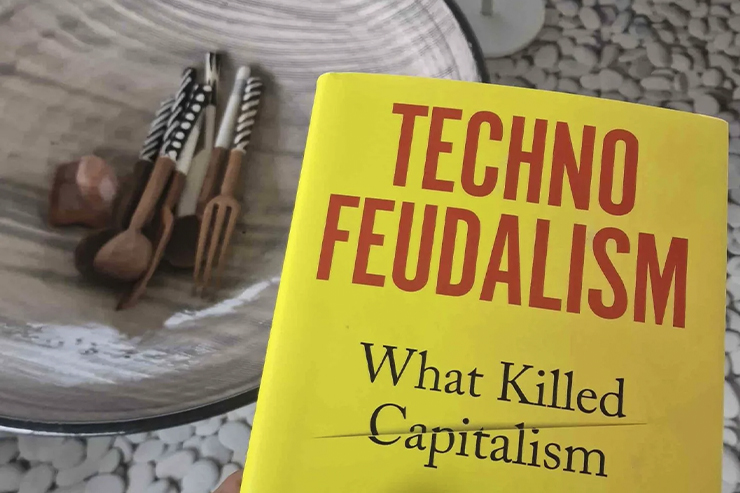
I know the quote does not relay any fragility between nations that have been in good standing for decades. Still, the elites running our feudal/capitalistic system in the West – well, they can still dream. And speaking of neo-feudalism, a new book by the brilliant (if sometimes quirky) Yanis Varoufakis, speaks mightily on what’s really going down in the West vs. East geopolicy wars we’re in. The book, entitled “Techno-feudalism: What Killed Capitalism” proclaims capitalism as dead amid “an epochal shift” backwards in time. Varoufakis argues, his points about the technocrats and their fiefdoms by creating the parable below. Insert the first name “Mark” where Jeff is mentioned, and you’ll see the truth of the Greek economist’s theory:
“Imagine the following scene straight out of the science fiction storybook. You are beamed into a town full of people going about their business, trading in gadgets, clothes, shoes, books, songs, games and movies. At first everything looks normal. Until you begin to notice something odd. It turns out all the shops, indeed every building, belongs to a chap called Jeff. What’s more, everyone walks down different streets and sees different stores because everything is intermediated by his algorithm… an algorithm that dances to Jeff’s tune.”
The man who should have been Greece’s Prime Minister years ago uses Jeff (Bezos, the owner of Amazon) to illustrate how we peons and surfs produce value for technology companies simply by tweeting or posting. In Bezos’s case, Varoufakis points out that the Amazon founder does not produce capital, but he simply charges rent. He says this isn’t capitalism, but feudalism, exacted upon a citizenry unaware of what’s happening. I suggest you read The Guardian story about the book here.
Returning to the Russia-India situation, it’s easy to understand how the West, run by technocrats and old money who create only wealth without value, fear any system where real capital is created. Russia’s various industries, China’s, and especially India’s scare the hell out of those running the Western shell game. When all is said and done, Washington and its allies just talk or bomb, real competition has been eliminated.
Be seeing you
Posted in Uncategorized | Tagged: BRICS, Democratic Values, India, Narendra Modi, Russia, Technofeudalism | Leave a Comment »
Two Approaches to Getting Rid of Mexican Cartels: Drug Legalization and the Bukele Model
Posted by M. C. on March 28, 2024
How will this help to undermine the power and pelf of Mexican gangs? It is simple: a significant amount of their financial resources emanates from this one quarter. Running a bunch of hooligans takes finances, serious finances. The less wherewithal these mobsters have, the weaker they will be, and the more likely they will succumb to the forces of law and order in Mexico.
https://walterblock.substack.com/p/two-approaches-to-getting-rid-of
By RICARDO BENJAMIN SALINAS PLIEGO and WALTER E BLOCK
It is no exaggeration to say that gangs in Mexico are now more powerful than the Mexican police force. It is almost possible, but not quite, to say that these groups of criminals can fight even the Mexican Army on an almost equal basis. Needless to say, this situation calls for rectification, if the prosperity, flourishing and even the lives of innocent Mexicans are once again to be safeguarded.
From an anarcho-capitalist point of view, the purest form of libertarianism, the attitude toward this situation would be one of “A pox on both your houses.” You are both criminal gangs, albeit one of you has far more legitimacy than the other, mainly based on far better public relations than anything substantive. Both mulct funds from innocent people on a coercive basis. For one, these payments are “taxes”; for the other, “payments” or “payoffs.” But there is no real difference between the two.
However, such a philosophy is articulated by an estimated only 1% of all those calling themselves libertarians. What is the position of the other 99%, who aver that a very limited government is indeed justified? It would be one limited to providing armies to protect against foreign invasion, police to quell domestic robbers, rapists, murderers and their ilk, and courts to distinguish guilt from innocence and to uphold free enterprise and personal and private property rights. This is limited government libertarianism.
So, from this perspective, how best to deal with these Mexican criminal gangs which have been preying on innocent folk? It is certainly not to “hug” them. They are criminals, and must be dealt with accordingly; that is, harshly. Presumably, the Mexican government is now doing the best it can to achieve this goal. Is there any other option that does not call for more treasure, more soldiers, more sophisticated weaponry? Yes there is.
Legalize drugs. All of them. Without exception. The US state of Oregon has already taken a teeny, tiny, baby step in this direction. The recommendation to the Mexican government is to carry this civilized plan further, far further. Legalization should encompass all (addictive) drugs without exception.
How will this help to undermine the power and pelf of Mexican gangs? It is simple: a significant amount of their financial resources emanates from this one quarter. Running a bunch of hooligans takes finances, serious finances. The less wherewithal these mobsters have, the weaker they will be, and the more likely they will succumb to the forces of law and order in Mexico.
Be seeing you
Posted in Uncategorized | Tagged: Bukele Model, cartels, Drug Legalization, Mexico | Leave a Comment »
A Mixed Bag Decision For Julian Assange Today
Posted by M. C. on March 28, 2024
Posted in Uncategorized | Tagged: Julian Assange | Leave a Comment »
Freedom
Posted by M. C. on March 28, 2024
Ya! What he said!
Be seeing you
Posted in Uncategorized | Tagged: Freedom, Rodney Norman | Leave a Comment »
U.S. History of Using ISIS
Posted by M. C. on March 27, 2024
Moscow Theater attack reminds me of U.S. policy in Syria
Notably, this chemical weapons attack just happened to occur the day after Secretary of State Rex Tillerson publicly announced that regime change in Syria was no longer official U.S. policy. In other words—we were told—the day after the U.S. announced it was getting off Assad’s case, he committed an atrocity (of zero military value) that would guarantee that the U.S. recommit itself to getting rid of him.
https://petermcculloughmd.substack.com/p/us-history-of-using-isis
Back in 2015, the Guardian published a fascinating report titled Now the truth emerges: how the US fuelled the rise of Isis in Syria and Iraq, which detailed how U.S. and British intelligence were supporting Islamic jihadist rebel groups in Syria with the objective of overthrowing the regime of Syrian President Bashar al-Assad.
The report included a link to a leaked 2012 Department of Defense document about U.S. support for these rebel groups in Syria, including ISIS. This report stuck with me, and I was a reminded of it a couple of years later when Assad was accused in April 2017 of using chemical weapons against Syrian civilians.
Notably, this chemical weapons attack just happened to occur the day after Secretary of State Rex Tillerson publicly announced that regime change in Syria was no longer official U.S. policy. In other words—we were told—the day after the U.S. announced it was getting off Assad’s case, he committed an atrocity (of zero military value) that would guarantee that the U.S. recommit itself to getting rid of him.
Though most of the legacy press endorsed the assertion that Assad’s forces were behind the attack, a few discerning reporters noted that it could have easily been carried about by one of the Islamic jihadist groups operating in the region to make the Trump administration rethink its abandonment of its regime change objective. Sure enough, a couple of days after the chemical attack, Secretary of State Rex Tillerson announced that he was reconsidering his announcement the week before.
Now comes the news of a major terrorist attack on the Crocus City Hall in Moscow that has left hundreds dead and injured. The U.S. government claims the attack was carried out by ISIS-K, which has reportedly taken responsibility for it. However, Kremlin officials have alleged that some of the gunmen were trying to escape into Ukraine, utilizing a ‘window’ of support from across the border.
Be seeing you
Posted in Uncategorized | Tagged: chemical weapons, ISIS, Rex Tillerson, Syria | Leave a Comment »
 MCViewPoint