The mental pain endured by the Harvard bigwigs must be excruciating, and of course they have themselves to blame because they walked right into the Woke hustle with their eyes wide shut. They bargained away their dignity, and the university’s honor, for mere brownie points in a fool’s game calledWin big prizespretending to care about your fellow man.
“The old politics of right versus left, and Republican opposed to Democrat have now given way to a new existential struggle: Americans must choose between civilization—or its destroyers.” –Victor Davis Hanson
Now that you, the lucky ones, are beyond your steaming platters of pancakes and mighty rashers of bacon, and perhaps even a dram or two of grog in your coffee. . . and clawed your way through the bales of presents. . . a merry Christmas to all. . . and here’s something else to think about this morning:
You may have noticed that our country, formerly a republic of sovereign individuals, has become one great big racketeering operation run by a mafia-like cabal with Marxist characteristics — or, at least, Marxist pretenses. That is, it seeks to profit by every avenue of dishonesty and coercion, under the guise of rescuing the “oppressed and marginalized” from their alleged tormenters. Apparently, half the country likes it that way.
Much of the on-the-ground action in this degenerate enterprise is produced by various hustles. A hustle is a particularly low-grade, insultingly obvious racket, such as Black Lives Matter, DEI (Diversity, Equity, and Inclusion), and “trans women” (i.e., men) in women’s sports. Some of the profit in any hustle is plain moneygrubbing, of course. But there’s also an emotional payoff. Hustlers and racketeers are often sadists, so the gratification derived from snookering the credulous (feelings of power) gets amplified by the extra thrill of seeing the credulous suffer pain, humiliation, and personal ruin. (That’s what actual “oppressors” actually do.)
Categorically, anyone who operates a racket or a hustle is some sort of psychopath, a person with no moral or ethical guard-rails. Hustles are based on the belief that it is possible to get something for nothing, a notion at odds with everything known about the unforgiving laws of physics and also the principles of human relations in this universe. Even the unconditional love of a mother for her child is based on something: the amazing, generative act of creating new life, achieved through the travail of birth. Have you noticed, by the way, that the birth of human children is lately among the most denigrated acts on the American social landscape?
The flap over Harvard’s president, Claudine Gay, is an instructive case in the governing psychopathies of the day. I wish I’d been a roach on the tray of petit fours and biscotti brought into the Harvard Overseers’ board-room when they met to consider the blowback from Ms. Gay’s unfortunate remarks in Congress, followed by revelations of her career-long plagiarisms. The acrid odor of self-conscious corruption in the room must have overwhelmed even the bouquet of Tanzanian Peaberry coffee a’brew, and not a few of the board members must have reached for the sherry decanter as their shame mounted, and the ancient radiators hissed, and their lame rationalizations started bouncing off the wainscoted walls.
It’s difficult to know exactly when it happened, but not long ago many Americans suddenly looked around and discovered that they inhabited completely different moral universes from their neighbors.
Whether it’s Black Lives Matter, or teaching gender theory to children, or the usefulness or otherwise of the COVID restrictions, or a wide variety of other subjects, people on one side of the divide have exerted a moral imperialism over the other, refusing even to acknowledge that there can be another side on issues like these, and have instead tried to drive their opponents from polite society through intense social pressure and the outright suppression of dissident voices.
The same people who lecture us day and night about how we shouldn’t “impose our morality” on other people think absolutely nothing of demonizing half of America and imposing their ideas on other people’s children.
Scarcely anyone stops to ask: is this arrangement making us happy? Is it contributing to human flourishing?
To the contrary, it’s causing conflict, suspicion, anger, and frustration – and everyone knows it.
Yet for some reason we carry on, as if continuing down this path will somehow lead to a different result, even though any fool can see that things are only going to get worse.
The media, meanwhile, are happy to fan the flames of social conflict, but never urge us to consider the humane possibility of a world in which we simply don’t do this anymore.
My new eBook National Divorce, which I am giving away for free, offers a radical proposal: how about we just stop?
As I show in the book, there is nothing unconstitutional or “extremist” or unthinkable about national divorce.
What holds people back from considering it is a combination of status-quo bias and the superstitious reverence we’ve all been taught to have for “the Union.”
But as Thomas Jefferson correctly conceived of it, the Union is merely a means to an end. It is not an end in itself. Much less should it be treated as an object of religious reverence. If it does not promote liberty, then we should discard it and try something else.
Now, fair warning: the ideas you will encounter in this book are not to be found on the three-by-five card of allowable opinion. We are not even supposed to discuss the subject matter of this book, dear reader. Why, the New York Times hasn’t approved it for us!
But I’d say the time has come to steel our resolve and be willing to consider – radical though this may sound – ideas that the New York Times tells us are not allowed.
The very nature of totalitarianism involves the intoxicating temptation to create the perfect society through a combination of propaganda, centralized power, and the demonization of dissidents.
Against such a project we ought to set that couplet with which Michael Oakeshott concluded his essay on the Tower of Babel:
Who in fields Elysian would dwell Do but extend the boundaries of Hell.
We can always expect the regime and its supporters to try to outlaw things they don’t like. And once such things are illegal, we’ll hear all about the evils of the “lawbreakers” any time those lawbreakers threaten the prestige or power of the regime. (Lawbreaking in favor of the regime, of course, is always tolerated.) It’s a highly successful trick they’ve been using for thousands of years.
It has become something of a habit in both the American and Canadian media to insist that the Canadian trucker protest against vaccine mandates is an “illegal protest.” They are “illegal border protests,” one American news affiliate proclaims. Canada’s National Post dutifully refers to the protests in its headlines as illegal acts. The term “illegal” has been used a multitude of times by Liberal Party politicians in the House of Commons. The premier of Ontario—one of Canada’s most hysterical politicians—not only paints the protests as illegal but as a “siege.” Other opponents of the protests refer to them as an “occupation” and as an “insurrection.”
“Lawbreaker” as a Political Slur
So why the obsession with labeling the protests illegal? The idea, of course, is to cast suspicion on them and portray them as harmful and morally illegitimate. We could contrast the rhetoric surrounding the trucker protest with that of the Black Lives Matter protests. In the case of the BLM protests, illegal acts were downplayed and ignored, with one obvious riot labeled a “mostly peaceful” protest. when it comes to protests and other acts of which the regime approves, legality is never an issue.
The regimes of the world, of course, like to use legality as a standard for judging human behavior because the regimes make the laws. Whether or not the laws actually have anything to do with human rights, private property, or just basic common sense is another matter entirely. Thus history is replete with pointless, immoral, and destructive laws. Slavery has been lawful throughout much of human history. Temporary slavery—known as military conscription—is still employed by many regimes. In the US, the imprisonment of peaceful American citizens of Japanese descent was perfectly lawful under the US regime during World War II. Today, employers can face ruinous sanctions for hiring a worker who lacks the proper immigration paperwork. Worldwide, people can be jailed in many jurisdictions for years for the “crime” of possessing an illegal plant.
During covid, the reality of arbitrary law came very much to the fore when unelected health bureaucrats and lone elected executives began ruling by decree. They closed businesses, shut people up in their homes, and imposed vaccine and mask mandates. Those who refuse to comply—and businesses who refuse to enforce these edicts—are condemned as lawbreakers and subject to punishment.
The Moral Limits of “Law and Order”
All of these legal provisions, acts, and sanctions represent mockeries of basic natural rights rather than protections of them. The notion that laws can be perversions of true justice has long been obvious to many. In fact, the disconnect between morality and legality is a fundamental aspect of Western civilization. The basic notion is very old, but the idea’s endurance in the West was reinforced by the fact that Christianity began as an illegal religion and early Christians were often considered to be criminals deserving of the death penalty. It should be no surprise, then, that Saint Augustine declared an unjust law to be no law at all and compared kings to pirates: the decrees of pirates, of course, are not worthy of obedience or reverence. And if kings are like pirates, kingly decrees are of equal respectability. This same tradition fueled Saint Thomas Aquinas’s support for regicide (in certain cases). Needless to say, regicide has been always and everywhere declared illegal by the would-be targets.
Yet, unfortunately, declaring something to be “illegal” remains an effective slur. There is no shortage of people who proudly consider themselves to be blind supporters of “law and order” and who insist “lawbreakers” are axiomatically in the wrong. Their simple-minded refrain is “if you don’t like the law, change it” and many of these people naïvely believe that acts of legislators and regulators somehow reflect “the will of the people” or some sort of moral law. The opposite is often the reality.
Thankfully, in the United States, the value of lawbreaking is so “baked in” to the historical narrative that it’s difficult to ignore, even today. The American Revolution was fundamentally a series of illegal acts. The Declaration of Independence was little more than a declaration of a thoroughly illegal rebellion. In response, the king sent men to the colonies to enforce law and order. The American response to this attempt to enforce the law was to kill the government’s enforcers. Less violent acts committed by American rebels were equally criminal, ranging from the Boston Tea Party to a multitude of assaults on tax collectors committed by Samuel Adams’s Sons of Liberty.
Modern shills for the regime have unsurprisingly tried to redefine this conflict as one of a tussle over democracy. “Those American revolutionaries fought for democracy,” the claim goes. Thus, by their definition, no one is ever allowed to rebel in a jurisdiction that has occasional elections. (The reality is that the American rebellion was about the protection of human rights. Elections had little to do with it.)
Fortunately, it will take more than cheap slogans about democracy to undo the fact that the national origin story is about having contempt for the laws of one’s political leaders.
In much of the world, however, rebellion against unjust laws is not regarded with equal amounts of reverence. In Canada, for instance, the national origin story is largely about following the rules and politely asking one’s overlords for autonomy. This is bound to affect how one sees the roles of law and disobedience.
It Is Often Prudent to Follow Unjust Laws
This isn’t to say that open rebellion is necessarily wise. Avoiding illegal acts is often—if not usually—the prudent thing to do. We often follow the law simply to stay out of jail and avoid attracting the attention of regulators and government enforcers. For those who prefer spending time with their families to spending time in prison, this only makes sense. Moreover, disobeying unjust laws can often bring even more unjust laws as a result.
It is one thing to follow the law for prudential reasons. It is another thing entirely to assume the law brings with it some sort of moral imperative. Few laws do. Yes, there are laws against murder, but murder is just one case where the letter of the law happens to often match up with what is fundamentally moral and right. Countless laws lack such solid standing.
When we hear government officials or media pundits refer to something as “illegal” or unlawful, all this should really do is cause us to ask if the defense of these laws is actually prudent, moral, or necessary. Some laws are well founded in basic protections of property rights and other human rights. But many laws are nothing more than the fruits of political schemes to help the regime maintain power or to reward its friends at the expense of others.
We can always expect the regime and its supporters to try to outlaw things they don’t like. And once such things are illegal, we’ll hear all about the evils of the “lawbreakers” any time those lawbreakers threaten the prestige or power of the regime. (Lawbreaking in favor of the regime, of course, is always tolerated.) It’s a highly successful trick they’ve been using for thousands of years.
Ryan McMaken is a senior editor at the Mises Institute. Send him your article submissions for the Mises Wire and Power and Market, but read article guidelines first.
The proper end of debate is not the glorification of whoever “wins” the argument but the ascertainment of the truth or, at the very least, the elimination from contention of a false or misguided belief. Censorship makes this impossible to do,
Virtue signaling—the practice of highlighting what one takes to be one’s own moral superiority, often by loudly denouncing the character and comportment, including the speech, of other people—has become a dominant mode of rhetoric throughout social media and network television. Virtue theory, in contrast, is a teleological approach to normative morality concerned with how actions affect one’s soul or character. Historians of philosophy usually trace virtue theory to Aristotle’s Nicomachean Ethics, the first extant articulation of ideas such as that habits build character, and virtues represent “the golden mean” along a continuum of two vicious extremes. Courage, for example, lies between the two extremes of cowardice and recklessness, according to Aristotle.
It seems unlikely that many of the people who engage in virtue signaling have any genuine interest in the state of anybody’s soul. Certainly shrieking in outrage is unlikely to change anyone’s comportment, much less their beliefs, yet many people persist in the practice anyway, in part because it is both contagious and addictive. The structure of Twitter, in particular, makes it easy to react in a knee-jerk way to short proclamations with which one disagrees. It is in fact very difficult, if not impossible, to carry out reason-based debates in the allotted 280 letter spaces of a Tweet. It furthermore requires a degree of discipline to refrain from shrieking back at shrieking trolls on Twitter, even while knowing that many of them may well be bots—or unreasonable facsimiles…
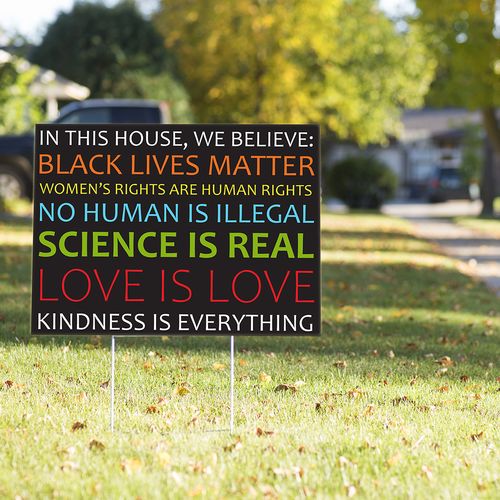
Having visited in 2021 several different U.S. cities, including Boston, Denver, Seattle, Salt Lake City, and Austin, where prominently displayed lawn signs profess the “enlightened” beliefs of the people residing there, I have been puzzling over the strange new phenomenon of essentially advertising one’s own “virtue.” I presume that what is being asserted is moral rather than epistemological superiority, because most of the proclamations on these signs do not contain much in the way of propositional content. “Love is love” is tautological, but “Black lives matter” and “Science is real” also do not represent any sort of cognitive breakthrough. For that reason, whenever I spot one of these signs, I find myself wondering how many people there are who really do believe the literal antitheses of the statements displayed. It would seem that anyone who believes that “Human lives matter” is committed to believing that “Black lives matter,” so there seems to be a hidden insinuation in these pronouncements that people who do not overtly profess such beliefs do not in fact agree and therefore constitute some sort of affront to good people everywhere, by despicably denying the humanity of black people and the deliverances of the scientific enterprise, among other things.
Yet it has become abundantly clear that the disagreements at issue are not really about the simple statements, per se. Instead, the banal expressions appear to be code for far more substantial and controversial positions, such as that “George Floyd was a hero,” and “Climate change is the most pressing problem facing us today.” In this way, nailing a sign in one’s front yard is a performative way of broadcasting that one belongs to the right club, and may explain the preponderance of such signs in some neighborhoods, where a veritable “war of the signs” is underway. (On one street in Somerville, Massachusetts, I saw “Black Lives Matter” and “Blue Lives Matter” placards displayed before adjacent homes.) Anecdotally, I can report that “Black Lives Matter” signs are far more common than “Blue Lives Matter” signs, so it seems that the inhabitants of some left-leaning neighborhoods may feel that by failing to post one of the rainbow signs professing the beliefs of the inhabitants of the house, they may be taken implicitly to ally themselves with the ideological enemy, deplorable Trump supporters and the like.
Alas, in the age of social media, many people appear to labor under the delusion that it suffices to have a “right-minded” opinion in order to be morally superior. This tendency was dialed up significantly during the Trump years, when the stark reality of what can only be termed tribalism became impossible to deny. “You’re either with us, or you’re against us,” serves politicians well during the build up to every war, but now it has infected civil society, to the point where many people reflexively revile anyone who disagrees with them on either Trump or the COVID-19 shots, facilely concluding that they must be not just idiots but also morally depraved.
Millions of Trump haters appear to believe not only that Trump is worthy of their abject abhorrence, but also that they are superior to Trump supporters, who have somehow failed to recognize the former president’s abhorrent character. Shockingly, they lament, millions of poor benighted souls verily celebrate the man as their savior! These polarized attitudes toward Trump are based on beliefs about what he does and why—about which there is considerable disagreement. Mindless worship of a political leader may be wrongheaded, but is it vicious?
To take another example, millions of people have put Dr. Anthony Fauci on a pedestal as their savior from the scourge of COVID-19. Interestingly enough, there seems to be a good deal of overlap between Trump haters and Fauci worshipers, which strongly suggests that the etiology of afflictions such as TDS (Trump Derangement Syndrome) and COVID Hysteria are traceable to CNN, MSNBC, and the like. Indeed, at this point in history, the most reliable determinant of whether any given person hates Trump and adores Fauci would seem to be not their education, social or economic status, or state of residence, but whether they watch television, and, if so, whether they spend their time at CNN or Fox News channel.
Of course, we often arrive at our beliefs through entirely random and arbitrary processes. We may be absolutely convinced that we are right—Murder is wrong!—but do we deserve any moral credit for having arrived at such a view? I suspect that it is this confusion which leads some people to despise critics. They mistakenly believe that a critic is asserting moral authority, when in fact he or she is making only an epistemological—or, at the most basic level, a logical—objection to what appears to be a manifest falsehood or contradiction. Calling George W. Bush and Tony Blair “war criminals” is to condemn them, but it is also to assert what the speaker takes to be a fact, for if the 2003 war on Iraq was a violation of international law, then its perpetrators were war criminals, and all of those killed in the conflict were victims, whether directly or indirectly, of premeditated, intentional homicide, better known as murder.
Moral rhetoric is intrinsically complicated, because we all have limited perspectives, and it would seem that one person’s incisive critic is another person’s shrieking troll. Being of a naturally critical bent and inclined to sit down and write when questions pop up in my mind, I can attest that some people do consider just about any form of criticism to be an obnoxious, insolent, and self-indulgent form of “virtue signaling.” They may appreciate intelligence in an abstract way, but when it comes after their cherished beliefs, that’s a completely different story.
Witness the plight of Socrates, the case of Julian Assange, or any of the countless other, unnamed, dissidents destroyed by their governments over the course of history. How dare you suggest that there may be weaknesses and contradictions in my views! Who are you to find fault with my opinions and beliefs? These sorts of reactions—typically angry—to attempts to highlight problems with fervently held dogmas have led me to reflect upon the question whether there is any significant distinction to be drawn between, say, screaming that someone is selfish for declining a “vaccine” which is purported not to stop transmission and infection but to moderate symptoms, and pointing out that voluntary obesity has contributed to hospital resource shortages throughout the Coronapocalypse because an estimated 78% of the people who die of COVID-19 are in fact obese.
At the same time that name-calling has become the rule not the exception in responding to anyone who happens to disagree, not only on social media, but also throughout the propagandized mainstream outlets which were formerly homes to journalism, one also occasionally encounters gentle exhortations to “Be Kind.” Only this morning, on a brisk walk on this cold and crisp winter day in Utah, I spotted an SUV with a license plate reading “B Kind.” (I immediately inferred that “Be Kind” had already been nabbed by another, even more enlightened thinker.) Even more so than the yard signs, the exhortation to “Be Kind” may in fact embody a contradiction of sorts, suggesting, as it seems to, that those who see the license plate are going to be mean unless they are told to do the opposite. The form of speech, after all, is an imperative, an order, a command. But is it really “kind” to order people around, or to suggest that, left to their own devices, they would naturally be mean?
The “Be Kind” trend may have been popularized in part by talk show host Ellen Degeneris, around the time when she was explaining her friendship with war criminal George W. Bush. (Oh—was that mean?)
Laurie Calhoun is the author of We Kill Because We Can: From Soldiering to Assassination in the Drone Age, War and Delusion: A Critical Examination, You Can Leave, and Philosophy Unmasked: A Skeptic’s Critique.
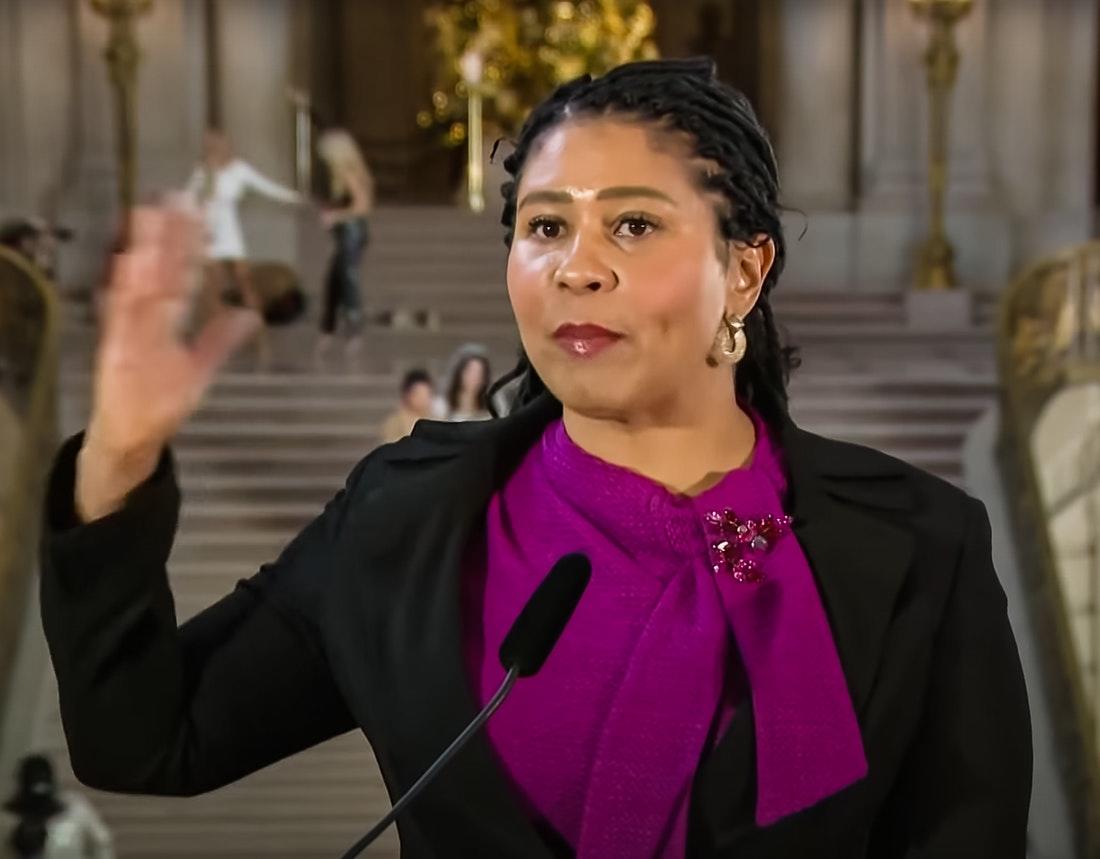
After Black Lives Matter protesters last year demanded that cities “Defund the Police,” San Francisco Mayor London Breed held a press conference to announce that her city would be one of the first to do exactly that. Breed announced $120 million in cuts to the budgets of both San Francisco’s police and sheriff’s departments. A spokesperson for the police officers’ union warned the cuts “could impact our ability to respond to emergencies,” but the police chief assured the public that the cuts “will not diminish our ability to provide essential services.”
Yesterday, Breed reversed herself in dramatic fashion, announcing that she was making an emergency request to the city’s Board of Supervisors for more money for the police to support a crackdown on crime, including open air drug dealing, car break-ins, and retail theft. The plan contains much of what the California Peace Coalition, which Environmental Progress and I cofounded last spring, has been demanding, including in a series of protests by parents of homeless addicts, parents of children killed by fentanyl, and recovering addicts.San Francisco Mayor Breed and other San Francisco politicians have for years promised to crack down on drug dealing and crime, and things have only grown worse over, so skepticism is merited. Already, progressives in San Francisco have denounced Mayor Breed’s plan, which she announced with the support of just two members of the city’s 11 Board of Supervisors, and without the apparent support of the city’s District Attorney.But there’s good reason for hope. Breed’s plan lays out big goals and makes very specific promises, including more funding for police. There will be a recall election next June of San Francisco’s District Attorney Chesa Boudin which many political experts believe will succeed. And the progressive Supervisor who represents the Tenderloin, the neighborhood with most of city’s open drug scene, is running for state assembly, creating a leadership vacuum and opportunity for Breed.More importantly, Breed’s speech has the potential to change the conversation about crime. Breed explicitly embraced “tough love,” which is a very different philosophy from Woke victimology, which divides the world into victims and oppressors and demands that victims, a category that includes street addicts and criminals, only be given things, from cash and clean needles to their own apartment with butler service, and not be held accountable for their actions.
“I’m proud this city believes in giving people second chances,” said Breed.“Nevertheless, we also need there to be accountability when someone does break the law…Our compassion cannot be mistaken for weakness or indifference…. I was raised by my grandmother to believe in ‘tough love,’ in keeping your house in order, and we need that, now more than ever.”
Breed punctuated her emotional speech with an explitive.
“It is time for the reign of criminals to end,” she said.“And it comes to an end when are more aggressive with law enforcement and less tolerant of all the bulls**t that has destroyed our city.”
Why is that? What explains Breed’s 180 degree reversal in less than 18 months? And what will determine whether she keeps her promise?
SF Mayor @LondonBreed has literally just called bullshit on progressive criminal justice reformers “It is time for the reign of criminals to end. It comes to an end when are more aggressive with law enforcement & less tolerant of all the BULLSHIT that has destroyed our city” pic.twitter.com/ewqheftUun
The main reason for Breed’s turnabout is skyrocketing crime. A report released yesterday by San Francisco’s Public Policy Institute of California concluded that homicides increased in Los Angeles, Oakland, San Diego, and San Francisco by 17% in 2021. Property crimes in those four cities rose 7% between 2020 and 2021, reaching 25,000 total in October. Two-thirds of increase is due to larcenies, mainly car break-ins (by 21%) and vehicle thefts (by 10%).
“Steve Wright of Leeds Metropolitan University is an expert on police and military technologies, and last year correctly predicted this pack-hunting mode of operation would happen. ‘The giveaway here is the phrase “a non-cooperative human subject,”’ he told me:
“What we have here are the beginnings of something designed to enable robots to hunt down humans like a pack of dogs. Once the software is perfected we can reasonably anticipate that they will become autonomous and become armed.
By Caitlin Johnstone, an independent journalist based in Melbourne, Australia. Her website is here and you can follow her on Twitter @caitoz
The elites are seeking to normalize the use of police robots by calling them ‘dogs’ – but the machines are the vanguard of a dystopian future that will see them cement their power in place forever.
Hawaii police are defending their use of pandemic relief funds for a robotic “police dog” made by Boston Dynamics which scans homeless people’s eyes to see if they have a fever.
“If you’re homeless and looking for temporary shelter in Hawaii’s capital, expect a visit from a robotic police dog that will scan your eye to make sure you don’t have a fever,” a new report from AP says. “That’s just one of the ways public safety agencies are starting to use Spot, the best-known of a new commercial category of robots that trot around with animal-like agility.”
“Acting Lt. Joseph O’Neal of the Honolulu Police Department’s community outreach unit defended the robot’s use in a media demonstration earlier this year,” AP reports. “He said it has protected officers, shelter staff and residents by scanning body temperatures between meal times at a shelter where homeless people could quarantine and get tested for COVID-19. The robot is also used to remotely interview individuals who have tested positive.”
This has understandably elicited criticism from civil rights advocates.
“Because these people are houseless it’s considered OK to do that,” Hawaii ACLU legal director Jongwook Kim told AP. “At some point it will come out again for some different use after the pandemic is over.”
This report comes just days after we learned that police in Winnipeg have also obtained a ‘Spot’ robot which they intend to use in hostage situations.
“The Winnipeg Police Service is set to acquire a pricey dog-shaped robot, to be used in hostage situations, that’s already been ditched by police in New York City.
“‘Spot’ is made by Boston Dynamics, which sells the device for US$74,500. Winnipeg police are spending $257,000 to acquire and use Spot. The 32-kilogram robot ‘has the ability to navigate obstacles, uneven terrain (and) situations where our traditional robot platforms can’t go into,’ said Insp. Brian Miln at a news conference Wednesday.”
Months earlier, the New York Police Department cancelled its lease of the same type of robot they obtained last year following public outcry. More from AP:
“The expensive machine arrived with little public notice or explanation, public officials said, and was deployed to already over-policed public housing. Use of the high-tech canine also clashed with Black Lives Matter calls to defund police operations and reinvest in other priorities.”
The company that makes the robots, Boston Dynamics, says it’s learned from the New York fiasco and is trying to do a better job of explaining to the public – and its customers – what Spot can and cannot do. That’s become increasingly important as Boston Dynamics becomes part of South Korean carmaker Hyundai Motor Company, which in June closed an $880 million deal for a controlling stake in the robotics firm.
To be absolutely clear, there is not actually any legitimate reason for any normal person to refer to these machines as a ‘robotic dog’, or a ‘high-tech canine’, or by a cutesy cliché name for a pet. These are robots. Robots that are being used by police forces on civilian populations. If the robots being used had two legs, or eight, they would not be able to apply such cuddly-wuddly labels, and public alarm bells would be going off a lot louder.
Which is of course the idea. As AP noted above, Boston Dynamics is acutely aware that it has a PR situation on its hands and needs to manage public perception if it wants to mainstream the use of these machines and make a lot of money. Because it’s a known fact that Westerners tend to be a lot more sympathetic to dogs than even to other humans; arbitrarily branding a quadrupedal enforcement robot a ‘dog’ helps facilitate this agenda.
On-the-ground robot policing is becoming normalized today under the justification of Covid-19 precautions in the same way police around the world have normalized the use of drones to police coronavirus restrictions, at the same time police departments are rolling out dystopian systems for predicting future criminality using computer programs and databases.
“Steve Wright of Leeds Metropolitan University is an expert on police and military technologies, and last year correctly predicted this pack-hunting mode of operation would happen. ‘The giveaway here is the phrase “a non-cooperative human subject,”’ he told me:
“What we have here are the beginnings of something designed to enable robots to hunt down humans like a pack of dogs. Once the software is perfected we can reasonably anticipate that they will become autonomous and become armed.
“We can also expect such systems to be equipped with human detection and tracking devices including sensors which detect human breath and the radio waves associated with a human heart beat. These are technologies already developed.”
These developments always elicit nervous jokes about Terminator movies and the idea of Skynet robots going rogue and enslaving humanity, but the far more realistic and immediate concern is this technology being used on humans by other humans.
For as long as there have been governments and rulers, there has been an acute awareness in elite circles that the public vastly outnumber those who rule over them and could easily overwhelm and oust them if they ever decided to. Many tools have been implemented to address this problem, from public displays of cruelty to keep the public cowed and obedient, to the circulation of propaganda and power-serving religious doctrines, but at no time has any power structure in history ever produced a guaranteed protection against the possibility of being overthrown by their subjects who vastly outnumber them.
The powerful have also long been aware that robot and drone technologies can offer such a protection.
Once the legal and technological infrastructure for robotic security systems has been rolled out, all revolutionary theory that’s ever been written goes right out the window, because the proletariat cannot rise up and overthrow their oppressors if their oppressors control technologies which enable them to quash any revolution using a small security team of operators.
Or, better yet, fully automated technologies which can fire upon civilians without the risk of human sympathy taking the side of the people. According to a recent UN report, a Turkish-made drone may have been the first ever to attack humans with deadly force without being specifically ordered to.
“At least one autonomous drone operated by artificial intelligence (AI) may have killed people for the first time last year in Libya, without any humans consulted prior to the attack, according to a U.N. report.
“According to a March report from the U.N. Panel of Experts on Libya, lethal autonomous aircraft may have ‘hunted down and remotely engaged’ soldiers and convoys fighting for Libyan general Khalifa Haftar. It’s not clear who exactly deployed these killer robots, though remnants of one such machine found in Libya came from the Kargu-2 drone, which is made by Turkish military contractor STM.”
So at this point, we’re essentially looking at a race to see if the oligarchic empire can manufacture the necessary environment to allow the use of robotic security forces to lock their power in place forever before the masses get fed up with the increasing inequalities and abuses of the status quo and decide to force a better system into existence.
What’s more, as the woke elites fly the BLM and Pride flags, they have started to look down on the American flag. The BLM flag is almost viewed as an antidote to the Stars and Stripes. BLM protesters say it represents ‘slavery, genocide and war’. Burning the American flag was commonplace during last year’s BLM riots.
Secretary of state Antony Blinken has authorised US embassies to fly the Black Lives Matter and rainbow Pride flags. The immediate spur for this decision is clear. Late May marked the one-year anniversary of George Floyd’s death and June is Pride month. But to fly flags other than the Stars and Stripes from the buildings that represent the US abroad is still extraordinary. It shows that the Biden administration is committed to exporting its woke values around the globe.
Embassies have flown BLM flags in many countries, including Bosnia, Cambodia and the UK, while Pride flags have been flown by embassies in Russia, Luxembourg and Namibia. In a move seemingly designed to troll the Vatican, which remains opposed to same-sex marriage, the US embassy to the Holy See tweeted that it was celebrating Pride month by displaying the rainbow flag. There are no reports of rainbow flags in Saudi Arabia, however.
Blinken and his State Department claim that flying these flags merely signals the US’s support for the rights of ‘people of colour’ and ‘LGBTQI+ persons’. But this does not explain why Pride and BLM, which are political movements, enjoy such a privileged status.
In March, and again in April, 167,000 immigrants were caught crossing our southern border illegally. The invaders are now coming not only from Central and South America but also from Africa, the Islamic world and the largest and most populous continent, Asia. And their destiny may be to replace us.
For as the endless invasion proceeds, native-born Americans have ceased to reproduce themselves. Not since the birth dearth of the Great Depression and WWII, when the Silent Generation was born, has the U.S. population experienced such a birth decline as today.
After nine people were shot to death by a public transit worker, who then killed himself in San Jose, the latest mass murder in America, California Governor Gavin Newsom spoke for many on the eve of this Memorial Day weekend.
“What the hell is going on in the United States of America? What the hell is wrong with us?”
Good question. Indeed, it seems that the country is coming apart.
In May, Congress, to address a spate of criminal assaults on Asian Americans, enacted a new hate crimes law to protect them.
May also witnessed a rash of assaults on Jewish Americans to show the attackers’ hatred of Israel and support for the Palestinians in the Gaza war.
The terms “racist” and “racism” are now commonplace accusations in political discourse and a public square where whites are expected to ritually denounce the “white privilege” into which they were born.
In the year since the death of George Floyd and the rise of the Black Lives Matter “Defund the Police!” campaign, the shootings and killings of cops and citizens in our great cities have skyrocketed.
In March, and again in April, 167,000 immigrants were caught crossing our southern border illegally. The invaders are now coming not only from Central and South America but also from Africa, the Islamic world and the largest and most populous continent, Asia. And their destiny may be to replace us.
For as the endless invasion proceeds, native-born Americans have ceased to reproduce themselves. Not since the birth dearth of the Great Depression and WWII, when the Silent Generation was born, has the U.S. population experienced such a birth decline as today.
At the same time, a war of all against all in America seems to raise the question, to which recitation of the cliche — “Our diversity is our greatest strength” — no longer seems an adequate response:
Is there no limit to the racial, religious, ideological, political, cultural and ethnic diversity the nation can accommodate before it splinters into its component parts?
In professions of religious belief, atheists, agnostics and secularists have become our largest “congregation,” followed by Catholics and Protestants, both of which are in numerical decline.
Diversity of faiths leads to irreconcilable, clashing opinions about morality on the most divisive social issues of our era: abortion, homosexuality, same-sex marriage, etc.
Racial diversity, too, is bringing back problems unseen since the 1960s.
America was almost 90% white in 1960, but that figure is down to 60% and falling. In 25 years, we will all belong to racial minorities.
Are we Americans still united in our love of country? Do we still take pride in what we have done for our own people and what America has done for the world in the 400 years since Jamestown?
Hardly. Part of the nation buys into the academic and intellectual elites’ version of history, tracing America’s birth as a nation to the arrival of the first slave ship in Virginia in 1619.
We not only disagree about our history; some actually hate our history.
That hate can be seen in the statues and monuments destroyed, not just of Confederate military heroes but of the European explorers who discovered America, the Founding Fathers who created the nation, and the leaders, from Thomas Jefferson to Andrew Jackson to Teddy Roosevelt, who built the America we became.
Yet, tens of millions from all over the world still see coming to America as the realization of a life’s dream.
Some look at Western civilization as 500 years of colonialism, imperialism, genocide, slavery and segregation — practiced against people of color. This is the source of the West’s wealth and power, it is said, and that wealth and power should be redistributed to the descendants of the victims of Western rapacity.
For many, equality of opportunity is no longer enough. We must make restitution, deliver reparations and guarantee a future where an equality of rewards replaces an equality of rights.
Meritocracy must yield to equity. Elite high schools, such as Thomas Jefferson in Virginia, Stuyvesant in New York and Lowell in San Francisco, must abandon their emphasis on grades, tests and exams to gain admissions and prove progress.
And these schools must be remade to mirror the racial and ethnic composition of the communities where they reside.
And a new cancel culture has taken root in America.
Former U.S. Senator Rick Santorum, a CNN commentator, was fired for suggesting that Native American institutions and culture played no significant role in the foundation and formation of the American Republic.
“We birthed a nation from nothing. I mean, there was nothing here. I mean, yes, we have Native Americans,” Santorum said, adding: “There isn’t much Native American culture in American culture.”
Impolitic though this rendition was, was it wholly false?
Something is seriously wrong with a country that professes to be great but whose elite cannot abide the mildest of heresies to its established truth.
Calling such a person an authentic Marxist assumes an intellectual seriousness that is lacking in our intersectional politics. Khan-Cullors’ boast that she’s a Marxist because she adores the now-moribund American Communist Party and was a disciple of the onetime campus agitator Eric Mann doesn’t persuade me. These qualifications suggest that our real-estate addict knows how to market herself to the generic Left, which is kept going by antiwhite, culturally radical millionaires who I doubt have ever studied Marx’s Das Kapital.
On the front page of Sunday’s New York Post, a co-founder of Black Lives Matter, Patrisse Khan-Cullors, was described (appropriately in quotations) as a “Marxist.” It seems that Khan-Cullors, who is only 37, has purchased four sumptuous homes with donations to her organization (totaling more than $90 million). These gifts have allowed the BLM leader to lavish $3.2 million on real estate “in this country alone.” She is also considering the acquisition of beach property in the Bahamas, the sales value for which starts at $5 million.
This leads me to wonder how this affluent beneficiary of woke capitalism represents Marxism. Contrary to standard descriptions of this now-celebrated radical, I find no convincing evidence that she is a “trained Marxist.” Khan-Cullors may be a pernicious parasite on a decaying Judeo-Christian society and a once firm constitutional order, but this hardly qualifies her as a disciple of Marx and Lenin. She is exactly what she seems, an ostentatious nouveau riche who dabbles in fashionable radical poses and makes a fortune in the process.
Calling such a person an authentic Marxist assumes an intellectual seriousness that is lacking in our intersectional politics. Khan-Cullors’ boast that she’s a Marxist because she adores the now-moribund American Communist Party and was a disciple of the onetime campus agitator Eric Mann doesn’t persuade me. These qualifications suggest that our real-estate addict knows how to market herself to the generic Left, which is kept going by antiwhite, culturally radical millionaires who I doubt have ever studied Marx’s Das Kapital.
The conservative establishment should stop ascribing to Khan-Cullors and the thugs she helps finance an identity that flatters them unnecessarily. Like their well-attired leader, they are neither Marxists nor Communists. As an historian of political movements who has researched these subjects, I can’t see how the activists inspired by Khan-Cullors represent either Marxist theory or Marxist programs. People can be vicious and obnoxious and in love with terrorism without being Marxists; and BLM is all those things—but it is not identifiably Marxist.
In Europe, Marxist parties—whether the French or Italian Communist Party after World War II or the German Social Democratic Party (which remained formally Marxist until 1959)—comprised members of the working class. Neither here nor in Europe is the current Left attracting workers in large numbers. Instead, it accumulates LGBTQ activists, woke capitalists, racial minorities, and soccer moms.
Indigenous workforces have moved to the Right, and Donald Trump’s rebranding of the GOP as a “working-class party” reflects a trend that is sweeping other countries as well. Workers are moving toward the nationalist Right; while corporate capitalists are financing a post-Marxist Left, which appeals to cultural revolutionaries and antiwhite radicals. Let’s not worry about the unlikely possibility that the Biden Administration will inflict heavy tax burdens on its corporate capitalist sponsors. The Democrats are not likely to bite the hand that feeds them.
These post-Marxist leftists bear an eerie resemblance to what we used to call in the 1960s and 1970s “limousine liberals.” Over the decades these types have grown fonder of inciting violence, and more openly hostile to normal people. Kahn-Cullors, Kamala Harris, and other BLM well-wishers do not recall Rosa Luxemburg or the Spanish Communist leader of the 1930s Dolores Ibárrui (a.k.a. La Pasionaria). Instead, they are fashionistas and, like Harris, members of pseudo-Marxist cells like the Hillcrest Country Club (which, by the way, seems to have a meticulous member validation process).
Although Harris encouraged BLM and Antifa rioting last summer, she surely didn’t expect the disorder to reach her Brentwood estate. Our vice president resides in one of the wealthiest neighborhoods in Los Angeles, where she and her husband Doug Emhoff stay while in California. Nor would Michelle Obama, who has given vocal encouragement to BLM, expect BLM ruffians to invade her $11.4 million mansion on Martha’s Vineyard. Such woke leaders have higher concerns. Harris should not have to worry about the plight of abandoned, desperate children on our Southern border, a crisis that she and Joe devised to increase the Democratic vote, particularly in Texas. This engaged public servant has been busy buying her favorite cakes at the Brown Sugar Bakery in Chicago.
Many established conservatives such as Carol Swain, Mark Levin, and Dennis Prager have cited a key passage in the BLM program as evidence of Marxism: “We disrupt the Western-prescribed nuclear family structure requirement by supporting each other as extended families and ‘villages’ that collectively care for one another, especially our children, to the degree that mothers, parents, and children are comfortable.” This sounds like gibberish to me. I have no idea what makes this statement specifically Marxist.
Marxists in power have collectivized industries and agriculture, but not usually nuclear families. BLM may be demanding the creation of their imaginary African alternative to the Western family. In any case, I wouldn’t read too much into this bombast. Kahn-Cullors may have written the offending lines while on her way to buying real estate near the vice president.
About Paul Gottfried
Paul Edward Gottfried is the editor of Chronicles. An American paleoconservative philosopher, historian, and columnist, Gottfried is a former Horace Raffensperger Professor of Humanities at Elizabethtown College in Elizabethtown, Pennsylvania, as well as a Guggenheim recipient.
One reason Black Lives Matter is so difficult to talk about, and it elicits such a vast range of reactions, is that no one can pin down exactly what it is.
No decent human being could disagree with the assertion that the lives of black people matter – and if they don’t currently, then they should. But to agree with the claims made by protesters, activists and campaigners marching under the banner of ‘Black Lives Matter’ is a different question entirely.
Do you agree that US police forces are committing a ‘genocide’ of black Americans? And, if you do think this is happening, do you agree that actions that go beyond peaceful protest are justified in addressing this? Is it enough not to be racist, or must society be reorganised to be actively ‘anti-racist’?
And when we talk about the Black Lives Matter protests, do we mean the peaceful or the violent elements? The summer of Black Lives Matter in 2020 brought vast numbers of non-violent protesters out on to the streets. But it also gave rise to the most destructive rioting in US history. The ‘fiery, but mostly peaceful’ riots reportedly caused between $1 and $2 billion in property damages (as measured by insurance claims) – far in excess of the 1992 LA riots.
Then there is the friendly, corporate face of Black Lives Matter. BLM has been embraced by big businesses of practically every sector. Last summer, companies fell over each other to advertise their BLM-friendliness. Whether it was McDonald’s changing its name temporarily on social media to ‘Amplifying Black Voices’ or the CEO of JPMorgan Chase ‘taking the knee’ in front of an open bank vault, BLM and big business became best buddies.
And when big corporates open up their wallets to a cause, their money has to end up somewhere. Last week, the Dirt, a blog focusing on property owned by celebrities, revealed that Patrisse Khan-Cullors, co-founder of Black Lives Matter, had recently bought a $1.4million compound a short drive from Malibu. As the New York Post pointed out, this followed a string of property purchases, including four high-end homes, worth at least $3.2million (Khan-Cullors was reportedly also eyeing up a place in an elite enclave of the Bahamas, but it is not known if she bought it).





 MCViewPoint