


The Canadian government’s decision to freeze bank accounts in the trucker protests is a mad leap toward bureaucratic dystopia
On Christmas Eve, 2018, New York Times writer Andrew Ross Sorkin published, “How Banks Unwittingly Finance Mass Shootings.” Chronicling the credit card history of the man who killed 49 people at the Pulse nightclub in Orlando, Florida Sorkin noted Omar Mateen had not merely spent $26,532 on weapons and ammo in the eight months before the 2016 attack, but had wondered if his doing so had raised red flags:
Two days before Omar Mateen killed 49 people and wounded 53 more at the Pulse nightclub in Orlando, he went on Google and typed “Credit card unusual spending…” His web browsing history chronicled his anxiety: “Credit card reports all three bureaus,” “FBI,” and “Why banks stop your purchases.”
He needn’t have worried. None of the banks, credit-card network operators or payment processors alerted law enforcement officials about the purchases he thought were so suspicious.
Sorkin’s piece ended up being an argument in favor of credit-card companies, payment processors, banks, and others working together to bring about a Minority Report-style panacea in which society’s dangerous folk could be cyber-identified and stopped before they commit horrific acts. At one point he quoted George Brauchler, the District Attorney who prosecuted the Century 16 movie shooter in Aurora Colorado, James Holmes:
“Do I wish someone from law enforcement had been able to go to his door and knock on his door and figure out a way to talk their way into it or to freak him out?” he said of Mr. Holmes. “Yeah, absolutely.”
I’ve never owned a gun and have been sympathetic to gun control ideas for as long as I can remember. Sorkin, however, was not talking about gun control. He was theorizing a quasi-privatized vision of social control that would bypass laws by merging surveillance capitalism and law enforcement.
In a rhetorical trick that’s since become common, he described how the failure of companies like Visa to block Mateen’s purchases made them “enablers of carnage.” Clearly, someone made the mistake of letting Sorkin see Sam Raimi’s Spider-Man, and Cliff Robertson now whispers from the beyond to him too. If those with power to act don’t stop wrongdoing, aren’t they just shirking their great responsibility?
By the way, this same Sorkin once suggested he wouldn’t stop at arresting Edward Snowden, but go after the reporter who broke his story, too. “I would arrest him and now I’d almost arrest Glenn Greenwald, the journalist… he wants to help him get to Ecuador,” he said, on CNBC’s Squawk Box. It’s amazing how selective one can be in one’s authoritarian leanings. After Goldman, Sachs CEO Lloyd Blankfein appeared to commit perjury in 2011 when he told the Senate, “We didn’t bet against our clients,” Sorkin rushed an apologia into print saying “Mr. Blankfein wasn’t lying,” failing to remind audiences that his Dealbook blog at the Times was sponsored by… Goldman, Sachs.
Sorkin’s Visa piece is suddenly relevant again, after fellow former finance reporter Chrystia Freeland — someone I’ve known since we were both expat journalists in Russia in the nineties — announced last week that her native Canada would be making Sorkin’s vision a reality. Freeland arouses strong feelings among old Russia hands. Before the Yeltsin era collapsed, she had consistent, remarkable access to gangster-oligarchs like Boris Berezovsky, who appeared in her Financial Times articles described as aw-shucks humans just doing their best to make sure “big capital” maintained its “necessary role” in Russia’s political life. “Berezovsky was one of several financiers who came together in a last-ditch attempt to keep the Communists out of the Kremlin” was typical Freeland fare in, say, 1998.
Then the Yeltsin era collapsed in corrupt ignominy and Freeland immediately wrote a book called Sale of the Century that identified Yeltsin’s embrace of her former top sources as the “original sin” of Russian capitalism, a “Faustian bargain” that crippled Russia’s chance at true progress. This is Freeland on Yeltsin’s successor in 2000. Note the “Yes, Putin has a reputation for beating the press, but his economic rep is solid!” passage at the end:
It looks as if we’re about to fall in love with Russia all over again…
Compared to the ailing, drink-addled figure Boris Yeltsin cut in his later
years, his successor, Vladimir Putin, in the eyes of many western observers,
seems refreshingly direct, decisive and energetic… Tony Blair, who has already paid
Putin the compliment of a visit to Russia and received the newly installed
president in Downing Street in return, has praised him as a strong leader
with a reformist vision. Bill Clinton, who recently hot-footed it to Russia,
offered the equally sunny appraisal that “when we look at Russia today . . .
we see an economy that is growing . . . we see a Russia that has just
completed a democratic transfer of power for the first time in a thousand
years.”To be sure, some critics have lamented Putin’s support for the bloody second
war in Chechnya, accused him of eroding freedom of the press… and
worried aloud that his KGB background and unrepenting loyalty to the honor
of that institution could jeopardize Russia’s fragile democratic
institutions. But many of even Putin’s fiercest prosecutors seem inclined to
give him the benefit of the doubt when it comes to the economy…
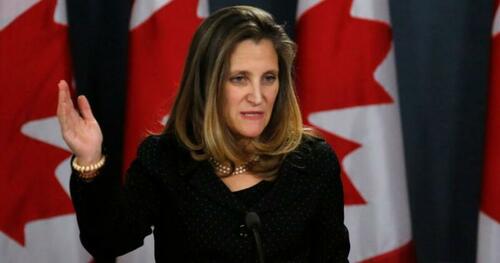
Years later, she is somehow Canada’s Finance Minister, and what another friend from our Russia days laughingly describes as “the Nurse Ratched of the New World Order.” At the end of last week, Minister Freeland explained that in expanding its Financial Transactions and Reports Analysis Centre of Canada (FINTRAC) program, her government was “directing Canadian financial institutions to review their relationships with anyone involved in the illegal blockades.”
The Emergencies Act contains language beyond the inventive powers of the best sci-fi writers. It defines a “designated person” — a person eligible for cutoff of financial services — as someone “directly or indirectly” participating in a “public assembly that may reasonably be expected to lead to a breach of the peace.” Directly or indirectly?
She went on to describe the invocation of Canada’s Emergencies Act in the dripping-fake tones of someone trying to put a smile on an insurance claim rejection, with even phrases packed with bad news steered upward in the form of cheery hypotheticals. As in, The names of both individuals and entities as well as crypto wallets? Have been shared? By the RCMP with financial institutions? And accounts have been frozen? As she confirmed this monstrous news about freezing bank accounts, Freeland burst into nervous laughter, looking like Tony Perkins sharing a cheery memory with “mother”:
Be seeing you

 MCViewPoint